
In the years following the public release of ChatGPT in late 2022, artificial intelligence rapidly transitioned from a novelty into a core operational layer inside modern organizations. By 2026, AI is no longer optionality is embedded into workflows, decision-making processes, and communication systems across nearly every industry. In response, many companies have invested heavily in AI literacy, requiring employees to attend training sessions, monitor new tools, and continuously report on emerging capabilities.
At first glance, this appears to be progress. Organizations are becoming more informed, more efficient, and more technologically capable. However, beneath this surface lies a subtle but growing problem—one that is not about technology itself, but about how humans are adapting to it. Increasingly, work is not enhanced by AI but displaced by it. The result is a quiet erosion of human judgment, ownership, and accountability.
This emerging phenomenon can be described as the Delegation Trap.
What Is the Delegation Trap?
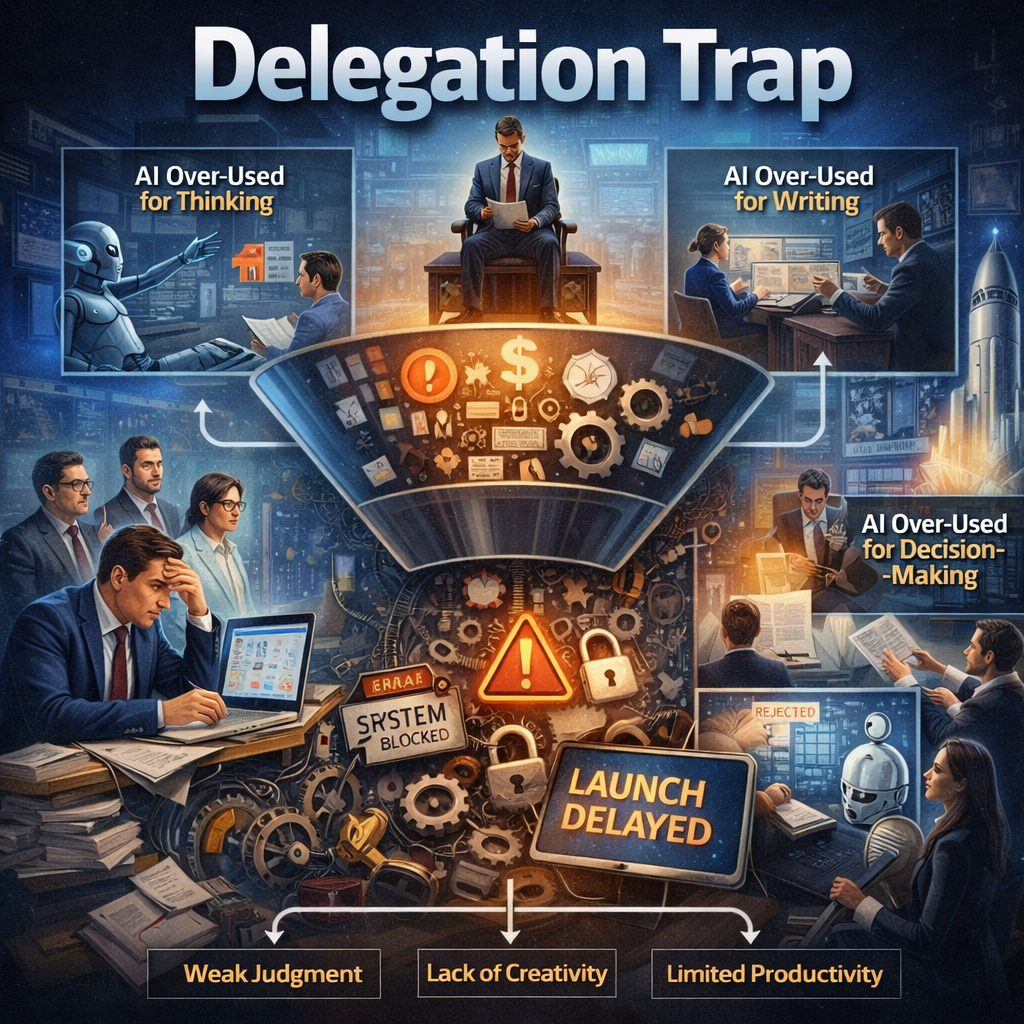
The Delegation Trap occurs when leaders rely too heavily on AI systems instead of empowering their teams to think, decide, and execute. Ironically, while AI is meant to accelerate productivity, it often concentrates decision-making authority at the top rather than distributing it.
Senior leaders, armed with AI-generated insights, become bottlenecks—reviewing, validating, and second-guessing outputs rather than delegating responsibility. Meanwhile, employees at lower levels begin to lose both the authority and confidence to act independently. Over time, execution slows, innovation stalls, and organizations become increasingly dependent on centralized decision-making.
Research from McKinsey & Company has repeatedly highlighted that high-performing organizations succeed not because of better tools, but because of faster decision cycles and empowered teams. Yet in AI-heavy environments, the opposite is occurring: more data, but slower decisions; more tools, but less ownership.
When AI Slows Execution Instead of Accelerating It
Consider a common operational scenario. A small issue emerges in a production system—something as trivial as a form validation error, where a system accepts “CA” but rejects “California.” Customers are unable to complete purchases. The fix is simple, but the process is not.
Instead of immediate action, the issue moves through layers of review:
- Engineers consult AI tools for diagnosis
- Proposed fixes are generated and regenerated
- Code reviews are delayed
- Approval chains expand
What should take hours stretches into days.
This is not a technical failure. It is a breakdown in ownership. Engineers hesitate to act without AI validation. Managers hesitate to approve without additional analysis. The organization becomes trapped—not by complexity, but by over-processing.
A 2025 study by Harvard Business Review observed that excessive reliance on decision-support systems can reduce individual accountability, as employees defer responsibility to “what the system recommends” rather than exercising judgment.
Three Forms of AI Overuse in Modern Workplaces
1. Overusing AI for Thinking
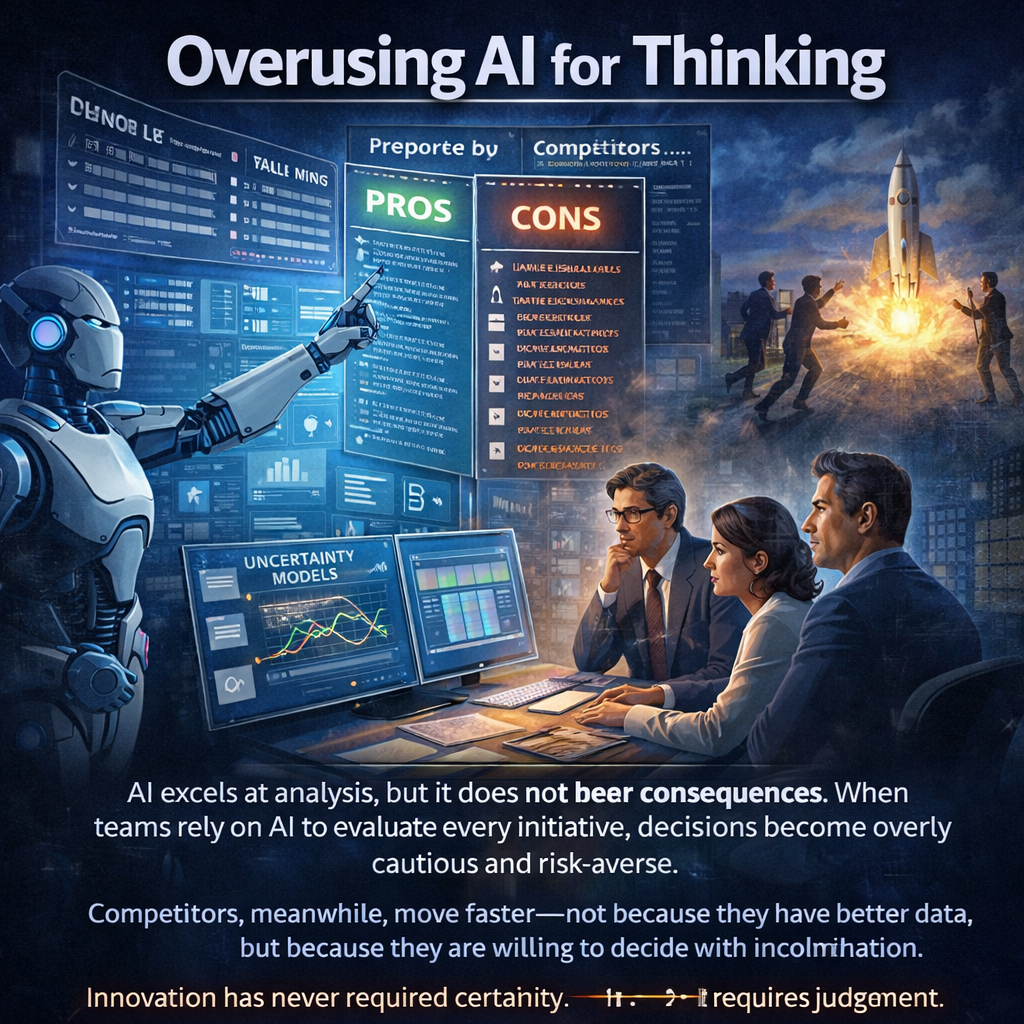
AI excels at analysis, but it does not bear consequences. When teams rely on AI to evaluate every initiative, decisions become overly cautious and risk averse.
Data teams generate extensive lists of pros and cons. Predictive models highlight uncertainties. AI tools simulate potential failures. While valuable, this abundance of analysis often delays action.
Competitors, meanwhile, move faster—not because they have better data, but because they are willing to decide with incomplete information.
Innovation has never required certainty. It requires judgment.
2. Overusing AI for Writing
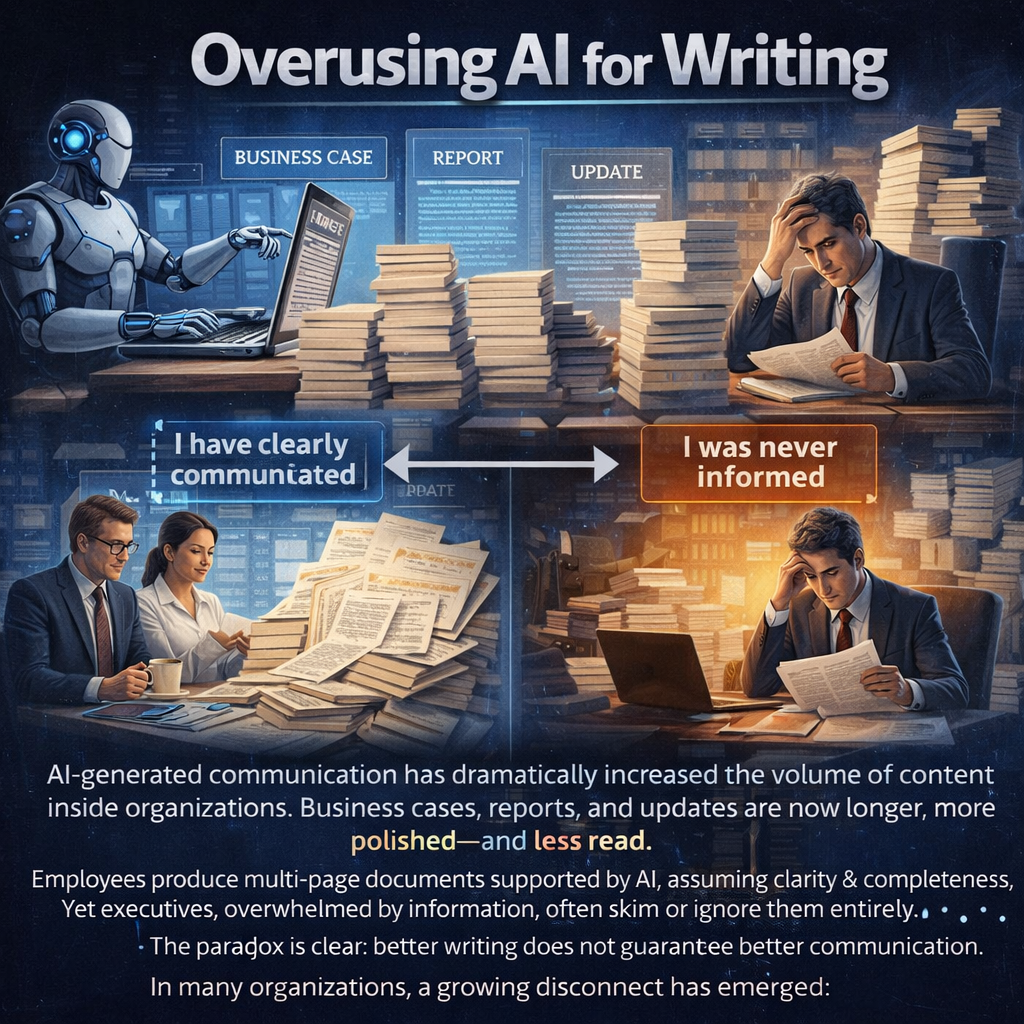
AI-generated communication has dramatically increased the volume of content inside organizations. Business cases, reports, and updates are now longer, more polished—and less read.
Employees produce multi-page documents supported by AI, assuming clarity and completeness. Yet executives, overwhelmed by information, often skim or ignore them entirely. The paradox is clear: better writing does not guarantee better communication.
In many organizations, a growing disconnect has emerged:
- Employees believe they have communicated clearly
- Leaders feel they are never informed
This gap is not caused by poor writing—it is caused by excessive writing without prioritization.
3. Overusing AI for Decision-Making
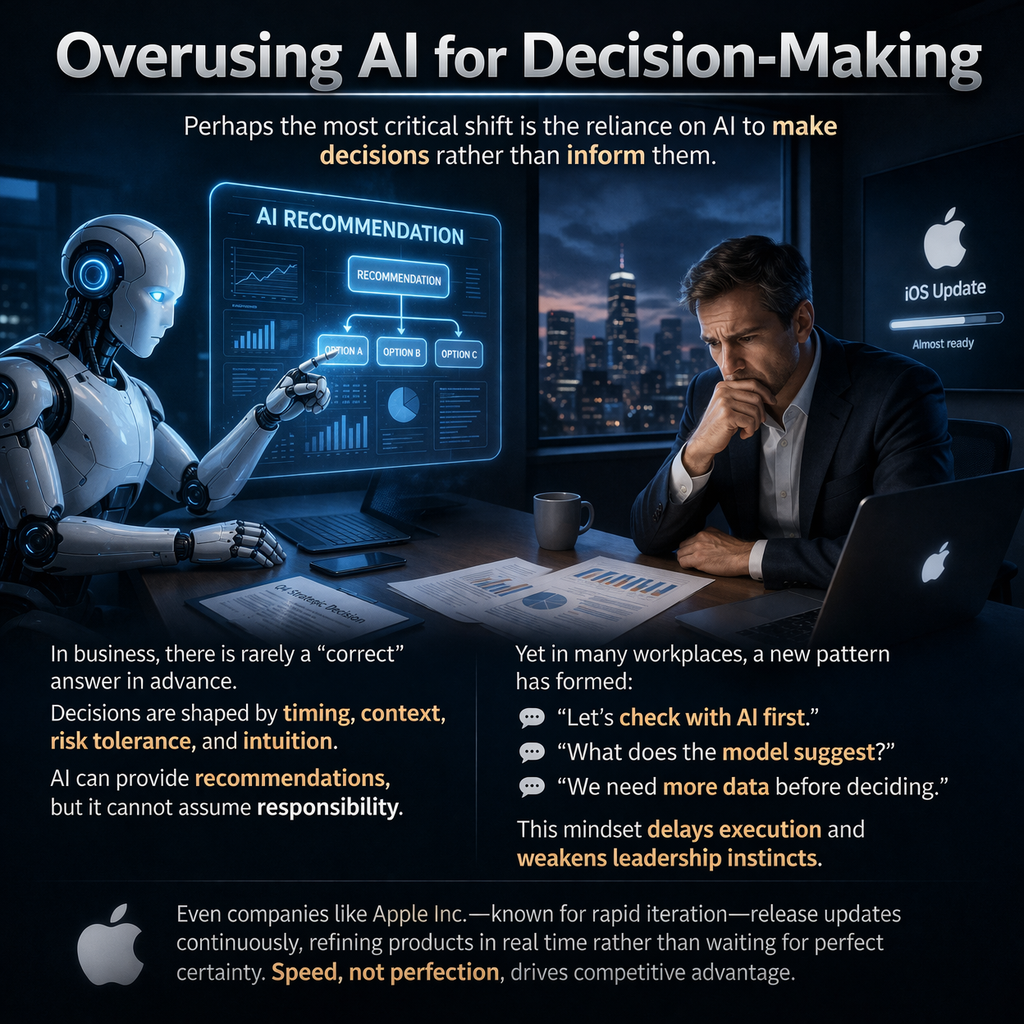
Perhaps the most critical shift is the reliance on AI to make decisions rather than inform them.
In business, there is rarely a “correct” answer in advance. Decisions are shaped by timing, context, risk tolerance, and intuition. AI can provide recommendations, but it cannot assume responsibility.
Yet in many workplaces, a new pattern has formed:
- “Let’s check with AI first.”
- “What does the model suggest?”
- “We need more data before deciding.”
This mindset delays execution and weakens leadership instincts.
Even companies like Apple Inc., known for rapid iteration—release updates continuously, refining products in real time rather than waiting for perfect certainty. Speed, not perfection, drives competitive advantage.
The Hidden Side Effects of AI Over-Reliance
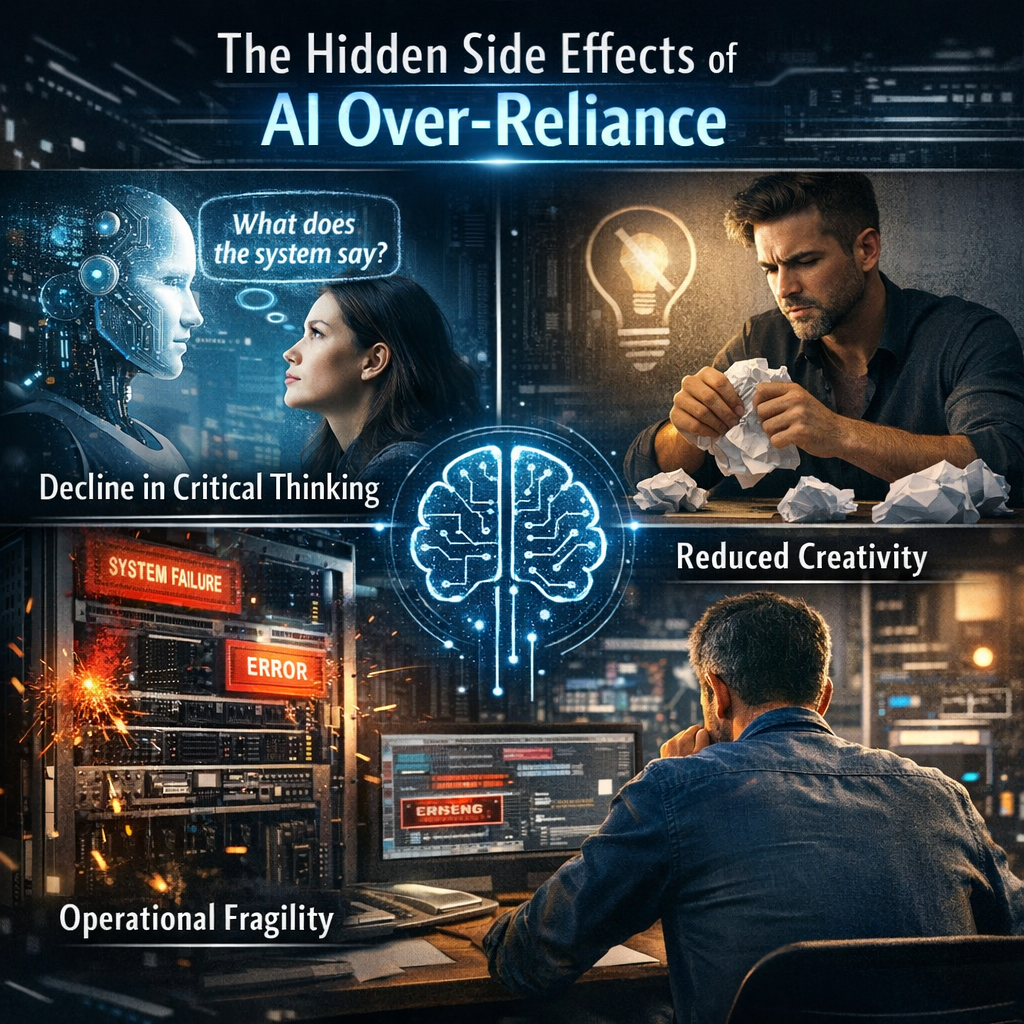
As these behaviors accumulate, organizations begin to experience deeper structural consequences:
1. Decline in Critical Thinking
Employees gradually lose the habit of independent reasoning. Instead of asking, “What do I think?” they ask, “What does the system say?”
2. Reduced Creativity
When AI evaluates ideas based on historical patterns, unconventional thinking is often filtered out. Employees become less willing to propose bold or unproven concepts.
3. Operational Fragility
Teams lose familiarity with underlying systems. As legacy knowledge fades, small issues cause disproportionate disruptions. Systems break not because they are complex—but because fewer people truly understand them.
Why This Matters Now
The Delegation Trap is not a distant risk—it is already visible across industries. Organizations are becoming more technologically advanced, yet less decisively human.
The core issue is not AI itself. AI is a powerful tool. The problem arises when responsibility is unintentionally transferred from people to machines.
Leadership, at its core, is not about having the best data. It is about making decisions, taking responsibility, and empowering others to act.
Reclaiming Ownership in the Age of AI
To avoid the Delegation Trap, organizations must rebalance the relationship between humans and machines:
- Use AI as an advisor, not an authority
- Delegate decisions, not just tasks
- Encourage faster execution over perfect analysis
- Reward judgment, not just correctness
AI should enhance human capability—not replace human responsibility.
Conclusion
The rise of AI has introduced extraordinary capabilities into the modern workplace. But it has also introduced a subtle risk: the erosion of ownership.
When leaders rely too heavily on AI, they unintentionally centralize decisions. When employees rely too heavily on AI, they lose confidence in their own judgment. The result is an organization that is informed—but hesitant, capable—but slow.
This is the Delegation Trap of 2026.
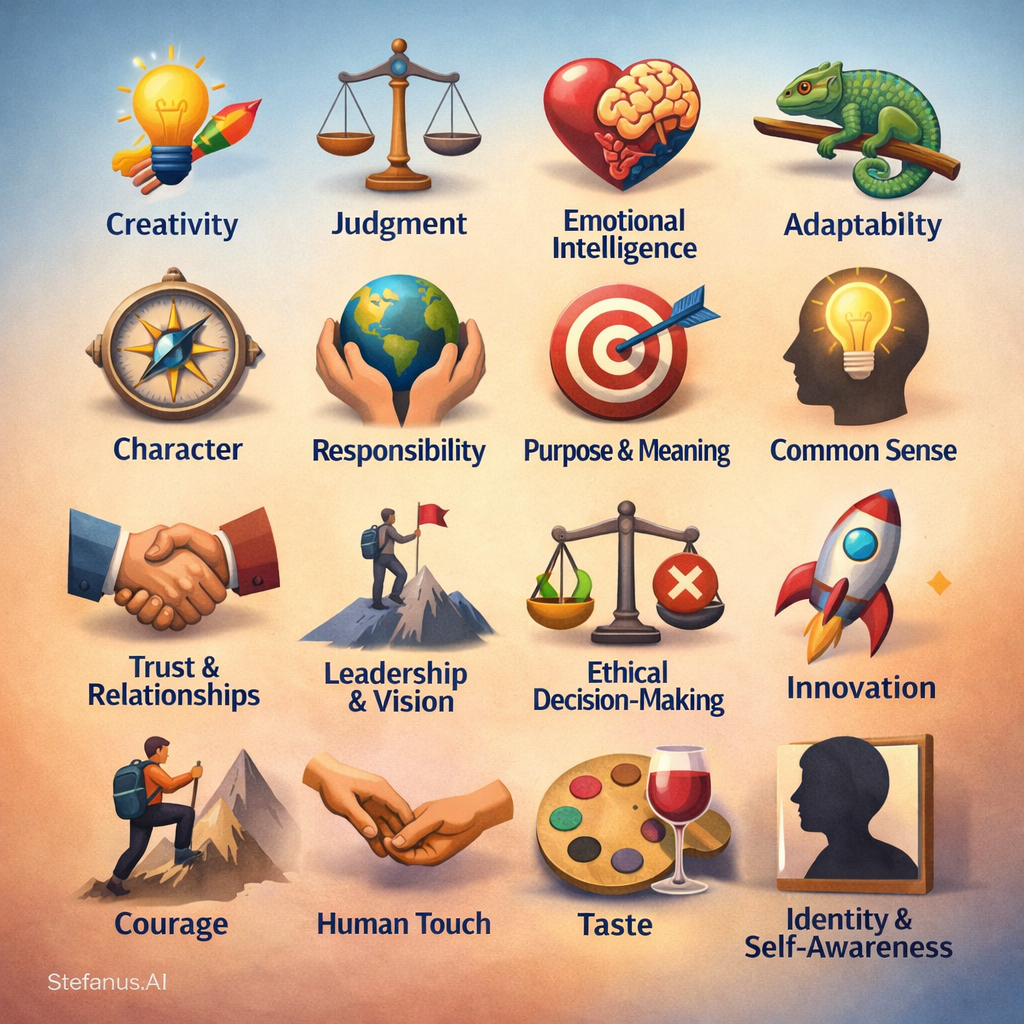
The future will not belong to organizations that use AI the most. It will belong to those that use AI wisely—while preserving what machines cannot replace: human judgment, accountability, and the courage to act.