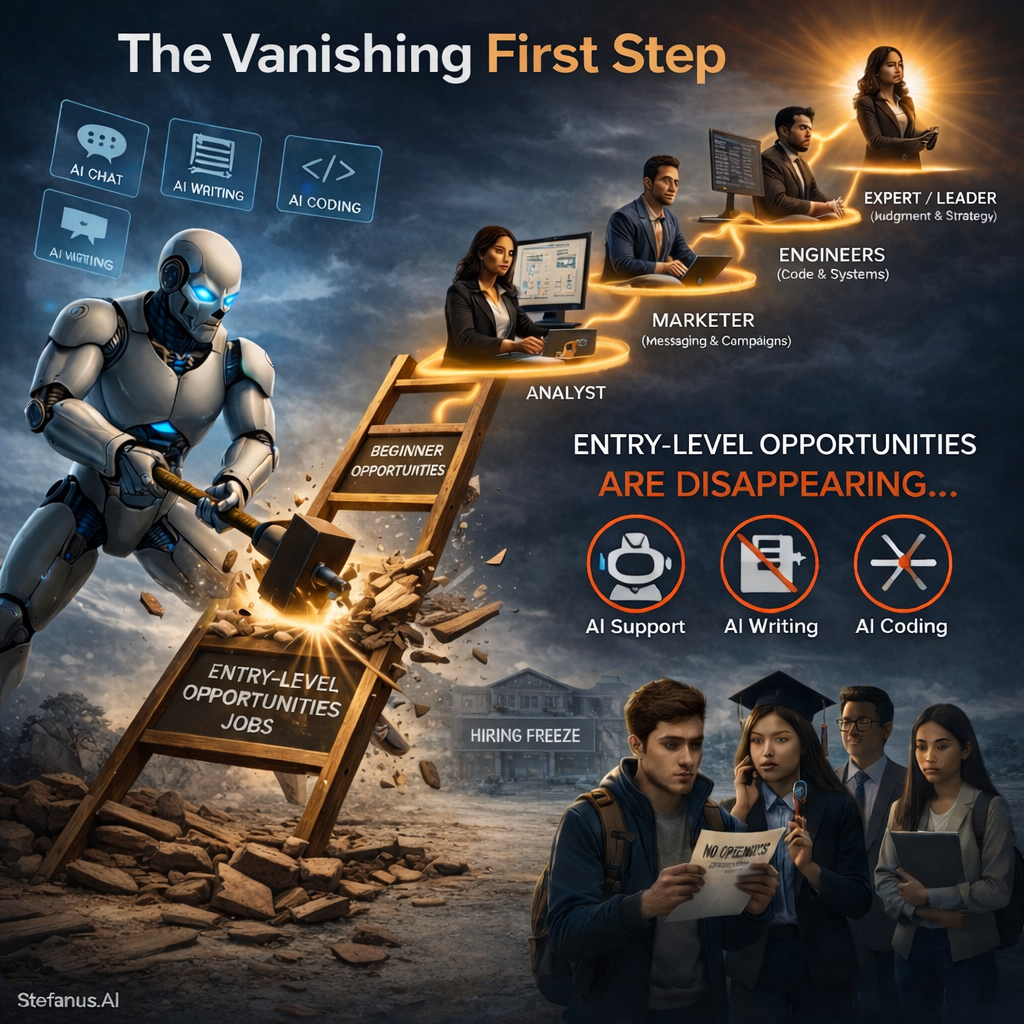

Since the widespread adoption of generative AI tools in the early 2020s, the conversation surrounding artificial intelligence and the future of work has largely been framed around two highly visible developments: the automation of entry-level tasks and the augmentation of senior-level decision-making.
Entry-level roles are declining as repetitive and structured tasks become increasingly automated, while senior leaders are gaining access to faster insights, more comprehensive data, and enhanced decision-support systems that improve their effectiveness.
At first glance, this appears to represent a natural and even desirable evolution toward greater efficiency and productivity across organizations.
However, beneath this surface-level narrative, a deeper and more structural shift is quietly unfolding—one that is not immediately visible in hiring data, job postings, or headline announcements.
The layer in between—the operational, coordinating, and decision-translating middle—is beginning to thin out, not through sudden elimination, but through gradual redundancy.
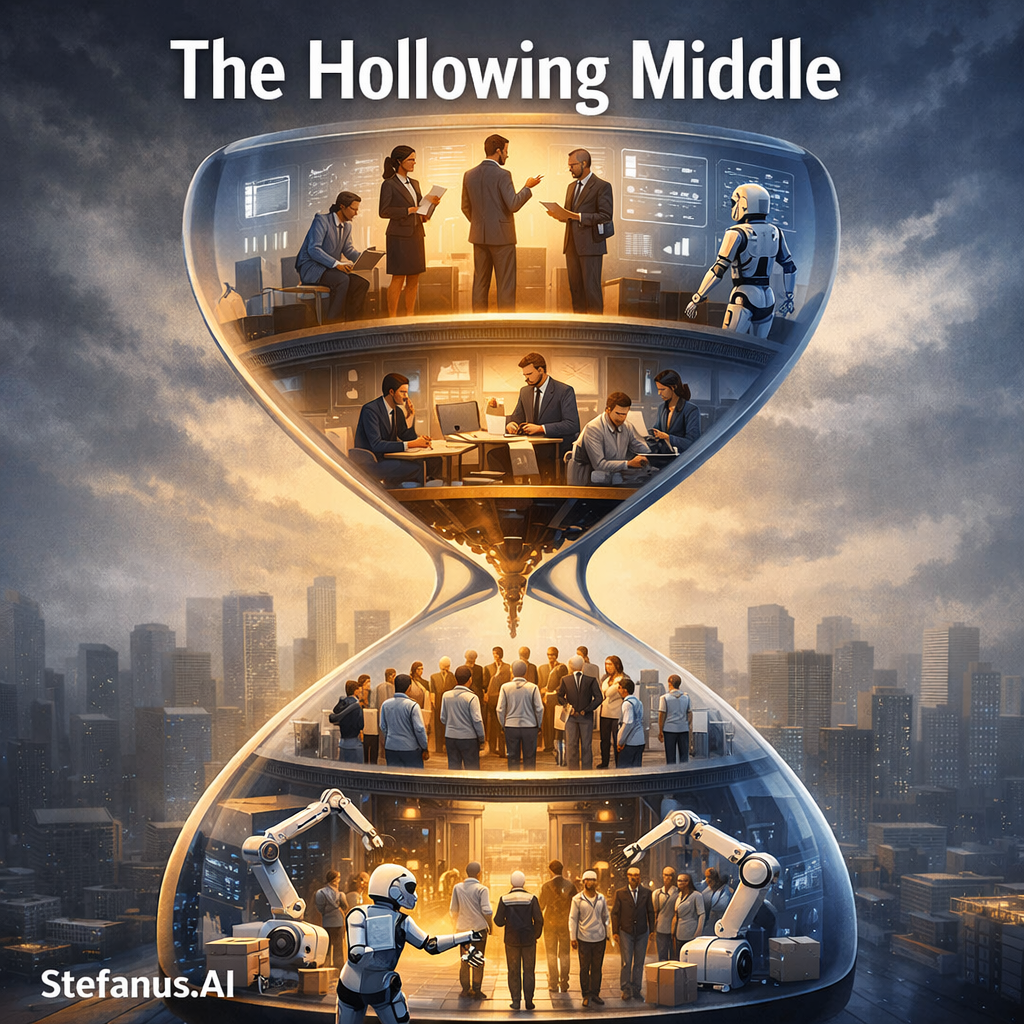
This phenomenon can be described as The Hollowing Middle.
And unlike the disappearance of entry-level roles, which affects how careers begin, this shift affects how organizations function at their core, because it removes the very layer that translates strategy into execution and ensures that complex systems operate cohesively.

What the Middle Layer Actually Does
Mid-level roles have never simply existed as an intermediate step between junior employees and senior leadership; rather, they have historically served as the connective infrastructure that enables organizations to operate effectively at scale.
These professionals are responsible for translating high-level strategic intent into actionable plans, converting raw and often fragmented data into meaningful insights, coordinating across teams with different priorities and constraints, and managing the timelines, dependencies, and trade-offs that arise in real-world execution.
They also play a critical role in filtering complexity for leadership—ensuring that senior decision-makers receive not just information, but context—while simultaneously guiding and mentoring junior employees who are still developing their judgment and understanding of how organizations function.
As McKinsey & Company describes, managers act as “translators, connectors, navigators, and coaches,”¹ a characterization that highlights their role not as task executors, but as system enablers.
In this sense, the middle layer does not merely contribute to productivity; it creates the conditions under which productivity is possible.
Why AI Targets the Middle
Artificial intelligence is particularly effective at performing the types of work that define mid-level roles, because these roles are often built around structured processes, repeatable patterns, and the synthesis of information across multiple sources.
AI systems can now summarize large volumes of information in seconds, generate structured reports and updates with high consistency, track progress across complex workflows, coordinate tasks between different systems, and produce data-driven insights that were once the domain of human analysts.
Recent research indicates that AI-assisted environments can improve productivity by as much as 20–60%, while a growing majority of firms now rely on AI to support or augment decision-making processes.² ³
These capabilities overlap almost perfectly with the responsibilities traditionally carried out by mid-level professionals, which explains why this layer is particularly vulnerable—not because it lacks value, but because its functions are highly compatible with automation.
What previously required multiple roles—a project manager to coordinate activities, an analyst to interpret data, and a manager to synthesize insights—can now increasingly be handled by integrated systems that operate continuously and at scale.
As a result, organizations are not abruptly removing mid-level roles, but are gradually reducing their necessity, leading to a structural shift that unfolds over time rather than all at once.

From Pyramid to Hourglass
For decades, organizations have been structured like pyramids, with a broad base of entry-level employees, a strong and stable middle layer, and a relatively small group of senior leaders at the top.
This structure allowed for both scalability and stability, as the middle layer absorbed complexity, ensured coordination, and maintained alignment across different parts of the organization.
However, AI is reshaping this traditional model into something that more closely resembles an hourglass, where both the base and the middle are narrowing while the top becomes more concentrated and increasingly empowered by technology.
The base is shrinking as routine tasks are automated, the middle is thinning as coordination and translation become system-driven, and the top is expanding in influence as leaders gain direct access to information and insights that previously flowed through multiple layers.
Firms themselves are beginning to acknowledge that AI is not simply eliminating jobs but reshaping the composition of work in fundamental ways.⁴
While this new structure may appear more efficient, it also introduces new forms of risk, because organizational stability has historically depended on the presence of a robust middle layer.

The Hidden Risks of a Hollowed Middle
One of the most significant risks associated with the hollowing middle is the gradual collapse of the leadership pipeline, as mid-level roles have traditionally served as the environment in which future leaders develop their judgment, learn to navigate ambiguity, and gain experience managing real-world trade-offs.
Without this stage, individuals may advance into senior roles without having fully developed the practical understanding required to lead effectively, resulting in a gap between authority and experience.
At the same time, organizations may become increasingly fragile, because while AI systems perform exceptionally well under stable and predictable conditions, they are less capable of handling unexpected disruptions, contextual nuances, or situations that require human judgment and adaptability.
Mid-level professionals have historically filled this gap by managing exceptions, interpreting context, and making adjustments that cannot easily be codified into systems.
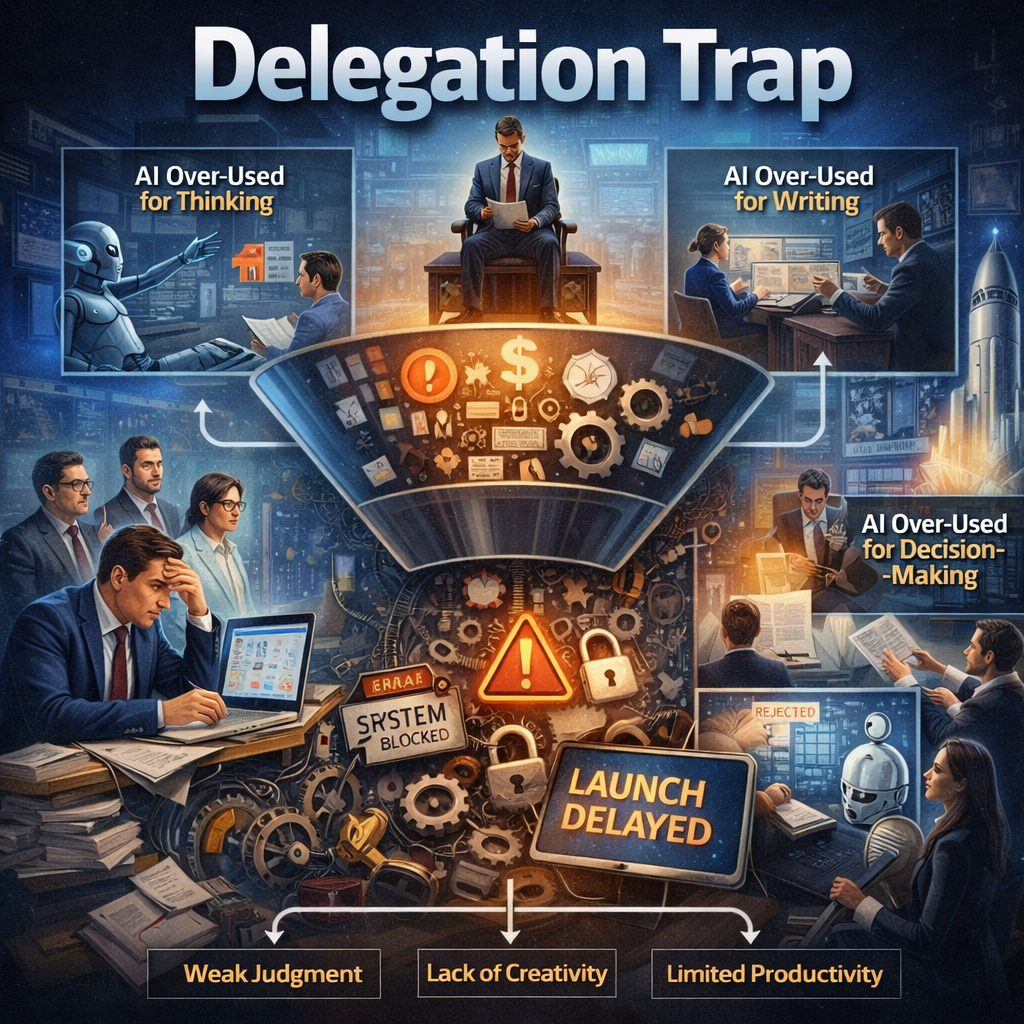
Another important consequence is the centralization of decision-making, as the removal of intermediary layers shifts authority upward, placing greater responsibility on senior leaders who must now process more information and make more decisions directly.
This creates a paradox in which organizations have access to faster and more comprehensive data yet may experience slower execution due to bottlenecks at the top.
There is also the risk of an illusion of alignment, as AI-generated dashboards and summaries create a sense of shared visibility, even when different teams interpret the same information in different ways.
Without a layer dedicated to interpreting meaning and ensuring consistency, organizations may appear aligned while operating with fragmented understanding.
Finally, the erosion of mentorship and cultural transmission represents a long-term risk, as mid-level professionals play a critical role in shaping how knowledge, values, and decision-making practices are passed down within an organization.

Why This Is Hard to See
The hollowing middle is difficult to detect precisely because it does not occur through dramatic or visible events, but rather through a series of small, incremental decisions that collectively reshape the organization over time.
It may begin with one fewer manager being hired, continue with a team operating without a dedicated coordinator, and expand as systems gradually replace reporting, tracking, and communication workflows.
Each individual decision appears rational and justified, often framed in terms of efficiency or cost reduction.
However, the cumulative effect of these decisions is structural, leading to a gradual transformation that is only fully visible in hindsight.
Even recent labor market data shows that most job postings still do not explicitly reference AI, even though that underlying workflows are increasingly being redesigned around it.⁵
These disconnects between visible signals and underlying change makes the hollowing middle particularly challenging to recognize in real time.

The Strategic Misunderstanding
At the core of this trend lies a fundamental misunderstanding about the role of the middle layer within organizations.
It is often perceived as overhead—an additional layer that slows down decision-making and adds cost without directly contributing to output.
However, this perspective overlooks the fact that the middle layer functions as organizational infrastructure, enabling coordination, alignment, and execution at scale.
It is the mechanism through which strategy becomes action, data becomes insight, and plans become outcomes.
Removing this layer without redefining its function risks weakening the system it supports, much like removing structural components from a building in the pursuit of efficiency.

What Needs to Change
The appropriate response to this shift is not to preserve the middle layer in its existing form, but to evolve it in a way that reflects the new capabilities and limitations of AI.
Mid-level roles should transition away from routine coordination and reporting tasks, and toward areas that require judgment, decision-making under uncertainty, and cross-functional problem-solving.
As AI takes over predictable and repeatable processes, human roles must increasingly focus on the non-routine—situations where context, ethics, and adaptability are essential.
At the same time, organizations must recognize that investing in AI alone is insufficient; they must also invest in developing human capabilities, particularly in areas such as critical thinking, communication, and leadership.
As McKinsey & Company notes, realizing the full value of AI depends on how quickly human skills evolve alongside technological capabilities.⁶
Finally, accountability must remain firmly within the human domain, as AI systems can provide recommendations and insights, but cannot assume responsibility for the consequences of decisions.

Conclusion
The hollowing middle represents a profound shift in organizational design, one that extends beyond automation to affect how work is structured, how decisions are made, and how leaders are developed over time.
While the removal of this layer may deliver short-term efficiency gains, it introduces long-term risks that are less visible but potentially more significant, including reduced resilience, fragmented understanding, and a weakened leadership pipeline.
The challenge for organizations is not simply to adapt to AI, but to rethink the role of the middle layer in a way that preserves its essential functions while aligning it with the capabilities of modern systems.
Because in the end, the middle is not where inefficiency resides.
It is where understanding is formed, where judgment is developed, and where organizations transform from collections of tasks into cohesive and adaptive systems.
Footnotes
- McKinsey & Company, Managing in the Era of Gen AI, 2025–2026.
- Academic research (2025), AI and Productivity Gains in Knowledge Work.
- Academic research (2025), AI in Enterprise Decision-Making.
- CEPR / VoxEU (2026), Firms Predict AI Productivity Boom.
- Indeed Hiring Lab / Business Insider (2026), labor market analysis.
- McKinsey & Company, Skills Reset for the AI Age, 2026.