
The gap between “imagining” an event and “executing” it has always been fraught with uncertainty. Event planners, directors, and nervous couples have long relied on mood boards and floor plans, hoping the final reality matches the vision. But just as a screenwriter’s script needs a storyboard before the cameras roll, a high-stakes live event needs a definitive visual and auditory rehearsal.
Enter PreLive, the AI-driven ecosystem that turns “what if” into “see it now.” The word “pre” means before. The concept of PreLive wasn’t born in the recent AI boom; it was whispered into existence exactly a quarter-century ago on January 18, 2001, with the registration of prelive.com. Back then, the technology to simulate a live human experience with cinematic fidelity simply didn’t exist. It was a futuristic dream waiting for the world to catch up.
Today, with the arrival of advanced generative AI, that 25-year-old vision has become a reality. PreLive is no longer just a domain name; it is a sophisticated, AI-enhanced tool that synthesizes sound, video, text, and imagery into a cohesive, immersive preview of any major life event.

The “Director’s Cut” for Real Life
Think of PreLive as the high-tech storyboard for the movie of your life. In Hollywood, a producer hires sketch artists to draw every frame—detailing exactly how an actor moves their hand, the tilt of a head, or the flow of a costume—before a single frame of film is shot.
PreLive brings this level of professional precision to event planning. It allows organizers and “producers” to generate several distinct scenarios before a single guest arrives, answering critical questions:
- Lighting: How will the sun or stage lights hit the subject at a specific hour?
- Acoustics: How will the audio bounce off the specific materials of the venue?
- Emotional Flow: Does the layout facilitate the intended mood of the gathering?
Scenario #1: The Orchestrated Wedding

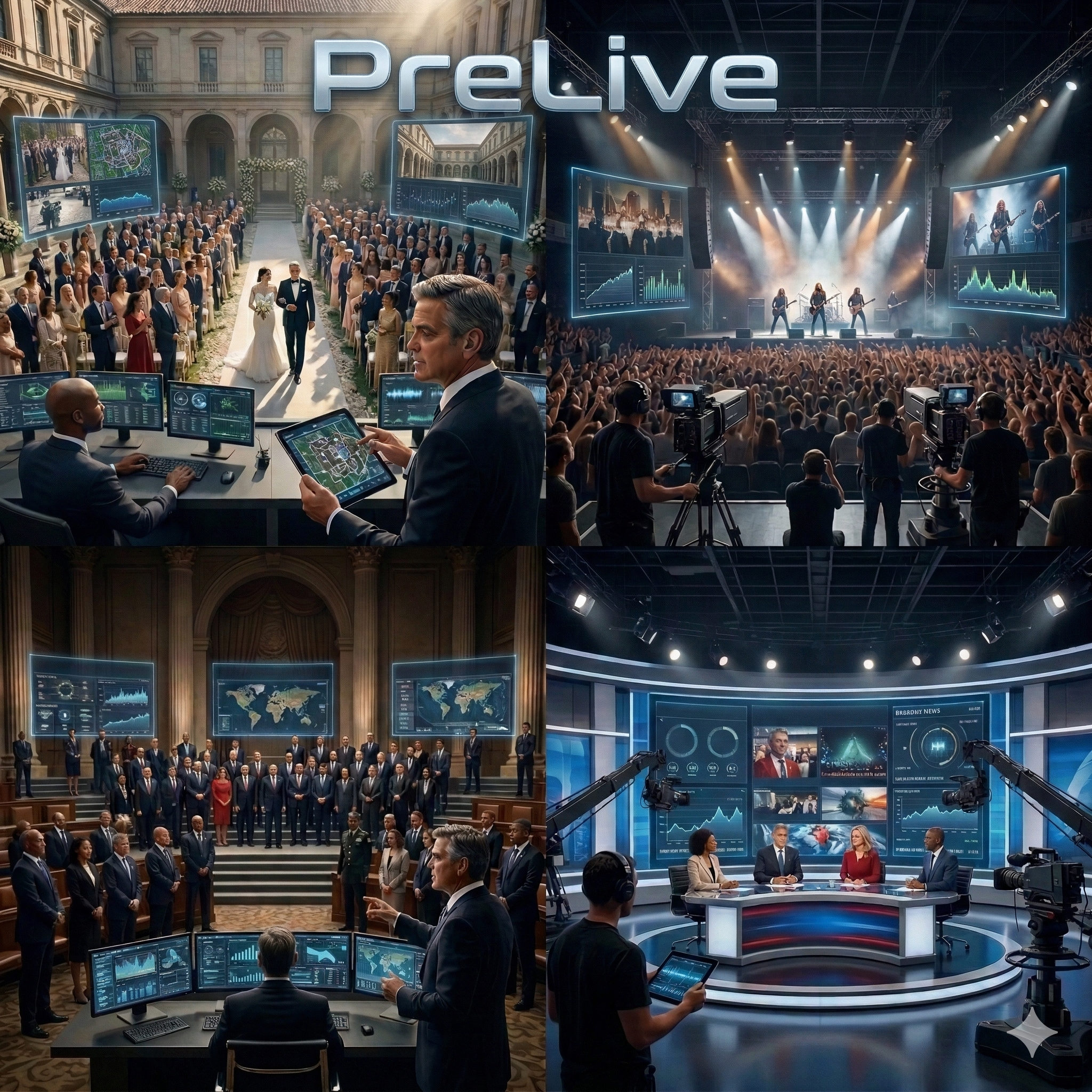
Imagine a wedding planner presenting a couple with a fully rendered AI simulation of their big day.
- Logistics: PreLive visualizes guest entrances, ensuring no bottlenecks in the foyer.
- Placement: Virtually “place” family members in specific sections to see how they interact with the space.
- The VIP Experience: Assign tables to special guests to check sightlines from every seat in the house.
Scenario #2: The Altar and the Atmosphere
PreLive captures nuances a floor plan cannot. It simulates the moment a bride is handed over at the altar and renders the pastor’s walk. Crucially, it integrates sound, allowing organizers to hear how the processional music reverberates through the rafters so audio adjustments can be made weeks in advance.
Scenario #3: The Global Summit Photo-Op

When world leaders meet, every second is a matter of international diplomacy and security.
- The Challenge: An event planner must coordinate dozens of high-profile individuals for a single “family photo.”
- The PreLive Advantage: Planners can simulate the exact standing positions based on height and protocol, the placement of flags (such as the American flag at center-stage), and the shadow fall-off from overhead rafters. This ensures the press core gets the perfect shot without keeping world leaders waiting.
Scenario #4: The School Christmas Carol

A holiday concert involves moving parts: excited children, a conductor, and a live TV crew.
- The Challenge: Managing the chaos of kids in costume while maintaining a professional broadcast.
- The PreLive Advantage: The planner uses the AI to see where the teacher should stand to guide the children without blocking the TV cameras. It simulates the “cut” between the conductor’s cues and the wide-angle shot of the Christmas tree, ensuring the TV crew knows exactly when to zoom in on the soloist.
Scenario #5: The Rockstar Stage Entrance

The moments before a rock concert are a cacophony of activity.
- The Challenge: Musicians in “fancy rockstar” gear are ready to burst onto the stage while technicians perform final checks.
- The PreLive Advantage: The planner coordinates the “dark start.” While the sound technician checks the frequency of the guitars on the monitor, PreLive simulates the pyrotechnics and lighting cues to ensure the musicians aren’t blinded during their entrance. It creates a bridge between the technical crew and the performers.
Efficiency Through Intelligence
The true power of PreLive lies in its ability to save time and slash costs. Traditionally, coordinating these massive events required a small army of staff and expensive physical mock-ups. PreLive provides a “digital twin” of the event. By identifying potential issues—like a cramped stage for a choir or a lighting glare on a world leader—in the AI-preview, organizers fix problems before they cost real-world dollars.
Conclusion: The New Standard for Live Excellence
PreLive is the bridge between a dream and a flawless execution. Whether it is a global summit, a high-octane concert, or an intimate wedding, this platform provides the clarity and confidence that only a “pre-live” look can offer.
As we move further into this AI-integrated era, the guesswork of event planning is over. The dream that started in 2001 has finally arrived to ensure that when the “real” camera starts rolling, everything is exactly where it’s meant to be.