
This paper begins with a deliberate premise: the future of artificial intelligence can no longer be fully understood within the boundaries of Earth.
Much of today’s discussion around AI remains centered on models, applications, and software capabilities. While important, this perspective is increasingly incomplete. What is unfolding is not simply an advancement in intelligence, but a shift in the infrastructure required to produce it.
Modern AI depends on large-scale physical system data centers, continuous energy supply, advanced semiconductors, and global connectivity. These are no longer supporting components; they are the primary constraints shaping how far AI can scale. The limiting factor is no longer algorithmic progress, but the infrastructure that sustains it.
It is this constraint that gives rise to the central idea of this paper: AI Beyond Earth.
The title reflects a transition that is already underway—the expansion of intelligence infrastructure beyond the planet. This is not a speculative vision, but a structural response to real limitations on Earth, including energy bottlenecks, land constraints, environmental pressures, and increasing geopolitical risks affecting critical infrastructure.
Space introduces a fundamentally different environment. It offers continuous solar energy, natural conditions for heat dissipation, and physical separation from terrestrial vulnerabilities. These are not incremental advantages; they directly address the core bottlenecks of modern AI systems.
This shift requires a change in perspective. Artificial intelligence should no longer be viewed solely as a software layer, or even as a terrestrial infrastructure system. It is evolving into an extra-terrestrial infrastructure layer, extending beyond Earth as part of its natural progression.
The urgency of this transition is reinforced by current geopolitical realities. Data centers are increasingly exposed to cyber threats, physical attacks, and regional instability. Institutions such as the World Bank and the International Monetary Fund emphasize that infrastructure resilience is now directly tied to economic stability and national security¹².
At the same time, academic research is reframing AI as foundational infrastructure. The Stanford Institute for Human-Centered Artificial Intelligence observes:
“AI is increasingly embedded in the physical systems that power economies.”³
This aligns with the work of Daron Acemoglu:
“Economic growth and political power are ultimately shaped by institutions and infrastructure.”⁴
If infrastructure defines power, then the location of that infrastructure defines sovereignty.
For the first time in history, that location is beginning to move beyond Earth.
The Emergence of Space-Based Intelligence
Artificial intelligence is entering a new phase: infrastructure expansion into orbit.
This shift is driven by converging structural pressures:
- Exponential demand for compute
- Energy limitations on Earth
- Rising geopolitical risks
- Capital concentration
As reported by the Financial Times, the space economy is transitioning from launch services toward orbital infrastructure and services, including communications and data processing⁵.
This marks a new kind of space race—not for territory, but for compute dominance.
Unlike the Cold War space race, this competition is continuous, economic, and infrastructural. It is not about symbolic achievement—it is about building systems that produce intelligence.
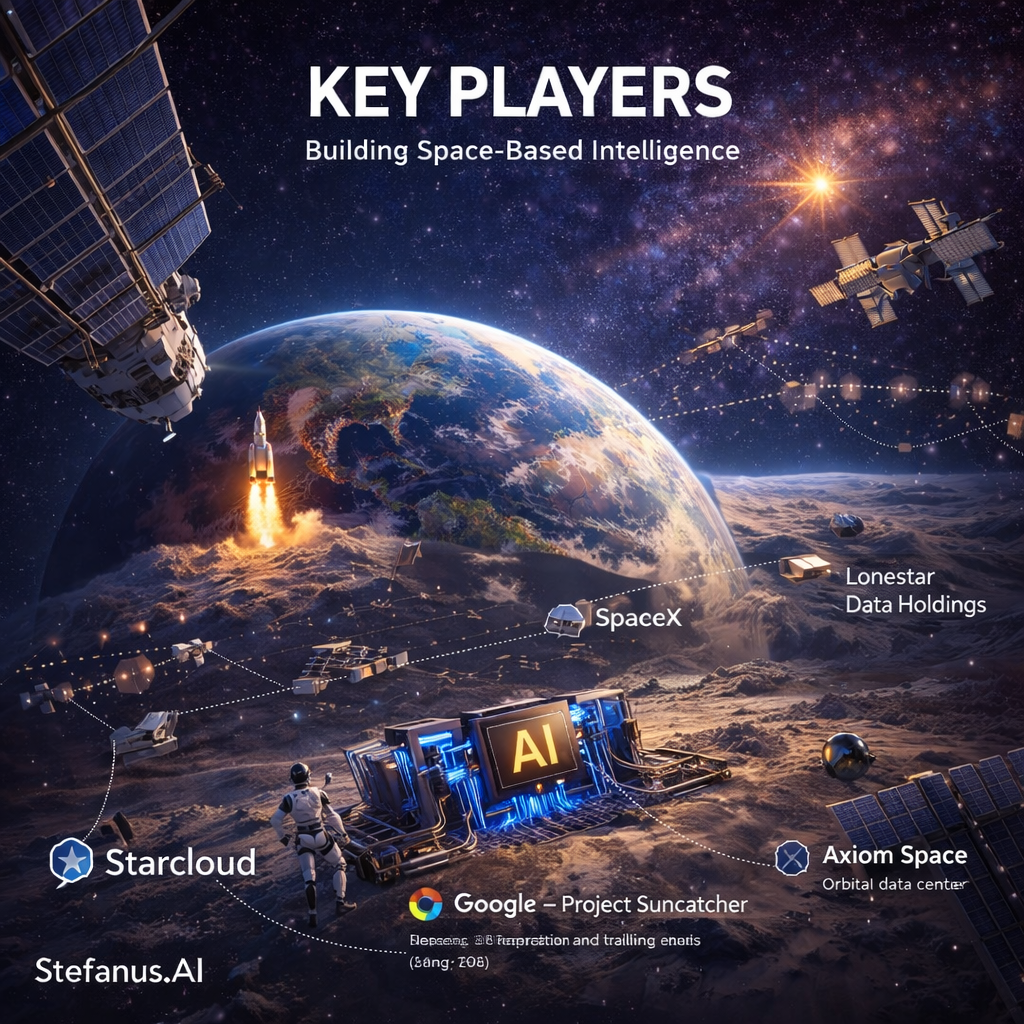
Key Players Driving the Rise of Space-Based Intelligence
1) Starcloud
Mission Goal: High-performance AI training in orbit
Status / Key Milestone:
- First AI model trained in space using NVIDIA H100 GPU (2025)¹¹
- ~$1.1B valuation (2026)
Advantages
- First-mover advantage in orbital AI training
- Demonstrates feasibility of running cutting-edge hardware in space
- Reduces dependence on terrestrial data centers
- Potential for near-unlimited solar-powered compute
Disadvantages
- Extreme hardware reliability challenges (radiation, maintenance)
- High launch and replacement costs
- Limited scalability in early-stage infrastructure
- Latency constraints for certain real-time workloads
2) Google — Project Suncatcher
Mission Goal: Scalable AI infrastructure using proprietary TPUs
Status / Key Milestone:
- Announced as research initiative (2025)¹²
- Planned launch of a solar-powered satellite constellation for AI workloads in 2027¹³
Advantages
- Deep integration with Google’s AI ecosystem (TPUs, data, cloud)
- Massive capital resources and engineering talent
- Potential vertical integration from model → infrastructure
- Strong experience in distributed systems
Disadvantages
- Regulatory scrutiny across multiple jurisdictions
- High dependency on launch partners
- Risk of centralization (monopoly concerns)
- Long development timelines
3) SpaceX
Mission Goal: Massive-scale orbital compute
Status / Key Milestone:
- Filed for permission with the U.S. government (FTC) in early 2026 to launch up to one million data-center satellites¹⁴
Advantages
- Full-stack control: launch + satellite deployment
- Proven large-scale constellation experience (Starlink)
- Rapid iteration capability
- Lower marginal launch cost compared to competitors
Disadvantages
- Regulatory and orbital congestion risks
- Space debris concerns
- Capital intensity at unprecedented scale
- Dependence on continuous launch cadence
4) Axiom Space
Mission Goal: Commercial orbital data center nodes
Status / Key Milestone:
- Building data centers as part of Axiom Station, with the first module planned for 2026–2027¹⁵
Advantages
- Modular infrastructure approach
- Integration with human-tended stations
- Potential hybrid model (human + autonomous operations)
- Strong partnerships with NASA
Disadvantages
- Higher operational complexity (human-rated systems)
- Limited scalability compared to satellite constellations
- Cost structure tied to station maintenance
- Slower deployment speed
5) Lonestar Data Holdings
Mission Goal: Lunar-based data storage and edge processing
Status / Key Milestone:
- Successfully tested lunar-orbiting data storage for disaster recovery (2025)¹⁶
Advantages
- Ultimate physical isolation (Moon-level security)
- Ideal for disaster recovery and data sovereignty
- Extremely resilient to terrestrial disruptions
- Unique positioning in niche high-value markets
Disadvantages
- Extremely high latency
- Very limited bandwidth
- High deployment and maintenance costs
- Not suitable for real-time AI workloads
Emerging Additional Players (Brief Mentions)
- Blue Origin – Proposed tens of thousands of solar-powered satellites
- China (Three-Body Computing Constellation) – AI satellite network for orbital supercomputing
- Aetherflux / Kepler Communications – deploying AI-enabled satellite infrastructure
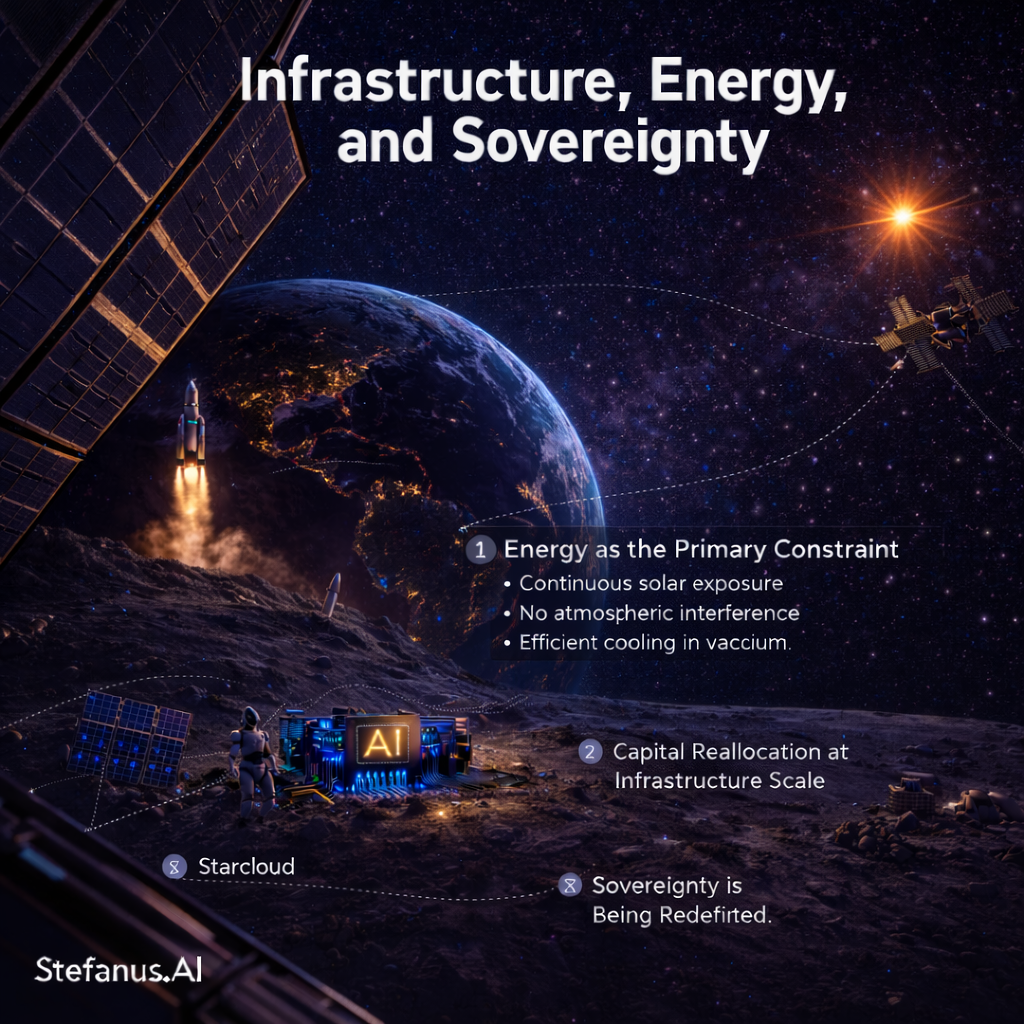
Strategic Analysis: Infrastructure, Energy, and Sovereignty
Artificial intelligence is converging with three foundational systems:
1. Energy as the Primary Constraint
The World Economic Forum estimates that data centers already consume approximately 1.5% of global electricity, with demand accelerating rapidly due to AI⁶.
Orbital systems provide:
- Continuous solar exposure
- No atmospheric interference
- Efficient cooling in vacuum
“The Sun is the largest accessible energy source for advanced computing systems.”¹⁷
This reframes AI as an energy-constrained system, not merely a computational one.
2. Capital Reallocation of Infrastructure Scale
The IMF projects trillions of dollars in AI-related infrastructure investment¹.
This aligns with historical infrastructure transitions:
- Railroads → industrial expansion
- Oil → geopolitical dominance
- Internet → digital economy
- Orbital compute → next phase
As Shoshana Zuboff writes:
“Instrumentarian power knows and shapes behavior at scale.”⁷
AI infrastructure is becoming the mechanism through which that power is exercised.
3. Sovereignty Is Being Redefined
Control over AI is increasingly determined by infrastructure location.
As Carl Benedikt Frey explains:
“Technological revolutions are defined by the systems that deploy them.”⁸
This creates a structural transition:
- From data sovereignty
- To infrastructural sovereignty
- To orbital sovereignty
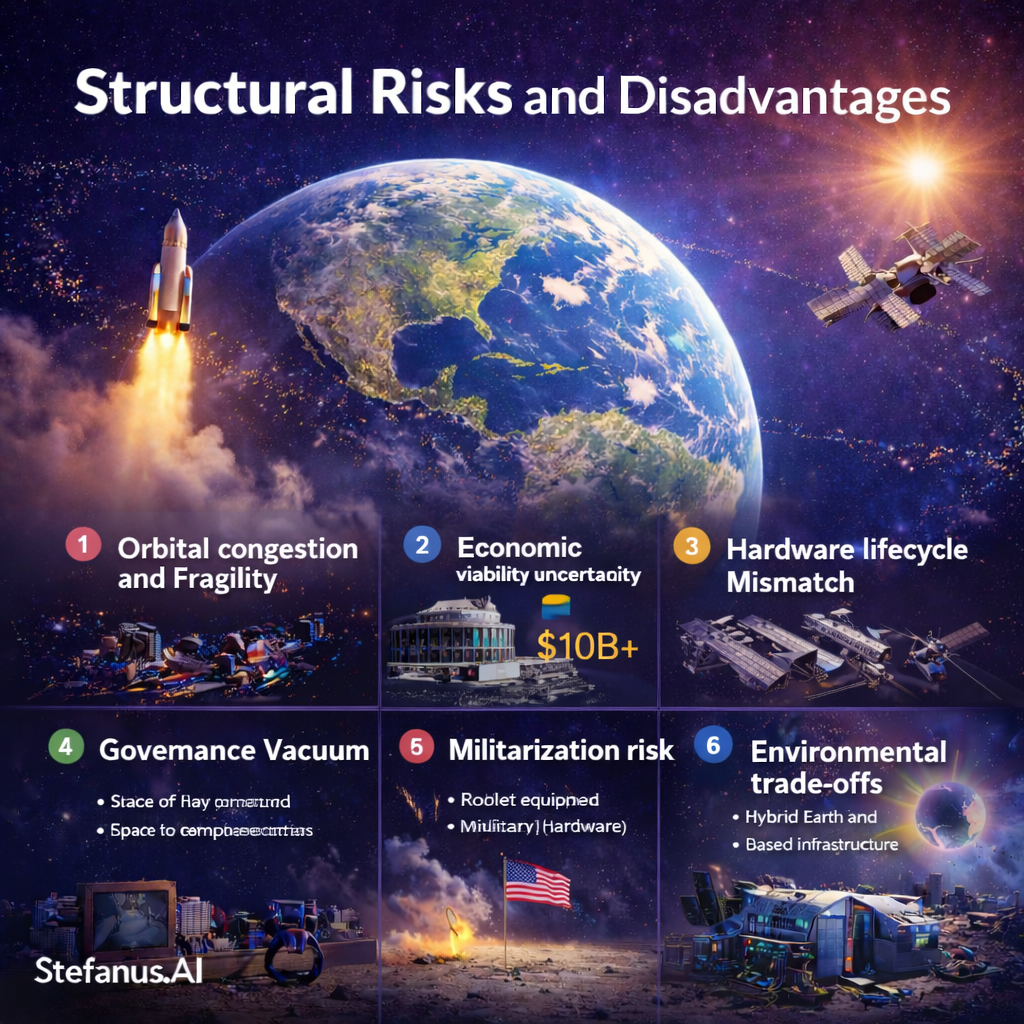
Structural Risks and Disadvantages
1. Orbital Congestion and Fragility
Large-scale satellite deployment introduces systemic risk.
The United Nations Office for Outer Space Affairs warns:
“Outer space is increasingly congested, contested, and competitive.”⁹
2. Economic Viability Uncertainty
Orbital data centers may cost $10B+ per deployment¹⁸.
This raises a fundamental question:
Is space-based compute economically optimal—or strategically unavoidable?
3. Hardware Lifecycle Mismatch
- AI evolves rapidly (12–24 months)
- Space infrastructure evolves slowly
This creates structural inefficiencies.
4. Governance Vacuum
There is no global framework for:
- Orbital AI infrastructure
- Compute monopolies in space
- Cross-border jurisdiction
5. Militarization Risk
Space-based AI infrastructure is inherently dual-use:
- Civilian → compute
- Military → intelligence systems
6. Environmental Trade-offs
- Rocket emissions
- Orbital debris
- Resource extraction
7. Architectural Constraints
Space cannot fully replace Earth:
- Latency remains
- Bandwidth is limited
- Hybrid systems will dominate
Conclusion: A Civilization-Scale Transformation
Artificial intelligence is not simply transforming industries—it is redefining the structure of civilization.
Historically, power has followed infrastructure:
- Agrarian societies → land
- Industrial societies → energy
- Digital societies → networks
Now:
AI societies → compute infrastructure
What makes this moment unprecedented is that infrastructure itself is leaving the planet.
For the first time:
- Intelligence production is separating from geography
- Infrastructure is moving beyond Earth
- Sovereignty is decoupling from territory
As Nick Bostrom warns:
“Superintelligence would be the last invention humanity needs to make.”¹⁰
But before that threshold is reached, a more immediate transformation is underway:
The infrastructure that produces intelligence is being rebuilt.
And it is being rebuilt in orbit.
This transformation operates at a civilization scale because it reshapes:
1. Power
Control shifts from land to infrastructure.
2. Economy
AI becomes the central driver of capital allocation.
3. Security
Infrastructure becomes both asset and target.
4. Sovereignty
Competition expands into orbital space.
The International Monetary Fund emphasizes:
“Infrastructure investment is central to long-term economic resilience.”¹
The deeper implication is clear:
Whoever controls space-based intelligence infrastructure will shape the future of global power.
This is why the framing “AI Beyond Earth” matters.
It is not a metaphor.
It is a direction.
And it marks the beginning of a new phase of human civilization—
one where intelligence is no longer bound by the planet that created it.
Footnotes
- IMF – AI and Global Growth
https://www.imf.org/en/Publications/fandd/issues/2026/03/point-of-view-ai-can-lift-global-growth-marcello-estevao - World Bank – Infrastructure
https://www.worldbank.org/en/topic/infrastructure - Stanford HAI AI Index
https://hai.stanford.edu/ai-index - Daron Acemoglu (MIT)
https://economics.mit.edu/faculty/acemoglu - Financial Times – Space Economy
https://www.ft.com/space - World Economic Forum – Data Centers
https://www.weforum.org/stories/2026/01/data-centres-space-ai-revolution/ - Shoshana Zuboff – Harvard Business School
https://www.hbs.edu/faculty/Pages/profile.aspx?facId=6607 - Carl Benedikt Frey – Oxford
https://www.oxfordmartin.ox.ac.uk/people/carl-benedikt-frey - UN Office for Outer Space Affairs
https://www.unoosa.org - Nick Bostrom – Oxford
https://www.oxfordmartin.ox.ac.uk/people/nick-bostrom - Reuters – Starcloud
https://www.reuters.com/business/retail-consumer/starcloud-reaches-11-billion-valuation-ai-space-race-heats-up-2026-03-30/ - Google Research – Space AI
https://research.google/blog/exploring-a-space-based-scalable-ai-infrastructure-system-design/ - Fortune – Project Suncatcher
https://fortune.com/2025/12/01/google-ceo-sundar-pichai-project-suncatcher-extraterrestrial-data-centers-environment/ - GeekWire – SpaceX
https://www.geekwire.com/2026/spacex-fcc-million-data-center-satellites/ - CarbonCredits – Axiom
https://carboncredits.com/elon-musks-spacex-eyes-solar-data-centers-in-space-to-power-the-ai-boom/ - TechCentral – Lonestar
https://www.techcentral.ie/google-wants-data-centres-in-space-by-2027/ - arXiv – Space Energy Systems
https://arxiv.org/abs/2511.19468 - Business Insider – Space Data Centers Cost
https://www.businessinsider.com/elon-musk-jeff-bezos-space-data-centers-scientists-ask-why-2026-4