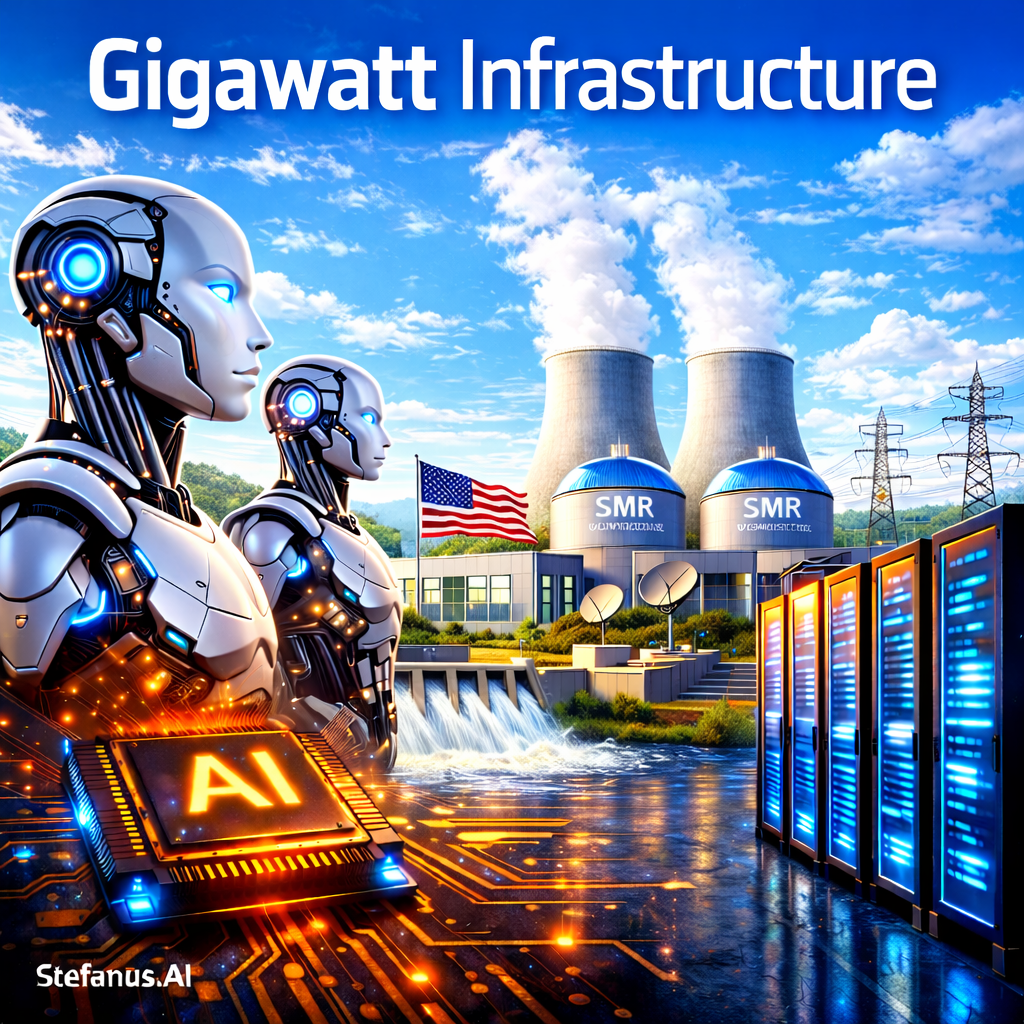

The center of technological competition is no longer confined to software—it is shifting toward the infrastructure that enables intelligence at scale. What matters now is not only how systems are designed, but where they operate. As computation expands beyond terrestrial data centers into satellites and orbital platforms, physical location becomes a strategic variable, transforming infrastructure itself into a primary source of power.
Yet this shift introduces a new and largely underestimated domain of vulnerability.
Orbital infrastructure is often framed as a solution to terrestrial risk—offering insulation from conflict, geographic redundancy, and truly global reach. But this promise is incomplete. The moment intelligence must move—between Earth, orbit, and emerging lunar systems—it becomes exposed. Transmission introduces a new class of risk shaped by the realities of physics, the pressures of geopolitics, and the growing capabilities of adversarial actors.
Signals must traverse contested space.
Satellites pass over adversarial territory.
Latency reshapes control.
Weapons can reach orbit.
This paper introduces the concept of Orbital Resilience—the ability of space-based intelligence systems to maintain integrity, availability, and sovereignty under conditions of interception, delay, and kinetic threat.
Rather than assuming space as a haven, this paper argues that orbit is becoming a contested layer of infrastructure, where the fragility of transmission may redefine the limits of AI power.
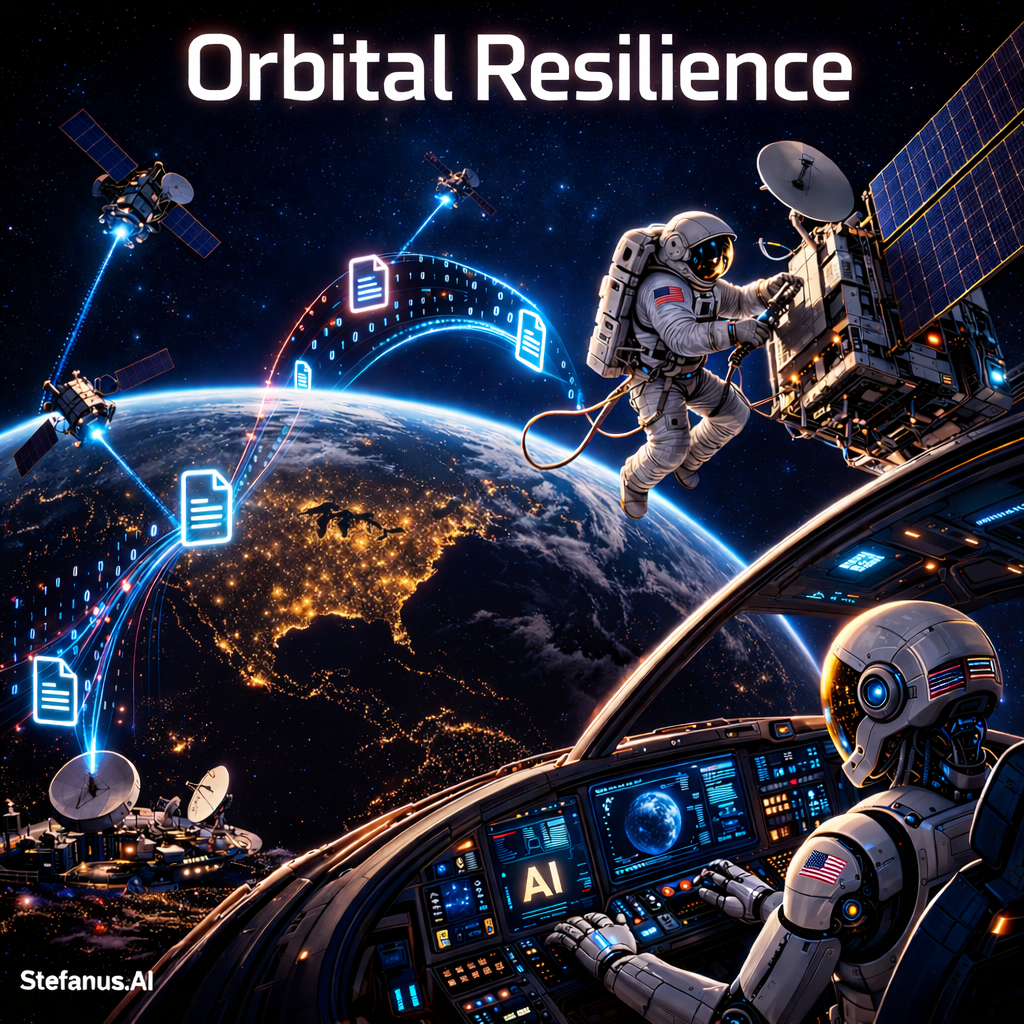
1. The Transmission Problem: Intelligence Must Travel
Space-based intelligence systems depend fundamentally on transmission.
Unlike terrestrial systems, where data remains within controlled fiber networks, orbital systems require continuous exchange:
- Earth → satellite uplink
- satellite → satellite relay
- satellite → Earth downlink
- Earth ↔ Moon (~2–5 seconds one-way; minutes in degraded conditions)
Each transmission creates exposure.
As Professor Bruce Schneier (Harvard Kennedy School) notes:
“Data in motion is often far more vulnerable than data at rest.”¹
This vulnerability is amplified in space, where signals propagate across:
- open electromagnetic spectrum
- predictable orbital paths
- internationally contested zones
The latency factor further complicates resilience. Lunar communication introduces:
- ~1.3 seconds one-way under ideal conditions
- multi-second delays under routing constraints
- potential multi-minute delays under degraded or relayed systems
As MIT researchers in distributed systems emphasize:
“Latency is not merely a technical constraint; it reshapes control authority and decision-making structures.”²
For AI systems operating at machine speed, even seconds introduce:
- desynchronization
- degraded coordination
- increased autonomy (and risk)
Thus, orbital intelligence is not continuous, it is intermittently sovereign.
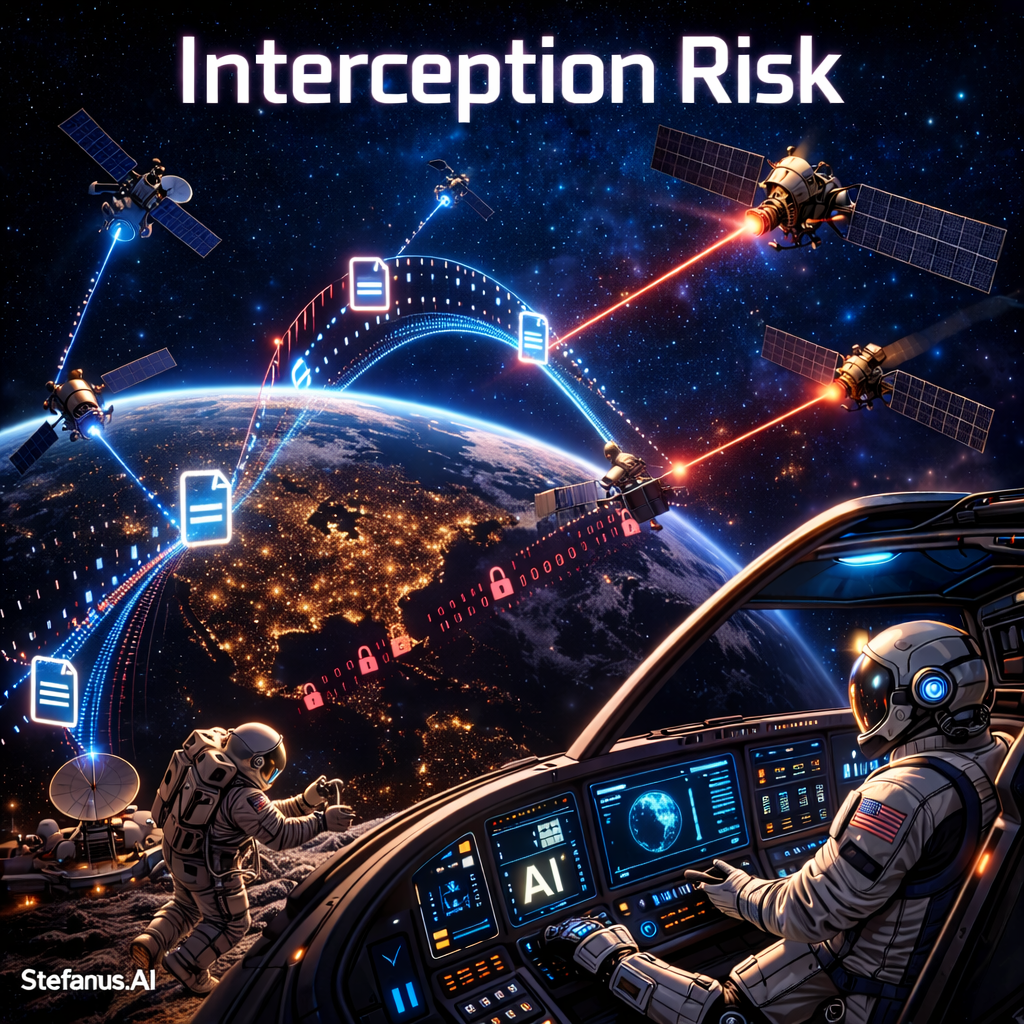
2. Interception Risk: The Long History of Signals Intelligence
The interception of transmitted information is not hypothetical—it is foundational to modern geopolitics.
During the Cold War, signals intelligence (SIGINT) became a primary domain of power.
Historical Precedents
- The Venona Project revealed extensive Soviet espionage through intercepted communications³
- The National Security Agency developed global interception capabilities via satellite and ground stations
- The ECHELON system enabled large-scale interception of international communications⁴
More recently, disclosures by Edward Snowden demonstrated that:
“The NSA collects communications everywhere it can—because it can.”⁵
This includes satellite links, microwave relays, and cross-border transmissions.
Modern Threat Landscape
According to a Center for Strategic and International Studies report:
“Space systems are inherently vulnerable to electronic warfare, including jamming, spoofing, and interception.”⁶
China and Russia have both demonstrated:
- satellite signal interception
- uplink spoofing
- cyber intrusion into ground stations
As Professor Elsa Kania (Harvard University) notes:
“Space is now a domain of persistent competition, where information dominance is contested.”⁷
In orbital systems, every transmission is potentially observable.
3. Orbital Sovereignty: The Problem of Passing Over Enemy Territory
Unlike terrestrial infrastructure, satellites cannot avoid geography.
Low Earth Orbit (LEO) systems:
- travel ~7.8 km/s
- orbit Earth every ~90 minutes
- pass over multiple sovereign territories per orbit
This creates a paradox:
Who controls the data when infrastructure passes over adversarial states?
The United Nations Office for Outer Space Affairs states:
“Outer space shall be free for exploration and use by all States.”⁸
Yet in practice:
- signals can be monitored when passing overhead
- ground stations within a country can capture transmissions
- electromagnetic emissions cannot respect borders
This creates de facto exposure without legal violation.
As Oxford scholar Professor Timothy Garton Ash argues:
“Global networks operate beyond traditional sovereignty, but power still accumulates where control is exercised.”⁹
Orbital systems thus operate in a condition of:
- legal openness
- operational vulnerability
4. Kinetic Threats: The Weaponization of Orbit
Orbital resilience is not only about data—it is about survival.
Anti-satellite (ASAT) weapons have been demonstrated by:
- United States
- Russia
- China
- India
In 2007, China destroyed a satellite in LEO, creating thousands of debris fragments¹⁰.
In 2021, Russia conducted a similar ASAT test, prompting international condemnation.
The NASA warned:
“Debris generated by destructive events can threaten spacecraft for decades.”¹¹
Parallel to Terrestrial Incidents
The destruction of Malaysia Airlines Flight MH17 shootdown illustrates the risk of operating within contested airspace.
A civilian aircraft—operating in international airspace—was destroyed by a surface-to-air missile.
The lesson extends to orbit:
- presence does not imply safety
- neutrality does not guarantee protection
As Professor Joan Johnson-Freese (U.S. Naval War College) notes:
“Space assets are increasingly viewed as legitimate military targets.”¹²
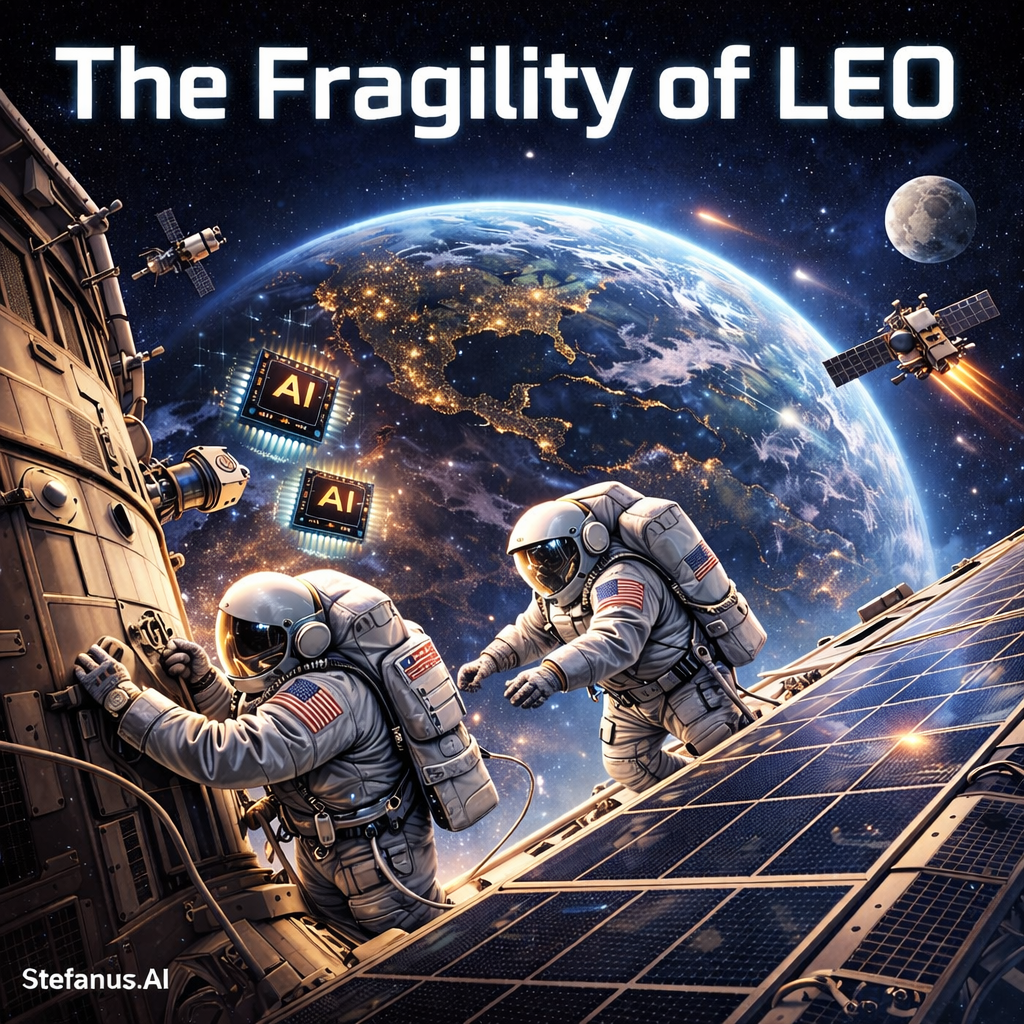
5. The Fragility of LEO: Density, Predictability, and Exposure
Low Earth Orbit is attractive for AI infrastructure due to:
- low latency
- proximity to Earth
- lower launch costs
However, it is also:
- the most congested orbital region
- the most predictable
- the most exposed
The European Space Agency reports:
“LEO is becoming increasingly congested, raising risks of collision and operational interference.”¹³
Additionally:
- orbital paths are publicly trackable
- satellites cannot maneuver arbitrarily
- infrastructure is physically fragile
This creates a structural asymmetry:
LEO systems are easy to locate, track, and target.
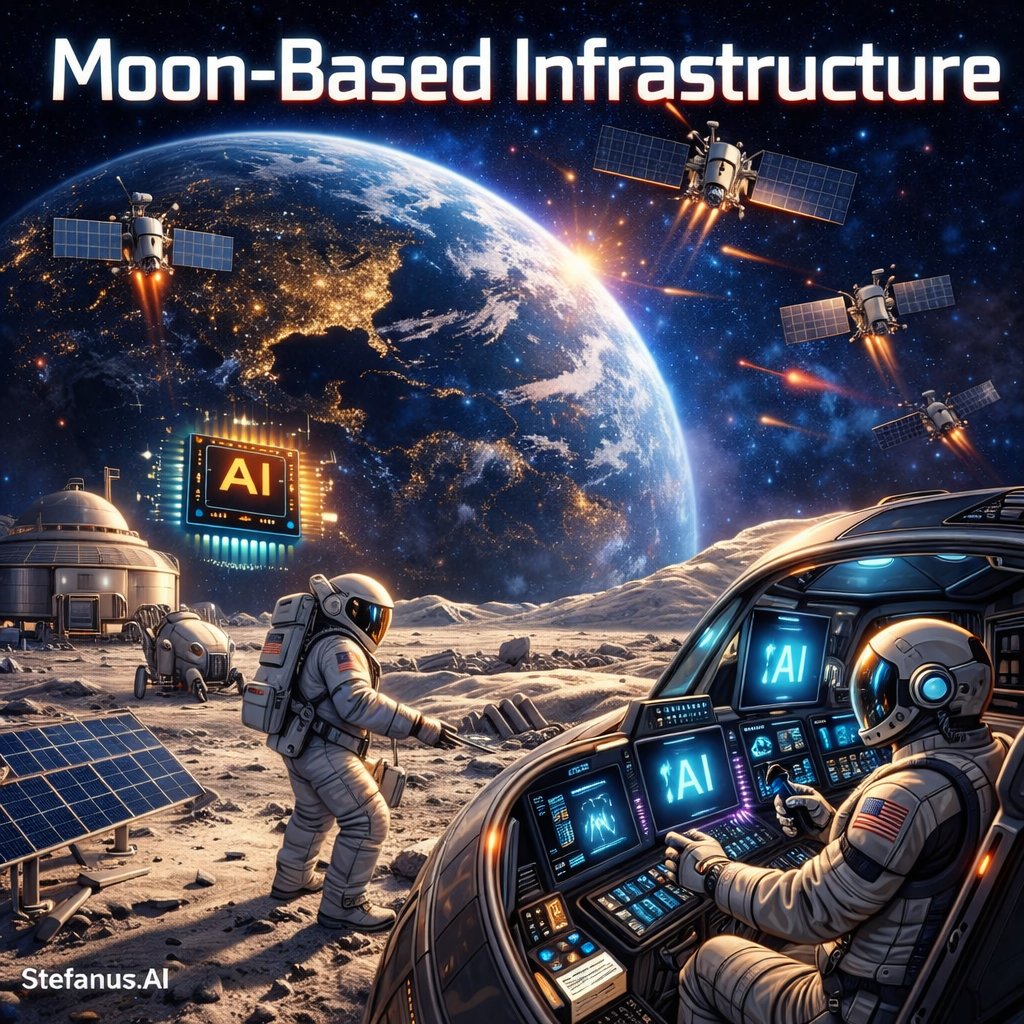
6. Latency and Autonomy: The Moon-Based Tradeoff
Lunar infrastructure introduces distance as both:
- protection
- constraint
Advantages:
- reduced exposure to terrestrial conflict
- physical separation from Earth-based threats
Disadvantages:
- communication delay (~2–5 seconds round trip or more)
- reduced real-time control
- increased reliance on autonomous systems
As Caltech researchers in autonomous systems argue:
“Delayed communication environments require systems to operate with higher degrees of autonomy and local decision-making.”¹⁴
This introduces a new risk:
AI systems must act without immediate human oversight.
Orbital resilience becomes not just a matter of protection, but of:
- trust in autonomous behavior
- tolerance for delayed intervention
7. Orbital Resilience as a Strategic Framework
Orbital resilience requires rethinking infrastructure across three dimensions:
1. Transmission Security
- quantum-resistant encryption
- directional communication (laser links)
- reduced broadcast exposure
2. Physical Redundancy
- distributed satellite constellations
- rapid launch replacement systems
- multi-orbit architectures (LEO + MEO + GEO + lunar)
3. Autonomous Continuity
- onboard AI decision systems
- degraded-mode operation capability
- local data processing (edge compute in orbit)
As IMF analysis on digital infrastructure resilience suggests:
“System resilience depends on redundancy, decentralization, and adaptability under stress.”¹⁵
Conclusion
Orbital infrastructure is often imagined as a solution to terrestrial fragility.
In reality, it introduces a new form of fragility.
Transmission exposes intelligence.
Orbit removes sovereignty.
Latency reshapes control.
Weapons extend into space.
The future of AI power will not be determined solely by:
- model capability
- data access
- compute scale
It will be determined by whether intelligence can survive transmission through contested space.
Orbital resilience is therefore not optional—it is foundational.
It defines whether intelligence remains:
- secure
- continuous
- sovereign
beyond Earth.
Footnotes & Sources
- Bruce Schneier, Data and Goliath, Harvard Kennedy School
https://www.schneier.com/books/data_and_goliath/ - MIT CSAIL – Distributed Systems and Latency
https://csail.mit.edu/research/distributed-systems - NSA – Venona Project
https://www.nsa.gov/History/Cryptologic-History/Historical-Figures-Publications/Publications/Cold-War/Venona/ - European Parliament – ECHELON Report
https://www.europarl.europa.eu/workingpapers/tempcom/echelon_en.htm - Edward Snowden Interview, The Guardian
https://www.theguardian.com/world/edward-snowden - CSIS – Space Threat Assessment
https://www.csis.org/analysis/space-threat-assessment - Elsa Kania, Harvard Belfer Center
https://www.belfercenter.org/person/elsa-b-kani - United Nations Office for Outer Space Affairs
https://www.unoosa.org/oosa/en/ourwork/spacelaw/index.html - Timothy Garton Ash, Oxford University
https://www.timothygartonash.com/ - NASA Orbital Debris Program – China ASAT
https://orbitaldebris.jsc.nasa.gov - NASA – Orbital Debris Risks
https://www.nasa.gov/mission_pages/station/news/orbital_debris.html - Joan Johnson-Freese, Naval War College
https://usnwc.edu/Faculty-and-Departments/Directory/Joan-Johnson-Freese - European Space Agency – Space Debris
https://www.esa.int/Safety_Security/Space_Debris - Caltech Autonomous Systems Research
https://www.caltech.edu/research/autonomous-systems - International Monetary Fund – Digital Infrastructure Resilience
https://www.imf.org/en/Publications