
The dominant conflicts of the 21st century are not fought primarily with fighter jets, missiles, or territorial invasions. They are fought through infrastructure—specifically, the infrastructure that produces intelligence.
Artificial intelligence has transformed semiconductors into the most strategic resource of the modern era. Unlike oil, which powered industrial economies, chips power cognition itself—the ability to model, predict, decide, and govern.
As Christopher Miller argues:
“The world economy runs on chips.” [1] (Wikipedia)
This transformation has created a new form of geopolitical interaction:
- Not diplomacy through treaties
- Not war through military force
- But negotiation through technological dependency
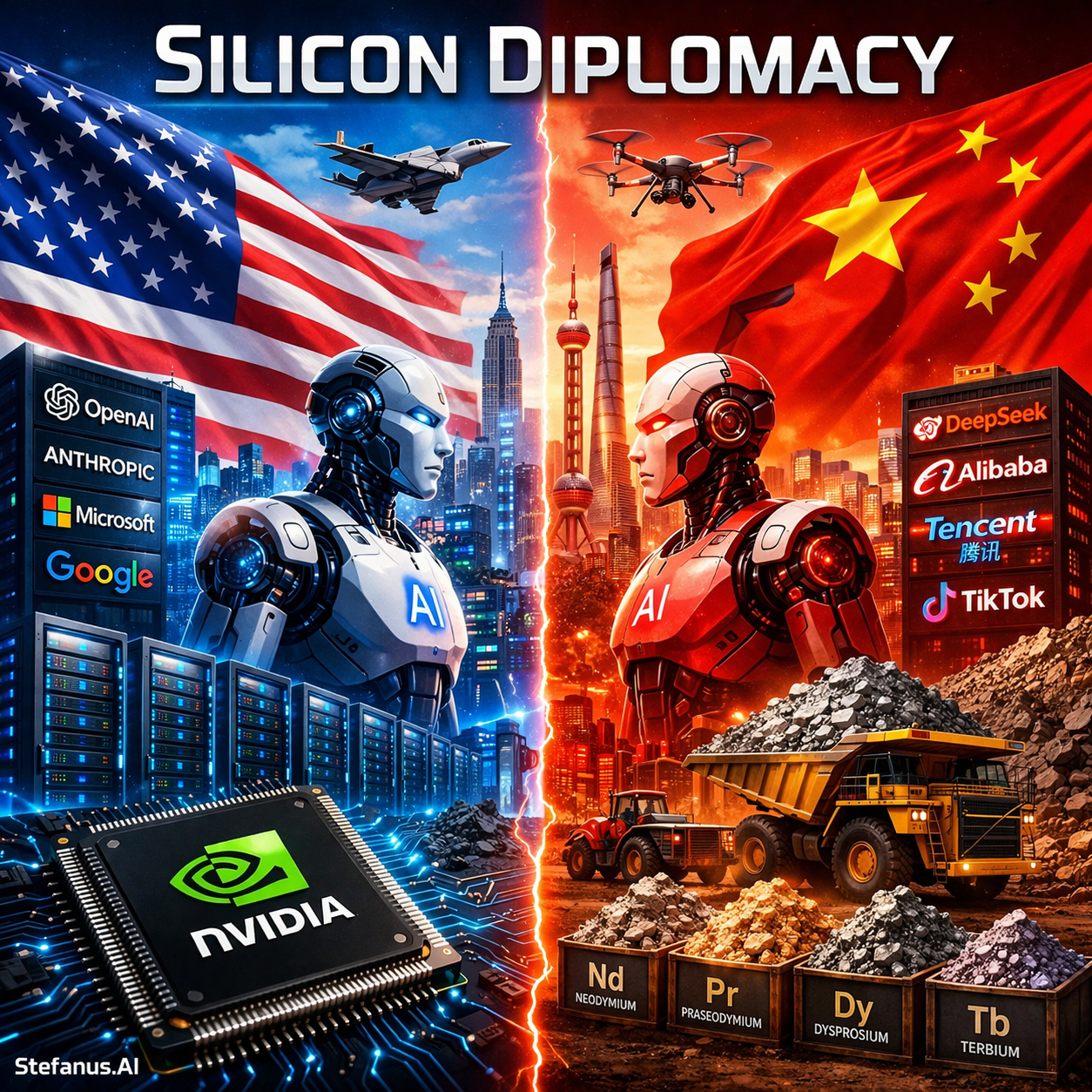
This paper defines that system as Silicon Diplomacy:
A form of geopolitical competition in which nations negotiate, constrain, and influence one another through control of semiconductors, compute infrastructure, and AI ecosystems.
At Stanford University, AI scholar James Landay recently observed:
“AI sovereignty will gain huge steam… countries try to show independence.” [2] (Stanford HAI)
This is the key shift:
sovereignty itself is being redefined through control of AI infrastructure.
Unlike traditional war:
- There are no battlefields
- No declarations
- No clear victories
Yet the stakes are existential.
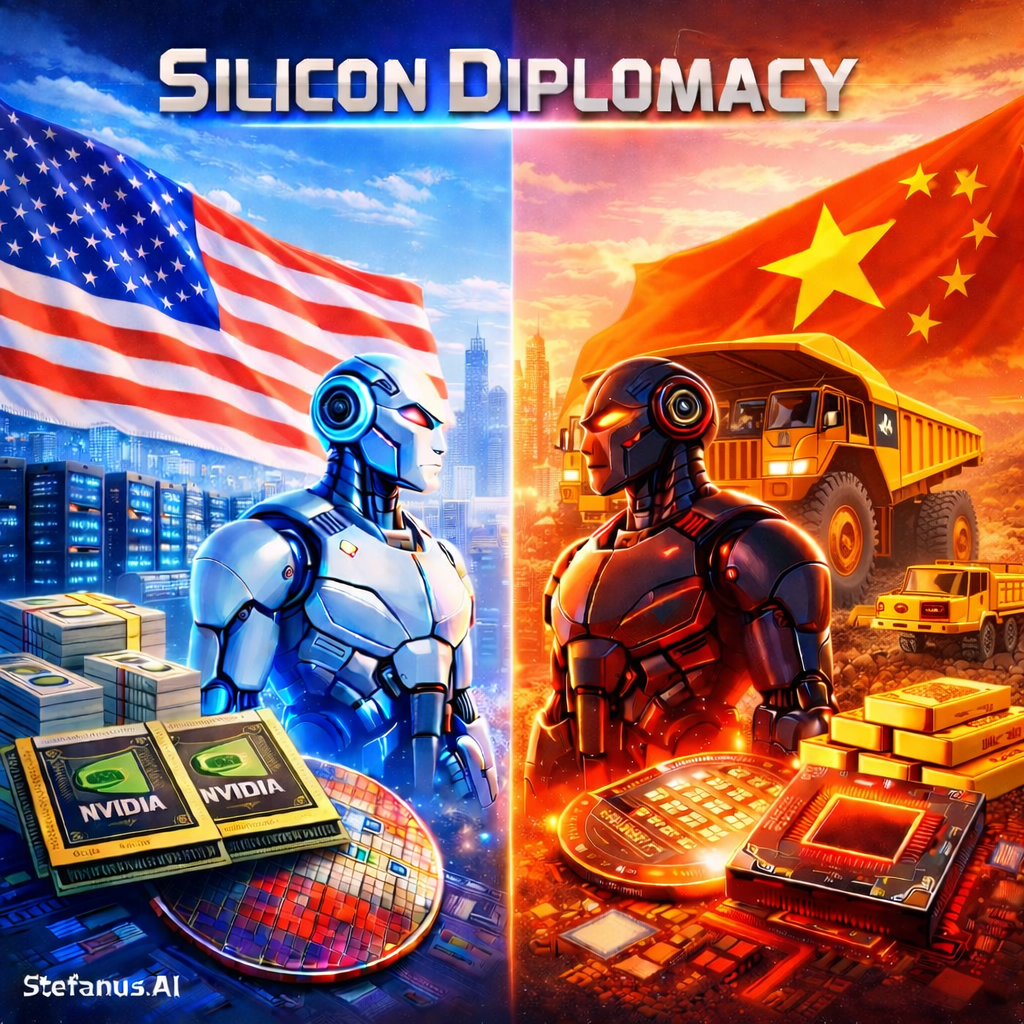
This is why the U.S.–China rivalry in AI is best understood not as a cold war or trade war—but as Silicon Diplomacy.
2. The Structural Nature of the AI Conflict
The competition between the United States and China is not merely technological—it is systemic.
At Massachusetts Institute of Technology, scholars studying global power shifts conclude:
“The international system is returning to bipolarity.” [3] (World Economic Forum)
Similarly, global technology analysts observe:
The semiconductor supply chain is splitting into “two competing ecosystems.” [4] (Man.com)
This division is visible across:
- Chips
- Cloud infrastructure
- AI models
- Financial systems
The result is not globalization—but fragmentation.
At International Monetary Fund, economists warn:
Geopolitical fragmentation is reshaping global trade and capital flows. [5]
Thus, the AI competition is not about who builds the best model—it is about:
Who controls the system that produces intelligence at scale.
3. The U.S. System — Control of Compute and Capital
The United States leads in the highest-value layers of the AI stack:
- Frontier models (OpenAI, Anthropic)
- Cloud infrastructure (Microsoft, Google)
- Semiconductor design (NVIDIA)
This dominance reflects structural advantages.
At Harvard University, policy researchers argue:
“Control over key nodes of production defines power.” [6]
The U.S. controls:
- AI chip design (GPU architecture)
- Advanced semiconductor IP
- Financial capital (USD system)
The U.S. dollar remains a critical layer of Silicon Diplomacy:
- Global AI investments are priced in USD
- Chip supply chains rely on dollar-based finance
- Sanctions and export controls are enforced through financial systems
This creates a dual-layer dominance:
- Technological control (chips)
- Financial control (currency)
However, this system has vulnerabilities.
Recent research shows:
U.S. academic institutions are losing Chinese-origin researchers due to geopolitical tensions. [7] (arXiv)
This highlights a paradox:
- The U.S. leads in innovation
- But depends on global talent flows
4. China’s System — Scale, Resources, and Strategic Depth
China operates under a fundamentally different model—one based on scale and state coordination.
Its advantages include:
- Large population → massive data generation
- State-led industrial policy
- Integrated technology deployment
More importantly, China controls upstream inputs:
- Rare earth minerals
- Processing and refining
These materials are essential for:
- AI chips
- Electronics
- energy systems
China has already demonstrated willingness to weaponize this leverage.
At the same time, China is pursuing technological self-sufficiency.
Analysts note:
China is building a “good-enough AI stack” independent of U.S. supply chains. [8] (Geopolitical Monitor)
This strategy is not about surpassing the U.S. immediately—but about:
reducing dependence and increasing resilience
5. Silicon as Leverage — The Rise of Corporate Power
The semiconductor industry has created a new class of geopolitical actors:
- NVIDIA
- TSMC
These companies operate at a scale where:
- Market value exceeds GDP of many countries
- Decisions influence global power balances
At the center is Jensen Huang, whose company produces the majority of AI training chips.
This has led to an unprecedented situation:
Private firms are now gatekeepers of national power.
As one recent debate highlighted:
- Selling advanced chips can be equivalent to transferring strategic capability
This is why chips are no longer commodities—they are:
instruments of diplomacy
6. The Semiconductor Conflict — Control vs Adaptation
6.1 The U.S. Strategy — Containment
The United States has imposed export controls designed to:
- Restrict China’s access to advanced AI chips
- Limit semiconductor manufacturing capabilities
These controls represent a major shift:
A departure from decades of open technological trade [9] (Wikipedia)
However, their effectiveness is debated.
At Harvard Kennedy School, analysis suggests:
Export controls can “accelerate domestic innovation.” [10]
6.2 The China Strategy — Adaptation
China’s response is not confrontation—but adaptation.
- Building domestic supply chains
- Investing in alternative architectures
- Leveraging scale
Evidence shows:
Constraints lead to “efficiency gains and workaround innovation.” [11]
This creates a dynamic equilibrium:
- U.S. restricts
- China adapts
7. Geography — Taiwan and the “Silicon Shield”
The global AI system is geographically fragile.
Taiwan represents the most critical node.
The concept of the “Silicon Shield” suggests:
Taiwan’s semiconductor dominance deters conflict due to global dependence [12] (Wikipedia)
However, this also creates risk:
- A single disruption could collapse global AI production
The geopolitical reality is stark:
- China views Taiwan as part of its territory
- The U.S. views Taiwan as strategically essential
Thus, Silicon Diplomacy intersects with:
the most dangerous geopolitical flashpoint in the world
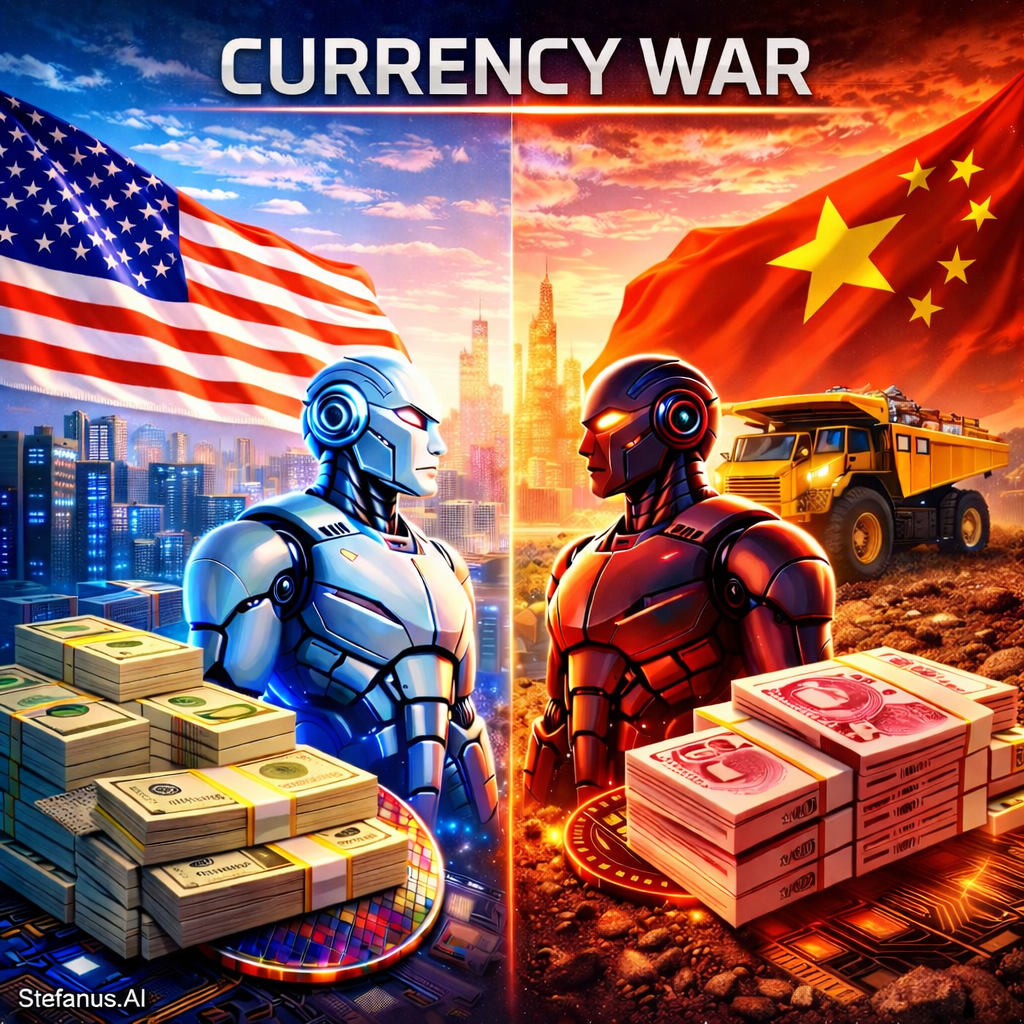
8. Currency War — USD vs Yuan
Silicon Diplomacy extends beyond chips into finance.
The United States:
- Dominates global finance through the USD
- Controls sanctions infrastructure
China:
- Promotes Yuan in BRICS economies
- Builds alternative financial systems
At Harvard, economist Kenneth Rogoff explains:
Global conflicts are now part of a “geopolitical chess game.” (The Economic Times)
This includes:
- Energy
- currency
- technology
Thus, the AI war is also a currency war.
9. Counterarguments — Why Neither Side Wins Completely
Against U.S. dominance:
- Talent dependence
- Manufacturing reliance
- Risk of fragmentation
Against China dominance:
- Lag in cutting-edge chips
- Dependence on foreign tools
At Carnegie, analysts conclude:
The U.S. can “delay but not stop” China’s rise.
10. Synthesis — Not War, But Negotiation Through Systems
Silicon Diplomacy differs from traditional war in a fundamental way:
- It is continuous
- It is indirect
- It is embedded in infrastructure
There are no clear victories—only:
- shifting dependencies
- evolving constraints
Even as competition intensifies, interdependence remains.
As recent analysis shows:
- Global AI systems are deeply interconnected
- No country controls the full stack
11. Conclusion — Why This Is Silicon Diplomacy
This paper is called Silicon Diplomacy because the defining interactions between the United States and China are no longer conducted primarily through traditional diplomatic channels or military confrontation.
They are conducted through:
- chip exports
- supply chain control
- financial systems
- technological ecosystems
This is not a war of bullets—it is a war of:
- compute
- infrastructure
- dependency
Silicon replaces language as the medium of negotiation.
The United States leverages:
- advanced chips
- financial dominance
China leverages:
- scale
- resources
- industrial coordination
Neither side can fully disengage.
Neither side can fully dominate.
And that is precisely the point.
The future of global power will not be decided on battlefields—but within the architecture of intelligence itself.
Footnotes
[1] Christopher Miller, Chip War
https://en.wikipedia.org/wiki/Chip_War (Wikipedia)
[2] Stanford HAI (James Landay), AI Sovereignty
https://hai.stanford.edu/news/stanford-ai-experts-predict-what-will-happen-in-2026 (Stanford HAI)
[3] MIT International Security Studies
https://direct.mit.edu/isec/article/49/2/7/125214 (World Economic Forum)
[4] Semiconductor supply chain fragmentation
https://www.man.com/insights/views-from-the-floor-2025-May-27 (Man.com)
[5] IMF, Geoeconomic Fragmentation
https://www.imf.org
[6] Harvard Kennedy School
https://www.hks.harvard.edu
[7] Wang, Academic workforce shifts
https://arxiv.org/abs/2411.15907 (arXiv)
[8] Geopolitical Monitor, China AI stack
https://www.geopoliticalmonitor.com/us-export-controls-and-chinas-good-enough-ai-stack/ (Geopolitical Monitor)
[9] U.S. Export Controls Overview
https://en.wikipedia.org/wiki/United_States_export_controls_on_AI_chips_and_semiconductors (Wikipedia)
[10] Harvard Kennedy School export control analysis
https://www.hks.harvard.edu
[11] Academic analysis on export control adaptation
https://arxiv.org
[12] Silicon Shield concept
https://en.wikipedia.org/wiki/Silicon_shield (Wikipedia)