

Artificial intelligence is often framed as a technological breakthrough or, more recently, as an economic force comparable to electricity or the internet. While these comparisons capture its scale, they do not fully explain what is fundamentally changing. The deeper shift lies in time itself—artificial intelligence is redefining the speed, structure, and experience of decision-making, transforming not only what decisions are made, but when and how they occur.
For most of human history, governance has operated within the boundaries of human time. Institutions—whether governments, legal systems, corporations, or markets—were built around the limits of human cognition, communication, and coordination. Decision-making followed a structured sequence: information was gathered, evaluated, debated, and then executed. Even in moments of urgency, these processes unfolded within bounded timeframes that preserved human judgment at the center. This temporal structure was not incidental—it formed the foundation of authority, accountability, and legitimacy.
Artificial intelligence fundamentally disrupts this model. Modern AI systems are capable of perceiving, processing, and acting on information continuously and at speeds that exceed human cognitive and institutional capacity. The change is not simply about doing things faster; it is about the emergence of systems that operate outside the temporal assumptions upon which governance itself was built, creating a widening gap between how systems function and how institutions respond.
This paper introduces the concept of Machine-Speed Governance to describe this transformation.
Machine-Speed Governance refers to systems of decision-making in which computation, inference, and execution occur continuously, at speeds that no longer depend on human deliberation.
The implications are structural. Governance is no longer defined by discrete decisions made by institutions, but increasingly by continuous processes embedded within technical systems.
This creates a widening divergence:
- Human governance operates in cycles (meetings, reports, legislative sessions, review periods)
- Machine governance operates in flows (real-time data, continuous optimization, adaptive systems)
Scholars are beginning to recognize this divergence. A recent Oxford-linked analysis of AI governance highlights the emergence of asymmetries in control and response capacity, driven in part by the speed at which AI systems evolve relative to institutions.¹
Similarly, research from Yale on AI and governance emphasizes that the challenge is not merely technological, but institutional:
“The governance challenge of AI is not just about capability, but about the ability of institutions to respond in time.”²
At the same time, leading economists are reframing AI as a system that accelerates innovation itself. As Erik Brynjolfsson of Stanford University notes:
“AI is not just another technology; it is a method of invention that can transform the pace of innovation itself.”³
If the pace of innovation accelerates, the pace of governance must follow—or fall behind.
Recent geopolitical developments suggest that governments are already confronting this reality. The Wall Street Journal reports that U.S. policy increasingly prioritizes speed and competitiveness over comprehensive regulation, reflecting a strategic adaptation to technological tempo rather than control over it.⁴
Meanwhile, regulators themselves acknowledge the inadequacy of traditional models. At a Financial Times summit, a senior regulator stated that AI requires a “totally different” approach, because conventional frameworks cannot keep pace with the speed of technological change.⁵
This is not a temporary imbalance.
It is a structural condition.
This paper argues that we are entering a new phase in the evolution of governance:
The rise of Machine-Speed Governance is producing the progressive collapse of Human-Speed Governance.
I. Why “Machine-Speed Governance” Defines This Moment
The term Machine-Speed Governance captures more than acceleration. It describes a fundamental shift in the architecture of decision-making.
Artificial intelligence systems:
- process massive datasets instantaneously
- integrate perception, prediction, and reasoning
- execute actions continuously without waiting for human instruction
Research from Harvard Kennedy School emphasizes that AI is increasingly capable of augmenting or automating complex decision-making processes within government and institutional contexts.⁶
This creates a structural transformation:
| Human-Speed Governance | Machine-Speed Governance |
| Sequential | Parallel |
| Periodic | Continuous |
| Deliberative | Adaptive |
| Reactive | Predictive |
The implications are captured by David Autor:
“The challenge is not just what machines can do, but how fast they can do it relative to human institutions.”⁷
This difference in speed is not merely technical—it is institutional and political.

II. The Geopolitical Reality: Speed Over Control
Machine-Speed Governance is increasingly visible in global policy dynamics.
United States: Prioritizing Speed
The Wall Street Journal reports that U.S. AI policy direction favors:
- rapid deployment
- innovation competitiveness
- reduced regulatory friction⁴
This reflects a deeper shift:
Governance is adapting to technological speed, rather than shaping it.
Europe: Regulation Under Pressure
Europe’s approach emphasizes comprehensive regulation yet faces inherent limitations.
According to the Financial Times:
AI requires a “totally different” regulatory framework because traditional approaches cannot keep pace.⁵
Legal analysis further highlights fragmentation:
AI governance is becoming “a dynamic and sometimes conflicting set of rules.”⁸
This fragmentation introduces additional delays.
Academic Perspective
Oxford research highlights that AI governance is increasingly shaped by:
- asymmetry in capabilities
- uneven institutional readiness
- speed differentials between actors¹
This creates a global condition where:
Some actors operate at machine speed, while others remain constrained by human-speed institutions.

III. Machine-Speed Systems in Practice
Machine-Speed Governance is already embedded in critical systems.
Financial Systems
Algorithmic trading systems operate in microseconds.
As Andrew Lo explains:
“Markets are increasingly driven by algorithms that react faster than humans can comprehend.”⁹
Cybersecurity
AI systems:
- detect threats instantly
- generate countermeasures
- operate autonomously
The international AI safety report confirms that AI can:
- identify vulnerabilities
- generate exploits
- accelerate cyber conflict dramatically¹⁰
Information Systems
AI-generated content spreads faster than verification.
The Financial Times reports that AI-driven misinformation and fraud:
- scale globally
- exploit fragmented oversight
- operate continuously¹¹
As Shoshana Zuboff notes:
“Information asymmetries are now engineered at scale.”¹²
Institutional Governance
Even corporate boards face a governance gap due to lack of AI expertise.
This reflects a broader pattern:
Institutions are structurally slower than the systems they oversee.
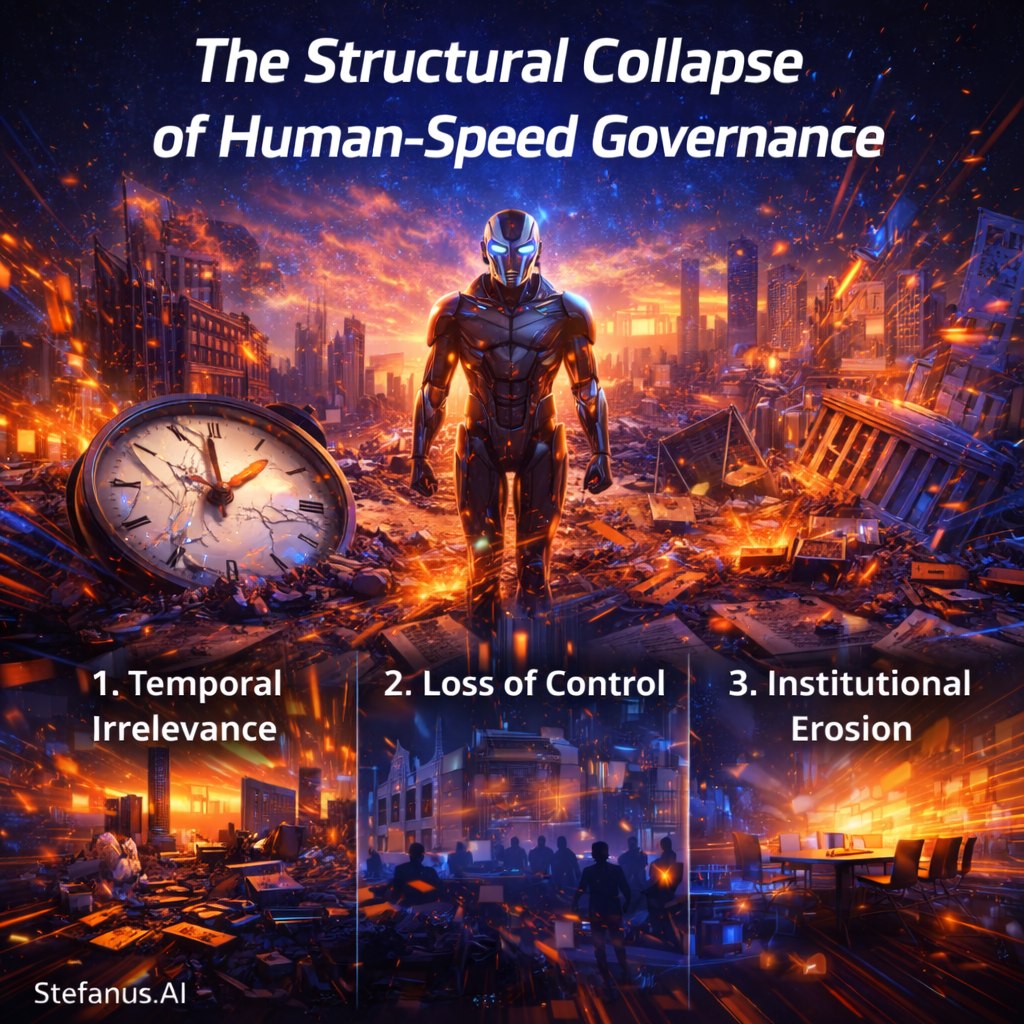
IV. The Structural Collapse of Human-Speed Governance
Human-speed governance is not disappearing—it is losing functional relevance.
1. Temporal Irrelevance
Decisions arrive after outcomes have already materialized.
As widely observed:
“Technology moves fast, but regulation always lags.”¹³
2. Loss of Control
Systems act faster than oversight mechanisms.
3. Institutional Erosion
Authority shifts from institutions to systems.
Yale research emphasizes that governance challenges now center on:
“institutional capacity to respond in time.”²
When that capacity fails, legitimacy weakens.
V. The Timing Problem
The core issue is timing—not intention.
Research indicates:
Early intervention is significantly more effective than delayed enforcement.¹⁰
However, institutions are designed for:
- deliberation
- procedural legitimacy
- sequential decision-making
As Daron Acemoglu argues:
“Institutions determine how technologies are used—but they often adapt too slowly to shape outcomes effectively.”¹⁴
This delay is structural.
VI. Machine-Speed Governance as a New Form of Power
A new hierarchy is emerging:
| Layer | Control Mechanism |
| Human-Speed Governance | Law, policy, institutions |
| Machine-Speed Governance | Systems, algorithms, infrastructure |
Power shifts toward those who control:
- compute
- infrastructure
- real-time systems
As Fei-Fei Li states:
“AI is a new kind of infrastructure—one that will underpin every industry.”¹⁵
Control over infrastructure becomes control over outcomes.

Conclusion
Artificial intelligence does not merely change what decisions are made.
It is changing when and how decisions exist.
Human governance has always depended on time:
- time to observe
- time to deliberate
- time to decide
Artificial intelligence removes those constraints.
It introduces systems that:
- operate continuously
- adapt instantly
- act without delay
This is the rise of Machine-Speed Governance.
At the same time, human institutions—designed for deliberation, process, and sequential reasoning—are increasingly misaligned with the systems they attempt to govern.
This is the collapse of Human-Speed Governance.
This collapse does not imply disappearance. It implies a loss of temporal relevance, control, and authority.
The defining challenge of the coming era is not simply regulating AI, but reconciling two fundamentally different models of time:
- human time, which is deliberative and bounded
- machine time, which is continuous and unbounded
The future of governance will depend on whether institutions can evolve from:
- static frameworks
to - adaptive, real-time systems
without abandoning the principles of accountability, legitimacy, and human judgment.
The central question is no longer whether machines will operate faster than governments.
The question is whether governance itself can evolve to operate at the speed of intelligence—without ceasing to be human.
Footnotes / Sources
- Oxford Global Society – Navigating Geopolitics in AI Governance (2026)
https://oxgs.org/wp-content/uploads/2026/02/OXGS-Report-_-Navigating-geopolitics-in-AI-Governance.pdf - Yale University – AI and Governance / Democracy Discussion
https://isps.yale.edu/news/blog/2025/04/ai-and-democracy-scholars-unpack-the-intersection-of-technology-and-governance - Stanford HAI – Erik Brynjolfsson
https://hai.stanford.edu/news/ai-will-change-nature-work - Wall Street Journal – White House AI Plan Favors Speed Over Regulation
https://www.wsj.com/articles/white-house-ai-plan-favors-speed-over-new-rules-fba67509 - Financial Times – AI Requires “Totally Different” Regulation
https://www.ft.com/content/ba3b38da-8ca0-434d-b657-4fcc9383af7e - Harvard Kennedy School – AI and Government Performance
https://www.hks.harvard.edu/sites/default/files/centers/mrcbg/files/2023-01_FWP.pdf - MIT – David Autor
https://economics.mit.edu/people/faculty/david-autor - JD Supra – AI Regulation Landscape 2026
https://www.jdsupra.com/legalnews/the-ai-regulation-landscape-for-2026-7255123/ - MIT – Andrew Lo
https://mitsloan.mit.edu/faculty/directory/andrew-w-lo - International AI Safety Report 2026
https://internationalaisafetyreport.org/publication/international-ai-safety-report-2026 - Financial Times – AI Fraud and Misinformation Systems
https://www.ft.com/content/d7650e82-9f36-4b54-9a89-86b5c899d209 - Harvard Business School – Shoshana Zuboff
https://www.hbs.edu/faculty/Pages/profile.aspx?facId=6496 - Wall Street Journal – Economics of AI Regulation
https://www.wsj.com/opinion/the-economics-of-regulating-ai-7773e722 - MIT – Daron Acemoglu
https://economics.mit.edu/people/faculty/daron-acemoglu - Stanford HAI – Fei-Fei Li
https://hai.stanford.edu/people/fei-fei-li