

Cities have always governed through visibility. The ability of local governments to maintain order—whether through policing, economic coordination, or social services—has depended not merely on authority, but on the capacity to observe patterns as they emerge, interpret signals before they escalate, and intervene with sufficient timing to prevent disorder from becoming systemic. Local enforcement, therefore, has never been about force alone; it has been about situational awareness, the continuous ability to see enough of reality to act effectively within it.
This paper, “The End of Local Enforcement,” is not written as a critique of local governments, nor as a claim that enforcement has disappeared in absolute terms, but rather as an examination of a structural transformation already underway. What appears to be a weakening of enforcement capacity in cities such as Los Angeles, Chicago, Paris, and London is, more fundamentally, a weakening of visibility itself—a condition in which the systems that once made governance possible are becoming increasingly opaque, fragmented, and resistant to observation.
The timing of this analysis is critical. The current phase of artificial intelligence development is no longer defined by centralized systems controlled by a small number of institutions, but by decentralized, open, and locally executable intelligence. Models can now run on personal devices, operate within encrypted environments, and be modified without oversight, compressing the timeline of technological diffusion from decades into years. As a result, the mechanisms that once enabled local governments to anticipate and manage risk—logs, centralized platforms, and traceable coordination—are dissolving at a pace faster than institutional adaptation.
In this emerging environment, the challenge is no longer whether governments can regulate AI, but whether they can see enough of what is happening to govern at all.

From Centralized Oversight to Distributed Opacity
Historically, local governance relied on centralized infrastructures that produced observable data: communications networks, financial systems, surveillance tools, and platform-mediated interactions. These systems created traceability, allowing governments to reconstruct events, identify actors, and intervene before escalation.
However, recent research demonstrates that artificial intelligence is rapidly moving away from this centralized model. Local AI systems—running on personal devices or private clusters—are now capable of performing tasks that previously required large-scale infrastructure, thereby eliminating the need for observable, platform-based interaction¹. At the same time, open-source AI has enabled unrestricted access to model weights and architectures, allowing users to modify and deploy systems independently of institutional oversight².
This shift is further reinforced by encryption technologies that secure not only data, but also the interaction between users and AI systems. Emerging standards are designed to encrypt prompts, outputs, and logs, effectively preventing external observation even by system operators³.
Taken together, these developments produce a new structural condition:
- Intelligence is locally executed
- Activity is encrypted
- Oversight is optional
In such an environment, the traditional mechanisms of governance—monitoring, auditing, and intervention—lose their foundational basis.

Los Angeles: Local Disorder Without Predictive Visibility
The implications of this transformation are already visible in Los Angeles, where enforcement challenges increasingly reflect a lack of predictive visibility rather than a lack of resources.
In June 2025, large-scale unrest led to highway shutdowns, fires, looting, and widespread property damage, forcing emergency responses across the city⁴. Vehicles were burned, businesses were ransacked, and major transportation corridors were disrupted, demonstrating how rapidly local conditions can escalate beyond immediate control.
At the same time, the city has experienced a rise in street takeovers, illegal racing events, and decentralized youth gatherings, often organized through digital channels that are difficult to monitor in advance. These events are not centrally coordinated, nor are they easily predicted; instead, they emerge from loosely connected networks that can mobilize quickly and disperse just as rapidly.
This phenomenon intersects with a deeper structural issue: the erosion of entry-level employment opportunities. As discussed in our earlier “The Vanishing First Step” thesis, the decline of accessible economic pathways for younger populations creates conditions in which individuals operate increasingly outside formal systems. Without institutional anchors—jobs, training pathways, or structured progression—coordination shifts into informal, often opaque networks.
In this context, local disorder is not simply a matter of behavior. It is a function of systems that are no longer visible early enough to be managed effectively.
Chicago: Fragmented Control in a Data-Rich Environment
In Chicago, the challenge takes a different form but reveals the same structural limitation.
Urban violence remains concentrated within specific communities and age groups, requiring highly targeted interventions that depend on accurate, real-time information⁵. Yet as communication and coordination move into decentralized and encrypted environments, the effectiveness of traditional policing methods—surveillance, informants, and predictive analytics—diminishes.
This creates a paradox in which local governments possess more data than ever before, yet less actionable insight:
- Information is abundant, but incomplete
- Activity is measurable, but not fully observable
- Enforcement is active, but increasingly reactive
The issue is not the absence of effort, but the absence of complete situational awareness, which is essential for effective local governance.

Europe: Rapid Escalation in Networked Urban Systems
Similar dynamics are evident across Europe, where recent urban unrest illustrates the growing gap between event formation and institutional response.
In Paris, large-scale riots in 2025 resulted in hundreds of arrests, widespread injuries, and extensive property damage, including the burning of hundreds of vehicles⁶. The speed and scale of escalation demonstrated how decentralized coordination can outpace the ability of local authorities to anticipate and contain events.
In the United Kingdom and Northern Ireland, riots across multiple cities led to injuries among police forces, mass arrests, and significant disruption to local communities⁷. These incidents were not centrally organized but emerged from distributed networks capable of rapid mobilization.
Across these cases, a consistent pattern emerges:
Events are no longer built gradually.
They are assembled rapidly, through systems that are only partially visible—if visible at all.

AI as a Force Multiplier for Invisible Coordination
Artificial intelligence amplifies these dynamics by increasing both capability and speed while reducing visibility.
Recent research into decentralized AI agents highlights that self-sovereign systems can operate independently, controlling digital assets and executing actions without centralized oversight, thereby reducing the role of human and institutional control⁸. Additionally, studies on multi-agent systems indicate that networks of interacting AI agents can coordinate in ways that evade traditional monitoring, enabling new forms of distributed and persistent activity⁹.
In parallel, real-world observations show that open-source AI models are increasingly being modified and deployed outside centralized safeguards, enabling activities such as automated fraud, disinformation, and coordinated cyber operations without platform-level detection¹⁰.
These developments create a new category of activity:
intelligent, coordinated, and largely invisible.
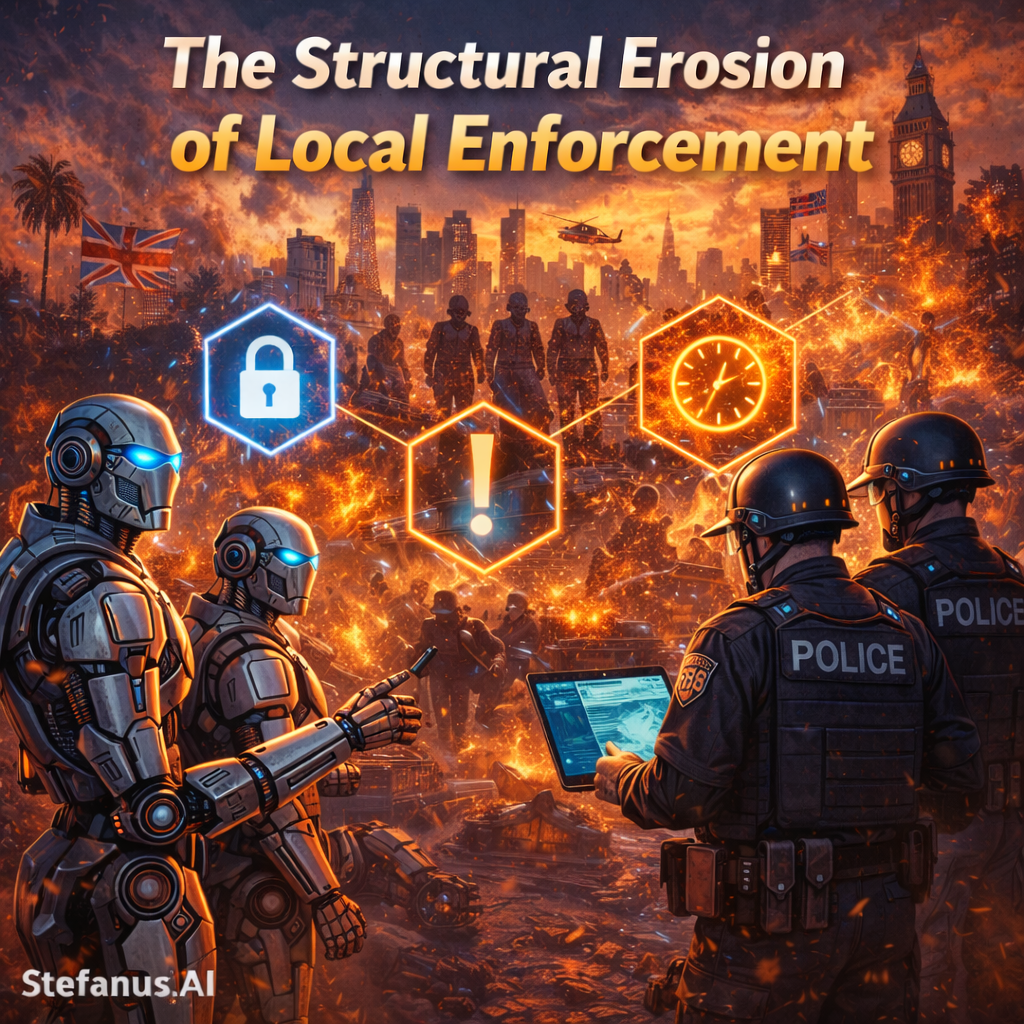
The Structural Erosion of Local Enforcement
Across cities in the United States and Europe, local governments are experiencing a gradual loss of three foundational capabilities:
1. Visibility
Coordination occurs within encrypted or decentralized systems, limiting the ability to detect activity before it manifests physically.
2. Enforcement Capability
Without identifiable coordination points, interventions become reactive rather than preventive, reducing their effectiveness.
3. Timing Advantage
Events scale faster than detection, compressing the window for response and increasing the likelihood of escalation.
This is not a temporary imbalance. It is a structural shift driven by the architecture of modern technology.
Conclusion
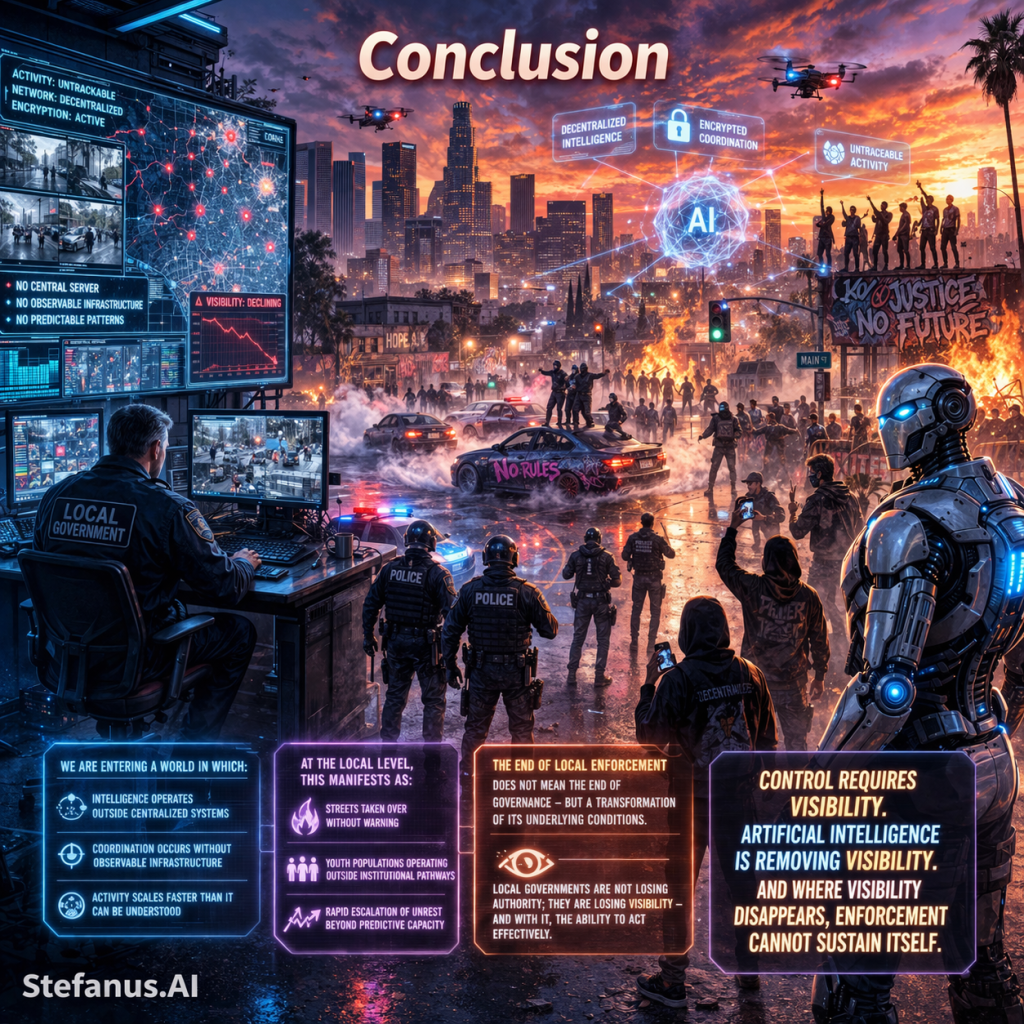
Local enforcement has always depended on the ability to see—to observe behavior, interpret signals, and act before disorder becomes systemic. Artificial intelligence, particularly in its decentralized and encrypted forms, is systematically removing this visibility.
We are entering a world in which:
- Intelligence operates outside centralized systems
- Coordination occurs without observable infrastructure
- Activity scales faster than can be understood
At the local level, this transformation manifests as:
- Streets taken over without warning
- Youth populations operating outside institutional pathways
- Rapid escalation of unrest beyond predictive capacity
The title “The End of Local Enforcement” does not suggest the disappearance of governance, but the transformation of its underlying conditions. Local governments are not losing authority; they are losing visibility, and with it, the ability to exercise that authority effectively.
Ultimately, the shift can be distilled into a single principle:
Control requires visibility.
Artificial intelligence is removing visibility.
And where visibility disappears, enforcement cannot sustain itself.
Footnotes (Sources & Links)
- B.A. Sokhansanj (2025), Local AI Governance: Addressing Model Safety and Policy Challenges, MDPI
https://www.mdpi.com/2673-2688/6/7/159 (MDPI) - Open-source Artificial Intelligence Overview, including Machado (2025), arXiv
https://en.wikipedia.org/wiki/Open-source_artificial_intelligence (Wikipedia) - Ina Fried (2025), OpenPCC: Encryption for AI Systems, Axios
https://www.axios.com/2025/11/05/openpcc-encryption-ai-mcp-data (Axios) - June 2025 Los Angeles Protests and Riots
https://en.wikipedia.org/wiki/June_2025_Los_Angeles_protests_against_mass_deportation - The Washington Post (2025), Homicide Trends in U.S. Cities
https://www.washingtonpost.com/nation/interactive/2025/homicide-rates-us-cities/ - 2025 Paris Riots (PSG Celebrations)
https://en.wikipedia.org/wiki/2025_Paris_Saint-Germain_celebration_riots - 2025 Northern Ireland Riots
https://en.wikipedia.org/wiki/2025_Northern_Ireland_riots - Hu, Liu, Rong (2025), Trustless Autonomy: Decentralized AI Agents, arXiv
https://arxiv.org/abs/2505.09757 (arXiv) - Schroeder de Witt (2025), Multi-Agent Security in Decentralized AI Systems, arXiv
https://arxiv.org/abs/2505.02077 (arXiv) - Reuters (2026), Open-source AI misuse and decentralized deployment risks
https://www.reuters.com/technology/open-source-ai-models-vulnerable-criminal-misuse-researchers-warn-2026-01-29/ (Reuters)