
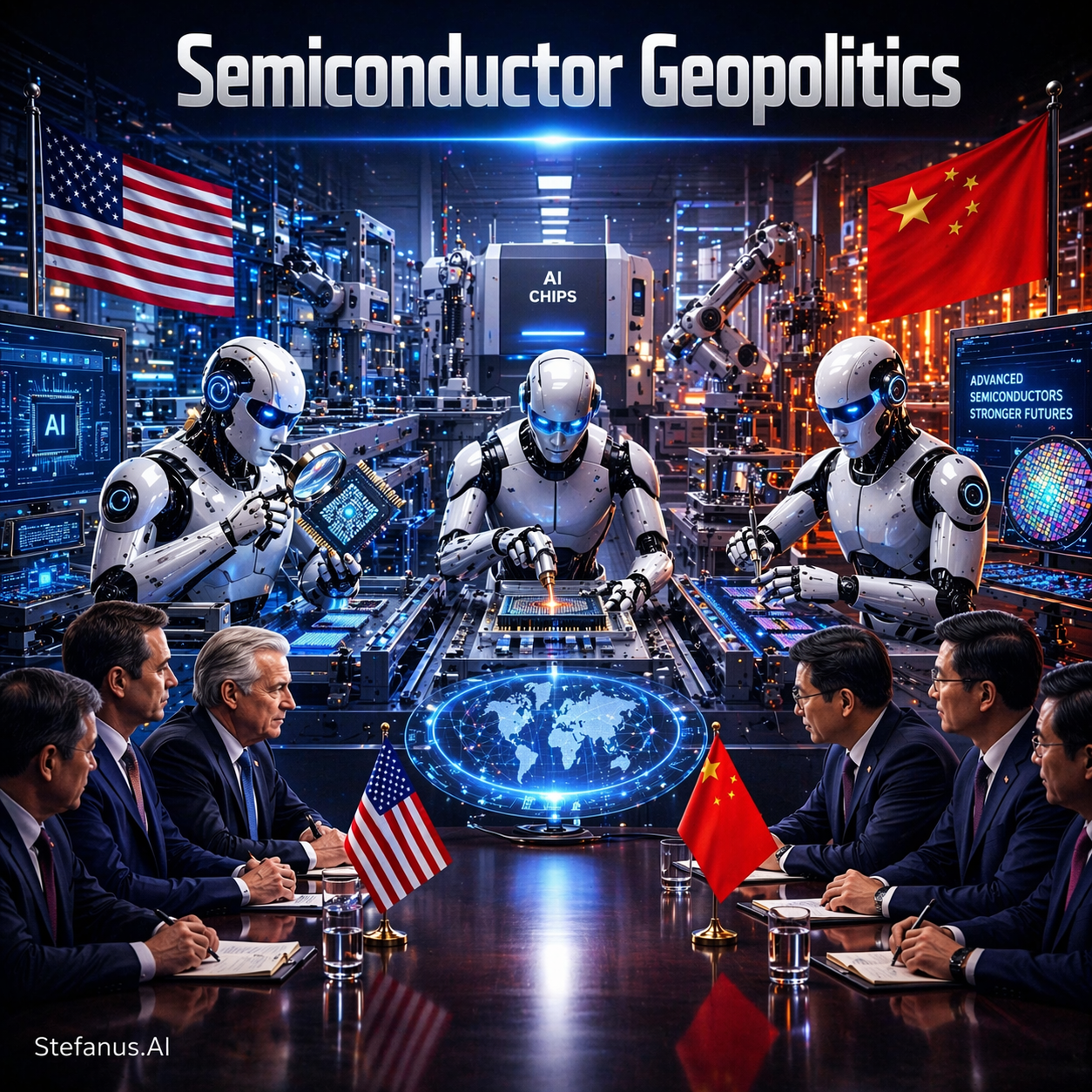

Semiconductors are no longer merely industrial inputs embedded in smartphones and laptops—they are the foundational infrastructure of modern civilization. From artificial intelligence (AI) systems and autonomous vehicles to quantum computing, advanced military systems, financial networks, and global communications, semiconductors form the invisible backbone of the modern economy.
In 2025, global semiconductor sales reached approximately $791.7 billion, growing at over 25% year-over-year, with projections approaching $1 trillion annually in the near term.¹ This is not cyclical growth—it is structural, driven by the rapid expansion of AI, electrification, and digital infrastructure at a planetary scale.
What makes this moment historically distinct is not just the scale of growth, but the concentration of value. AI chips—despite representing a small fraction of total chip volume—are rapidly becoming the economic core of the semiconductor industry. Hyperscale compute, rather than consumer electronics, is now the primary driver of capital allocation.
Erik Brynjolfsson (Stanford University):
AI is a general-purpose technology with impacts comparable to electricity.⁸
That comparison is not metaphorical—it is structural. Just as electricity reorganized industrial production, AI is reorganizing computation, labor, and capital allocation across every sector of the global economy.
At the center of this transformation sits NVIDIA, whose dominance in AI accelerators has positioned it as the critical supplier of compute infrastructure for the modern era. Its chips are not simply products—they are the engines of machine intelligence, embedded in every major AI system deployed by governments and corporations alike.
Across the industry, the scale of investment has reached historic proportions. Major technology firms—including hyperscalers such as Amazon, Microsoft, Google, and Meta—are projected to collectively spend over $600–650 billion annually on AI infrastructure by 2026, with the majority of that capital flowing directly into semiconductors, data centers, and compute systems. (Reuters)
This level of capital expenditure—approaching 2–3% of U.S. GDP in a single sector—signals a transformation of semiconductors from a supply chain component into a macroeconomic force. (Reuters)
At the same time, global supply chains are no longer operating under the logic of efficiency alone. They are fragmenting under geopolitical pressure. The United States is deploying tariffs, export controls, and industrial policy to secure technological leadership, while China is leveraging its dominance in rare-earth processing, materials, and industrial scale to counterbalance American advantages.
What emerges from this convergence is not simply competition—but a structural reordering of global power.
Semiconductors are no longer neutral goods traded in global markets. They are strategic assets, embedded in national security, economic sovereignty, and technological supremacy.
Thus emerges a new paradigm:
Semiconductor Geopolitics—where chips are not commodities, but instruments of power, leverage, and global dominance.

Section 1: Defining Semiconductor Geopolitics
Semiconductor geopolitics refers to the intersection of technology, national power, and global supply chain control, where access to chips determines economic growth, military capability, and technological leadership.
Historically, geopolitics focused on oil, trade routes, and territory. Today, it revolves around:
- Advanced chip fabrication (sub-5nm nodes)
- AI compute infrastructure (GPUs, accelerators)
- Critical materials (rare earths, gallium, germanium)
- Specialized equipment (EUV lithography)
The semiconductor ecosystem is not a single industry—it is a layered system:
| Layer | Dominant Players | Strategic Importance |
| Design | NVIDIA, AMD, Apple | AI compute leadership |
| Equipment | ASML | Absolute choke point |
| Fabrication | TSMC, Samsung | Production bottleneck |
| Materials | China | Supply chain control |
Daron Acemoglu (MIT):
Technological leadership defines economic dominance.³
The significance of this framework is profound: no single country controls the entire stack, creating interdependence—and vulnerability.
This is precisely why the term “Semiconductor Geopolitics” is the correct framing: it captures a system where power is distributed across multiple chokepoints, each capable of disrupting the global order.

Section 2: The Key Actors in the Semiconductor Race
The semiconductor race is not fought by nations alone—it is driven by a small number of highly specialized firms that control critical choke points.
2.1 Market Size and Economic Scale
- Global semiconductor market: **~$800B (2025)**¹
- Projected market: $1T+ within years¹
- Total industry market cap: **$12 trillion+**²
AI chips now represent the highest-margin segment, despite minimal volume share.
2.2 ASML: The Ultimate Chokepoint
ASML holds a monopoly on EUV lithography, with machines costing up to $200 million per unit.
- 2026 revenue forecast: €36–40 billion (Reuters)
- Only supplier globally for advanced nodes
Chris Miller (Tufts University):
ASML is the single most important company in the chip supply chain.⁵
Without ASML, no advanced semiconductor manufacturing exists.
2.3 NVIDIA and AI Compute Economics
NVIDIA dominates the AI GPU market.
- AI chips priced: ~$25,000–$40,000 per unit (Reuters)
- Orders exceeding millions of units annually (Reuters)
A single hyperscale data center:
- 100,000+ GPUs
- Capital cost: $3B–$10B+ per facility
This creates a new industrial category: compute infrastructure as capital asset.
2.4 Fabrication Power: TSMC, Samsung, Intel
TSMC:
Samsung Electronics:
- 73% DRAM + 51% NAND dominance (with SK Hynix) (Wikipedia)
Intel:
- ~6% foundry share (Tom’s Hardware)
Total foundry market:
- $320B (2025) (Tom’s Hardware)
2.5 Geographic Concentration
- Asia-Pacific: ~51–53% global semiconductor revenue (Precedence Research)
- U.S.: Dominates design (~50%+ global share) (Tom’s Hardware)
- Taiwan + Korea: Fabrication dominance
This concentration creates systemic risk—especially around Taiwan.

Section 3: China’s Rare-Earth Dominance
China’s control over rare-earth processing is one of the most decisive strategic advantages in the semiconductor ecosystem.
Rare earths are not rare in nature—but processing them into usable materials requires advanced chemical engineering, environmental tolerance, and industrial scale—areas where China has built a decades-long advantage.
- ~70–90% global processing capacity¹²
- 270,000 metric tons annual production (2025) (Wikipedia)
- 44 million tons reserves (Wikipedia)
China also controls:
- Gallium and germanium exports (critical for chips)
- Processing technologies (export-restricted)
Vaclav Smil:
Modern systems depend on fragile material flows.¹³
China has demonstrated willingness to weaponize this dominance:
- Export restrictions during trade tensions
- Post-COVID supply disruptions
This creates a structural imbalance:
- U.S.: design + capital
- China: materials + processing

Section 4: Resource Diplomacy and Global Supply Chains
To counter China’s dominance, the United States and its allies are engaging in resource diplomacy across multiple regions.
Key Resource Regions
| Region | Resource | Strategic Role |
| Africa (DRC) | Cobalt | Battery + chips |
| Australia | Lithium | Semiconductor materials |
| Indonesia | Nickel | EV + chip supply |
| Canada | Critical minerals | Allied supply chain |
| Ukraine | Untapped reserves | Future leverage |
Joseph Nye (Harvard):
Power lies in controlling networks of interdependence.¹⁵
The U.S. strategy includes:
- Bilateral mining agreements
- Supply chain reshoring
- Strategic alliances (Chip 4 alliance controls 82% of global production) (Wikipedia)
Section 5: Domestic Constraints in the United States
Despite resource potential, the U.S. faces significant bottlenecks:
Key Barriers
- Environmental regulations
- Long permitting cycles (7–10 years)
- Lack of processing infrastructure
Example: Salton Sea lithium reserves:
- Among largest in North America
- Still under development due to regulatory complexity
Daniel Yergin:
Energy transitions are shaped by politics as much as technology.¹⁷
Even when raw materials are available, the U.S. lacks sufficient processing infrastructure, often relying on foreign expertise—including Japanese firms—for refinement.
This creates a paradox: resource abundance without industrial capability.
Section 6: The Long War—Export Controls and Strategic Competition
The semiconductor conflict is a long-duration geopolitical contest.
Key Data Points
- China subsidies: $142B+ over decade (Tom’s Hardware)
- U.S. subsidies: ~$39B (CHIPS Act era) (Tom’s Hardware)
- U.S. chip firms: 50%+ global share (Tom’s Hardware)
- China: ~4–5% advanced share (Tom’s Hardware)
Export Controls
- Restrictions on advanced GPUs
- Ban on EUV tools to China (Reuters)
Graham Allison:
Great power competition often centers on technology leadership.¹⁹
China’s response:
- Massive domestic investment
- State-backed semiconductor funds
- Reverse engineering + localization

Section 7: America’s Response—CHIPS Act and Terafab Expansion
CHIPS Act Scale
- $50B+ federal investment²⁰
- Hundreds of billions in private capital
Major Projects
- TSMC Arizona fabs
- Intel Ohio mega-fab
- Samsung Electronics Texas facility
Terafab Concept
The next evolution is Terafab:
- Gigawatt-scale fabrication clusters
- Integrated with power grids, AI compute, logistics
- Located in regions like Texas (Austin’s Tera Corridor)
This transforms fabs into industrial ecosystems, not standalone factories.
Andrew Ng:
AI will reshape every major industry.²¹
Europe’s Response
- European Chips Act (€43B initiative)
- Focus on strategic autonomy
- ASML as central pillar
Conclusion: Semiconductor Geopolitics as the New World Order
This paper demonstrates that semiconductors are no longer a sector—they are the foundation of geopolitical power.
- AI has concentrated economic value into advanced chips
- Supply chains are fragmented across geopolitical rivals
- Materials, fabrication, and compute are unevenly distributed
The result is a new global structure:
- U.S. → Design + AI compute
- China → Materials + industrial scale
- Taiwan/Korea → Fabrication dominance
- Europe → Equipment and regulation
This is not temporary.
It is a long-term structural realignment of global power.
Thus, the term Semiconductor Geopolitics is not descriptive—it is predictive.
The next decade will not be defined by who builds the most products—but by who controls the most advanced chips.
And in that world, compute is power, fabrication is sovereignty, and semiconductors are destiny.

Footnotes
- Semiconductor Industry Association – https://www.semiconductors.org/global-annual-semiconductor-sales-increase-25-6-to-791-7-billion-in-2025/ (Semiconductor Industry Association)
- Deloitte Semiconductor Outlook – https://www.deloitte.com/us/en/insights/industry/technology/technology-media-telecom-outlooks/semiconductor-industry-outlook.html (Deloitte)
- Daron Acemoglu (MIT) – https://economics.mit.edu
- ASML Reports – https://www.asml.com
- Chris Miller – https://www.simonandschuster.com/books/Chip-War
- WSJ / FT AI Capex (see reporting)
- Bloomberg AI cluster coverage
- Erik Brynjolfsson – https://hai.stanford.edu
- TSMC IR – https://www.tsmc.com
- World Bank Data – https://www.worldbank.org
- OECD Semiconductor Data – https://www.oecd.org
- USGS Rare Earth Report – https://www.usgs.gov
- Vaclav Smil – https://www.vaclavsmil.com
- UN Supply Chain Report – https://www.un.org
- Joseph Nye – https://www.hks.harvard.edu
- California Energy Commission – https://www.energy.ca.gov
- Daniel Yergin – https://www.ihsmarkit.com
- U.S. Commerce Dept – https://www.commerce.gov
- Graham Allison – https://www.belfercenter.org
- CHIPS Act – https://www.whitehouse.gov
- Andrew Ng – https://www.deeplearning.ai

Comments
[…] factories are powered by chips that remain scarce, expensive, and geopolitically sensitive. The supply chain spans continents—design in the United States, fabrication in Taiwan, […]
[…] geopolitics introduces non-linear shocks […]
[…] The final dimension of Gigarmageddon is geopolitical. […]
[…] 2.4 Chips as Geopolitical Assets […]
[…] It is a geopolitical condition. The AI race is already inseparable from U.S.–China competition, semiconductor export controls, rare earth supply chains, energy markets, military communications, lunar ambition, […]
[…] At the core of this competition lies the semiconductor industry. […]
[…] semiconductor race is now one of the central theaters of geopolitical competition. Chips are no longer merely commercial goods traded across global markets. They are […]
[…] Chinese state semiconductor fund are all expressions of the same underlying reality: compute is geopolitically strategic, and nations are acting […]
[…] this phenomenon. Compute is expensive. Energy is scarce. Advanced semiconductors are constrained by geopolitical supply chains. Datacenter construction timelines extend across years. Regulatory approvals for power […]