
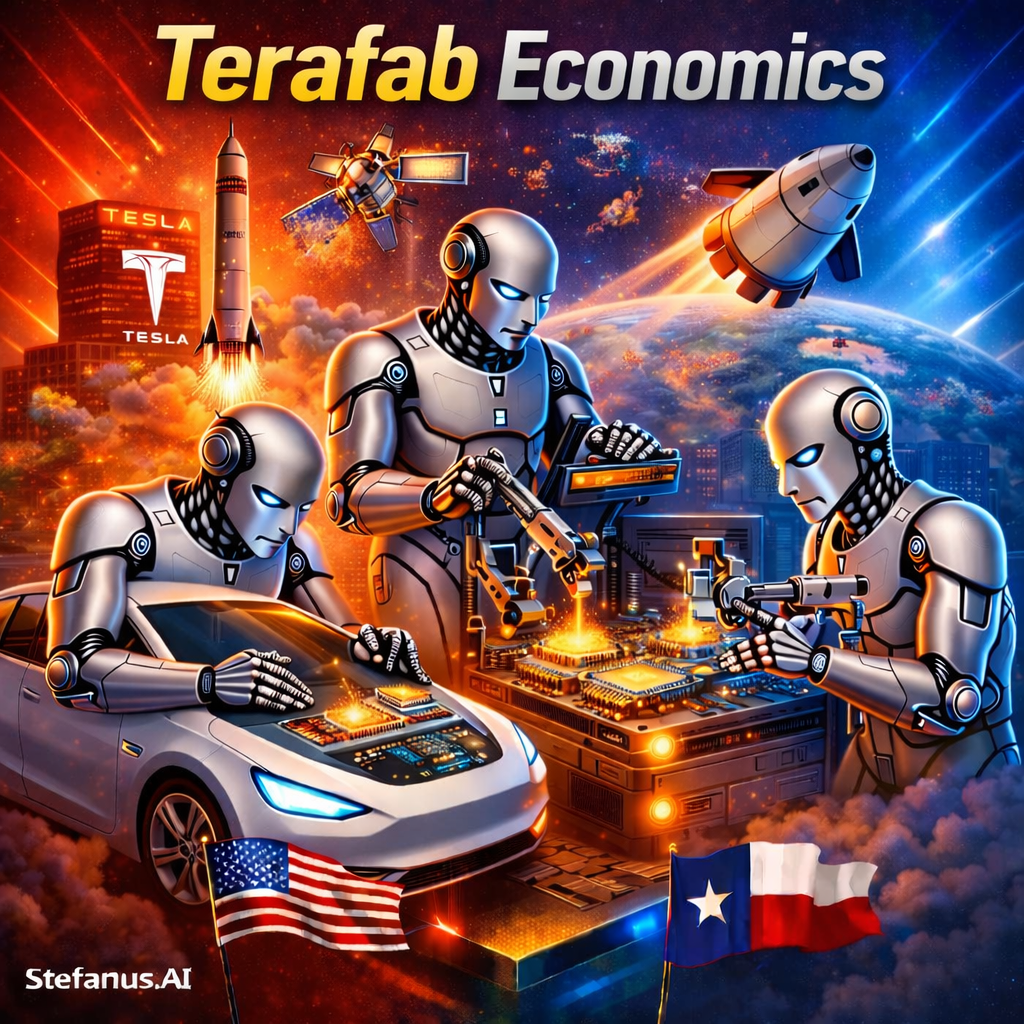

The frontier of industrial power is no longer defined by production capacity alone—it is defined by the scale at which computation can be manufactured, integrated, and deployed. What began as a revolution in software has evolved into a contest over physical infrastructure, energy systems, and fabrication dominance.
This paper introduces a new term: Terafab Economics.
Terafab Economics describes the emergence of trillion-dollar, vertically integrated AI manufacturing zones capable of producing computation at terawatt-scale energy and tera-level processing output, where fabrication, energy, and deployment converge into a single industrial system.¹
Over a decade ago, Elon Musk popularized the term Gigafactory through Tesla—a symbol of industrial scale defined by gigawatt-hour battery production. But as artificial intelligence systems expand exponentially, the language of scale itself is evolving.
Gigafactories are no longer sufficient.
The new frontier is measured in terawatts, not gigawatts.
Recent reporting from The Wall Street Journal confirms that Tesla and SpaceX are pursuing a massive semiconductor complex in Austin, Texas, driven by urgent shortages in AI chips and the inability of existing suppliers to scale fast enough². At the same time, Texas has emerged as one of the most aggressive industrial magnets in the United States, with Austin evolving into a dense cluster of advanced manufacturing anchored by Tesla’s Gigafactory footprint and expanding semiconductor investments³.
This transition reflects a deeper structural shift:
- From manufacturing products → to manufacturing intelligence
- From energy consumption → to energy dominance
- From isolated factories → to integrated compute ecosystems

Section 1: From Gigafactories to Terafactories
The concept of industrial scale has historically followed energy curves. The 20th century was defined by oil refineries and steel mills. The early 21st century introduced semiconductor fabs and cloud data centers. Today, we are entering a new phase:
Factories that manufacture intelligence at planetary scale.
Researchers at Massachusetts Institute of Technology observe that AI infrastructure demand is now growing at a pace that “outstrips traditional industrial scaling laws,” requiring exponential increases in both compute density and energy supply⁴. The International Monetary Fund similarly notes that AI-driven capital expenditure is reshaping global industrial policy, with hundreds of billions of dollars flowing into semiconductor and compute infrastructure annually⁵.
The shift from giga to tera is not semantic—it is structural:
- Gigafactories → produce components
- Terafactories → produce systems of intelligence

Section 2: Terafab Defined — The Austin Tera-Corridor
On March 21, 2026, Elon Musk introduced Terafab, a new class of semiconductor-industrial system designed to operate at unprecedented scale.
Terafab represents:
- $20–$25+ billion initial investment²
- Strategic location near Tesla’s Texas manufacturing base
- Ambition to produce 1 terawatt equivalent compute capacity annually
This initiative is not merely another fabrication plant—it is a fully integrated system architecture.
Core Capabilities
- Chip design
- Semiconductor fabrication
- Memory production
- Advanced packaging
- System deployment
All under one unified ecosystem
The output is not just chips—it is intelligence deployed across:
- Tesla autonomous vehicles
- xAI large-scale models
- SpaceX satellite and orbital systems
Stanford research highlights that vertical integration in AI infrastructure “reduces latency, compresses cost structures, and enhances strategic independence,” reinforcing the viability of Terafab’s model⁶.
Section 3: Geopolitics of Terafab Economics
3.1 California’s Industrial Decline
California’s regulatory structure—combined with rising operational costs and energy constraints—has accelerated the relocation of advanced manufacturing.
Research from Stanford University finds that firms increasingly cite “regulatory unpredictability and escalating costs” as key drivers behind industrial migration⁷.
This environment contributed to the strategic decision by Elon Musk to relocate major operations to Texas.
3.2 Texas as a Terafab Magnet
Texas offers a radically different economic framework:
- Low regulatory friction
- Competitive tax structures
- Abundant land
- Access to diverse energy sources
The World Bank emphasizes that regions combining energy availability with policy efficiency are emerging as primary attractors for next-generation industrial investment⁸.
Austin is rapidly forming a Tera-Corridor:
- Samsung Electronics semiconductor expansion
- Tesla’s manufacturing ecosystem
- AI infrastructure clustering
3.3 National Implications
Industrial power is shifting away from traditional coastal innovation hubs toward energy-rich inland territories, redefining the geography of technological dominance.

Section 4: Strategic Advantages of Elon Musk’s Terafab Vision
4.1 Full Vertical Integration
Terafab seeks to unify design, manufacturing, and deployment—reducing reliance on external supply chains dominated by TSMC.
Harvard economist Dani Rodrik argues that:
“Control over production chains is becoming as critical as control over innovation itself.”⁹
4.2 Cross-Ecosystem Utilization
Terafab creates a closed-loop system:
- Tesla → mobility intelligence
- xAI → model training
- SpaceX → orbital deployment
4.3 Partnership with Intel
Collaboration with Intel suggests:
- Hybrid architecture development
- U.S.-based semiconductor resurgence
- Reduced reliance on overseas fabrication
4.4 Strategic Disruption Risk
Should competitors be concerned?
Yes—because Terafab challenges:
- NVIDIA’s dominance in AI chips
- TSMC’s manufacturing leadership
- Fragmented global supply chains

Section 5: Structural Risks — What If Terafab Fails?
5.1 Lack of Direct Experience
Semiconductor fabrication remains one of the most complex industrial processes in existence. MIT researchers emphasize that:
“Chip manufacturing requires atomic precision under extreme conditions, where even minor deviations can cascade into system-level failures.”¹⁰
Unlike rockets or vehicles, fabrication operates at scales where physics becomes a limiting factor.
5.2 Capital Intensity and Financial Exposure
Terafab’s cost places it among the most capital-intensive private industrial projects ever attempted². The IMF warns that such investments are highly sensitive to macroeconomic conditions, including interest rates and liquidity cycles¹¹.
Recent analysis from the Financial Times highlights that the AI boom is increasingly dependent on sustained capital flows, raising concerns about potential overextension if economic conditions tighten¹².
5.3 Demand Uncertainty
Oxford scholars caution that:
“Technological expansion often overshoots near-term demand, creating cycles of overcapacity before equilibrium is reached.”¹³
The risk is that Terafab could produce more compute than the market can immediately absorb.
5.4 Competition Against Established Giants
Competing simultaneously with TSMC and NVIDIA presents a dual-front challenge rarely attempted at this scale.
The Wall Street Journal characterizes this ambition as a “Herculean undertaking,” given the entrenched dominance of these players².
5.5 ASML Constraint
ASML remains the sole provider of EUV lithography machines, each costing up to $400 million.
Yale researchers warn:
“EUV concentration represents a systemic bottleneck in advanced semiconductor production.”¹⁴
5.6 Chinese Competitive Acceleration
Huawei has accelerated domestic chip development, creating a parallel technological ecosystem that challenges Western dominance.
5.7 Execution Risk at Terascale
Terafab aims to achieve output levels far exceeding current global norms, targeting terawatt-scale compute production.
This raises critical questions:
- Can supply chains scale accordingly?
- Can energy infrastructure support sustained operation?
- Can execution timelines be maintained?
Even industry observers acknowledge that:
this may represent “one of the most ambitious industrial efforts ever attempted.”²

Section 6: Future Implications of Terafab Economics
6.1 Redefining Industrial Power
Terafab Economics signals a transition from GDP-based metrics toward compute-based sovereignty, where nations and corporations are evaluated by their ability to generate and sustain computation.
6.2 Energy–Compute Convergence
Researchers at California Institute of Technology emphasize that:
“The future limits of computation are defined by energy availability and thermal constraints—not transistor scaling alone.”¹⁵
This positions Terafab as both a manufacturing system and an energy infrastructure project.
6.3 Rise of the Tera-Corridor
Austin exemplifies a new industrial geography:
- Co-location of fabrication, energy, and compute
- Rapid policy-driven expansion
- Attraction of global capital
Local Texas reporting indicates that infrastructure investment is accelerating due to business-friendly policy frameworks and energy availability, reinforcing the Tera-Corridor thesis.
6.4 Corporate Sovereignty
MIT economists note that:
“Private-sector infrastructure investment in AI now rivals the scale historically associated with nation-states.”¹⁶
This suggests the emergence of corporate industrial sovereignty.
6.5 Space-Based Compute Integration
Terafab’s outputs are expected to extend into orbital systems, supporting:
- Satellite AI processing
- Space-based data infrastructure
- Distributed global intelligence networks
This connects terrestrial manufacturing with extraterrestrial computation.
6.6 Feedback Loop Manufacturing
Terafab enables rapid iteration cycles:
- Design → Fabricate → Test → Redesign
This transforms manufacturing into a continuous computational process, accelerating innovation timelines².
6.7 Emergence of Closed-Loop AI Ecosystems
Terafab creates a self-reinforcing system:
- Chips → Tesla
- Chips → xAI
- Chips → SpaceX
Eliminating external dependencies while amplifying internal synergy.
Conclusion: Why “Terafab Economics” Defines This Era
The transition from Gigafactories to Terafactories is not merely an evolution in scale—it is a transformation in the nature of industrial power itself.
The term Terafab Economics is chosen with precision.
It captures three defining shifts:
1. Scale
The movement from gigawatt to terawatt-scale infrastructure, driven by exponential AI demand.
2. Integration
The convergence of:
- Fabrication
- Energy
- Compute
- Deployment
into a unified industrial system.
3. Economic Reconfiguration
A global economy increasingly organized around:
- Compute capacity
- Energy availability
- Infrastructure dominance
Every section of this paper—from Texas policy advantages to semiconductor bottlenecks, from ASML constraints to orbital integration—converges into a single thesis:
Terafab Economics is the governing logic of the AI industrial age.
It explains:
- Why capital is concentrating at unprecedented scale
- Why industrial geography is shifting inland
- Why corporations are becoming infrastructure powers
- Why energy and compute are merging into a single strategic axis
And ultimately:
The future will not be determined by who designs intelligence—but by who can manufacture it at terascale.

Footnotes
- MIT AI Infrastructure Scaling
https://www.mit.edu - The Wall Street Journal – Tesla & SpaceX Chip Factory
https://www.wsj.com/tech/tesla-spacex-plan-to-build-new-chip-factory-in-texas-4dfb9a46 - Tesla Gigafactory Texas Overview
https://en.wikipedia.org/wiki/Gigafactory_Texas - MIT Research on AI Scaling
https://www.mit.edu - IMF AI Capital Investment Trends
https://www.imf.org - Stanford HAI Infrastructure Research
https://hai.stanford.edu - Stanford SIEPR Manufacturing Study
https://siepr.stanford.edu - World Bank Investment Competitiveness
https://www.worldbank.org - Dani Rodrik – Harvard University
https://drodrik.scholar.harvard.edu - MIT Semiconductor Manufacturing Complexity
https://www.mit.edu - IMF Financial Stability Report
https://www.imf.org - Financial Times – AI Investment Trends
https://www.ft.com - Oxford Technology Cycles
https://www.ox.ac.uk - Yale Semiconductor Supply Chain Analysis
https://som.yale.edu - Caltech Energy and Compute Limits
https://www.caltech.edu - MIT Political Economy of Infrastructure
https://economics.mit.edu

Comments
[…] already home to the emerging Terafab corridor near Austin, is positioning itself as a convergence point […]
[…] The next evolution is Terafab: […]
[…] long periods of time. This means that semiconductor leadership is not simply a function of money or fabrication capacity; it is also a function of accumulated human […]
[…] Terafab (upcoming) […]
[…] Intel is attempting to reenter the advanced foundry race through 18A and 14A. Elon Musk’s Terafab vision, now tied to Tesla, SpaceX, and Intel, represents perhaps the most extreme version of […]
[…] business decision. The move brought with it the Tesla Gigafactory in Austin and, subsequently, the Terafab facility at the same location — manufacturing infrastructure whose scale and strategic […]