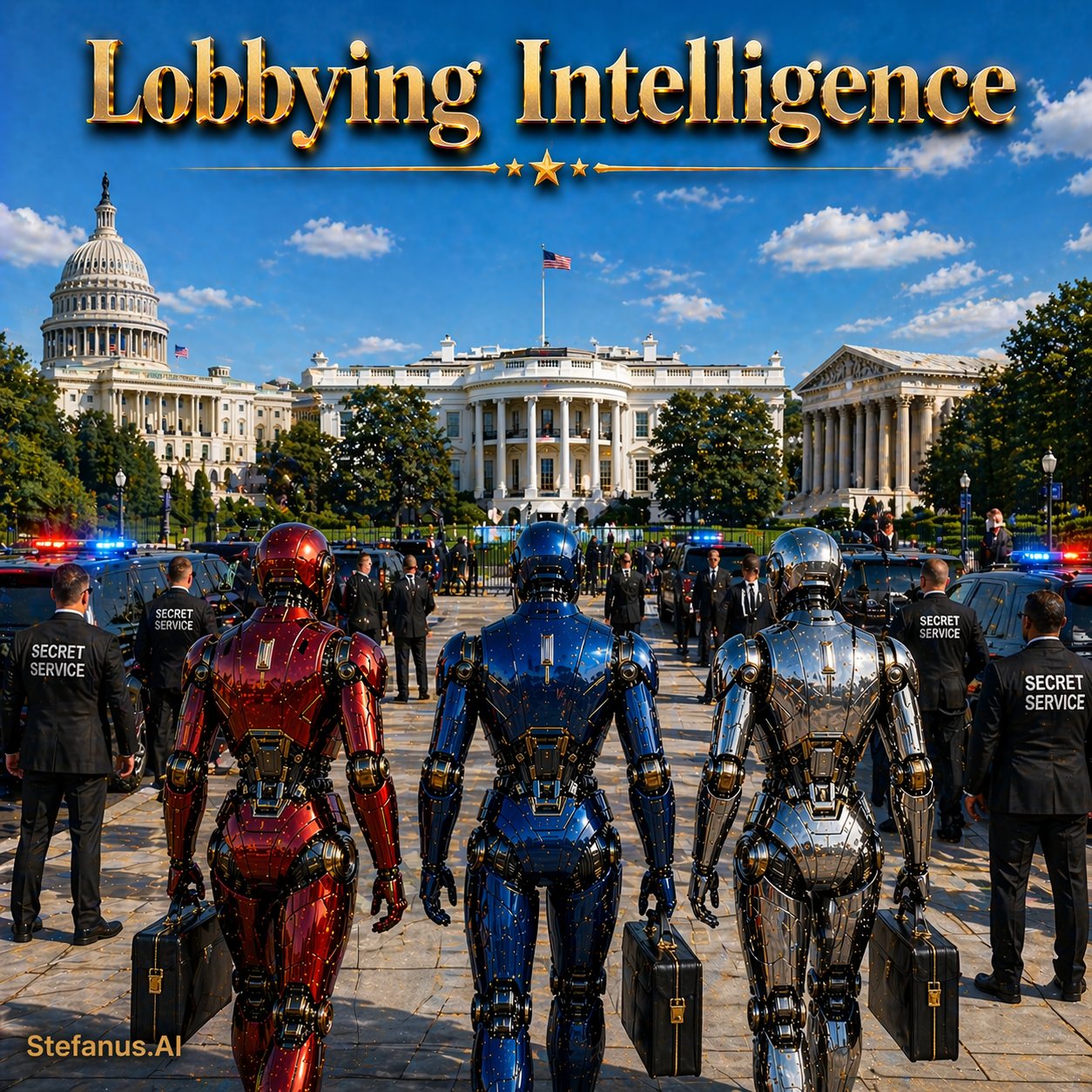

In January 2025, a striking visual emerged from the inauguration of the new U.S. president: a front-row constellation of technology elites—founders, CEOs, and their spouses—representing the most powerful hyperscale companies in the world. Among them were leaders tied to Meta, Google, Amazon, Nvidia, and newer AI-native actors such as OpenAI and Anthropic.
What appeared ceremonial was, in reality, structural.
The convergence of political power and computational power had entered a new phase.
Yet, beneath this continuity of influence, a divergence began to form. Reports in early 2026 revealed that two relative newcomers—OpenAI and Anthropic—had dramatically expanded their presence in Washington, D.C., at a pace that outstripped even seasoned incumbents. Lobbying disclosures, policy roundtables, and executive appearances signaled something deeper than routine engagement.
Something had shifted.
Why would companies built on code, models, and data suddenly invest heavily in political capital?
Why would engineers become lobbyists?
Why would alignment debates move from research labs into federal hearings?
This paper introduces a new framework:
A system in which political influence becomes a core layer of the AI stack, alongside energy, chips, data centers, and models.
In this paradigm, intelligence is no longer only artificial—it is also institutionalized, negotiated, and regulated through policy channels.
“AI is a general-purpose technology, but its trajectory will be shaped as much by governance as by innovation.”¹
The thesis of this paper is simple but profound:
As AI scales exponentially, lobbying becomes infrastructure.
And in Q1 2026, that infrastructure came online.

Section 1 — The Mechanics of Washington Lobbying
To understand “Lobbying Intelligence,” we must first define the system itself.
Lobbying in Washington, D.C. is not informal persuasion—it is a regulated, disclosed, and institutionalized economic activity governed by federal law, including reporting requirements under frameworks enforced by entities such as the Public Disclosure Commission (PDC) and federal registries.
At its core:
Lobbying expenditures represent the total financial investment made to influence policy outcomes.
This includes:
- Lobbying Fees (Compensation): Payments to registered lobbyists or firms
- Expenditures: Travel, meals, events, and engagement costs
- Policy Campaign Costs: Research, legal strategy, and coalition building
These are publicly disclosed, making lobbying one of the rare domains where influence can be quantified.
According to reporting from Axios, Q1 2026 marked a surge in AI-related lobbying activity, with emerging firms significantly increasing spending year-over-year.
“Lobbying disclosures are one of the clearest windows into corporate priorities.”²
This is critical: lobbying is not noise—it is signal.
Where companies spend politically reveals where they see risk, opportunity, or existential dependency.
In the AI era, that dependency is expanding rapidly into:
- Copyright law
- Export controls
- National security frameworks
- Energy and infrastructure policy
- Space and orbital governance
Lobbying, therefore, is no longer peripheral—it is strategic positioning within the AI value chain.

Section 2 — Hyperscalers and the Acceleration of Influence
Traditional hyperscalers—Google, Meta, Amazon, Microsoft, Nvidia, AMD—have long maintained a presence in Washington. However, their lobbying strategies historically centered on:
- Antitrust
- Privacy regulation
- Tax policy
- Platform governance
In Q1 2026, a shift occurred.
The focus moved toward AI-specific structural constraints:
- Compute supply
- Energy access
- Export restrictions on chips
- National AI competitiveness
Why the Surge?
Because AI growth is no longer linear—it is infrastructural and geopolitical.
Companies like:
- Nvidia (dominant in accelerators)
- AMD (emerging AI competitor)
- Amazon Web Services
- Google Cloud
are facing constraints that cannot be solved purely by engineering.
They require policy alignment.
“Technology competition is increasingly shaped by state policy, not just market forces.”³
Comparative Lobbying Dynamics (Q1 2026)
- Legacy firms: steady but high baseline spending
- AI-native firms: sharp YoY growth
- Semiconductor firms: increased focus on export policy
The reason is clear:
AI is colliding with national security.
And once that happens, Washington becomes unavoidable.

Section 3 — OpenAI and the Politics of Scale
The emergence of Sam Altman as both a technologist and policy actor represents a defining moment in “Lobbying Intelligence.”
In 2026, OpenAI’s strategy evolved from research leadership to infrastructure-scale ambition.
The most symbolic event:
The announcement of Stargate, a proposed $500 billion AI infrastructure initiative, alongside Larry Ellison and federal leadership.
This marked a transition:
From model builder → to national infrastructure partner
Key Signals
- Direct White House engagement
- Participation in federal AI roundtables
- Alignment with infrastructure policy
- Early data center construction in Texas
What is OpenAI Lobbying For?
- Massive data center expansion approvals
- Energy prioritization for AI workloads
- Copyright flexibility for training data
- Federal AI investment frameworks
- International AI leadership positioning
“The frontier of AI is no longer just technical—it is institutional.”⁴
OpenAI’s lobbying strategy reflects a realization:
Scaling intelligence requires scaling permission.

Section 4 — Anthropic and the Politics of Alignment
If OpenAI represents scale, Anthropic represents constraint.
Led by Dario Amodei, the company positioned itself as an AI safety leader.
However, this stance collided with national security interests.
The Conflict
Anthropic reportedly resisted requests to modify safeguards for military applications.
This triggered:
- Tensions with defense authorities
- Temporary classification as a “supply chain risk”
- Legal escalation
The Turning Point
Following the release of its advanced model (“Mythos”), engagement with federal leadership resumed.
This reflects a core tension:
Alignment vs. deployment
“AI safety debates are ultimately political decisions about acceptable risk.”⁵
What is Anthropic Lobbying For?
- Safety standards embedded in federal policy
- Limits on military AI usage frameworks
- Regulatory clarity for frontier models
- Partnership positioning with government
Anthropic’s trajectory reveals something critical:
Even resistance must eventually engage with power.

Section 5 — Lessons from Q1 2026
1. The Power Bottleneck
AI is constrained not by algorithms—but by:
- Energy
- Policy
- Permits
- Regulation
2. Lobbying as Infrastructure
Lobbying is no longer reactive—it is proactive scaling strategy.
3. Political Alignment Cycles
Anthropic’s shift shows:
- Initial resistance
- Institutional pressure
- Strategic realignment
4. AI Firms Are Becoming Political Actors
Not indirectly—but directly.
“The firms building AI are now shaping the rules under which it operates.”⁶
5. The New Stack
The AI stack now includes:
- Energy
- Chips
- Data Centers
- Models
- Applications
- Policy (Lobbying Intelligence)
Conclusion
The events of Q1 2026 reveal a structural transformation.
AI companies are no longer just technology firms—they are policy-dependent institutions.
The presence of founders at presidential inaugurations was not symbolic.
It was predictive.
It signaled the emergence of a system where:
- Compute requires approval
- Scale requires negotiation
- Innovation requires alignment with state power
This is why the term “Lobbying Intelligence” fits.
Because intelligence is no longer defined solely by models or compute capacity.
It is defined by the ability to:
- Navigate regulation
- Influence policy
- Align with national priorities
“Power in the AI era will belong to those who can integrate technology, capital, and governance.”⁷
In this world, the most powerful AI system may not be the largest model.
It may be the one best aligned with Washington.

Footnotes:
- Erik Brynjolfsson — Stanford University — https://www.stanford.edu
- Axios — Lobbying Reports 2026 — https://www.axios.com
- World Bank — Technology and Development Report — https://www.worldbank.org
- IMF — AI and Economic Policy — https://www.imf.org
- Stuart Russell — UC Berkeley — https://people.eecs.berkeley.edu/~russell/
- UN — AI Governance Reports — https://www.un.org
- MIT Technology Review — AI Policy Analysis — https://www.technologyreview.com