
Introduction — Why SIXF, Why Now
We are no longer at the beginning of artificial intelligence. We are at the beginning of its industrialization phase — and the numbers confirm that the stakes have never been higher.
In 2026 alone, global spending on AI is forecast to reach $2.52 trillion, representing a 44% year-over-year surge, according to Gartner.1 AI infrastructure investment alone accounts for $401 billion of that figure.1
The scale is staggering at the hyperscaler level: the five largest U.S. cloud and AI infrastructure providers — Microsoft, Alphabet, Amazon, Meta, and Oracle — have collectively committed between $660 and $690 billion in capital expenditure for 2026, nearly doubling their 2025 levels.2 Roughly $450 billion of that spend is directly tied to AI infrastructure: servers, GPUs, datacenters, and networking.2
In 2025 alone, full-year AI infrastructure spending totaled $318 billion — more than double the $153 billion recorded in 2024 — and IDC projects it will reach $487 billion in 2026, on a trajectory toward the trillion-dollar threshold by 2029.3
Sovereign funds, national governments, and hyperscalers are racing to build the largest compute systems ever assembled. Electricity grids, semiconductor supply chains, and global talent flows are being reorganized around one central premise:
More intelligence will solve more problems.
But this premise is incomplete — and dangerously so.

First articulated with the registration of SIXF.com on April 5, 2003, this paper introduces Super Intelligence X-Files (SIXF): a framework for understanding the class of problems that remain unsolved, unsolvable, unknown (SIUK), and unexplained even in the presence of exponential compute, advanced models, and global data integration.
“More data is not always better — it can obscure signal.”
— Sendhil Mullainathan, MIT / NBER²
The urgency of SIXF is not theoretical — it is temporal. By 2030, the Five-Layer AI Economy will be largely locked in:
- energy grids allocated
- chip supply chains hardened
- datacenter geographies fixed
- model leadership consolidated
- application ecosystems entrenched
If we do not understand the limits now, we will build systems assuming certainty where uncertainty is permanent.
This paper connects SIXF directly to the six foundational layers of the AI economy:
- Energy
- Chips
- Datacenters
- Models
- Applications & Agentic Systems
- Talent
And it argues one overarching thesis: AI does not eliminate uncertainty. It industrializes it.

Section 2 — SIXF Across the Five-Layer AI Economy
This section defines what SIXF actually is — not as abstraction, but as real, quantifiable failure modes already emerging inside the AI economy today. Each layer includes: what the system is supposed to do; where it breaks (the X-File); and why it cannot be fully solved.
2.1 SIXF Layer 1: Energy — The System That Cannot Guarantee Power
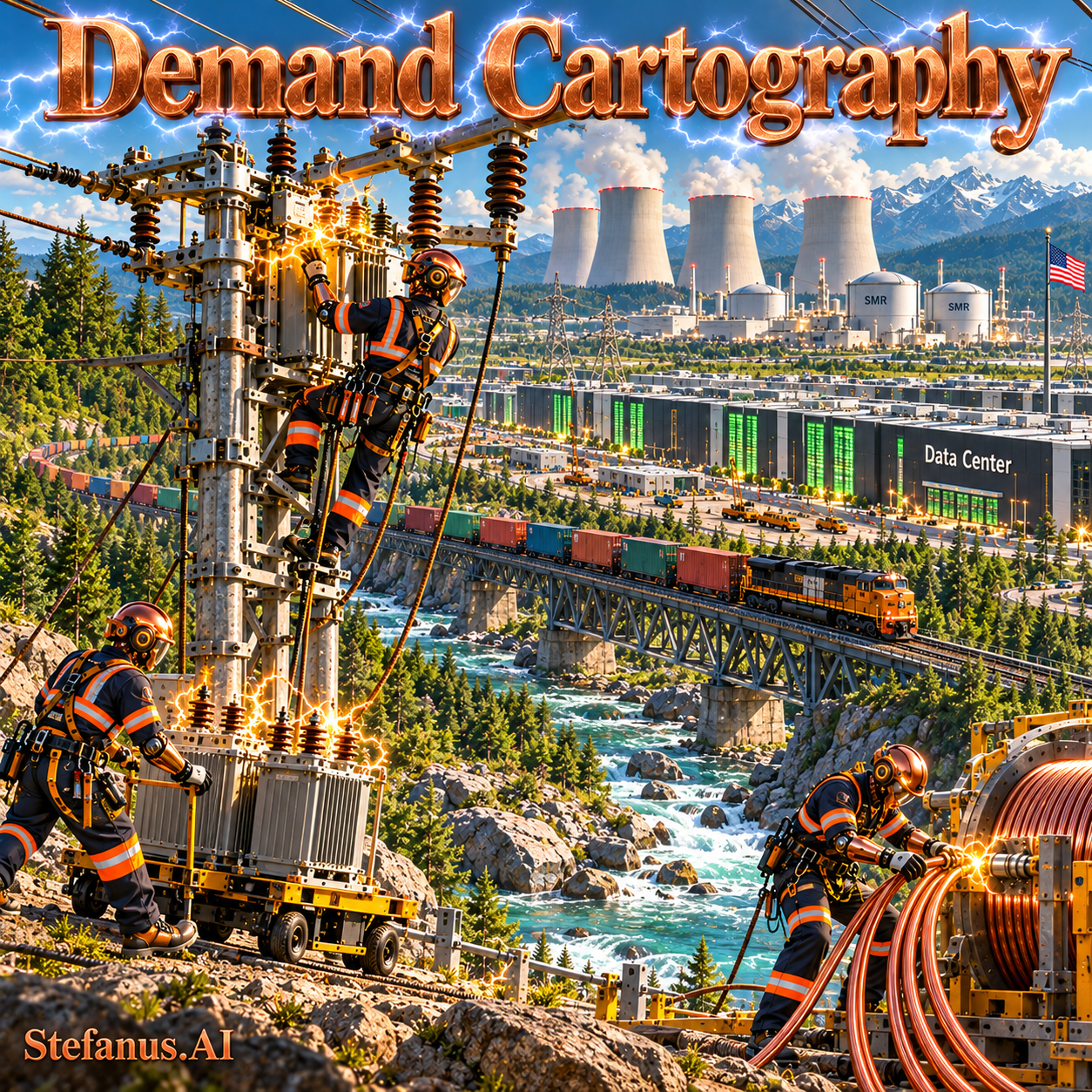
The AI economy is, at its foundation, an energy conversion system. Every model, every inference, every training run ultimately resolves into electricity demand — and that demand is now growing faster than any prior digital wave.
According to the IEA’s updated 2026 analysis, electricity consumption from data centres roughly doubled from 415 TWh in 2024 to approximately 485 TWh in 2025 — a 17% year-over-year surge — and is projected to reach 950 TWh by 2030, accounting for nearly 3% of global electricity demand by that date.4 AI-focused data centres will be the dominant driver: electricity consumption from AI-optimized facilities is set to triple over the same period.4
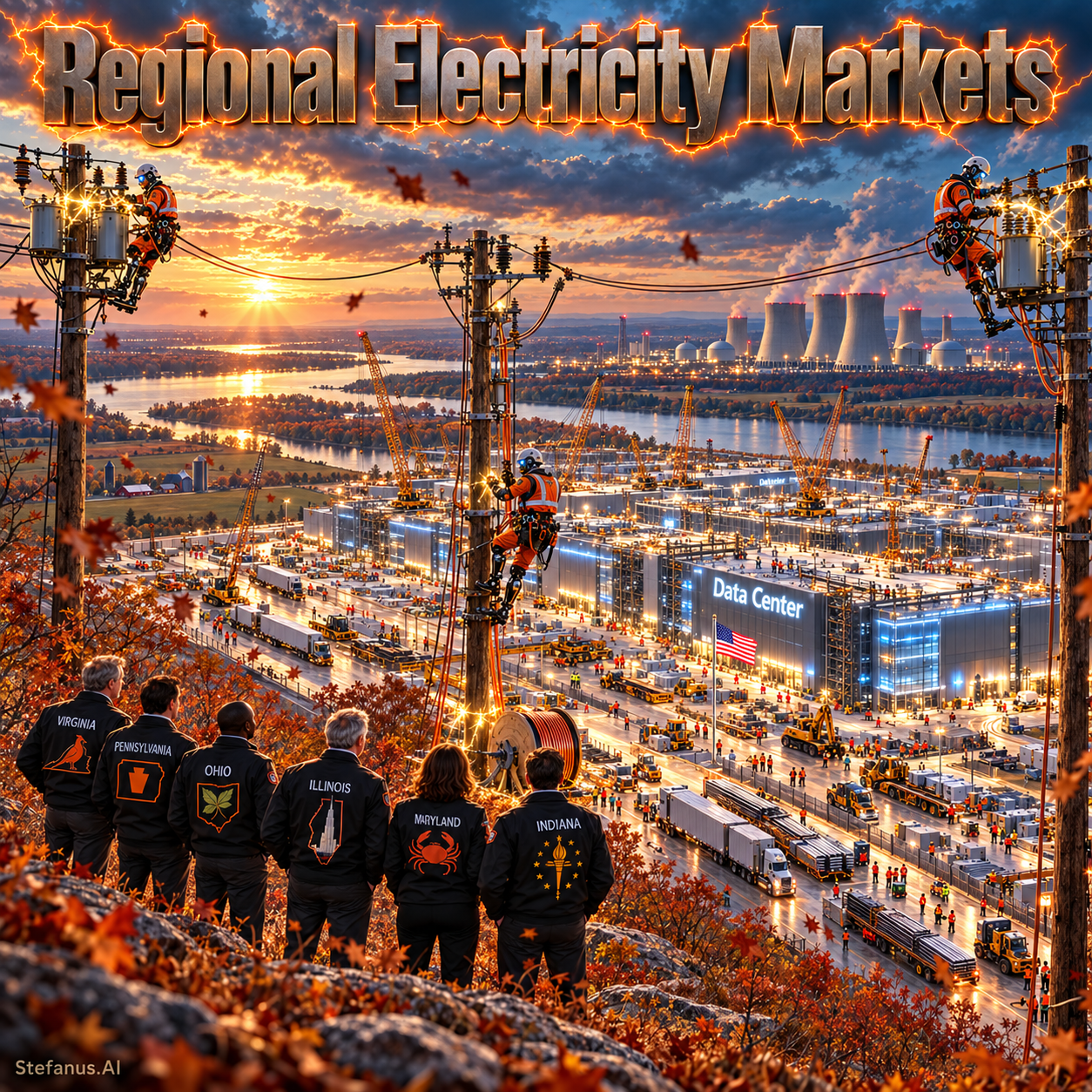
In the United States, by 2030 data centres are projected to consume more electricity for processing data than all energy-intensive manufacturing combined — including aluminum, steel, cement, and chemicals.5 In some regional clusters — Virginia, Oregon, Ireland — the Power Stress Index already exceeds the threshold of local grid vulnerability.6
“Global electricity demand from data centres is set to more than double over the next five years, consuming as much electricity by 2030 as the whole of Japan does today.”
— Fatih Birol, Executive Director, International Energy Agency³
What is the SIXF Here?
The X-File in energy is not capacity — it is continuity under compounding uncertainty.
The tech sector now accounts for approximately 40% of all corporate power purchase agreements for renewables signed in 2025, and the pipeline of conditional offtake agreements between data centre operators and small modular reactor (SMR) nuclear projects has grown from 25 gigawatts at the end of 2024 to 45 gigawatts as of early 2026.7
Yet even this unprecedented mobilization cannot close the gap: grid permitting takes 5–10 years; weather systems remain unpredictable; renewable energy is intermittent; and electricity infrastructure is among the most interdependent and fragile of all human systems.
SIXF Energy = You cannot guarantee power stability for intelligence at scale.
This is not an engineering gap. It is a systemic constraint of civilization infrastructure.
2.2 SIXF Layer 2: Chips — The Supply Chain That Cannot Be Secured
AI runs on silicon. But silicon is not evenly distributed, and the ecosystem that produces it represents one of the most geographically concentrated and geopolitically exposed supply chains in human history.
TSMC fabricates approximately 90% of all advanced logic chips below ten nanometers — making a single Taiwanese company the physical substrate of global AI training capacity.8 ASML in the Netherlands remains the sole manufacturer of EUV lithography machines, without which advanced chip fabrication is impossible anywhere on earth.8
“Semiconductor supply chain geopolitical risk is the structural exposure created when three companies — TSMC, ASML, and NVIDIA — control the world’s advanced AI chip production from politically fragile geographies.”
— Dr. Raphael Nagel, Tactical Management⁸
The semiconductor market is expected to reach $1 trillion in revenue by 2029, driven by surging AI chip demand and rising memory prices.9 Yet the market is simultaneously fragmenting under geopolitical pressure: what was once the world’s most globally integrated supply chain — with extreme regional specialization across design, fabrication, materials, and assembly — is now fracturing under trade policy and export controls.9
NVIDIA, for example, has raised prices on its AI GPUs by as much as 15% for high-end AI accelerators, citing increased manufacturing costs and U.S. trade restrictions.9
What is the SIXF Here?
The X-File is the non-replicability of the semiconductor ecosystem. Even with the U.S. CHIPS Act, the EU Chips Act, and billions in global subsidies, we cannot replicate TSMC’s yield and accumulated process expertise in any policy cycle. TSMC’s $40 billion Arizona facility — the flagship of domestic reshoring — will not be fully operational until 2028, and will remain a fraction of TSMC’s Taiwan capacity for years beyond that.
Knowledge is tacit, not merely capital-driven. Geopolitics introduces non-linear shocks that no supply chain model can fully anticipate.
SIXF Chips = Compute supply is permanently exposed to geopolitical instability.

2.3 SIXF Layer 3: Datacenters — The Infrastructure That Cannot Scale Freely
Datacenters are where intelligence becomes physical. They are, increasingly, where the limits of the physical world assert themselves most clearly against the ambitions of digital systems.
The capital expenditure of five large technology companies surged to more than $400 billion in 2025 and is projected to increase by a further 75% in 2026, according to the IEA’s Key Questions on Energy and AI report.7
Some new AI facilities consume power equivalent to entire cities. Data centers in Ireland already account for more than 20% of the nation’s total electricity consumption. In Frankfurt, they approach 42% of local electricity demand.10
In the U.S., AI-specific data centre electricity demand is projected to grow 30% annually through 2030 — roughly four times faster than total electricity demand growth across all other sectors.4
What is the SIXF Here?
The X-File is friction between digital demand and physical reality — friction that is simultaneously technical, political, and ecological.
Communities are mobilizing against data center construction. Water consumption for cooling is drawing regulatory scrutiny: U.S. data centers consumed approximately 17 billion gallons of water in 2023, with direct consumption in hyperscale facilities expected to reach 16 to 33 billion gallons annually by 2028. Zoning restrictions, grid interconnection queues, and public sentiment are all hardening against the pace of AI infrastructure expansion.
“Scaling compute is not just technical — it is political and physical.”
— Dario Amodei, CEO, Anthropic¹¹
SIXF Datacenters = Intelligence cannot outscale geography and society.
2.4 SIXF Layer 4: Models — Intelligence That We Do Not Understand
Models are advancing faster than theory. The gap between what AI systems can do and what we can explain about how they do it has not narrowed with scale — it has widened.
In 2026, frontier AI hallucination rates sit between 3.1% and 19.1% depending on model, task family, and reasoning configuration — substantially improved from 2024 baselines of 15–45%, but nowhere near zero.12
Reasoning-focused models have introduced a new paradox: OpenAI’s o3 and o4-mini, while among the most capable models available, exhibit hallucination rates of 33% and 48% respectively on person-specific factual questions.13 Global financial losses tied to AI hallucinations reached $67.4 billion in 2024.13
There were 362 documented AI incidents in 2025 — up from 233 in 2024, a 55% year-over-year increase and the highest annual count in the AI Incident Database’s history.13
“We do not fully understand why deep learning works.”
— Yoshua Bengio, Mila Institute / Turing Award Laureate¹⁴
What is the SIXF Here?
The X-File is opacity of intelligence itself. Models learn patterns without explicit causality. Interpretability research, though advancing, remains far behind the frontier. Emergent behaviors — capabilities that appear suddenly and unpredictably at scale — continue to surprise even their creators.
Anthropic’s 2025 interpretability research on Claude identified internal circuits responsible for declining to answer when the model lacks sufficient information — and showed that hallucinations occur when these circuits are incorrectly inhibited. This is progress. But it also reveals the depth of what remains unknown: we are still mapping terrain that scales faster than our maps.
“On some factual tasks, frontier models may already hallucinate less often than humans. It’s a provocative claim — but it highlights the real goal: predictable, measurable reliability, not perfection.”
— Dario Amodei, CEO, Anthropic, 2025 Developer Event¹¹
SIXF Models = Intelligence scaling beyond human comprehension.

2.5 SIXF Layer 5: Applications and Agentic Systems — The World That Cannot Be Modeled
Applications connect AI to reality. And reality, as it turns out, is not stable — nor predictable, nor closed, nor fully modelable at any scale of compute.
In 2026, agentic AI has moved from experimental prototype to mission-critical production deployment. AI agents now retrieve data, invoke tools, and act across enterprise workflows — often with minimal human oversight. The complexity and surface area of failure has grown proportionally.
According to recent industry research, 89% of organizations have implemented observability for their AI agents, with quality issues emerging as the primary production barrier, cited by 32% of organizations.15 Some enterprises are now seeing monthly AI bills in the tens of millions of dollars, with agentic AI’s continuous inference sending token costs spiraling unpredictably.16
“The real world is messy, and AI systems struggle with that messiness.”
— Andrew Ng, AI Fund / DeepLearning.AI¹⁷
What is the SIXF Here?
The X-File is context collapse in real-world environments. Autonomous systems fail in edge conditions that were never represented in training data. Agents misinterpret instructions in ways that compound across multi-step workflows. Systems behave differently under slight context shifts — in language, culture, domain, or regulatory environment.
Real-world environments are non-stationary: they change. Human behavior is unpredictable. Edge cases are not just numerous — they are infinite, and continuously generated by a world that does not hold still for any model.
SIXF Applications = Reality cannot be fully simulated or predicted.
2.6 SIXF Layer 6: Talent — The Constraint That Cannot Be Engineered
AI is built by humans. The entire edifice of the Five-Layer AI Economy — every chip, every datacenter, every model, every application — depends on a remarkably small, globally distributed pool of specialized human knowledge. And that pool is now under threat from policy, geopolitics, and the sheer pace of required skill formation.
Two-thirds of the top AI startups in the United States were founded by immigrants, and most PhD-level AI talent in the U.S. is foreign-born.18 More than half of students who graduated from U.S. STEM PhD programs between 2015 and 2017 were foreign nationals. China, meanwhile, is forecasted in 2025 to nearly double the number of STEM PhDs it produces annually.18
The policy environment in 2025–2026 has introduced significant new headwinds: staff cuts at U.S. immigration agencies, revocation of Harvard’s ability to enroll international students, travel bans affecting more than 280,000 students from 12 countries, and expected changes to H-1B and STEM OPT pathways that economists warn could be a significant blow to attracting world-class talent.19
The contrast with peer nations is stark: Canada, the United Kingdom, and Australia have all enacted more welcoming immigration policies specifically designed to recruit workers with in-demand AI skills, offering streamlined paths to naturalization. Canada attracted nearly 40,000 foreign-born graduates of U.S. institutions in 2025 alone.19
“Human capital is the ultimate engine of growth.”
— Gary Becker, Nobel Laureate in Economics²⁰
What is the SIXF Here?
The X-File is dependency on unstable human systems: immigration policy, geopolitics, education pipelines, and the irreducibly long cycles of expert formation. You cannot engineer a world-class AI researcher in a single policy cycle. You cannot build a STEM pipeline in a fiscal year. And you cannot recover quickly from the structural loss of talent flows that took decades to establish.
SIXF Talent = Intelligence depends on systems outside engineering control.
Conclusion — Why SIXF Must Be Understood Before 2030
Across all six layers, one pattern emerges with unmistakable clarity. It does not matter how much capital is deployed, how many fabs are built, or how many parameters are added to the next frontier model. The pattern holds:
AI is not a system of certainty. It is a system built on permanent uncertainty.
Energy cannot be guaranteed at the pace intelligence demands. Chips cannot be fully secured against geopolitical disruption. Datacenters cannot scale infinitely against the friction of physical and political reality. Models cannot be fully understood by the minds that create them. Applications cannot be fully controlled in a world that does not hold still. Talent cannot be engineered on demand or replaced by policy.
“The important thing is not to stop questioning.”
— Albert Einstein²¹
This is precisely why Super Intelligence X-Files (SIXF) matters now — not in 2030, when the infrastructure decisions will be locked, the capital will be deployed, the geopolitical alignments will be set, and the compounding consequences of today’s assumptions will be irreversible.
By 2030, IDC projects that global AI infrastructure spending will eclipse one trillion dollars annually. The five hyperscalers alone plan to add approximately two trillion dollars of AI-related assets to their combined balance sheets — facing annual depreciation expenses exceeding their combined 2025 profits. The Gartner projection of $3.3 trillion in total AI spending by 2027 represents one of the largest capital mobilizations in economic history.
If we misunderstand the limits today, we will build systems that assume certainty — where none exists. We will dimension grids that cannot be guaranteed. We will concentrate supply chains that cannot be secured. We will deploy models we cannot fully explain. We will agentic-enable workflows in a reality we cannot fully model. And we will depend on talent pipelines we are actively dismantling.
SIXF is not a weakness of AI. It is the defining condition of its future. The industrialization of intelligence is underway — and the most important systems to understand are not the ones we are building. They are the ones we are assuming.
The question is not whether AI will transform the world.
The question is whether we understand the systems upon which that transformation depends.

Footnotes & References
1. Gartner, Inc. — Worldwide AI Spending Forecast, January 2026. https://www.gartner.com/en/newsroom/press-releases/2026-1-15-gartner-says-worldwide-ai-spending-will-total-2-point-5-trillion-dollars-in-2026
2. Futurum Group — AI CapEx 2026: The $690B Infrastructure Sprint, February 2026. https://futurumgroup.com/insights/ai-capex-2026-the-690b-infrastructure-sprint/
3. IDC Worldwide AI Infrastructure Tracker — Q4 2025 Results & 2026 Forecast, April 2026. https://www.idc.com/resource-center/blog/ai-infrastructure-spending-caps-historic-year-at-90-billion-in-q4-2025-2029-spending-to-eclipse-1-trillion/
4. International Energy Agency (IEA) — Key Questions on Energy and AI, April 2026. https://www.iea.org/reports/key-questions-on-energy-and-ai/executive-summary
5. IEA — Energy and AI Special Report, April 2025. https://www.iea.org/news/ai-is-set-to-drive-surging-electricity-demand-from-data-centres-while-offering-the-potential-to-transform-how-the-energy-sector-works
6. arXiv — Concentrated Siting of AI Data Centers Drives Regional Power-System Stress, 2025. https://arxiv.org/pdf/2604.06198
7. IEA — Data Centre Electricity Use Surged in 2025, April 2026. https://www.iea.org/news/data-centre-electricity-use-surged-in-2025-even-with-tightening-bottlenecks-driving-a-scramble-for-solutions
8. Dr. Raphael Nagel — Semiconductor Supply Chain Geopolitical Risk: A Board Guide, March 2026. https://www.raphaelnagel.com/semiconductor-supply-chain-geopolitical-risk
9. Omdia/Informa — How Trade Tensions Are Reshaping the Global Semiconductor Landscape, 2025. https://omdia.tech.informa.com/blogs/2025/sep/how-trade-tensions-are-reshaping-the-global-semiconductor-landscape
10. Brookings Institution — Global Energy Demands Within the AI Regulatory Landscape, 2026. https://www.brookings.edu/articles/global-energy-demands-within-the-ai-regulatory-landscape/
11. Dario Amodei, CEO, Anthropic — public statements, 2025. https://www.anthropic.com
12. Digital Applied — AI Model Hallucination Rate Benchmarks 2026: 5-Model Study, April 2026. https://www.digitalapplied.com/blog/ai-model-hallucination-rate-benchmarks-2026-study
13. SuprMind / AI Incident Database — AI Hallucination Rates & Benchmarks 2026. https://suprmind.ai/hub/ai-hallucination-rates-and-benchmarks/
14. Yoshua Bengio, Mila Institute — Turing Award Laureate, on limits of deep learning theory. https://mila.quebec
15. Maxim AI — State of AI Hallucinations and Agent Observability in 2025. https://www.getmaxim.ai/articles/the-state-of-ai-hallucinations-in-2025-challenges-solutions-and-the-maxim-ai-advantage/
16. Deloitte / TheStreet — The Next Phase of AI Spending, May 2026. https://www.thestreet.com/investing/the-next-phase-of-ai-spending-is-already-underway
17. Andrew Ng — DeepLearning.AI; on AI systems and real-world complexity. https://www.deeplearning.ai
18. Institute for Progress / NITRD — Strengthening America’s AI Workforce, March 2025. https://ifp.org/strengthening-americas-ai-workforce
19. Brookings / Lawfare — Trump’s Immigration Policies May Threaten American AI Leadership, October 2025. https://www.brookings.edu/articles/trumps-immigration-policies-may-threaten-american-ai-leadership/
20. Gary Becker — Nobel Memorial Prize in Economics, University of Chicago. https://www.nobelprize.org/prizes/economic-sciences/1992/becker/biographical/
21. Einstein Archives — Princeton University Press. https://einsteinpapers.press.princeton.edu