
Not until 2019 did the United States create a new branch of the armed forces. The United States Space Force was established on December 20, 2019,¹ becoming the first new branch of the armed services since the National Security Act of 1947. That founding moment was not simply an administrative reorganization. It was an institutional declaration that warfare had evolved in a direction that existing structures could no longer contain. Space — once a passive environment above the battlefield — had become a contested military domain in its own right.
“The U.S. Space Force was established on Dec. 20, 2019, creating the first new branch of the armed services since 1947.” ¹
The creation of the Space Force reflected a simple but profound strategic realization: once satellites became essential for communication, navigation, targeting, missile warning, reconnaissance, weather prediction, and global command, orbit could no longer remain merely a supporting layer beneath the battlefield. It had to become a domain — defended, contested, and commanded like any other.
The United States now approaches a second transformation of comparable magnitude. If the Space Force marked the militarization of orbit, the next transformation is the militarization of cognition.
On May 1, 2026, the Department of Defense (Department of War) announced Classified Networks AI Agreements with eight of the world’s leading frontier artificial intelligence and technology companies — SpaceX, OpenAI, Google, NVIDIA, Reflection AI, Microsoft, Amazon Web Services, and Oracle — to deploy advanced AI capabilities on classified networks for lawful operational use.² The significance of this moment is not simply contractual. It represents the practical birth of what this paper calls the AI-First Force.
“The Department has entered into agreements with eight of the world’s leading frontier artificial intelligence companies… to deploy their advanced AI capabilities on the Department’s classified networks for lawful operational use.” ²
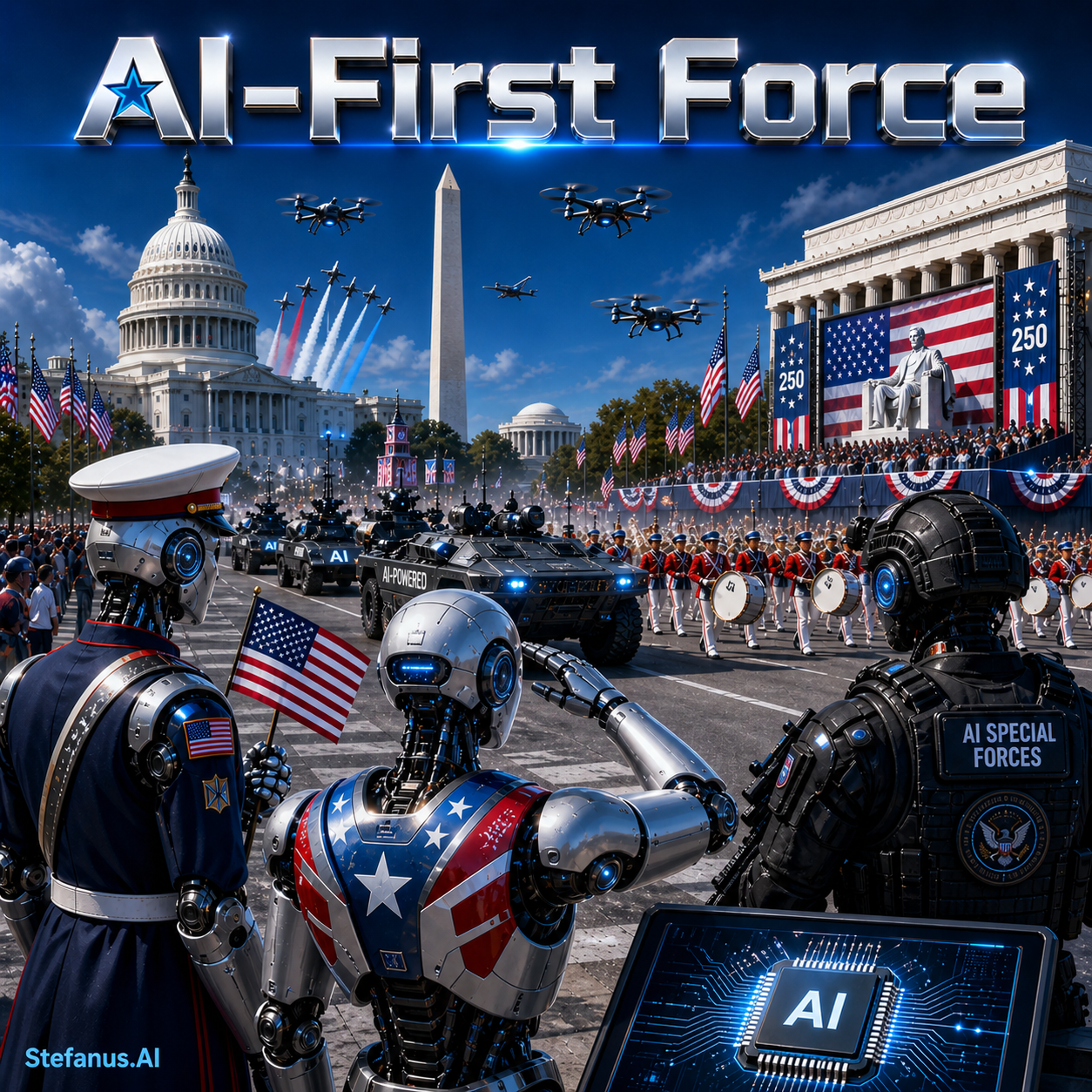
This paper uses the term AI-First Force not because Congress has formally legislated a seventh branch of the armed forces, but because the operational reality is already forming beneath the surface of existing institutions. Artificial intelligence is becoming a horizontal force layer across the Army, Navy, Air Force, Marines, Space Force, intelligence agencies, logistics networks, cyber commands, and classified enterprise systems. It is not defined by land, sea, air, or space. It is defined by decision velocity.
The AI-First Force is therefore the de facto seventh branch in functional terms — not a uniformed service with a color or a seal, but a military operating system. Its terrain is not geography. Its terrain is time. Its weapon is not only firepower. Its weapon is the speed of interpretation. And its decisive advantage is not in possessing more platforms, but in converting data into decision faster than adversaries can react.
This is why the title matters. AI-First Force means that artificial intelligence is no longer treated as an optional tool bolted onto existing military systems. It becomes the first layer of interpretation between data and command, between surveillance and action, between bureaucratic process and force projection. It sits at the beginning of the chain, not the end.
In earlier work, I have described this broader transformation through concepts such as Compute Mercantilism, Infrastructure Primacy, Temporal Supremacy, Distributed Leviathan, Orbital Resilience, and Gigawatt Infrastructure. AI-First Force sits at the intersection of all of them. It is Compute Mercantilism because military advantage increasingly depends on access to chips, cloud, data centers, classified compute, and energy. It is Infrastructure Primacy because the decisive military platform is no longer merely the aircraft carrier or the stealth bomber; it is the integrated compute stack beneath every platform. It is Temporal Supremacy because the winner is the side that can observe, orient, decide, and act inside the adversary’s decision cycle. It is Distributed Leviathan because the state increasingly governs at machine speed through private hyperscaler infrastructure.
This is not science fiction. It is the declared direction of U.S. military modernization. In January 2026, the Department’s Artificial Intelligence Strategy articulated the goal with unusual directness: to become an ‘AI-first’ warfighting force across all components, from front to back.³
“We will become an ‘AI-first’ warfighting force across all domains.” ³
The central thesis of this paper is clear: the AI-First Force is the emerging de facto seventh branch of U.S. military power — a cross-domain, AI-enabled decision architecture designed to remove bureaucratic bottlenecks, accelerate operational integration, and give the United States cognitive and temporal superiority over its adversaries.
This paper proceeds in four sections. Section 1 defines what AI-First Force means and why the concept demands more than a technological label. Section 2 explains its core strategic architecture through four reinforcing pillars. Section 3 shows where AI is already embedded in today’s military — not as experiment, but as operational reality. Section 4 draws the strategic lessons from hyperscaler-military integration and explains why the future of American defense power will be built through a hybrid system of state authority and private compute infrastructure.

Section 1: What Is AI-First Force?
An AI-First Force is a military force reorganized around artificial intelligence as the first layer of interpretation, coordination, and acceleration. It does not mean that human commanders disappear, nor does it suggest that machines should independently decide matters of war and peace. It means that the military begins with the assumption that every domain — land, sea, air, space, cyber, logistics, intelligence, and enterprise administration — will be increasingly mediated by AI from the moment data enters the system.
In the traditional model, military decision-making begins with human observation. A sensor collects data. An analyst reviews it. A staff officer prepares a report. A commander receives options. Legal and policy review may occur. Orders are transmitted. Units move. The sequence is human-heavy, document-heavy, and often slow. Each layer of translation between information and action introduces delay, and in modern warfare, delay is rarely neutral.
In an AI-first model, the military still preserves human command at the center of authority, but the pipeline that feeds command changes fundamentally. AI systems ingest sensor streams, classify patterns, summarize intelligence, identify anomalies, suggest priorities, simulate scenarios, forecast maintenance needs, optimize logistics, and surface decision options at machine speed. The human commander does not vanish from this picture; rather, the commander is moved upstream — into judgment, accountability, and authorization — rather than drowning in raw information that cannot be processed quickly enough.
This is why AI-First Force is fundamentally about decision superiority. The advantage is not only that AI can process more data than a human team. The deeper advantage is that AI reduces the time between signal and meaning. In war, delay creates vulnerability. It gives adversaries time to hide, move, deceive, disperse, strike, or escape. AI-First Force is designed to close that window.
The Department’s Joint All-Domain Command and Control vision reflects this same logic. JADC2 seeks to connect sensors, shooters, and commanders across all domains so that decision-makers receive the information they need when they need it.⁴
“JADC2 is intended to provide decision-makers with the information they need, when they need it, across all domains.” ⁴
But AI-First Force goes beyond connection. Connection alone creates networks. AI creates interpretation. A connected battlefield without AI may simply produce more data overload — sensors feeding into screens that no one has time to read. A connected battlefield with AI can become an intelligent battlefield, where signals are filtered, prioritized, and converted into operational recommendations before they overwhelm the system.
This is the essential difference between digitization and cognition. Digitization moves information. Cognition interprets information. AI-First Force is the transition from digital military networks to cognitive military networks — from moving data to making sense of it.
The economist Herbert Simon understood the problem long before battlefield AI existed. In an information-rich world, he argued, attention itself becomes scarce.⁵
“A wealth of information creates a poverty of attention.” ⁵
Simon’s observation is one of the intellectual foundations of AI-First Force. The U.S. military does not suffer from a shortage of information. It suffers from an excess of it. Satellites see too much. Drones record too much. Cyber systems log too much. Sensors transmit too much. Reports accumulate faster than analysts can absorb them. The human mind cannot process this volume at operational tempo.
AI changes that equation. It functions as an attention allocator. It tells commanders what matters, what changed, what is unusual, what is urgent, what is connected, and what may happen next. In doing so, AI becomes the cognitive infrastructure of modern warfare — not a replacement for human judgment, but the scaffolding through which human judgment can operate at the speed the modern battlefield demands.
The AI-First Force has several defining characteristics that distinguish it from simply adding AI tools to existing military processes. First, it is cross-domain — it does not belong to any single branch but operates across all of them. Second, it is infrastructure-dependent, requiring chips, cloud, data centers, energy, secure networks, edge compute, and satellite connectivity at scale. Third, it is data-hungry, because AI systems require training data, operational data, intelligence data, logistics data, maintenance data, and continuous feedback loops to function well. Fourth, it is bureaucracy-sensitive, because AI cannot be integrated quickly if procurement cycles, compliance reviews, legacy IT systems, and institutional risk aversion slow every deployment. Fifth, it is ethically constrained, because the more AI touches targeting, surveillance, intelligence, and command support, the more the system must preserve accountability, legality, traceability, and human responsibility.
For all these reasons, AI-First Force is not simply a technology concept. It is a new model of military organization — one that asks a simple but powerful question: what would the U.S. military look like if artificial intelligence were not added at the end of every process, but designed into the beginning of every process?

Section 2: The Four Strategic Pillars of AI-First Force
The architecture of AI-First Force can be understood through four strategic pillars: decision superiority, hyperscaler integration, operational application, and data as ammunition. These pillars are not independent. They reinforce one another in a continuous cycle. Decision superiority requires AI. AI requires compute. Compute requires hyperscaler infrastructure. Hyperscaler infrastructure requires secure public-private partnerships. And all of it depends on data collected, labeled, protected, and processed at institutional scale.
2.1 Decision Superiority: Acting Inside the Adversary’s Time Cycle
Decision superiority is the ability to make better decisions faster than the adversary. It is not merely speed for its own sake — a fast wrong decision is dangerous, and a slow correct decision may arrive too late to matter. The goal is to combine speed, accuracy, contextual awareness, and command accountability into a sustained operational advantage.
Military theory has long emphasized the decisive importance of decision cycles. The OODA loop — observe, orient, decide, act — captures the fundamental insight that combat advantage belongs to the side that can move through this cycle faster and more effectively than the opponent. AI compresses the OODA loop by automating the most labor-intensive parts of observation and orientation. It helps commanders see patterns earlier, interpret events faster, and evaluate options with deeper context than any human staff alone could provide in the same timeframe.
RAND has described how AI-enabled systems can compress decision timelines and allow commanders to operate inside adversaries’ decision loops.⁶
“AI-enabled systems can compress decision timelines and enable commanders to act inside adversaries’ decision loops.” ⁶
This is where AI-First Force becomes a doctrine of Temporal Supremacy. The side that owns the timeline owns the initiative. If one force can interpret satellite imagery, drone feeds, radar tracks, cyber indicators, and logistics status in near real time, while the opposing side must wait for human review and slow reporting chains, the faster side gains more than efficiency. It gains initiative — the ability to shape events rather than merely react to them. Decision superiority applies beyond direct combat as well. It matters in crisis response, cyber defense, missile warning, supply routing, and diplomatic signaling. AI-enabled speed allows the military to anticipate rather than merely react.
2.2 Hyperscaler Integration: When Silicon Valley Becomes a National Security Partner
The AI-First Force cannot be built by the military alone — not because the military lacks seriousness or discipline, but because frontier AI is being developed primarily inside commercial technology ecosystems that evolved outside of government. The largest model builders, cloud operators, chip designers, satellite connectivity providers, and AI platform companies are concentrated in private institutions that the Department of Defense does not control and cannot simply replicate.
This creates a new and fundamental strategic dependency. The Pentagon needs Silicon Valley not only for software, but for speed, talent, architecture, and scale. Hyperscale companies know how to operate massive cloud systems, build global data pipelines, deploy models across millions of concurrent users, secure distributed infrastructure, and optimize compute workloads at a level of sophistication that traditional government procurement was never designed to produce. These capabilities are now directly relevant to national defense.
The Joint Warfighting Cloud Capability contract illustrates the infrastructure dimension of this transformation. The Department awarded JWCC to Amazon Web Services, Google, Microsoft, and Oracle as a multi-vendor cloud vehicle to provide commercial cloud services across all classification levels — from headquarters to the tactical edge.⁷
“JWCC is a multiple-award contract vehicle that will provide the DoD the opportunity to acquire commercial cloud capabilities and services directly from the commercial Cloud Service Providers at the speed of mission, at all classification levels, from headquarters to the tactical edge.” ⁷
The phrase ‘at the speed of mission‘ deserves particular attention. The mission cannot wait for slow infrastructure. The battlefield cannot pause for outdated procurement cycles. And AI cannot run on rhetoric — it needs compute, data, networking, and clear deployment pathways. Hyperscaler integration transforms cloud infrastructure from an administrative convenience into a military backbone. Cloud is no longer where email and documents live. It becomes the environment where AI models are deployed, intelligence is processed, mission data is fused, and decision support is delivered at the tempo of modern conflict.
This is the military expression of Compute Mercantilism. In the age of AI, compute is not merely a commercial asset — it is a strategic reserve. Nations compete for GPUs, chips, data centers, cloud regions, energy capacity, fiber routes, satellite links, and trained engineers. The state that can mobilize compute fastest can mobilize intelligence fastest, and the state that mobilizes intelligence fastest operates at a fundamentally different tempo than those that cannot.
2.3 Operational Application: AI Across the Entire Force
AI-First Force is not a single use case or a single program. It is a portfolio of applications embedded across the entire military system — reconnaissance analysis, target recognition, cyber defense, predictive maintenance, logistics optimization, personnel assignment, training simulation, medical triage, space surveillance, language translation, document summarization, and command decision support. The applications are distinct, but the unifying theme is acceleration.
AI helps the military do things that humans already do — but faster, more consistently, and at greater scale. It does not remove the need for expertise. It changes where expertise is applied and what expertise is focused on. An intelligence analyst may spend less time manually watching video footage and more time validating AI-flagged anomalies. A logistics officer may spend less time assembling spreadsheets and more time choosing among AI-generated routing options. A maintenance team may spend less time reacting to failures and more time preventing them. A commander may spend less time waiting for fragmented reports and more time evaluating integrated strategic options.
This is why AI-First Force is both operational and administrative — it changes the battlefield, and it also changes the headquarters. It helps the force fight faster, but it also helps the institution govern itself faster. The two are inseparable, because a military that accelerates at the edge but stalls in the center will never achieve the coherence that decision superiority demands.
2.4 Data as Ammunition: The New Military Resource
In business and technology discussions, the phrase ‘data is the new oil’ has become a familiar shorthand for the centrality of data to modern value creation. In military terms, however, the analogy is both accurate and insufficient.⁸ Data in warfare functions less like oil — a fuel to be refined — and more like ammunition: raw material that must be processed, aimed, and deployed to produce effect.
“Data is the new oil.” ⁸
A drone feed can become a targeting input. A satellite image can reveal a missile launcher’s position. A maintenance log can prevent aircraft failure before a critical mission. A cyber signal can expose an active intrusion. A logistics record can reveal a supply-chain vulnerability before it becomes a capability gap. A battlefield sensor reading can trigger a defensive response. In each case, the data itself does not produce the effect — the interpretation of the data does.
Raw data without AI becomes burden. Processed data becomes advantage. This is the transformation from information abundance to decision ammunition. AI-First Force therefore treats data as a strategic asset that must be collected, protected, labeled, processed, fused, and governed with the same institutional seriousness applied to any other class of military resource. The military advantage belongs not merely to the force that has more data, but to the force that turns data into operational meaning faster than any adversary can respond.

Section 3: The AI Battlefield Already Exists
The AI-First Force is not a theory waiting for a distant future. It already exists in operational fragments across today’s military systems, intelligence workflows, satellite networks, command platforms, predictive maintenance programs, logistics operations, and classified enterprise agreements. What makes 2026 a turning point is not that the military suddenly discovered artificial intelligence, but that AI is now moving from isolated experimentation into the operating logic of the force itself. The language has changed, the contracts have changed, and the institutional commitment has changed. AI is no longer a pilot program. It is becoming a program of record.
In earlier decades, military modernization was measured in aircraft carriers, stealth bombers, nuclear submarines, precision missiles, radar systems, and satellites. In the AI era, modernization is increasingly measured by how fast a military can convert overwhelming data into useful operational judgment. The battlefield now produces more information than human analysts can process: drone feeds, satellite imagery, radar tracks, signals intelligence, cyber logs, logistics data, maintenance records, biometric indicators, terrain maps, and open-source signals. Without AI, this volume becomes noise. With AI, it becomes operational advantage.
This is precisely why the Department of Defense’s 2026 Classified Networks AI Agreements carry such institutional weight. By bringing SpaceX, OpenAI, Google, NVIDIA, Reflection AI, Microsoft, Amazon Web Services, and Oracle onto classified networks for lawful operational use,² the Department placed frontier commercial AI inside the secure architecture of military work — where it can support intelligence, command, logistics, targeting analysis, cyber defense, and enterprise operations simultaneously.
“This effort supports the Department’s AI Acceleration Strategy by enabling new capabilities across its three core tenets of warfighting, intelligence, and enterprise operations.” ²
This is the practical birth of what this paper calls AI-First Force — not a new branch in the ceremonial sense, but a new operating layer inside every branch.
3.1 Project Maven: From Drone Video to Machine-Interpreted War
The first and most consequential example is Project Maven, originally established in 2017 as the Algorithmic Warfare Cross-Functional Team. Its purpose was to accelerate the Department of Defense’s integration of big data and machine learning, with an initial focus on intelligence, surveillance, and reconnaissance.⁹ In practical terms, Project Maven was created because the U.S. military had too much video, too many images, too many sensor streams, and too few human analysts capable of reviewing all of it quickly enough to produce actionable intelligence.
“I am establishing the Algorithmic Warfare Cross-Functional Team… to accelerate DoD’s integration of big data and machine learning.” ⁹
Project Maven represents a structural shift from human-only interpretation to machine-assisted interpretation. Instead of requiring analysts to manually watch hundreds of hours of drone footage searching for patterns, AI systems can flag vehicles, structures, movement changes, suspicious activity, and potential targets automatically. The analyst does not disappear from this process — the analyst’s role is elevated. The human moves from searching through raw data to evaluating machine-filtered possibilities, applying judgment where it is most valuable.
The original Maven memo was also an institutional signal, not merely a technology directive. The creation of an Algorithmic Warfare Cross-Functional Team was a deliberate workaround — a way to move faster than the normal bureaucratic process allowed. It bypassed legacy silos to create a cross-functional integration pathway for AI. That instinct — using AI adoption as a vehicle for institutional acceleration — is one of the defining patterns of AI-First Force.
By 2026, Maven had evolved far beyond its origins. Reuters reported in March 2026 that the Pentagon planned to adopt Palantir’s Maven AI system as a core command-and-control platform and establish it as a formal program of record — ensuring long-term institutional funding, contracting pathways, training requirements, and operational permanence.¹⁰
“The Pentagon has decided to officially adopt Palantir’s Maven AI system as a core military command-and-control platform.” ¹⁰
That transition from experiment to program of record marks an institutional crossing point. AI is no longer attached to military operations. It is becoming part of the core operating system of military command.
3.2 AI Target Recognition: Seeing Faster Than the Enemy Can Hide
AI target recognition addresses one of the most fundamental constraints of modern warfare: the battlefield generates more imagery than humans can review at operational speed. Satellites, drones, surveillance aircraft, ground sensors, and reconnaissance teams together produce an enormous volume of visual data. The human eye is powerful, but it is not scalable across the volume and velocity that contemporary conflict generates.
AI target-recognition systems can scan imagery for objects, vehicles, buildings, ships, aircraft, missile launchers, radar systems, roads, bridges, trenches, supply depots, and anomalous patterns of activity. This matters because the modern battlefield is not static. Targets move. Vehicles camouflage. Command posts relocate. Missile launchers disappear beneath cover. Supply convoys disperse into civilian routes. The side that detects these changes faster gains initiative before the opponent has time to react.
In an AI-First Force, target recognition is not only about identifying an isolated object. It is about connecting that object to a larger operational picture — understanding what a truck’s presence means in the context of a logistics pattern, what a radar emission implies about an air-defense network’s activation, or what a heat signature reveals about concealed equipment. AI helps connect these fragments into an interpretive pattern faster than any human team can assemble from raw imagery alone. This is where data becomes ammunition: not because the image itself causes harm, but because the interpretation of that image can trigger movement, deterrence, or action.
3.3 Targeting and Decision Support: From Human Search to Machine Recommendation
The most sensitive and strategically consequential application of AI is targeting support. This does not mean that AI should independently decide to apply lethal force. It means that AI systems increasingly assist the targeting process by identifying possible targets, ranking threat priorities, recommending asset allocation, and helping commanders understand available options within tight time constraints.
In artillery, missile defense, drone operations, naval warfare, air operations, and special operations, timing is decisive. A target may appear for only minutes before moving. A convoy may disperse. A launcher may relocate before a strike window closes. A commander may be choosing between several imperfect options simultaneously. AI can accelerate this process by narrowing the field of attention, filtering irrelevant alternatives, and surfacing the most time-critical decision points.
This is precisely why human oversight is not a constraint on AI-First Force — it is a requirement of it. The purpose of AI in targeting is to support command judgment, not to replace moral and legal responsibility. The Department of Defense’s Responsible AI framework is unambiguous on this point.¹¹
“DoD personnel will exercise appropriate levels of judgment and care, while remaining responsible for the development, deployment, and use of AI capabilities.” ¹¹
This principle marks the essential boundary between an AI-assisted military and an uncontrolled autonomous war machine. The AI-First Force must be fast — but it must also be governable. Speed without accountability becomes operational danger. Accountability without speed becomes strategic paralysis. The institutional challenge is to build both, simultaneously, without sacrificing either.
3.4 Predictive Maintenance: AI as the Invisible Readiness Layer
Predictive maintenance may sound less dramatic than targeting or reconnaissance, but in terms of strategic consequence, it may be just as important. Military power depends not only on the existence of advanced weapons systems, but on their continuous availability. A fighter jet that cannot fly, a helicopter with failing components, a ship waiting for parts, a vehicle stuck in a maintenance depot, or a drone grounded before its mission — none of these represent military power. They represent stranded capital and degraded readiness.
AI can analyze maintenance logs, sensor readings, engine performance data, vibration patterns, temperature fluctuations, part failure histories, and operational usage cycles to predict when equipment is likely to fail before the failure actually occurs. This capability allows commanders to repair systems before breakdowns happen, reducing unplanned downtime, improving operational readiness, and extending the usable life of extraordinarily expensive platforms.
If AI can detect landing-gear stress, engine degradation, rotor fatigue, battery decline, or component wear patterns before they cause failure, the military gains what no reactive maintenance system can provide: operational continuity. This is where AI-First Force connects directly to Infrastructure Primacy. The decisive advantage comes not from possessing advanced platforms in isolation, but from keeping those platforms operational at scale, continuously, across the full range of military readiness requirements. AI becomes the invisible maintenance layer of national defense.
3.5 Logistics and Personnel Movement: Moving the Force Before the Crisis Peaks
Logistics is the bloodstream of military power. Every operation — from deterrence to sustained combat to humanitarian response — depends on fuel, food, ammunition, medical supplies, spare parts, transportation, personnel movement, warehousing, shipping routes, airlift capacity, port access, and precise timing. When logistics fails, strategy collapses regardless of how strong the force appears on paper.
AI can optimize these systems by forecasting demand, identifying bottlenecks before they constrain operations, rerouting shipments around degraded nodes, allocating aircraft and vessels efficiently, scheduling maintenance windows, predicting port congestion, and matching personnel to mission requirements at scale. This is especially consequential in the Indo-Pacific theater, where distance, island chains, contested maritime corridors, and sophisticated anti-access/area-denial capabilities make logistics extraordinarily difficult and delay extraordinarily costly.
The World Bank has observed that digital technologies can significantly improve logistics efficiency and resilience.¹² That civilian insight becomes substantially more important in a military context, where logistics inefficiency does not produce cost overruns — it produces mission failure. A force that uses AI to optimize logistics can move faster with fewer wasted resources, anticipate shortages before commanders feel them, and identify the fastest, safest, and most operationally sound routing options before the decision point arrives. AI logistics is not merely administrative. It is strategic.
3.6 Space Intelligence: AI Above the Battlefield
The AI-First Force extends into orbit. Space is already essential to communication, missile warning, navigation, weather forecasting, reconnaissance, surveillance, and targeting across every terrestrial domain. But as the number of satellites — military, commercial, and foreign — grows into the thousands, space itself becomes too complex for human-only monitoring and interpretation.
AI can help identify satellites, track ownership patterns, detect abnormal maneuvers, monitor proximity operations, classify orbital behavior, and distinguish routine station-keeping from potential hostile intent. This matters because future conflict will not be limited to Earth’s surface. It will depend critically on the continuity of space-based intelligence, communication, and navigation. A force blinded in orbit loses capability across every domain simultaneously.
This connects AI-First Force to Orbital Resilience. The force that can see from space, interpret from space in near real time, and protect its space infrastructure will hold an asymmetric advantage in every terrestrial domain. AI becomes the interpreter of orbital complexity — the cognitive layer that transforms thousands of satellite tracks, emission patterns, and proximity events into actionable intelligence at machine speed.
3.7 Enterprise AI: Removing Bureaucratic Bottlenecks from Inside the Institution
One of the most underestimated applications of AI is inside the military bureaucracy itself. The U.S. military is not only a warfighting institution — it is also one of the largest administrative systems in the world. It manages personnel records, legal reviews, procurement documents, logistics forms, readiness reports, intelligence summaries, budget requests, training programs, interagency coordination, and compliance documentation at a volume and velocity that no purely human system can process without significant friction.
If the military becomes AI-first only at the battlefield edge while remaining paper-first inside headquarters, the transformation will be incomplete and ultimately self-defeating. The speed achieved at the tactical level will be constantly undermined by the slow institutional processes that govern what reaches the tactical level in the first place.
AI can summarize documents, search classified knowledge systems, identify procurement delays, detect duplicative programs, compare vendor proposals, draft routine reports, translate technical requirements, track compliance, and help commanders retrieve institutional knowledge faster than any legacy system allows. In each case, the effect is the same: the distance between need and fulfillment decreases, and institutional friction dissolves into institutional velocity.
The Department’s AI Acceleration Strategy explicitly framed this as a core objective — aggressively eliminating the bureaucratic barriers that prevent AI from reaching its full operational potential.³
“The Department will achieve this objective by… aggressively identifying and eliminating bureaucratic barriers to deeper integration.” ³
This is the bridge between Section 3 and Section 4. AI-First Force is not only about battlefield use cases. It is about institutional acceleration at every level — removing the friction that prevents America’s military from absorbing America’s technological advantage fast enough to matter.

Section 4: Strategic Lessons from Hyperscaler-Military Integration
The rise of an AI-First Force teaches one central lesson: the future of American military power will not be built by the Pentagon alone. It will be built through a new hybrid architecture in which the state provides legitimacy, mission authority, classified networks, command responsibility, and rules of engagement, while hyperscale companies provide cloud capacity, AI models, chips, software engineering, satellite connectivity, cybersecurity tools, and the industrial speed that traditional defense procurement has consistently struggled to match.
This is not merely outsourcing. It is the creation of a new national-security operating system — one where the boundary between Silicon Valley and the Pentagon becomes less visible because the battlefield itself is increasingly software-defined. The Joint Warfighting Cloud Capability contract already points in this direction: commercial cloud infrastructure is no longer an administrative utility. It is becoming the battlefield’s digital foundation.⁷
This is why AI-First Force must be understood as the military expression of Infrastructure Primacy. Whoever controls the compute layer controls the tempo of modern operations. Whoever controls the data layer controls what commanders can see. Whoever controls the AI layer controls the speed at which meaning is extracted from the chaos of modern conflict. In previous eras, the decisive infrastructure was railroads, oil pipelines, ports, airbases, radar stations, aircraft carriers, satellites, and fiber-optic cables. In the AI era, the decisive infrastructure is the fused stack of cloud, chips, models, classified networks, sensors, and inference systems operating together in near real time.
4.1 Filling the Talent Gap: Why the Military Needs Silicon Valley’s Engineering Depth
The first strategic lesson is about talent. The U.S. military possesses discipline, command structure, operational experience, battlefield credibility, and constitutional authority — but it does not organically possess enough frontier AI researchers, machine-learning engineers, cloud architects, chip designers, cybersecurity specialists, and product-cycle software builders to compete alone against the pace of commercial technological change. This is not a criticism of the institution. It is a structural reality.
The modern AI economy moves through software iteration, model deployment, cloud scaling, and data feedback loops at a velocity that traditional government procurement was simply never designed to match. Paul Scharre told the Senate Armed Services Committee that the core problem the Defense Department faces is attempting to compete in twenty-first-century technologies using a twentieth-century bureaucracy.¹³
“The core problem the Defense Department faces is that it is attempting to compete in 21st century technologies using a 20th century bureaucracy.” ¹³
This sentence captures the bureaucratic bottleneck that AI-First Force is specifically designed to break. The problem is not only that the Pentagon needs better technology. The deeper problem is that the Pentagon needs a faster institutional metabolism — the capacity to absorb, evaluate, deploy, and iterate on new capabilities at a speed that adversaries cannot anticipate or outpace.
AI cannot be integrated into the force at the pace of old contracting cycles, old approval ladders, and old compliance-heavy procurement pathways. If adversaries are training models, deploying autonomous systems, fusing satellite data, and accelerating cyber operations on commercial timelines, then the United States cannot afford to treat AI as a side project waiting for a decade-long acquisition process to conclude. This is where hyperscalers matter not merely as vendors, but as reservoirs of specialized knowledge — institutional partners who know how to compress product cycles from years to months, and sometimes from months to weeks. AI-First Force is therefore not only a military reform. It is a talent-absorption strategy.
4.2 Moving Faster Than Adversaries: Speed as the New Form of Deterrence
The second lesson is about speed as a strategic condition, not merely a tactical convenience. In the industrial age, military power was measured by the number of ships, tanks, aircraft, missiles, and troops that could be projected. In the AI age, those measurements still matter — but they are no longer sufficient. A slower force with more platforms can lose to a faster force with better sensing, better targeting, better logistics, and better decision support. The advantage belongs to the side that makes the adversary permanently reactive.
The Center for Strategic and International Studies has described this transformation as the arrival of algorithmic systems across military, intelligence, and foreign-policy decision-making — a condition that cannot be reversed and can only be navigated.¹⁴
“The question will not be if a web of algorithms extends across the military, intelligence community, and foreign policy decisionmaking institutions, but how lines of code interact with the human clash of wills at the heart of strategy.” ¹⁴
This is the new battlefield. It is not only physical — it is computational. It is a contest over who can turn data into action first, who can force the adversary into a lagging decision cycle, and who can operate with initiative while the opponent is still processing what happened.
But speed also creates danger. The National Security Commission on Artificial Intelligence warned that improperly governed AI-enabled and autonomous weapons could create crisis instability and unintended escalation — precisely because they operate faster than human deliberation can reliably track.¹⁵
“The unchecked global use of such systems potentially risks unintended conflict escalation and crisis instability.” ¹⁵
AI-First Force must therefore be fast — but not reckless. It must accelerate the military without removing responsibility from human command. It must compress bureaucracy without compressing ethics. The goal is to use AI to remove bottlenecks, not to remove judgment from the system that relies on it.
4.3 The Hybrid Partnership: Why Military Contracts Are Now Acts of National Strategy
The third lesson concerns the nature of the public-private relationship that AI-First Force creates. Hyperscaler-military integration is not a simple commercial transaction. It is a new form of the defense-industrial relationship, one where the boundary between commercial and military infrastructure becomes structurally porous — because the battlefield depends on commercial infrastructure that was never originally designed for military use.
The U.S. government gains access to frontier technology, deployment velocity, and operational scale. The companies gain long-term revenue, institutional legitimacy, and strategic proximity to national-security missions. This is a win-win arrangement in the commercial sense — but it is also a transformation in the meaning of sovereignty. In the old defense-industrial model, the major contractors built the physical platforms: aircraft, ships, missiles, radar, armored vehicles. In the AI-first model, the most consequential contractors may also be cloud providers, chipmakers, model labs, satellite-internet firms, and data-platform companies.
Project Maven’s evolution illustrates this precisely. What began in 2017 as an experimental effort to apply machine learning to drone imagery became, by 2026, a core command-and-control and targeting-support architecture for the entire force.¹⁰ The state remains sovereign, but it increasingly governs through private infrastructure. The military gives the mission; the hyperscaler provides the operating layer. The commander gives the order; the cloud carries the data. The analyst asks the question; the model produces the recommendation. This is the logic of Distributed Leviathan — state power exercised at machine speed through private infrastructure it does not own but cannot operate without.
4.4 Removing Bureaucratic Bottlenecks: AI as an Institutional Accelerator
The fourth lesson is that AI does not only help the military fight faster — it can help the military govern itself faster, and this distinction matters more than it might appear. A military organization is not only a battlefield machine. It is an enormous administrative system, and the administrative layer is where AI integration often stalls first and longest.
AI can reduce these bottlenecks by automating document review, summarizing intelligence reports, flagging procurement delays, identifying maintenance risks before they cascade, matching personnel skills to mission requirements, and improving search across classified knowledge systems. In each case, the effect is to reduce the friction between institutional need and institutional capability — to narrow the gap between what the military knows and what it can act on.
Brookings has observed that while AI adoption across the federal government is accelerating, clear bottlenecks remain — including talent shortages, procurement challenges, cultural risk aversion, outdated infrastructure, and data-governance problems.¹⁶
“Adoption of AI across the federal government is accelerating… Yet, clear bottlenecks remain.” ¹⁶
The future force cannot be AI-first at the battlefield edge while remaining paper-first at headquarters. The Pentagon cannot run machine-speed operations through human-speed administrative pipes indefinitely without losing the strategic tempo that AI is supposed to provide. AI-First Force must therefore attack bureaucratic bottlenecks simultaneously at the battlefield, in the enterprise, and in the acquisition culture — because the bottleneck will always relocate to whichever layer has not yet been reformed.
4.5 Responsible AI: The Necessary Balance Between Speed and Human Control
The fifth lesson is that the AI-First Force must be built around trust — not as a public-relations consideration, but as an operational requirement. No commander will rely on an AI system that cannot be explained, tested, audited, secured, or shut down when it behaves unexpectedly. No democracy should deploy AI into military operations without accountability structures that remain comprehensible to human oversight. No alliance can build interoperability around opaque machines that behave unpredictably under pressure.
The Department of Defense adopted five AI ethical principles — responsible, equitable, traceable, reliable, and governable — precisely because the more AI enters targeting, logistics, cyber defense, intelligence analysis, and command support, the more the military must prove that machine-speed systems remain under lawful human authority.¹¹ The principle of governability is especially important in this context. The Defense Innovation Board was explicit about its scope.¹⁷
“AI systems should be designed and engineered to fulfill their intended function while possessing the ability to detect and avoid unintended harm or disruption, and disengage or deactivate deployed systems that demonstrate unintended escalatory or other behavior.” ¹⁷
This is the balance point of AI-First Force: speed paired with control. The goal is not to create a military that blindly obeys machine recommendations. The goal is to create a military that uses machines to see faster, understand faster, prepare faster, and act faster — while preserving human responsibility over force, escalation, and law. That balance is not a philosophical aspiration. It is a structural requirement for the institution to remain legitimate in a democratic society.
4.6 The Geopolitical Dimension: AI-First Force as Democratic Compute Power
The final strategic lesson is geopolitical. The AI-First Force is not only about the U.S. military becoming more efficient. It is about whether democratic societies can organize technological power faster — and more legitimately — than authoritarian competitors. China, Russia, Iran, and other adversarial systems are also pursuing AI-enabled warfare, drone autonomy, cyber operations, surveillance fusion, and algorithmic command systems. The competition is not simply about who has better models. It is about who can integrate models into doctrine, infrastructure, logistics, command, and industrial policy at speed.
This is why AI-First Force belongs to the same family of ideas as Compute Mercantilism and Infrastructure Primacy. National power is now measured in part by access to chips, data centers, energy, cloud regions, secure networks, satellite constellations, and AI talent. Military advantage increasingly depends on civilian infrastructure that was not originally built as military infrastructure — and that no government can build alone.
The danger is that the United States could have the best frontier companies in the world and still fail to integrate them into national defense quickly enough to matter. The opportunity is that America’s open innovation system, venture capital ecosystem, research universities, hyperscale companies, and defense institutions can be fused into an AI-first defense architecture that adversaries cannot easily replicate — not because they lack ambition, but because the institutional conditions that produced Silicon Valley are not transferable by fiat.
This is the true strategic meaning of the AI-First Force. It is not a single office, a single contract, a single model, or a single branch created by statute. It is a structural convergence: Pentagon authority, Silicon Valley speed, hyperscale infrastructure, AI cognition, and national-security urgency fusing into a coherent force architecture. In the old world, the military advantage belonged to the country that could mobilize steel, oil, ships, aircraft, and factories fastest. In the new world, the advantage will belong to the country that can mobilize compute, energy, chips, data, models, networks, and human judgment into one coherent and governable force.

Conclusion: Why AI-First Force Is Not a Future Possibility
I named this paper AI-First Force because the phrase captures the transition now unfolding inside American military power. The United States is not merely adding AI to existing systems as an incremental modernization effort. It is beginning to reorganize military operations, intelligence workflows, logistics, classified networks, procurement culture, and enterprise administration around AI as the first layer of acceleration — the interpretive substrate through which every other layer of military capability must now flow.
When the Space Force was created in 2019, it institutionally recognized that orbit had become a strategic domain requiring dedicated command, specialized doctrine, and its own service structure. When AI entered classified networks in 2026 through formal agreements with frontier technology companies, the United States began the analogous recognition that cognition itself had become a strategic domain — one that must be commanded, integrated, and governed with the same seriousness previously reserved for land, sea, air, and space.
This does not mean AI should replace human judgment. It means that human judgment must now operate through a faster, deeper, and more intelligent infrastructure than any previous generation of commanders has had access to. The commander remains responsible. The law remains binding. Ethical principles remain necessary. But the decision environment has changed in ways that cannot be reversed by institutional preference or bureaucratic inertia. No human organization can manually process the full scale of modern military data at the speed that modern conflict demands.
The lessons this paper has traced are sequential and reinforcing.
Data is now ammunition — it must be collected, protected, processed, and converted into actionable meaning at institutional scale.
Compute is now infrastructure — chips, clouds, data centers, energy systems, and classified networks are no longer background utilities; they are military foundations that must be secured, expanded, and integrated.
Speed is now deterrence — the side that can decide faster can deter faster, defend faster, and respond before the adversary has finished processing the previous move.
Hyperscalers are now strategic actors — they are not replacing the state, but they are increasingly building the infrastructure through which the state exercises power at machine speed.
And bureaucracy is now a battlefield — a military that cannot reform its own internal processes will consistently fail to integrate AI fast enough to matter, regardless of how advanced its technology partners become.
This is the full meaning of AI-First Force. It is the force that emerges when artificial intelligence becomes the connective tissue between infrastructure, intelligence, and command — when the battlefield becomes too fast for paperwork, too complex for human-only analysis, and too data-rich for traditional military systems to process without cognitive amplification. It is not the replacement of American military tradition. It is the continuation of that tradition through the means that history has now placed in front of it.
The AI-First Force is not a future possibility. It is already forming. And the country that masters this transition will not merely possess better technology. It will possess the power to operate in time — before others can respond, before adversaries can react, and before the window of strategic initiative closes.

Footnotes
- United States Space Force, “About Us,” official Space Force website.
https://www.spaceforce.mil/about-us/ - U.S. Department of Defense, “Classified Networks AI Agreements,” May 1, 2026.
https://www.war.gov/News/releases/release/Article/4475177/classified-networks-ai-agreements/ - U.S. Department of Defense, Artificial Intelligence Strategy for the Department of War, January 2026.
https://media.defense.gov/2026/Jan/12/2003855671/-1/-1/0/ARTIFICIAL-INTELLIGENCE-STRATEGY-FOR-THE-DEPARTMENT-OF-WAR.PDF - U.S. Department of Defense, “Summary of the Joint All-Domain Command & Control Strategy,” March 17, 2022.
https://media.defense.gov/2022/Mar/17/2002958406/-1/-1/1/SUMMARY-OF-THE-JOINT-ALL-DOMAIN-COMMAND-AND-CONTROL-STRATEGY.PDF - Herbert A. Simon, “Designing Organizations for an Information-Rich World,” in Computers, Communications, and the Public Interest, 1971.
https://digitalcollections.library.cmu.edu/awweb/awarchive?type=file&item=33748 - RAND Corporation, Artificial Intelligence and Deterrence: Science, Practice, and Policy, RAND research on AI-enabled decision cycles.
https://www.rand.org/pubs/research_reports/RR2797.html - U.S. Department of Defense, “Department of Defense Announces Joint Warfighting Cloud Capability Procurement,” December 7, 2022.
https://www.war.gov/News/Releases/Release/Article/3239378/department-of-defense-announces-joint-warfighting-cloud-capability-procurement/ - Bernard Marr, “Big Data: The 10 Most Important Quotes,” Forbes, March 2, 2017, including Andrew Ng’s data quote.
https://www.forbes.com/sites/bernardmarr/2017/03/02/big-data-the-10-most-important-quotes/ - Robert O. Work, U.S. Department of Defense, “Establishment of an Algorithmic Warfare Cross-Functional Team,” April 25, 2017.
https://dodcio.defense.gov/Portals/0/Documents/Project%20Maven%20DSD%20Memo%2020170425.pdf - Mike Stone and Krystal Hu, Reuters, “Pentagon to adopt Palantir AI as core US military system, memo says,” March 20, 2026.
https://www.reuters.com/technology/pentagon-adopt-palantir-ai-as-core-us-military-system-memo-says-2026-03-20/ - U.S. Department of Defense, Responsible Artificial Intelligence Strategy and Implementation Pathway, June 2022.
https://media.defense.gov/2022/Jun/22/2003022604/-1/-1/0/Department-of-Defense-Responsible-Artificial-Intelligence-Strategy-and-Implementation-Pathway.PDF - World Bank, “Digital Technologies in Transport and Logistics,” World Bank Transport overview.
https://www.worldbank.org/en/topic/transport - Paul Scharre, “Preserving U.S. Military Advantage Amid Rapid Technological Change,” testimony before the Senate Armed Services Committee, March 12, 2024.
https://www.armed-services.senate.gov/download/scharre-statement-31224 - Center for Strategic and International Studies, “Algorithmic Stability: How AI Could Shape the Future of Deterrence,” June 10, 2024.
https://www.csis.org/analysis/algorithmic-stability-how-ai-could-shape-future-deterrence - National Security Commission on Artificial Intelligence, Final Report, Chapter 4.
https://reports.nscai.gov/final-report/chapter-4 - Brookings Institution, “Assessing the state of AI adoption across the federal government,” April 2026.
https://www.brookings.edu/articles/assessing-the-state-of-ai-adoption-across-the-federal-government/ - Defense Innovation Board, “AI Principles: Recommendations on the Ethical Use of Artificial Intelligence by the Department of Defense,” October 2019.
https://innovation.defense.gov/ai/

Comments
[…] The Stargate Project announcement was made at the White House, framed explicitly in terms of American leadership, national security, and strategic competition with China. This framing — AI infrastructure as a […]