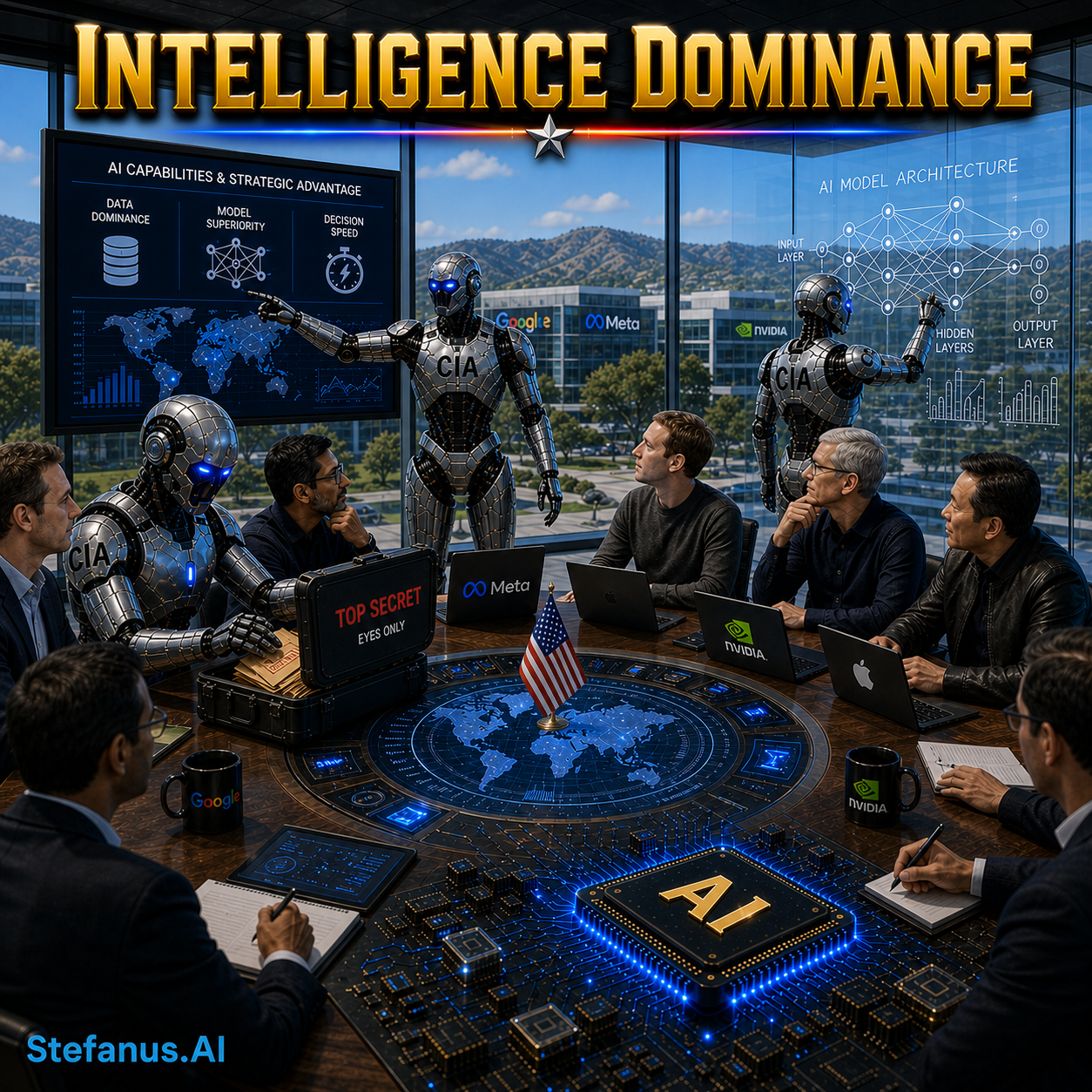

For most of modern history, the strength of a nation’s military was measured in firepower, troop size, and industrial capacity. Victory depended on logistics, weapons manufacturing, and the ability to sustain prolonged conflict. The twentieth century—from World War II through the Cold War—cemented this paradigm, where dominance was defined by nuclear arsenals, air superiority, and mechanized warfare.
But in the early decades of the twenty-first century, a profound transformation is underway. War is no longer decided solely by physical force—it is increasingly determined by the speed, accuracy, and scale of intelligence.
Artificial intelligence has begun to reshape the battlefield into something fundamentally different: a domain where decisions occur at machine speed, patterns are detected across vast datasets, and outcomes are influenced before human commanders can even react. In this new paradigm, the decisive advantage is not merely who has the most weapons—but who has the most advanced intelligence systems integrated into every layer of warfare.
This shift has given rise to what can be defined as Intelligence Dominance.
“Artificial intelligence is not just another technology—it is a general-purpose technology that will transform every sector, including defense.”¹
At the center of this transformation is an unexpected alliance: the convergence of the U.S. military establishment—represented by the United States Department of Defense (Department of War)—and a concentrated group of hyperscale technology firms including Google, Microsoft, Amazon Web Services, OpenAI, Nvidia, Oracle, Reflection, and SpaceX.
This alignment was not inevitable. In fact, less than a decade ago, it appeared unlikely.

The Silicon Valley Rebellion (2018)
In 2018, thousands of employees at Google openly protested the company’s involvement in Project Maven, a Pentagon initiative designed to apply AI to drone surveillance.
“We believe that Google should not be in the business of war.”²
The backlash was unprecedented. It represented a moment when the technology sector asserted moral independence from military objectives. Google ultimately withdrew from the contract, signaling a temporary boundary between commercial AI development and military application.
Yet that boundary proved fragile.
The Collapse of Separation
By 2026, the relationship between Silicon Valley and Washington has undergone a structural reversal. Instead of resistance, there is now deep integration.
Several forces drove this shift:
- Geopolitical competition with China
- Massive defense contracts and funding incentives
- Regulatory pressures from Europe and global markets
- Recognition that AI is a strategic asset comparable to nuclear capability
As Sam Altman observed:
“The strategic importance of AI will shape global power structures in ways we are only beginning to understand.”³
This convergence has reached a critical milestone in 2026, as the Pentagon formalized partnerships with major AI companies to deploy systems on classified and top-secret networks.
The Emergence of Intelligence Dominance
The core argument of this paper is that we are witnessing the emergence of a new doctrine:
Intelligence Dominance = The ability of a nation to integrate private-sector AI into military, intelligence, and decision-making systems at scale, enabling faster, more accurate, and more autonomous strategic actions than any adversary.
This doctrine transforms:
- Warfighting → from kinetic to cognitive
- Command structures → from hierarchical to algorithmic
- Intelligence → from human analysis to machine-driven inference
“The side that can observe, orient, decide, and act faster will prevail.”⁴
AI compresses this entire cycle into milliseconds.

Section 1: Why Private Tech Companies Are Aligning with the U.S. Government
The alignment between hyperscale technology firms and the U.S. government is not merely opportunistic—it is structural, driven by economic incentives, geopolitical necessity, and technological asymmetry.
1.1 Defense Contracts as Strategic Capital
The first driver is financial scale.
Government contracts in cloud computing, AI infrastructure, and satellite systems now rival or exceed traditional commercial markets. Programs involving Amazon Web Services and Microsoft have reached tens of billions of dollars in value.
“Cloud computing is now central to national security.”⁵
Defense spending has effectively become a parallel capital allocation system, where the government acts as the largest customer for advanced AI systems.
1.2 Investor Alignment and Defense Capital
Behind these companies lies a network of investors increasingly aligned with national security objectives.
The rise of AI startups backed by firms connected to defense ecosystems indicates that capital itself is becoming geopolitical.
“Technology and national security are now deeply intertwined.”⁶
This convergence ensures that private innovation is no longer isolated from state interests.
1.3 Regulatory Pressure and Strategic Protection
European regulations, including strict AI governance frameworks, have imposed significant compliance burdens on U.S. firms.
In response, companies are increasingly aligning with U.S. federal policy to gain strategic protection and influence.
1.4 Talent Asymmetry
Perhaps the most critical driver is the talent gap.
The Department of Defense cannot match the concentration of AI researchers found in private firms like OpenAI or Google DeepMind.
“The government will need to rely on private sector expertise to remain competitive in AI.”⁷
This dependency makes partnership unavoidable.

Section 2: The Rise of Classified AI Infrastructure
2.1 The 2026 Inflection Point
On May 1, 2026, the Pentagon formalized agreements with major technology firms to deploy AI systems across Impact Level 6 (Secret) and Level 7 (Top Secret) networks.
This marks the transition from experimental AI adoption to full operational integration.
2.2 The Multi-Layered AI Stack
The emerging architecture integrates multiple layers:
- Models → OpenAI, Google
- Compute → Nvidia, Reflection (AI startup founded in 2024 by former Google DeepMind)
- Cloud → Microsoft, Amazon Web Services, Oracle
- Orbit → SpaceX
This stack transforms the military into a digitally integrated intelligence system.
2.3 Toward an AI-First Military Doctrine
The Pentagon’s objective is explicit:
“We must accelerate AI adoption across the force.”⁸
Applications include:
- Real-time battlefield awareness
- Autonomous systems
- Predictive intelligence
- Logistics optimization
2.4 The Strategic Implication
This integration creates a feedback loop:
AI → better decisions → more data → better AI
The result is compounding intelligence advantage.

Section 3: Intelligence, Trust, and the Global Perception Problem
The emergence of Intelligence Dominance introduces a paradox that sits at the center of the global AI order: the same systems that enhance national security domestically can simultaneously erode trust internationally. As the United States integrates artificial intelligence into classified and top-secret military environments, a fundamental question arises—can AI systems developed within one sovereign power ever be perceived as neutral by another?
This is not merely a technical issue. It is a question of power, history, and embedded capability.
3.1 AI as a Strategic Surveillance Layer
Artificial intelligence systems—particularly those deployed at hyperscale—are not passive tools. They are active inference engines, capable of extracting patterns, behaviors, and predictions from vast amounts of data. When integrated into national security frameworks, these systems become extensions of intelligence agencies.
The historical precedent is clear.
“The Snowden disclosures revealed the extraordinary reach of U.S. surveillance capabilities across global communications.”⁹
The revelations surrounding the National Security Agency demonstrated that digital infrastructure—email systems, cloud storage, telecommunications—could be leveraged for intelligence gathering on a global scale.
Artificial intelligence amplifies this capability exponentially.
Unlike traditional surveillance, which depends on human analysts, AI systems can:
- Process billions of data points in real time
- Identify hidden correlations across domains
- Predict behavior before it occurs
“AI will dramatically increase the scale and precision of surveillance.”¹⁰
This creates a structural shift: surveillance is no longer episodic—it becomes continuous, predictive, and autonomous.
3.2 Embedded Intelligence and the Sovereignty Question
As U.S.-developed AI systems expand globally—through cloud platforms, enterprise software, and consumer applications—foreign governments are increasingly concerned about embedded intelligence risks.
The concern is not hypothetical. It is rooted in a simple premise:
If AI systems are trained, hosted, or maintained within U.S. jurisdiction, then under certain legal frameworks, data access may be compelled by the U.S. government.
“Data is the new oil—but it is also the new source of geopolitical power.”¹¹
This raises critical questions for foreign states:
- Can U.S.-built AI systems be trusted with sensitive national data?
- Will AI platforms act as indirect extensions of U.S. intelligence?
- Should countries develop their own sovereign AI ecosystems?
The result is a growing movement toward model sovereignty and digital fragmentation, where nations seek to control their own AI infrastructure.
3.3 The Weaponization of Civilian Technology
One of the defining characteristics of modern conflict is the dual-use nature of technology. Devices originally designed for civilian communication, navigation, or productivity can be repurposed for military objectives.
Recent conflicts have demonstrated how deeply integrated technology has become in warfare. Communications infrastructure, satellite systems, and even handheld devices can be transformed into tactical assets—or vulnerabilities.
“In the digital age, every connected device is a potential battlefield.”¹²
This reality introduces a new layer of strategic risk:
- Smartphones become tracking systems
- Satellites become targeting platforms
- AI models become decision engines for military operations
The boundary between civilian and military technology has effectively collapsed.
3.4 Trust Deficit and Global AI Fragmentation
As a result, the world is entering a phase of AI fragmentation, where trust is no longer universal.
Countries are beginning to:
- Restrict foreign AI platforms
- Localize data storage and processing
- Invest in domestic AI ecosystems
This mirrors earlier trends in semiconductor and telecommunications industries but operates at a deeper level—the level of cognition and decision-making.
“We are moving toward a world of competing technological spheres.”¹³
In this fragmented environment, Intelligence Dominance becomes not just a military objective, but a geopolitical organizing principle.

Section 4: U.S.–China Escalation and the Geopolitics of AI Power
If Section 3 defines the trust problem, Section 4 defines the power struggle.
The integration of AI into national security systems is not occurring in isolation. It is unfolding within the context of an intensifying strategic rivalry between the United States and the China.
4.1 The Narrowing Technological Gap
For much of the early AI revolution, the United States maintained a clear lead in research, talent, and infrastructure. However, China has rapidly accelerated its capabilities through state-backed investment, industrial policy, and large-scale data utilization.
“China is on track to rival—or even surpass—the United States in key areas of artificial intelligence.”¹⁴
Chinese firms, supported by government initiatives, have achieved significant progress in:
- Computer vision
- Surveillance systems
- Large-scale deployment of AI applications
The gap is no longer measured in decades—it is increasingly measured in months or years.
4.2 Semiconductor Warfare: The Foundation of Intelligence Dominance
At the core of this competition lies the semiconductor industry.
Advanced AI systems depend on high-performance chips—particularly GPUs and specialized accelerators produced by companies like Nvidia.
The United States has responded with aggressive export controls designed to limit China’s access to these technologies.
“Semiconductors have become the new strategic choke point in global competition.”¹⁵
These restrictions include:
- Limiting exports of advanced AI chips
- Blocking manufacturing equipment to Chinese fabs
- Restricting collaboration with Chinese firms
This is not conventional trade policy—it is technological containment strategy.
4.3 Escalation Through Asymmetric Incidents
Beyond formal policy, the rivalry is increasingly expressed through asymmetric and ambiguous incidents.
Examples include:
- High-altitude surveillance balloons
- Drone incursions near sensitive infrastructure
- Cyber intrusions targeting critical systems
Each incident reflects a broader pattern: competition below the threshold of open conflict, enabled by advanced technology.
“Future conflict will occur in the gray zone between war and peace.”¹⁶
Artificial intelligence amplifies this gray zone by enabling faster, more precise, and less attributable actions.
4.4 Diplomatic Fragility in the AI Era
Despite escalating tensions, diplomatic engagement continues.
High-level meetings between U.S. and Chinese leadership underscore the dual reality of competition and interdependence.
However, AI introduces a destabilizing factor: speed.
Traditional diplomacy operates on human timescales—days, weeks, months.
AI operates on milliseconds.
“AI compresses decision-making timelines in ways that could increase the risk of unintended escalation.”¹⁷
This compression creates a dangerous mismatch:
- Human leaders deliberate slowly
- AI systems act instantly
The risk is not just conflict—it is miscalculation at machine speed.
4.5 Europe and the Third Axis of Regulation
While the U.S. and China compete for technological dominance, Europe is positioning itself as a regulatory superpower.
Through comprehensive frameworks, the European Union seeks to shape the ethical and legal boundaries of AI deployment.
This introduces a third axis:
- U.S. → innovation and scale
- China → state integration and control
- Europe → regulation and governance
“Europe may not lead in AI development, but it will shape how AI is governed.”¹⁸
For U.S. companies, this creates a complex environment:
- Align with U.S. national security
- Comply with European regulation
- Compete with Chinese state-backed firms
4.6 Intelligence Dominance as the New Strategic Doctrine
The convergence of these dynamics—technological competition, semiconductor control, geopolitical rivalry, and regulatory divergence—leads to a single conclusion:
Artificial intelligence is no longer a tool within geopolitics. It is the foundation of geopolitics itself.
Intelligence Dominance becomes the organizing doctrine of this new era.
“Whoever leads in AI will have a decisive advantage in both economic and military power.”¹⁹

Section 5: Strategic Lessons, Institutional Realignment, and the Architecture of Intelligence Dominance
The preceding sections have established three foundational dynamics:
(1) the integration of artificial intelligence into classified military systems,
(2) the erosion of global trust in cross-border AI infrastructure, and
(3) the intensifying geopolitical competition between the United States and China.
What emerges from this convergence is not merely a technological shift, but a systemic reorganization of power.
Artificial intelligence is no longer an enabling tool—it is becoming the primary architecture through which national security is executed, economic strength is amplified, and geopolitical advantage is sustained.
This section distills the lessons from this transformation and outlines the structural implications for governments, private companies, and the global order.
5.1 The Collapse of the Public–Private Boundary
Historically, the relationship between governments and private industry—particularly in the United States—has been characterized by a degree of separation. Private companies innovated; governments regulated or procured.
That model is no longer sufficient.
The scale and complexity of artificial intelligence systems—especially those required for national security—have rendered governments dependent on private-sector capabilities. Hyperscale firms such as Google, Microsoft, Amazon Web Services, and OpenAI now control critical components of the AI stack, from foundational models to cloud infrastructure.
“The boundary between the state and the firm is blurring in the digital age.”²⁰
This blurring creates a hybrid structure that can be described as a distributed national security apparatus, in which private companies act as extensions of state capability.
Unlike traditional defense contractors, however, these firms are not solely dependent on government contracts. They operate globally, serve billions of users, and possess independent strategic agendas.
This introduces a fundamental tension:
- Governments require control and security
- Companies require scale and global reach
Managing this tension becomes central to sustaining Intelligence Dominance.
5.2 Intelligence as Infrastructure, Not Application
One of the most important conceptual shifts in understanding artificial intelligence is recognizing that it is no longer merely an application layer. It is becoming infrastructure—as fundamental as electricity, transportation, or telecommunications.
“General-purpose technologies reshape entire economies, not just individual sectors.”²¹
Artificial intelligence now operates across:
- Military command systems
- Financial markets
- Healthcare diagnostics
- Supply chain logistics
- Communication networks
This ubiquity transforms intelligence into a baseline capability, rather than a specialized function.
For national security, this means that AI must be treated as:
- A strategic asset
- A critical dependency
- A potential vulnerability
Failure to control this infrastructure results not just in inefficiency, but in systemic exposure to adversaries.
5.3 The Rise of Algorithmic Command Structures
As AI systems become more integrated into defense operations, command structures themselves begin to evolve.
Traditional military hierarchies are designed around human decision-making cycles—chains of command, layers of authorization, and sequential analysis. These structures are increasingly incompatible with the speed of AI-driven environments.
“Decision advantage will depend on integrating humans and machines effectively.”²²
The emerging model is not purely autonomous, but machine-augmented command:
- AI systems generate options and predictions
- Human operators validate and authorize actions
- Feedback loops refine future decisions
Over time, however, the balance may shift further toward automation.
This raises critical questions:
- At what point does human oversight become symbolic rather than substantive?
- Can accountability be maintained in machine-driven systems?
- Who is responsible for errors generated by AI recommendations?
These questions are not theoretical—they are operational challenges already emerging within defense institutions.
5.4 Private Companies as Strategic Actors in Warfare
One of the most profound implications of Intelligence Dominance is the elevation of private technology firms into strategic actors in warfare.
Companies like SpaceX, through satellite infrastructure, and Nvidia, through compute dominance, are no longer peripheral suppliers. They are core enablers of military capability.
“Private companies now play a central role in national security.”²³
This transformation introduces a new category of actor:
the techno-strategic firm.
Characteristics include:
- Control over critical infrastructure (cloud, chips, satellites)
- Global operational footprint
- Direct engagement with government contracts
- Influence over technological standards
Unlike traditional defense contractors, these firms:
- Serve both civilian and military markets
- Operate across multiple jurisdictions
- Influence public discourse and policy
This dual role creates both opportunities and risks:
- Enhanced innovation and capability
- Increased complexity in governance and accountability
5.5 Lessons for Private Technology Firms
For private companies, Intelligence Dominance is not optional—it is structural. The question is not whether to engage with national security, but how to engage responsibly and strategically.
Lesson 1: Neutrality Is No Longer Viable
The global fragmentation of AI systems means that companies will inevitably be drawn into geopolitical competition.
“Technology companies cannot remain geopolitically neutral in a bifurcated world.”²⁴
Lesson 2: Security Becomes a Core Competency
AI systems deployed in national security contexts must meet the highest standards of:
- Data protection
- Model integrity
- Operational resilience
Lesson 3: Governance Frameworks Must Evolve
Ethical principles established in earlier phases of AI development must now be adapted to military and intelligence applications.
This includes:
- Clear rules of engagement
- Accountability mechanisms
- Transparency where possible
Lesson 4: Long-Term Alignment with State Objectives
Companies must align with national strategies while maintaining operational independence.
This requires:
- Strategic partnerships
- Policy engagement
- Investment in secure infrastructure
5.6 Lessons for Government and National Security Institutions
Governments must also adapt to the realities of Intelligence Dominance.
Lesson 1: Build Sustainable Public–Private Partnerships
Ad hoc contracts are insufficient. Long-term frameworks are required to ensure:
- Continuity
- Security
- Mutual trust
Lesson 2: Invest in Talent and Institutional Capacity
The reliance on private-sector expertise must be balanced with internal capability development.
“Human capital remains the foundation of technological power.”²⁵
Lesson 3: Establish Clear Governance Structures
AI deployment in defense contexts must be guided by:
- Legal frameworks
- Ethical standards
- Operational doctrines
Lesson 4: Manage Escalation Risks
The speed and autonomy of AI systems increase the risk of unintended conflict.
Governments must develop mechanisms to:
- Slow decision cycles when necessary
- Maintain human oversight
- Coordinate internationally
5.7 Intelligence Dominance as a Strategic Doctrine
Bringing these elements together, Intelligence Dominance can be formalized as a strategic doctrine with three core pillars:
Pillar 1: Integration
Seamless integration of AI across:
- Military systems
- Intelligence agencies
- Private-sector infrastructure
Pillar 2: Acceleration
The ability to:
- Process information faster
- Make decisions more rapidly
- Act before adversaries can respond
Pillar 3: Control
Control over:
- Data
- Models
- Compute infrastructure
- Deployment environments
“Speed, scale, and control will define power in the AI era.”²⁶
These pillars transform Intelligence Dominance from a descriptive concept into an operational framework.

Conclusion: Intelligence Dominance as the Defining Doctrine of the AI Century
The transformation outlined across this paper is neither incremental nor temporary. It is structural. It is systemic. And most importantly, it is irreversible.
From the early resistance of Silicon Valley engineers in 2018 to the formal integration of hyperscale artificial intelligence systems into classified and top-secret networks by 2026, the United States has crossed a threshold. What once appeared as a tension between private innovation and state power has evolved into a deeply interdependent architecture of national capability.
Artificial intelligence has not merely entered the domain of national security—it has redefined it.
From Military Superiority to Intelligence Superiority
For centuries, military power was measured in physical terms:
- The size of armies
- The sophistication of weapons
- The reach of logistics
In the twentieth century, this expanded to include nuclear deterrence and industrial capacity. But in the twenty-first century, a new metric has emerged—the ability to generate, process, and act upon intelligence faster and more accurately than any adversary.
“The future of warfare will be defined by who can process information and make decisions the fastest.”²⁷
This shift marks the transition from military superiority to intelligence superiority.
The implications are profound:
- Battles may be decided before they begin
- Strategies may be optimized in real time
- Outcomes may be shaped by algorithms rather than commanders
In this environment, Intelligence Dominance is not simply advantageous—it is decisive.
The Convergence of Hyperscalers and the State
At the heart of this transformation lies the convergence between the United States Department of Defense and a concentrated set of hyperscale firms, including Google, Microsoft, Amazon Web Services, OpenAI, Nvidia, Oracle, Reflection, and SpaceX.
This convergence is not incidental—it is necessary.
The complexity of modern AI systems, the scale of compute infrastructure, and the concentration of technical talent have made it impossible for governments to operate independently. At the same time, the geopolitical stakes of artificial intelligence have made it impossible for private firms to remain detached from national strategy.
What emerges is a new institutional form:
A hybrid public–private intelligence architecture, in which the capabilities of the state and the innovations of the private sector are fused into a single operational system.
The New Battlefield: Cognitive, Invisible, Continuous
Unlike traditional warfare, which is geographically bounded and temporally discrete, AI-driven conflict operates across a different set of dimensions.
It is:
- Cognitive → targeting decision-making processes
- Invisible → embedded in software, data, and networks
- Continuous → operating in real time, without clear beginning or end
“The battlefield of the future will exist everywhere data flows.”²⁸
This redefinition of the battlefield introduces a new strategic reality:
conflict is no longer an event—it is a condition.
Artificial intelligence systems operate persistently, shaping outcomes across domains long before kinetic force is applied.
The Fragility of Speed: Escalation in the Age of AI
Yet the very capabilities that enable Intelligence Dominance also introduce new forms of risk.
The compression of decision-making timelines—from hours to seconds, from seconds to milliseconds—creates the possibility of unintended escalation.
“The speed of AI systems could outpace human ability to manage crises.”²⁹
In traditional diplomacy and military strategy, time functions as a buffer—a space for reflection, negotiation, and de-escalation. AI reduces or eliminates that buffer.
This creates a structural vulnerability:
- Misinterpretations can propagate instantly
- Automated responses can trigger cascading effects
- Human oversight may arrive too late
The challenge is not only to build faster systems—but to ensure that speed does not outpace control.
Global Fragmentation and the End of Universal Technology
As explored in earlier sections, the integration of AI into national security architectures has profound implications for global trust.
The world is no longer converging toward a single technological ecosystem. Instead, it is fragmenting into competing spheres:
- U.S.-aligned AI systems
- China-centered technological infrastructure
- European regulatory frameworks
“We are entering an era of technological bifurcation.”³⁰
In this environment, AI is no longer neutral. It carries:
- Political assumptions
- Legal constraints
- Strategic implications
For global users, this raises difficult choices:
- Which systems to trust
- Which ecosystems to adopt
- Which risks to accept
Why “Intelligence Dominance” Is the Right Framework
The term Intelligence Dominance captures this transformation more precisely than any existing framework.
It reflects three core realities:
1. Intelligence as the Primary Source of Power
Power is no longer derived solely from physical assets, but from the ability to:
- Generate insights
- Predict outcomes
- Influence decisions
2. Integration Across Systems
Intelligence is not isolated—it is embedded across:
- Military operations
- Economic systems
- Digital infrastructure
3. Acceleration and Scale
The defining characteristic of AI-driven intelligence is its ability to operate at:
- Massive scale
- Machine speed
- Continuous frequency
Together, these elements redefine dominance itself.
Action Framework: What Must Be Done
To sustain Intelligence Dominance, both private companies and government institutions must act decisively.
For Private Technology Companies
- Develop secure, sovereign AI architectures
- Align with national security frameworks without losing global competitiveness
- Invest in transparency and trust mechanisms
- Build resilience against misuse and adversarial attacks
For the U.S. Government
- Strengthen long-term partnerships with hyperscale firms
- Expand investment in AI talent and research
- Establish clear governance for AI deployment in defense
- Lead international efforts to define norms and standards
For the Global Community
- Recognize AI as a strategic domain
- Develop mechanisms to reduce escalation risk
- Balance innovation with accountability
Final Reflection: The Future of Power
The convergence of artificial intelligence, national security, and private-sector innovation represents one of the most significant transformations in modern history.
It is comparable to:
- The industrial revolution
- The nuclear age
- The rise of the internet
But it is also fundamentally different.
Artificial intelligence does not simply augment human capability—it begins to replicate and accelerate cognition itself.
“AI is the most powerful technology humanity has ever created.”³¹
In such a world, the question is no longer whether nations will compete—it is how they will compete, and whether that competition can be managed without catastrophic consequences.
Intelligence Dominance offers both an opportunity and a warning:
- An opportunity to enhance security, efficiency, and strategic clarity
- A warning that power, once accelerated beyond human control, may become difficult to contain
The outcome of this transformation will define not only the future of warfare, but the future of global order.
And at the center of it all lies a single, defining truth:
The nation that masters intelligence—at scale, at speed, and with control—will shape the destiny of the twenty-first century.

Footnotes
1. Erik Brynjolfsson, MIT — Artificial Intelligence and the Modern Economy
https://www.mit.edu
2. Daisuke Wakabayashi, “Google Employees Protest Pentagon Contract,” The New York Times (2018)
https://www.nytimes.com/2018/04/04/technology/google-letter-ceo-pentagon-project.html
3. Sam Altman, OpenAI — Public Statements on AI and Global Power
https://openai.com
4. John Boyd, OODA Loop Theory, U.S. Air Force Doctrine
https://www.airuniversity.af.edu
5. “U.S. Defense Cloud Contracts and Big Tech,” Reuters
https://www.reuters.com
6. Center for Strategic and International Studies (CSIS), AI and National Security
https://www.csis.org
7. Brookings Institution, AI Talent and U.S. Competitiveness
https://www.brookings.edu
8. U.S. Department of Defense, DoD Artificial Intelligence Strategy
https://www.defense.gov
9. Glenn Greenwald, “NSA Collecting Phone Records,” The Guardian (2013)
https://www.theguardian.com/world/2013/jun/06/nsa-phone-records-verizon-court-order
10. Shoshana Zuboff, The Age of Surveillance Capitalism, Harvard Business School
https://www.hbs.edu/faculty/Pages/item.aspx?num=56791
11. “The World’s Most Valuable Resource Is No Longer Oil, but Data,” The Economist
https://www.economist.com/leaders/2017/05/06/the-worlds-most-valuable-resource-is-no-longer-oil-but-data
12. “Technology and the Future of Warfare,” Financial Times
https://www.ft.com
13. Henry Farrell & Abraham Newman, “Weaponized Interdependence,” Foreign Affairs
https://www.foreignaffairs.com/articles/world/2019-10-15/weapons-interdependence
14. Kai-Fu Lee, AI Superpowers
https://www.aisuperpowers.com
15. Chris Miller, Chip War: The Fight for the World’s Most Critical Technology
https://www.chipwar.com
16. Michael Mazarr, RAND Corporation, Gray Zone Conflict
https://www.rand.org
17. Paul Scharre, Center for a New American Security (CNAS), AI and Military Decision-Making
https://www.cnas.org
18. Anu Bradford, The Brussels Effect, Columbia Law School
https://www.law.columbia.edu
19. U.S. National Security Commission on Artificial Intelligence (NSCAI), Final Report
https://www.nscai.gov
20. Shoshana Zuboff, Harvard Business School, Surveillance Capitalism and Power
https://www.hbs.edu/faculty/Pages/item.aspx?num=56791
21. Erik Brynjolfsson & Andrew McAfee, The Second Machine Age, MIT
https://ide.mit.edu/publication/the-second-machine-age/
22. Defense Advanced Research Projects Agency (DARPA), AI Strategy
https://www.darpa.mil
23. Center for Strategic and International Studies (CSIS), Technology and National Security
https://www.csis.org
24. Henry Kissinger, Eric Schmidt, Daniel Huttenlocher, The Age of AI
https://www.penguinrandomhouse.com
25. World Bank, Human Capital Project Report
https://www.worldbank.org
26. “AI, Power, and Global Competition,” Financial Times
https://www.ft.com
27. Paul Scharre, Army of None: Autonomous Weapons and the Future of War
https://www.cnas.org/publications/books/army-of-none
28. NATO, Emerging and Disruptive Technologies Report
https://www.nato.int
29. RAND Corporation, AI and Escalation Risks in Warfare
https://www.rand.org
30. “Technology Fragmentation and Global Order,” Financial Times
https://www.ft.com
31. Henry Kissinger, Eric Schmidt, Daniel Huttenlocher, The Age of AI
https://www.amazon.com/Age-I-Our-Human-Future/dp/0316273805


Comments
[…] announcement was made at the White House, framed explicitly in terms of American leadership, national security, and strategic competition with China. This framing — AI infrastructure as a public good and […]
[…] This is the architecture of modern financial markets, modern content platforms, and, increasingly, modern military operations. It raises a question that no technical advancement can resolve: when autonomous loops make […]
[…] which — like those of other frontier labs — impose restrictions on the use of its models for some military and intelligence applications, restrictions the company has had to periodically clarify and, in places, loosen as its government […]