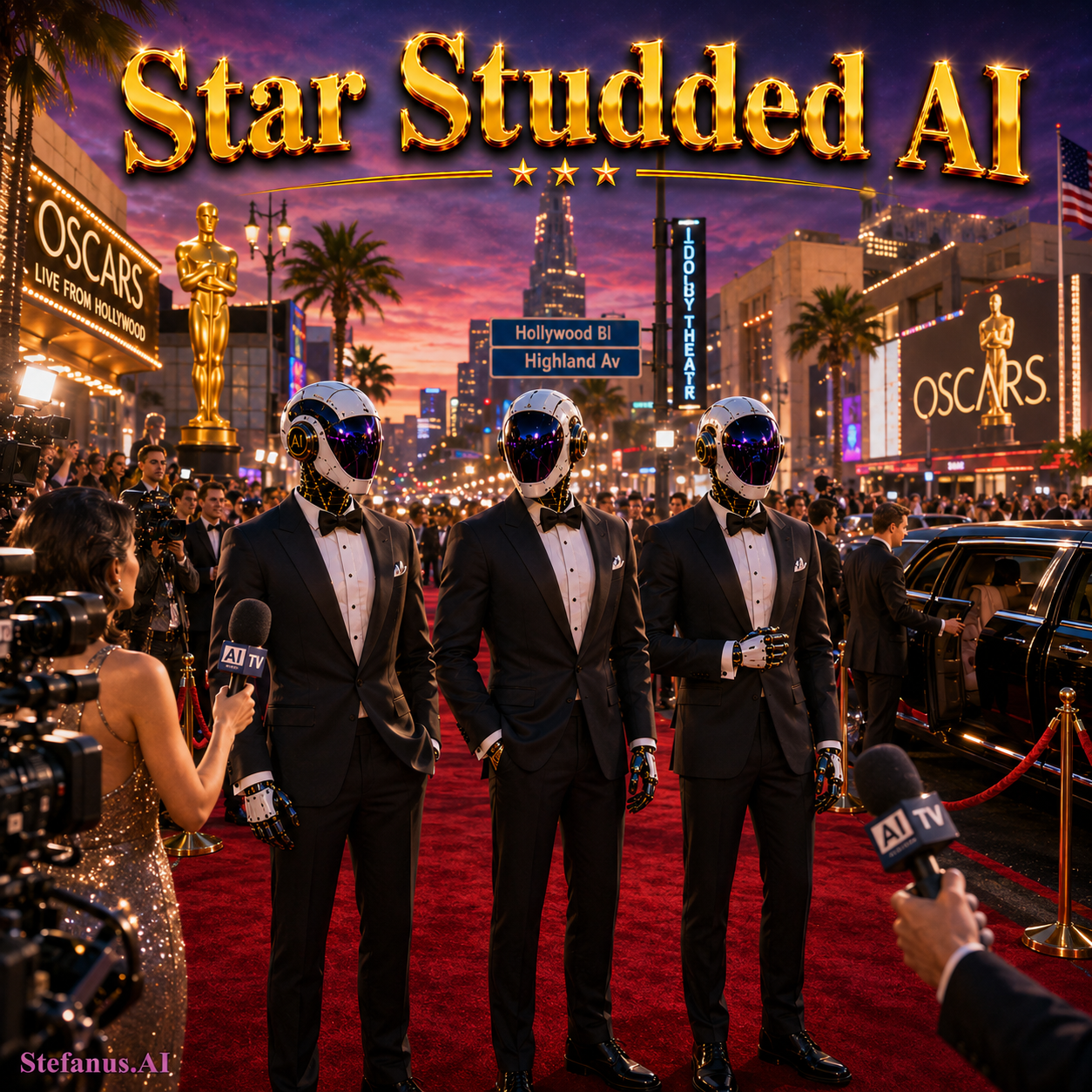

Introduction: Why “Star-Studded AI”?
Artificial intelligence has spent the past several years moving through predictable institutional corridors. First came the researchers, who debated architectures, scaling laws, transformer efficiencies, alignment frameworks, and compute bottlenecks. Then came the hyperscalers — Microsoft, Google, Amazon, Meta — who transformed AI from laboratory theory into industrial infrastructure by committing tens of billions of dollars to chips, datacenters, networking equipment, and energy procurement. Then came regulators, unions, economists, and policy analysts, each attempting to define the legal and social boundaries of systems whose capabilities appeared to advance faster than governance mechanisms could adapt.
Hollywood, for much of that period, was expected to be among AI’s fiercest opponents. That expectation was not irrational. For actors, AI represented synthetic likeness replication conducted at industrial scale. For writers, it suggested script generation and labor substitution. For voice artists, it implied cloning without consent. For visual effects teams, AI raised fears of workflow compression that could eliminate thousands of jobs. For producers, it introduced uncertainty around copyright ownership, legal exposure, and reputational risk. For unions, AI became a labor battlefield unlike any the entertainment industry had navigated before.
And yet, in a remarkably compressed period of time, the emotional geometry began to shift. What had once been taboo began to look negotiable. What had once been adversarial began to look opportunistic. What had once been framed as existential risk began, in selected contexts, to be reconceived as acceleration.
The significance of this transition cannot be understood merely as another chapter in the long serial of technology disruption. Hollywood has lived through many transitions before — sound, color, television, cable, CGI, digital editing, streaming, social media, creator platforms. Artificial intelligence, however, is not simply another production tool. It is a synthetic capability layer capable of altering authorship, identity, economics, and the production stack simultaneously. It threatens and promises across every dimension of creative labor at once. That is what makes the current moment different in kind, not merely in degree.
What makes the moment especially noteworthy is not simply that Hollywood is adapting. It is that some of Hollywood’s most visible figures are no longer merely reacting to AI — they are actively participating in its commercialization architecture.
Ben Affleck, founding an AI production technology company, InterPositive, and selling it to Netflix in 2026 for an estimated $600 million. Trey Parker and Matt Stone, building synthetic visual technology through Deep Voodoo years before mainstream cultural acceptance stabilized. Reese Witherspoon, publicly encouraging AI literacy and normalizing experimentation. Doug Liman, integrating AI-enabled filmmaking workflows into production practice. Reid Hoffman, commercializing synthetic identity frameworks in ways that extend celebrity capital into programmable infrastructure. Lucy Guo, architecting creator monetization systems that intersect with AI-native digital economies.
This is not a story about celebrities discovering technology. This is a story about celebrity capital becoming part of technology diffusion infrastructure. That distinction matters enormously. Throughout industrial history, major technologies did not achieve mass adoption solely because they were technically superior. They succeeded because institutions, brands, governments, or cultural validators translated technical novelty into social legitimacy.
Everett M. Rogers, whose foundational work in diffusion theory remains the authoritative framework for understanding how innovations spread through social systems, observed precisely this mechanism: 1
“Diffusion investigations show that most individuals do not evaluate an innovation on the basis of scientific studies of its consequences, although such objective evaluations are not entirely irrelevant, especially to the very first individuals who adopt. Instead, most people depend mainly upon a subjective evaluation of an innovation that is conveyed to them from other individuals like themselves who have previously adopted the innovation.” — Everett M. Rogers, Diffusion of Innovations, 5th ed. (2003)²
Rogers’s insight has direct bearing on artificial intelligence’s current trajectory. Consumers do not need to understand transformer architectures to embrace AI-enhanced creativity if trusted public figures normalize its use. Creators do not need procurement committees to experiment with generative workflows. Studios do not need ideological certainty if economic incentives become overwhelming. The question, therefore, is not only who builds the most capable models — it is who makes those models feel socially permissible to an audience that is still emotionally forming its relationship with artificial intelligence.
This paper introduces a framework for understanding that transition. Star-Studded AI refers to the phase in artificial intelligence commercialization in which celebrity influence, cultural legitimacy, entertainment infrastructure, creator ecosystems, and audience trust accelerate AI adoption faster than conventional enterprise distribution channels.
The framework identifies a deeper structural transformation beneath the surface-level observation of celebrities experimenting with new tools. Hollywood’s A-list may increasingly function as a distribution layer for artificial intelligence — not just culturally, but commercially, economically, and strategically. In conventional enterprise adoption, technological diffusion follows familiar institutional pathways: vendor to enterprise sales to procurement review to executive approval to deployment to internal adoption. Star-Studded AI introduces an alternative diffusion pathway: celebrity endorsement to audience curiosity to creator experimentation to cultural normalization to platform monetization to enterprise legitimization. The latter can move dramatically faster.
This paper therefore argues that AI’s next commercialization frontier may not be determined solely by model developers, hyperscalers, or semiconductor manufacturers. It may also be shaped by those who control aspiration, attention, cultural legitimacy, and audience behavior. That is why this framework is called Star-Studded AI.

Section 1: From Taboo to Selective Embrace — The Psychology of Industrial Reversal
To understand Star-Studded AI, one must first understand the psychological reversal that made it possible. Hollywood’s initial relationship with artificial intelligence was not cautious curiosity. It was defensive suspicion — a suspicion rooted in the specific nature of what AI appeared capable of threatening.
The entertainment industry’s anxiety around automation is not new. Mechanization has historically challenged forms of creative labor whenever production workflows become standardized. Yet artificial intelligence felt categorically different because it did not merely automate repetitive physical functions. It appeared to intrude directly into identity, authorship, performance, and imagination — the domains Hollywood has always considered irreducibly human.
The 2023 strikes by the Writers Guild of America and SAG-AFTRA made these concerns visible to a broader public in unprecedented ways. AI became shorthand for existential labor displacement on a scale the entertainment industry had never confronted. The SAG-AFTRA strike ran for one hundred and eighteen days — the longest actors’ strike against film and television studios in Hollywood history — and was the first time actors and writers walked out simultaneously since 1960.
Duncan Crabtree-Ireland, SAG-AFTRA’s National Executive Director and Chief Negotiator, described the union’s position at the 2024 World Economic Forum Annual Meeting in Davos: 8
“We came in saying we’re willing to partner with you on AI, but there have to be guardrails and protections built into the contract.” — Duncan Crabtree-Ireland, SAG-AFTRA National Executive Director, World Economic Forum, Davos, January 2024
The contracts that emerged from those negotiations represent something historically significant: the first major collective bargaining framework in any industry to formally govern AI’s use of human identity.16 Both agreements established the foundational legal principle that one must be human to be a writer of literary material or a performer behind a Digital Replica — and thus eligible for credit and compensation.9 That principle, seemingly obvious in retrospect, required a work stoppage that halted the American film and television industries to establish.
These concerns were not abstract. Artificial intelligence differs from previous media technologies because it creates synthetic outputs that can imitate creative contribution itself. Traditional automation replaces mechanical repetition. Artificial intelligence threatens symbolic labor — authorship, performance, identity projection, emotional expression, aesthetic judgment, narrative construction. These are precisely the domains Hollywood has historically considered most deeply human, and therefore most fiercely protected.
Nobel Prize-winning economist Daron Acemoglu of MIT, whose research on technology and labor markets has become a defining framework for understanding AI’s economic implications, has characterized much current AI deployment as what he calls “so-so technology”: applications that perform at best only marginally better than humans, but save companies money by substituting cheaper machine output for human labor.5 This framing captures exactly what Hollywood’s unions feared: not that AI would dramatically exceed human creative capability, but that it would be deployed as a cost-reduction mechanism even before reaching genuine creative parity.
And yet cultural narratives rarely remain static once economic incentives evolve. The reversal did not happen because Hollywood suddenly resolved its philosophical concerns about machine creativity. The reversal happened because AI’s practical framing began to change in ways that made selective accommodation economically rational.
Instead of being presented purely as a replacement engine, AI increasingly appeared — in strategic communications, in product positioning, in the public statements of credible creative figures — as a productivity multiplier. That psychological repositioning was decisive. If AI replaces writers, resistance remains fierce. If AI accelerates ideation, lowers production costs, enhances post-production, enables creative experimentation, or reduces infrastructure overhead, resistance becomes more negotiable.
This pattern is consistent with Erik Brynjolfsson’s research on AI and productivity at Stanford, which found that generative AI tools increased overall worker productivity by an average of fourteen percent, with the most significant gains — thirty-four percent — accruing to novice and lower-skilled workers.3 The implication is that AI’s value proposition is strongest not as a replacement for peak human capability, but as an infrastructure that compresses the distance between average and expert performance.
“Access to the tool increases productivity, as measured by issues resolved per hour, by 14% on average, including a 34% improvement for novice and low-skilled workers but with minimal impact on experienced and highly skilled workers.” — Erik Brynjolfsson, Danielle Li, and Lindsey Raymond, “Generative AI at Work,” NBER Working Paper 31161 / The Quarterly Journal of Economics (2023/2025)³
Hollywood’s emerging posture is not “AI everywhere.” It is closer to “AI where economically useful and reputationally survivable.” That nuance matters. The entertainment industry is not becoming uniformly pro-AI. It is becoming selectively pragmatic. That selective pragmatism creates space for public figures to shape adoption norms — and once public figures participate, taboo weakens rapidly through a dynamic Rogers described as the signaling cascade of early adopters influencing majority behavior.
Rogers observed that innovations spread not through universal rational evaluation but through social proof transmitted across networks: 20 early adopters who are perceived as credible, successful, and culturally aligned signal to the broader population that adoption is permissible. In Hollywood’s case, early adopters happen to be among the most visible and trusted cultural figures in the world. The mechanism is the same as in any diffusion process; the amplification is extraordinary.

Section 2: The New Celebrity-Technologist Class — From Endorsement to Infrastructure
Hollywood historically separated creative prestige from infrastructure ownership. Actors performed. Studios financed. Engineers built tools. Technologists operated infrastructure. These categories were kept distinct not by accident but by institutional design — the studio system, union contracts, and the guild framework all reinforced the boundary between creative and commercial functions.
Artificial intelligence is beginning to blur those distinctions in ways that are commercially consequential and institutionally disruptive. A new class is emerging: the celebrity-technologist. These are not merely celebrities endorsing products for promotional fees. They are active participants in technological infrastructure, commercialization, or strategic normalization of AI systems. That distinction — between promotional celebrity and operational celebrity — affects legitimacy, capital allocation, audience behavior, and commercialization pathways in fundamentally different ways.
Ben Affleck and the InterPositive Architecture
Ben Affleck’s AI positioning matters not simply because of celebrity recognition, but because of how he framed AI’s role in filmmaking, and because that framing was backed by a four-year operational commitment that culminated in one of the most significant AI acquisitions in Hollywood history.
In 2022, Affleck founded InterPositive, an AI production technology company developed entirely in stealth. The company trained proprietary AI models on a controlled soundstage dataset representing real-world production conditions — not text prompts or synthetically generated training data, but actual cinematographic vocabulary. As Affleck described the company’s founding philosophy:11
“I wanted to build a workflow that captures what happens on a set, with vocabulary that matched the language cinematographers and directors already spoke and included the kind of consistency and controls they would expect. We also built in restraints to protect creative intent, so the tools are designed for responsible exploration while keeping creative decisions in the hands of artists — and ensuring that the benefits of this technology flow directly back to the story they’re trying to tell.” — Ben Affleck, on InterPositive’s founding methodology (2026)¹¹
At the 2024 CNBC Delivering Alpha investor summit, Affleck offered what has since become one of the most widely quoted formulations of AI’s relationship to human creativity from any public figure in the entertainment industry:10
“AI can write you excellent imitative verse that sounds Elizabethan. It cannot write you Shakespeare.” — Ben Affleck, CNBC Delivering Alpha Summit, November 2024¹⁰
That formulation is not merely rhetorical. It encodes a specific philosophical claim about the nature of AI capability — one that distinguishes imitation from origination, technical competence from artistic judgment. Affleck went further in the same remarks to articulate a specific commercial theory of AI’s value in production:10
“What AI is going to do is going to dis-intermediate the more laborious, less creative, and more costly aspects of filmmaking, that will allow costs to be brought down, that will lower the barrier to entry, that will allow more voices to be heard, that will make it easier for the people who want to make Good Will Huntings to go out and make it.” — Ben Affleck, CNBC Delivering Alpha Summit, November 2024¹⁰
In March 2026, Netflix acquired InterPositive in a transaction valued at approximately $600 million. The sixteen-person team joined Netflix, and Affleck assumed a senior advisory role. Patent documentation reviewed by Deadline revealed that InterPositive projected production cost reductions of ten to twenty percent overall, with specific departments such as visual effects estimated at fifty percent reduction and background actors at seventy percent.12
Affleck’s strategic importance within the Star-Studded AI framework operates on multiple levels simultaneously. As a filmmaker and Academy Award winner, he carries institutional credibility within the creative community. As an entrepreneur who built and sold a successful AI company, he carries financial credibility within the investment community. And as a public figure whose AI statements reached millions of viewers across news channels, he carries cultural credibility with audiences who are still forming their intuitions about what AI in creative work means.
His positioning also demonstrates how the celebrity-technologist role differs from traditional celebrity endorsement. Affleck did not merely attach his name to an existing AI product. He founded a company, spent four years building it, articulated a coherent philosophical framework for AI’s appropriate role in filmmaking, and then transferred that technology into the largest streaming infrastructure in the world. That is not endorsement. That is infrastructure construction.17
Trey Parker and Matt Stone: Synthetic Media Before Consensus
If Ben Affleck represents pragmatic industrial adoption arriving at the precise moment of maximum strategic leverage, Trey Parker and Matt Stone represent something different: anticipatory synthetic experimentation that predates mainstream cultural consensus by years.
The creators of South Park began building what would become Deep Voodoo in early 2020 — not as a response to the AI investment cycle, but as a practical solution to a production problem. They were developing a deepfake-based feature film about Donald Trump and could not find effects houses in Los Angeles capable of delivering the quality their technology demanded. As Stone later recalled: “A couple of effects houses in L.A. just kind of gave us the runaround. This has happened before in our career, where we go, OK, well, we’ve got to go figure it out ourselves.”14
In December 2022, Deep Voodoo secured a $20 million investment led by Connect Ventures — an investment partnership between CAA and New Enterprise Associates — representing the company’s first external capital. Stone described the company’s development with characteristic directness:13
“We stumbled upon this amazing technology and ended up recruiting the best deepfake artists in the world. We are psyched to share their brilliance with the Hollywood creative community.” — Matt Stone, Deep Voodoo investment announcement, December 2022¹³
Deep Voodoo’s commercial portfolio demonstrates synthetic media’s practical reach even before the AI investment boom of 2023-2026. The company provided visual effects for Kendrick Lamar’s “The Heart Part 5” music video, in which Lamar’s face transforms into the visages of OJ Simpson, Jussie Smollett, Nipsey Hussle, Kobe Bryant, and Kanye West — a deployment of deepfake technology at the intersection of music, celebrity identity, and cultural commentary that reached tens of millions of viewers globally.
What distinguishes Deep Voodoo within the Star-Studded AI framework is not merely the technology — deepfake capabilities have proliferated rapidly — but the ethical framework Parker and Stone built around it. The company operates on a strict licensing model, refusing to work with any studio that has not obtained authorization from the actors or estates whose likenesses are being used.14 In a technological domain notorious for consent violations, that positioning represents a strategic choice to build cultural legitimacy through restraint rather than through capability demonstration alone.
This is historically notable for a reason that extends beyond entertainment economics. Satirists — and Parker and Stone occupy a unique position in American satire — often perceive emerging cultural tensions before institutions formalize them. South Park has spent nearly three decades functioning as a seismograph for social absurdities that other forms of cultural production were too cautious to address directly. Their early engagement with synthetic media technology suggests that certain creative operators recognized the identity-programmability thesis — the idea that celebrity likeness could become software-compatible infrastructure — years before that thesis became commercially legible.

Section 3: The Labor Architecture of AI — Hollywood as Test Case for Global Industry
The 2023 Hollywood labor disputes were not merely a sectoral disagreement between studios and unions. They were, in retrospect, the most consequential public negotiation in any industry about the terms under which artificial intelligence would be permitted to operate within a human creative economy. The outcomes of those negotiations — and the compromises they embedded — will function as a template, a warning, and a precedent for every other industry facing AI-driven labor displacement.
SAG-AFTRA’s AI framework established two foundational categories that will likely recur across AI labor governance wherever human identity is involved. “Digital Replicas” — AI-generated reproductions of a specific performer’s voice or likeness — require informed consent and compensation. “Synthetic Performers” — entirely AI-generated characters that appear to be natural performers but are not recognizable as any specific individual — trigger a different, weaker set of protections, requiring only that studios notify SAG-AFTRA and bargain in good faith over “appropriate consideration.”7
The legal and commercial implications of that distinction are significant. As the Center for Democracy and Technology observed in its analysis of the agreement: studios are likely to argue that many uses of Synthetic Performers fall outside the scope of bargaining, since the requirement is limited to situations where studios would otherwise have used a human performer.9 That structural ambiguity creates incentive for studios to develop Synthetic Performer capability precisely to avoid the consent and compensation requirements attached to Digital Replicas.
Daron Acemoglu and Simon Johnson, in their 2023 book Power and Progress, framed the core question that Hollywood’s negotiations were attempting — with partial success — to answer: technology creates economic growth, but who captures that growth?19 Their analysis favors technological innovations that increase worker productivity while keeping people employed, sustaining growth better over time. But as Acemoglu has written of AI specifically, much current generative AI deployment focuses on mimicking whole people — creating synthetic substitutes for human presence rather than amplifying human capability. That distinction, between augmentation and substitution, is precisely the fault line along which Hollywood’s labor negotiations ran.
The WGA’s agreement established one foundational principle that SAG-AFTRA’s was criticized for failing to secure explicitly: that AI is not human, and therefore that literary material generated by AI cannot qualify for writing credit or compensation.16 SAG-AFTRA’s negotiating committee took a different approach — focusing on consent and compensation frameworks rather than categorical exclusion — arguing that the nature of acting, which centers on physical performance and identity, required different protections than the nature of writing.
“Another area of concern that will likely come in the future is the creation of fully synthetic performers. It’s one thing to scan a performer — maybe train an AI using that particular performer’s past performances and then create a performance that reflects them — it’s another thing to take a generative AI system and train it with thousands or tens of thousands of performers, and then have it create a new performer who doesn’t have a corresponding human being. What does that mean? How does that affect jobs? How does that affect fair compensation?” — Duncan Crabtree-Ireland, SAG-AFTRA National Executive Director and Chief Negotiator, World Economic Forum Annual Meeting, 2024⁸
Crabtree-Ireland’s question is not rhetorical. It identifies what may become the defining labor challenge of the AI era across industries: the point at which synthetic capability becomes so generative, so compositionally promiscuous, and so economically advantaged that the notion of tracing it back to identifiable human labor — and therefore compensating that labor — becomes practically unenforceable. Hollywood is attempting to build the legal and contractual architecture to govern that transition. The success or failure of that architecture will matter far beyond the entertainment industry.

Section 4: Identity as Infrastructure — The Synthetic Self and Its Commercial Architecture
Hollywood historically monetized celebrity identity through a scarcity model: a star could only appear in so many films, sign so many endorsements, make so many public appearances. Scarcity structured the economics of celebrity because human presence is finite. Artificial intelligence introduces the possibility that presence itself becomes distributable infrastructure.
Shoshana Zuboff, whose work on surveillance capitalism at Harvard Business School has become foundational to understanding how digital systems transform human experience into economic value, identified the mechanism that makes AI’s identity architecture so commercially potent: the systematic translation of human behavior and presence into behavioral data that can be processed, replicated, and monetized.6 In Zuboff’s framework, human experience becomes raw material. In the entertainment industry’s emerging AI architecture, human identity — voice, likeness, performance style, emotional range — becomes programmable infrastructure.
“Surveillance capitalism unilaterally claims human experience as free raw material for translation into behavioral data. Although some of these data are applied to product or service improvement, the rest are declared as a proprietary behavioral surplus, fed into advanced manufacturing processes known as ‘machine intelligence.’” — Shoshana Zuboff, The Age of Surveillance Capitalism (PublicAffairs, 2019)⁶
Zuboff’s analysis was developed primarily in the context of platform capitalism — Google, Facebook, the behavioral advertising complex. But its implications extend directly to the entertainment industry’s AI transition. When studios train models on performers’ past performances, they are doing precisely what Zuboff describes: translating human experience — years of craft, emotional labor, physical performance — into behavioral surplus that can be processed, replicated, and deployed without the presence of the originating human being.
The economic implications of this transformation are extraordinary. A celebrity historically monetized through a portfolio of discrete transactions: film contracts, endorsements, public appearances, interviews, merchandise licensing. Each of these required the celebrity’s active, time-limited participation. A synthetic identity architecture creates entirely new monetization pathways that operate independently of the celebrity’s time.
Interactive AI companions. Personalized fan engagement at scale. Digital training content delivered in a celebrity’s synthetic voice. Brand spokesperson replication across markets and languages simultaneously. AI-driven consumer interaction operating continuously. Synthetic licensing ecosystems that permit authorized use of a celebrity’s identity for commercial purposes the celebrity has never personally endorsed.
These pathways are not theoretical. They are emerging commercial realities. Reid Hoffman’s public experiments with AI-generated versions of himself — creating interactive digital representations that can engage with audiences, answer questions, and project his intellectual persona at scale — point toward the commercial logic underlying synthetic identity: that recognition, historically scarce, may become infinitely distributable.
Hollywood understands identity economics better than nearly any other industry in human history. For more than a century, the entertainment industry has built systems for capturing, packaging, and monetizing human recognition. The infrastructure of agents, managers, publicists, licensing attorneys, brand consultants, and intellectual property specialists all exists to maximize the commercial extraction from a finite human presence. Artificial intelligence does not make that infrastructure obsolete. It makes it more powerful by removing the scarcity constraint. That prospect creates both extraordinary commercial opportunity and severe legal complexity — and it explains why the SAG-AFTRA negotiations spent so much attention on frameworks for post-mortem consent, because the economics of synthetic identity extend far beyond any individual performer’s lifetime.

Section 5: Cultural Legitimization — The Mechanism by Which Trust Travels
Technological transitions rarely succeed solely because the technology functions. They succeed because society decides the technology feels acceptable. This psychological threshold is systematically underestimated in technology analysis, which tends to focus on capability curves, market penetration rates, and enterprise adoption metrics. Cultural acceptance — the emotional decision by ordinary people that a technology is permissible in their lives — is a different kind of threshold, and it is governed by different mechanisms.
Rogers’s diffusion theory provides the essential framework for understanding how cultural acceptance travels. He identified five adopter categories — innovators, early adopters, early majority, late majority, and laggards — and argued that the critical leverage point in any diffusion process is the early adopter: the individual who is well-integrated into the social system, whose opinion is respected, and whose adoption signals to the broader majority that an innovation is safe to embrace.1 Rogers described the early adopter’s essential function as “decreasing uncertainty about an innovation for potential adopters in his or her social system” — serving, in effect, as a trust relay between innovators and the mass market.2
In the context of artificial intelligence and entertainment, celebrities may function as something more powerful than conventional early adopters. They are early adopters with global audience reach, established emotional relationships with their followers, and the cultural authority that comes from sustained creative achievement. When Reese Witherspoon discusses AI literacy publicly, or when Ben Affleck frames AI as a tool for enabling more diverse creative voices rather than eliminating existing ones, they are performing the trust relay function Rogers described — but at a scale that no traditional early adopter can match.
The mechanism is subtle but empirically well-documented. Corporate AI messaging triggers skepticism because corporate self-interest is legible and expected. Celebrity curiosity triggers emulation because celebrities are perceived — often irrationally, but persistently — as members of the audience’s aspirational community. The same claim carries different weight depending on who makes it. When OpenAI publishes a benchmark, it reaches engineers. When a beloved cultural figure experiments with AI in her creative practice, it reaches everyone that celebrity has ever reached — which is to say, it reaches a significant fraction of the global population.
This is precisely how normalization operates. Normalization is not ideological agreement. It is emotional acclimatization — the gradual shift from “this technology feels threatening” to “this technology is something successful people I trust are exploring.” That shift does not require persuasion in the conventional sense. It requires repeated, visible signals from trusted figures that engagement with the technology is safe and, eventually, expected.
Star-Studded AI depends heavily upon this process. Artificial intelligence’s broad cultural diffusion will not be determined exclusively by infrastructure deployment or model capability. It will also be determined by emotional legitimacy. That legitimacy is built through the kind of trust architecture that celebrities have spent their careers constructing — and that they are now, whether intentionally or as a consequence of their own economic choices, deploying in service of AI adoption.

Section 6: The Creator Economy Bridge — From Legacy Hollywood to Decentralized Entertainment Capital
If Hollywood represents legacy entertainment power — concentrated, institutional, hierarchical, heavily capitalized — the creator economy represents something structurally different: decentralized entertainment capitalism in which distribution is platform-mediated, audience relationships are direct, and the individual creator is simultaneously producer, distributor, brand, and asset class.
The creator economy is relevant to the Star-Studded AI framework for a specific reason: it represents AI’s fastest and most frictionless adoption pathway. Creators do not have procurement committees. They do not have legal departments reviewing AI usage. They do not have union contracts governing the conditions of their experimentation. They have audiences, platforms, and the economic urgency to maintain output at a pace that human creative capacity alone struggles to sustain.
This creates structural conditions in which AI adoption is not a strategic decision requiring institutional approval — it is an economic survival mechanism. Creators who can leverage AI to produce more content, more quickly, at higher production quality, with lower per-unit cost, gain competitive advantages that are immediately legible in audience metrics, platform algorithmic amplification, and sponsorship revenue.
Lucy Guo sits at a particularly interesting intersection within this ecosystem. Her work at the intersection of technology, AI-native entrepreneurship, creator monetization, and cultural commercialization positions her as a bridge figure between the legacy entertainment economy and the emerging AI-native creator infrastructure. The significance of that position is not merely biographical. It reflects a structural reality: the creator economy is the laboratory in which AI adoption norms are being established most rapidly, and the figures who shape those norms in the creator economy will influence the broader cultural framing of what AI-assisted creativity means.
The creator economy also illuminates something important about the economics of synthetic identity that legacy Hollywood is only beginning to grapple with. In the creator economy, the creator is the brand. The creator’s voice, personality, aesthetic sensibility, and audience relationship constitute the entire economic architecture. AI tools that can replicate or extend that brand — creating more content, engaging more audience members, maintaining presence across more platforms simultaneously — represent an economic multiplier whose value creators immediately comprehend, because they live inside the scarcity constraints that AI would relieve.
This is why AI adoption in the creator economy is not primarily driven by ideology or institutional permission. It is driven by competitive pressure. And as that competitive pressure normalizes AI assistance in creator workflows, it produces exactly the cultural signaling cascade that Rogers’s diffusion framework predicts: early adopters demonstrate economic advantage; that advantage signals to the majority that adoption is rational; normalization follows, and the technology moves from the margins to the infrastructure.

Section 7: The Star-Studded AI Diffusion Pathway — A Structural Analysis
Having surveyed the individual actors and mechanisms of Star-Studded AI across Hollywood’s production infrastructure, its labor governance architecture, its identity economics, and its creator economy adjacencies, it is now possible to articulate the framework’s structural logic with greater precision.
Star-Studded AI is not a unified strategy. No coordinated campaign is directing celebrities toward AI adoption. There is no industry-wide mandate producing the observed pattern. What is happening is something more organically consequential: a convergence of individual economic incentives, cultural perceptions, technological capabilities, and institutional pressures that is producing celebrity AI participation as a predictable emergent phenomenon.
The structural logic proceeds as follows. First, AI presents specific economic opportunities to entertainment figures that are distinct from — and in important ways more attractive than — the opportunities it presents to most other industries. For a filmmaker like Ben Affleck, AI offers the possibility of compressing production costs dramatically without compromising creative control, potentially democratizing the ability to make expensive-looking films and thereby widening the pool of viable creative projects. For creators like Parker and Stone, AI offers the ability to produce synthetic media of a quality previously requiring massive VFX infrastructure. For identity owners across the spectrum, AI offers the possibility of extending commercial reach beyond the constraints of finite human presence.
Second, the emotional framing challenge that AI faces — the difficulty of achieving public trust in a technology that many people find threatening — is precisely the kind of challenge that celebrity cultural authority is well-suited to address. Celebrities do not make AI trustworthy through technical demonstration. They make it trustworthy through identity endorsement — by associating their own credibility, their own aesthetic judgment, their own creative reputation with the technology’s responsible and artistically defensible use.
Third, and perhaps most importantly, the entertainment industry’s participation in AI commercialization accelerates diffusion into sectors far beyond entertainment itself. When AI-assisted filmmaking becomes the industrial norm, when synthetic media appears in mainstream cultural products, when AI-generated content is embedded in the creator economy at scale, these phenomena normalize AI across the entire consumption surface of culture. Everyone who watches Netflix, follows creators, listens to music, plays games, or engages with social media is exposed to AI-assisted content production — whether or not they recognize it as such. That normalization is the most powerful form of technology diffusion because it operates without requiring conscious adoption decisions.
This is the deepest implication of Star-Studded AI. It is not primarily about celebrities endorsing products, or even about celebrities building technology companies. It is about the entertainment industry functioning as an involuntary diffusion engine for artificial intelligence — embedding AI into the cultural infrastructure through which hundreds of millions of people experience daily life, without those people necessarily making any explicit decision to adopt AI. Rogers noted that “the adoption of other highly visible innovations like new cars and hair styles is especially likely to be status motivated.”1 Entertainment, which trades in aspiration and status construction more systematically than any other industry, is therefore the natural vector through which AI achieves the kind of diffusion that transcends conscious decision-making altogether.

Section 8: Risks, Ethical Fault Lines, and the Governance Imperative
A complete analysis of Star-Studded AI cannot be confined to its commercial logic and diffusion mechanics. The framework also operates across a set of ethical fault lines whose implications are still being determined — in courtrooms, in legislative chambers, in collective bargaining, and in the informal governance of cultural norms.
The most significant of these fault lines concerns consent. The entire SAG-AFTRA framework for governing digital replicas is built on the principle of informed consent: that performers must knowingly agree to the creation and use of their synthetic likenesses, with a reasonably specific description of the intended applications. That principle is sound in conception. Its enforceability in practice remains deeply uncertain. AI systems are trained on vast datasets; the ability to trace specific outputs back to specific training inputs — and therefore to enforce consent frameworks against specific commercial uses — is technically contested and legally untested at the scale that matters.
The ethical dimension extends beyond performers to audiences. Shoshana Zuboff’s analysis of surveillance capitalism identified a structural dynamic that applies directly to the entertainment AI ecosystem: the extreme asymmetry of knowledge and power between those who control behavioral data systems and those whose data fuels them.15 Audiences who consume AI-assisted content are rarely informed that they are doing so; audiences who interact with synthetic celebrity personas may not know that no human is present; audiences whose preferences are used to train recommendation systems and content generation models are participating in their own behavioral surplus extraction without meaningful disclosure or compensation.
“Right now, however, the extreme asymmetries of knowledge and power that have accrued to surveillance capitalism abrogate these elemental rights as our lives are unilaterally rendered as data, expropriated, and repurposed in new forms of social control, all of it in the service of others’ interests and in the absence of our awareness or means of combat.” — Shoshana Zuboff, The Age of Surveillance Capitalism (PublicAffairs, 2019)¹⁵
The labor displacement question — the oldest and most contested dimension of AI’s social impact — does not disappear within the Star-Studded AI framework. It is reframed. When Ben Affleck argues that AI will “lower the barrier to entry and allow more voices to be heard,” he is making a claim about distributional benefit: that the cost reductions AI enables will expand creative participation rather than merely concentrating the gains among existing power holders. That claim may be correct. It may also be precisely what early proponents of every major labor-displacing technology have argued before the distributional consequences became clear.
Acemoglu and Johnson’s framework from Power and Progress is instructive here. They argue that technological innovation has historically created widely shared prosperity when it expanded employment and increased worker productivity, and has historically concentrated gains when it replaced labor without creating new categories of work.19 AI’s trajectory on this dimension is not yet determined. Hollywood’s experience — the VFX industry facing fifty percent cost reductions, background actors facing seventy percent displacement, visual effects teams confronting structural consolidation — represents an early data point in a longer distributional story whose outcome is not preordained.
The governance imperative that emerges from Star-Studded AI is therefore not simply about regulating AI technology. It is about governing the diffusion infrastructure itself — the mechanisms through which cultural normalization is achieved, the consent frameworks that determine whose identity can be synthesized and under what conditions, the labor agreements that establish what rights survive into an era of synthetic performance, and the disclosure standards that determine what audiences know about the content they consume.

Conclusion: Celebrity Capital as Technology Infrastructure
This paper has argued that the next phase of artificial intelligence commercialization will not be determined exclusively by the organizations that build the most capable models, control the most compute, or command the most enterprise contracts. It will also be shaped by those who control aspiration, cultural legitimacy, and audience behavior — by the figures whose public participation translates technical novelty into social permission.
Star-Studded AI describes the structural mechanism through which celebrity capital becomes technology infrastructure. Ben Affleck’s InterPositive does not merely reduce production costs for Netflix. It embeds a filmmaker-centered, creatively protective framing of AI into the cultural imagination of an industry that was previously resistant to precisely that kind of claim. Trey Parker and Matt Stone’s Deep Voodoo does not merely provide deepfake VFX services. It demonstrates, through a decade of anticipatory practice, that synthetic identity manipulation can be conducted responsibly, commercially, and with ethical integrity intact. The SAG-AFTRA and WGA agreements do not merely establish contractual protections. They create the legal and normative framework within which all subsequent AI identity governance will be contested.
Rogers observed that innovations spread through social systems not primarily through rational evaluation of their technical merits, but through the trust networks that connect people to one another.2 Celebrity is, in its essence, a trust network operating at global scale. When credible entertainment figures engage seriously with AI — not as promoters, but as participants, builders, and critical practitioners — they are activating exactly the diffusion mechanism Rogers described, but with an amplification factor that no previous technology adoption cycle has had access to.
The economic theory of celebrity-as-infrastructure has profound implications for how we understand AI commercialization going forward. Investment analysis that focuses exclusively on model performance, API pricing, enterprise contracts, and datacenter buildout may be missing a significant determinant of which AI applications achieve mass adoption and which remain technically sophisticated but culturally marginal. The variable of cultural legitimacy — who endorses this technology, who builds with it visibly, who normalizes it through their own creative practice — may be as consequential as any technical benchmark.
For the entertainment industry, the implications are double-edged. On one side sits extraordinary commercial opportunity: the ability to extend the value of creative assets, reduce the friction of production, democratize access to high-quality storytelling tools, and create entirely new monetization pathways through synthetic identity infrastructure. On the other side sits genuine risk: to the labor of working performers and writers, to the integrity of consent in an industry that has historically exploited the asymmetry between studio power and individual vulnerability, and to the cultural norms that determine what audiences believe they are experiencing when they engage with entertainment.
The governance frameworks being built right now — in SAG-AFTRA contracts, in California legislation, in federal copyright proceedings, in the internal policies of streaming platforms, and in the ethical commitments of companies like Deep Voodoo — will determine which side of that edge the entertainment industry lands on. Those frameworks are imperfect. They are contested. They are being constructed in real time, under commercial pressure, without the luxury of knowing what the technology will be capable of in five years. That is the nature of governing a transition while the transition is happening.
What is certain is that artificial intelligence will not achieve cultural legitimacy in isolation. It will achieve legitimacy through the same mechanism that every major technology has used: association with trusted human figures who demonstrate its value, define its boundaries, and absorb the reputational risk of early adoption. In the current moment, some of those trusted human figures happen to be among the most recognizable faces in the world.
That is the deepest meaning of Star-Studded AI. Celebrity capital, long understood as a mechanism for monetizing human recognition, is becoming something structurally more significant: an infrastructure for distributing artificial intelligence into culture. Whether that distribution serves the broader human interest — whether it expands creative possibility more than it displaces creative labor, whether it empowers audiences more than it exploits them, whether it produces an AI-enabled entertainment economy that is more diverse and more equitable than the one it replaces — remains an open question.
The answer will be determined not only by the quality of the technology, but by the choices made by the people who stand at the intersection of cultural legitimacy and commercial infrastructure. Hollywood’s A-list is, whether they intended it or not, among those people.
The stakes of their choices extend far beyond the entertainment industry.

Footnotes and References
1. Everett M. Rogers, Diffusion of Innovations, 5th ed. (New York: Free Press, 2003), p. 5. Available: https://www.goodreads.com/work/quotes/129867-diffusion-of-innovations
2. Everett M. Rogers, Diffusion of Innovations, 5th ed. (New York: Free Press, 2003), p. 19. Full quote archive at: https://www.goodreads.com/author/quotes/77898.Everett_M_Rogers
3. Erik Brynjolfsson, Danielle Li, and Lindsey Raymond, “Generative AI at Work,” NBER Working Paper 31161 (April 2023). Published in The Quarterly Journal of Economics, 140(2), 2025, pp. 889–958. Available: https://academic.oup.com/qje/article/140/2/889/7990658
4. Daron Acemoglu, “The Simple Macroeconomics of AI,” NBER Working Paper 32487 (May 2024). MIT Economics. Available: https://economics.mit.edu/sites/default/files/2024-04/The%20Simple%20Macroeconomics%20of%20AI.pdf
5. Daron Acemoglu, “What Do We Know About the Economics of AI?” MIT Economics (December 2024). Available: https://economics.mit.edu/news/daron-acemoglu-what-do-we-know-about-economics-ai
6.Shoshana Zuboff, The Age of Surveillance Capitalism: The Fight for a Human Future at the New Frontier of Power (New York: PublicAffairs, 2019). Harvard Business School Faculty Page: https://www.hbs.edu/faculty/Pages/item.aspx?num=56791
7. SAG-AFTRA and AMPTP, 2023 TV/Theatrical Contracts: Artificial Intelligence Resources. Official SAG-AFTRA documentation: https://www.sagaftra.org/contracts-industry-resources/member-resources/artificial-intelligence
8. Duncan Crabtree-Ireland (SAG-AFTRA National Executive Director and Chief Negotiator), quoted at World Economic Forum Annual Meeting, Davos, January 2024. Source: https://www.weforum.org/stories/2024/03/ai-hollywood-strike-sag-aftra-technology/
9. Center for Democracy and Technology, “The SAG-AFTRA Strike is Over, But the AI Fight in Hollywood is Just Beginning” (January 4, 2024). Available: https://cdt.org/insights/the-sag-aftra-strike-is-over-but-the-ai-fight-in-hollywood-is-just-beginning/
10. Ben Affleck, remarks at CNBC Delivering Alpha 2024 Summit, November 2024. Reported by multiple outlets including: https://www.moviemaker.com/ben-affleck-ai-explains/
11. Ben Affleck, founder of InterPositive, quoted in Netflix acquisition announcement (March 2026). Source: https://variety.com/2026/film/news/netflix-acquires-ben-affleck-ai-filmmaking-startup-interpositive-1236679498/
12. Deadline, “Before Netflix Deal, Ben Affleck’s AI Firm Set Aggressive Production Cost-Cutting Targets” (April 2026). Available: https://deadline.com/2026/04/netflix-ben-affleck-ai-firm-interpositive-film-production-savings-1236770381/
13. Matt Stone, quoted in Deep Voodoo $20M funding announcement (December 2022). Source: https://variety.com/2022/digital/news/trey-parker-matt-stone-deep-voodoo-deepfake-funding-1235466563/
14. Hollywood Reporter, “Is Trey Parker and Matt Stone’s Deep Voodoo the Rare Company Doing AI Right?” (April 2026). Available: https://www.hollywoodreporter.com/tv/tv-news/matt-stone-trey-parker-deep-voodoo-ai-south-park-trump-1236552586/
15. Shoshana Zuboff, “Surveillance Capitalism and the Challenge of Collective Action,” New Labor Forum, 28(1), 2019. Quoted in Goodreads archive: https://www.goodreads.com/work/quotes/46170685
16. Perkins Coie, “Generative AI in Movies and TV: How the 2023 SAG-AFTRA and WGA Contracts Address Generative AI” (April 2024). Available: https://perkinscoie.com/insights/blog/generative-ai-movies-and-tv-how-2023-sag-aftra-and-wga-contracts-address-generative
17. Ben Affleck, public statement on InterPositive company formation, published by Netflix (March 2026). Source: https://www.hollywoodreporter.com/business/digital/ben-affleck-ai-netflix-1236521806/
18. Stanford Institute for Economic Policy Research, “Generative AI Boost Can Boost Productivity Without Replacing Workers” (December 2023). Source: https://siepr.stanford.edu/news/generative-ai-boost-can-boost-productivity-without-replacing-workers
19. Daron Acemoglu and Simon Johnson, Power and Progress: Our Thousand-Year Struggle Over Technology and Prosperity (New York: PublicAffairs, 2023). IMF review available: https://www.imf.org/en/publications/fandd/issues/2023/12/rebalancing-ai-acemoglu-johnson
20. Wikipedia, “Diffusion of Innovations.” Available: https://en.wikipedia.org/wiki/Diffusion_of_innovations