
Introduction
On May 8, 2026, the hosts of the All-In Podcast explored a concept they informally called “Elon Web Services” (EWS) — a hypothetical infrastructure paradigm arising from Elon Musk’s vertically integrated ecosystem of compute, energy, and space assets. The conversation captured, with unusual precision, a structural transformation that has been quietly unfolding across the global technology sector: the realization that artificial intelligence infrastructure is no longer a backend utility, but the defining layer of economic power, geopolitical leverage, and competitive advantage in the twenty-first century.
That same week, on May 6, 2026, the hypothesis became reality. SpaceXAI — the entity formed by the merger of Musk’s xAI and SpaceX — announced a four-year agreement to lease the entire computing capacity of the Colossus 1 supercomputer to Anthropic, maker of the Claude family of AI models.
That amounts to more than 300 megawatts of new AI compute via more than 220,000 Nvidia GPUs. SpaceX said Anthropic has also expressed interest in working with the private space company to develop orbiting AI data centers.¹
The deal is remarkable not only for its scale, but for what it reveals about the structural forces reshaping the AI industry. Anthropic’s annualized revenue surged from $9 billion at the end of 2025 to roughly $30 billion by early April 2026 — and the company still faces a critical compute bottleneck. Meanwhile, xAI’s Colossus 1 was running at just 11 percent utilization, far below the 40 percent typical of rival clusters.² The economics of unused compute, meeting the voracious appetite of a fast-growing AI lab, produced the most surprising infrastructure partnership in recent memory.
This episode encapsulates the defining dynamic of New Cloud: compute is scarce, demand is explosive, and the traditional hyperscaler model — designed for horizontal, general-purpose computing — is structurally ill-suited to meet the vertical intensity that AI workloads require. A new class of providers, which industry analysts variously label “neocloud” or “GPU cloud,” has emerged to fill this gap. This paper anchors on the term New Cloud — a concept with historical roots stretching back to our registration of the domain NewCloud.com on May 13, 2008 — to describe a computing paradigm built from first principles around high-performance GPU infrastructure, on-demand access, and AI-native architecture.
The thesis of this paper is straightforward: New Cloud is not a niche segment or a transitional phenomenon. It is the foundational infrastructure layer of the AI economy, and its rise will determine which organizations, nations, and ecosystems maintain competitive advantage in the decade ahead. The evidence — from hyperscaler capex commitments, energy consumption projections, academic research, and breakthrough hardware announcements — points uniformly in one direction: the center of gravity in computing has shifted, and it will not shift back.
In the sections that follow, we examine the defining characteristics of New Cloud (Section 1), its structural divergence from traditional hyperscalers (Section 2), the hardware revolution enabling it (Section 3), the key market players shaping the ecosystem (Section 4), the energy-compute convergence constraining and enabling its growth (Section 5), institutional and academic perspectives (Section 6), and the strategic lessons it offers for technologists, investors, and policymakers (Section 7).

Section 1: Key Characteristics of New Cloud
At its core, New Cloud is not an incremental evolution of cloud computing — it is a deliberate specialization. It is the industrialization of GPU infrastructure as a first-class service, designed to meet the compute requirements of the most demanding AI workloads at a cost structure that makes broad adoption feasible.
1.1 GPU-as-a-Service (GPUaaS)
The foundational offering of New Cloud is GPU-as-a-Service (GPUaaS): direct, programmatic access to high-end GPUs such as NVIDIA’s Hopper (H100, H200) and Blackwell (B200, GB200, GB300) architectures. Unlike traditional cloud models that abstract hardware behind virtualization layers, New Cloud often exposes bare-metal or near-bare-metal access, enabling developers to extract full GPU performance without the overhead penalties of hypervisor stacks.
The global GPU-as-a-Service market illustrates the scale of this shift:
The GPUaaS market will grow from $3.16 billion in 2023 to $25.53 billion by 2030, reflecting surging demand for on-demand access to cutting-edge computational power.³
This trajectory transforms GPUs from optional accelerators into core economic assets — the oil wells of the digital economy.
1.2 AI-Optimized Infrastructure
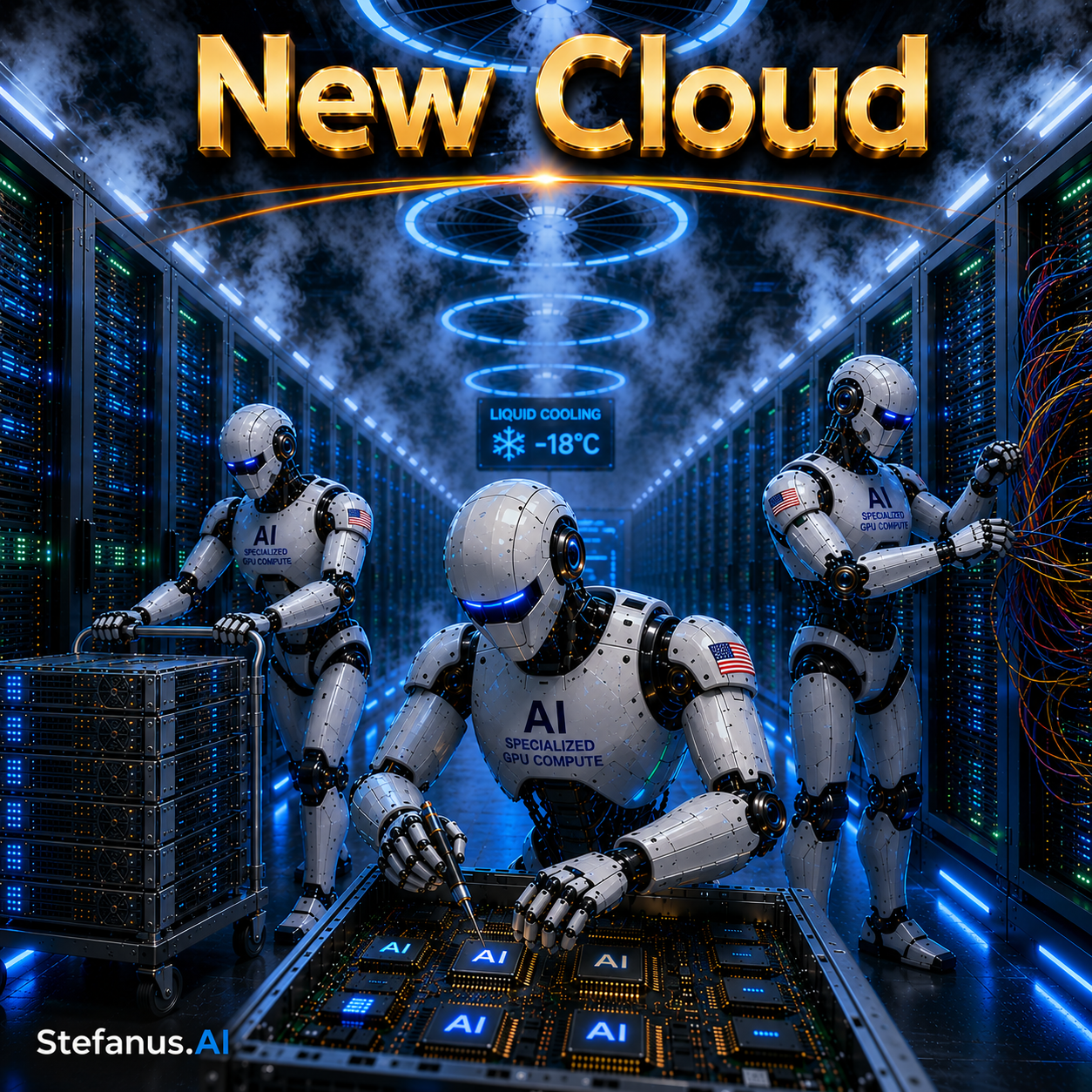
New Cloud providers design their entire infrastructure stack explicitly for AI workloads. This includes high-bandwidth interconnects such as NVLink and InfiniBand, low-latency cluster architectures, liquid cooling systems capable of handling the thermal output of next-generation GPUs, and optimized data pipelines for distributed training across thousands of GPUs simultaneously.
As Jensen Huang, founder and CEO of NVIDIA, articulated at the GTC 2025 keynote:
“AI has made a giant leap — reasoning and agentic AI demand orders of magnitude more computing performance. We designed Blackwell Ultra for this moment — it’s a single versatile platform that can easily and efficiently do pretraining, post-training and reasoning AI inference.”⁴
This framing is architecturally significant. New Cloud is not building data centers in the traditional sense; it is constructing AI production facilities — what Huang calls “AI factories” — purpose-built to manufacture intelligence at scale.
1.3 Transparent, Cost-Effective Pricing
Traditional hyperscalers rely on complex, multi-dimensional pricing structures that bundle compute tiers, storage classes, data egress fees, and managed services into opaque cost models. New Cloud simplifies this into transparent hourly GPU pricing, often delivering dramatically lower effective costs for pure AI workloads. Industry estimates suggest specialized GPU clouds can reduce AI training costs by 62 to 85 percent compared to equivalent workloads on traditional cloud environments.⁵
A recent benchmark analysis by Introl Research confirmed that neocloud providers offer a 62 percent cost advantage for comparable GB300 GPU access relative to hyperscaler equivalents — a differential that is not marginal but transformative for the economics of AI development.⁶
1.4 Agility and Hardware Cadence
Because New Cloud providers focus exclusively on GPU compute, they can deploy new hardware generations faster, avoid the legacy system constraints that slow hyperscaler transitions, and iterate infrastructure more rapidly. CoreWeave, for example, reached general availability for GB200 NVL72 cloud instances on February 4, 2025 — months before most hyperscalers offered equivalent capacity at scale.
This agility allows New Cloud providers to stay at the leading edge of silicon innovation rather than trailing it — a structural advantage that compounds over time as each GPU generation delivers orders-of-magnitude performance improvements.
1.5 Bare-Metal Economics and Their Risks
The bare-metal-as-a-service model (BMaaS) that defines New Cloud creates powerful unit economics but also introduces systemic risks. McKinsey’s infrastructure consulting practice has cautioned:
“Neoclouds originally emerged as stopgaps to address the GPU shortage, but their bare-metal-as-a-service economics are fragile.”⁷
The fragility stems from the capital intensity of GPU procurement, the debt loads required to fund buildout ahead of revenue, and the concentration risk of depending on a small number of major customers. CoreWeave, for instance, carries a debt-to-EBITDA ratio of approximately 8.87x, and both CoreWeave and Nebius have issued billions in debt to fund their expansion programs.⁸ Understanding these dynamics is essential for any assessment of the New Cloud sector’s long-term sustainability.

Section 2: New Cloud vs. Traditional Hyperscalers: A Structural Divergence
2.1 The Design Philosophy Divide
The divergence between New Cloud and traditional hyperscalers is rooted in design philosophy, not merely in technical specifications. Hyperscalers evolved to serve horizontal demand: millions of applications across thousands of industries, requiring breadth of services, geographic redundancy, and enterprise-grade managed offerings. Amazon Web Services alone offers over 200 distinct services. New Cloud evolves to serve vertical intensity: AI workloads that demand extreme compute concentration, minimal abstraction overhead, and maximum raw GPU performance.
This distinction produces fundamentally different architectures, pricing models, and operational priorities. Hyperscalers built for the many; New Cloud builds for the most demanding few — and in doing so, captures disproportionate value at the frontier of AI development.
2.2 Microsoft’s $60 Billion Validation
Perhaps the most compelling evidence of the structural gap between hyperscalers and New Cloud is Microsoft’s own behavior. Despite being one of the world’s largest cloud providers, Microsoft found itself unable to build AI data center capacity fast enough to serve its customers:
Microsoft has committed over $60 billion to neocloud providers, with $23 billion going to British startup Nscale alone for 200,000 GB300 GPUs. Azure’s capacity crunch now extends into mid-2026. The hyperscaler’s pivot to renting AI infrastructure signals a fundamental shift in how cloud giants scale.⁹
The reason is structural, not financial. New Cloud providers secured power agreements and land before the 2023-2024 AI surge, giving them a 6-to-18-month deployment cycle for GPU installation versus the 3-to-5-year permitting and construction timeline for building new data centers from scratch. Power availability — not capital — has become the primary constraint on AI infrastructure expansion.
2.3 Comparative Framework
| Dimension | Traditional Hyperscalers | New Cloud |
| Focus | General-purpose computing, storage, 200+ managed services | Specialized GPU compute and AI-native workloads |
| GPU Access | High demand; frequent shortages; shared queues | Dedicated provisioning; bare-metal or near-bare-metal |
| Pricing | Complex multi-dimensional tiers; often opaque | Transparent hourly GPU pricing; up to 62–85% cheaper for AI |
| Hardware Cadence | Slower rollout; burdened by legacy systems | Faster adoption of each GPU generation |
| Service Breadth | Comprehensive; integrates databases, ML platforms, SaaS | Narrow; focused on GPU compute with growing ecosystem |
| Capital Structure | Self-funded from diversified revenue; strong balance sheets | Heavy debt loads; GPU-collateralized financing |
| Deployment Speed | 3–5 years for new greenfield data center construction | 6–18 months to install GPUs in pre-permitted sites |
The market is not witnessing replacement — it is witnessing bifurcation. Hyperscalers remain essential for enterprise integration, managed services, and the long tail of cloud workloads. New Cloud captures the frontier: the most compute-intensive, cost-sensitive, and performance-critical AI tasks where every dollar of GPU efficiency matters.

Section 3: The Hardware Revolution: NVIDIA’s Blackwell Era and Beyond
No analysis of New Cloud is complete without understanding the hardware generation that has made it technically feasible and economically compelling. NVIDIA’s Blackwell architecture — and its successor generations — represents a step-function improvement in AI compute density that is directly enabling the New Cloud business model.
3.1 The Blackwell Architecture
Introduced in 2024 and reaching broad deployment in 2025, the Blackwell architecture introduced fifth-generation Tensor Cores, native support for sub-8-bit data types (including MXFP4 and MXFP6 micro-scaling formats), and a second-generation Transformer Engine optimized for generative AI inference. The flagship GB200 NVL72 rack-scale system — connecting 36 Grace CPUs and 72 Blackwell GPUs via NVLink — delivers 30x faster real-time inference for trillion-parameter LLMs compared to the prior Hopper generation, while reducing cost and energy consumption by up to 25x.¹⁰
3.2 Blackwell Ultra: The GB300 Generation
At GTC 2025, NVIDIA announced Blackwell Ultra — the next evolution of the Blackwell platform. The GB300 NVL72 represents a significant step beyond its predecessor:
- 15 petaFLOPS of dense FP4 compute per GPU
- 288 GB of HBM3e memory per GPU — 50% more than the B200
- 1.1 ExaFLOPS FP4 per GB300 NVL72 rack — 1.5x the AI performance of the GB200 NVL72
- 50x increase in AI factory revenue opportunity compared to Hopper-based platforms
- 1,400W TDP per GPU — a 40% increase from the B200, requiring liquid cooling as standard¹¹
Cloud providers among the first to offer Blackwell Ultra-powered instances include CoreWeave, Crusoe, Lambda, Nebius, and Nscale — all New Cloud providers — alongside hyperscalers AWS, Google Cloud, Microsoft Azure, and Oracle Cloud Infrastructure.¹²
3.3 The Rubin Roadmap and the 2026–2028 Horizon
NVIDIA has publicly confirmed a multi-generation roadmap that extends the compute density trajectory well beyond Blackwell. The Vera Rubin architecture, scheduled for the second half of 2026, will use HBM4 memory at 13 TB/s bandwidth and deliver 50 petaFLOPS per GPU — more than three times the density of the B300. The Rubin NVL144 rack will achieve 3.6 ExaFLOPS of FP4 compute — more than three times the GB300 NVL72’s rack-level performance. Rubin Ultra follows in 2027, and the Feynman architecture is scheduled for 2028.¹³
This roadmap has a direct implication for New Cloud: providers who secure and deploy today’s Blackwell hardware are simultaneously positioning themselves for the next hardware cycle — and the next, and the next. Infrastructure advantage compounds.
3.4 Performance Benchmarks: MLPerf Evidence
Independent MLPerf Training benchmarks provide the most rigorous third-party validation of NVIDIA Blackwell’s generational improvements. In the MLPerf Training v5.1 round, the GB300 NVL72 completed the Llama 3.1 405B benchmark 1.9x faster than the GB200 NVL72 did in the prior round, bringing the cumulative performance gain compared to Hopper to 4.2x at the 512-GPU scale.¹⁴ This means a New Cloud provider deploying GB300 hardware today delivers the equivalent training throughput of 4.2 Hopper-class clusters of the same GPU count — with proportionally lower energy consumption and cost per trained model.

Section 4: The New Cloud Ecosystem: Key Players and Recent Developments
The New Cloud ecosystem is already populated by a set of highly specialized players, each occupying a distinct strategic position in the GPU infrastructure stack. What follows is an updated analysis of the major providers, incorporating the most recent funding rounds, revenue figures, and strategic developments through May 2026.
4.1 SpaceXAI and the Colossus Infrastructure: From Concept to Reality
The “Elon Web Services” concept discussed in the introduction has materialized — though not in the form originally imagined. Following the merger of xAI and SpaceX in early 2026 into a combined entity valued at $1.25 trillion, the resulting SpaceXAI announced on May 6, 2026 a four-year lease of the Colossus 1 supercomputer to Anthropic for approximately $5 billion annually.¹⁵
The Colossus infrastructure that underlies this deal is itself a landmark:
- Colossus 1: The original Memphis, Tennessee cluster, now leased to Anthropic. Features over 220,000 NVIDIA GPUs (H100, H200, and GB200 accelerators) consuming more than 300 megawatts of power, originally constructed in 122 days at a former Electrolux factory.
- Colossus 2: The next-generation supercluster to which SpaceXAI has migrated its own training workloads, featuring 550,000 GB200 and GB300 accelerators consuming over 1 gigawatt of power — representing a $18 billion hardware investment that positions it as the world’s largest single-site AI training installation.¹⁶
The strategic significance of the Colossus 1 lease extends beyond its immediate terms. It establishes SpaceXAI as a GPU infrastructure landlord — a neocloud provider generating recurring revenue from compute assets no longer needed for its own model training. With SpaceXAI preparing for an IPO targeting a $1.75 trillion valuation in June 2026, the lease converts a stranded asset (Colossus 1 was running at 11 percent utilization) into a revenue-generating instrument that strengthens the pre-IPO financial narrative.¹⁷
Anthropic also expressed interest in partnering with SpaceX to develop orbiting AI data centers — a concept that, if realized, would represent the next frontier of New Cloud infrastructure: compute freed from terrestrial power grid constraints entirely.¹⁸
4.2 CoreWeave (NASDAQ: CRWV) — The Platinum Standard
CoreWeave is the largest and most operationally mature pure-play neocloud company, having gone public on NASDAQ in March 2025 at $40 per share — the largest US tech IPO since 2021. By the metrics that matter for AI infrastructure, CoreWeave has established itself as the benchmark provider:
- Revenue: $5.13 billion in fiscal year 2025 — a 168% increase year-over-year, making it by its own account the fastest cloud platform to reach $5 billion in annual revenue
- Scale: 43 data centers, 850 megawatts of active power, 250,000 NVIDIA GPUs as of year-end 2025
- Expansion: Plans to more than double active power capacity in 2026, from 850 MW to over 1.7 GW, with a longer-term target of 5+ GW by 2030
- Backlog: $67 billion in contracted revenue — a 342% year-over-year increase — providing exceptional visibility
- Analyst projection: Revenue expected to reach $12.5 billion by end of 2026 and $33.5 billion by 2028¹⁹
Independent performance benchmarking by SemiAnalysis’s ClusterMAX 2.0 rating system placed CoreWeave as the only provider in the Platinum tier — citing its proprietary SUNK (Slurm-on-kubernetes) scheduling system, local NGC container mirrors enabling sub-10-second PyTorch container downloads, and consistent premium pricing power that reflects genuine performance differentiation.²⁰
The key risk is balance sheet leverage: CoreWeave carries a debt-to-EBITDA ratio of approximately 8.87x, with aggregate debt estimated between $20 and $30 billion, primarily GPU-collateralized equipment financing. David Linthicum, former chief cloud strategy officer at Deloitte, has cautioned: “If I was running CoreWeave… [my concern] would be the runway runs out — in other words, the lenders want their money back before I’m able to hit profitability.”²¹ This remains the central risk to the neocloud investment thesis.
4.3 Nebius Group (NASDAQ: NBIS) — The Full-Stack Alternative
Nebius has undergone one of the most remarkable corporate transformations in recent technology history — from the remnants of Russian internet giant Yandex (which completed its divestiture of all Russian assets in July 2024) to a pure-play AI infrastructure company targeting European and global markets. Unlike CoreWeave’s infrastructure-operations focus, Nebius offers a more comprehensive full-stack solution for AI development, combining GPU cloud services with proprietary software including Token Factory and Aether AI development tooling.
Key metrics as of May 2026:
- Q4 2025 revenue: $228 million — substantial year-over-year growth
- 2025 full-year revenue: approximately $529.8 million
- Analyst projections: 523% growth forecast for 2025 (actualized), followed by additional 206% expansion in 2026 — a trajectory that could take revenue past $10 billion by end of 2027
- Balance sheet: Approximately $3.7 billion in cash against $4.9 billion in total debt as of year-end 2025, plus a $4.3 billion convertible note raise and $2 billion NVIDIA investment in early 2026
- Geographic footprint: Finland, Iceland, France, Israel, UK, plus US — more globally diversified than CoreWeave
- Target power: 3 GW by end of 2026, funded in part by a $7.1 billion construction loan led by J.P. Morgan²²
In April 2026, Meta signed a $7 billion infrastructure agreement with Nebius — the largest single infrastructure deal in Nebius’s history — validating the full-stack model and providing the revenue visibility needed to service its debt program. The deal involves deployment of next-generation Vera Rubin GPU hardware, with workloads expected to come online through 2027.²³
4.4 Lambda Labs — The Developer’s GPU Cloud
Lambda Labs occupies a differentiated niche in the New Cloud ecosystem, targeting developers, research labs, and AI startups with a developer-first experience and broad GPU availability. Lambda was among the named recipients of Microsoft’s $60 billion neocloud commitment, providing GPU capacity to Azure at hyperscaler scale while maintaining its own direct customer relationships. The SemiAnalysis ClusterMAX 2.0 benchmark placed Lambda in the Gold tier for performance consistency and container initialization speed.²⁴
4.5 Crusoe Energy Systems — The Energy-First Model
Crusoe represents the most innovative energy-infrastructure synthesis in the New Cloud ecosystem. Founded in 2018 with a mission to capture wasted natural gas from oil-field flaring and repurpose it to power compute infrastructure, Crusoe has evolved into a vertically integrated AI infrastructure company that owns the entire value chain from energy capture to GPU cluster deployment.
Recent developments reveal the scale of Crusoe’s ambition:
- Stargate partnership: Central role in OpenAI’s $500 billion Stargate project, with $11.6 billion in financing to build a 1.2-gigawatt AI campus in Abilene, Texas — supporting up to 400,000 NVIDIA GB200 units
- Wyoming expansion: An additional 1.8 GW data center campus announced in partnership with Tallgrass Energy
- Valuation: Exceeds $10 billion following a $1 billion+ Series E round in October 2025, backed by Founders Fund, Fidelity, and NVIDIA
- Revenue trajectory: From $276 million in 2024 to a projected $998 million in 2025, with a clear path toward $2 billion in 2026
- Energy cost advantage: 30 to 50% lower than traditional hyperscalers through stranded gas utilization at approximately 1/13th standard electricity rates, combined with renewable sources²⁵
A $750 million credit facility from Brookfield Asset Management in June 2025 — a financing structure typically reserved for mature infrastructure assets — validated Crusoe’s model as a viable, long-term business rather than a venture-stage experiment. Crusoe’s edge is structural: it solves the energy problem before it solves the compute problem.
4.6 Voltage Park, WhiteFiber, TensorWave, and Emerging Players
The New Cloud ecosystem extends well beyond the flagship providers. Voltage Park emphasizes bare-metal GPU capacity at scale, targeting enterprises and research institutions that require maximum hardware control. WhiteFiber and TensorWave have emerged as additional neocloud entrants, reflecting the robust demand environment that continues to attract new capital and operational teams into GPU infrastructure. Genesis Cloud serves European markets with sustainable, renewable-powered GPU compute. Nscale, the British startup that secured $23 billion of Microsoft’s neocloud commitment for 200,000 GB300 GPUs across four countries, represents the emerging international tier of New Cloud — providers with European operational footprints and aggressive capacity buildout timelines.²⁶

Section 5: The Energy-Compute Convergence: New Cloud’s Greatest Constraint and Opportunity
Perhaps the most consequential force shaping the trajectory of New Cloud is the convergence of energy infrastructure and computing infrastructure into a single, co-dependent system. Power is not merely an input to New Cloud — it is the binding constraint on its growth, the primary differentiator among providers, and increasingly a strategic asset in its own right.
5.1 The IEA’s Landmark Findings
The International Energy Agency’s 2026 report, Key Questions on Energy and AI, provides the most authoritative quantitative framework for understanding this convergence:
The global electricity demand of data centres grew by 17% in 2025. Electricity consumption from AI-focused data centres grew even faster, surging 50% in 2025. Our updated projections see electricity consumption from data centres roughly doubling from 485 TWh in 2025 to 950 TWh in 2030, accounting for around 3% of global electricity demand by that date. Electricity consumption from AI-focused data centres grows much faster than overall data centre electricity consumption, tripling in this period.²⁷
The implications are profound. At current trajectories, AI data centers will consume more electricity in 2030 than the entire nation of Japan does today. The pipeline of conditional offtake agreements between data center operators and small modular reactor (SMR) nuclear projects has grown from 25 gigawatts at the end of 2024 to 45 gigawatts today — suggesting that New Cloud may ultimately accelerate the commercialization of next-generation nuclear energy technology.²⁸
5.2 Goldman Sachs: The Capacity Shortfall
Goldman Sachs Research has documented the physical reality of AI infrastructure constraints with striking precision:
Goldman Sachs documents an 11 GW US shortfall today, widening to 40+ GW by 2028. McKinsey’s $6.7T build-out requires 125 GW of incremental AI capacity by 2030. Physical infrastructure is the binding constraint, not demand.²⁹
In successive reports, Goldman Sachs has upwardly revised its data center power demand growth forecast — from 165% growth by 2030 (versus 2023) to 175%, and most recently to 220% in a March 2026 report. The revisions reflect a market where each round of hyperscaler reinvestment steepens the power consumption curve.³⁰
5.3 Academic Research: Regional Grid Stress
A peer-reviewed study published in April 2026, “Concentrated Siting of AI Data Centers Drives Regional Power-System Stress Under Rising Global Compute Demand” (arxiv.org/pdf/2604.06198), provides the most granular analysis of geographic AI infrastructure concentration and its grid implications:
Results show that new AI infrastructure is highly concentrated in North America, Western Europe, and the Asia-Pacific, which together account for more than 90% of projected compute capacity. Aggregate electricity consumption by the six leading firms is projected to increase from roughly 118 TWh in 2024 to between 239 TWh and 295 TWh by 2030. Regions such as Oregon, Virginia, and Ireland may experience high Power Stress Index values exceeding 0.25, indicating local grid vulnerability.³¹
This research has direct policy implications: the geographic concentration of New Cloud infrastructure creates systemic risks for regional power grids that may require regulatory intervention — new permitting frameworks, grid investment requirements, or geographic diversification mandates.
5.4 The Brookhaven-Lawrence Berkeley Power Measurement Study
A December 2024 empirical study by researchers from Brookhaven National Laboratory and Lawrence Berkeley National Laboratory (“Empirical Measurements of AI Training Power Demand on a GPU-Accelerated Node”) provided critical ground-truth data for AI infrastructure planning:
The maximum observed power draw of an 8-GPU NVIDIA H100 HGX node during large language model training was approximately 8.4 kW — 18% lower than the manufacturer-rated 10.2 kW, even with GPUs near full utilization. Increasing batch size from 512 to 4,096 images for ResNet reduced total training energy consumption by a factor of four.³²
These findings have immediate practical implications for New Cloud operators: actual power consumption is measurably lower than nameplate ratings, creating opportunity for higher GPU density per megawatt than conservative capacity planning would suggest. This data directly informs the capital efficiency calculus that makes New Cloud economically viable.
5.5 Crusoe and the Stranded Energy Solution
Crusoe Energy’s model represents the most innovative structural response to the energy constraint. By capturing stranded natural gas that would otherwise be flared — wasted energy generating only emissions — and converting it into electricity for GPU clusters, Crusoe effectively creates new power supply from existing waste streams. Its Digital Flare Mitigation technology achieves energy costs approximately 30 to 50 percent below traditional hyperscalers, with the potential for costs as low as 1/13th of standard electricity rates at individual well sites. As AI-related energy expenditure increasingly dominates operating costs — energy can represent 60 percent or more of AI data center operating costs — this structural advantage compounds.

Section 6: Institutional and Academic Perspectives
The academic and institutional research community has begun to engage seriously with New Cloud as both a technical and policy phenomenon. The following recent studies and analyses are particularly relevant.
6.1 The University of Memphis GPU Infrastructure Initiative
A 2025 paper from the University of Memphis — “Cultivating Multidisciplinary Research and Education on GPU Infrastructure for Mid-South Institutions” — documents the first regional mid-scale GPU cluster (iTiger) established to support AI education and research across under-resourced institutions in the Mid-South region:
To support rapid scientific advancement and promote access to large-scale computing resources for under-resourced institutions at the Mid-South region, the University of Memphis established the first regional mid-scale GPU cluster, iTiger, a valuable high-performance computing (HPC) infrastructure. While the White House and NSF launched the National Artificial Intelligence Research Resource (NAIRR-Pilot), shareable CI accessibility to enable multidisciplinary research and education remains challenges.³³
This research illustrates a critical dimension of New Cloud’s societal implications: the democratization of GPU access is not automatic. Without deliberate policy intervention — such as the NAIRR pilot — the compute concentration enabled by New Cloud may deepen rather than narrow research infrastructure inequalities between well-resourced and under-resourced institutions.
6.2 The Brookings Institution: Energy and AI Governance
The Brookings Institution’s April 2026 policy brief on “Global Energy Demands Within the AI Regulatory Landscape” frames the energy-AI nexus as a governance challenge requiring coordinated international response:
By one estimate, the energy consumption of data centers could approach 1,050 TWh by 2026, which, if data centers were a country, would make them the fifth largest energy consumer in the world, between Japan and Russia.³⁴
The brief notes that the EU’s AI Act — which began enforcement in 2025 — imposes requirements on providers of general-purpose AI models and the infrastructure that supports them. As data center regulations tighten across Europe, the geographic distribution of New Cloud investment will increasingly be shaped by regulatory considerations, not merely energy economics.
6.3 The World Economic Forum: Getting the $7 Trillion Right
In April 2026, the World Economic Forum published an analysis titled “Here’s How to Get the $7 Trillion AI Hardware Buildout Right,” drawing on McKinsey and Goldman Sachs research to frame the scale of the AI infrastructure investment cycle and its broader economic implications:
McKinsey and Company project $7 trillion in data center investment through 2030, with $5.2 trillion dedicated to AI workloads alone. The five largest US cloud and AI infrastructure companies have committed $660 to 690 billion in capital expenditure for 2026, nearly double 2025 levels. Tech capex now stands at 1.9% of GDP, a figure that rivals the combined scale of the Interstate Highway System and the Apollo Program.³⁵
The WEF analysis identifies a critical economic tension: AI services currently generate approximately $30 billion in annual revenue against hundreds of billions in infrastructure spend. For AI to spread the way the internet did, inference costs must fall sharply — requiring either massive efficiency gains in how AI models run or fundamental breakthroughs in the infrastructure itself. New Cloud providers are positioned on both sides of this equation: they benefit from inference demand and are incentivized to drive down costs through hardware efficiency.
6.4 Goldman Sachs: The $7.6 Trillion Cumulative Capex Estimate
Goldman Sachs Global Institute’s most recent infrastructure analysis — published March 2026 — provides the most comprehensive forward model of AI infrastructure investment:
The baseline model implies $765 billion in annual AI CapEx in 2026, growing to $1.6 trillion in annual CapEx in 2031. These figures include a variety of components necessary for the AI build-out… Together these layers account for baseline estimates that anticipate roughly $7.6 trillion of cumulative CapEx between 2026 and 2031.³⁶
Within this investment cycle, New Cloud providers capture a structurally growing share. Their ability to deploy capital faster than hyperscalers — leveraging pre-permitted sites, GPU-collateralized financing, and operational focus — gives them a compounding deployment advantage in a market where speed-to-capacity translates directly to revenue.

Section 7: Strategic Lessons from New Cloud
The rise of New Cloud carries a set of strategic lessons that extend beyond the technology sector to encompass energy policy, geopolitics, institutional access, and the economics of innovation itself.
7.1 Compute Is the New Strategic Resource
The Colossus 1 lease — in which a company whose CEO publicly called his counterpart’s product “evil” nonetheless leased him 220,000 GPUs for $5 billion annually — illustrates the extraordinary economic pressure that compute scarcity creates. When demand outstrips supply at sufficient magnitude, commercial logic overrides competitive dynamics. Compute has become what oil was in the twentieth century: a strategic resource whose control confers power that transcends ideological alignment.
7.2 Infrastructure Determines Innovation Velocity
New Cloud’s most important contribution is structural democratization — and its most important risk is structural concentration. By enabling organizations without massive capital budgets to access frontier GPU compute, New Cloud dramatically expands the population of actors who can participate in AI development. The University of Memphis’s iTiger GPU cluster — and the NSF’s NAIRR initiative it participates in — exemplifies this democratization at the institutional level. But the same forces that enable access for some simultaneously concentrate control among the few large New Cloud providers whose scale and balance sheets survive the capital intensity of the sector.
7.3 Energy Is the Binding Constraint — and the Strategic Differentiator
Among New Cloud providers, the most durable competitive advantages will not come from GPU procurement — NVIDIA sells to everyone — but from energy access. Providers who have secured long-term power agreements, developed on-site generation capabilities, or pioneered novel energy sourcing models (as Crusoe has) will maintain cost structures that competitors cannot replicate on compressed timescales. The IEA projects that global data center electricity consumption will triple in AI-focused facilities by 2030. The New Cloud providers who solve the energy equation most elegantly will capture the greatest share of this growth.
7.4 Access, Not Ownership, Defines Competitive Advantage
The on-demand GPU model that New Cloud pioneered has changed the fundamental economics of AI development. Organizations that once required hundreds of millions in upfront hardware investment to compete at the frontier can now access equivalent compute on hourly billing terms, scaling dynamically with workload and budget. This shift from a fixed-cost, ownership-based model to a variable-cost, access-based model is not merely economic — it is structural. It changes which organizations can participate in AI development, how quickly they can iterate, and what risk they must assume to compete.
7.5 The Geopolitical Dimension
New Cloud infrastructure is not geopolitically neutral. The concentration of AI compute in specific geographies — primarily the United States, with growing European and Asia-Pacific presence — reflects and reinforces patterns of technological power. Anthropic’s stated preference for infrastructure partnerships with “politically stable, democratic countries with secure AI supply chains” signals that compute access is increasingly evaluated through a national security lens. The EU’s AI Act, the US Commerce Department’s export controls on advanced semiconductors, and the $47.5 billion Chinese state semiconductor fund are all expressions of the same underlying reality: compute is geopolitically strategic, and nations are acting accordingly.
7.6 The Risk of Fragile Economics
New Cloud’s rapid growth must be assessed alongside its structural vulnerabilities. The sector’s reliance on GPU-collateralized debt, the concentration of revenue among a small number of hyperscaler customers (Microsoft represents a significant fraction of CoreWeave’s revenue, for example), and the uncertain timeline to profitability create real risks of financial distress if AI demand growth decelerates before capital can generate adequate returns. As Wolfe Research analysts noted in April 2026: “The heavy lifting on AI development and monetization is happening in places public equity investors can’t access, but public markets’ eyes are moving to AI beneficiaries, and neoclouds are becoming increasingly relevant.”³⁷ Increasing relevance does not guarantee financial resilience.

Conclusion
The emergence of New Cloud represents a decisive and durable shift in the architecture of the global digital economy. It is not a transitional phenomenon or a niche market segment. It is the foundational infrastructure layer of the AI era — the physical substrate upon which the next generation of artificial intelligence will be built, trained, deployed, and monetized.
The evidence assembled in this paper — from the SpaceXAI-Anthropic Colossus deal to NVIDIA’s Blackwell Ultra architecture, from CoreWeave’s $67 billion revenue backlog to the IEA’s projection that AI data center electricity consumption will triple by 2030, from academic research on regional grid stress to Goldman Sachs’s $7.6 trillion cumulative capex estimate — converges on a single conclusion: the center of gravity in computing has permanently shifted from general-purpose horizontal infrastructure to specialized vertical compute.
The shift can be summarized in five structural transformations:
- From general-purpose infrastructure to specialized AI compute: The design philosophy, capital structure, and competitive dynamics of cloud infrastructure have bifurcated. Hyperscalers remain essential for the broad enterprise market; New Cloud dominates the AI frontier.
- From ownership to on-demand access: The economics of AI development have been fundamentally rewritten. Organizations access GPU compute as a variable-cost service rather than owning it as a fixed asset — changing who can participate in AI development and how quickly they can iterate.
- From software-first to infrastructure-first AI: The limiting factor for AI progress has become compute availability, not algorithmic innovation. Infrastructure determines innovation velocity — and New Cloud infrastructure is the accelerant.
- From energy as a utility to energy as a strategic asset: The convergence of compute and energy has elevated power access to a primary competitive differentiator. The New Cloud providers who solve the energy equation most elegantly will define the sector’s long-term competitive landscape.
- From commercial to geopolitical: AI infrastructure has become an expression of national power. Compute access, export controls, energy sovereignty, and orbital data centers are no longer merely technical concepts — they are instruments of geopolitical strategy.
New Cloud is not replacing hyperscalers. It is redefining the center of gravity in cloud computing — establishing a new category of infrastructure whose strategic importance is commensurate with the transformative impact of AI itself. For technologists, investors, policymakers, and institutional researchers, understanding New Cloud is no longer optional. It is the prerequisite for navigating the AI economy.
“Compute is the new oil — scarce, valuable, and geopolitically significant. And the AI factories being built today are the wells, pipelines, and refineries of the twenty-first century.”
The New Cloud paradigm—first defined in principle with the registration of NewCloud.com in May 2008 and now fully instantiated in the GPU clusters, energy alignments, and orbital-scale ambitions of 2026—has moved beyond conjecture into permanence. It is not a future state. It is the present condition. And it now stands as the primary infrastructure through which intelligence is manufactured, distributed, and contested at global scale.

Footnotes & Sources
1. Yahoo Finance / Reuters. Anthropic to rent all AI capacity at SpaceX’s Colossus data center, May 2026. https://finance.yahoo.com/news/anthropic-to-rent-all-ai-capacity-at-spacexs-colossus-data-center-180327774.html
2. Remio.ai. Elon Musk Called Anthropic Evil. Then He Leased It 220,000 GPUs, May 2026. https://www.remio.ai/post/elon-musk-called-anthropic-evil-then-he-leased-it-220-000-gpus
3. Hyperstack Cloud Research. How GPUs Impact Cloud Computing in 2026. https://www.hyperstack.cloud/blog/case-study/how-gpus-impact-cloud-computing
4. Jensen Huang, NVIDIA Newsroom. NVIDIA Blackwell Ultra AI Factory Platform Paves Way for Age of AI Reasoning, GTC 2025. https://nvidianews.nvidia.com/news/nvidia-blackwell-ultra-ai-factory-platform-paves-way-for-age-of-ai-reasoning
5. Introl Research. Microsoft’s $60B Neocloud Bet — 62% cost advantage for comparable GPU access. https://introl.com/blog/microsoft-60-billion-neocloud-spending-capacity-crunch-december-2025
6. Introl Research. Microsoft’s $60B Neocloud Bet, January 2026. https://introl.com/blog/microsoft-60-billion-neocloud-spending-capacity-crunch-december-2025
7. McKinsey & Company, cited in CNBC. Wall Street is getting bullish on neoclouds. These stocks hold more risk than other AI plays, April 2026. https://www.cnbc.com/2026/04/25/wall-street-is-getting-bullish-on-neoclouds-these-stocks-hold-more-risk-than-other-ai-plays.html
8. CNBC / FactSet. Wall Street is getting bullish on neoclouds. These stocks hold more risk, April 2026. https://www.cnbc.com/2026/04/25/wall-street-is-getting-bullish-on-neoclouds-these-stocks-hold-more-risk-than-other-ai-plays.html
9. Introl Research. Microsoft’s $60B Neocloud Bet — Nscale, Nebius, CoreWeave, Iren, Lambda deals, January 2026. https://introl.com/blog/microsoft-60-billion-neocloud-spending-capacity-crunch-december-2025
10. NVIDIA Newsroom. NVIDIA Blackwell Platform Arrives to Power a New Era of Computing. https://nvidianews.nvidia.com/news/nvidia-blackwell-platform-arrives-to-power-a-new-era-of-computing
11. NVIDIA / Introl Research. NVIDIA Blackwell Ultra and B300 — Infrastructure Requirements 2025. https://introl.com/blog/nvidia-blackwell-ultra-b300-infrastructure-requirements-2025
12. NVIDIA Newsroom. NVIDIA Blackwell Ultra AI Factory Platform — cloud provider partners. https://nvidianews.nvidia.com/news/nvidia-blackwell-ultra-ai-factory-platform-paves-way-for-age-of-ai-reasoning
13. NextPlatform / NVIDIA GTC 2025. NVIDIA Draws GPU System Roadmap Out to 2028. https://www.nextplatform.com/2025/03/19/nvidia-draws-gpu-system-roadmap-out-to-2028/
14. NVIDIA Technical Blog. NVIDIA Blackwell Enables 3x Faster Training and Nearly 2x Training Performance Per Dollar, December 2025. https://developer.nvidia.com/blog/nvidia-blackwell-enables-3x-faster-training-and-nearly-2x-training-performance-per-dollar-than-previous-gen-architecture/
15. CryptoBriefing. xAI leases Colossus 1 supercomputer to Anthropic for $5B annually ahead of planned IPO, May 2026. https://cryptobriefing.com/xai-leases-colossus-anthropic-5b-ipo/
16. Introl Research. xAI Colossus Hits 2 GW: 555,000 GPUs, $18B, Largest AI Site, January 2026. https://introl.com/blog/xai-colossus-2-gigawatt-expansion-555k-gpus-january-2026
17. CryptoBriefing. xAI leases Colossus 1 supercomputer to Anthropic, IPO targeting $1.75T valuation, May 2026. https://cryptobriefing.com/xai-leases-colossus-anthropic-5b-ipo/
18. Tom’s Hardware. Musk’s SpaceX rented access to Colossus supercomputer to rival Anthropic — orbital data centers interest, May 2026. https://www.tomshardware.com/tech-industry/artificial-intelligence/musks-spacex-has-rented-out-access-to-its-supercomputers-220-000-nvidia-gpus
19. MLQ.ai / Tech-Insider.org. CoreWeave & Nebius AI Infrastructure Analysis, March 2026. https://mlq.ai/research/coreweave/
20. SemiAnalysis. ClusterMAX 2.0: The Industry Standard GPU Cloud Rating System, November 2025. https://newsletter.semianalysis.com/p/clustermax-20-the-industry-standard
21. David Linthicum, former Chief Cloud Strategy Officer, Deloitte — cited in CNBC. Wall Street is getting bullish on neoclouds, April 2026. https://www.cnbc.com/2026/04/25/wall-street-is-getting-bullish-on-neoclouds-these-stocks-hold-more-risk-than-other-ai-plays.html
22. IndexBox / MLQ.ai. AI Infrastructure Growth 2026: CoreWeave & Nebius Revenue & Projections. https://www.indexbox.io/blog/ai-infrastructure-boom-neocloud-providers-coreweave-and-nebius-report-surging-revenue/
23. Tech-Insider.org. Meta-Nebius $7B AI Infrastructure Deal Breakdown 2026. https://tech-insider.org/meta-nebius-27-billion-ai-infrastructure-deal-2026/
24. SemiAnalysis. ClusterMAX 2.0: Lambda Gold tier rating. https://newsletter.semianalysis.com/p/clustermax-20-the-industry-standard
25. TSG Invest / Crusoe.ai. Crusoe Energy AI Infrastructure — $10B valuation, energy cost advantage. https://tsginvest.com/crusoe-energy/
26. Introl Research / CNBC. Microsoft $60B neocloud spending; Nscale 200,000 GB300 GPUs. https://introl.com/blog/microsoft-60-billion-neocloud-spending-capacity-crunch-december-2025
27. International Energy Agency. Key Questions on Energy and AI — Executive Summary, April 2026. https://www.iea.org/reports/key-questions-on-energy-and-ai/executive-summary
28. International Energy Agency. Data centre electricity use surged in 2025, IEA News, April 2026. https://www.iea.org/news/data-centre-electricity-use-surged-in-2025-even-with-tightening-bottlenecks-driving-a-scramble-for-solutions
29. AL Capital Advisory / Goldman Sachs Research. AI Capex Cycle 2026: $725B Hyperscaler Buildout — CFA Analysis. https://alcapitaladvisory.com/research/intelligence/ai-infrastructure.html
30. Prism News / Goldman Sachs. Goldman Sachs says AI infrastructure faces grid, optics and cooling bottlenecks, May 2026. https://www.prismnews.com/workplace/goldman-sachs/goldman-sachs-says-ai-infrastructure-faces-grid-optics-and
31. Latif et al., arXiv. Concentrated siting of AI data centers drives regional power-system stress under rising global compute demand, April 2026. https://arxiv.org/pdf/2604.06198
32. Latif, Newkirk, Carbone et al. — Brookhaven National Laboratory & Lawrence Berkeley National Laboratory. Empirical Measurements of AI Training Power Demand on a GPU-Accelerated Node, December 2024. https://arxiv.org/pdf/2412.08602
33. Sharif, Han, Liu, Huang — University of Memphis. Cultivating Multidisciplinary Research and Education on GPU Infrastructure for Mid-South Institutions, 2025. https://arxiv.org/pdf/2504.14786
34. Brookings Institution. Global Energy Demands Within the AI Regulatory Landscape, April 2026. https://www.brookings.edu/articles/global-energy-demands-within-the-ai-regulatory-landscape/
35. World Economic Forum. Here’s How to Get the $7 Trillion AI Hardware Buildout Right, April 2026. https://www.weforum.org/stories/2026/04/ai-investments-7-trillion-buildout-right/
36. Goldman Sachs Global Institute. Tracking Trillions: The Assumptions Shaping the Scale of the AI Build-Out, March 2026. https://www.goldmansachs.com/insights/articles/tracking-trillions-the-assumptions-shaping-scale-of-the-ai-build-out
37. Wolfe Research, cited in CNBC. Wall Street is getting bullish on neoclouds — neoclouds becoming increasingly relevant to public markets, April 2026. https://www.cnbc.com/2026/04/25/wall-street-is-getting-bullish-on-neoclouds-these-stocks-hold-more-risk-than-other-ai-plays.html

Comments
[…] new category of cloud provider — variously described as “New Cloud“ — has emerged to fill the gaps that hyperscaler pricing and availability constraints leave […]
[…] semiconductors and cloud, quantum computing is emerging as the next frontier of technological sovereignty competition. […]