
Introduction: The Strategic Shift
The global technology ecosystem has entered what historians will likely call the era of AI industrialization — a period in which the old distinctions between physical infrastructure, software architecture, and machine intelligence have effectively dissolved. For nearly two decades, enterprise executives treated servers, cloud capacity, and application development as isolated budget lines, governed by separate procurement cycles, separate leadership mandates, and separate performance metrics. That era is ending. The forces dismantling it are not merely evolutionary upgrades in processor speed or model capability. They are structural, irreversible, and accelerating with a velocity that most organizational frameworks have not been designed to absorb.
The clearest and most momentous signal of this transformation arrived on June 16, 2026, when SpaceX — four days after its record-breaking Nasdaq debut that valued the company at more than $2 trillion — announced a definitive agreement to acquire Anysphere, the San Francisco-based company behind the AI coding assistant Cursor, in an all-stock transaction valued at $60 billion.
The announcement reverberated through boardrooms, investment banks, and research laboratories in equal measure, not because of its size alone, but because of what it revealed about the underlying logic of the new competitive order. SpaceX, through its February 2026 merger with xAI, had assembled the world’s most powerful privately owned supercomputing complex — the Colossus cluster in Memphis, Tennessee, eventually scaling to 555,000 NVIDIA GPUs with plans for 1 million — yet its AI segment was still generating a $6.36 billion operating loss in 2025.[1] The compute was extraordinary. What was missing was the workflow — the daily, sticky, revenue-generating interface through which enterprise customers would pay to access that power.
Cursor, with its $2.6 billion in annualized B2B revenue by mid-2026, its penetration into roughly half of the Fortune 500, and its status as the fastest-growing enterprise software company ever recorded, filled exactly that void.
As Bret Greenstein, Chief AI Officer of West Monroe — and one of the most influential corporate AI strategists in the United States — observed on the day of the announcement:
“SpaceX appears to be following a pattern we’ve already seen at Tesla with vertical integration. AI also requires the infrastructure to support it, including energy, data centers, and connectivity, all of which tie directly to SpaceX’s broader goals. This level of vertical integration could become a major competitive advantage as AI advances.”
— Bret Greenstein, Chief AI Officer, West Monroe [2]
This paper is written to provide the intellectual scaffolding for understanding why that observation is not merely a description of one deal but a prescription for the entire enterprise economy. The framework I call Corporate Compute Integration — or CCI — captures the logic, the mechanisms, and the strategic imperatives that every executive in every sector must now understand. It is not a framework about technology. It is a framework about economic power, competitive defensibility, and organizational survival in the age of superintelligence.
The pages that follow trace CCI from its technical foundations through its business strategy implications, its value creation mechanics, and its pillars of executive action. They are grounded not only in the SpaceX-Cursor story, but in the broader evidence now accumulating from Stanford, MIT, the IMF, and the earnings calls of the world’s most powerful technology companies. The conclusion is unambiguous: the enterprises that master this framework will define the commercial order of the next decade. Those that do not will find themselves structurally disadvantaged in ways they will struggle to reverse.

Section 1: What Is Corporate Compute Integration?
Defining the New Paradigm
To understand Corporate Compute Integration, one must first understand what it is not. It is not a data center strategy. It is not a cloud migration plan. It is not an AI implementation roadmap of the kind that consultants have been selling to Fortune 500 companies since 2022. Those frameworks are, by their nature, additive — they describe how an organization can layer artificial intelligence capabilities onto its existing architecture. CCI is fundamentally different. It describes the complete reconceptualization of what a technology asset is, what it produces, and where in the corporate value chain it should reside.
1.1 Technical Definition
At the technical level, Corporate Compute Integration is the deliberate, end-to-end alignment of enterprise-scale processing power — encompassing hardware infrastructure, power generation, cooling architecture, and networking fabric — with high-frequency user-facing applications and the specialized foundational AI models that power them. Rather than treating raw compute as a backend utility accessed intermittently through API calls or cloud subscriptions, CCI treats compute, models, and software as a single, unified, continuously co-evolving asset.
The Colossus supercluster is the most extreme contemporary embodiment of this philosophy at the infrastructure layer. Initially built with 100,000 NVIDIA H100 GPUs in 122 days — a construction pace that the semiconductor industry widely described as physically impossible — the facility was expanded to 200,000 GPUs within a further 92 days, and by January 2026 had grown to over 555,000 GPUs across three Memphis buildings, drawing on a total power capacity approaching 2 gigawatts.[3] The cluster achieves a total memory bandwidth of 194 petabytes per second and provides over one exabyte of storage capacity, connected through NVIDIA’s Spectrum-X Ethernet networking platform at 95% throughput efficiency.[4] These are not incremental improvements over prior data center designs. They represent a categorical departure — a new class of physical infrastructure for which existing governance frameworks, procurement cycles, and return-on-investment models are entirely inadequate.
1.2 Strategic Definition
At the strategic level, CCI represents the transition of artificial intelligence from a costly backend experiment — consuming enormous capital while generating uncertain returns — into a front-facing revenue machine that compounds in value with every unit of user interaction. The strategic insight at the heart of CCI is deceptively simple: a company does not merely want to own raw computing power. It wants to own the specific software workflow where daily business value is realized, because only through that ownership does it gain access to the telemetry data that continuously makes its AI systems smarter, and through that self-reinforcing loop, more defensible than any competitor who lacks the same integrated stack.
1.3 The Evolution from Cost Center to Core Asset
The shift from compute-as-cost-center to compute-as-core-asset is not merely semantic. It has direct implications for how capital expenditure is valued, how operating losses are interpreted, and how competitive moats are constructed. According to the Stanford HAI 2026 AI Index, major cloud providers accelerated capital expenditures dramatically, with Google reporting more than $150 billion in annual capex in 2025 alone.[5] The IMF’s January 2026 World Economic Outlook noted that spending on information technology had climbed to the highest level seen in over two decades, particularly in the United States, and identified AI infrastructure investment as a primary driver of its upward revision of the 2026 global growth forecast to 3.3%.[6]
What these numbers reveal is that compute is no longer infrastructure in the traditional sense — a cost to be minimized and depreciated. It is the primary productive asset of the intelligence economy, as fundamental to competitive position as a steel mill was to the industrial economy or a prime retail location was to the commercial economy of the twentieth century. The executives who understood this first and who moved to secure integrated positions across the compute-model-workflow stack are now erecting barriers to entry that their slower-moving competitors will find extremely difficult to surmount.
1.4 The SpaceX-Cursor Case Study
The SpaceX-Cursor acquisition is the most vivid illustration of CCI logic in action. SpaceX’s 2025 annual report disclosed total consolidated revenue of $18.7 billion, driven by Starlink’s connectivity operating income of $4.4 billion — but offset by an AI segment operating loss of $6.36 billion.[7] The Colossus facilities were running at low utilization. According to SpaceX’s own IPO filings, Colossus 1’s utilization had dropped to approximately 11% before the Anthropic compute-leasing deal was signed in May 2026.[8] A supercomputer consuming hundreds of millions of dollars in operating costs while running at 11% capacity is not merely a financial inefficiency. It is the ultimate symbol of what happens when compute exists without workflow.
The Cursor acquisition resolves that structural failure in a single stroke. Cursor had grown from $100 million in annualized recurring revenue in January 2025 to $500 million by June, crossed $1 billion by November 2025, and reached $2.6 billion by mid-2026.[9] No enterprise software company had ever scaled at that velocity. And critically, Cursor’s growth had been constrained not by market demand or product quality, but by compute access. As noted in the acquisition filings, Cursor had “indicated that training its own AI models was limited by a shortage of compute resources.”[10] SpaceX had too much compute. Cursor had too little. The deal fused these two complementary deficits into a single integrated asset.
1.5 From Experimental Generation to Commercial Execution
The broader significance of the CCI framework is that it marks the end of what might be called the experimental generation of enterprise AI — the period from 2022 to 2025 during which companies treated artificial intelligence primarily as a subject of pilot programs and proof-of-concept deployments — and the beginning of the commercial execution phase. A landmark 2025 study from MIT’s NANDA initiative, analyzing generative AI adoption across enterprises, reached the sobering conclusion that 95% of generative AI pilot programs failed to produce measurable financial impact.[11] The researchers attributed these failures not to model quality but to “poor workflow integration and misaligned organizational incentives.”[11]
That finding is both a diagnosis and a prescription. The diagnosis is that compute and models, in isolation, do not produce business value. The prescription is that only through deep integration with the workflows where business decisions are made and business value is created does AI begin to deliver on its extraordinary promise. Corporate Compute Integration is the framework that enables that integration at enterprise scale.

Section 2: Building the Infrastructure Core
The Technical Layer of Corporate Compute Integration
The infrastructure layer of Corporate Compute Integration is not merely a question of acquiring sufficient GPU capacity. It encompasses the physical engineering of heat removal, the management of power generation and grid relationships, the design of networking fabric to maintain coherence across hundreds of thousands of processors, and the governance of capital expenditure cycles that dwarf those of most industrial enterprises. Executives who approach AI infrastructure through the lens of traditional IT procurement — focused on unit costs and depreciation schedules — will systematically underestimate both the strategic significance and the operational complexity of what they are building.
2.1 The Realities of High-Capacity Compute: Capital Expenditure at Civilizational Scale
The capital requirements of frontier AI infrastructure have reached a scale that was effectively unimaginable five years ago. SpaceX’s xAI division reported AI capital expenditures of $12.7 billion in 2025 and an additional $7.7 billion in the first quarter of 2026 alone — an annualized run rate exceeding $30 billion per year for a single company’s AI infrastructure.[12] The 555,000 GPUs deployed across the Memphis Colossus sites were purchased for approximately $18 billion, making it the world’s largest single-site AI training installation.[3]
These figures expose a structural reality that separates the CCI era from all prior technology investment cycles: the minimum viable infrastructure for frontier AI capability now requires capital outlays that only a handful of organizations in the world can finance. This is not a temporary bottleneck that will be resolved by cost reductions in the next product cycle. It reflects the underlying physics of the problem — training the next generation of frontier models requires orders of magnitude more compute than the current generation, and the energy required to power and cool that compute represents a resource constraint that is simultaneously financial, geopolitical, and environmental.
2.2 Data Center Dynamics: The Colossus Model
The Colossus supercluster in Memphis, Tennessee, represents the most advanced expression of the CCI infrastructure thesis currently in operation. Its initial 100,000-GPU phase was completed in 122 days — a timeline that SemiAnalysis, the leading semiconductor research firm, described as “redefining the global compute race.”[4] The facility then doubled to 200,000 GPUs within 92 additional days. By January 2026, a third building had been acquired, bringing total site power capacity to nearly 2 gigawatts — making Colossus the world’s first gigawatt-scale AI training cluster.[3]
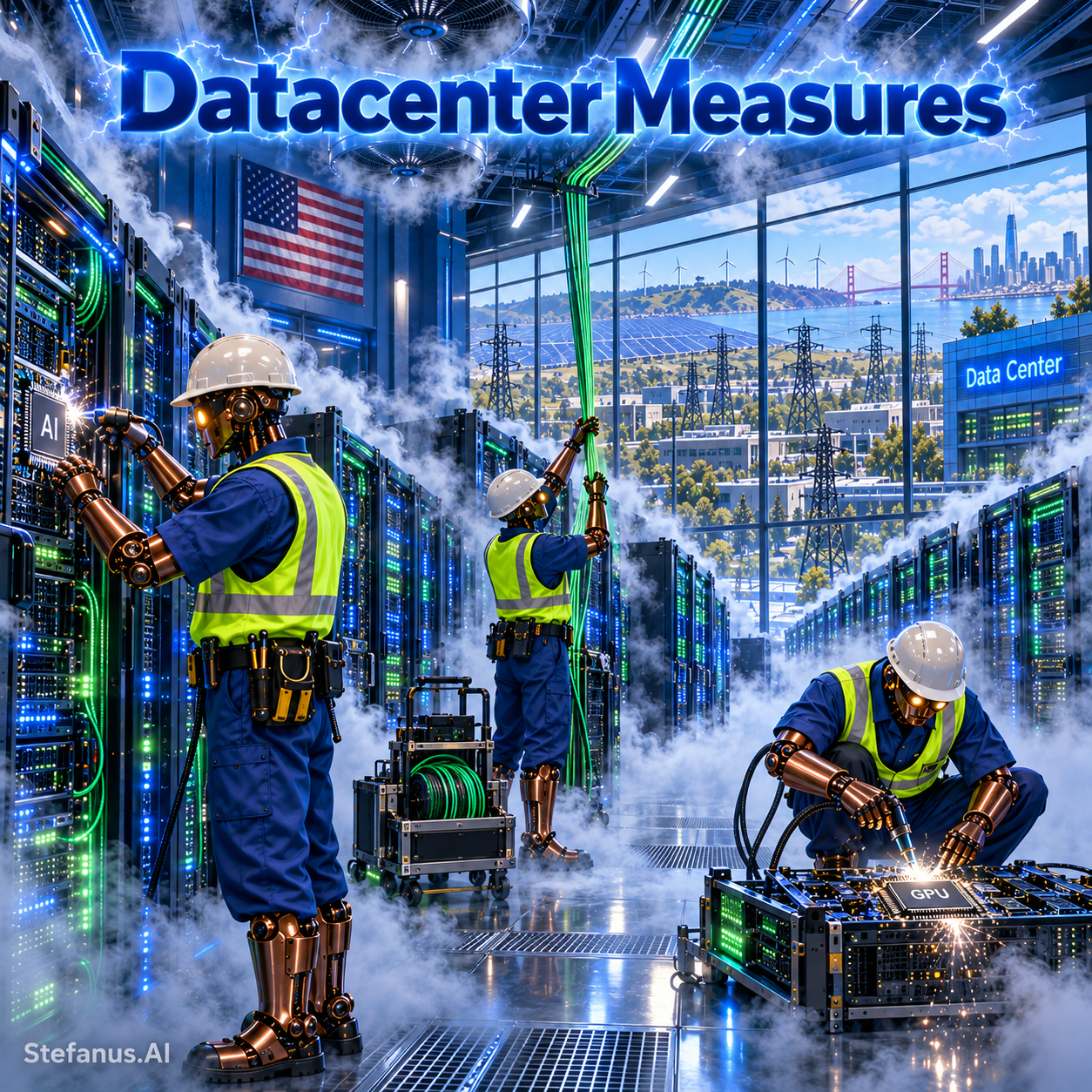
The engineering choices made at Colossus reveal principles that will define infrastructure design across the industry for the next decade. The facility employs Direct Liquid Cooling — circulating coolant directly to GPU chips rather than relying on conventional air cooling — enabling hardware density that would otherwise produce catastrophic thermal failure. Networking is achieved through NVIDIA’s Spectrum-X Ethernet platform, maintaining 95% throughput efficiency across the cluster compared to roughly 60% on traditional Ethernet architectures. Power is provided through a combination of Tennessee Valley Authority grid capacity and on-site gas turbine generation, with SpaceX holding approximately 49.9% equity in a joint venture with Solaris Energy Infrastructure to secure over 1.1 gigawatts of dedicated turbine capacity by mid-2027.
What makes the Colossus model particularly instructive for CCI strategy is not merely its scale but its speed. The 19-day window from rack installation to first training run demonstrates that the competitive advantage in AI infrastructure is not only about how much compute you can build, but about how quickly you can deploy it and begin extracting value. Organizations that rely on traditional data center development cycles — typically spanning four years from site selection to full operation — will find themselves perpetually behind those who have mastered the compressed construction model pioneered in Memphis.
2.3 Physical Asset Dominance and the Orbital Frontier
The terrestrial infrastructure layer, formidable as it is, represents only the first dimension of physical asset dominance in the CCI era. SpaceX’s unique position derives from its ability to integrate Colossus-class ground infrastructure with its orbital assets through Starlink — a network that by the end of 2026 is projected to serve approximately 17 million subscribers and is already generating $4.4 billion in operating income from its connectivity segment.[13]
The convergence of terrestrial AI training clusters and orbital connectivity networks creates the possibility of a genuinely new architecture: distributed inference at a planetary scale, in which the most computationally intensive operations are performed in Memphis while the outputs are delivered to enterprise users anywhere on Earth through satellite broadband. This architecture eliminates the latency and reliability constraints that have historically made AI inference dependent on proximity to large metropolitan data centers, opening AI-powered applications to the roughly 3.5 billion people who currently lack access to reliable terrestrial broadband.
The strategic significance of this integration extends beyond market size. It creates a structural advantage that no pure-software competitor can replicate, because it is rooted in physical assets — launch vehicles, satellites, spectrum licenses, ground stations, power generation facilities — whose construction takes years and whose operation is protected by regulatory frameworks that create durable barriers to entry.

Section 3: Owning the Workflow
The Business Strategy Layer of Corporate Compute Integration
The infrastructure layer of Corporate Compute Integration provides the raw material for competitive advantage. The workflow layer is where that advantage is converted into revenue, market position, and the self-reinforcing data loops that make integrated positions increasingly difficult to dislodge. Without a dominant workflow position, even the most extraordinary infrastructure investment produces what one analyst memorably described as “a massive expressway without vehicles” — immense capacity consuming enormous capital while generating no recurring value.
3.1 Why Compute Without Workflow Fails
The evidence for the proposition that compute without workflow is an incomplete and ultimately unsustainable business model is now abundant and unambiguous. Before the Anthropic and Google compute-leasing deals were signed in May and June 2026, Colossus 1 was running at approximately 11% utilization.[8] SpaceX’s AI segment posted a $2.47 billion operating loss in the first quarter of 2026 alone, with total AI capital expenditures reaching $7.7 billion in that single quarter.[12] The mathematics were brutal: billions of dollars of capital deployed to build compute capacity that, absent a workflow layer, sat largely idle while the meter ran on power, cooling, personnel, and debt service.
“It’s not just putting up a big data center and filling it full of GPU chips. It’s a capability within an organization.”
— Thomas H. Davenport, Fellow, MIT Initiative on the Digital Economy; MIT Sloan Management Review [14]
Davenport’s observation captures precisely what the compute-without-workflow failure mode reveals: infrastructure, however impressive, must be connected to organizational capability — to the workflows where employees, customers, and partners make decisions and generate value — before it begins to pay for itself. The enterprise that builds the data center first and then attempts to find workflows to populate it is making a fundamental strategic error. CCI demands that the workflow anchor be identified, acquired, or constructed before or simultaneously with the infrastructure investment, not as an afterthought.
3.2 Anatomy of an Elite Enterprise Application
Understanding what makes Cursor the ideal workflow anchor for SpaceX’s infrastructure strategy requires examining what distinguishes elite enterprise applications from the broader universe of AI-powered software. The distinguishing characteristics are not primarily technical. They are behavioral and economic.
First, elite enterprise applications achieve deep daily embeddedness — they are not consulted periodically or used for specific projects. They are open on the developer’s screen for the majority of every working day. Cursor’s AI coding assistant sits directly within the Visual Studio Code interface where software developers spend their professional lives. Every line of code written, reviewed, debugged, or committed passes through Cursor’s interface. This creates a level of workflow penetration that no standalone AI service, however sophisticated, can approach.
Second, elite applications achieve what might be called institutional irreversibility — the costs of switching away from them grow over time as the organization’s codebases, team conventions, and institutional memory become increasingly adapted to the tool’s specific behaviors. Cursor’s penetration into approximately half of the Fortune 500 means that its switching costs are now embedded in the workflows of hundreds of thousands of professional software developers.[9]
Third, and most critically for CCI purposes, elite applications generate telemetry data of exceptional quality. According to Cursor’s Developer Habits Report, at the start of 2026, if developers accepted 100 lines of AI-generated code, approximately 76 lines remained in the codebase after one hour — a retention rate reflecting genuine utility rather than speculative acceptance.[15] Each of those accepted lines, each correction, each rejection, each subsequent edit, represents a data point of extraordinary value for training the next generation of coding models.
3.3 Combating Vendor Lock-In While Creating Defensible Ecosystems
One of the more sophisticated tensions in CCI strategy concerns the simultaneous need to avoid becoming a captive customer of any single technology provider while constructing the kind of sticky ecosystem that makes customers reluctant to leave your own platform. The resolution of this tension lies in the architecture of integration itself.
SpaceX’s approach is instructive. Its compute-leasing agreements with Anthropic and Google — worth $26 billion in annualized recurring revenue combined — each include a 90-day termination clause, allowing SpaceX to redirect compute capacity from external customers to internal needs as market conditions evolve. This structure creates optionality at every level: the company is not locked into serving external customers if its own models outperform the competition, nor is it locked into deploying its own models if external leasing revenues exceed what internal use would generate.
At the same time, by acquiring Cursor and integrating it with the xAI model stack, SpaceX is building an ecosystem that competitors will struggle to replicate. Microsoft examined and declined to acquire Cursor. OpenAI approached Anysphere’s leadership twice and was rebuffed.[16] The deal ultimately went to the one company that could offer Cursor not just capital but something no software company on Earth could match: unlimited compute at scale, plus orbital connectivity infrastructure, plus the Grok model family, plus the X platform’s distribution network with 1.3 billion supported accounts.[17]

Section 4: Value Creation and the Data Feedback Loop
The Economics of Integration
The economic logic of Corporate Compute Integration is, at its core, a logic of compounding. Once the infrastructure layer and the workflow layer are integrated, they begin to generate a form of value that neither could produce in isolation: a continuously self-improving data feedback loop that makes the integrated system progressively more capable, more efficient, and more difficult to displace with each passing month. This loop is not merely a competitive advantage. It is, over sufficient time, a structural barrier to entry that compounds in the same way that network effects compound in platform businesses — except that it operates at the frontier of what AI can do, rather than merely at the level of connections among users.
4.1 Converting Infrastructure Losses into Software Profit Engines
The financial transformation that CCI enables is perhaps best illustrated by the trajectory of SpaceX’s AI segment. In 2025, that segment generated an operating loss of $6.36 billion on $12.7 billion of capital expenditure.[7] By May and June 2026 — through the Anthropic deal at $1.25 billion per month and the Google deal at $920 million per month — SpaceX had converted the idle capacity of that same infrastructure into $26 billion in annualized recurring revenue.[18] In less than four months from the xAI merger in February 2026, the company had signed contracts worth a combined $75 billion in total future revenue.[19]
This conversion from loss to recurring revenue did not require SpaceX to build new infrastructure, develop new models, or acquire new customers in any traditional sense. It required only that the company find workflow partners willing to pay market rates for compute capacity that already existed. The Cursor acquisition then adds the second layer: instead of merely leasing compute to competitors, SpaceX now owns the workflow through which enterprise developers interact with AI systems, capturing recurring software subscription revenue, workflow telemetry data, and the platform dependency that comes with deep enterprise penetration.
The Stanford HAI 2026 AI Index provides independent confirmation of this economic dynamic at the market level. The report notes that estimated U.S. consumer surplus from AI reached $172 billion annually by early 2026, up from $112 billion a year earlier, with the median value per user tripling over the same period.[20] Generative AI is now deployed in at least one business function at 70% of organizations globally.[20] The economic value being created is real, large, and accelerating — and the companies positioned at the intersection of the infrastructure and workflow layers are capturing a disproportionate share of it.
4.2 The Proprietary Data Cycle
“The updated 2025 US data suggests we are now transitioning out of this investment phase into a harvest phase where those earlier efforts begin to manifest as measurable output.”
— Erik Brynjolfsson, Director, Stanford Digital Economy Lab; Financial Times Op-Ed, February 2026 [21]
Brynjolfsson’s “harvest phase” concept is not merely a macroeconomic observation. It describes a specific mechanism that operates at the level of individual integrated systems: the accumulation of workflow interaction data eventually reaches a critical mass at which the AI models it has been training begin to outperform models trained on static datasets, creating a performance advantage that justifies higher pricing, attracts more users, and generates more training data in a virtuous cycle.
The quality of the training data generated within integrated workflow environments is qualitatively different from anything available through conventional dataset curation. When a developer accepts or rejects a line of AI-generated code, they are providing a signal that reflects not abstract preferences but actual professional judgment in a specific production context. When they correct a model’s output, they are annotating it with expert knowledge that cannot be purchased at any price on any dataset marketplace. When they return to a piece of AI-generated code days later and modify it, they are providing longitudinal feedback about the durability and real-world utility of AI outputs.
This workflow-derived training data creates a moat that Brynjolfsson, in his research at the Stanford Digital Economy Lab, has described as central to understanding why AI productivity gains are concentrated in a small number of firms: “a small cohort of power users” who are “automating end-to-end workstreams with AI agents, completing tasks in hours instead of weeks.”[21] Those power users are not merely more productive. They are generating the training signals that make the next generation of models more powerful, which attracts more users, which generates more training data — a compounding advantage invisible in any single quarterly earnings report but decisive over a five-year competitive horizon.
4.3 Quantifying Productivity Gains from Agentic Workflows
The productivity literature on AI-assisted enterprise workflows has shifted dramatically in tone and substance between 2024 and 2026. Early studies focused on narrow task-completion metrics — how much faster can a software developer write a for-loop with AI assistance? By 2025, the research had matured to examine more systemic effects. A study by Yang et al. found that advanced large language models could achieve efficiency improvements ranging from 30 to 100 times over traditional manual coding in specific contexts.[22]
Brynjolfsson estimated U.S. productivity growth at roughly 2.7% in 2025 — nearly double the 1.4% annual average of the prior decade — attributing this acceleration to the completion of what he termed the “productivity J-curve”: the investment and restructuring phase through which all General Purpose Technologies must pass before they begin to produce measurable macroeconomic returns.[21]
The Stanford 2026 AI Index corroborated this picture at the skill and employment level, finding that job postings mentioning “Agentic AI” skills increased by more than 280% in a single year, from 0.06% of all postings in 2024 to 0.23% in 2025, representing approximately 90,000 distinct positions in the United States alone.[23]
“By 2050, most people will command workforces larger than the biggest multinational corporations of today. But our employees won’t be people sitting in cubicles or standing on factory floors. They will be fleets of AI agents — digital workers which can perform tasks like design products, write code, negotiate supply chains, run complex experiments, and devise marketing campaigns while we sleep.”
— Erik Brynjolfsson, Stanford Digital Economy Lab; TIME Magazine, January 2026 [24]
The enterprise implications of this trajectory are significant. Organizations that integrate AI workflows at the application layer — and that connect those workflows to proprietary model infrastructure — are not merely gaining a productivity advantage measured in worker-hours. They are positioning themselves to operate with a fundamentally different organizational architecture than their competitors, one in which the marginal cost of executing additional workflows approaches zero while the quality of output continuously improves.

Section 5: Strategic Playbook for the Modern Executive Suite
Navigating the CCI Decision Framework
The strategic decisions that Corporate Compute Integration demands of executive leadership do not admit of generic answers. The appropriate CCI posture for a global financial institution is different from that appropriate for a mid-size industrial manufacturer, which is different again from that appropriate for a technology-native startup operating in a market where AI capability is the primary basis of competition. What is common across all of these contexts is the necessity of making explicit, deliberate choices — and of making them now, while the competitive positions being established are still fluid enough to enter.
5.1 Build, Buy, or Partner: The Three Paths to Compute Integration
The first and most fundamental strategic decision any organization must make in the CCI framework is whether to build proprietary compute infrastructure, acquire existing infrastructure or workflow assets, or construct partnership structures that provide access to integrated capabilities without requiring full ownership.
The build option is viable only for organizations with access to capital at the scale of tens of billions of dollars, technical talent sufficient to design and operate frontier-class data center infrastructure, and a timeline that accommodates the 18-to-24 months required to bring major new compute capacity online. In practice, this means the universe of viable builders is extremely small: the major hyperscalers (Microsoft, Google, Amazon, Meta), the most well-capitalized AI-native companies (Anthropic, OpenAI, xAI), and a small number of sovereign wealth funds operating at the intersection of national strategy and technology investment.
The buy option — exemplified by the SpaceX-Cursor transaction — is appropriate for organizations with access to public equity as strategic currency, the operational capacity to integrate acquired businesses at speed, and a clear thesis about which workflow assets are positioned for extraordinary growth. The IMF’s April 2026 note on the global economic implications of AI warned explicitly that “economies of scale in frontier AI models increase barriers to entry and market power,” concentrating advantage among a small number of dominant firms and “hyper-scalers.”[25] The acquisition route is the primary mechanism through which non-incumbent organizations can break into the integrated stack.
The partner option — engaging through compute-leasing arrangements, API access, or co-development agreements — is the path available to the majority of enterprises. The critical insight for organizations pursuing this path is that partnership agreements must be designed with future optionality in mind. Lock-in to a single compute provider or a single model family is strategically dangerous, as the rapid evolution of AI capabilities means that today’s leading model may be materially outperformed within 12 to 18 months. The 90-day termination clauses embedded in SpaceX’s leasing agreements with Anthropic and Google represent a template for how sophisticated organizations manage this optionality — maintaining the ability to redirect resources as the competitive landscape evolves.
5.2 Mitigating Financial Strain While Remaining Agile
The capital intensity of CCI strategy creates genuine financial risk that executive leadership must manage with the same rigor applied to any major infrastructure investment. SpaceX’s accumulated deficit reached $41.3 billion as of the March 2026 IPO pricing date, reflecting the enormous capital consumption of building and operating frontier-class AI infrastructure ahead of the revenue it generates.[26]
“AI has monopolized boardroom discussions and inflated the stock market. This year, organizations confront the challenges of enterprise AI deployment and the need to drive tangible business value.”
— Thomas H. Davenport and Randy Bean; MIT Sloan Management Review, January 2026 [27]
Davenport and Bean’s observation about the “level-set year” for AI — the moment when hype confronts the hard discipline of organizational implementation and financial accountability — describes precisely the environment in which CCI strategy must be executed. The organizations most likely to navigate this environment successfully are those that have separated the discipline of capital allocation for infrastructure investment from the discipline of organizational change management required to extract value from that infrastructure.
The most effective risk mitigation strategies combine three elements: staged capital deployment that ties infrastructure investment to demonstrated workflow revenue; flexible leasing structures that allow compute capacity to be redirected between internal use and external revenue generation as market conditions evolve; and portfolio diversification across multiple AI model providers and workflow applications, preventing over-dependence on any single technology or vendor relationship.
5.3 Future-Proofing Against Rapid Convergence
The velocity of AI capability development means that any specific technical investment made today faces the risk of obsolescence on a timeline measured in years rather than decades. The Stanford AI Index 2026 noted that while Agentic AI skills saw explosive demand growth, categories like “ChatGPT,” “Conversational AI,” and “Chatbot” all experienced year-over-year decreases — reflecting the speed at which what was cutting-edge in 2023 had become baseline expectation by 2025.[23]
The strategic response to this convergence risk is not to avoid investment but to invest in the elements of the stack that converge most slowly. Physical infrastructure — data center buildings, power generation capacity, cooling systems, networking fabric — has a useful life measured in decades and will be required by whoever operates the next generation of AI models, regardless of the specific architecture those models employ. Workflow positions — the daily habits and institutional dependencies of enterprise users — are similarly durable, because switching costs accumulate over years of usage and the organizational disruption of replacing a deeply embedded tool is rarely justified by marginal performance improvements in a competitor.
“AI represents the most transformative General Purpose Technology since the Industrial Revolution, with agentic AI having the potential for automating work across enterprises.”
— Erik Brynjolfsson, Stanford Digital Economy Lab [28]
The model layer, by contrast, converges rapidly and should generally not be the primary target of proprietary investment for organizations outside the small universe of frontier AI labs. The appropriate posture for most enterprises is to engage model capabilities through partnerships and API access, preserving the ability to switch providers as the competitive model landscape evolves, while concentrating proprietary investment and strategic attention on the infrastructure and workflow layers where durable advantage can be built.

Section 6: The Pillars of Corporate Compute Integration
What the SpaceX-Cursor Era Has Taught Us
The preceding analysis of CCI strategy — its technical foundations, its business logic, its value creation mechanics, and its executive decision framework — resolves into a set of organizing principles that I call the Pillars of Corporate Compute Integration. These pillars are not a checklist. They are a conceptual architecture for understanding why the companies winning the AI era are winning, and what the companies that are not winning must do differently. Each pillar addresses a distinct dimension of the integrated competitive position that CCI requires.
Pillar 1: Compute Without Workflow Is an Empty Expressway
The foundational insight of Corporate Compute Integration is that raw processing capacity, however extraordinary, generates no recurring revenue, accumulates no proprietary data, and creates no competitive moat in the absence of a high-frequency, deeply embedded application workflow through which enterprise users interact with AI systems on a daily basis. Owning the most powerful supercomputing cluster in the world while running it at 11% utilization — as Colossus 1 was operating before the Anthropic deal — is not a competitive advantage. It is a capital destruction machine.
The executive lesson is not that infrastructure investment is unwise. It is that infrastructure investment must be paired simultaneously with workflow strategy. The sequence matters: identify the workflow anchor first, then build or acquire the infrastructure that powers it. Organizations that build infrastructure first and search for workflows later will spend years consuming capital at frontier scale while generating sub-frontier returns.
Pillar 2: Vertical Integration Beats Fragmented Technology Stacks
The era of technology fragmentation — in which enterprises assembled AI capabilities by purchasing separate services from separate vendors across the compute, model, and application layers — is ending. The performance advantages, data advantages, and cost advantages available to organizations that control all three layers simultaneously are sufficiently large that fragmented stacks will progressively struggle to compete on the dimensions that enterprise customers care most about: response quality, latency, reliability, data security, and total cost of ownership.
As a study published in arXiv in 2026 on the shift from horizontal layering to vertical integration in AI-driven software development demonstrated, AI enables “a shift towards less fragmented, more integrated workflows, potentially rendering traditional silos obsolete.”[29] The SpaceX acquisition of Cursor is the most dramatic corporate expression of this principle, but the logic applies to organizations at every scale. Even enterprises that cannot afford to build or acquire frontier infrastructure can pursue vertical integration at the level available to them — standardizing on a smaller number of AI providers, deepening integration between their workflow tools and their data infrastructure, and building institutional capability to switch layers independently as the technology evolves.
Pillar 3: The Best Training Data Is Workflow Data
One of the most consequential and least understood dimensions of CCI strategy is the relationship between workflow ownership and model quality. The organizations that own the daily workflows of professional knowledge workers are accumulating training data of a quality and specificity that cannot be purchased, synthesized, or replicated by any competitor who lacks equivalent workflow penetration. Every professional decision made within an integrated AI workflow — every acceptance, rejection, correction, and downstream use of AI-generated output — is a training signal that reflects real professional judgment in a real production context.
This is the mechanism through which Fei-Fei Li’s human-centered AI philosophy finds its most powerful commercial expression. Li, the Sequoia Professor of Computer Science at Stanford and founding co-director of Stanford’s Human-Centered AI Institute, has consistently argued that “AI is a tool” whose values are ultimately human values — and that the quality of AI systems depends fundamentally on the quality and breadth of the human feedback incorporated into their training.[30] Workflow-derived training data is the highest-quality form of human feedback available to AI developers, because it is generated in the context of real professional stakes by practitioners with domain expertise. The organizations that own those workflows own the feedback mechanism that produces the next generation of models.
Pillar 4: Public Equity Is Strategic Currency for Infrastructure Scale
The $60 billion SpaceX-Cursor transaction was structured entirely in SpaceX stock — no cash consideration, no debt, no structured payments. This choice was not a concession to necessity but a deliberate exercise of strategic intelligence about the role of public equity in the CCI era. SpaceX’s Nasdaq IPO, which raised more than $80 billion and valued the company at more than $2 trillion, was executed not merely to provide liquidity to existing shareholders but to create the currency through which the company could absorb critical software assets, reshape market landscapes, and accelerate the convergence of infrastructure and workflow at the scale the moment demands.[16]
The lesson for executives is that in the CCI era, valuation is not merely a financial metric — it is a strategic instrument. Companies that build credible AI narratives, demonstrate integrated infrastructure-workflow positions, and achieve the public market valuations that credibility generates can acquire assets with their stock that they could not purchase with cash, and can do so at velocities that competitors reliant on traditional debt or equity financing cannot match. The ability to move at the speed of the market — to sign a $60 billion acquisition four days after the most transformative IPO in the company’s history — is itself a competitive advantage in an environment where timing matters as much as position.
Pillar 5: Flexibility Underpins Massive Capital Outlays
The paradox of CCI at the frontier is that it requires the largest capital commitments in the history of commercial technology while simultaneously demanding the greatest operational flexibility. SpaceX’s solution to this paradox — embedding 90-day termination clauses in both the Anthropic and Google compute-leasing agreements — represents a template that deserves careful study by any organization managing large-scale AI infrastructure.[31]
The 90-day clause is not merely a contractual protection. It is an architectural principle: the compute infrastructure remains a fungible strategic asset that can be redirected between external revenue generation and internal capability development as market conditions evolve. If Grok’s competitive position improves relative to Claude and Gemini, SpaceX can redirect Colossus capacity from Anthropic to internal xAI model training. If the external leasing market continues to command premium pricing, SpaceX can extend the leasing arrangements while building additional capacity for internal use. The flexibility to exercise either option is worth billions of dollars in strategic optionality — and it was preserved, not sacrificed, in the design of the contractual architecture.
Pillar 6: The Macroeconomic Tide Is Rising — But Not Equally
The IMF’s December 2025 workshop on the global economic implications of AI concluded that the macroeconomic transition underway should be treated as “a macro-critical transition rather than a standard technology shock,” driven not by frontier capability alone but by “the speed and breadth of diffusion and the readiness of institutions and infrastructure to absorb the technology.”[25] The Fund’s January 2026 World Economic Outlook revision — upgrading the 2026 global growth forecast to 3.3% on the basis of AI investment momentum — provided quantitative confirmation that the macroeconomic impact of the AI buildout is now large enough to be visible in GDP statistics.[6]
But the same analysis warned explicitly that the gains are “concentrated in a limited set of technology-linked industries, rather than spread broadly across the global economy,” and that “what matters is not frontier capability alone but also how AI is adopted and integrated into production, with resulting economic rents likely accruing disproportionately to AI-intensive firms and countries, generating winner-take-most global dynamics.” The macroeconomic tide is rising, but it is rising faster in some places than others — and the organizations that have positioned themselves at the intersection of infrastructure and workflow ownership are the ones standing on the highest ground.
Pillar 7: Organizational Transformation Must Match Infrastructure Scale
The final and most frequently neglected pillar of Corporate Compute Integration is the organizational dimension. The MIT NANDA study that found 95% of generative AI pilots failing to produce measurable financial impact did not find that the technology was inadequate.[11] It found that organizations were inadequate — that their workflows, incentive structures, governance frameworks, and change management capabilities were not fit for the purpose of converting AI capability into AI value.
The 2026 AI and Data Leadership Executive Benchmark Survey found that 38% of large enterprises had appointed a chief AI officer or equivalent role, but identified “little consensus on to whom that job reports” — a finding that reveals the organizational incoherence with which most enterprises are approaching AI integration. A chief AI officer who lacks authority over infrastructure investment, workflow design, data governance, and model selection cannot execute CCI strategy. They can only observe it from the organizational periphery while the companies that have achieved genuine vertical integration pull away from them in the competitive rankings.
The organizational imperative of CCI demands that AI leadership be elevated to the same level of authority and accountability as the CFO and the CTO — because in the intelligence economy, AI infrastructure and AI workflow are as fundamental to the organization’s competitive position as its financial structure and its technology architecture. Organizations that treat AI as a functional initiative rather than a core strategic capability will find, as Brynjolfsson’s productivity J-curve predicts, that they are perpetually in the investment phase, never reaching the harvest.

Conclusion:
The $60 billion acquisition of Cursor by SpaceX, announced on June 16, 2026 — four days after the largest initial public offering in market history — will be remembered as the precise moment at which the corporate AI race shifted its center of gravity from theoretical software potential to raw industrial execution. It marks the arrival of a new competitive order in which the fundamental unit of advantage is not the model, not the algorithm, not the data center in isolation, but the integrated stack: compute infrastructure fused with foundational models, fused with the daily workflow habits of enterprise users, fused with the self-reinforcing data feedback loops that make each layer stronger over time.
For business executives, the lesson of Corporate Compute Integration is simultaneously simple and demanding. It is simple in its logic: success in the intelligence economy depends on the seamless alignment of massive compute capital with entrenched, daily user habits, mediated by AI models that grow more capable with every interaction they record. It is demanding in its execution: achieving that alignment requires capital commitments at civilizational scale, organizational transformations that touch every function and every level of the enterprise, and strategic decisions made at velocities that traditional governance frameworks were not designed to support.
The seven pillars articulated in this paper — compute requires workflow, vertical integration beats fragmentation, workflow data is the best training data, public equity is strategic currency, flexibility preserves optionality, the macroeconomic tide rewards the prepared, and organizational transformation must match infrastructure scale — are not predictions about what might become important. They are descriptions of what is already determining outcomes, right now, in the competitive engagements playing out among the world’s most powerful technology companies.
The IMF is right that this is a macro-critical transition. Stanford is right that we are entering the harvest phase. MIT is right that organizational readiness is the binding constraint on value creation. And the SpaceX-Cursor deal is right that the companies willing to move at the speed and scale that the moment demands — to sign transformative acquisitions days after record-breaking IPOs, to lease billions in compute to competitors while simultaneously acquiring the workflows to deploy that compute internally, to treat physical infrastructure and enterprise software as dimensions of a single, unified strategic asset — are the companies that will define the commercial architecture of the next decade.
For any enterprise aiming to lead the global market in the age of superintelligence, Corporate Compute Integration is no longer an advanced topic to be monitored from a distance. It is the foundational playbook. The question is not whether to engage with it but how quickly and how completely you can master it — because the organizations already executing it are not waiting.

Footnotes and Endnotes:
[1] SpaceX (SPCX). 2025 Annual Report / S-1 IPO Filing — AI segment operating loss of $6.36 billion; 2025 consolidated revenue of $18.7 billion; Starlink operating income of $4.4 billion. Filed with the U.S. Securities and Exchange Commission, May 2026. https://www.sec.gov/Archives/edgar/data/0001181412/000162828026040610/spacexfwp.htm
[2] Greenstein, Bret (Chief AI Officer, West Monroe). Quote on SpaceX vertical integration and Cursor acquisition. Yahoo Finance / SpaceX Cursor AI Deal announcement, June 16, 2026. https://finance.yahoo.com/markets/stocks/article/spacex-announces-60-billion-cursor-deal-to-boost-ai-coding-125509159.html
[3] Introl Blog. xAI Colossus Hits 2 GW: 555,000 GPUs, $18B, Largest AI Site. January 3, 2026. https://introl.com/blog/xai-colossus-2-gigawatt-expansion-555k-gpus-january-2026
[4] TokenRing / Financial Content. Colossus Rising: How xAI’s Memphis Supercomputer Redefined the Global Compute Race. January 1, 2026. [Also: SemiAnalysis, “xAI’s Colossus 2,” 2025]. https://markets.financialcontent.com/wral/article/tokenring-2026-1-1-colossus-rising-how-xais-memphis-supercomputer-redefined-the-global-compute-race
[5] Stanford HAI. 2026 AI Index Report — Economy Chapter. Google reported more than $150 billion in annual capex in 2025. Stanford Institute for Human-Centered AI, April 2026. https://hai.stanford.edu/ai-index/2026-ai-index-report/economy
[6] International Monetary Fund. World Economic Outlook Update, January 2026. Global growth forecast revised to 3.3% for 2026. IMF Chief Economist Pierre-Olivier Gourinchas cited AI infrastructure investment as primary driver. https://www.aol.com/articles/imf-sees-steady-global-growth-093446583.html
[7] IndMoney / SpaceX Cursor AI Deal Analysis. SpaceX Cursor AI Deal: $60 Billion to Fix xAI’s Coding Gap. 2025 financials: $18.7B revenue, $4.4B connectivity income, $6.36B AI operating loss, $12.7B AI capex. June 16, 2026. https://www.indmoney.com/blog/us-stocks/spacex-cursor-ai-deal-xai-coding-gap-spacex-stock-rises
[8] KuCoin / IndMoney. SpaceX IPO Boosted by Anthropic and Google Contracts Worth $21.7 Billion Monthly. Colossus 1 utilization at ~11% before Anthropic deal. June 2026. https://www.kucoin.com/news/flash/spacex-ipo-boosted-by-anthropic-and-google-contracts-worth-21-7b-monthly
[9] TechFunding News / Techzine Global. SpaceX Buys Cursor-Maker Anysphere for $60B. Revenue growth: $100M ARR (Jan 2025) → $500M (Jun 2025) → $1B (Nov 2025) → $2.6B (mid-2026). Fortune 500 penetration cited. June 16, 2026. https://techfundingnews.com/spacex-buys-anysphere-cursor-60b-all-stock-xai-enterprise-ai/
[10] Techzine Global. SpaceX Acquires Cursor for $60 Billion. Cursor’s compute shortage and access to Colossus described. Transaction closing expected Q3 2026. June 16, 2026. https://www.techzine.eu/news/devops/142197/spacex-acquires-cursor-for-60-billion/
[11] MIT NANDA Initiative / Stanford Digital Economy Lab. Pereira, Graylin, and Brynjolfsson. The Enterprise AI Playbook. Stanford Digital Economy Lab, March 2026. MIT NANDA 2025 study: 95% of generative AI pilots fail to produce measurable financial impact. https://digitaleconomy.stanford.edu/app/uploads/2026/03/EnterpriseAIPlaybook_PereiraGraylinBrynjolfsson.pdf
[12] KuCoin / IndMoney. SpaceX xAI Deals With Google and Anthropic: SPCX IPO Valuation Impact. AI capex $12.7B (2025) + $7.7B (Q1 2026); Q1 2026 AI operating loss $2.47B. June 2026. https://www.indmoney.com/blog/us-stocks/spacex-xai-compute-deals-google-anthropic-ipo-valuation
[13] Via Satellite. Assessing SpaceX Finances, Addressable Market, and the AI Pitch Ahead of IPO. Starlink projected at ~17 million subscribers by end of 2026. June 2026. https://www.satellitetoday.com/finance/2026/06/03/assessing-spacex-finances-addressable-market-and-the-ai-pitch-ahead-of-ipo/
[14] Davenport, Thomas H. (MIT Fellow; Babson College). “Action Items for AI Decision Makers in 2026.” MIT Sloan Management Review, March 3, 2026. Quote: “It’s not just putting up a big data center and filling it full of GPU chips. It’s a capability within an organization.”. https://mitsloan.mit.edu/ideas-made-to-matter/action-items-ai-decision-makers-2026
[15] IndMoney / Cursor Developer Habits Report. SpaceX Cursor AI Deal Analysis. Cursor Developer Habits Report: 76 of every 100 accepted AI code lines still in codebase after one hour (Q1 2026 data). June 16, 2026. https://www.indmoney.com/blog/us-stocks/spacex-cursor-ai-deal-xai-coding-gap-spacex-stock-rises
[16] TechTimes / CNBC. SpaceX Seals $60 Billion Cursor Acquisition Four Days After Record IPO. Microsoft examined but declined bid; OpenAI rebuffed twice. SpaceX IPO raised >$80 billion. June 16, 2026. https://www.techtimes.com/articles/318476/20260616/spacex-seals-60-billion-cursor-acquisition-four-days-after-record-ipo.htm
[17] SpaceX SEC Filing (Form FWP). Space Exploration Technologies Corp, Form FWP, FY2026. xAI described as “vertically integrated AI platform.” Grok and X: 1.3 billion supported accounts, ~550M MAUs. Filed with SEC, 2026. https://www.sec.gov/Archives/edgar/data/0001181412/000162828026040610/spacexfwp.htm
[18] TechCrunch / Reuters / Yahoo Finance. Google will pay SpaceX $920M per month for compute (TechCrunch, June 5, 2026); Anthropic $1.25B/month through 2029 (Reuters, May 2026). Combined $26B annualized. https://techcrunch.com/2026/06/05/google-will-pay-spacex-920m-per-month-for-compute/
[19] CryptoBriefing / KuCoin. SpaceX Secures Google AI Compute Deal After Anthropic Pact Ahead of IPO. Total contracted future revenue from Anthropic and Google exceeds $70B; $75B in total contracts in <4 months post-merger. https://cryptobriefing.com/spacex-google-ai-compute-deal-ipo/
[20] Stanford HAI. 2026 AI Index Report — Economy. U.S. AI consumer surplus: $172B annually by early 2026 (up from $112B). Generative AI used in at least one business function at 70% of organizations globally. https://hai.stanford.edu/ai-index/2026-ai-index-report/economy
[21] Brynjolfsson, Erik (Director, Stanford Digital Economy Lab). Financial Times Op-Ed: “The AI Productivity Take-Off Is Finally Visible.” February 2026. U.S. productivity ~2.7% in 2025 (vs 1.4% decade average). “Harvest phase” quote. Also: Yahoo Finance / AOL coverage, February 15–16, 2026. https://finance.yahoo.com/news/one-stanford-original-ai-gurus-205316027.html
[22] Yang et al. (2024) / Eloundou et al. (OpenAI) (2024). Cited in: “From Horizontal Layering to Vertical Integration: A Comparative Study of the AI-Driven Software Development Paradigm.” arXiv:2601.22667, 2026. AI efficiency improvements of 30–100x in coding contexts. https://arxiv.org/pdf/2601.22667
[23] Lightcast and Stanford University. Annual AI Index 2026. Agentic AI job postings: +280% YoY (0.06% → 0.23% of all postings); ~90,000 positions in U.S. April 2026. https://lightcast.io/resources/research/stanford-ai-index-2026
[24] Brynjolfsson, Erik (Stanford Digital Economy Lab). “AI Changed Work Forever in 2025.” TIME Magazine, January 2, 2026. Quote on AI agent “workforces” by 2050. https://time.com/7342494/ai-changed-work-forever/
[25] International Monetary Fund. Global Economic and Financial Implications of Artificial Intelligence: Lessons from a Scenario Planning Exercise. IMF Notes, Volume 2026, Issue 002. April 3, 2026. “Winner-take-most” dynamics; barriers to entry from compute concentration. https://www.elibrary.imf.org/view/journals/068/2026/002/article-A001-en.xml
[26] KuCoin / IndMoney. SpaceX IPO Boosted by Anthropic and Google Contracts. Accumulated deficit of $41.3 billion as of March 2026 pricing date; $4.3B net loss in Q1 2026 alone. https://www.kucoin.com/news/flash/spacex-ipo-boosted-by-anthropic-and-google-contracts-worth-21-7b-monthly
[27] Davenport, Thomas H. and Bean, Randy. Five Trends in AI and Data Science for 2026. MIT Sloan Management Review. Also: “Action Items for AI Decision Makers in 2026,” MIT Sloan, March 3, 2026. https://sloanreview.mit.edu/article/five-trends-in-ai-and-data-science-for-2026/
[28] Brynjolfsson, Erik. Speaker profile and keynote citations. Stern Strategy Group, updated June 4, 2026. Quote on AI as “most transformative General Purpose Technology since the Industrial Revolution”. https://sternstrategy.com/speakers/erik-brynjolfsson/
[29] arXiv:2601.22667. “From Horizontal Layering to Vertical Integration: A Comparative Study of the AI-Driven Software Development Paradigm.” 2026. Citing Durante et al. (2024) and Wang et al. (2025) on agentic AI and integrated workflows. https://arxiv.org/pdf/2601.22667
[30] Li, Fei-Fei (Sequoia Professor, Stanford University; Co-Director, Stanford HAI). “AI is a tool. And tools don’t have independent values — their values are human values.” Issues in Science and Technology interview, April 2024. Also: PBS Firing Line, May 23, 2025; McKinsey Author Talks, December 2023. https://issues.org/interview-godmother-ai-fei-fei-li/
[31] Yahoo Finance / CNBC. SpaceX, Google Compute Deal Raises Eyebrows Ahead of IPO. 90-day termination clauses in both Anthropic and Google compute agreements described. June 5, 2026. https://finance.yahoo.com/markets/stocks/article/spacex-google-compute-deal-raises-eyebrows-ahead-of-ipo-120522033.html