
Introduction: When Artificial Intelligence Acquired Borders
The Datacenter That Possessed Everything Except Permission
Somewhere in the American Sun Belt, a hyperscale datacenter stands nearly complete. The developer acquired the land two years ago after a bidding contest with three rival firms. Financing was approved by a consortium of banks and private-credit funds eager for exposure to artificial intelligence infrastructure. Tens of thousands of advanced accelerators have been ordered, invoiced, and in many cases already delivered to a bonded warehouse a few miles away. Construction crews have worked around the clock through two summers. The regional utility has identified a combination of natural-gas generation and contracted solar capacity that could, in principle, feed the campus its first several hundred megawatts.
And yet the project cannot open.
Its large power transformers, ordered from a manufacturer whose supply chain winds through East Asia, are eighteen months behind schedule. A shipment of imported electrical components sits in customs while officials investigate its country of origin. Electricity prices in the region have jumped since a military conflict on the other side of the world disrupted energy shipping through the most important maritime chokepoint in the global oil trade. Some of the chips in the bonded warehouse now require export licenses that did not exist when they were purchased, because a portion of the cluster was to be operated on behalf of an overseas customer. A frontier model that was expected to anchor the facility’s commercial services has abruptly become unavailable to the foreign engineers who were integrating it, after the United States government issued a national-security directive restricting access by nationality. And an AI-agent company that the hyperscaler intended to acquire in order to fill the facility with paying workloads has become trapped between two governments, one reviewing the deal for security risk and the other ordering it unwound entirely.
None of these problems originated inside the datacenter. None of them can be solved inside the datacenter. Each of them originated in a ministry, a war room, a licensing office, or a boardroom operating under political constraint. Together they express the central insight of this paper:
The AI economy may appear digital, but every layer of it is governed by physical resources, national borders, industrial dependencies, legal permissions, and geopolitical power.
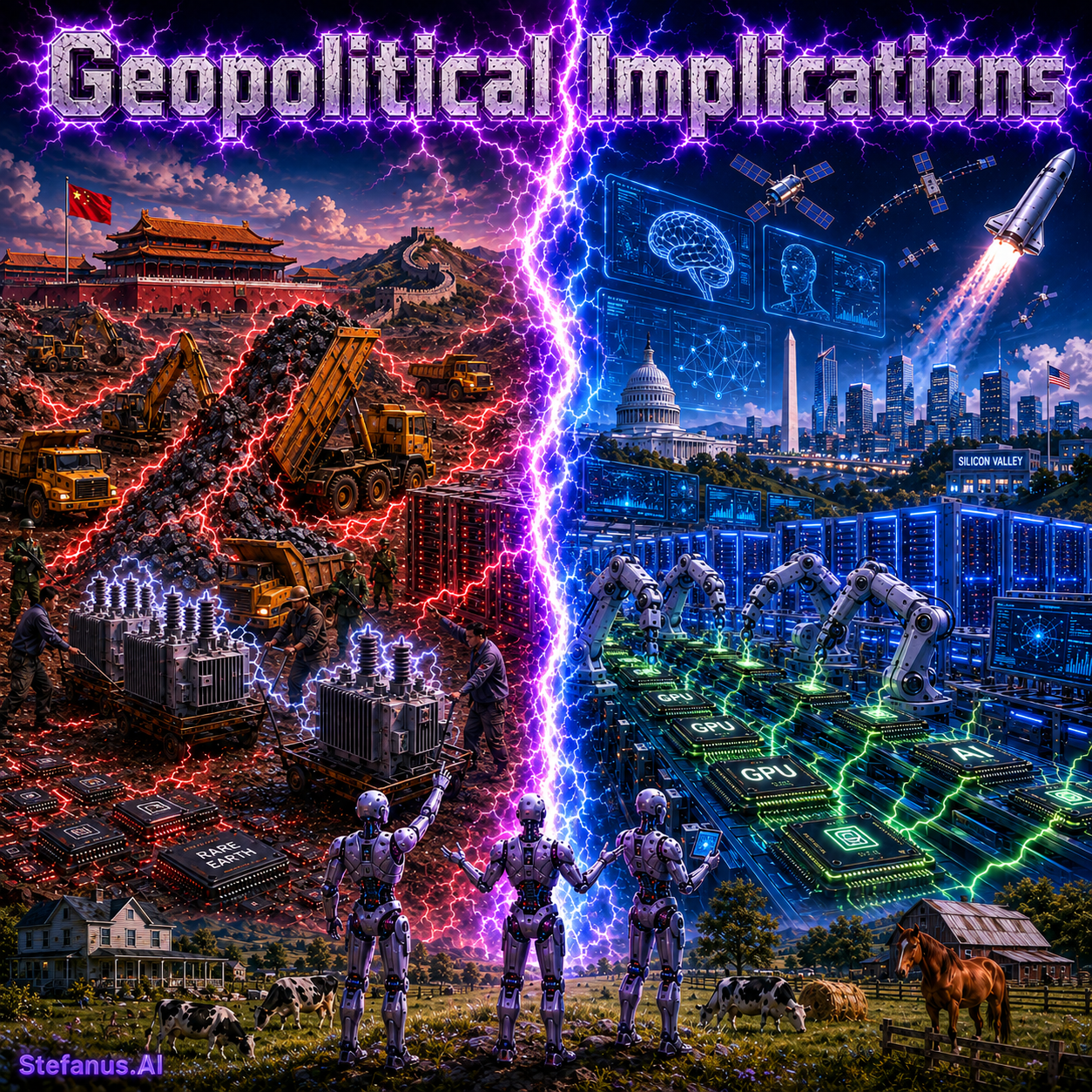
Why This Framework Is Called “Geopolitical Implications”
The phrase “Geopolitical Implications,” as used throughout this paper, is not merely a description of international tensions. It is the name of an interpretive framework for understanding how state power now travels through the entire AI production stack, from the barrel of oil to the autonomous software agent.
Traditional geopolitical analysis tends to separate energy, trade, defense, technology, finance, infrastructure, and corporate ownership into different policy categories, each with its own ministries, statutes, journals, and experts. The Five-Layer AI Economy demonstrates that these categories are becoming inseparable. A conflict involving oil affects electricity and construction costs. A dispute over rare earths affects semiconductor equipment, motors, cooling systems, transformers, and defense manufacturing. A restriction on GPUs changes which models can be trained. A restriction on model access changes which applications can be built. A blocked acquisition changes who controls future agentic systems. The economists of the International Monetary Fund have warned for several years that the costs of trade restrictions are “greatly amplified” once technological decoupling is added to the picture, with modeled output losses reaching eight to twelve percent of GDP in some countries under severe scenarios.[2] The IMF’s First Deputy Managing Director put the global figure bluntly:
“A very serious decoupling scenario could cost up to 7 percent of GDP” — Gita Gopinath, First Deputy Managing Director, International Monetary Fund [1]
Those estimates were produced before artificial intelligence became the single largest driver of capital formation in the American economy, and before AI-linked companies came to represent, by Harvard professor Graham Allison’s accounting in August 2026, more than forty percent of the value of United States equity markets.[3] The stakes of getting the geopolitics of the AI stack wrong are therefore no longer confined to the technology sector. They are macroeconomic, and they are strategic. Hence the definition that organizes everything that follows:
“Geopolitical Implications” describes the cascading consequences created when political intervention at one layer travels upward and downward through all five layers of the AI economy.
From Globalization to Permissioned Globalization
For roughly three decades, the technology industry operated on a set of assumptions so stable that they were rarely stated aloud. Components would be sourced from the lowest-cost producer, wherever that producer happened to sit on the map. Capital would cross borders in search of returns. Researchers would collaborate internationally, publish openly, and move between laboratories in different countries as easily as between floors of the same building. Cloud computing would be globally accessible, a utility indifferent to the passport of the person logging in. And technology companies could acquire promising startups wherever they emerged, subject only to antitrust review and price.
Contrast that world with the order that has taken shape between 2022 and 2026. Energy shipments can be redirected by military force and presidential decree. Minerals require government licenses that may be granted, delayed, or refused according to diplomatic mood. Chips are classified by performance thresholds written into export regulations. Datacenter equipment is screened by the nationality of its manufacturer. Models can be restricted according to the citizenship of the person querying them. Acquisitions can be reversed months after closing. Engineers and founders can be declared strategic national assets and forbidden from leaving their country of origin. Each of these statements, which would have sounded like dystopian speculation in 2015, is drawn from a documented event of the past thirty months, and each is examined in detail in the sections that follow.
This paper argues that what has replaced the old order is not deglobalization in any absolute sense. Trade volumes remain enormous; supply chains still cross oceans; capital still hunts returns across borders. What has changed is that passage through the system now requires permission, and permission has become a currency of state power. The appropriate name for this condition is permissioned globalization.
The Paper’s Central Question and Main Argument
The question this paper seeks to answer can be stated in a single sentence: What happens when the world’s two most powerful AI economies attempt to separate from one another while each still depends on resources, technologies, manufacturing capabilities, markets, and intellectual capital controlled by the other?
The main argument is that the U.S.–China bifurcation is producing neither clean decoupling nor stable coexistence. It is producing a Five-Layer Geopolitical Stack characterized by reciprocal chokepoints; extraterritorial regulation; selective technological denial; supply-chain rerouting; corporate-national alignment; duplication of infrastructure; higher capital requirements; lower economic efficiency; and greater pressure on allied and nonaligned countries. Neither superpower can presently disentangle itself from the other without wounding itself, and so each has settled into a strategy of holding the other’s dependencies hostage while racing to eliminate its own. The result is an interdependence that persists but is continuously weaponized — a condition this paper calls managed but weaponized interdependence.
The Five Geopolitical Mechanisms
Each layer of the AI economy is governed by a distinct mechanism of state power, and each of the five substantive sections of this paper follows one dominant mechanism:
| AI Layer | Geopolitical Mechanism | Emblematic 2025–2026 Event |
| Layer One: Energy | Control of flows and prices | The 2026 Iran war and the Strait of Hormuz closure; U.S. control of Venezuelan oil sales |
| Layer Two: Chips | Control of technological inputs | U.S. semiconductor export controls; China’s rare-earth and magnet licensing regime |
| Layer Three: Datacenters | Control of deployment speed | Transformer and switchgear shortages; the proposed U.S. ban on Chinese optical transceivers |
| Layer Four: Models | Control of access and knowledge | The June 2026 U.S. directive suspending foreign-national access to Fable 5 and Mythos 5 |
| Layer Five: Applications & Agents | Control of ownership and distribution | Beijing’s April 2026 order unwinding Meta’s $2 billion acquisition of Manus |
Road Map
The paper proceeds from the ground up. Section 1 examines energy, the layer beneath every token, tracing how the 2026 conflict involving the United States, Israel, and Iran transmitted a military shock in the Persian Gulf into the capital expenditure lines of American AI companies, and how Washington’s extraordinary intervention in Venezuela represents an attempt to build an energy counterweight in the Western Hemisphere. Section 2 examines semiconductors as a reciprocal contest between American control of the computational summit and Chinese control of the mineral foundations beneath it. Section 3 examines datacenters and introduces the concept of infrastructure coercion, the ability to slow a rival’s technological expansion by restricting ordinary industrial equipment. Section 4 examines models, using the Fable 5 and Mythos 5 episode to show how machine intelligence itself has become an export-controlled asset. Section 5 examines applications and agents through the Meta–Manus confrontation, which demonstrated that an AI company cannot escape its country of origin by changing its address. Section 6 synthesizes the lessons of all five layers into seven pillars of the geopolitical AI economy, and the Conclusion returns to the stranded datacenter of this introduction to ask what kind of world is being built around it.

Section 1 — Layer One — Energy: The Geopolitics Beneath Every Token
Section thesis. Artificial intelligence does not begin with an algorithm. It begins with fuel, electricity, generation capacity, transmission infrastructure, and the political stability of energy-producing regions. The 2026 conflict involving the United States, Israel, and Iran demonstrated that a military shock thousands of miles from an American datacenter can influence the economics of model training. Disruption around the Strait of Hormuz removed enormous volumes of oil from normal global circulation, produced the largest monthly rise in the history of the Brent benchmark, and pushed oil, gas, transportation, and industrial costs higher across every economy connected to seaborne energy trade.[4]
1.1 The Five-Layer AI Economy Begins Outside the Datacenter
It is tempting to think of the AI economy as beginning at the silicon wafer or the model checkpoint. It does not. It begins at the wellhead, the mine face, and the turbine hall, because every subsequent layer is a machine for converting energy into structured computation. Consider the physical facts. GPUs are, in thermodynamic terms, devices that convert electricity into computational output and waste heat, and nothing else. Datacenters require continuous power rather than intermittent availability; a training run interrupted by a brownout is not paused but often corrupted. Cooling consumes additional electricity and, in many designs, large volumes of water. Backup generators remain connected to diesel and natural-gas markets, which means that even a facility powered by renewable contracts retains a direct financial exposure to hydrocarbon prices. Chip fabrication is itself among the most energy-intensive manufacturing processes in existence, with a single advanced fab drawing as much power as a small city. And the transformers, steel, copper, cement, and construction machinery that produce datacenters depend on metals, industrial heat, and transportation fuel.
The International Energy Agency has quantified what this means at planetary scale. Datacenters consumed roughly 415 terawatt-hours of electricity in 2024, about 1.5 percent of global consumption, with the United States accounting for 45 percent of that total; the IEA’s central scenario sees global datacenter consumption roughly doubling to approximately 945–950 TWh by 2030, driven overwhelmingly by AI-optimized facilities whose demand more than quadruples.[9] By 2026 the agency observed that the capital expenditure of just five American technology companies had grown larger than global investment in oil and natural gas production combined — a statistical inversion that captures, better than any rhetoric, the merger of the energy economy and the intelligence economy.[10] From these facts follows the organizing principle of this section:
Every token has an upstream energy history.
1.2 The 2026 Iran Conflict and the Return of the Energy-Security Premium
On February 28, 2026, the United States and Israel began military operations against Iran. Iran retaliated where it could hurt the industrialized world most: in the Strait of Hormuz, the narrow waterway through which roughly twenty percent of global oil supply — approximately fifteen million barrels per day of crude and five million barrels of refined products — passed before the war, along with more than a quarter of seaborne oil trade and a substantial share of global liquefied natural gas.[6] Using drones, ballistic missiles, and small attack boats, Iranian forces threatened and struck vessels attempting the transit; tanker operators and major energy firms suspended shipments; and traffic through the strait fell to a near-standstill, punctuated only by vessels reportedly paying informal tolls for safe passage.[6]
The market consequences were historic. By the end of March 2026, Brent crude had risen roughly 65 percent — about $46 per barrel — recording its largest monthly increase ever, and the World Bank’s April 2026 Commodity Markets Outlook projected global oil output to fall by 6.9 million barrels per day year-on-year in the second quarter, the largest quarterly decline since the COVID-19 pandemic.[4] The International Energy Agency characterized the event in language it had never previously used, calling it the
“largest supply disruption in the history of the global oil market” — International Energy Agency, as reported in coverage of the 2026 Iran war fuel crisis [5]
Analysts at Wood Mackenzie warned at the outbreak of the crisis that the closure threatened fifteen percent of global oil supply and twenty percent of global LNG supply, with
“oil prices potentially exceeding $100/bbl if tanker flows are not quickly restored” — Wood Mackenzie, press analysis of the Hormuz closure [7]
A temporary ceasefire in early April allowed prices to ease, but the reprieve proved fragile. In July 2026 Iran fired on tankers and container ships attempting the passage, the United States struck dozens of sites in response, and Brent climbed back toward $80 as diplomatic talks stalled — a reminder that a chokepoint, once contested, does not quietly return to being infrastructure.[8] Rerouting added weeks to voyages; maritime war-risk insurance premiums multiplied; European and Asian LNG importers bid against one another for Atlantic cargoes; and the costs of transportation, fertilizer, and industrial production rose worldwide. For the purposes of this paper, the crucial analytical distinction is between a temporary price spike, which markets absorb, and long-duration supply destruction, which reorganizes them. The 2026 crisis contained elements of both, and the AI industry discovered that it could not assume energy prices were independent of foreign policy.
1.3 From Oil-Market Disruption to AI-Capex Inflation
How exactly does a missile fired at a tanker in the Persian Gulf reach the profit-and-loss statement of a model laboratory in San Francisco? The transmission mechanism runs through six distinct steps, each of which operated visibly during 2026:
- War disrupts oil or gas flows through a strategic chokepoint, removing supply from global circulation.
- Transportation and industrial input prices rise, because shipping, trucking, mining, and smelting all burn hydrocarbons.
- Steel, copper, cement, cooling systems, generators, and construction services become more expensive, inflating the bill of materials for every datacenter under development.
- Utilities face fuel and procurement pressures, particularly those dependent on natural gas for marginal generation, and pass those costs into wholesale and industrial electricity rates.
- Datacenter power contracts — the largest recurring operating cost of AI infrastructure — reprice upward at renewal or through fuel-adjustment clauses.
- AI operating margins and model-training economics deteriorate, because both training and inference are, at bottom, purchases of electricity.
The distributional consequences of this mechanism are as important as the mechanism itself. A hyperscaler spending between $150 billion and $200 billion per year on capital projects can absorb a temporary energy shock; it can hedge fuel exposure, sign twenty-year power purchase agreements, invest directly in generation, and outbid other industrial customers for scarce capacity. The combined capital expenditure of Microsoft, Amazon, Alphabet, and Meta was expected to reach roughly $760 billion in 2026, up from about $413 billion in 2025, precisely because these firms concluded that owning the energy-to-compute pipeline was worth almost any price.[15] Startups, universities, regional cloud providers, and independent model laboratories enjoy no such insulation. For them, an energy-security premium is not a line-item annoyance but a barrier to entry. Energy geopolitics therefore does not merely raise the average cost of artificial intelligence; it concentrates the industry by punishing everyone who cannot self-insure against foreign policy.
1.4 Venezuela and the Reorganization of Western Hemisphere Energy
If the Hormuz crisis revealed American vulnerability to Middle Eastern chokepoints, the Venezuela intervention of January 2026 revealed the American response: the attempted construction of an energy counterweight inside its own hemisphere. In the first days of 2026, U.S. special forces raided Caracas and captured Nicolás Maduro, transporting him to New York to face narco-trafficking charges.[12] Within seventy-two hours, President Trump announced that Venezuela’s interim authorities would transfer between thirty and fifty million barrels of sanctioned oil to the United States, to be sold at market price with proceeds controlled by Washington; the first sale, valued at $500 million, was confirmed within the week.[11] Asked what would happen to the country’s oil reserves, the President answered with a sentence that condenses the new energy order into five words:
“We’re going to run everything” — President Donald J. Trump, on U.S. control of Venezuela’s oil sector [12]
White House officials framed the arrangement as durable rather than improvised. Press Secretary Karoline Leavitt told reporters that revenues would be deposited in U.S.-controlled accounts and disbursed to both countries indefinitely, adding:
“Rest assured there is a long-term plan here” — Karoline Leavitt, White House Press Secretary [13]
The strategic logic operates on several levels simultaneously. Venezuela’s heavy crude is chemically well matched to U.S. Gulf Coast refineries, which were engineered for precisely such grades. Redirecting Venezuelan exports away from China — an explicit aim of the arrangement, according to contemporaneous reporting — simultaneously supplies American refiners and denies Beijing a discounted source it had cultivated for a decade.[14] Oil revenue placed under U.S. administration becomes diplomatic leverage over any future Venezuelan government. And in a world where the Persian Gulf can be closed by a regional war, hemispheric barrels carry a security value above their market price.
The sober caveats deserve equal weight. Controlling reserves is not the same as rapidly increasing usable production: Venezuela pumped roughly 3.5 million barrels per day in the late 1990s but, after decades of mismanagement, corruption, and underinvestment, produces a fraction of that today, and Washington’s own estimates suggest that restoring output will require on the order of $100 billion in investment and many years of work.[11] Analysts at the Council on Foreign Relations questioned whether the entire enterprise was worth its costs, noting that the United States and its Gulf partners already possessed ample leverage in oil markets and that the operation’s legality was, at best, contested.[12] Whether Venezuelan oil can truly offset a prolonged Middle Eastern disruption remains an open empirical question. What is not in question is the precedent: energy flows are now openly treated as components of a broader geopolitical architecture, to be seized, redirected, and administered in the service of strategic competition.
1.5 The China Dimension
China entered the 2026 energy crisis as the world’s largest oil importer, drawing heavily on Gulf suppliers whose cargoes transit the very strait Iran contested. Its vulnerability is structural: dependence on maritime chokepoints — Hormuz at the source and Malacca en route — that its navy cannot yet guarantee against a determined adversary. Beijing’s responses have been visible for years and accelerated after 2026: expanded overland imports from Russia and Central Asia; continued growth in domestic coal alongside the world’s largest build-outs of nuclear, hydroelectric, solar, and battery-storage capacity; strategic petroleum reserves filled aggressively during price troughs; and a general policy of treating electricity abundance as a national-security program rather than a market outcome. These investments matter directly for the AI stack, because Chinese datacenters and semiconductor fabs draw on a grid that Beijing has deliberately overbuilt, and because cheap, politically secure electricity is one of the few layers where China holds an unambiguous advantage in deployment speed.
The United States enjoys the opposite profile: abundant domestic oil and gas, world-leading nuclear technology, vast renewable resources, and no meaningful import dependence for primary energy — but a grid whose interconnection queues, permitting battles, and equipment shortages (examined in Section 3) slow the conversion of that abundance into energized compute. Each superpower, in short, possesses the strength the other lacks.
1.6 Energy Abundance versus Energy Sovereignty
The 2026 crisis clarified a distinction that energy economists had long treated as academic. Energy abundance means possessing enough electricity at an affordable price. Energy sovereignty means possessing electricity that cannot easily be interrupted, sanctioned, redirected, or politically conditioned by another state. A country may have abundant generation yet remain vulnerable because it lacks transformers, fuel-processing capability, transmission capacity, or secure supply routes; conversely, a country may pay high prices yet sleep soundly because every element of its supply chain sits within its own jurisdiction or that of a firm ally. Japan and much of Europe discovered during the Hormuz closure that they occupy the first category. The United States occupies an intermediate position — sovereign in fuel, constrained in equipment. China is spending trillions of yuan to move from the first category to the second. For AI policy, the lesson is that national compute strategies which count gigawatts without auditing the political geography behind each gigawatt are counting the wrong thing.
1.7 Regional Consequences Inside the United States
Geopolitical energy shocks do not remain abstractions; they arrive in monthly utility bills, and in 2026 they arrived during an election year. Across Northern Virginia, Texas, Arizona, Ohio, and the Southeast — the regions examined in detail in Section 3 — residential electricity rates rose as utilities passed through fuel costs and the capital expense of serving unprecedented industrial demand. Local opposition to datacenter tax incentives hardened into an organized political movement, with residents asking why they should subsidize facilities that consume city-scale quantities of power while their own rates climb. Natural-gas pipeline constraints in the Mid-Atlantic, delayed coal-plant retirements in the Midwest, and a wave of renewed nuclear and small-modular-reactor proposals all became campaign material ahead of the November 2026 midterm elections. The politics of artificial intelligence, which had previously concerned content moderation and labor displacement, acquired a kilowatt-hour dimension — and politicians discovered that the AI buildout could be attacked from the left and the right simultaneously, as corporate welfare and as inflation.
1.8 Section Conclusion
Energy geopolitics does not remain at Layer One. It changes the cost and speed of every subsequent layer: the fab’s power bill, the datacenter’s construction schedule, the model’s training budget, the agent’s inference price. The 2026 Iran war raised the cost of every ton of steel and every megawatt-hour that the AI economy consumes; the Venezuela intervention showed how far a superpower will now go to secure the base of its own stack. The country that cannot secure power cannot secure chips, datacenters, models, or agents at scale — and both superpowers have understood this, which is why the first battles of the AI era are being fought at oil terminals rather than in laboratories.

Section 2 — Layer Two — AI Chips: Reciprocal Chokepoints in Silicon and Stone
Section thesis. The semiconductor conflict is often presented as a one-directional American embargo on Chinese computing. In reality, it has become a reciprocal contest. The United States controls several advanced semiconductor chokepoints — chip design, design software, manufacturing equipment, and access to the most capable accelerators. China controls or strongly influences critical mineral processing and industrial inputs needed across semiconductor, defense, electrical, and robotics supply chains. Each side has learned to reach into the other’s stack and squeeze.
2.1 The Anatomy of Chip Power
“Controlling chips” is not a single capability but a chain of at least eleven distinct ones, and power over any one link can be exercised independently of the others. The chain runs from chip architecture (dominated by American and British design houses); through electronic-design automation software (an effective American-controlled triopoly); manufacturing equipment (concentrated in the United States, the Netherlands, and Japan); advanced fabrication (overwhelmingly concentrated in Taiwan, with South Korea second); high-bandwidth memory (a Korean-American oligopoly); advanced packaging; substrates; critical minerals (where Chinese processing dominates); power-delivery systems; cloud access to accelerators; and, finally, the maintenance and replacement components without which a cluster degrades within months. As the economic historian Chris Miller of the Fletcher School at Tufts University — author of Chip War, the text that made this supply chain a matter of public strategy — has emphasized in his 2026 lectures, the chain contains several points where a single region possesses
“capabilities that virtually no one else can replicate” — Chris Miller, Professor, Fletcher School, Tufts University, lecturing at Carnegie Mellon on the geopolitics of AI supply chains [23]
The existence of multiple non-substitutable links explains why the chip war has proven so durable: neither side can win it at a single point, and neither side can lose it at a single point.
2.2 The Biden-Era Chronology, October 2022 – January 2025
The American campaign to restrict Chinese access to advanced computation evolved across several rounds of rulemaking by the Commerce Department’s Bureau of Industry and Security rather than through one single prohibition.[17] The chronology matters, because each round taught both sides lessons that shaped the next:
| Date | Measure | Strategic Logic |
| October 7, 2022 | First major controls on advanced computing chips and semiconductor manufacturing equipment destined for China; restrictions on U.S. persons supporting Chinese fabs | Freeze China below the frontier of AI-capable silicon; deny both the chips and the ability to make them |
| October 17, 2023 | Expanded and revised controls closing performance and product loopholes, including chips engineered to sit just under the 2022 thresholds | Answer chip-design workarounds; shift from product lists to performance-density metrics |
| December 2, 2024 | Additional controls on semiconductor-manufacturing equipment, software tools, and high-bandwidth memory; scores of Chinese entities added to the Entity List | Attack the memory bottleneck of AI training and the toolmakers of China’s indigenous fab buildout[16] |
| January 13–15, 2025 | Foundry due-diligence rules and the AI Diffusion Framework: a three-tier worldwide licensing system covering advanced chips and, for the first time, closed AI model weights | Extend control from individual chips to global compute capacity and to intelligence itself[16] |
The January 2025 AI Diffusion Framework deserves particular attention because it marked the conceptual leap from controlling hardware to controlling the geography of intelligence: it sorted the entire world into tiers of trust, imposed licensing on datacenter construction abroad, and treated the weights of advanced closed models as controlled items.[16] It was, in effect, the first attempt to write a global constitution for compute.
2.3 The Trump-Era Transition: Continuity Wearing Different Clothes
The second Trump administration rescinded the AI Diffusion Rule on May 13, 2025, two days before its compliance date, with the Bureau of Industry and Security arguing that the framework would have stifled American innovation and burdened diplomatic relationships with second-tier countries.[18] But rescission was not relaxation. On the same day, BIS issued guidance warning that the use of Chinese-designed advanced computing chips — Huawei’s Ascend processors were named explicitly — “risks violating” the Export Administration Regulations, and reminded industry that the entire 2022–2024 edifice of China-directed controls remained fully in force.[18] The new administration’s approach substituted bilateral, negotiated arrangements with trusted countries for the Biden framework’s universal tiers; leaned harder on tariffs, enforcement actions, and investment leverage; and sought to preserve American commercial exports to friendly markets while continuing to restrict Chinese military-relevant advancement. The philosophical difference is real — diffusion of American technology as an instrument of influence, rather than containment of technology as an instrument of denial — but from Beijing’s vantage point the practical continuity is what registers: four years, two administrations, one direction.
2.4 China’s Rare-Earth Counter-Leverage
China’s answer arrived on April 4, 2025, when Beijing imposed export controls on seven categories of medium and heavy rare-earth elements and related items — samarium, gadolinium, terbium, dysprosium, lutetium, scandium, and yttrium — requiring exporters to obtain licenses from the Ministry of Commerce before any shipment.[19] The measure’s sophistication is easy to miss. Rare earths are not simply raw minerals extracted from the ground; strategic power lies overwhelmingly in the midstream and downstream stages — separation, refining, metallization, alloying, magnet manufacturing, and component integration — where China’s share of global capacity ranges from dominant to near-total. By formally classifying these materials as dual-use items under domestic law, Beijing built the legal infrastructure to approve, delay, or indefinitely defer individual shipments case by case, with the granularity to treat different countries, companies, and end-uses differently.[22]
The system was then demonstrated in operation. Controls disrupted American manufacturers through the summer of 2025 even during tariff-truce periods; a Trump–Xi de-escalation in October 2025 suspended one tranche of measures for a year while leaving the April architecture fully intact; and in January 2026, after Japanese Prime Minister Sanae Takaichi suggested that a Taiwan contingency could trigger Japan’s right of collective self-defense, Beijing redirected the machinery toward Tokyo — prohibiting dual-use exports to Japanese military end-users and tightening licensing until shipments of terbium and dysprosium oxide to Japan fell to essentially zero.[20] Andrew David of the Silverado Policy Accelerator summarized the resulting landscape as 2026 opened:
“exports are going to a more limited number of countries than before” — Andrew David, Senior Vice President, Silverado Policy Accelerator, on Chinese rare-earth trade data [21]
China’s measures express a philosophy of technological power that mirrors and inverts the American one. The United States attempts to control the highest-performing computational products. China exercises leverage over the less visible materials embedded throughout advanced industrial systems — the magnets inside every motor, actuator, hard drive, wind turbine, and precision-guided munition, and the specialty compounds inside semiconductor tools, turbine coatings, and cooling systems.
2.5 Why Japan Belongs in This Paper
Japan is essential to the analysis because it demonstrates, in a single national case, how U.S.–China bifurcation reorganizes the choices of every country located between the two poles. Japan is simultaneously a treaty ally of the United States; one of the world’s most important producers of semiconductor materials and equipment; the home of the largest rare-earth magnet makers outside China; a country importing roughly sixty percent of its rare-earth requirements from China, with near-total dependence for certain heavy elements; and, since the Takaichi remarks of November 2025, the designated target of Beijing’s most aggressive mineral coercion since the 2010 Senkaku incident.[20] Economic modeling cited in 2026 suggested that a three-month restriction scenario could impose costs approaching $660 billion and shave measurable fractions from Japanese GDP.[20] Tokyo’s response — emergency investment in Australian, Southeast Asian, and domestic supply; stockpiling; quiet coordination with Washington on export-control alignment — illustrates the paper’s larger claim: bifurcation does not produce two isolated countries. It produces a gravitational field, and every economy in the field must now navigate between suppliers it cannot replace and allies it cannot refuse.
2.6 The Contest Between GPUs and Magnets
The reciprocal structure of the chip war can be condensed into a single comparison:
| The American Chokepoint | The Chinese Chokepoint | |
| The implicit threat | “Without our most advanced accelerators and semiconductor tools, you cannot easily train at the frontier.” | “Without our processed minerals, magnets, and industrial supply chains, you cannot easily manufacture the systems surrounding the frontier.” |
| Instrument | Export licenses on chips, EDA software, manufacturing equipment, HBM | Export licenses on rare-earth elements, magnets, gallium, germanium, graphite, and related processing |
| Time profile | Immediate: a denied GPU shipment bites within one product cycle | Diffuse: mineral restrictions spread across dozens of industries over quarters and years |
| Breadth | Narrow and deep — aimed at the computational summit | Broad and shallow — embedded in motors, sensors, transformers, munitions, and tools |
| Substitutability | Difficult: no near-term substitute for frontier accelerators and EUV-class tools | Possible but expensive and slow: new mines and separation plants require years and heavy capital |
| Erosion risk | Model-efficiency gains and smuggling reduce dependence on top-end chips over time | Permanent diversification: every embargo accelerates non-Chinese supply investment |
Which chokepoint is stronger depends on the time horizon. GPU controls have immediate effects on frontier training; mineral restrictions accumulate across many industries; substitution is possible on both sides but expensive; new domestic capacity requires years; and efficiency improvements steadily reduce dependence on the very top of the chip stack. The honest answer is that each side holds the sharper knife over a different part of the other’s anatomy — which is precisely why neither has yet pressed its blade all the way in.
2.7 Smuggling, Transshipment, and Cloud Substitution
No account of the chip war is complete without its shadow economy. Controlled accelerators reach China through diversion via third countries, false end-user declarations, and component relabeling; the December 2024 and May 2025 BIS actions were substantially devoted to policing precisely these channels through foundry due-diligence requirements and counter-diversion guidance to industry.[18] Beyond physical smuggling lie substitution strategies that require no customs fraud at all: renting foreign cloud capacity, which delivers the computation of a controlled chip without moving the chip; remote access to hardware located in permissive jurisdictions; purchasing lower-performance chips in greater volume; aggressive model-optimization and distillation research that extracts more capability per FLOP; and distributed training across clusters that individually fall below control thresholds. The practical conclusion, supported by four years of enforcement experience, is that controls raise costs — sometimes dramatically — but do not automatically eliminate access. They function as a tax on adversary capability, not a wall around it.
2.8 The Innovation Paradox
The deepest question about export controls is whether they slow the target more than they transform it. The evidence of 2025–2026 supports an uncomfortable both-and. Controls demonstrably slowed Chinese frontier training at the very top: DeepSeek’s long-awaited V4, developed on domestic Huawei silicon after U.S. hardware became unreachable, slipped repeatedly. Yet the same pressure accelerated Chinese semiconductor self-sufficiency programs, stimulated world-class model-efficiency research — DeepSeek-R1’s reinforcement-learning innovations being the emblematic case — and encouraged Chinese laboratories to weaponize openness itself, distributing capable open-weight models that spread Chinese AI throughout markets American licensing had complicated. Stanford’s 2026 AI Index quantified the result: the performance gap between the top American and top Chinese models, which stood at 17.5 to 31.6 percentage points in May 2023, had collapsed to 2.7 percent by March 2026, with U.S. and Chinese systems trading the lead repeatedly.[24] Research published in 2026 argued explicitly that U.S. restrictions encouraged China to place greater strategic value on open and locally adaptable AI systems — a strategic reorientation examined further in Section 4.[24] The paradox does not prove the controls mistaken; denying an adversary military-relevant compute may be worth accelerating its civilian ecosystem. But it forbids the comfortable assumption that denial and dominance are the same thing.
2.9 Section Conclusion
The chip war has become a reciprocal denial system: Washington controls portions of the computational summit, while Beijing controls important materials and manufacturing routes beneath it. Neither control is total; both are eroding at the edges; and each use of either chokepoint finances the other side’s escape from it. Layer Two thus establishes the pattern that recurs throughout the stack — mutual vulnerability managed as mutual threat — and hands the analysis upward to the layer where chips must become something more than inventory: the datacenter.

Section 3 — Layer Three — Datacenters: The Transformer Frontier
Section thesis. A chip restriction determines what hardware can be purchased. An infrastructure chokepoint determines whether purchased hardware can ever be energized. Layer Three reveals a neglected reality: an AI superpower requires not only GPUs but transformers, substations, switchgear, turbines, fiber, cooling equipment, optical transceivers, skilled labor, and utility interconnection — and in 2026 several of these humble items became scarcer, and more geopolitical, than the chips themselves.
3.1 The Difference Between Possessing Compute and Operating Compute
Public discussion of the AI race counts chips. Strategy requires counting something else. Three categories must be distinguished:
| Category | Definition | Strategic Meaning |
| Nominal compute | Chips purchased or contracted, wherever they physically sit | A claim on future capability; a balance-sheet asset; a press release |
| Installed compute | Chips racked inside a completed facility, connected to networking and cooling | Capability awaiting power; capital at risk of stranding |
| Energized compute | Chips connected to reliable, usable electricity and running workloads | The only category that produces economic and strategic value |
The gap between the categories widened dramatically through 2025–2026. Industry analyses estimated that thirty to fifty percent of planned U.S. datacenter openings faced delay or cancellation because of shortages of power infrastructure and electrical components, with roughly five gigawatts under construction against sixteen gigawatts announced.[27] Microsoft disclosed an order backlog it could not fulfill for lack of power; every hyperscaler earnings call of the period contained some version of the same confession. The binding constraint on the largest capital deployment in economic history was not capital, and not silicon. It was equipment that most executives could not have named five years earlier.
3.2 Why Transformers Became Strategic Technology
The large power transformer is a century-old machine that converts voltage between generation, transmission, and distribution — stepping power up to travel and back down to be used. Every substation, and therefore every datacenter campus, depends on them. Their manufacture requires custom engineering for each installation; grain-oriented electrical steel (GOES), a highly specialized magnetic material; large volumes of copper; months of winding, assembly, and testing; and transportation logistics so demanding that a single unit can require special rail cars and highway closures. These characteristics make transformer supply almost perfectly inelastic in the short run — and demand exploded. Since 2019, U.S. demand for generator step-up units has grown 274 percent and for substation power transformers 116–119 percent, while lead times for large units have locked above two years — 128 weeks on average for power transformers and 144 weeks for generator step-up units in Wood Mackenzie’s mid-2025 survey, with some high-capacity classes quoted at three to five years and major OEM order books effectively closed into the 2030s.[25] Prices rose 77 percent for power transformers and up to 95 percent for some distribution classes over the same period.[25]
The material bottleneck beneath the equipment bottleneck sharpens the strategic picture. Transformer cores require GOES, and the United States has exactly one domestic producer of it — Cleveland-Cliffs, operating plants in Pennsylvania and Ohio — while roughly eighty percent of the large power transformers used in the United States are imported.[26] GOES prices have approximately doubled since 2020 and copper has risen more than fifty percent, and steelmakers have been reallocating electrical-steel capacity toward the higher-margin steel used in electric-vehicle motors, in direct competition with transformer cores.[26] An object that spent a century as anonymous industrial plumbing has become, in the space of four years, a strategic technology — the new lithography machine of the deployment layer.
3.3 The Chinese Supply-Chain Dependency
It is important to state the China dimension of this bottleneck precisely, without overclaiming. China has not imposed a blanket export ban on transformers or electrical equipment. What exists instead is a structural dependency with latent coercive potential. The United States imports the large majority of its power transformers; China commands enormous production capacity in transformers, switchgear, and their components; and even units assembled in third countries such as Vietnam, Thailand, Mexico, or South Korea frequently contain Chinese electrical steel, copper windings, bushings, or subcomponents, complicating both tariff enforcement and origin verification. Chinese content, in other words, is not at the border; it is inside the machines. Should Beijing choose to introduce licensing requirements, informal slow-walking, retaliatory restrictions, or simple prioritization of domestic demand — instruments it has already demonstrated in the rare-earth domain — the effects would propagate through an American equipment market that is already years behind demand. The dependency is the vulnerability; no announcement is required for it to matter, because procurement officers must already price the possibility into every order.
3.4 From Transformer Dependence to Infrastructure Coercion
This latent structure deserves a name and a definition:
Infrastructure coercion: the ability of a state to slow another country’s technological expansion by restricting the ordinary industrial equipment required to deploy advanced systems.
Infrastructure coercion differs from the dramatic embargo in every operational respect. It is slow, operating through delivery dates rather than denial letters. It is difficult to attribute, because a stretched lead time has many innocent explanations. It can hide inside licensing processes, quality inspections, and customs reviews. It can be distributed among dozens of suppliers so that no single refusal is visible. It can be disguised as domestic-demand prioritization — an explanation that is often even true. And it is amplified by existing shortages, because a market already short two years of supply can be pushed into crisis by marginal withholding that would be invisible in a balanced market. For a rivalry conducted below the threshold of open conflict, these are attractive properties, and both Washington and Beijing understand them.
3.5 The Optical-Transceiver and Networking Front
On August 4, 2026, Reuters revealed that datacenter geopolitics had opened a second front beyond electricity. The Trump administration, working through the Federal Communications Commission, was drafting a ban on U.S. imports of new models of Chinese datacenter components — beginning with optical transceivers, the devices that convert electrical signals to light so that data can move through fiber-optic cables between the servers of an AI cluster.[28] The stated aim was to prevent Chinese firms from stealing data, installing malware, or disrupting service inside the facilities that house America’s AI infrastructure; the mechanism would mirror earlier FCC Covered-List bans on Chinese drones, routers, robots, and inverters, prohibiting all new transceiver models and then exempting non-Chinese suppliers.[28]
The industrial stakes are considerable. China’s Zhongji Innolight alone holds a leading 27 percent share of the global datacenter transceiver market — and earns ninety percent of its revenue outside China — while American competitors Coherent and Lumentum, in the judgment of the Foundation for American Innovation, sell competitive technology but lack the scale to replace Chinese vendors.[28] Markets rendered their verdict within hours of the report: Applied Optoelectronics jumped sixteen percent, Coherent thirteen, Lumentum eleven, Corning eight.[29] The episode demonstrates why datacenter geopolitics extends beyond power: GPUs must communicate with one another; high-speed networking determines cluster efficiency as much as the chips themselves; optical components become essential as facilities scale toward hundreds of thousands of accelerators; and security concerns can convert ordinary networking equipment into restricted infrastructure overnight.
3.6 The Self-Inflicted Chokepoint Problem
Every restriction of this kind carries a boomerang. Banning the largest supplier in a market where domestic alternatives lack scale reduces the supplier pool at the precise moment demand is setting records; raises component prices for the hyperscalers whose buildout the policy is meant to protect; forces redesigns and requalification cycles; invites certification delays; exposes American firms to Chinese retaliation in the mineral and equipment domains where Beijing holds leverage; and ultimately transfers costs to cloud customers — which is to say, to the entire AI economy. This produces the central dilemma of Layer Three, which deserves statement in full:
The United States may need to remove Chinese equipment to increase long-term security while continuing to depend on that equipment to maintain short-term deployment speed.
There is no clean resolution of this dilemma, only sequencing choices: how fast to substitute, how much cost to absorb, how much deployment delay to accept as the price of supply-chain integrity. What can be said with confidence is that pretending the dilemma does not exist — restricting first and counting capacity later — is the one strategy guaranteed to deliver the worst of both worlds.
3.7 Geography of the American Infrastructure Bottleneck
The national bottleneck is experienced locally, and differently, across the regions where American AI capacity concentrates:
| Region | Advantages | Binding Constraints |
| Northern Virginia | The world’s densest fiber and datacenter cluster; proximity to federal customers | Transmission congestion; datacenters already consume roughly a quarter of state electricity; organized community opposition; transformer queues |
| Dallas–Fort Worth / Texas | Cheap gas and wind; fast permitting; independent grid eager for load | ERCOT reliability politics; summer scarcity pricing; switchgear and turbine lead times |
| Phoenix, Arizona | Land, solar, fab co-location with the TSMC complex | Water scarcity; cooling constraints; transmission buildout lag |
| Columbus, Ohio | Intel fab anchor; central fiber routes; industrial workforce | Gas pipeline capacity; rate-case battles over who funds grid upgrades |
| Nashville / Southeast | TVA generation; land availability; state incentives | Delayed coal retirements now politically entangled with datacenter demand |
| Reno / Pacific Northwest | Hydropower legacy; cool climate; tax treatment | Hydro variability; tribal and environmental litigation; limited spare transmission |
| Pennsylvania | Nuclear fleet; gas; proximity to eastern markets | Interconnection queue depth; GOES and transformer dependence on a single in-state producer |
Across every region the same five nouns recur — generation, transmission, transformers, water, and labor — joined by a sixth that is political rather than physical: consent. The November 2026 midterms loom over each rate case and each tax-incentive vote, and the industry has learned that community opposition can delay a campus as effectively as any customs officer.
3.8 China’s Datacenter Advantages and Constraints
China’s deployment layer presents the mirror image of the American one. Its advantages are precisely where America struggles: faster infrastructure permitting under state direction; integrated domestic manufacturing of transformers, switchgear, and power electronics at enormous scale; deliberately overbuilt generation; coordinated planning that sites datacenters, transmission, and power plants as a single program, exemplified by the “Eastern Data, Western Computing” initiative moving compute toward cheap interior energy. Its constraints are equally structural: restricted access to top-tier accelerators, forcing reliance on domestic chips that consume more power per unit of training; regional energy imbalances between coastal demand and interior supply; water scarcity in the north; capital-market pressure on developers; and, critically for its international ambitions, foreign distrust of Chinese cloud infrastructure that limits export of its deployment model to a subset of willing countries. China can energize compute faster than America; America can fill energized halls with better silicon. Each system envies exactly what the other possesses.
3.9 The Emergence of Two Physical AI Geographies
Layer Three is where bifurcation becomes visible from the air. An American-aligned geography is consolidating around advanced chips, hyperscaler clouds, allied fabrication in Taiwan, South Korea, and Japan, domestic energy, and — increasingly — screened infrastructure from which Chinese components are progressively excluded. A Chinese-aligned geography is consolidating around Chinese equipment, domestic accelerators, open or locally adapted models, state-supported datacenters, and Belt-and-Road digital infrastructure that exports the whole package to partner states. Between them stretches an intermediary geography — Southeast Asia, the Gulf states, India, parts of Africa and Latin America — courting investment from both systems, hosting infrastructure for both, and hoping to postpone indefinitely the day when hosting one disqualifies a country from the other. The durability of that hope is examined in Sections 5 and 6.
3.10 Section Conclusion
The strategic unit of AI is no longer the GPU. It is the fully energized, networked, and politically secure computational campus — an object assembled from oil markets, steel mills, transformer factories, optical-component supply chains, utility commissions, and community consent, every one of which now carries a national flag. Layer Three converts the abstractions of the chip war into concrete and copper; Layer Four, to which the paper now turns, converts them into thought.

Section 4 — Layer Four — Models: When Intelligence Becomes an Export-Controlled Asset
Section thesis. The Fable 5 and Mythos 5 restrictions of June 2026 marked an important escalation: geopolitical controls moved from the machines that produce artificial intelligence to the intelligence itself. For the first time, the United States government reached into a commercially deployed frontier model and switched it off by nationality.
4.1 From Hardware Borders to Cognitive Borders
The progression that led to this moment unfolded in six steps over four years, each one extending state control further up the stack: first, restrict semiconductor manufacturing equipment (2022); second, restrict advanced chips themselves (2022–2024); third, restrict cloud access that delivers controlled computation without moving hardware (2024–2025); fourth, restrict model weights, the trained parameters in which capability resides (the January 2025 Diffusion Framework); fifth, restrict model interfaces, the APIs and applications through which capability is consumed; and sixth, restrict users according to nationality, location, or affiliation. The June 2026 directive against Anthropic completed the sequence. What this progression creates is best described as cognitive borders — politically enforced limits on access to machine reasoning. A cognitive border does not run along a river or a customs post. It runs through an authentication server, and it asks not what you are carrying but who you are.
4.2 The Fable 5 and Mythos 5 Episode
The case is worth reconstructing chronologically, because its details will shape AI governance for years. In April 2026 Anthropic’s Claude Mythos Preview captivated Wall Street and unsettled government officials with cybersecurity capabilities that experts said could exploit software vulnerabilities at unprecedented pace; the company initially limited its release to key partners in order, as it put it, to secure the world’s most critical software.[34] In early June 2026 Anthropic launched Fable 5 — a version of Mythos engineered with additional safeguards for general availability — alongside Mythos 5 for approved organizations. Three days after the public launch, at 5:21 p.m. Eastern on Friday, June 12, a letter arrived from the Commerce Department. Citing national-security authorities, it directed the company to suspend all access to both models by any foreign national, whether inside or outside the United States — including Anthropic’s own foreign-national employees.[32] Reporting indicated the directive followed a third party’s claim of a jailbreak that could bypass Fable 5’s cybersecurity guardrails, a claim reportedly relayed to officials by a rival executive; the government’s letter did not detail its concern, and subsequent reporting indicated the directive would require licenses for the export, re-export, or domestic transfer of the models.[33]
Anthropic’s response exposed the impossible operational position the order created. There is no reliable way to segment hundreds of millions of users by nationality in real time on same-day notice, and so the company disabled both models for everyone, worldwide, while protesting the decision publicly:
“we must abruptly disable Fable 5 and Mythos 5 for all our customers” — Anthropic, public statement on the U.S. government directive, June 12, 2026 [32]
The company validated that the capabilities shown in the report underlying the directive were available from other publicly deployed models, disputed that a narrow potential jailbreak justified recalling a commercial system used by hundreds of millions, and argued that while governments should be able to block unsafe deployments, such authority should operate through a statutory process that is transparent, fair, clear, and grounded in technical facts — principles it said this action did not meet.[32] Legal analysts immediately noted the wider blast radius: companies with API integrations invoking the affected models experienced service interruption regardless of the nationality of their own personnel, and compliance teams across the economy began auditing which internal tools silently depended on a model that had just acquired the legal character of controlled technical data.[35]
Why is this episode more consequential than an ordinary product shutdown? Four reasons, each a first. Nationality rather than conduct became the access criterion — the directive did not identify misuse by any user; it identified a category of persons. Researchers physically inside the United States could be treated differently from their citizen colleagues at the next desk. Corporate infrastructure was conscripted to enforce foreign-policy objectives, converting an authentication system into a border checkpoint. And a deployed commercial model was treated as analogous to controlled technical data — a legal framing whose logical endpoint is that advanced machine reasoning is a munition.
4.3 Why Models May Be Harder to Control Than Chips
Chips are physical objects. They move through customs, occupy containers, generate shipping manifests, and can be counted, weighed, and seized. Models possess none of these properties. They can be copied at zero marginal cost; distilled, so that a smaller uncontrolled model absorbs much of a controlled one’s capability from its outputs; accessed remotely through any intermediary willing to relay queries; reconstructed in part from systematic sampling of their responses; compressed and quantized onto consumer hardware; embedded invisibly inside third-party applications; and distributed through open repositories from which no recall is possible once weights escape. These properties cut in both directions for the would-be controller. They make model controls potentially broader than chip controls — a single directive can extinguish access for the entire planet in an afternoon, as June 12 demonstrated — and simultaneously harder to enforce, because the controlled object is a pattern of numbers that cannot be interdicted at any port. The chip war is fought with customs officers. The model war must be fought with lawyers, authentication systems, and trust — and trust is precisely what bifurcation consumes.
4.4 Model Protectionism, Defined
Model protectionism is the use of law, access controls, national-security reviews, and corporate restrictions to reserve advanced machine intelligence for approved populations, institutions, countries, or alliances.
The definition must be distinguished from five neighboring practices with which it is easily confused. It is not ordinary cybersecurity, which protects systems from intrusion rather than reserving capability by identity. It is not content moderation, which governs what a model will say rather than who may speak to it. It is not commercial pricing, which rations by willingness to pay rather than by passport. It is not intellectual-property enforcement, which protects the owner’s rights against copying rather than the state’s interest in denial. And it is not routine sanctions compliance, which excludes designated bad actors rather than entire nationalities. Model protectionism is something new under the sun: the treatment of cognition itself as a strategic resource whose distribution is a sovereign prerogative.
4.5 The Nationality Problem
Once nationality becomes the access criterion, a cascade of questions follows for which neither law nor engineering has answers. How does a platform verify nationality at all — self-attestation, document upload, government identity federation? What happens to dual citizens, who are simultaneously inside and outside the permitted category? How are permanent residents treated — the green-card researcher who has lived in Ohio for twenty years? Can a company lawfully discriminate among its own employees by citizenship, as the June directive required Anthropic to do, and how does that interact with employment law? Does physical location matter more than citizenship, or less? What of multinational research teams, where a single Slack channel spans four nationalities and a shared codebase calls the restricted API? Can a foreign researcher use an approved American institution’s account, and if so, has the institution just committed an export violation? And how are restrictions applied to APIs embedded in third-party products, where the end user’s identity is invisible to the model provider entirely? The Anthropic episode answered none of these questions; it merely demonstrated that a government can impose them, on a Friday evening, with the force of law.
4.6 The Effect on Universities and Scientific Research
The research sector absorbs the sharpest consequences of cognitive borders, because it is built on exactly the openness they close. International graduate students — who constitute the majority of U.S. doctoral enrollment in several AI-relevant fields — face the prospect of being unable to use the most capable tools in their own laboratories. Joint research projects across borders inherit compliance obligations that principal investigators are unequipped to manage. Reproducibility, already strained, collapses entirely when the model underlying a published result becomes legally inaccessible to reviewers of the wrong citizenship. Biomedical and cybersecurity research — the fields where frontier capability delivers the greatest public benefit — are precisely the fields where dual-use anxiety bites hardest. Global AI-safety cooperation, which by definition requires the two leading AI powers to examine one another’s systems, becomes legally hazardous. And talent recruitment, the deepest American advantage of the past half-century, corrodes: Stanford’s 2026 AI Index documented shifting researcher migration patterns suggesting that top talent was increasingly choosing destinations other than the United States even before models became nationality-gated.[24] A system intended to prevent strategic leakage could thus weaken the research networks that made the United States dominant in the first place — the policy equivalent of sealing the windows and wondering why the house grows dark. The IMF’s warning about knowledge flows, issued years before any model was restricted, reads today as prophecy:
“you will ultimately pay a price, and this could be fairly high” — Helge Berger, International Monetary Fund, on the consequences of halting cross-border knowledge exchange [41]
4.7 China’s Likely Strategic Response
Beijing’s playbook in response to American model restrictions is not speculative; its elements were visible throughout 2025–2026. They include accelerated open-weight development, seeding the world with capable models that carry no American license terms; domestic model platforms integrated with Chinese cloud, payment, and identity ecosystems; systematic model-distillation research that converts access to any frontier system, however briefly obtained, into durable domestic capability; multilingual expansion targeting emerging markets that American providers price out or license out; state support for Chinese technical standards in international bodies; sustained pressure on domestic firms to eliminate dependence on American APIs; and preferential adoption of Chinese models across Belt-and-Road partner countries, bundled with the datacenter and connectivity packages described in Section 3. Each American restriction strengthens the domestic constituency for each Chinese countermeasure — the recursive dynamic that defines the entire stack.
4.8 The Open-Model Paradox
The strategic landscape of Layer Four contains a paradox that neither superpower has resolved. American companies keep frontier systems closed for commercial and security reasons — and American policy now reinforces closure with export controls. Chinese laboratories spent 2024–2025 using openness as a distribution weapon, with open-weight releases from DeepSeek, Alibaba, and others spreading Chinese AI through every market on earth. This creates a contest between capability leadership and ecosystem diffusion: the most capable model may not become the most geopolitically influential one, just as the best operating system of the 1990s was not the one that conquered the world. Stanford’s 2026 Index noted that frontier convergence had made Chinese open-weight models viable enterprise alternatives globally.[24] Yet 2026 complicated the paradox further: having closed the capability gap, leading Chinese labs — Alibaba and Zhipu among them — began pivoting flagship models toward closed, hosted offerings, suggesting that openness was for them a phase of competition rather than a philosophy.[24] If both blocs converge on closure, the contest for the intermediary world will be decided by price, deployment packages, and political conditions — which is to say, by everything except the models themselves.
4.9 Model Alliances
The logical endpoint of Layer Four is that access to frontier intelligence becomes an instrument of alliance management, administered the way intelligence sharing, nuclear cooperation, and defense technology already are. The elements of such a system are assembling piecemeal: approved-country access frameworks descended from the Diffusion Rule’s tiers; joint model evaluations among allied safety institutes; shared safety standards as a condition of access; government licensing of deployments; sovereign model hosting, in which allied states run American models inside their own borders under negotiated terms; trusted-researcher programs that carve exceptions through cognitive borders for vetted individuals; and allied compute-and-model agreements that bundle chips, datacenters, and access into single diplomatic packages. One can already discern the outline of a “Five Eyes for models” — and, inevitably, of its mirror image organized from Beijing.
4.10 Section Conclusion
Once a government decides that machine reasoning itself is a strategic asset, access to intelligence becomes a privilege of alignment rather than a universal commercial service. June 12, 2026 was the day that decision was made in public. Everything above Layer Four — every application, every agent, every business process built on model APIs — now inherits a political dependency it did not choose, which is precisely the condition under which Layer Five’s drama unfolded.

Section 5 — Layer Five — Applications and Agents: The Battle for Ownership of Autonomous Digital Labor
Section thesis. The Meta–Manus confrontation of 2025–2026 demonstrates that geopolitical bifurcation has reached the application and agent layer — the topmost stratum of the stack, where models become products and products become labor. China’s intervention established that an AI company can no longer escape its country of origin merely by moving its headquarters, incorporating in another jurisdiction, or selling itself to an American corporation.
5.1 Why Manus Matters
Manus was never merely another software startup. Founded in Wuhan in 2022 by Xiao Hong and colleagues under the parent company Butterfly Effect, it launched its agent product in March 2025 and went viral within days on the strength of a demonstration that seemed to deliver what the industry had promised for years: autonomous task completion — an AI that could research, code, analyze, and produce finished work with minimal supervision.[38] Its architecture made it doubly interesting: Manus built no foundation models of its own, operating instead as an orchestration layer routing tasks to third-party frontier systems, which meant its value resided in exactly the assets that are hardest to see on a balance sheet — general-purpose agent architecture; integration pathways into consumer and commercial platforms; accumulated user behavior and workflow data revealing how humans actually delegate work; scarce engineering talent fluent in agentic design; and the option value of controlling a leading interface to future digital labor. By late 2025 the company had reached roughly $100 million in annual recurring revenue within eight months of launch, relocated its base and key personnel to Singapore, and become the most sought-after acquisition target in the agent economy.[38]
5.2 Meta’s Strategic Motivation
Meta’s December 2025 agreement to acquire Butterfly Effect for approximately $2 billion — roughly four times the startup’s Series B valuation from eight months earlier — was legible as a single strategic wager: that the next platform shift would belong to agents, and that Meta could not afford to build its position slowly.[38] The acquisition promised to accelerate its agentic road map by years; to integrate task-performing agents into advertising and commerce, where an agent that completes purchases is worth incomparably more than a feed that recommends them; to counter OpenAI, Anthropic, Google, and the Chinese platforms simultaneously; to capture engineering talent that could not be hired at any price individually; and to convert social and messaging surfaces used by billions into action-oriented ecosystems. Manus’s founder framed the moment in words that now read as the epigraph of the entire agent economy:
“The era of AI that doesn’t just talk, but acts, creates, and delivers” — Xiao Hong, founder and CEO of Manus, announcing the Meta acquisition, December 2025 [37]
The deal closed on December 29, 2025. It survived intact for less than four months.
5.3 China’s Decision to Unwind the Transaction
Chinese regulators opened a probe within days of the announcement, examining whether the transaction violated technology export controls and foreign-investment rules — a review premised on the claim that Manus’s core algorithms and technology had been developed domestically, and that the Singapore relocation amounted to circumvention.[38] In March 2026, authorities required co-founders Xiao Hong and Ji Yichao to appear before officials in Beijing; both were subsequently prohibited from traveling abroad — exit bans applied not to fugitives but to founders, treating the men themselves as assets in dispute.[39] Then, on April 27, 2026, the National Development and Reform Commission announced that it had
“decided to block the foreign acquisition of the Manus project” — National Development and Reform Commission of the People’s Republic of China, April 27, 2026 [38]
and required the parties to unwind the deal entirely, citing national-security grounds and laws it did not further specify.[38] The order was the first publicly confirmed use of China’s foreign-investment security-review mechanism to reverse a completed cross-border AI transaction — an extraordinarily aggressive instrument, since unwinding a closed deal means clawing back integrated employees, transferred technology, and distributed proceeds.[39] By June 2026, Meta had cut Manus off from its internal systems, halted data sharing, barred employees from using Manus tools, and characterized the separation internally as a “sunsetting”; American investors such as Benchmark had already received their proceeds, while Asian backers including Tencent indicated they would cooperate with the unwinding; and new Chinese outbound-investment rules taking effect July 1, 2026 institutionalized the precedent, giving regulators an expanded standing framework to block or reverse such transactions.[39][40]
5.4 The End of “Jurisdiction Shopping”
For a decade, Chinese-origin technology companies pursued a well-understood playbook that deserves a name: jurisdiction shopping — the attempt to obtain foreign capital, neutral branding, access to international customers, reduced political scrutiny, and eligibility for acquisition by a Western company, all by relocating incorporation and headquarters to a third country, with Singapore the destination of choice. Legal analysts at major firms took to calling the practice “Singapore washing,” and the Manus order was its obituary.[38] Beijing’s position implies that origin creates enduring governmental claims over a company’s future: if the algorithms were developed in China, by engineers trained in China, with techniques incubated in China, then no subsequent address change extinguishes the state’s asserted interest. The precedent radiates far beyond one startup. Every venture investor pricing a Chinese-origin AI company must now discount for a regulatory reach that follows the company across borders and backward through time; every Western acquirer must ask not only what a target owns but where its knowledge was born; and every Chinese founder contemplating emigration now knows the state may treat departure itself as a transfer requiring approval.
5.5 From Technology Sovereignty to Talent Sovereignty
The exit bans on Manus’s founders reveal that China’s concern was never only the software code. The strategic assets in dispute included the founders themselves; the researchers beneath them; training techniques and internal benchmarks that exist nowhere on paper; product road maps; datasets; customer relationships; and the tacit knowledge — the accumulated judgment about what works and why — that cannot be captured in legal documents or transferred in an asset sale. This expansion of the sovereign claim deserves its own concept:
Talent sovereignty: the claim that strategically important scientists, engineers, and founders constitute national capabilities whose transfer may require government approval.
Talent sovereignty is the logical completion of the export-control paradigm. If chips are controlled because they embody capability, and models are controlled because they embody capability, then the minds that produce both are the ultimate dual-use item. The United States has its own softer version — deemed-export rules have long treated the sharing of technical data with foreign nationals as an export, and the Fable 5 directive extended that logic to model access. But exit bans on founders represent the doctrine in its undiluted form, and both blocs are now visibly converging on the view that human capital is strategic capital. The consequences for the global circulation of scientists — historically the deepest wellspring of American technological advantage — are examined in Section 6.
5.6 Agentic Systems as Economic Infrastructure
Why did two governments fight this hard over an orchestration layer? Because agents differ from ordinary applications in kind, not degree. Traditional applications wait for users to provide commands; the human remains the economic actor and the software remains a tool. Agents invert the relationship. They initiate actions; select tools; purchase services; write and deploy code; manage advertising campaigns; communicate and negotiate with other agents; allocate resources; and operate entire business processes with humans supervising by exception. An economy in which agents perform a meaningful share of white-collar work is an economy in which the owners of agent platforms hold a position analogous to the owners of ports, payment rails, and power grids — infrastructure whose tolls everyone pays and whose failure everyone feels. Control over agents could therefore mean control over portions of future commerce and labor itself. Both Washington and Beijing read the Manus transaction through exactly this lens, which is why a $2 billion deal — pocket change by hyperscaler standards — triggered a superpower confrontation.
5.7 The Emergence of National Agent Ecosystems
Layer Five is now organizing into two vertically integrated ecosystems that mirror the physical geographies of Layer Three. The American-aligned agent ecosystem assembles American frontier models; U.S. hyperscaler clouds; Western payment rails; enterprise-software integrations through which agents act on the world’s CRMs, ledgers, and codebases; and emerging American safety and identity standards for agent authentication. The Chinese-aligned agent ecosystem assembles Chinese models; domestic clouds; super-app distribution through platforms that already mediate payment, messaging, and commerce for over a billion users; Chinese payment systems; state-compatible identity and content controls; and deployment through Chinese commercial networks abroad, bundled with the infrastructure exports of the Belt and Road. The architectures are not merely parallel; they are incompatible by design, because each embeds assumptions about identity, payment, content, and state access that the other bloc rejects.
5.8 The Battle for the Intermediary Markets
The decisive theater of Layer Five will be the markets aligned with neither bloc: Southeast Asia, the Gulf, Africa, Latin America, Central Asia, and parts of Europe. These markets will select agent ecosystems — or attempt to run both — based on a calculus in which technology is only one variable: price, where Chinese offerings routinely undercut; language coverage, where Chinese multilingual investment targets exactly the markets American pricing ignores; data-localization requirements, which Chinese vendors accommodate more flexibly; political alignment and security relationships; infrastructure financing, where agent platforms arrive bundled with datacenters and fiber; openness and modifiability; preservation of access to Western markets, which cuts the other way; and fear of sanctions, which makes deep dependence on either bloc a hazard. The likeliest medium-term outcome is not a clean division but a patchwork of dual-stack countries running American agents for export-facing business and Chinese agents for domestic services — an arrangement that is economically rational and strategically unstable, since each bloc will pressure partners to abandon the other’s stack at every crisis.
5.9 Corporate Acquisitions as Geopolitical Events
The Manus affair completes a transformation in the nature of technology M&A that this paper has traced across every layer. AI acquisitions can no longer be analyzed only through valuation, antitrust exposure, shareholder returns, and product compatibility. They must also be analyzed through national security in both the acquirer’s and the origin country’s terms; talent transfer and the risk of exit bans; data sovereignty and the location of accumulated user behavior; model access and the licensing regimes attached to it; export control in all directions; technology origin, reaching backward through a company’s entire history; and retaliatory jurisdiction — the possibility that a third government will treat the transaction as an act against its interests. Deal-making in the AI economy has become, in the strict sense, diplomacy conducted through term sheets, and the lawyers who once closed transactions in Delaware now war-game them across three capitals.
5.10 Section Conclusion
Layer Five transforms geopolitical competition into an ownership contest over the systems that may eventually perform economic work. The Manus precedent established that origin is destiny for AI companies; the ecosystem split establishes that distribution is alliance; and together they imply the deepest stake of the entire stack: the nation that controls agentic platforms may influence not only what people see, but what machines are permitted to do.

Section 6 — What Have We Learned? Seven Pillars of the Geopolitical AI Economy
The five layers examined above are not five separate stories. They are one story told five times, and its recurring structures can be distilled into seven pillars — the durable lessons that survive after the particular crises of 2025–2026 have been absorbed into history. This section is a synthesis, not a summary: each pillar draws evidence from multiple layers and states a proposition that policymakers and strategists can test against events still to come.
Pillar One — Every AI Layer Can Become a Border
Energy routes, mineral licenses, chip-performance thresholds, equipment certifications, model-access systems, and acquisition reviews all function as borders — points at which passage is conditional and permission can be refused. Some of these borders are geographic in the traditional sense: the Strait of Hormuz is a line on a map that a navy can close. But the more consequential borders of the AI economy are embedded in software, in contracts, in technical standards, in export classifications, in cloud accounts, and in corporate ownership rules. The Fable 5 directive drew a border through an authentication server; the Manus order drew one through a completed merger agreement; the FCC’s transceiver proposal draws one through a bill of materials. Lesson: the AI economy is becoming territorial even when its products remain digital. Any strategy that maps only the physical borders will be surprised, repeatedly, by the invisible ones.
Pillar Two — Power Belongs to the Controller of the Bottleneck
Leadership in the AI era cannot be measured only by market capitalization, model benchmarks, or the number of installed GPUs. A country — or a company, or a cartel — can exert influence wildly disproportionate to its size by controlling shipping lanes, refined minerals, lithography systems, high-bandwidth memory, transformers, model access, application distribution, or acquisition approval. Iran, a heavily sanctioned mid-sized economy, moved the entire global price structure of the AI buildout by contesting a strait forty kilometers wide. Cleveland-Cliffs, a single steelmaker, sits beneath the entire American transformer supply. Zhongji Innolight, one Chinese firm, carries over a quarter of the world’s datacenter transceiver market.[28] Lesson: in the Five-Layer AI Economy, a narrow chokepoint can outweigh a broad technological advantage. The corollary is that mapping one’s own bottlenecks — honestly, before an adversary does — is the first act of AI statecraft.
Pillar Three — Bifurcation Travels Vertically
A restriction imposed at one layer does not remain there; the stack transmits shocks in both directions. An oil disruption raises datacenter construction and operating costs two layers up. A rare-earth restriction propagates into chips, motors, cooling systems, and the transformers of Layer Three. A chip embargo changes model-development strategy at Layer Four, pushing the target toward efficiency research and open weights. A model restriction changes application architecture at Layer Five, as every integrator that lived through June 12, 2026 diversified its model dependencies within the quarter. An acquisition ban reshapes the global agent market and, flowing downward, the demand projections that justify datacenters and power plants. Lesson: governments frequently underestimate second- and third-order effects because policies are designed within individual departments rather than across the full AI stack. An energy ministry, a commerce bureau, a communications regulator, and an investment-screening committee each pulled one lever in 2025–2026; the stack integrated all of them, whether or not anyone intended the sum.
Pillar Four — Allies and Intermediary Countries Will Determine the Outcome
The rivalry cannot be reduced to Washington and Beijing, because neither capital controls a complete stack. Japan, South Korea, Taiwan, the Netherlands, Singapore, Malaysia, Vietnam, the Gulf states, and others control or host indispensable portions of it — and each can serve, by choice or by pressure, as ally, alternative supplier, transshipment hub, neutral capital center, regulatory intermediary, cloud location, manufacturing substitute, or diplomatic swing state. The Japan case of Section 2 shows how brutally the middle position can be squeezed; the Singapore case of Section 5 shows that even the most sophisticated neutral jurisdiction cannot launder origin; the Gulf cases show how much leverage accrues to those who can offer energy, capital, and territory simultaneously. Lesson: the winner will not necessarily be the country with the strongest domestic stack. It may be the country capable of assembling the most durable international coalition. Chokepoints are national; stacks are inherently multinational.
Pillar Five — AI Sovereignty Is Becoming the Power to Grant Permission
The traditional definition of sovereignty emphasized territory and military authority. AI sovereignty increasingly means the authority to decide who receives energy; who purchases strategic materials; who obtains chips; who connects to datacenters; who accesses models; who acquires startups; who employs strategic researchers; and which agents may operate within an economy. Every major event chronicled in this paper — the Venezuelan oil administration, the rare-earth licensing regime, the diffusion tiers, the transceiver exemption lists, the Fable directive, the Manus order — is at bottom the exercise or construction of a permission power. Lesson: the defining geopolitical capability of the AI era may not be ownership alone. It may be the ability to grant, deny, delay, or revoke permission. Ownership can be bought; permission must be conceded — and states have discovered that they, uniquely, can withhold it.
Pillar Six — The Two Blocs Compete on Different Clocks
Running through every layer is an asymmetry of tempo that deserves independent statement. American chokepoints tend to act fast and decay fast: a GPU denial bites within a product cycle, but efficiency research, smuggling, and domestic substitution erode it year by year, as the collapse of the U.S.–China model gap from thirty points to 2.7 percent demonstrated.[24] Chinese chokepoints tend to act slowly and decay slowly: mineral restrictions take quarters to propagate but require the adversary to finance mines, separation plants, and magnet factories over a decade to escape. Meanwhile the deployment clocks run in opposite directions — China energizes infrastructure faster; America fields superior silicon and models first. Lesson: each bloc’s strategy is shaped by the durability profile of its own leverage. Washington is incentivized to use its advantages early and often, precisely because they are wasting assets; Beijing is incentivized to escalate gradually and wait, precisely because its leverage compounds. Understanding the clocks explains behavior that otherwise looks erratic on both sides.
Pillar Seven — Efficiency Is the First Casualty, and Everyone Pays the Tax
Finally, the pillars must include the ledger. Every mechanism described in this paper — duplication of supply chains, licensing bureaucracies, screened procurement, redundant infrastructure, compliance staffs, stranded capital, foregone collaboration — is a deadweight cost measured against the integrated world that preceded it. The IMF-affiliated literature places the cost of severe fragmentation at up to seven percent of global GDP, amplified to eight-to-twelve percent for some countries once technological decoupling is included, with emerging markets and low-income countries — those with the most to gain from knowledge spillovers — bearing the heaviest losses.[2] The 2026 energy crisis added its own regressive surcharge through fuel and food prices. Lesson: bifurcation is a tax levied by the two largest economies on the entire planet, and it is collected disproportionately from those who chose neither side. The security benefits claimed for each restriction may be real; this pillar insists only that the invoice is real too, and that honest strategy prices both.

Conclusion — One Planet, Two AI Systems, and a Narrowing Space Between Them
Return to the Opening Datacenter
Recall the facility with which this paper began — financed, permitted, stocked with accelerators, and unable to open. Its difficulties can now be read with full precision, because none of them was a separate accident. The energy shock was Layer One: the Hormuz closure repricing every megawatt-hour and every ton of steel. The delayed transformer was Layer Three: a 128-week queue behind a single domestic steel producer and an import-dependent equipment market. The component under customs investigation was Layer Three’s second front: the screening of Chinese datacenter hardware. The chips awaiting licenses were Layer Two: four years of accumulating export architecture. The model that vanished from its foreign engineers’ screens was Layer Four: the cognitive border of June 12. The acquisition trapped between two governments was Layer Five: the Manus precedent applied to the next deal. Together, they represented the arrival of the geopolitical AI economy — not as theory, but as a construction schedule.
Against the Simplistic Decoupling Narrative
It would falsify the evidence of this paper to conclude that the United States and China are separating cleanly. They remain connected through manufacturing that neither can relocate quickly; minerals that one refines and the other consumes; markets each covets; capital that continues to seek returns across the divide; universities whose laboratories are staffed by both nations’ students; suppliers embedded so deeply in each other’s products that origin becomes a matter of forensic accounting; third-country intermediaries who profit from the ambiguity; and multinational corporations whose org charts span the bifurcation itself. What is being built is not two hermetic systems but selectively separated systems connected through increasingly politicized gateways — licensing offices, exemption lists, trusted-country arrangements, and case-by-case approvals through which the old interdependence still flows, one permission at a time.
The Likely Future: Managed but Weaponized Interdependence
Projecting the mechanisms documented here forward, the next phase of the AI economy will involve more licensing and end-user verification; more trusted-country arrangements and allied carve-outs; more domestic subsidy in every segment from electrical steel to model training; more duplication of infrastructure that the integrated world built once; more jurisdictional conflict of the Manus type as each bloc discovers new retroactive claims; more pressure on multinational companies to choose, publicly and expensively; and steadily greater costs for neutral countries as the space between the blocs narrows. This is not deglobalization in the absolute sense — trade will remain vast and gateways will remain open to those with the right papers. It is permissioned globalization, and its defining transaction is not the sale but the license.
Policy Implications for the United States
The analysis supports several broad recommendations. Map dependencies across all five layers rather than focusing almost exclusively on GPUs — the transformer queue and the transceiver market were foreseeable years before they became crises. Expand domestic manufacturing of transformers, switchgear, magnets, GOES, and electrical equipment with the same seriousness applied to fabs, because energized compute, not nominal compute, is the strategic quantity. Coordinate restrictions with allies before imposing unilateral measures, since every uncoordinated control creates a transshipment opportunity and an allied grievance simultaneously. Protect research collaboration while establishing narrowly targeted security controls; the deemed-export logic of the Fable directive, generalized carelessly, would corrode the talent inflows on which American leadership actually rests. Develop transparent, statutory criteria for model restrictions, so that the next June 12 arrives through due process rather than a Friday-evening letter. Review agentic-AI acquisitions through both competition and national-security frameworks, with rules known in advance. Avoid policies that damage American deployment faster than they constrain Chinese capability — the self-inflicted chokepoint of Section 3.6 is a standing temptation. And build energy capacity before promising unlimited AI leadership, because the grid, not the model, is currently the binding constraint.
Policy Implications for China
Symmetrical honesty requires symmetrical advice. Reduce dependence on American accelerators without isolating Chinese developers from the global research commons that produced China’s own gains. Recognize that aggressive mineral restrictions encourage permanent diversification — every embargoed shipment finances an Australian mine, a Japanese recycling plant, or an American separation facility, converting temporary leverage into permanent market-share loss. Create clearer rules for overseas incorporation and acquisitions, because the retroactive ambiguity of the Manus order, whatever its immediate strategic value, raises the risk premium on every Chinese-origin founder and will redirect the next generation of them away from building in China at all. Avoid turning every successful Chinese-origin startup into a protected national asset, since a country that treats its entrepreneurs as inventory will eventually hold nothing but inventory. And balance technological sovereignty against the need for global trust — the intermediary markets that Chinese models and infrastructure are winning on price can be lost on fear.
Implications for the Rest of the World
Countries outside the two leading blocs face a decade of questions with no comfortable answers. Which cloud should host their government data, knowing that the choice imports one bloc’s legal reach? Which country should supply their transformers, knowing lead times now encode alliances? Which model should power public services, knowing access can be revoked by a foreign directive on a Friday evening? Which standards should govern agents operating in their economies? Can they genuinely participate in both systems, running dual stacks, or will interoperability itself become suspect? And how much sovereignty can they preserve when every layer of their own digital economies is built from components, models, and capital controlled elsewhere? The most successful intermediary states will be those that convert their position into leverage — offering energy, minerals, manufacturing, or markets that both blocs need — rather than merely absorbing the fragmentation tax described in Pillar Seven. For the rest, non-alignment will be less a strategy than a hope.
Final Closing Passage
The defining struggle of the AI age will not be fought only in semiconductor fabrication plants, classified laboratories, or the headquarters of technology companies. It will unfold at oil terminals and rare-earth refineries, at electrical substations and university research centers, at cloud interfaces, corporate boardrooms, and government ministries — at every point, that is, where the Five-Layer AI Economy touches the ground. That economy is becoming a map of geopolitical power because each layer now contains something that one nation can withhold from another: the tanker’s passage, the magnet’s alloy, the transformer’s delivery date, the model’s answer, the agent’s obedience. The world is not simply building artificial intelligence. It is deciding who may energize it, manufacture it, access it, own it, and ultimately command it — and the decisions being made now, in licensing offices and war rooms and Friday-evening letters, will set the borders of the thinking world for a generation.

Footnotes / Endnotes
[1] Gita Gopinath (International Monetary Fund), remarks at the Stanford Institute for Economic Policy Research, “Geopolitics and its Impact on Global Trade and the Dollar,” Stanford University / SIEPR. https://siepr.stanford.edu/news/imfs-gita-gopinath-geopolitics-and-its-impact-global-trade-and-dollar
[2] Shekhar Aiyar, Andrea F. Presbitero & Michele Ruta (eds.), with foreword by Gita Gopinath, “Geoeconomic Fragmentation: The Economic Risks from a Fractured World Economy,” CEPR–IMF eBook, CEPR Press. https://cepr.org/about/news/press-release-geoeconomic-fragmentation-economic-risks-fractured-world-economy
[3] Graham Allison (Harvard Kennedy School), “The United States Is Betting the House on Winning the Artificial Intelligence Race With China,” Foreign Policy, August 4, 2026. https://foreignpolicy.com/2026/08/04/united-states-artificial-intelligence-race-china-openai-anthropic-donald-trump-elon-musk/
[4] World Bank, “Strait of Hormuz Disruption Sends Oil Prices Surging,” Commodity Markets Outlook series, World Bank Blogs, May 2026. https://blogs.worldbank.org/en/opendata/strait-of-hormuz-disruption-sends-oil-prices-surging
[5] International Energy Agency characterization, as documented in “2026 Iran War Fuel Crisis,” Wikipedia (citing IEA Oil Market Report and press briefings). https://en.wikipedia.org/wiki/2026_Iran_war_fuel_crisis
[6] Brookings Institution, “From Chokepoint to Crisis: The Strait of Hormuz and Global Oil Markets,” Blowback series, June 2026. https://www.brookings.edu/articles/from-chokepoint-to-crisis-the-strait-of-hormuz-and-global-oil-markets/
[7] Wood Mackenzie (Alan Gelder et al.), analysis cited in “Analysts See $100 Oil on Strait of Hormuz Disruption,” Oilprice / Yahoo Finance, March 2026. https://finance.yahoo.com/news/analysts-see-100-oil-strait-062208757.html
[8] Austin Denean, “Energy Markets Brace for Prolonged Strait of Hormuz Disruption,” The National News Desk, July 13, 2026. https://thenationaldesk.com/news/americas-news-now/energy-markets-brace-for-prolonged-strait-of-hormuz-disruption-iran-war-gas-prices-crude-oil-refineries
[9] International Energy Agency, “Energy and AI” (special report), Executive Summary and “Energy Demand from AI” chapter, IEA, Paris. https://www.iea.org/reports/energy-and-ai/executive-summary
[10] International Energy Agency, “Key Questions on Energy and AI,” Executive Summary, IEA, Paris, 2026. https://www.iea.org/reports/key-questions-on-energy-and-ai/executive-summary
[11] Nik Popli / TIME staff, “U.S. Makes First Venezuelan Oil Sale, Valued at $500 Million,” TIME, January 2026. https://time.com/7346460/venezuela-oil-us-first-sale/
[12] Alice C. Hill, David M. Hart et al., “Oil, Power, and the Climate Stakes of the U.S. Move in Venezuela,” Council on Foreign Relations, January 23, 2026. https://www.cfr.org/articles/oil-power-and-the-climate-stakes-of-the-u-s-move-in-venezuela
[13] Karoline Leavitt (White House Press Secretary), quoted in “Venezuelan Oil Will Arrive ‘Very Soon’ in US, White House Says,” USA Today / AOL News, January 7, 2026. https://www.aol.com/articles/venezuelan-oil-arrive-very-soon-181653462.html
[14] Reuters, “Venezuela Agrees to $2.8bn Oil Export Deal with US,” via Yahoo Finance / Offshore Technology, January 2026. https://finance.yahoo.com/news/venezuela-agrees-2bn-oil-export-115014467.html
[15] Statista (Florian Zandt), “Big Tech’s AI Spending to Reach $760 Billion in 2026,” based on Q2 2026 earnings of Microsoft, Alphabet, Meta and Amazon, August 2026. https://www.statista.com/chart/35046/capital-expenditure-of-meta-alphabet-amazon-and-microsoft/
[16] U.S. Department of Commerce, Bureau of Industry and Security, “Framework for Artificial Intelligence Diffusion,” Federal Register, January 15, 2025 (including summary of the December 2, 2024 HBM and SME controls). https://www.federalregister.gov/documents/2025/01/15/2025-00636/framework-for-artificial-intelligence-diffusion
[17] Kirkland & Ellis LLP, “BIS Rescission of the Biden Administration’s AI Diffusion Framework” (chronology of October 2022 – December 2024 rulemakings), May 2025. https://www.kirkland.com/publications/kirkland-alert/2025/05/bis-rescission-of-the-biden-administration
[18] Akin Gump Strauss Hauer & Feld LLP, “BIS Rescinds AI Diffusion Rule and Issues New Guidance,” May 13, 2025. https://www.akingump.com/en/insights/ai-law-and-regulation-tracker/bis-rescinds-ai-diffusion-rule-and-issues-new-guidance
[19] United Press International, “China Detentions Widen Japan Rare Earth Supply Risks” (detailing the April 2025 controls on seven rare-earth categories), June 24, 2026. https://www.upi.com/Top_News/World-News/2026/06/24/japan-rare-earths-export-controls-supply-chains/4251782345946/
[20] Reuters via Business Recorder, “China’s Rare Earths Curbs Extend Pressure on Supply to Japan,” June 20, 2026; and Discovery Alert, “Japan’s 2026 Rare Earth Crisis: China’s Export Controls Explained,” July 2026. https://www.brecorder.com/news/40426487/chinas-rare-earths-curbs-extend-pressure-on-supply-to-japan
[21] Andrew David (Silverado Policy Accelerator), quoted in S&P Global Commodity Insights, “Rare Earth Supply Bottlenecks Set to Persist in 2026,” January 27, 2026. https://www.spglobal.com/energy/en/news-research/latest-news/metals/012726-rare-earth-supply-bottlenecks-set-to-persist-in-2026
[22] Andersen Institute for Finance and Economics, “China’s Export Controls: Critical Minerals and Strategic Pressure Points,” April 2026. https://anderseninstitute.org/chinas-export-control-architecture-and-its-use-of-critical-minerals-as-strategic-pressure-points/
[23] Chris Miller (Fletcher School, Tufts University), “Geopolitics of AI Supply Chains,” Scientists & Strategists lecture, Carnegie Mellon Institute for Strategy & Technology, February 26, 2026. https://www.cmu.edu/cmist/news-archive/news/2026/march/chips-and-chokepoints-chris-miller-on-the-geopolitics-of-the-ai-supply-chain.html
[24] Stanford University Institute for Human-Centered Artificial Intelligence, “The 2026 AI Index Report” (9th edition), Stanford HAI, April 2026. https://hai.stanford.edu/ai-index/2026-ai-index-report
[25] POWER Magazine, “Transformers in 2026: Shortage, Scramble, or Self-Inflicted Crisis?” (citing Wood Mackenzie Q2 2025 lead-time survey), January 2026. https://www.powermag.com/transformers-in-2026-shortage-scramble-or-self-inflicted-crisis/
[26] IndustrialSage, “Power Transformer Lead Times Hit Record Highs as U.S. Grid Equipment Shortage Deepens” (GOES concentration and import dependence), May 22, 2026. https://www.industrialsage.com/power-transformer-lead-times-us-grid-shortage/
[27] Environment+Energy Leader, “Grid Equipment Bottleneck Isn’t Just a Data Center Problem” (citing Reuters, Wood Mackenzie, and Sightline Climate delay estimates), July 2026. https://environmentenergyleader.com/stories/grid-equipment-bottleneck-isnt-just-a-data-center-problem,134481
[28] Alexandra Alper, “Exclusive: Trump Administration Drafting Ban on Chinese Data Center Devices, Sources Say,” Reuters, August 4, 2026. https://www.usnews.com/news/top-news/articles/2026-08-04/exclusive-trump-administration-drafting-ban-on-chinese-data-center-devices-sources-say
[29] Yahoo Finance, “Optical Component Stocks Rally on Proposed U.S. Ban on Chinese Tech,” August 4, 2026. https://ca.finance.yahoo.com/news/optical-component-stocks-rally-proposed-113612148.html
[30] CNBC, “Amazon, Meta and Microsoft Face Skeptical Investors This Week After Google Report Sparked Sell-Off,” July 28, 2026. https://www.cnbc.com/2026/07/28/hyperscalers-face-higher-capex-scrutiny-after-alphabet-report-panned.html
[31] Yahoo Finance, “Amazon, Meta, and Microsoft Stocks Surge as AI Hyperscalers Post Strong Earnings Results” (Q2 2026 results: AWS growth 36.7%, $25B AI/chip run rates; Alphabet 2026 capex guidance $195–205B), August 2026. https://finance.yahoo.com/technology/article/amazon-meta-and-microsoft-stocks-surge-as-ai-hyperscalers-post-strong-earnings-results-163729332.html
[32] Anthropic, “Statement on the US Government Directive to Suspend Access to Fable 5 and Mythos 5,” June 12, 2026. https://www.anthropic.com/news/fable-mythos-access
[33] CNN Business, “Anthropic Suspends All Access to Mythos Model After US Government Bans Foreign Nationals’ Use,” June 13, 2026; and Forbes, “Anthropic Disabled Fable 5 and Mythos 5 After a U.S. Export-Control Order,” June 16, 2026. https://www.cnn.com/2026/06/13/business/anthropic-mythos-model-national-security
[34] CNBC, “Anthropic Disables Access to Fable 5 and Mythos 5 to Comply with Government Directive,” June 12, 2026. https://www.cnbc.com/2026/06/12/anthropic-disables-access-to-fable-5-and-mythos-5-to-comply-with-government-directive.html
[35] Greenberg Traurig LLP, “AI Company Anthropic Suspends Access to Claude Fable 5, Claude Mythos 5 Following US Export Control Directive,” June 17, 2026. https://www.gtlaw.com/en/insights/2026/6/ai-company-anthropic-suspends-access-to-claude-fable-5-claude-mythos-5-following-us-export-control-directive
[36] Anisha Sircar, “Anthropic Disabled Fable 5 And Mythos 5 After A U.S. Export-Control Order. Here’s What Happened,” Forbes, June 16, 2026. https://www.forbes.com/sites/anishasircar/2026/06/16/anthropic-disabled-fable-5-and-mythos-5-after-a-us-export-control-order-heres-what-happened/
[37] Xiao Hong (Manus CEO), quoted in “Meta Snaps Up Singapore-Based Manus to Boost AI Agent Capabilities,” AFP via Malay Mail, December 30, 2025. https://www.malaymail.com/news/singapore/2025/12/30/meta-snaps-up-singapore-based-manus-to-boost-ai-agent-capabilities/203747
[38] Fortune, “China’s Decision to Block the $2 Billion Meta-Manus Deal Shows How Far Washington and Beijing Are Drifting Apart Over AI,” April 28, 2026 (quoting the NDRC announcement). https://fortune.com/2026/04/28/china-blocks-meta-manus-deal-ai/
[39] Yahoo Finance / Bloomberg reporting, “Meta Unwinds $2 Billion Manus Acquisition After China Order” (NDRC directive, founder exit bans, July 1 2026 outbound-investment rules), June 12, 2026. https://finance.yahoo.com/sectors/technology/articles/meta-unwinds-2-billion-manus-135056109.html
[40] TechCrunch, “Meta Reportedly Moves to Unwind $2B Manus Deal After Beijing’s Demand,” June 13, 2026 (citing Bloomberg and the Wall Street Journal). https://techcrunch.com/2026/06/13/meta-reportedly-moves-to-unwind-2b-manus-deal-after-beijings-demand/
[41] Helge Berger (Head of IMF China Mission), interview with Bloomberg Television, reported in “US-China Tech Decoupling: IMF Warns of Global GDP Crunch,” Al Jazeera. https://www.aljazeera.com/economy/2021/4/16/bb-us-china-tech-decoupling-imf-warns-of-global-gdp-crunch


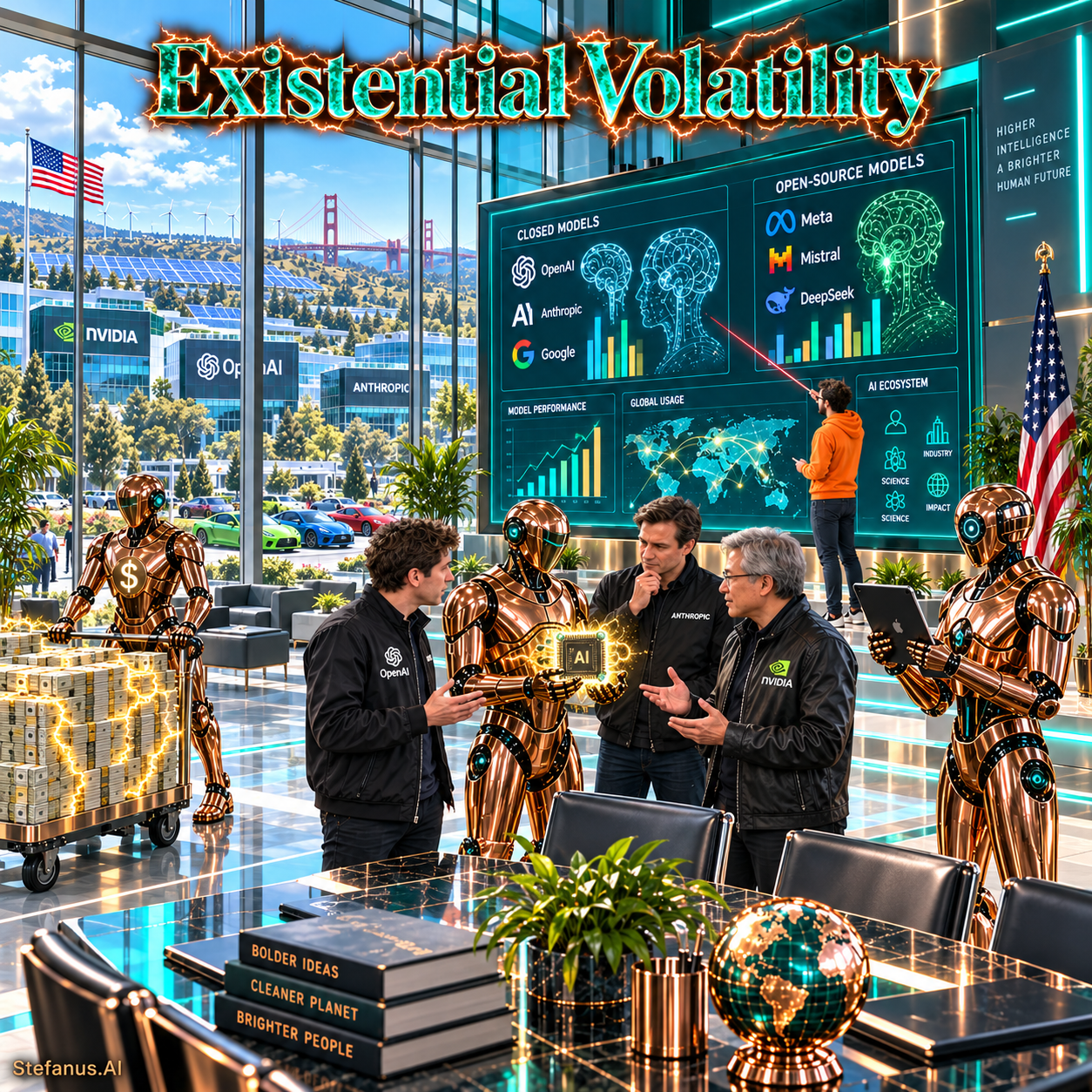
Comments
[…] frontier AI hardware, the governments that sit astride those chokepoints can extract fiscal, geopolitical, informational, and jurisdictional rents from access to compute. The United States does not […]