
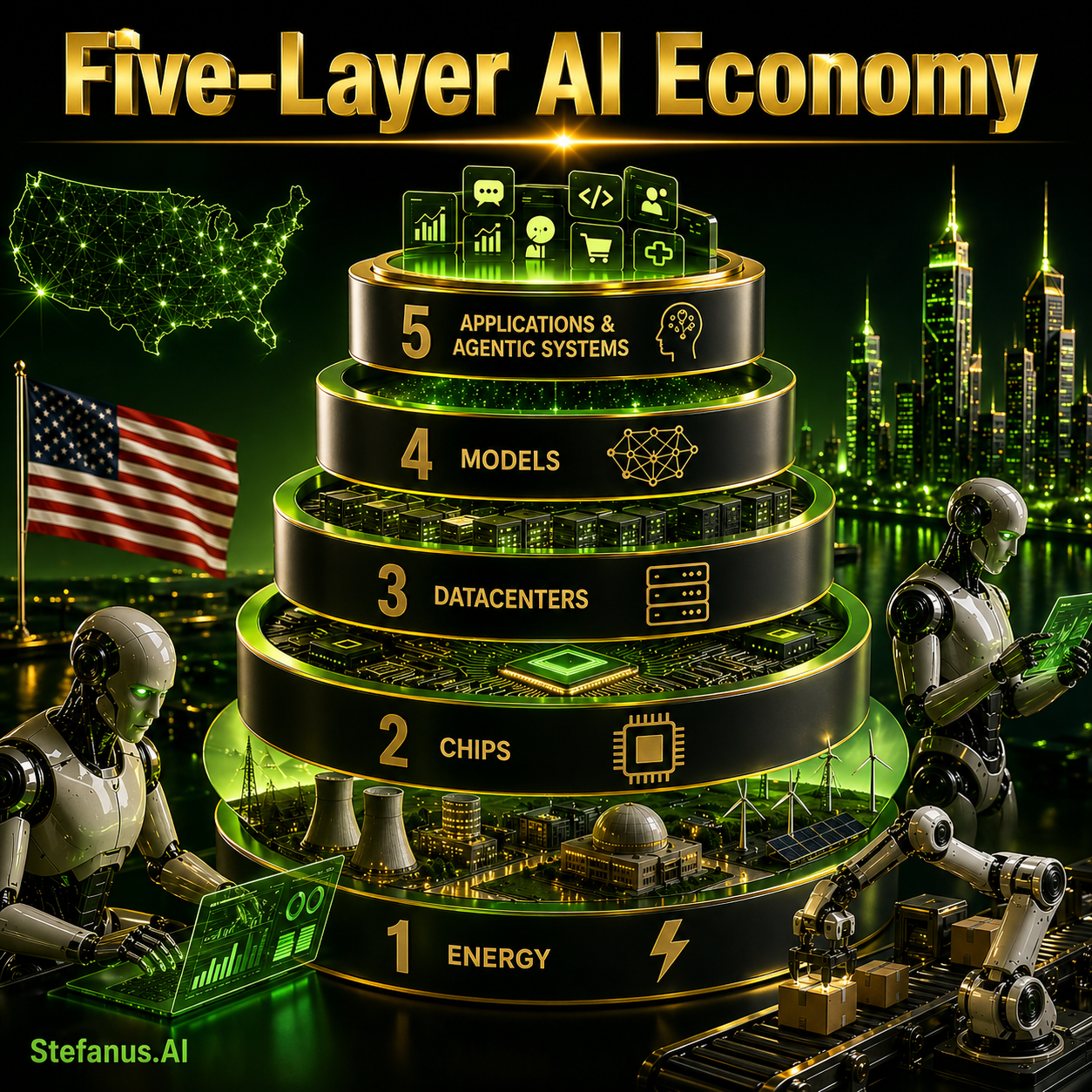

On April 16, 2026, at Stanford Graduate School of Business, Jensen Huang described artificial intelligence as a “five-layer cake”—a conceptual model spanning energy, chips, datacenters, models, and applications. This same framing appeared earlier at the World Economic Forum Annual Meeting, where the idea of AI as infrastructure—not software—was repeatedly emphasized.
“AI is not just software. It is infrastructure.”¹
This paper takes that conceptual statement and expands it into a fully articulated economic framework: the Five-Layer AI Economy.
This is not a metaphor. It is a structural model.
Artificial intelligence today is not a single market, not a vertical industry, and not a software category. It is a stacked industrial system in which each layer depends on the one below it, and constrains the one above it.
“General-purpose technologies reshape entire economies.”²
The Five-Layer AI Economy reveals a new kind of hierarchy:
- Energy determines whether computation is possible
- Chips determine how efficiently computation can be performed
- Datacenters determine how much computation can scale
- Models determine how intelligence emerges from compute
- Applications determine how that intelligence is monetized
“The ultimate limit to computation is energy.”³
This is the central organizing principle of the paper:
The AI economy is not driven by ideas alone—it is governed by physical, industrial, and geopolitical constraints.

Layer 1: Energy — The Foundation of Intelligence
Energy is the physical substrate of artificial intelligence. Every computation, every model inference, every training run is fundamentally a conversion of electrical energy into information processing.
This layer includes:
- Power generation (nuclear, gas, renewables)
- Grid infrastructure
- Cooling systems (liquid, immersion, thermal transfer)
AI systems consume electricity at unprecedented scale:
- Training a frontier model = hundreds of megawatt-hours
- Hyperscale datacenters = gigawatt-level demand
1.1 Energy as the Binding Constraint
Energy is not just the first layer—it is the non-negotiable constraint that defines the entire system.
Every AI output—every token generated, every inference executed, every model trained—is a direct transformation of electrical energy into computational work.
“Energy is the only universal currency.”⁴
In previous computing eras, energy was abstracted away. In the AI era, it returns as a central variable.
“The history of technology is the story of energy harnessed more effectively.”⁵
1.2 The Gigawatt Transition
The scale shift is unprecedented and accelerating:
- Traditional enterprise datacenters: 5–20 MW
- Hyperscale cloud datacenters: 50–100 MW
- AI clusters today: 100–300 MW
- Next-generation AI campuses: approaching 1 gigawatt (GW)
“Data centers are becoming the new steel mills of the digital economy.”⁶
This is not incremental growth. It is industrial transformation.
1.3 Hyperscaler Energy Demand
Major hyperscalers are now among the largest energy consumers in the world:
- Microsoft → multi-campus AI clusters approaching GW scale
- Google → 24/7 carbon-free energy contracts
- Amazon → largest corporate renewable buyer globally
- Meta Platforms → large-scale AI training facilities
“The scale of computing infrastructure is approaching that of heavy industry.”⁷
1.4 Nuclear Revival and Structural Mismatch
AI exposes a fundamental mismatch:
- Renewable energy = intermittent
- AI compute = continuous, non-stop
“There is no path to deep decarbonization without nuclear energy.”⁸
This drives renewed focus on:
- nuclear energy
- small modular reactors (SMRs)
- co-located power generation
1.5 The Gigarmageddon Reality
“We are entering an era where energy availability will cap technological progress.”⁹
AI demand is growing faster than grid expansion, faster than energy infrastructure deployment, and faster than policy adaptation.
This is not a temporary bottleneck.
It is structural.
Key Players
- NextEra Energy (NEE)
- Chevron (CVX)
- Constellation Energy (CEG)
- Vistra (VST)
- Oklo
- Nano Nuclear Energy
Economic Scale
- NextEra Energy: ~$28B annual revenue
- Chevron: ~$200B+ annual revenue
- Constellation Energy: ~$24B

Layer 2: Chips — The Intelligence Engine
2.1 Converting Energy into Compute
Chips are the layer where energy becomes computation.
“Compute is the new currency of artificial intelligence.”¹⁰
This layer includes:
- GPUs
- CPUs
- memory (HBM)
- interconnect
2.2 Market Concentration
- ~75% of AI workloads run on GPUs
- ~90% of those GPUs are produced by NVIDIA
“Accelerated computing is the future of computing.”¹¹
2.3 Strategic Bottlenecks
- TSMC → manufacturing
- ASML → EUV lithography
“ASML is the sole supplier of EUV lithography systems.”¹²
These are global chokepoints.
Without TSMC:
- NVIDIA cannot ship GPUs
- Apple cannot ship iPhones
- AMD cannot compete
Each ASML’s EUV machine:
- costs ~$200M+
- requires decades of R&D
- cannot be easily replicated
2.4 Chips as Geopolitical Assets
“Semiconductors are at the center of geopolitical competition.”¹³
Chips are no longer just products—they are instruments of power.
Key Players
- NVIDIA
- TSMC
- AMD
- Intel
- ASML
- Qualcomm
- Broadcom
- Terafab (upcoming)
Economic Scale
- NVIDIA: ~$120B+ revenue run-rate (AI-driven surge)
- TSMC: ~$70B+
- ASML: ~$30B

Layer 3: Datacenters — The AI Factories
3.1 Industrialization of Compute
Datacenters aggregate chips into massive compute systems.
This layer includes:
- hyperscale server farms
- high-speed networking
- cloud platforms
- space-based infrastructure
“The cloud is the factory floor of the AI economy.”¹⁴
3.2 Capital Intensity
“AI infrastructure spending is entering the hundreds of billions annually.”¹⁵
Hyperscalers are investing at a scale previously reserved for:
- oil
- manufacturing
- national infrastructure
Key Players
- Amazon Web Services
- Microsoft
- Meta Platforms
- CoreWeave
Space-Based Intelligence Infrastructure
- SpaceX / Starlink
- Blue Origin
Economic Scale
- AWS: ~$90B+ revenue
- Microsoft Azure (est.): $70B+
- Google Cloud: ~$40B+

Layer 4: Models — The Brains
4.1 Models as Intelligence Engines
Models convert compute into intelligence.
“Scaling laws reveal that larger models trained on more data and compute perform better.”¹⁶
4.2 Economics of Model Development
Frontier models require:
- tens of thousands of GPUs
- months of training
- massive energy consumption
“Training cutting-edge AI systems now requires resources comparable to large industrial projects.”¹⁷
4.3 Structural Constraint
“The limiting factor in AI progress is increasingly compute, not ideas.”¹⁸
This fundamentally changes innovation:
- breakthroughs are no longer purely algorithmic
- they are infrastructural
4.4 Strategic Alignment
Model companies are deeply tied to infrastructure providers:
- Microsoft ↔ OpenAI
- Amazon ↔ Anthropic
- Google ↔ internal stack
4.5 From Models to Agents
“AI systems are moving from answering questions to performing tasks.”¹⁹
This marks the transition from:
- static intelligence → dynamic action
Key Players
- OpenAI
- Anthropic
- xAI
Revenue Reality
- OpenAI: ~$3–5B estimated
- Anthropic: ~$1–2B estimated

Layer 5: Applications & Agentic Systems — The Economic Layer
5.1 From Intelligence to Economic Value
“AI only creates value when it is applied.”²⁰
Applications are where intelligence becomes:
- revenue
- productivity
- automation
5.2 Agentic Transformation
“AI agents will transform workflows across industries.”²¹
Agentic systems:
- plan
- execute
- iterate
5.3 Industry Transformation
“AI will reshape labor, productivity, and economic output simultaneously.”²²
Impact sectors:
- healthcare
- finance
- logistics
- software
- transportation
5.4 The Revenue vs Power Paradox
Applications generate revenue—but depend entirely on lower layers.
Revenue sits at the top.
Power sits below.
Key Players
- Palantir Technologies
- Salesforce
- Shopify
- Adobe
- ServiceNow
- Tesla
Economic Scale
- Salesforce: ~$35B
- Adobe: ~$20B
- Palantir: ~$2B
5.5 Economic Role and Others:
Applications:
- deliver value
- reach customers
- define monetization
Cross-Layer Power Dynamics
The most important insight:
| Layer | Power Type | Constraint |
| Energy | Physical | Electricity |
| Chips | Technical | Manufacturing |
| Datacenters | Scale | Capital |
| Models | Intelligence | Data + compute |
| Applications | Economic | Distribution |
Power flows bottom → up
Revenue flows top → down
Cost Model of Intelligence
“The cost of intelligence is rising exponentially.”²⁸
Drivers:
- energy
- compute
- capital
Example
- Training GPT-class model:
- Compute: $100M+
- Energy: tens of millions
- Infrastructure: billions

6. Geopolitics of the AI Economy
Artificial intelligence is no longer confined to corporate competition—it has become a central axis of geopolitical power.
“The chip industry has become ground zero for geopolitical rivalry.”²³
6.1 Fragmentation
“We are witnessing the fragmentation of the global technology ecosystem.”²⁴
For decades, the semiconductor supply chain was globally integrated:
- design in the U.S.
- manufacturing in Taiwan
- materials from Asia
- equipment from Europe
AI has fractured this system.
The world is moving toward technological blocs.
6.2 U.S. Strategy
The U.S. approach is built on:
- export controls on advanced chips
- CHIPS and Science Act subsidies
- alliances with key partners (Japan, Netherlands)
“Technology leadership is now a matter of national security.”²⁵
The U.S. is not just competing—it is shaping the rules of access.
6.3 China Strategy
China’s approach focuses on:
- domestic semiconductor manufacturing
- vertical integration
- state-backed capital deployment
“Self-reliance in technology is a strategic imperative.”²⁶
Despite constraints, China continues to:
- invest heavily in AI infrastructure
- build alternative supply chains
6.4 Chips as Strategic Weapons
Export restrictions on AI chips demonstrate a new reality:
Chips are no longer commercial goods—they are geopolitical instruments.
6.5 Energy + Compute = Sovereignty
The convergence of energy and compute introduces a new concept:
Compute Sovereignty
A nation’s power is now tied to:
- energy capacity
- semiconductor access
- datacenter scale
“Energy security is now inseparable from digital security.”²⁷
6.6 The New Global Order
The Five-Layer AI Economy is reshaping geopolitics into:
- Energy powers (U.S., Middle East)
- Chip powers (U.S., Taiwan, Netherlands)
- Compute powers (U.S., China)
- Application powers (global software leaders)
6.7 Strategic Implication
The key takeaway:
The AI stack is becoming the foundation of national power.
Control of this stack determines:
- technological leadership
- economic growth
- military capability
Conclusion
The title Five-Layer AI Economy is not descriptive—it is diagnostic.
It identifies a structural transformation in how intelligence is produced, distributed, and monetized.
AI is no longer:
- software
- a product
- a feature
AI is becoming the organizing system of the global economy.
“General-purpose technologies transform entire economic systems.”²
What We Have Learned
- Constraints define outcomes
- Power resides at the bottom
- Vertical integration determines winners
- AI reshapes geopolitics
- Progress is physically bounded
“The winners of the AI era will control the stack.”²⁹
Future Impact
“The integration of AI into the economy will rival the impact of electricity.”³⁰
AI will reshape:
- global energy systems
- industrial policy
- corporate strategy
- geopolitical power
Final Synthesis
Intelligence is no longer abstract—it is industrial.
The future will be decided by those who control energy, chips, and infrastructure.

Footnotes
- Jensen Huang — Stanford GSB Talk
https://www.gsb.stanford.edu - Erik Brynjolfsson — MIT Economics (GPT framework)
https://economics.mit.edu - Rolf Landauer — IBM Research, “Information is Physical”
https://research.ibm.com - Vaclav Smil — Energy and Civilization
https://mitpress.mit.edu - Vaclav Smil — Energy Transitions
https://www.sciencedirect.com - McKinsey Global Institute — Data Centers
https://www.mckinsey.com - Stanford HAI — Infrastructure Reports
https://hai.stanford.edu - MIT Energy Initiative
https://energy.mit.edu - Vaclav Smil — Growth Limits
https://www.sciencedirect.com - Stanford HAI — AI Index
https://hai.stanford.edu - Jensen Huang — NVIDIA GTC
https://www.nvidia.com - ASML — EUV Lithography
https://www.asml.com - CSIS — Semiconductor Geopolitics
https://www.csis.org - McKinsey — Cloud Economy
https://www.mckinsey.com - McKinsey — AI Investment
https://www.mckinsey.com - Jared Kaplan et al. — OpenAI Scaling Laws
https://arxiv.org/abs/2001.08361 - OpenAI — Training Costs
https://openai.com - Stanford HAI — Compute Constraints
https://hai.stanford.edu - Demis Hassabis — DeepMind
https://deepmind.google - World Bank — Digital Economy
https://www.worldbank.org - Andrew Ng — AI Transformation
https://www.deeplearning.ai - World Economic Forum
https://www.weforum.org - CSIS — Tech Rivalry
https://www.csis.org - IMF — Fragmentation
https://www.imf.org - U.S. Commerce Dept
https://www.commerce.gov - China State Council
http://english.www.gov.cn - U.S. DOE
https://www.energy.gov - arXiv — AI Cost Scaling
https://arxiv.org - Harvard Business Review
https://hbr.org - Brynjolfsson & McAfee — NBER
https://www.nber.org

Comments
[…] urgency of SIXF is not theoretical — it is temporal. By 2030, the Five-Layer AI Economy will be largely locked in: energy grids allocated, chip supply chains hardened, datacenter […]
[…] center of American AI industrial capacity. The evidence spans every layer of Jensen Huang’s five-layer AI economy — from data center campuses and energy infrastructure to, most recently, a domestic chip […]
[…] Geography fits directly and necessarily into the Five-Layer AI Economy because each layer carries geographic requirements that are as concrete and as immovable as any […]
[…] analyzing what has already been struck, one must understand what Jensen Huang built with his five-layer framework — and why it is, simultaneously, the most powerful conceptual map of modern AI and the most […]
[…] published on June 2, 2026, I argued that regional ecosystems had begun competing to own a five-layer artificial-intelligence economy, and that this competition would help determine the winners of the twenty-first century. [5] This […]
[…] — important commodities, but commodities nonetheless. What is being partitioned today is a five-layer system that, taken together, constitutes the productive apparatus of machine intelligence itself. Each […]
[…] Five-Layer AI Economy provides a useful framework for understanding why this shift […]
[…] necessary, and, increasingly, how quickly a new AI factory can begin operating at all. Within the Five-Layer AI Economy — the analytical structure I use across this research program, running from electricity and land […]
[…] is why Subsurface Compute fits naturally into the Five-Layer AI Economy framework that organizes this paper. Layer One — Energy — is no longer simply an external utility […]
[…] paper situates the argument within the Five-Layer AI Economy framework that organizes my broader body of work. The layers, and the role Networking Silicon plays […]
[…] Five-Layer AI Economy provides the analytical framework for the remainder of this paper, and it is worth stating the […]
[…] Repatriation also connects naturally to the five-layer structure of the AI economy that Jensen Huang sketched publicly at Davos in January 2026, when he described artificial […]
[…] the Five-Layer AI Economy—Energy, Chips, Datacenters, Models, and Applications and Agents—Baseload Capture represents a […]
[…] Five-Layer AI Economy is useful precisely because it reveals that artificial intelligence is not a single market but a […]