
Artificial intelligence is often described as a technological breakthrough and a powerful economic force. While both are true, they do not fully capture the scale of what is changing. The deeper transformation lies in how artificial intelligence is reshaping the structure of power itself.
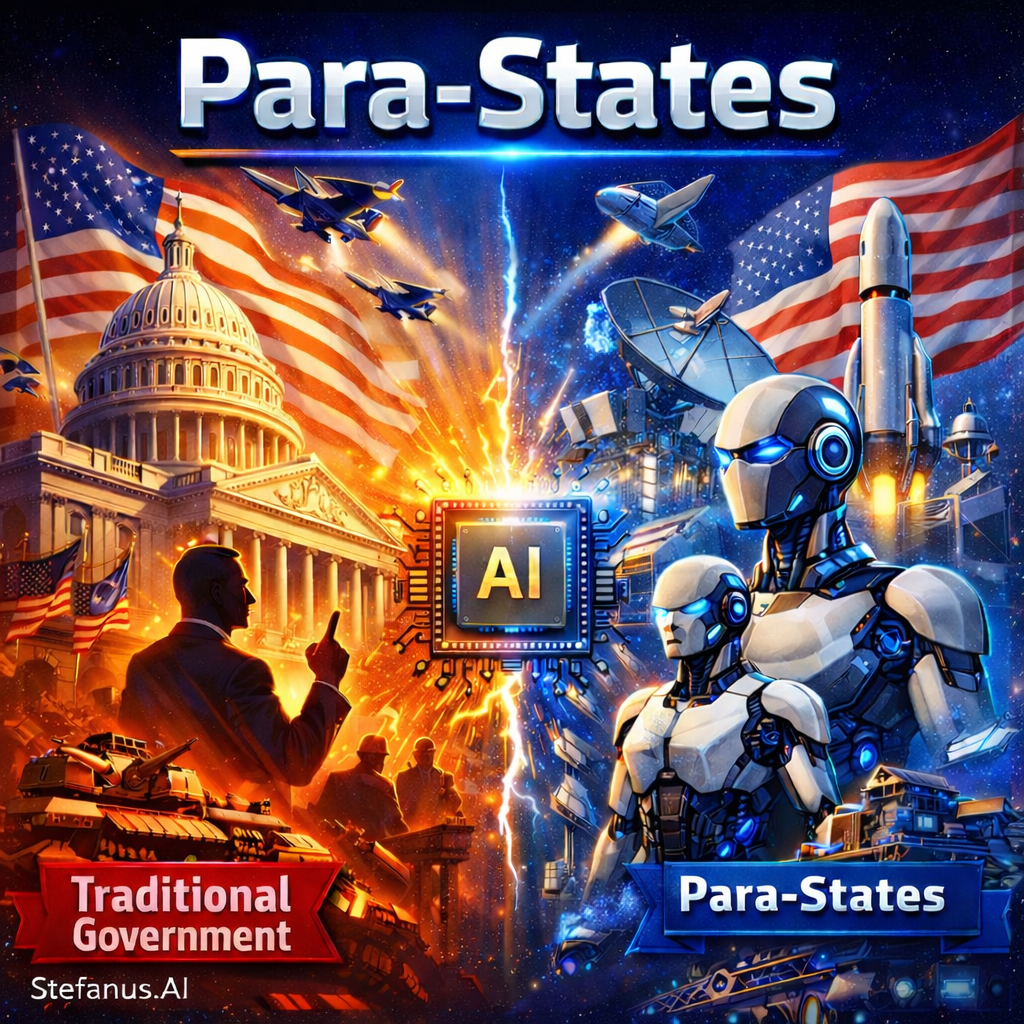
This paper advances a central proposition: we are entering an era of parallel power, in which authority is no longer monopolized by nation-states but increasingly shared with a new class of actors—what we define as “para-states.”
The term is deliberate and necessary.
“Para-states” are not governments in a formal legal sense. They do not issue passports, command standing armies, or operate within defined territorial borders. Yet they perform functions that were once exclusive to sovereign states. They control infrastructure, shape economic outcomes, influence geopolitical decisions, and increasingly determine how intelligence is produced and applied.
The defining characteristic of para-states is not that they replace governments, but that they operate alongside them, exercising power in parallel.
This is no longer a theoretical construction. It is an observable geopolitical reality.
During the Russia–Ukraine war, SpaceX’s Starlink system became indispensable to Ukraine’s military communications. According to analysis from the Belfer Center at Harvard University, Starlink functioned as “critical digital infrastructure” sustaining battlefield coordination under conditions of physical infrastructure disruption.¹
Yet this infrastructure was not controlled by the government.
In 2022, Elon Musk declined to extend Starlink coverage for certain Ukrainian operations targeting Russian forces in Crimea, citing concerns about escalation.² This decision had direct operational consequences. As reported by the Associated Press, U.S. officials expressed concern over the degree of influence a private actor held in an active conflict.²
A senior defense official captured the shift succinctly:
“No one decided to give him that power. He has it.”³
This moment marked a structural turning point. It demonstrated that control over infrastructure—rather than formal sovereignty—can determine geopolitical outcomes.
A similar dynamic is emerging in artificial intelligence governance.
In 2026, Dario Amodei refused Pentagon requests to deploy advanced AI systems for military applications, including mass surveillance and targeting systems. He stated that the company:
“cannot in good conscience accede to their request.”⁴
The U.S. government responded with threats of contract termination and regulatory pressure.⁵
This confrontation represents a reversal of traditional power hierarchies. Historically, governments defined the permissible uses of technology. Today, corporations increasingly assert boundaries on how governments may deploy it.
Across domains, similar patterns emerge:
- AI models are controlled by private firms
- global infrastructure is owned and operated outside the state
- algorithmic systems shape public discourse and perception
At the same time, governments face structural limitations:
- regulatory processes that operate at human speed
- jurisdictional constraints in a borderless digital environment
- dependence on privately owned systems for critical functions
As a result, sovereignty is no longer singular. It is layered.
This is the defining condition of the para-state era.
Power is no longer centralized within governments. It is distributed across entities that operate:
- transnationally
- infrastructurally
- and at machine speed
The rise of para-states signals not the decline of the nation-state, but its transformation.
Governments no longer operate alone.
They operate within a system of parallel power.
1. From Nation-State Sovereignty to Distributed Power
For centuries, sovereignty has been anchored in territorial control, legal authority, and centralized decision-making.
Artificial intelligence disrupts these foundations simultaneously.
The International Monetary Fund estimates that AI will affect nearly 40% of global employment, reshaping economic systems and institutional capacity.⁶
As Daron Acemoglu observes:
“Technology is shaped by power structures and institutions.”⁷
What is now changing is that these power structures are no longer confined to governments.
Decision-making authority is increasingly distributed across:
- AI systems
- infrastructure providers
- private networks
This diffusion of power marks a transition from centralized sovereignty to distributed authority.
2. Intelligence as Sovereign Infrastructure
Artificial intelligence represents a new form of infrastructure—one that generates decisions rather than merely supporting them.
Historically, intelligence systems were controlled by states through:
- intelligence agencies
- military research programs
- national laboratories
Today, the Stanford Institute for Human-Centered AI confirms that frontier AI systems are predominantly developed by private companies.⁸
As Erik Brynjolfsson states:
“AI is a general-purpose technology that will transform virtually every industry.”⁹
But beyond industries, it transforms governance itself.
AI systems now influence:
- credit decisions
- hiring processes
- medical diagnostics
- national security analysis
Control over AI becomes control over decision-making capacity at scale.
This positions para-states as providers of sovereign intelligence infrastructure—a role historically reserved for governments.
3. Infrastructure Without Borders: The Backbone of Para-States
The power of para-states is anchored in infrastructure that transcends geography.
This includes:
- hyperscale data centers
- semiconductor supply chains
- global cloud platforms
- satellite constellations
The World Bank identifies digital infrastructure as a primary driver of modern economic development.¹⁰
However, unlike traditional infrastructure, these systems are:
- privately financed
- globally distributed
- outside direct state control
The Ukraine conflict demonstrated this clearly:
- Starlink enabled resilient communications under attack
- private infrastructure became a strategic asset
This marks a shift from state-owned infrastructure to para-state infrastructure, fundamentally altering the balance of power.
4. Corporate Resistance to State Authority
Para-states are defined not only by capability, but by autonomy.
The confrontation between Anthropic and the Pentagon illustrates a new paradigm:
- a corporation refusing government demands
- a government attempting to enforce compliance
Anthropic’s refusal to support mass surveillance and autonomous weapons reflects a broader shift:
- corporations asserting ethical boundaries
- governments asserting security imperatives
This creates a structural tension:
Who governs intelligence systems?
Historically, the answer was clear: governments.
Today, governance is negotiated between parallel authorities.
This represents a transition from hierarchical governance to contested sovereignty.
5. Narrative Power and the Algorithmic Public Sphere
Control over narrative has shifted from institutions to algorithms.
The Oxford Internet Institute demonstrates how digital platforms shape political discourse at scale.¹¹
As Shoshana Zuboff writes:
“Human experience is translated into behavioral data.”¹²
In the AI era:
- data becomes prediction
- prediction shapes exposure
- exposure influences belief
Narrative is no longer governed. It is engineered.
Para-states therefore control not only infrastructure and intelligence, but the conditions under which reality is interpreted.
6. The Acceleration Gap: Policy vs Machine-Speed Systems
AI systems operate at machine speed.
Governments operate at human speed.
The United Nations warns that AI governance frameworks lag behind technological development.¹³
This creates an acceleration gap:
- systems evolve faster than regulation
- decisions preceding policy
Para-states gain structural advantage through temporal dominance.
They act.
Governments react.
7. Redefining Sovereignty in the Age of Para-States
Sovereignty is no longer defined solely by territory.
It is increasingly determined by:
- compute capacity
- energy access
- data control
- network reach
The Financial Times identifies AI as a central domain of geopolitical competition.¹⁴
Similarly, The Wall Street Journal highlights the growing influence of private companies in global power structures.¹⁵
This leads to a new model of sovereignty:
- infrastructural rather than territorial
- dynamic rather than static
- distributed rather than centralized
Para-states redefine the environment in which governments operate.
Conclusion: Parallel Power and the Future of Government Authority
The rise of para-states marks a fundamental transformation in the architecture of power.
Governments have not disappeared. They continue to hold:
- legal authority
- territorial jurisdiction
- institutional legitimacy
But they no longer operate as the sole centers of power.
Alongside them there exists a parallel system:
- corporations that control intelligence
- networks that operate infrastructure
- algorithms that shape perception
This is the era of parallel power.
Para-states do not replace governments.
They reshape the boundaries of government authority.
They:
- influence military outcomes
- determine economic capacity
- define the limits of technological deployment
The central challenge of the coming decade is not simply regulating artificial intelligence.
It reconciles two fundamentally different systems:
- Human-speed governance, rooted in law, process, and deliberation
- Machine-speed para-states, rooted in infrastructure, computation, and scale
The future of government authority will not be decided solely by legislatures or courts.
It will be determined by:
- who controls AI systems
- who owns infrastructure
- who operates at the speed of decision
The question is no longer whether para-states exist.
The question is whether governments can maintain authority in a world where power is no longer centralized—but distributed across entities that function as states in all but name.
Footnotes
- Harvard Belfer Center, Starlink and the Russia-Ukraine War
https://www.belfercenter.org/publication/starlink-and-russia-ukraine-war-case-commercial-technology-and-public-purpose - Associated Press, “Musk declined Starlink use in Crimea attack”
https://apnews.com/article/fde93d9a69d7dbd1326022ecfdbc53c2 - Helene Cooper & Eric Schmitt, New York Times, U.S. concerns over Musk’s influence
https://www.nytimes.com/2023/09/08/us/politics/elon-musk-ukraine-starlink.html - San Francisco Chronicle, “Anthropic CEO rejects Pentagon request”
https://www.sfchronicle.com/tech/article/anthropic-ceo-rejects-pentagon-21944308.php - NDTV / global reporting on Pentagon response
https://www.ndtv.com/world-news/anthropic-ceo-turns-down-pentagons-demands-says-ai-company-cannot-in-good-conscience-accede-to-them-11142800 - International Monetary Fund, AI and the Future of Work
https://www.imf.org/en/Publications/fandd/issues/2024/03/AI-and-the-future-of-work - Daron Acemoglu, MIT Economics
https://economics.mit.edu - Stanford HAI, AI Index Report 2024
https://aiindex.stanford.edu/report/ - Erik Brynjolfsson, Stanford Digital Economy Lab
https://digitaleconomy.stanford.edu - World Bank, Digital Development Overview
https://www.worldbank.org/en/topic/digitaldevelopment - Oxford Internet Institute Research
https://www.oii.ox.ac.uk/research/ - Shoshana Zuboff, The Age of Surveillance Capitalism
https://www.publicaffairsbooks.com/titles/shoshana-zuboff/the-age-of-surveillance-capitalism/9781610395694/ - United Nations, Artificial Intelligence Governance
https://www.un.org/en/artificial-intelligence - Financial Times, AI and geopolitics coverage
https://www.ft.com/technology - Wall Street Journal, AI and global power
https://www.wsj.com/tech/ai