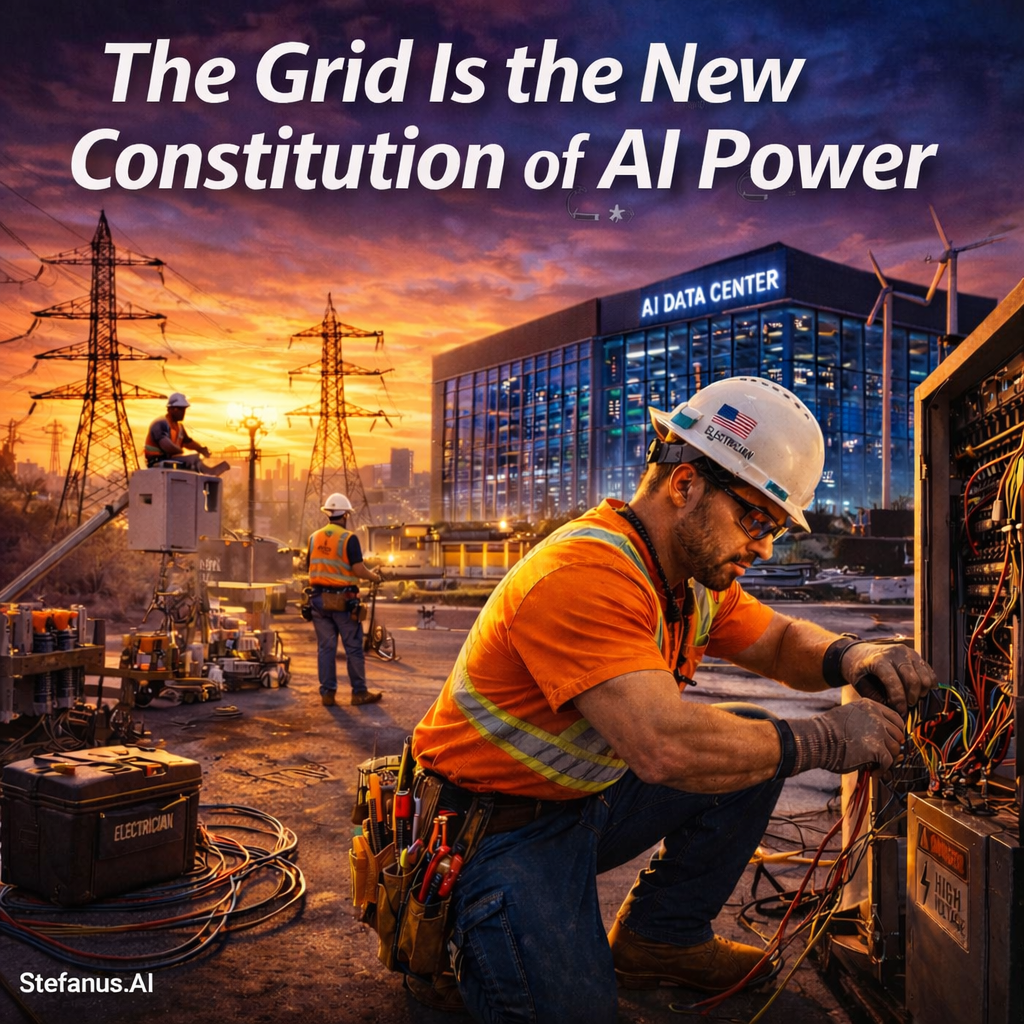

Artificial intelligence is often framed as a revolution in software, but its true impact is unfolding at a deeper level. It is, in essence, a transformation of infrastructure. What distinguishes this moment is not merely the rapid advancement of models, but the growing dependence of intelligence on physical systems that must operate continuously, at scale, and within an increasingly unstable geopolitical environment.
This is why the term “Space-Based Intelligence” is used deliberately. It captures a structural shift now underway: intelligence is no longer confined to code or abstract computation—it is rooted in infrastructure. And that infrastructure, once assumed to be stable and invisible, is becoming both constrained and vulnerable on Earth.
This relationship between intelligence and infrastructure is not new. Throughout history, intelligence has always been shaped by the systems that support it. Human intelligence was limited by biology. Industrial intelligence expanded through machines and factories. Digital intelligence emerged through terrestrial networks and data centers. Each phase extended capability, but remained bounded by its underlying platform.
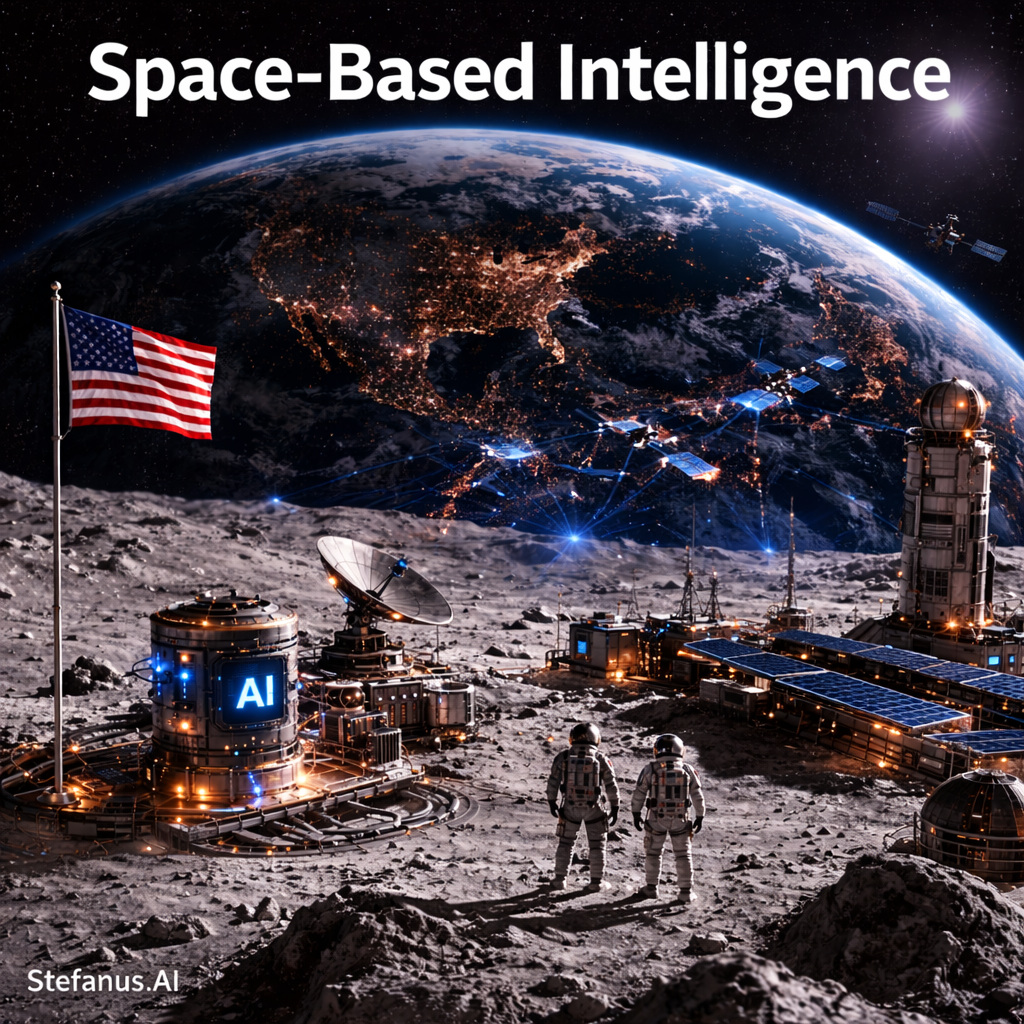
Today, artificial intelligence is reaching a scale where those terrestrial boundaries are no longer sufficient. The systems that once enabled intelligence are now beginning to limit it, marking the transition to a new phase—one where the future of intelligence depends not just on better models, but on where and how that intelligence can be sustained.
The expansion of AI is increasingly constrained by three interlocking limits:
energy availability, physical infrastructure, and geopolitical risk.
Data centers require vast amounts of electricity, land, and cooling capacity, all of which are finite and contested resources. According to the International Energy Agency, global data center electricity demand could more than double within this decade, placing unprecedented pressure on national grids [1]. In the United States and Europe, utilities are already warning that AI-driven demand may outpace capacity expansions.
At the same time, the physical concentration of computer infrastructure introduces new vulnerabilities. Data centers—once considered neutral—are now strategic assets.
Recent conflicts in the Middle East provide a clear signal for this transformation. Missile and rocket attacks have struck industrial zones, logistics hubs, and energy infrastructure, raising serious concerns about the proximity of digital infrastructure to active conflict environments. Reporting from the Financial Times and The Wall Street Journal highlights growing risks to global infrastructure, including facilities tied to Western technology ecosystems [2][3].
Even when data centers themselves are not directly targeted, their dependencies are exposed:
- power grids can fail
- cooling systems can be disrupted
- fiber routes can be severed
- supply chains can be interrupted
This reveals a structural reality:
As artificial intelligence becomes central to economic and national power, its infrastructure becomes a target.
As Daron Acemoglu explains:
“The impact of AI will depend not just on algorithms, but on how it is deployed within economic and institutional structures.” [4]
Those structures are now under strain.
At the same time, institutions such as the World Bank and International Monetary Fund emphasize that infrastructure constraints are becoming central to long-term economic growth in the AI era [5][6].
This convergence—explosive demand, structural limits, and geopolitical fragility—is forcing a new direction.
If intelligence cannot be reliably sustained on Earth, it must be extended beyond it.
This is the foundation of Space-Based Intelligence: the relocation of computational infrastructure into orbit, where energy is abundant, constraints are reduced, and geopolitical exposure is minimized.
This paper advances a central thesis:
The final layer of sovereignty in the age of artificial intelligence will be defined by control over space-based intelligence infrastructure.
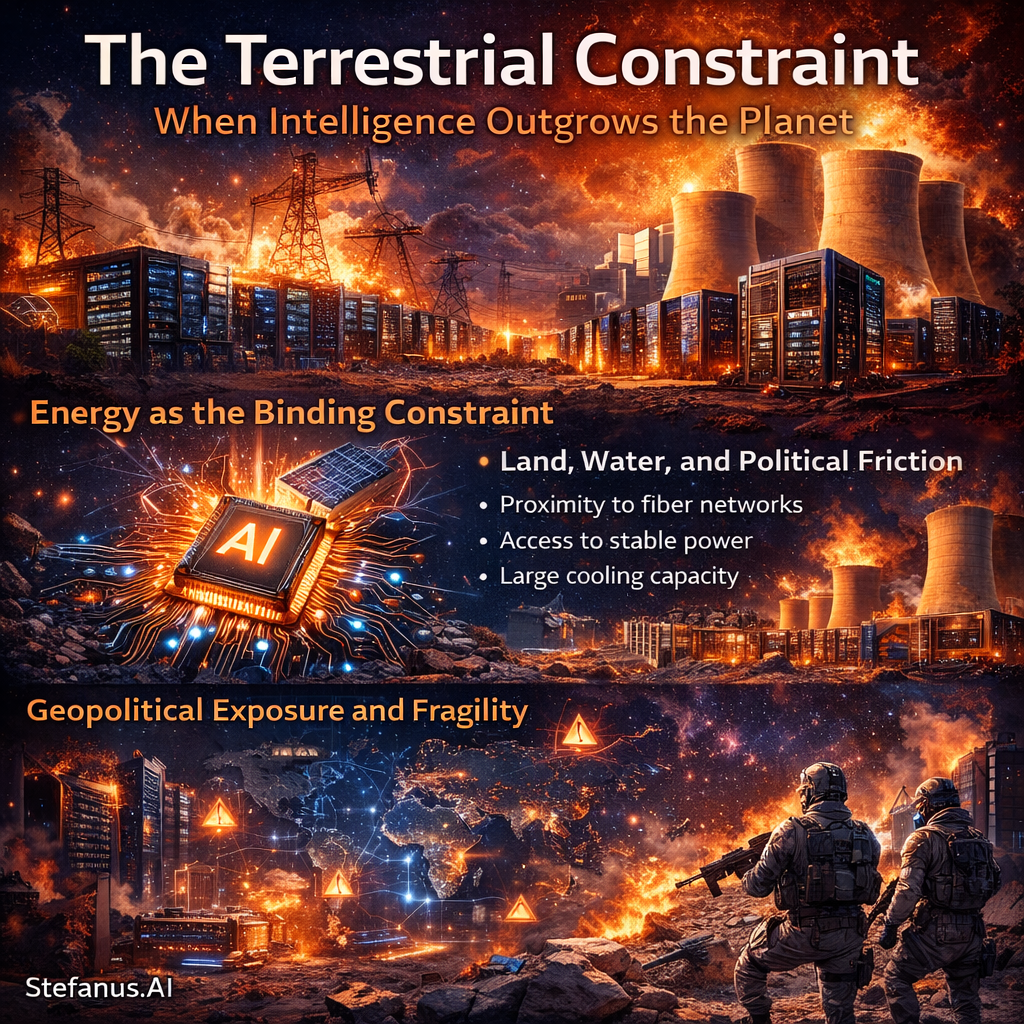
1. The Terrestrial Constraint: When Intelligence Outgrows the Planet
Artificial intelligence has entered a phase in which physical infrastructure—not algorithms—is the primary bottleneck of progress. This marks a historic transition: intelligence is no longer limited by what we can design, but by what we can sustain.
Research from Harvard University and Massachusetts Institute of Technology shows that AI-driven productivity gains are increasingly dependent on access to compute, energy, and infrastructure rather than purely software innovation [7][8].
As Erik Brynjolfsson observes:
“The bottleneck is shifting from ideas to implementation—from algorithms to the infrastructure needed to run them.” [9]
Energy as the Binding Constraint
The scale of AI energy demand is unprecedented. Training a single frontier model can consume as much electricity as thousands of households over extended periods. At scale, this creates systemic pressure.
The International Energy Agency warns:
“Electricity demand from data centres, AI and cryptocurrency could double by 2026.” [1]
This is not a temporary spike—it is a structural shift.
Land, Water, and Political Friction
Data centers require:
- proximity to fiber networks
- access to stable power
- large cooling capacity
This has created local resistance. In regions such as Ireland, the Netherlands, and parts of the United States, governments have delayed or rejected new data center projects due to environmental concerns.
Geopolitical Exposure and Fragility
The clustering of infrastructure introduces systemic risk. When compute is concentrated geographically, it becomes vulnerable to disruption—whether through conflict, cyber operations, or policy changes.
As Nicholas Stern notes:
“Infrastructure choices made today will shape economic possibilities for decades.” [10]
In the AI era, those choices determine where intelligence can exist—and where it can be disrupted.
2. The Orbital Alternative: Computing Beyond Earth
Orbital data centers do not merely optimize existing systems; they redefine them.
Instead of operating within terrestrial constraints, they change the operating environment entirely.
Physics as a Competitive Advantage
In orbit:
- solar energy is continuous
- cooling is achieved through radiation in vacuum
- infrastructure is independent of land and water constraints
Research highlighted in Scientific American suggests that space-based data centers could achieve significantly higher efficiency while eliminating key bottlenecks [11].
Industrial Momentum
This is no longer speculative:
- SpaceX has reduced launch costs dramatically
- Blue Origin is building long-term space infrastructure
- startups are developing modular orbital compute systems
Market projections indicate rapid growth in orbital data infrastructure over the next decade [12].
A New Geography of Intelligence
The most profound shift is conceptual:
Intelligence is no longer tied to geography.
Orbital systems can operate independently of national borders, local infrastructure, or regional instability.
As Fei-Fei Li emphasizes:
“AI is not just an algorithmic revolution; it is a systems-level transformation.” [13]
Orbital computing represents that transformation at its highest level.
3. Energy as the New Foundation of Intelligence
Artificial intelligence is fundamentally an energy system.
The United Nations has noted:
“Digital transformation is increasingly dependent on sustainable energy systems.” [14]
From Compute to Energy Dominance
The hierarchy of constraints has evolved:
- hardware → compute
- compute → energy
As Vaclav Smil argues:
“Energy is the only universal currency.” [15]
In the context of AI, this becomes literal.
Orbital Energy Abundance
In space:
- energy is continuous
- generation is scalable
- dependence on national grids is eliminated
This leads to a new hierarchy:
Data → Compute → Energy → Orbit
Control over energy becomes control over intelligence.
4. Security and Resilience in a Fragmented World
The global system is becoming more fragmented, not less.
Research from Yale University highlights increasing vulnerability of critical infrastructure to both physical and cyber threats [16].
Infrastructure as Strategic Target
In modern conflict, infrastructure is no longer collateral, it is strategic.
Energy systems, logistics networks, and increasing data infrastructure are becoming focal points.
Orbital systems provide:
- distributed architecture
- independence from local disruption
- persistent operation
As Henry Kissinger observed:
“Control of territory is no longer the sole basis of power.” [17]
In the AI era, control of infrastructure, especially resilient infrastructure—becomes decisive.
5. Orbital Sovereignty: Redefining Power
The emergence of Space-Based Intelligence introduces orbital sovereignty.
Institutions such as the Center for Strategic and International Studies highlight space as a domain of strategic competition [18].
New Dimensions of Sovereignty
Orbital sovereignty includes:
- control over satellite constellations
- access to launch capabilities
- ownership of orbital infrastructure
As Joseph Nye explains:
“Power is the ability to affect others to get the outcomes you want.” [19]
In the AI era, that ability depends on control over intelligence infrastructure.
Blurring State and Corporate Power
Unlike traditional sovereignty, orbital infrastructure is heavily influenced by private actors, creating hybrid power structures.
Layered Sovereignty
- Territorial
- Digital
- Orbital
The third layer may ultimately dominate the others.
Conclusion: Sovereignty Beyond Earth
The history of power is the history of infrastructure.
Artificial intelligence introduces a new requirement: continuous, energy-intensive computation on a global scale. This requirement cannot be fully satisfied within the constraints of Earth.
Space-Based Intelligence represents the next stage.
It removes dependence on terrestrial systems.
It reduces exposure to geopolitical risk.
It redefines sovereignty itself.
As Satya Nadella stated:
“AI is the defining technology of our times.” [20]
But its defining constraint is infrastructure.
The central question becomes:
Who controls the infrastructure that produces intelligence?
As that infrastructure moves into orbit, sovereignty follows.
Footnotes
[1] International Energy Agency – Energy and AI (Electricity Demand)
https://www.iea.org/reports/energy-and-ai/energy-demand-from-ai (IEA)
[2] Financial Times – AI energy demand / infrastructure pressure (example coverage)
https://www.ft.com/content/852bc3e2-d7fb-467b-9651-077a7d09a0ce (Financial Times)
[3] Wall Street Journal – AI data centers energy usage
https://www.wsj.com/business/energy-oil/ai-data-centers-desperate-for-electricity-are-building-their-own-power-plants-291f5c81 (The Wall Street Journal)
[4] MIT – Daron Acemoglu (AI economics & institutions)
https://economics.mit.edu/people/faculty/daron-acemoglu
[5] World Bank – Digital development & infrastructure
https://www.worldbank.org/en/topic/digitaldevelopment
[6] IMF – AI and economic outlook
https://www.imf.org/en/Publications/WEO
[7] Harvard Kennedy School – AI, economy, and infrastructure
https://www.hks.harvard.edu/centers/mrcbg/programs/growthpolicy/ai
[8] MIT Economics – AI productivity research
https://economics.mit.edu/research
[9] Stanford Digital Economy Lab – Erik Brynjolfsson
https://digitaleconomy.stanford.edu
[10] London School of Economics – Nicholas Stern
https://www.lse.ac.uk/granthaminstitute/profile/nicholas-stern/
[11] Scientific American – Data Centers in Space
https://www.scientificamerican.com/article/data-centers-in-space/
[12] Orbital Data Center Market (industry projection)
https://www.dcmarketinsights.com/report/in-orbit-data-centers-market
[13] Stanford HAI – Fei-Fei Li / AI systems perspective
https://hai.stanford.edu
[14] United Nations – Digital transformation & infrastructure
https://www.un.org/en/digital-cooperation
[15] Vaclav Smil – Energy theory (official site)
https://vaclavsmil.com
[16] Yale University – Infrastructure & global risk research
https://jackson.yale.edu/research
[17] Henry Kissinger – AI & geopolitics (Foreign Affairs article)
https://www.foreignaffairs.com/articles/2021-08-24/artificial-intelligence-and-future-power
[18] CSIS – Space as strategic domain
https://www.csis.org/programs/aerospace-security-project
[19] Harvard Kennedy School – Joseph Nye (power theory)
https://www.hks.harvard.edu/faculty/joseph-s-nye-jr
[20] Microsoft – Satya Nadella AI statement
https://news.microsoft.com/ai