
For decades, digital power has been understood as a function of software, data, and networks. The dominant assumption was that intelligence scaled through code: better models, more data, faster chips. Infrastructure mattered, but it remained secondary—an enabling layer rather than a determining one.
That assumption is no longer sufficient.
Artificial intelligence has entered a phase in which computation is no longer abstract, but materially grounded in energy systems, industrial supply chains, and physical infrastructure. Training and operating advanced AI systems now require vast quantities of electricity, cooling, land, and capital, transforming intelligence into a form of infrastructure-intensive production.
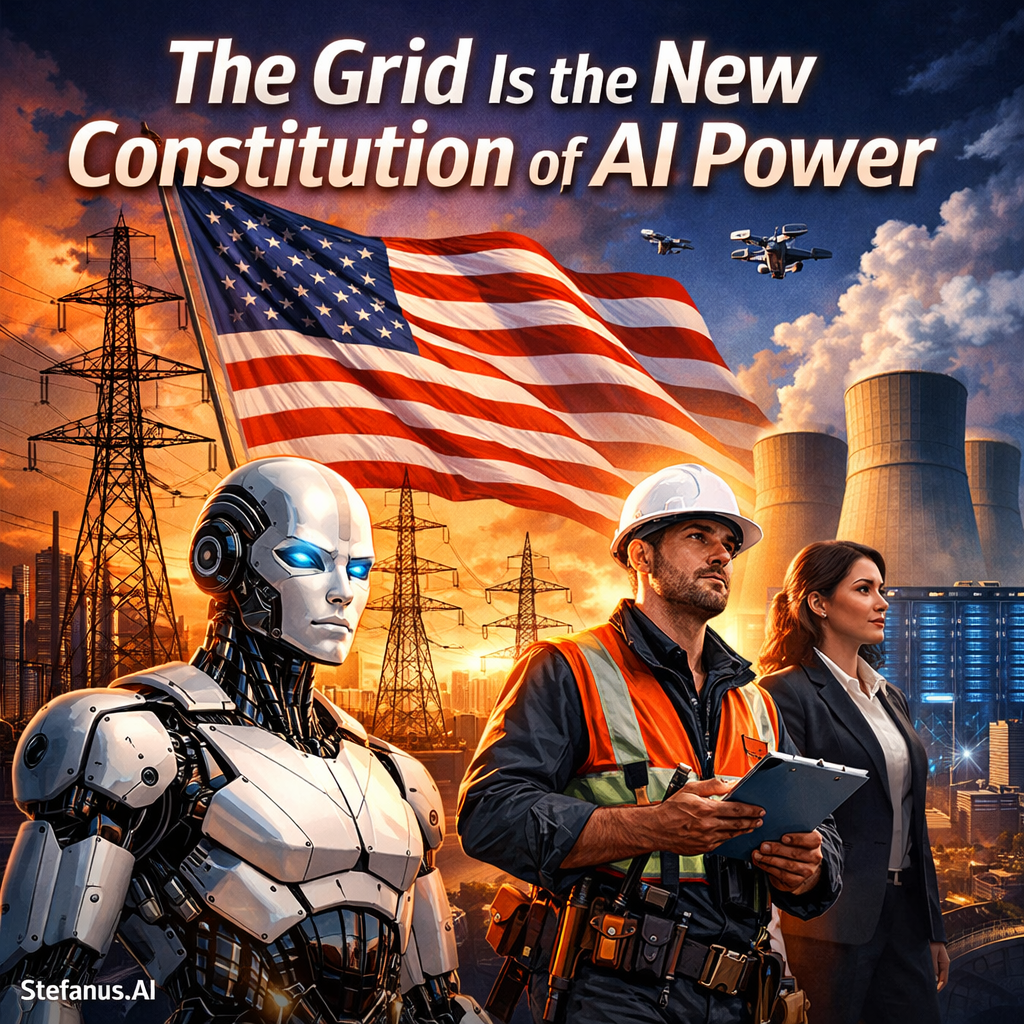
This paper adopts the title The Grid Is the New Constitution of AI Power to capture this structural shift. Just as a political constitution defines the limits, rules, and distribution of authority within a system, the electric grid increasingly defines the boundaries within which artificial intelligence can exist, expand, and operate. It determines what can be built, where it can be built, and at what speed.
At the same time, a parallel question is emerging: if the grid becomes the constraint, can it be bypassed or supplemented? The growing interest in small modular nuclear reactors, microreactors, and localized energy systems suggests that the future of AI will be shaped not by a single infrastructure, but by competing energy architectures.
The central argument of this paper is therefore twofold:
First, the expansion of artificial intelligence is now governed by the availability and structure of electricity.
Second, emerging energy systems—particularly nuclear—are not replacing the grid, but redefining the architecture of power itself.
I. Intelligence Has Become Infrastructure
The scale of modern AI systems has fundamentally altered the economics of computation.
Large AI data centers now operate at levels of energy consumption previously associated with entire cities. Some facilities exceed one gigawatt of demand, equivalent to hundreds of thousands of homes [1]. At the same time, global investment in AI infrastructure has reached unprecedented levels, with major technology firms committing over $600 billion annually [2].
This transformation reflects a deeper shift in intelligence.
AI systems now require:
- Continuous, high-density electricity
- Advanced cooling systems with substantial water usage
- Large-scale physical facilities
- Rapid hardware turnover cycles
Recent research shows that AI data centers introduce new stress patterns into electrical systems, including concentrated peak loads and persistent high baseline demand [3].
The implication is clear:
Intelligence is no longer purely informational. It is infrastructural.
II. The Grid as Bottleneck and Gatekeeper
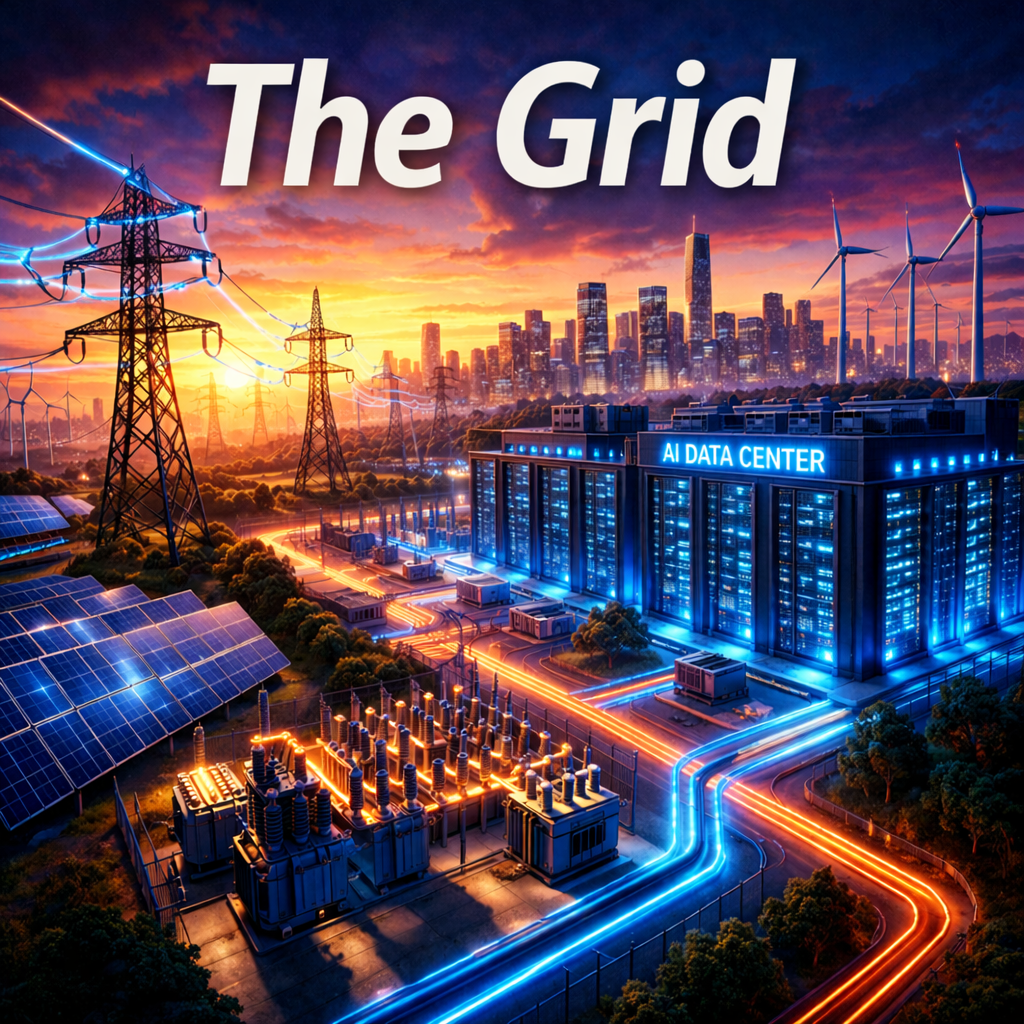
As AI demand accelerates, the electric grid has emerged as the primary constraint on expansion.
After decades of relatively flat growth, electricity demand in the United States is rising sharply, driven largely by data center expansion [4]. The U.S. Energy Information Administration projects continued increases through at least 2027 [5].
Yet the grid is not prepared for this shift.
- Transmission expansion is slow and politically constrained
- Interconnection queues are backlogged for years
- Regional capacity shortages are emerging
- Infrastructure was not designed for concentrated AI loads
In Texas, interconnection requests for data centers alone have exceeded 200 gigawatts—far beyond current capacity [1].
This creates a structural imbalance:
AI is scaling faster than the systems required to power it.
In response, companies are increasingly exploring off-grid solutions, including on-site generation and dedicated energy systems [6].
The grid is therefore no longer a neutral utility. It is a gatekeeper, determining which projects proceed and which do not.
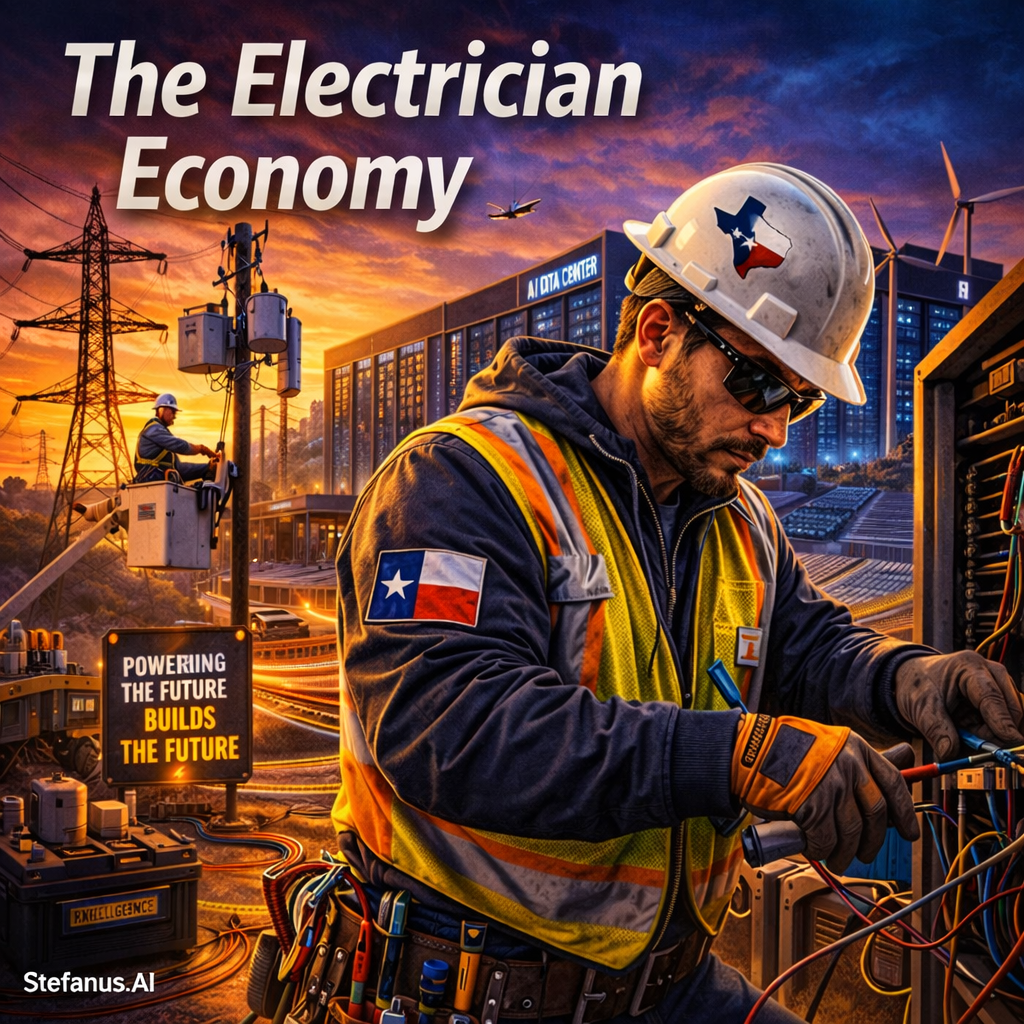
III. Labor Reordering: The Electrician Economy
The transformation of AI into infrastructure is reshaping labor markets in unexpected ways.
While attention often focuses on engineers, the expansion of data centers has created acute shortages in skilled electrical labor—particularly in regions like Texas.
Building AI infrastructure requires expertise in:
- High-voltage systems
- Transformer installation
- Grid interconnection
- Industrial-scale electrical engineering
Recent reporting indicates that the AI boom is diverting skilled workers from other sectors, including housing construction [7]. In some cases, electricians are earning wages comparable to or exceeding traditional professional roles, reflecting both scarcity and strategic importance.
Companies are increasingly competing for this limited workforce, including actively poaching electricians across projects.
This signals a deeper shift:
In an infrastructure-driven AI economy, the most valuable labor is that which enables physical systems.
IV. The Cost of Intelligence: Localized Burdens
The expansion of AI infrastructure is redistributing costs across society.
As electricity demand rises, prices follow. In some regions, electricity costs are increasing faster than overall inflation due to data center demand [8]. Wholesale electricity prices have surged significantly in certain markets [9].
Texas illustrates this dynamic clearly:
- New transmission infrastructure is required
- Costs are passed on to ratepayers
- Electricity prices are expected to rise if supply does not keep pace [10]
Communities are also facing:
- Increased water usage
- Land and environmental concerns
- Grid reliability risks
- Political and regulatory tension [11]
This creates a structural asymmetry:
The benefits of AI are global, while the costs are local.
V. Supply Chains, Tariffs, and Physical Constraints
Even when capital, labor, and land are available, AI expansion faces another constraint: industrial supply chains.
Data centers require specialized equipment, including transformers, cables, switchgear, and power systems. These components are difficult to scale quickly.
Recent reporting shows that U.S. data center expansion depends heavily on imported electrical equipment, with shortages already delaying projects [12].
Tariffs and trade tensions further complicate the situation:
- Import restrictions increase costs
- Lead times extend significantly
- Domestic capacity remains insufficient
As a result, projects are delayed not by lack of capital, but by lack of physical components.
AI is constrained not only by computation, but by industrial production.

VI. Nuclear as a Parallel Grid: Promise and Constraint
As the limitations of the grid become increasingly apparent, attention has shifted toward an alternative: building energy systems alongside AI infrastructure.
Among the most prominent proposals is the deployment of small modular reactors (SMRs) and microreactors—compact nuclear systems designed for flexible, localized power generation.
Unlike traditional nuclear plants, SMRs are:
- Smaller in scale (often under 300 MWe)
- Factory-built and modular
- Deployable near demand centers
- Scalable overtime
Technical research highlights that SMRs are particularly suited for high-density, continuous-load environments, such as data centers [13].
This has led to growing alignment between nuclear development and AI infrastructure.
Several companies are positioning themselves at this intersection:
- Oklo Inc. — focused on microreactors designed for industrial and AI applications [14]
- NuScale Power — developing scalable SMR systems with regulatory approval progress [15]
- Nano Nuclear Energy — pursuing portable microreactors for flexible deployment [16]
- Ticker symbols: Oklo Inc. (NYSE: OKLO); NuScale Power (NYSE: SMR); Nano Nuclear Energy (NASDAQ: NNE)
The strategic logic is straightforward:
If the grid cannot scale fast enough, energy must be built at the point of computation.
This model creates a parallel energy system, partially decoupling AI infrastructure from traditional utilities.
1. Nuclear as Localized Sovereignty
SMRs introduce the possibility of on-site energy sovereignty.
Instead of relying on constrained grids, data centers could operate with dedicated power sources, reducing exposure to:
- Transmission bottlenecks
- Grid congestion
- Regulatory delays
- Price volatility
In this framework, energy becomes vertically integrated into the AI stack.
Some analysts suggest that nuclear companies could become critical enablers of AI, not merely energy providers but infrastructure partners in computational scaling [17].
2. Structural Limits of Nuclear Expansion
Despite its promise, nuclear energy faces significant constraints.
Recent reporting highlights several key barriers:
- High capital costs relative to alternatives
- Long regulatory approval timelines
- Workforce shortages (e.g., specialized welders, engineers)
- Limited fuel supply chains [18]
In the United States, the nuclear workforce may need to triple by 2050, even as many workers approach retirement [18].
Furthermore, SMR deployment remains largely pre-commercial. While companies are advancing designs, widespread deployment is expected later in the decade [19].
This creates a paradox:
Nuclear is widely viewed as the long-term solution, but it cannot solve the immediate constraint.
3. Capital Markets and the Financialization of Power
The growing importance of nuclear energy is reflected in capital markets.
SMR-related companies have seen significant valuation shifts, driven by expectations of future AI-driven demand rather than current revenue [20].
Some projections suggest nuclear could become a multi-trillion-dollar market, as electricity demand accelerates globally [21].
This reflects a broader trend:
The future of AI is increasingly priced not only in software markets, but in energy markets.
4. Hybrid Energy Architecture
The most likely outcome is not the replacement of the grid, but a hybrid system:
- Traditional grids provide baseline capacity
- Nuclear systems supplement high-intensity demand
- On-site generation reduces dependency
- Energy becomes a strategic asset rather than a uniform utility
In this model, the grid remains central—but it is no longer singular.
VII. Toward Electric Sovereignty
The convergence of these dynamic grid constraints, labor shortages, supply chain limits, and emerging energy systems—points toward a new form of geopolitical competition.
Electric sovereignty refers to the ability to:
- Generate sufficient power
- Expand transmission systems
- Secure infrastructure supply chains
- Allocate electricity strategically
Countries that succeed will shape the trajectory of AI.
Those that fail will be constrained not by innovation, but by infrastructure.
Conclusion
Artificial intelligence is often framed as a revolution in software. In reality, it is a transformation of infrastructure.
The defining feature of this transformation is the centrality of electricity. What was once a background utility has become the primary limiting factor in the expansion of intelligence.
This shift reshapes multiple dimensions simultaneously.
First, it redefines power. Control over algorithms and data remains important, but it is increasingly subordinate to control over energy systems. Electricity becomes the foundation upon which all higher layers of intelligence depend.
Second, it restructures economies. Labor markets shift toward infrastructure-critical skills. Supply chains become strategic assets. Capital flows increasingly toward energy systems rather than purely digital innovation.
Third, it redistributes costs. Local communities bear the burden of global AI systems through higher electricity prices, environmental strain, and infrastructure demands.
Fourth, it transforms geopolitics. Nations compete not only in technological capability, but in their ability to build and sustain energy systems at scale. Sovereignty becomes inseparable from electricity.
Finally, it reframes the nature of innovation. The pace of AI development is no longer determined solely by breakthroughs in research, but by the capacity to construct, power, and maintain the physical systems that enable computation.
Emerging solutions such as nuclear energy do not overturn this reality, they reinforce it. Whether through centralized grids, modular reactors, or hybrid systems, the governing constraint remains the same: energy.
The future of artificial intelligence will be written not only in code, but in power plants, transmission lines, and industrial systems.
In that sense, the grid—and its extensions—has become more than infrastructure. It defines the limits of possibility. It allocates capability. It structures power.
And in the age of artificial intelligence, it is becoming the closest thing to a constitution.
Footnotes
[1] Reuters (2026)
https://www.reuters.com/markets/commodities/us-ai-boom-faces-electric-shock-2026-02-25/
[2] Reuters (2026)
https://www.reuters.com/world/china/big-techs-635-billion-ai-spending-faces-energy-shock-test-sp-global-says-2026-03-31/
[3] https://arxiv.org/abs/2509.07218
[4] Grid Strategies (2025)
https://gridstrategiesllc.com/wp-content/uploads/Grid-Strategies-National-Load-Growth-Report-2025.pdf
[5] Reuters / EIA (2026)
https://www.reuters.com/business/energy/us-power-demand-surge-data-centers-could-lift-fossil-fuel-generation-eia-says-2026-03-12/
[6] Axios (2026)
https://www.axios.com/2026/04/03/ai-power-data-centers-energy-grid
[7] Washington Post (2026)
https://www.washingtonpost.com/technology/2026/02/07/ai-spending-economy-shortages/
[8] Financial Times (2026)
https://www.ft.com/content/a644bdcf-cbbe-427b-883c-3ad034353bbb
[9] Tom’s Hardware (2025)
https://www.tomshardware.com/tech-industry/data-center-boom-sends-some-wholesale-electricity-prices-soaring-up-to-267-percent-in-five-years
[10] Houston Chronicle (2026)
https://www.houstonchronicle.com/projects/2026/texas-water-electricity-data-center-boom/
[11] Houston Chronicle (2026)
[12] Bloomberg (2026)
[13] https://arxiv.org/abs/2504.02599
[14] Motley Fool / Yahoo Finance (2026)
[15] Reuters (2025)
https://www.reuters.com/business/energy/us-approves-bigger-nuclear-reactor-design-nuscale-document-says-2025-05-29/
[16] Investor reports (2026)
[17] Yahoo Finance (2026)
[18] MarketWatch (2026)
https://www.marketwatch.com/story/americas-nuclear-renaissance-has-everything-except-uranium-welders-and-a-plan-0851782d
[19] Reuters (2025–2026)
[20] Barron’s / MarketWatch (2025–2026)
[21] Bank of America estimates via Yahoo Finance (2026)