
Have you noticed something subtle, almost invisible, yet increasingly persistent?
Every time you type a prompt into systems like OpenAI’s ChatGPT, Google’s Gemini, Microsoft’s Copilot, or Anthropic’s Claude, the responses feel slightly shorter, sometimes cut off, occasionally delayed—forcing you to wait those extra seconds as the system “thinks.”
This is not accidental.
This is not purely algorithmic.
This is the earliest consumer-facing signal of a deeper structural constraint: energy scarcity in the age of artificial intelligence.
We are still in 2026—not even 2030—yet the system already hints at limits. Now imagine a world just a few years ahead, where billions of queries, trillions of tokens, and millions of autonomous agents operate simultaneously across industries, governments, and daily life. The invisible infrastructure behind these interactions—data centers, transmission lines, substations, and power plants—is being pushed toward a threshold it was never designed to sustain.
This paper introduces a new term:
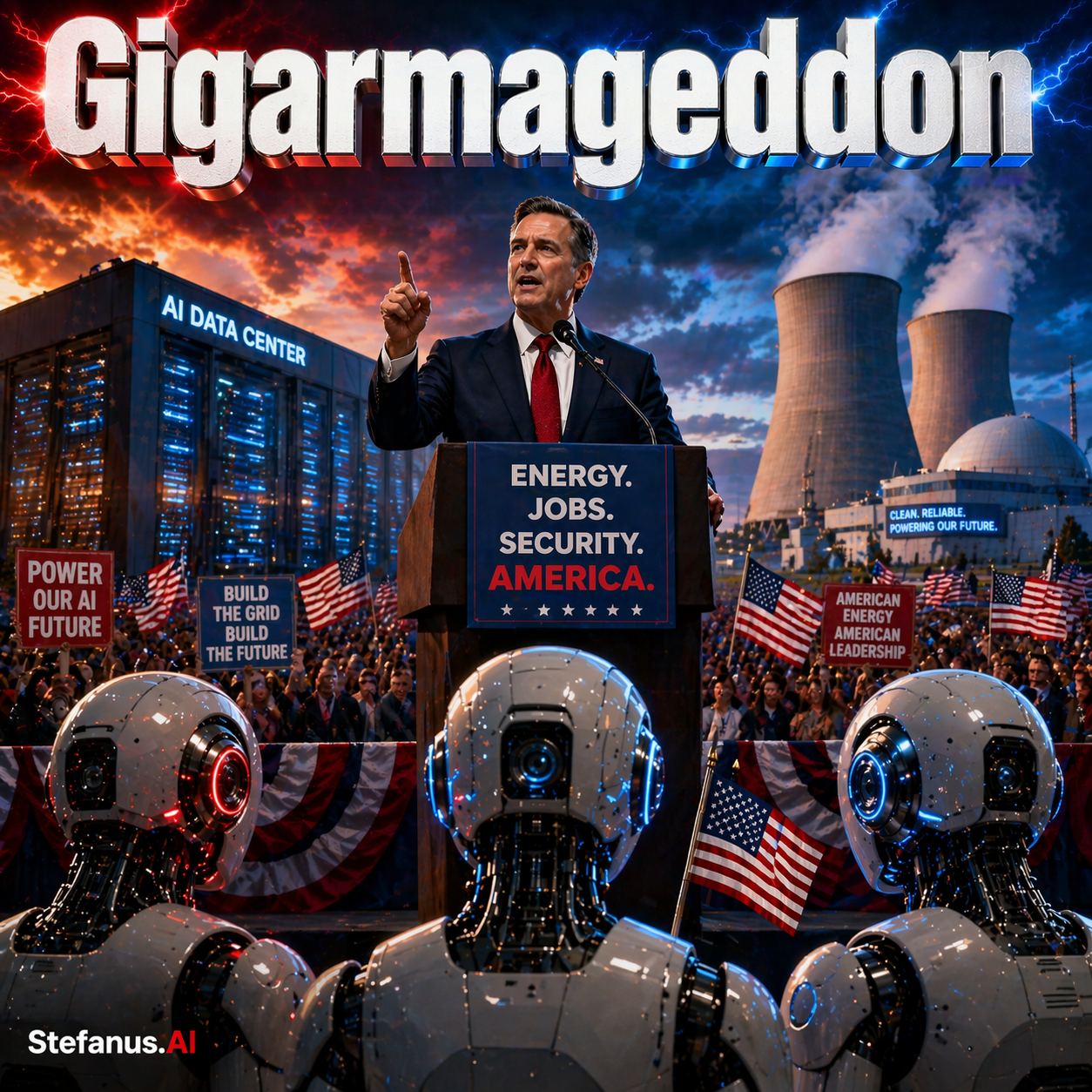
A structural condition in which AI-driven demand for gigawatt-scale electricity exceeds the ability of existing energy systems to reliably supply it, forcing trade-offs between compute, cost, latency, and access.
Gigarmageddon is not a distant theoretical scenario. It is already forming beneath the surface of modern AI deployment—and its early signals are visible to anyone paying close attention.

Section 1 — The Current Energy Reality: A System Under Acceleration
The scale of the shift is already measurable.
In April 2026, Fortune reported:
“Data centers are already driving roughly 50% of new U.S. electricity demand growth.”¹
This is not incremental change—it is structural transformation. For decades, electricity demand growth was tied to population, manufacturing, and transportation. Today, compute itself has become a primary driver of energy demand.
At the same time, utilities are preparing for an unprecedented expansion cycle.
“Utilities are planning $1.4 trillion in grid investment by 2030 to support AI demand.”²
— Business Insider
Yet even this scale of investment may be insufficient under extreme scenarios.
“Power demand from AI could rise as much as 10×.”³
— Axios
Academic research reinforces that the issue is not only total demand, but geographic concentration:
“Large data center clusters introduce significant regional grid stress and reliability risks.”⁴
— Arman Shehabi et al., Lawrence Berkeley National Laboratory
The contradiction is clear:
- The national grid may appear stable in aggregate
- But local systems are being overwhelmed, particularly in regions where hyperscale AI clusters concentrate
Gigarmageddon is therefore not a single failure—it is a distributed imbalance across the system.

Section 2 — Hyperscalers: Securing Power Before It Exists
The largest AI companies are no longer simply consumers of electricity. They are becoming strategic actors in energy markets, securing long-term contracts and reshaping infrastructure planning itself.
Meta — Multi-Gigawatt Commitments
Meta is pursuing energy agreements at a scale approaching multi-gigawatt capacity, with estimates nearing 6 GW across its expanding AI infrastructure footprint. This level of consumption is comparable to multiple nuclear reactors operating continuously.
To contextualize:
- 1 gigawatt ≈ power for ~750,000 homes
- 6 gigawatts ≈ a small nation’s electricity consumption
Google — Moving Toward Nuclear Integration
Google has explored nuclear partnerships and long-duration baseload solutions, signaling a shift from procurement to direct influence over generation strategy.
“Energy systems must scale faster than demand, or shortages become structural.”⁵
— Prof. Mark Z. Jacobson, Stanford University
Amazon — Hydropower Concentration
Amazon relies heavily on hydroelectric resources in the Columbia River basin in Oregon, creating dependencies tied to water availability and regional capacity limits.
xAI — Natural Gas and Community Resistance
xAI, led by Elon Musk, deployed large-scale infrastructure in Memphis using natural gas. The project triggered local opposition, highlighting a new reality: AI infrastructure is no longer politically invisible.
OpenAI — Concentrated Compute Demand
OpenAI operates large compute clusters with bursty, high-intensity energy demand, stressing peak capacity rather than average load.
Anthropic — Linking Tokens to Energy
Anthropic implicitly ties usage (tokens) to energy consumption, reinforcing a fundamental shift: intelligence is no longer abstract—it is metered in electricity.
“Technological progress does not eliminate constraints—it shifts them.”⁶
— Prof. David Autor, MIT

Section 3 — Politics: The Rise of Anti–Data Center Movements
Gigarmageddon is not just an engineering problem. It is now a political force shaping elections, campaigns, and public sentiment.
Maine — The First Pause
Maine proposed an 18-month moratorium on data center development, reflecting growing concern about grid capacity and environmental trade-offs.
Virginia — Elections Driven by Energy
Northern Virginia, the world’s largest data center hub, has become a political battleground.
John McAuliff successfully campaigned on restricting data center expansion.
This marks a turning point:
Energy allocation has entered electoral politics.
Georgia — Political Turnover
Peter Hubbard and Alicia Johnson unseated incumbents who supported data center growth.
Federal Policy — Moratorium Thinking
In March 2026, Alexandria Ocasio-Cortez and Bernie Sanders introduced the AI Data Center Moratorium Act.
“Infrastructure becomes political the moment it reshapes distribution.”⁷
— Prof. Jacob Hacker, Yale University
Wisconsin — Direct Democracy
Port Washington passed the first anti–data center referendum (April 2026), signaling a shift toward citizen-level control over compute infrastructure.
Midterm Election Implications
Gigarmageddon is now influencing:
- Campaign narratives
- State-level policy platforms
- Voter sentiment around energy and cost
The emerging political question is no longer abstract:
Should energy prioritize AI—or communities?
Section 4 — Why Energy Cannot Scale Fast Enough
Despite urgency, structural limitations remain.
Renewables — Intermittency Constraint
Solar and wind are expanding rapidly but remain intermittent.
“Intermittency remains the central challenge for renewable systems.”⁸
— Prof. Nate Lewis, Caltech
Nuclear — Time-to-Deploy Barrier
Nuclear energy offers stability but requires long timelines, often 5–10 years from approval to operation.
Transmission — The Hidden Bottleneck
Even when energy exists, it cannot always be delivered:
- Permitting delays
- Infrastructure aging
- Local opposition
Gigarmageddon emerges not from a single failure—but from multiple compounding constraints.

Section 5 — State Action: Policy, Nuclear Revival, and Energy Realignment
Politics is now driving infrastructure decisions. Gigarmageddon is forcing states to act—not ideologically, but structurally.
Wyoming — SMR Deployment
TerraPower, backed by Bill Gates, is advancing small modular reactors (SMRs).
“SMRs allow scalable, repeatable deployment rather than one-off mega-projects.”⁹
— Prof. Jacopo Buongiorno, MIT
Michigan — Palisades Nuclear Revival
Governor Gretchen Whitmer supported reopening the Palisades nuclear plant.
This is a reversal of previous shutdown decisions—demonstrating that energy scarcity reshapes policy priorities.
Pennsylvania — Grid Pressure Meets Industry
In Pennsylvania, two major coal plants—Conemaugh and Keystone—are being kept online beyond their planned 2028 shutdown, reflecting rising concern over electricity reliability. The move signals a broader shift toward preserving existing power capacity as demand surges, with President Donald Trump calling it a “big win” for the state.
Rising demand from AI infrastructure is pushing regulators to reconsider:
- Interconnection rules
- Capacity expansion
- Grid resilience
Iowa — Renewable Abundance, Structural Limits
Iowa’s wind leadership positions it well—but intermittency requires hybrid solutions.
Texas — Energy + Compute Integration
Texas is building a model where energy and compute are co-located, forming integrated industrial systems.
State Competition
States are now competing for AI infrastructure—while simultaneously managing political backlash.
“Large-scale economic shifts inevitably trigger political realignment.”¹⁰
— Prof. Dani Rodrik, Harvard University
Section 6 — Geopolitics: Energy as the New Strategic Layer
The final dimension of Gigarmageddon is geopolitical.
China — Centralized Advantage
China benefits from:
- Faster nuclear deployment
- Centralized decision-making
- Fewer permitting constraints
United States — Fragmented System
United States faces:
- Federal-state misalignment
- Local opposition
- Regulatory complexity
“Energy capacity defines the ceiling of economic growth.”¹¹
— Prof. Dietrich Vollrath, University of Oxford
Conclusion — Why Gigarmageddon Defines This Era
Gigarmageddon is not just a term—it is a framework.
It explains why:
- AI systems show early signs of latency
- Companies secure gigawatts years in advance
- States reopen nuclear plants
- Politicians campaign against data centers
It captures the convergence of:
- Technology
- Infrastructure
- Politics
- Geopolitics
The future of AI will not be decided solely in research labs.
It will be decided in:
- State legislatures
- Energy commissions
- Election campaigns
The defining question ahead is no longer:
How intelligent can AI become?
It is:
How much power can we sustain to keep it running—without breaking the system?

Footnotes
1. Lila MacLellan, Fortune
https://fortune.com/2026/04/20/ai-data-centers-electricity-demand-growth/
2. Business Insider Energy Desk
https://www.businessinsider.com/utilities-14-trillion-grid-investment-ai-power-demand-2026
3. Ben Geman, Axios
https://www.axios.com/2026/energy/ai-power-demand-data-centers
4. Arman Shehabi et al., Lawrence Berkeley National Laboratory
https://arxiv.org/abs/2007.04848
5. Mark Z. Jacobson, Stanford University
https://web.stanford.edu/group/efmh/jacobson/Articles/I/100PctPaper.pdf
6. David Autor, MIT
https://workofthefuture.mit.edu/research-post/the-work-of-the-future-building-better-jobs/
7. Jacob Hacker, Yale University
https://yalebooks.yale.edu/book/9780300108642/the-divided-welfare-state/
8. Nathan S. Lewis, Caltech
https://pubs.acs.org/doi/10.1021/ar400236e
9. Jacopo Buongiorno, MIT
https://energy.mit.edu/research/future-nuclear-energy-carbon-constrained-world/
10. Dani Rodrik, Harvard University
https://drodrik.scholar.harvard.edu/files/dani-rodrik/files/industrial-policy-twenty-first-century.pdf
11. Dietrich Vollrath, University of Oxford
https://www.press.uchicago.edu/ucp/books/book/chicago/F/bo27552164.html
Comments
[…] 1.5 The Gigarmageddon Reality […]
[…] Prioritization becomes even more urgent under what I call Gigarmageddon: the moment when exponential AI demand collides with insufficient power, insufficient grid […]
[…] electricity constraint is not a problem that money can solve on a short horizon. The United States faces a shortfall of […]