
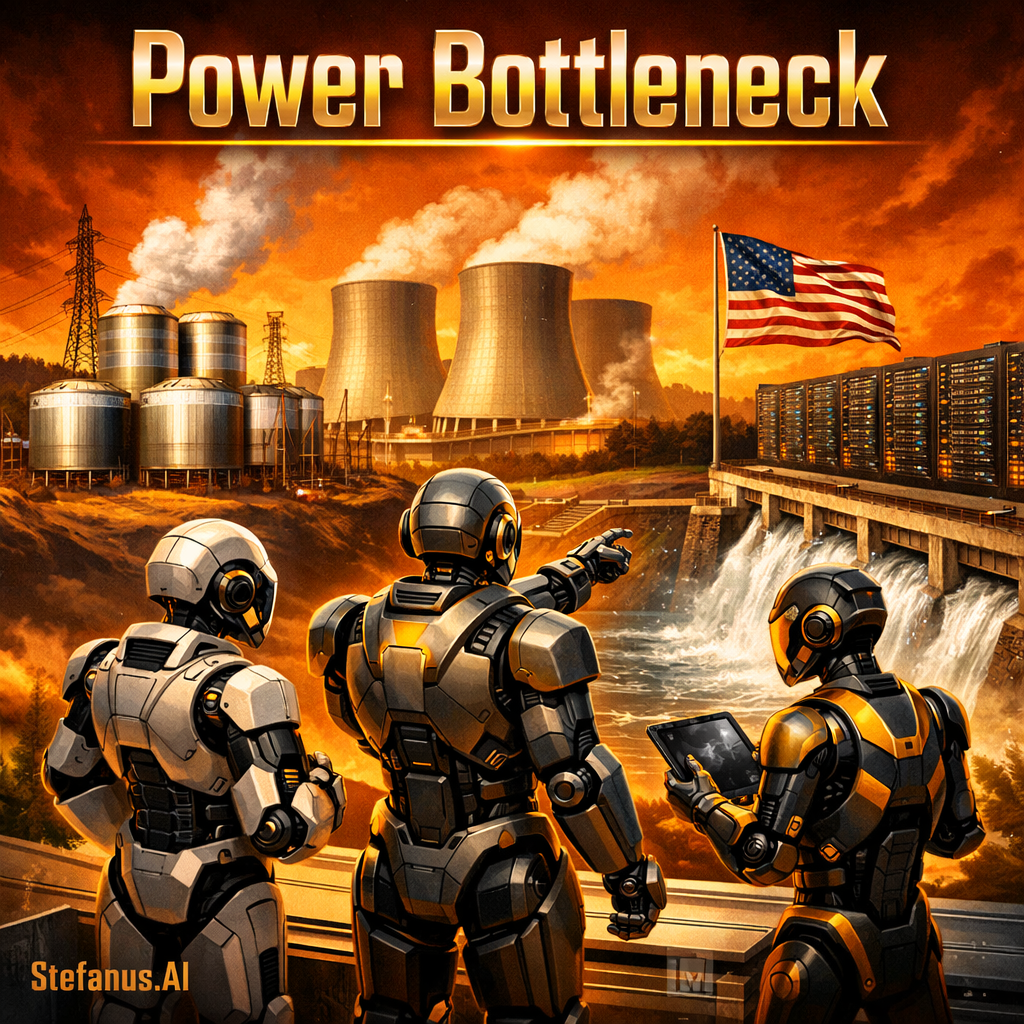

The modern artificial intelligence revolution—defined by hyperscale models, agentic systems, and trillion-line codebases—is often framed as a problem of compute, talent, and capital. Yet beneath these visible layers lies a far more rigid constraint: electricity. No matter how sophisticated models designed by companies like OpenAI, Anthropic, or Google become, their ultimate throughput is governed not by algorithms, but by watts.
The paradox is striking. At the exact moment when AI systems are approaching exponential capability—through agentic architectures, autonomous reasoning, and continuous inference—the underlying electrical infrastructure in the United States remains largely linear, aging, and in many regions, fragile. Much of today’s grid architecture was built in the mid-20th century, designed for predictable industrial loads rather than dynamic, always-on, high-density compute clusters.
The historical shadow of nuclear energy policy still shapes this constraint. The Chernobyl disaster and the Fukushima Daiichi nuclear disaster profoundly altered public perception, leading to decades of plant closures, stalled development, and regulatory caution.
Today, that hesitation manifests as delay.
AI data centers—particularly hyperscale facilities requiring 20 MW to 500 MW—are increasingly encountering bottlenecks in permitting, interconnection, and power allocation. Projects are postponed, scaled down, or delayed. Recent reporting suggests a significant portion of U.S. AI data center construction faces delays due to grid constraints.¹
Even ambitious initiatives such as the Stargate AI infrastructure initiative have encountered headwinds tied to energy availability.
At the application layer, subtle behavioral shifts may already reflect these constraints. Systems like ChatGPT and Claude are increasingly optimized for efficiency—shorter outputs, constrained token usage, and selective reasoning depth—not purely for user experience, but for energy economics.
This paper formalizes the term Power Bottleneck—a structural constraint where the growth of artificial intelligence is limited not by compute design, but by electricity supply. The term captures a transition point in the industrialization of intelligence, where energy becomes the dominant limiting factor.

Section 1: The Physics of Intelligence — Why AI Demands Continuous Power
Artificial intelligence is not software in the traditional sense; it is an energy-intensive industrial process. Every token generated, every model trained, and every inference executed requires continuous electrical input across thousands of synchronized processors.
Modern AI clusters—powered by GPUs developed by NVIDIA—operate at densities exceeding 30–100 kW per rack.
A researcher from Massachusetts Institute of Technology states:
Electricity has become the “hidden input” of AI—without stable and scalable power, even the most advanced models cannot function.¹
The financial implications are equally significant. Facilities like Elon Musk’s xAI cluster are estimated to incur electricity costs approaching hundreds of millions annually. Hyperscalers such as Microsoft, Amazon, and Meta collectively consume gigawatts of power.
According to the International Energy Agency:
Data centers could consume more than 1,000 terawatt-hours annually by 2030.²
This is exponential demand colliding with finite infrastructure.

Section 2: Exponential AI Growth Meets Finite Power Supply
Since the release of ChatGPT in late 2022, AI adoption has accelerated at a pace rarely seen in technological history. Startups and incumbents alike—from OpenAI to Anthropic—have expanded model size, user base, and enterprise integration simultaneously.
A study from Stanford University observes:
AI compute demand is doubling approximately every 6 to 12 months, far outpacing energy infrastructure expansion timelines.³
This divergence creates a structural imbalance: while AI companies can deploy capital rapidly—building data centers, acquiring GPUs, and hiring talent—they cannot as easily secure electricity. Power generation, transmission upgrades, and interconnection approvals often require 5 to 10 years, creating a lag that compounds over time.
As a result, several structural frictions are emerging:
- Data center applications are increasingly delayed or rejected due to insufficient grid capacity
- Environmental impact reviews are expanding in scope, now explicitly including AI-driven load projections
- Interconnection queues across multiple U.S. regions are backlogged, in some cases exceeding several years
A senior analyst from Harvard University explains:
The bottleneck is no longer compute—it is the ability to plug into the grid.⁴
The implication is profound: AI companies are not running out of ideas—they are running out of electricity.

Section 3: State-Level Fractures — Policy, Resistance, and Legal Battles
Across the United States, the Power Bottleneck is no longer theoretical—it is manifesting in legislation, lawsuits, and local resistance.
1. Grid Stress and Cost Escalation
Data centers already account for a growing share of national electricity consumption, with projections suggesting a doubling by 2030. This surge is contributing to localized electricity price increases of 30–50% in some regions, as utilities scramble to upgrade infrastructure.
A report from Pew Research Center notes:
The rapid expansion of data centers is placing unprecedented pressure on regional grids and electricity pricing.⁵
2. Maine’s Landmark Moratorium
In a historic move, lawmakers in Maine enacted an 18-month moratorium on hyperscale data centers exceeding 20 MW—the first policy of its kind in the United States.
A policy commentary explains:
“If these centers aren’t thoughtfully planned and coordinated, they can place extraordinary demands on electric infrastructure and host communities.”⁶
The decision followed reports that electricity costs had already risen significantly over the past five years, intensifying public concern.
3. Nationwide Legislative Momentum
Maine is not alone. At least a dozen states—including Texas, Arizona, Virginia, and Ohio—are actively evaluating or drafting legislation targeting data center energy usage, zoning, and environmental constraints.⁷
These measures include:
- Energy caps for hyperscale facilities
- Mandatory environmental impact disclosures
- Zoning restrictions near residential communities
4. Legal Battles and Environmental Justice
In Memphis, civil rights organizations have filed lawsuits against data center operators over emissions from gas-powered backup turbines, citing violations of the Clean Air Act.
This introduces a new dimension: AI infrastructure is now intersecting with environmental justice movements.
5. Local Resistance Movements
Across multiple states, local communities are increasingly opposing new data centers due to:
- Noise pollution
- Water consumption
- Land usage
- Carbon emissions
The Power Bottleneck is no longer a technical constraint—it is a democratic negotiation between capital, infrastructure, and society.

Section 4: Energy Reinvention — Nuclear Revival and Strategic Power
Facing structural constraints, both governments and corporations are pivoting toward alternative energy strategies.
States such as Michigan are exploring the reopening of nuclear facilities like Palisades, while others—including Texas, Arizona, and Pennsylvania—are accelerating nuclear and hybrid energy investments.
A researcher from California Institute of Technology explains:
Small Modular Reactors (SMRs) offer scalable, reliable baseload power that aligns closely with data center demand profiles.⁸
Meanwhile, TerraPower—backed by Bill Gates—is advancing next-generation nuclear systems in partnership with Wyoming.
Corporate strategies are also evolving:
- Direct acquisition of power plants
- On-site generation infrastructure
- Long-term energy contracts and private grids
In a notable development, Trump Media & Technology Group announced a $6 billion merger with TAE Technologies to explore fusion-powered AI infrastructure.
The signal is unmistakable: AI companies are becoming energy companies.

Section 5: Federal Policy — The New Energy Doctrine for AI
The federal government is now actively redefining the relationship between AI and energy.
1. Ratepayer Protection Doctrine
In 2026, major technology firms agreed to absorb the cost of electricity expansion rather than passing it to consumers.
President Donald Trump stated:
“Big Tech companies are committing to fully cover the cost of increased electricity production required for AI data centers.”⁹
This marks a structural shift: AI infrastructure must internalize its energy footprint.
2. GRID Act — Forced Energy Independence
The proposed GRID Act would require large data centers (≥20 MW) to secure independent power sources, effectively mandating:
- On-site generation
- Nuclear or SMR integration
- Renewable + storage systems
This policy transforms data centers from passive consumers into active energy producers.
3. FERC Interconnection Reform
The Federal Energy Regulatory Commission is reforming interconnection processes to address backlog and grid instability.
Regulators warn:
Rapid AI-driven load growth could increase blackout risks and electricity costs without structural reform.¹⁰
4. Strategic Implication
Energy policy is now AI policy.
The United States is entering a new doctrine:
- Compute sovereignty requires energy sovereignty
- AI expansion requires energy independence
- Infrastructure must scale in parallel with intelligence

Section 6: Economic Consequences — The Cost of Being Left Behind
States that fail to attract AI infrastructure risk structural decline.
A study by the World Bank notes:
Digital infrastructure investment is increasingly correlated with regional economic competitiveness.¹¹
An economist from University of Oxford adds:
Regions that fail to host compute infrastructure may become consumers, not producers, of intelligence.¹²
The implication is clear:
- Lost tax revenue
- Lost jobs
- Lost technological relevance
AI is foundational infrastructure—not optional.
Conclusion: Power Bottleneck as the Defining Constraint of the AI Century
The term Power Bottleneck is not merely descriptive—it is diagnostic. It captures a systemic constraint that will define the trajectory of artificial intelligence over the next decade.
The evidence is converging:
- Utilities face trillion-dollar investment requirements to support AI growth¹³
- Data center demand is accelerating faster than grid expansion
- States are legislating, communities are resisting, and regulators are intervening
This is no longer a future risk—it is a present constraint.
If unaddressed, the Power Bottleneck will do more than slow AI—it will reshape its geography. AI will not scale where talent exists, or where capital flows—but where electricity is abundant, reliable, and politically viable.
This creates a new hierarchy of power:
- Energy-rich states will become AI superhubs
- Energy-constrained regions will fall behind
- Corporations will vertically integrate into energy production
- Governments will redefine infrastructure policy around compute demand
By 2027, companies like OpenAI, Anthropic, and Google will not be asking whether they can build more powerful models.
They will be asking a more fundamental question:
Do we have enough power to run them?
Thus, naming this phenomenon—Power Bottleneck—is not an academic exercise. It is a strategic act.
Because in the industrialization of intelligence, the ultimate limiter is no longer silicon.
It is electricity.

Footnotes
¹ Massachusetts Institute of Technology (MIT). Energy and AI Systems Report, 2025. https://energy.mit.edu
² International Energy Agency (IEA). Electricity 2024 Report. https://www.iea.org
³ Stanford University HAI. AI Index Report 2025. https://hai.stanford.edu
⁴ Harvard Kennedy School. Energy Program Analysis, 2025. https://www.hks.harvard.edu
⁵ Pew Research Center. Energy Use and Data Centers, 2025. https://www.pewresearch.org
⁶ Tech policy analysis on Maine data center moratorium. https://www.techradar.com
⁷ Washington Post. States evaluating data center restrictions, 2026. https://www.washingtonpost.com
⁸ California Institute of Technology. Energy Systems Review, 2025. https://www.caltech.edu
⁹ The White House. Ratepayer Protection Announcement, 2026. https://www.whitehouse.gov
¹⁰ Reuters. FERC data center interconnection policy, 2026. https://www.reuters.com
¹¹ World Bank. Digital Economy Report. https://www.worldbank.org
¹² Oxford Internet Institute. AI Infrastructure Geography, 2025. https://www.oii.ox.ac.uk
¹³ Energy infrastructure investment projections (utility sector analysis), 2026.
Comments
[…] global attention revolved around large language models, GPU shortages, hyperscale datacenters, electricity bottlenecks, chip export controls, and the extraordinary spectacle of trillion-dollar AI capital expenditure […]
[…] at all. It is the logical consequence of a set of structural forces — semiconductor scarcity, power bottlenecks, capital concentration, competitive dynamics — that have been building since at least 2023 and […]
[…] of generation and cooling. The IEA’s estimate that a fifth of planned projects risk delay from grid constraints is the clearest single statement of where the wall now […]