
When I was attending graduate school at the University of Southern California in Los Angeles, one of the most durable business lessons I encountered was the theory of First-Mover Advantage. The idea was simple enough for every business student to remember, but deep enough to shape how companies, investors, and governments think about strategic timing: the first serious entrant into a new market can define the category, capture scarce resources, build customer loyalty, and create barriers that make later competition more expensive.
In its simplest form, First-Mover Advantage means that the first company to occupy a market segment may gain a competitive position before others even understand the opportunity. It can build brand recognition before the vocabulary of the market is settled. It can secure suppliers before inputs become scarce. It can sign customers before switching costs rise. It can shape technical standards before governments and competitors understand what needs to be regulated. In some industries, first movers do not merely enter the race early; they design the racetrack.
But business history also teaches the opposite lesson. First movers often create markets they do not ultimately dominate. Myspace helped define social networking, but Facebook became the platform empire. Webvan imagined online grocery delivery before broadband, mobile commerce, and logistics networks were ready; Amazon and later grocery-delivery platforms absorbed the market after the infrastructure matured. Netscape popularized the commercial browser, but Microsoft, Google, Apple, and others shaped the later operating layers of the web. First-mover advantage can be real, but it can also become first-mover burden.
This paper begins with that tension because the new AI race is not happening only inside laboratories, data centers, or chip foundries. It is now moving beyond Earth.

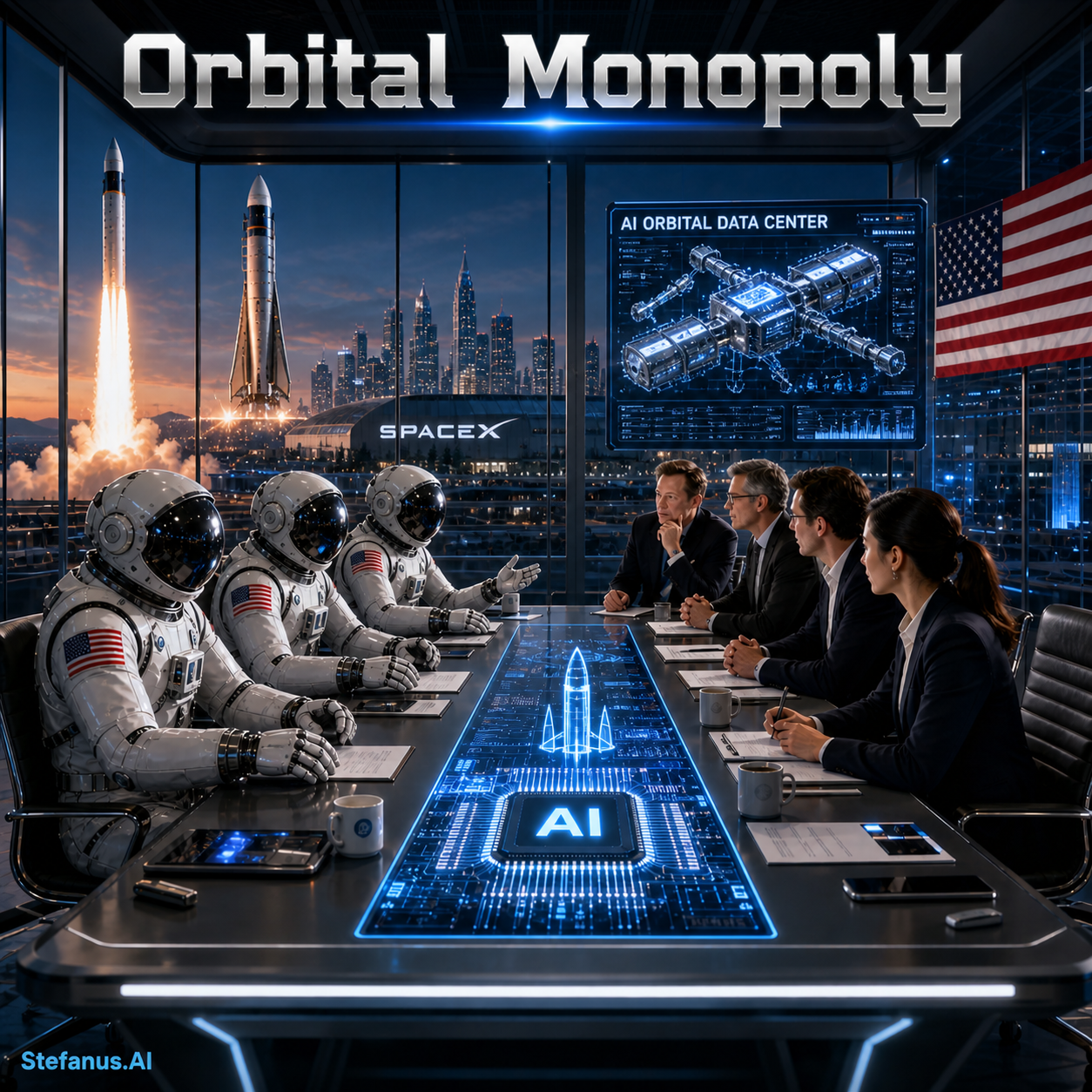
The core argument of this paper is that the next great AI monopoly may not be a software monopoly, a cloud monopoly, or even a chip monopoly. It may be an orbital monopoly: the concentration of launch capability, satellite networks, orbital compute, and space-based intelligence infrastructure into the hands of a few companies with the capital, engineering depth, regulatory access, and national-security relationships required to operate beyond Earth.
I call this system Orbital Monopoly because orbit is becoming the outermost layer of the AI economy. In earlier industrial revolutions, monopoly emerged around railroads, oil pipelines, telegraphs, ports, operating systems, search engines, and cloud platforms. In the AI era, the same logic is expanding upward. The company that controls orbital infrastructure may eventually influence global connectivity, battlefield communications, direct-to-device networks, geospatial intelligence, space-based compute, and the future placement of AI data centers outside terrestrial grids.
This is not science fiction anymore. SpaceX’s Starlink constellation has grown into the dominant low-Earth-orbit broadband system, with current reporting placing active Starlink satellites above 10,000 by early May 2026.¹ SpaceX also has deepening national-security relationships: Reuters reported that SpaceX’s Starshield unit was building a spy-satellite network for the U.S. National Reconnaissance Office under a classified contract valued at about $1.8 billion.² In January 2026, Reuters reported that the FCC approved SpaceX’s proposal to deploy an additional 7,500 second-generation Starlink satellites, increasing its permitted total to roughly 15,000—not one million, but still a scale no competitor has matched.³ Then, in a separate and more radical filing, SpaceX sought FCC authorization for up to one million satellites for a proposed solar-powered orbital data center system designed to support AI workloads.⁴
This distinction matters. The one-million-satellite concept is a filing, not an approval. But the existence of the filing itself reveals the direction of strategic imagination. SpaceX is no longer thinking only about rockets or satellite internet. It is thinking about orbital compute.
That is why the title Orbital Monopoly is not merely dramatic language. It describes a structural possibility: once launch, satellite density, spectrum access, military integration, direct-to-device connectivity, and orbital AI compute begin to converge, the market may not behave like earlier internet markets where second movers could catch up. Orbit has physical scarcity. Orbit has regulatory scarcity. Orbit has national-security sensitivity. Orbit has spectrum constraints. Orbit has launch bottlenecks. Orbit has collision risk. Orbit has enormous capital barriers. These are not ordinary startup conditions. These are monopoly-forming conditions.
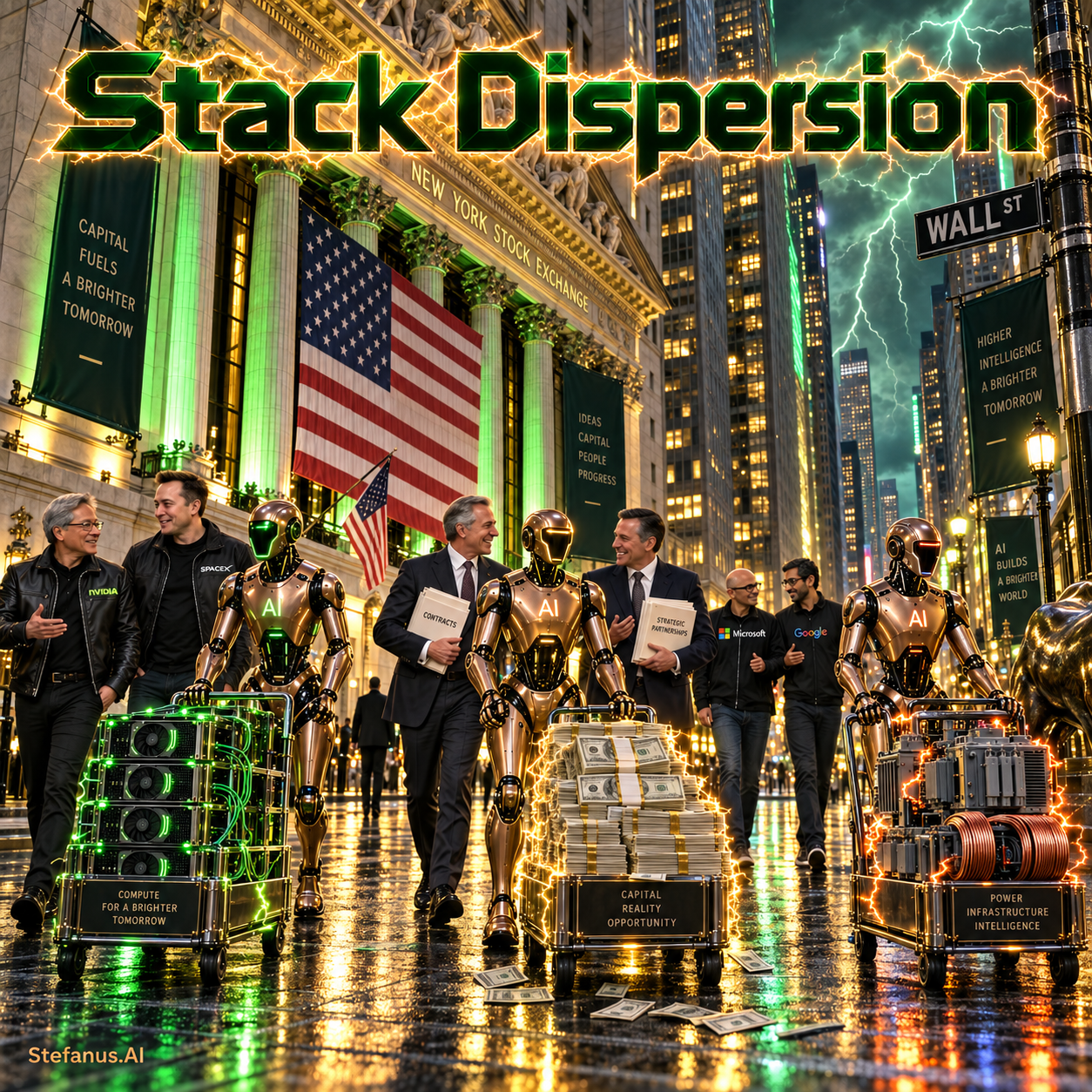
The AI economy on Earth is already divided into layers. NVIDIA dominates the advanced AI chip layer. Amazon Web Services controls a major part of the cloud and data-center layer. Microsoft embeds AI into productivity and operating-system environments through Copilot and its relationship with OpenAI. Google controls search, cloud, AI models, Android, and data infrastructure. OpenAI and Anthropic shape the frontier model layer. Meta attempts to control open model distribution, social data, and AI-integrated consumer platforms. Tesla and xAI attempt to connect robotics, vehicles, data, and large-scale compute. But most companies own only part of the stack.
Elon Musk’s strategic advantage is that his companies may be moving toward a more vertically integrated structure: SpaceX for launch and Starlink, xAI for frontier AI, Tesla for robotics and manufacturing, and new industrial ambitions such as Terafab-style manufacturing in Texas. Jeff Bezos, by contrast, approaches the problem through Amazon’s cloud empire, Amazon Leo/Project Kuiper, AWS data centers, Blue Origin’s launch ambitions, and the possibility of connecting terrestrial cloud capacity with orbital networks. Amazon says Amazon Leo will roll out more broadly in 2026 after enterprise preview activity and ongoing satellite deployments.⁵ Blue Origin’s New Glenn rocket is designed to carry up to 45 metric tons to low Earth orbit, signaling that Bezos’s space strategy is no longer only symbolic tourism but heavy infrastructure.⁶
The geopolitical layer is equally important. The United States and China are not merely competing over who builds better chatbots. They are competing over chips, rare earths, lunar missions, satellite networks, launch systems, spectrum, military communications, energy systems, and industrial control. The AI race is becoming a full-stack sovereignty race. TSMC is expanding in Arizona to support advanced chip demand and reportedly plans a chip packaging plant there by 2029.⁷ NVIDIA announced a Space-1 Vera Rubin Module for space-based AI inferencing, geospatial intelligence, autonomous space operations, and orbital data centers.⁸ Michigan’s Palisades nuclear restart, Pennsylvania’s Keystone and Conemaugh coal extension, and state-level data-center incentives show that AI infrastructure is already reshaping domestic energy policy.⁹ ¹⁰
The deeper question is no longer: who has the best AI model?
The deeper question is: who controls the infrastructure where intelligence runs?
In a terrestrial economy, that infrastructure means chips, land, data centers, energy, cooling, fiber, water, and state permits. In an orbital economy, it means rockets, satellites, spectrum, ground stations, defense contracts, solar power, orbital slots, collision management, and extraterrestrial compute. The company that captures those layers first may not merely win a market. It may define a civilization-scale platform.
“This article surveys the theoretical and empirical literature on mechanisms that confer advantages and disadvantages on first-mover firms.”¹¹
That sentence, from Marvin Lieberman and David Montgomery’s classic work on First-Mover Advantage, sounds modest. But in the orbital age, the mechanisms are no longer only brand, scale, and customer switching costs. They include the sky itself.

Section 1 — First-Mover Advantage: From Business Theory to Orbital Lock-In
Every section of this paper must begin with a simple premise: AI is no longer only about intelligence. It is about infrastructure. Once we understand that AI is infrastructure, the concept of First-Mover Advantage becomes more powerful than it appears in ordinary business textbooks. In software, a second mover can copy features. In consumer apps, a second mover can acquire users through better design. In online retail, a second mover can improve logistics after the first mover proves demand. But in orbital infrastructure, second movers face a different type of barrier. They do not merely need better software. They need rockets, launch cadence, spectrum approvals, orbital safety systems, manufacturing capacity, geopolitical trust, and billions of dollars before the first dollar of orbital revenue becomes predictable.
This is why First-Mover Advantage in orbit may be closer to railroad advantage, oil-pipeline advantage, or undersea-cable advantage than to app-store advantage. The first company to build the infrastructure can shape the routes, standards, contracts, and dependencies that follow. Once institutions depend on that infrastructure, the advantage becomes political and military, not merely commercial.
1.1 What First-Mover Advantage Really Means
First-Mover Advantage is commonly defined as the competitive advantage gained by the initial significant occupant of a market segment. But that definition is too narrow for the orbital AI age. The more useful definition is this:
First-Mover Advantage is the ability to convert early entry into structural dependency.
A first mover becomes powerful when others cannot easily avoid its system. Customers may depend on its interface. Suppliers may optimize around its demand. Regulators may write rules around its existence. Developers may build tools around its standards. Governments may sign contracts because no alternative exists at comparable scale. Investors may treat the company as the category itself.
In normal markets, first movers gain advantages through brand, scale, learning, and customer loyalty. In orbital markets, first movers gain advantage through something deeper: infrastructure inevitability.
SpaceX is the strongest current example. It did not simply launch satellites first; it created a reusable launch machine that allowed satellite deployment at a cadence competitors struggle to match. Starlink then became not merely a product but a global communications layer. Once that layer supports consumers, airlines, ships, emergency response, war zones, and military agencies, the company’s advantage becomes embedded across society.
1.2 The Three Classical Sources of First-Mover Advantage
Lieberman and Montgomery’s classic theory helps organize the issue. First movers often benefit from three broad mechanisms: technological leadership, preemption of scarce assets, and buyer switching costs.¹¹ Each mechanism becomes more intense in orbit.
First, technological leadership matters because launch engineering compounds. Every successful reusable rocket landing creates operational knowledge. Every satellite generation improves design. Every mass deployment reveals failure rates, software fixes, and orbital behavior. A competitor cannot simply read a paper and reproduce this learning curve. It must launch, fail, recover, iterate, and finance the process.
Second, preemption of scarce assets matters because orbit is not infinite in practical terms. Low Earth orbit has congestion risks. Spectrum rights are contested. Ground-station relationships matter. Launch windows matter. Regulatory trust matters. Orbital safety and debris management become strategic constraints. The earlier a company builds density, the more it shapes the usable environment.
Third, switching costs matter because satellite networks are ecosystems. Customers buy terminals. Carriers integrate direct-to-device systems. Airlines sign connectivity contracts. Militaries integrate communications into operational doctrine. Governments build emergency response systems around availability. Once a country, company, or military unit depends on a particular constellation, switching becomes more than a commercial decision. It becomes a national-security risk.
1.3 Why First Movers Sometimes Fail
But a serious paper cannot romanticize First-Mover Advantage. Many first movers fail because they enter before infrastructure is ready. Webvan understood online grocery too early. It had the concept but not the cost structure, mobile adoption, logistics optimization, and consumer behavior needed to sustain it. Myspace built social networking but failed to create the identity layer, developer ecosystem, and product discipline that Facebook later achieved. Netscape opened the browser era but lost strategic control to operating-system and search-platform giants.
First movers fail when they confuse category creation with category control.
That distinction is essential for orbital AI. SpaceX is not powerful merely because it entered early. It is powerful because it entered early and then scaled repeatedly. It transformed launch from episodic spectacle into industrial cadence. The difference between a first mover and a durable first mover is not timing alone. It is execution density.
1.4 Why Orbit Changes the Historical Pattern
In many internet markets, second movers can catch up because distribution is digital. A better app can spread quickly. A better search engine can replace a portal. A better social network can migrate users. But orbital infrastructure is not infinitely reproducible. Every competitor needs launch capacity. Every satellite requires capital. Every constellation requires spectrum. Every deployment creates collision and debris obligations. Every government customer demands reliability.
This makes orbit more likely to create durable concentration. The first mover that reaches sufficient scale may not merely enjoy advantage; it may acquire orbital lock-in.
Orbital lock-in occurs when a company’s satellite density, launch cadence, regulatory approvals, and customer dependencies make its system structurally difficult to replace. This is the foundation of Orbital Monopoly.

Section 2 — Musk vs. Bezos: The Two Architectures of AI Beyond Earth
The second section must begin with a deeper explanation because this is not a personality contest between Elon Musk and Jeff Bezos. It is a contest between two infrastructure philosophies. Musk’s approach is vertically integrated, operationally aggressive, and engineering-led. Bezos’s approach is platform-based, capital-rich, cloud-integrated, and distribution-oriented. Musk begins with rockets and expands toward intelligence. Bezos begins with cloud and commerce and expands toward orbit. One is building from the sky downward. The other is building from the cloud upward.
Both understand the same strategic truth: AI growth will eventually demand infrastructure that Earth alone may struggle to supply. Energy constraints, land constraints, cooling constraints, permitting delays, interconnection queues, and geopolitical fragmentation will push companies to explore new compute environments. Orbital compute is not yet mature, but the direction is visible. If AI becomes the main industrial engine of the twenty-first century, then space will not remain a symbolic frontier. It will become an infrastructure frontier.
2.1 Elon Musk’s Stack: Launch, Satellites, AI, Robotics, Manufacturing
Elon Musk’s advantage is that his companies touch multiple physical layers of the AI future. SpaceX controls launch and Starlink. Starlink controls satellite broadband. Starshield deepens the defense and intelligence relationship. xAI builds frontier AI and operates Colossus-scale compute in Memphis. Tesla builds robotics, vehicles, batteries, and manufacturing expertise. The proposed Terafab idea points toward a new industrial scale for AI-era manufacturing.
This is why Musk’s orbital strategy is larger than Starlink subscriptions. Starlink is the cash-flow and network layer. SpaceX is the launch layer. Starshield is the national-security layer. xAI is the model layer. Tesla is the robotics and physical-world data layer. If these layers converge, Musk’s companies may control an unusually complete AI stack.
That does not mean the system is guaranteed to succeed. The risks are enormous. SpaceX’s reported IPO valuation targets above $2 trillion remain market expectations, not destiny. Reuters reported in April 2026 that SpaceX was targeting a valuation above $2 trillion in a potential IPO and could raise as much as $75 billion, but valuation is not the same as durable profit.¹² A company can be strategically important and still financially overvalued. But the market’s willingness to discuss SpaceX in trillion-dollar terms reflects a broader recognition: SpaceX is no longer only an aerospace company. It is becoming a telecom, defense, AI-infrastructure, and orbital-platform company.
2.2 Jeff Bezos’s Stack: AWS, Amazon Leo, Blue Origin, Distribution
Jeff Bezos’s strategy is different. Amazon Web Services is already one of the most important terrestrial cloud infrastructures in the world. It supports enterprises, startups, governments, and AI companies. Amazon’s AI strategy also includes partnerships and infrastructure support for Anthropic. While Musk owns a dominant launch system, Bezos owns one of the dominant cloud systems.
The missing layer has been orbit.
Amazon Leo, formerly Project Kuiper, represents Amazon’s strategic push to build a low-Earth-orbit communications system capable of competing with Starlink. In April 2026, Amazon further expanded this ambition by moving to acquire Globalstar for approximately $11.6 billion, strengthening its position in satellite communications and accelerating the build-out of its nascent LEO infrastructure. Amazon noted that the service entered enterprise preview in November 2025 and is targeting a broader rollout throughout 2026 as additional satellites are deployed and coverage expands.⁵ In parallel, launch momentum continues: Space.com reported in late April 2026 that an Ariane 6 mission successfully deployed 32 Amazon Leo satellites, adding to a constellation that has already surpassed several hundred units in orbit.¹³ Amazon’s satellite strategy extends well beyond consumer broadband. Its deeper objective is to extend the reach of AWS into space—integrating orbital connectivity with enterprise cloud services, remote industrial operations, defense applications, and eventually edge AI systems operating across a globally distributed network.
Blue Origin adds the launch layer. Its New Glenn rocket is designed for heavy-lift missions, with Blue Origin stating it can carry 45 metric tons to low Earth orbit.⁶ That capability matters because orbital AI infrastructure will require large payloads, repeatable launch, and cost reduction. A company cannot dominate orbital data centers without launch economics.
2.3 Musk Builds Vertically; Bezos Builds Platform Gravity
The simplest comparison is this:
Musk builds vertically. Bezos builds platform gravity.
Musk’s model is: own the rocket, own the satellite, own the constellation, own the AI lab, own the robotics platform, own the factory. Bezos’s model is: own the cloud, own the customer relationships, own the marketplace, own the logistics, own the enterprise contracts, and extend that platform into orbit.
Musk’s advantage is speed and integration. Bezos’s advantage is enterprise trust and cloud scale. Musk can move faster because he controls more of the physical stack. Bezos can monetize deeply because AWS already sits inside corporate infrastructure. Musk’s orbital monopoly risk comes from launch and satellite dominance. Bezos’s orbital monopoly possibility comes from linking AWS to space-based networks.
The future may not be one monopoly. It may be a duopoly: SpaceX as orbital access and satellite density; Amazon as cloud-orbit integration.
But duopoly is still not open competition.

Section 3 — SpaceX as the Strongest Example of Orbital First-Mover Advantage
This section is the heart of the paper because SpaceX is the best existing example of First-Mover Advantage becoming orbital lock-in. Many companies talk about space. SpaceX launches. Many companies talk about satellite broadband. SpaceX operates the largest constellation. Many companies talk about reusable rockets. SpaceX made reuse routine. Many companies talk about defense relevance. SpaceX is already embedded in U.S. national-security space architecture.
In a normal market, competitors can wait for the first mover to make mistakes. In orbit, waiting may become fatal. Every month of delay widens the operational gap. Every launch adds satellites. Every satellite adds coverage. Every coverage improvement adds customers. Every customer adds revenue. Every revenue cycle funds more launches. This is the flywheel of Orbital Monopoly.
3.1 Starlink as Density Advantage
Starlink’s advantage is not merely that it has many satellites. Its advantage is that satellite density creates network quality. The more satellites in orbit, the better the coverage, redundancy, capacity, and service continuity. Space.com reported in late April 2026 that Starlink had nearly 10,300 active satellites and that SpaceX had completed its 50th launch of the year, with 42 of those launches being Starlink missions.¹ This cadence is difficult for competitors to match because it combines manufacturing, launch, software, ground terminals, regulatory approvals, and consumer distribution.
This matters for AI because global connectivity is the nervous system of distributed intelligence. AI systems need data, inference access, user interaction, remote monitoring, robotics coordination, defense communications, and edge deployment. If Starlink becomes the connectivity layer for ships, aircraft, rural regions, military units, autonomous vehicles, and direct-to-device phones, it becomes an intelligence distribution layer.
3.2 Starshield and the National-Security Layer
The most important monopoly power is not always visible in consumer markets. Sometimes it appears through government dependency. Reuters reported in March 2024 that SpaceX was building a spy-satellite network for the U.S. National Reconnaissance Office through its Starshield business, under a classified contract signed in 2021 worth about $1.8 billion.² Reuters later reported additional details about the 2021 contract to develop hundreds of satellites capable of collecting and relaying high-resolution imagery of military and intelligence targets.¹⁴
This is not ordinary procurement. It means SpaceX is becoming part of the U.S. intelligence infrastructure. Once a private company becomes deeply integrated into national-security architecture, its market power cannot be analyzed like a normal telecom company. It becomes a para-state infrastructure provider: private ownership, public dependency, strategic indispensability.
This is one of the strongest reasons for the term Orbital Monopoly. The monopoly is not only commercial. It is institutional.
3.3 The FCC, 15,000 Satellites, and the One-Million-Satellite Filing
A careful paper must separate approval from ambition. In January 2026, Reuters reported that the FCC approved SpaceX’s plan to deploy 7,500 additional second-generation Starlink satellites, bringing the permitted total to 15,000.³ That approval alone strengthens SpaceX’s orbital lead.
Separately, FCC documents show that SpaceX filed an application on January 30, 2026, seeking authority to launch and operate a new non-geostationary satellite system of up to one million satellites for a proposed “SpaceX Orbital Data Center” system.⁴ Reuters described the proposal as a plan to orbit satellites that would harness solar power for AI data centers.¹⁵
This does not mean the FCC approved one million satellites. It means SpaceX formally introduced the concept into the regulatory system. But in strategy, filings matter. They reveal intent. They shape regulatory debate. They warn competitors. They tell investors where the company wants to go. They tell governments that a new industrial category is emerging.
The phrase Orbital Data Center may eventually become as important as “cloud computing.” It suggests that data centers may not remain terrestrial buildings consuming land, water, and grid electricity. They may become modular orbital platforms powered by solar energy and connected through satellite networks. This is still early, but early does not mean irrelevant. Every monopoly begins as an implausible map.
3.4 Starship as the Missing Cost-Curve Breakthrough
The orbital data center idea depends on launch cost. If launch remains expensive, orbital compute remains symbolic. If reusable heavy-lift launch becomes routine, orbital compute becomes economically imaginable. SpaceX’s Starship program is therefore not merely a Mars project; it is potentially the cost-curve foundation for orbital industrialization.
SpaceX’s monopoly risk increases if Starship becomes reliable because it would allow the company to deploy larger satellites, data-center modules, power systems, and orbital infrastructure at a scale competitors cannot match. Falcon 9 gave SpaceX the first orbital broadband advantage. Starship could give SpaceX the orbital industrial advantage.
This is why the SpaceX IPO discussion is not only about financial markets. It is about whether investors believe SpaceX can convert launch dominance into orbital infrastructure dominance. Reuters reported the potential IPO valuation target above $2 trillion, while other market commentary framed Starlink and Starship as central valuation pillars.¹² The market is not valuing only rockets. It is valuing the possibility of a new infrastructure monopoly.

Section 4 — Who Gets Left Behind in AI Beyond Earth?
This section requires a different kind of explanation because “left behind” does not mean weak. NVIDIA, Microsoft, Google, Meta, OpenAI, and Anthropic are not weak companies. They are among the most important firms in the AI age. But orbital AI changes the definition of strategic completeness. A company can dominate one layer and still be dependent on another company for access to the future operating environment.
The AI economy is becoming a stack, and stack power belongs to companies that control bottlenecks. NVIDIA controls chips. TSMC fabricates the world’s most important advanced chips. Microsoft controls enterprise software distribution and Azure. Amazon controls cloud infrastructure. Google controls search, models, cloud, and mobile operating systems. Meta controls social distribution and open AI model momentum. OpenAI and Anthropic control frontier model imagination. But orbit introduces a bottleneck many of these firms do not own: launch and satellite infrastructure.
4.1 NVIDIA: The Chip King Without Rockets
NVIDIA is arguably the central company of the AI infrastructure boom. Its GPUs made the modern AI model economy possible. Its CUDA ecosystem created a software moat. Its systems roadmap increasingly defines what “AI factory” means. In March 2026, NVIDIA announced the Space-1 Vera Rubin Module as part of its accelerated platform for space, saying the Rubin GPU on the module would deliver up to 25 times more AI compute for space-based inferencing than an H100 GPU and would support orbital data centers, geospatial intelligence, and autonomous space operations.⁸
This is a major development. It means NVIDIA understands the orbital AI market. It also means space-based compute will require specialized hardware. Space is hostile: radiation, heat, vacuum, power constraints, repair difficulty, and reliability requirements make ordinary data-center design insufficient.
But NVIDIA does not own the rocket. It does not own the constellation. It does not own the orbital slots. It may power orbital intelligence without controlling orbital deployment. That makes NVIDIA powerful but dependent. In the terrestrial AI economy, NVIDIA is the tollbooth. In the orbital AI economy, SpaceX may become the road.
4.2 Microsoft: Copilot, OpenAI, and the Limits of Software Gravity
Microsoft has enormous strength in enterprise distribution. Copilot gives Microsoft a path into every office worker’s daily workflow. Azure gives it compute infrastructure. Its relationship with OpenAI gives it frontier model exposure. But Microsoft’s strategic weakness is that it does not control orbital infrastructure. It can rent it, partner for it, invest in it, or integrate with it. But it does not own it.
This matters because the AI economy may shift from model access to infrastructure access. If inference moves toward edge devices, satellites, defense systems, autonomous vehicles, factories, and orbital compute, then software companies may need physical infrastructure alliances. Microsoft can dominate productivity AI, but productivity AI is not the same as orbital AI.
4.3 Google and the Search Empire’s Atmospheric Boundary
Google controls extraordinary assets: search, YouTube, Android, DeepMind, Google Cloud, TPUs, and global data infrastructure. It is one of the few companies with enough technical depth to compete across multiple AI layers. But even Google faces the orbital boundary. It has cloud, chips, models, and operating systems, but not a SpaceX-equivalent launch and satellite broadband platform.
Google’s opportunity is to integrate AI, mapping, geospatial data, and cloud services into orbital partnerships. Its risk is that the orbital connectivity layer becomes controlled by a competitor.
4.4 Meta: Open Models Without Orbital Control
Meta’s open-source AI strategy gives it influence over model distribution. It can shape developer ecosystems and reduce dependence on closed model providers. But Meta’s weakness is physical infrastructure beyond Earth. It can build data centers and buy chips, but it cannot independently place compute in orbit.
This is why reported workforce reductions and capital reallocation across Big Tech matter. AI infrastructure is expensive. Companies are shifting capital away from labor growth and toward data centers, chips, energy, and automation. A company that cannot fund physical infrastructure at trillion-dollar scale may remain influential but not sovereign.
4.5 OpenAI and Anthropic: Frontier Models Inside Someone Else’s Infrastructure
OpenAI and Anthropic are model companies with enormous cultural and technical influence. But they are structurally dependent on compute, cloud, chips, and energy. If AI moves into orbital infrastructure, model companies may depend even more heavily on physical infrastructure owners.
This creates an uncomfortable future: the companies that define intelligence may not control where intelligence runs.
That is the deepest meaning of Orbital Monopoly.

Section 5 — Geopolitics Beyond Earth: China, Chips, Rare Earths, Energy, and the Dollar System
The fifth section must expand beyond companies because orbital monopoly is not only a corporate strategy. It is a geopolitical condition. The AI race is already inseparable from U.S.–China competition, semiconductor export controls, rare earth supply chains, energy markets, military communications, lunar ambition, and the strategic role of the U.S. dollar. Once AI infrastructure moves into orbit, these tensions do not disappear. They intensify.
Space has always been geopolitical. The Cold War space race was not only about exploration. It was about missile technology, surveillance, prestige, communications, and ideological competition. The new space race is different because private companies now operate infrastructure that governments need. In the twentieth century, governments built space systems and contractors supported them. In the twenty-first century, private platforms may build systems so large that governments become dependent on them.
5.1 The U.S.–China Orbital-AI Competition
China’s space program has advanced significantly, including lunar missions and ambitions for a sustained presence beyond Earth. The United States cannot treat orbital AI as a private hobby. If China builds independent satellite constellations, lunar infrastructure, space-based solar systems, and domestic AI chips, then orbital infrastructure becomes part of national power.
The United States currently benefits from private-sector acceleration. SpaceX gives America a launch cadence no traditional government program could easily replicate. But this creates a dependency paradox. The U.S. gains speed through private enterprise, but it also becomes dependent on private infrastructure for public power.
China’s model is different. It may move more slowly in some private-market dimensions, but it can align state priorities, industrial policy, military strategy, and infrastructure deployment. The U.S. system is more innovative but fragmented. The Chinese system is more centralized but potentially less flexible. Orbital AI will test which model scales better.
5.2 Export Controls and the Fragmentation of the AI Stack
The U.S. has used export controls to restrict China’s access to advanced AI chips. This strategy aims to slow China’s frontier AI capabilities by limiting access to the most advanced GPUs and semiconductor manufacturing tools. But export controls also accelerate China’s domestic substitution efforts through Huawei and other domestic players.
TSMC’s Arizona expansion illustrates the American effort to rebuild domestic semiconductor capacity. Reuters reported in January 2026 that TSMC had purchased a second parcel of land in Arizona to support expansion and respond to strong AI-related demand, enabling what was described as an independent gigafab cluster.¹⁶ Reuters also reported in April 2026 that TSMC planned to open a chip packaging plant in Arizona by 2029.⁷
This matters for orbital AI because chips are the inner engine of space-based intelligence. If AI chips cannot be manufactured, packaged, exported, or secured, orbital compute cannot scale. The orbital stack begins in fabs before it reaches rockets.
5.3 Rare Earths and Material Sovereignty
China’s control over rare earth processing remains a strategic vulnerability for the United States and its allies. AI chips, electric vehicles, satellites, defense systems, and robotics all depend on critical minerals and advanced materials. Orbital Monopoly therefore depends not only on rockets and satellites but also on mining, processing, magnets, wafers, packaging, and supply chains.
A space-based AI system sounds futuristic, but its foundation is terrestrial material control. The satellite begins in the mine. The chip begins in the chemical supply chain. The rocket begins in metallurgy. The AI model begins in energy-intensive factories. The monopoly in orbit may be built from monopolies on Earth.
5.4 Energy Shocks, Middle East Conflict, and AI Infrastructure
AI infrastructure is energy infrastructure. If conflict in the Middle East disrupts oil supply, energy prices rise. If energy prices rise, electricity markets feel pressure. If electricity markets tighten, data-center expansion becomes more expensive. If data-center expansion slows, AI deployment slows. The chain is indirect but real.
Even companies seeking renewable energy or nuclear power remain exposed to global energy markets because grids, construction, fuel, backup generation, and capital costs are interconnected. AI cannot escape geopolitics by becoming digital. It becomes more geopolitical because it consumes physical resources at extraordinary scale.
5.5 State Energy Policy as AI Strategy
The United States is already seeing state-level energy decisions become AI strategy. Michigan’s Palisades nuclear restart is one example. Reuters reported that the U.S. government approved the environmental review for restarting Palisades, which could make it the first permanently shut-down U.S. nuclear plant to come back online; the restart is tied to growing electricity demand from data centers and AI.⁹ Earlier Reuters reporting noted that Michigan Governor Gretchen Whitmer signed a budget providing $150 million in funding for the Palisades restart.¹⁷
Pennsylvania offers another example. Governor Josh Shapiro’s administration filed to enter a consent decree allowing the Keystone and Conemaugh plants to continue operating while completing environmental upgrades; the state said the plants provide more than 3,400 megawatts for the regional grid.¹⁰ Critics argued that keeping coal plants open increases pollution and costs, showing the tension between reliability and environmental policy.¹⁸
This is the domestic version of Orbital Monopoly’s energy problem. If terrestrial data centers cannot secure power, orbital data centers become more attractive. But orbital systems also require manufacturing, launch energy, ground infrastructure, and regulatory permission. There is no escape from energy. There is only relocation of the constraint.
5.6 The Dollar, Petrodollar, and AI Supremacy
The U.S. dollar system has long been supported by financial depth, military power, energy markets, and global trust. AI infrastructure now becomes part of that system. Countries that control AI compute, satellite networks, energy supply, and defense communications will shape global economic influence. If the United States maintains orbital infrastructure leadership, it strengthens the technological foundation of dollar power. If rivals build parallel stacks, the world moves toward infrastructure blocs.
This is why AI policy cannot be separated from energy policy, chip policy, space policy, and monetary strategy. The future reserve currency may still be the dollar, but the future reserve asset may be compute.

Section 6 — Strategic Lessons for Hyperscalers: How Not to Be Left Behind
The sixth section must become practical because the audience includes corporate, state, and federal leaders. Orbital Monopoly is not only a warning; it is a strategic map. If orbit becomes the outermost layer of AI infrastructure, companies must decide whether to build, partner, regulate, or resist. States must decide whether they want to become energy hosts, chip hosts, launch hosts, or merely consumers of systems built elsewhere. Federal leaders must decide whether private orbital monopolies strengthen national power or create dangerous dependency.
The next AI strategy cannot be only “build better models.” That is already too narrow. The next strategy must ask: who controls the five physical foundations of AI—energy, chips, data centers, networks, and orbital infrastructure?
6.1 Hyperscalers Must Move From Cloud to Sovereign Infrastructure
Amazon, Microsoft, Google, and Meta are hyperscalers because they built cloud-scale infrastructure. But the cloud era was still Earth-bound. The orbital era requires a new kind of hyperscale thinking. Companies must secure power, land, chips, cooling, fiber, satellite connectivity, launch partnerships, and possibly orbital compute.
Amazon is the most natural non-SpaceX contender because AWS already monetizes cloud infrastructure and Amazon Leo can become a space-network extension of AWS. Google has technical depth but needs orbital partnerships. Microsoft has enterprise distribution but needs infrastructure sovereignty beyond Azure. Meta has AI ambition but must decide whether open models are enough without physical control.
6.2 Companies Must Treat Launch as Strategic, Not Peripheral
For most tech companies, launch has been someone else’s problem. In the orbital AI age, launch becomes a strategic input. A company that cannot launch cannot deploy orbital compute. A company that cannot deploy cannot control the orbital layer. A company that cannot control the orbital layer may rent intelligence infrastructure from a competitor.
This does not mean every hyperscaler must build rockets. But every hyperscaler must understand launch dependency. They need partnerships, diversified providers, long-term capacity contracts, and policy strategies that prevent one company from becoming the unavoidable gatekeeper.
6.3 States Must Become AI Infrastructure States
State governments are already competing for data centers, chip fabs, energy projects, and grid investments. Texas, Arizona, Virginia, Indiana, Michigan, Pennsylvania, and California all represent different versions of the AI infrastructure state. Texas offers land, energy, manufacturing, and political willingness to host industrial scale. Arizona offers semiconductor geopolitics through TSMC. Virginia offers data-center density but faces grid strain. Michigan offers nuclear restart symbolism. Pennsylvania shows the return of reliability politics through coal extensions. California remains the home of AI talent and capital but faces energy, permitting, and regulatory constraints.
Governors are becoming AI infrastructure brokers. They do not merely cut ribbons. They negotiate the physical future of intelligence.
6.4 Workforce Reductions and Capital Reallocation
The public often sees layoffs as a labor-market story. In the AI infrastructure age, layoffs may also be a capital-allocation story. Companies reduce headcount in some areas while increasing spending on AI chips, data centers, energy contracts, and automation. This is not simply cost-cutting. It is a shift from human operating expenditure to machine capital expenditure.
That shift is morally and politically difficult. It raises questions about employment, tax bases, inequality, retraining, and social stability. But from the corporate perspective, the direction is clear: AI infrastructure requires enormous capital. Companies will reallocate toward the systems they believe define future market power.
6.5 Federal Policy Must Prevent Private Infrastructure Dependency From Becoming Public Vulnerability
The U.S. government benefits from SpaceX’s speed. But if one company becomes too central to communications, launch, intelligence, and orbital compute, national resilience may weaken. Monopoly can accelerate innovation, but it can also create dependency. This is the central policy dilemma of Orbital Monopoly.
Peter Thiel famously argued in the Wall Street Journal that “competition is for losers,” writing that lasting value comes from building monopoly-like businesses.¹⁹ That logic may work for startups and investors. But governments cannot think only like investors. A monopoly that enriches shareholders may still create systemic risk if it controls infrastructure that the military, emergency services, financial markets, and AI systems depend on.
“If you want to create and capture lasting value, look to build a monopoly.”¹⁹
That quote is powerful because it captures Silicon Valley’s ambition. But public policy must ask the follow-up question: what happens when the monopoly is in orbit?
Conclusion — Why I Call This Orbital Monopoly
I call this paper Orbital Monopoly because the next great AI struggle will not be limited to who builds the best model, who sells the most chips, or who owns the largest data center campus. Those are still important. But they are not the final layer. The final layer is orbital infrastructure: the ability to launch, connect, compute, observe, relay, and coordinate intelligence beyond Earth.
First-Mover Advantage taught us that early entrants can capture markets, but business history taught us that early entry is not enough. Myspace came before Facebook. Webvan came before Amazon Fresh. Netscape came before the browser-platform empires. First movers can fail when they lack execution, capital discipline, timing, or infrastructure maturity.
SpaceX is different because it is not merely first. It is first at scale. It has launch cadence, satellite density, consumer adoption, military integration, regulatory momentum, and a vision for orbital data centers. Amazon and Blue Origin are trying to catch up, but the gap is not only technical. It is structural. The company that launches most often learns fastest. The company with the largest constellation attracts the most customers. The company with the deepest military integration becomes hardest to replace. The company with the boldest regulatory filings defines the next policy debate before competitors arrive.
Orbital Monopoly does not mean one company already owns space. It means the conditions for monopoly are forming in orbit.
Those conditions include:
- high capital barriers;
- launch bottlenecks;
- spectrum scarcity;
- satellite density advantages;
- national-security integration;
- orbital congestion;
- AI compute demand;
- direct-to-device connectivity;
- solar-powered data-center concepts;
- and the geopolitical race between the United States and China.
If AI remains Earth-bound, it will be constrained by grids, water, cooling, land, permits, and politics. If AI expands into orbit, it will be constrained by rockets, satellites, spectrum, orbital safety, and space law. Either way, intelligence is no longer abstract. It is built, powered, cooled, launched, and governed.
The leaders who understand this will stop asking only, “Who has the best AI model?” They will ask:
Who owns the chips?
Who owns the power?
Who owns the launch?
Who owns the satellites?
Who owns the orbital compute?
Who owns the decision layer above Earth?
That is why Orbital Monopoly matters. It is not a metaphor. It is a framework for understanding the next phase of AI power.
The first age of AI was about models.
The second age is about infrastructure.
The third age may be about orbit.
And if that third age arrives, the winner may not simply dominate a market.
It may control the sky through which intelligence moves.

Footnotes
1. Space.com, “SpaceX launches its 50th mission of the year, sends 25 Starlink satellites to orbit,” reporting nearly 10,300 active Starlink satellites in late April 2026. (Space)
2. Joey Roulette and Marisa Taylor, Reuters, “Musk’s SpaceX is building spy satellite network for U.S. intelligence agency, sources say,” March 16, 2024. (Reuters)
3. Reuters, “FCC approves SpaceX plan to deploy an additional 7,500 Starlink satellites,” January 9, 2026. (Reuters)
4. Federal Communications Commission, DA 26-113, SpaceX application seeking authority for a new NGSO satellite system of up to one million satellites for the “SpaceX Orbital Data Center,” February 4, 2026. (FCC Docs)
5. Amazon Staff, “What is Amazon Project Kuiper / Amazon Leo?” About Amazon, noting enterprise preview in November 2025 and broader rollout planned in 2026. (aboutamazon.com)
6. Blue Origin, “New Glenn,” official vehicle description stating payload capacity of 45 metric tons to LEO. (Blue Origin)
7. Reuters, “TSMC plans to open chip packaging plant in Arizona by 2029, executive says,” April 22, 2026. (Reuters)
8. NVIDIA, “NVIDIA Launches Space Computing, Rocketing AI Into Orbit,” March 16, 2026. (NVIDIA Investor Relations)
9. Reuters, “US approves environmental review for Michigan nuclear plant restart,” May 30, 2025. (Reuters)
10. Office of Pennsylvania Governor Josh Shapiro, “Shapiro Administration Files Motion to Enter Consent Decree…,” April 21, 2026. (Pennsylvania Government)
11. Marvin B. Lieberman and David B. Montgomery, “First-Mover Advantages,” Strategic Management Journal, 1988; Stanford Graduate School of Business listing. (Stanford Graduate School of Business)
12. Reuters, “SpaceX targets more than $2 trillion valuation in IPO, Bloomberg News reports,” April 2, 2026. (Reuters)
13. Space.com, “Europe’s powerful Ariane 6 rocket launches 32 Amazon internet satellites to orbit,” April 30, 2026. (Space)
14. Reuters, “Trump Air Force nominee arranged satellite contract in manner that favored Musk’s SpaceX,” February 7, 2025. (Reuters)
15. Reuters, “SpaceX seeks FCC nod for solar-powered satellite data centers for AI,” February 1, 2026. (Reuters)
16. Reuters, “Taiwan contract chipmaker TSMC’s US investments,” January 15, 2026. (Reuters)
17. Reuters, “Holtec takes step to give Michigan nuclear plant new life,” October 6, 2023. (Reuters)
18. Environmental Defense Fund, statement on Governor Shapiro’s Keystone and Conemaugh coal plant extension proposal, April 23, 2026. (Environmental Defense Fund)
19. Peter Thiel, “Competition Is for Losers,” Wall Street Journal, September 12, 2014.

Comments
[…] it had ‘expressed interest’ in partnering with SpaceX to develop multiple gigawatts of orbital AI compute capacity — an extraordinary statement that signals the relationship between the two companies extends […]