

The modern discourse around artificial intelligence continues to be dominated by familiar abstractions—models, parameters, chips, and algorithms. Yet beneath these layers of technological sophistication lies a far more fundamental constraint, one that is older than computing itself but now increasingly decisive in shaping its trajectory: the production, allocation, and governance of electricity.
Artificial intelligence, particularly in its current large-scale, hyperscale-driven form, is not merely a software phenomenon. It is an industrial system—one that consumes vast quantities of energy, requires continuous uptime, and depends on infrastructure that must be built, maintained, and regulated across physical space. As companies such as Amazon, Google, Meta, Microsoft, OpenAI, Anthropic, xAI, and Nvidia expand their ambitions toward a future defined by trillion-line software ecosystems and agentic systems, they encounter a constraint that cannot be abstracted away: the availability of reliable, scalable, and politically sanctioned power.
“Data centers are among the fastest-growing sources of electricity demand, and their scale presents new challenges for the grid.”¹
— Christopher Knittel
This shift is not incremental; it is structural. Estimates from Massachusetts Institute of Technology indicate that data center electricity demand could approach or exceed one thousand terawatt-hours annually within the coming decade². This level of consumption would position AI infrastructure as one of the largest energy consumers on the planet, comparable to entire industrial economies.

Yet what distinguishes AI demand from traditional industrial consumption is not merely its scale, but its temporal and operational characteristics. AI workloads are persistent, non-cyclical, and intolerant of interruption. Unlike manufacturing plants that may operate in shifts, or residential consumption that follows predictable daily patterns, AI data centers require continuous, high-density power delivery.
“The grid was not designed for the type of constant, high-load demand that large data centers now impose.”³
— Harvard Belfer Center
This reality has profound implications. It shifts the locus of technological competition away from purely technical domains and into the realm of governance. It elevates the role of state-level actors—governors, public utility commissions, regulatory bodies—from peripheral stakeholders to central architects of the AI future.
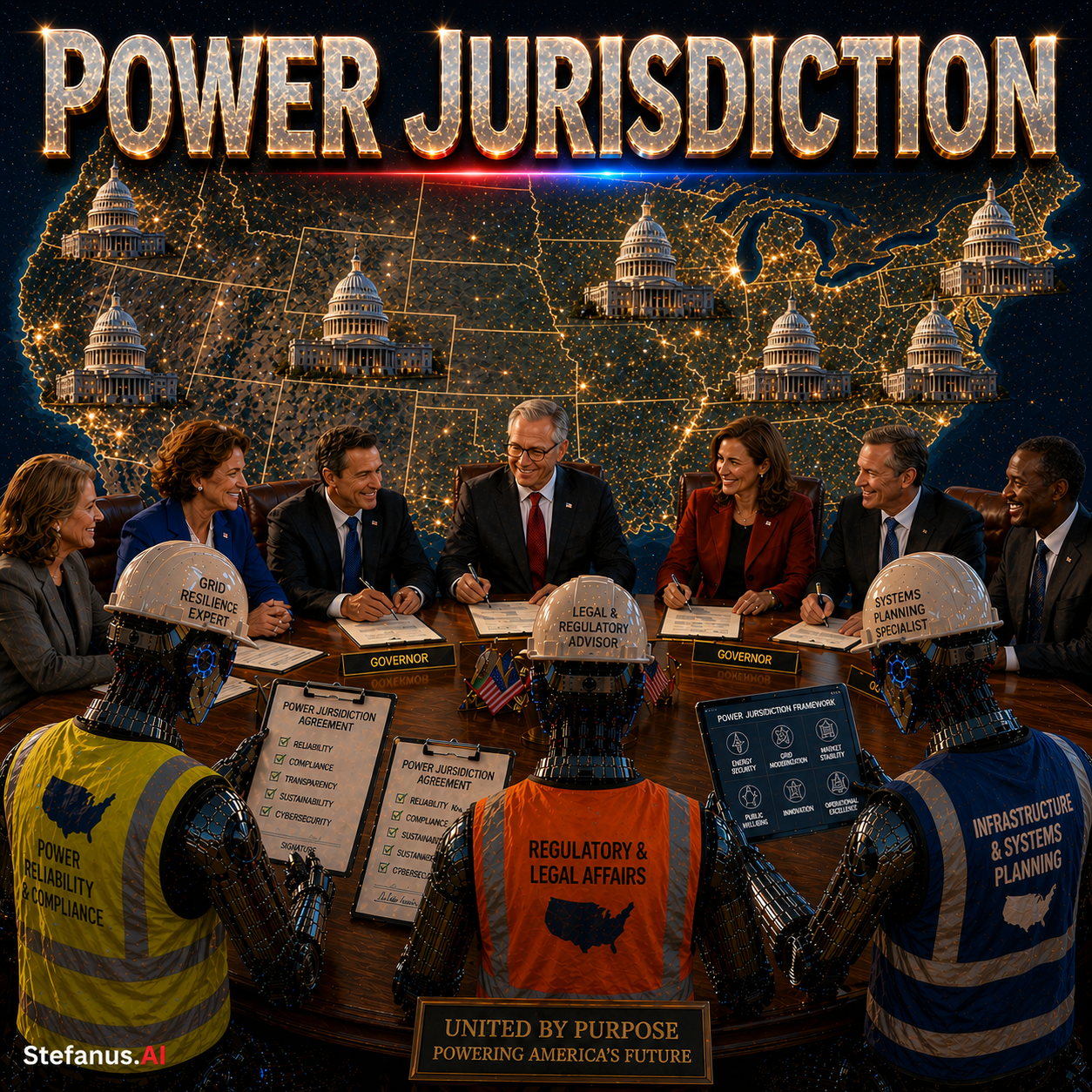
This transformation gives rise to the concept of Power Jurisdiction.
Power Jurisdiction refers to the condition in which the growth and distribution of artificial intelligence become inseparable from the authority of state governments to permit, regulate, finance, and defend the energy systems upon which that growth depends. It is not merely a regulatory overlay; it is a foundational restructuring of technological sovereignty.

Section 1 — Michigan: Cold Climate, Industrial Memory, and Nuclear Reawakening
Michigan provides one of the most compelling examples of how legacy industrial regions can re-emerge as critical nodes in the AI infrastructure landscape. The state’s strategy is not rooted in radical reinvention, but in the strategic recombination of geography, infrastructure, and policy.
Under Gretchen Whitmer, Michigan has signaled a willingness to attract data center investment while maintaining a cautious approach to its societal and environmental implications. This balance reflects an understanding that AI infrastructure, while economically valuable, introduces new forms of strain on local systems.
At a fundamental level, Michigan benefits from its climate. Cooling constitutes a significant portion of data center operational costs, and ambient temperature directly influences energy efficiency.
“Energy use in computing is fundamentally constrained by thermodynamics, particularly the need to dissipate heat.”⁴
— Vaclav Smil
Yet Michigan’s strategic importance extends beyond climate. The proposed reopening of the Palisades Nuclear Plant represents a profound shift in U.S. energy policy. For decades, nuclear facilities have moved toward retirement; the concept of reactivation introduces a new dimension to the energy transition.
“Extending or restoring nuclear capacity is one of the fastest and most reliable ways to maintain grid stability while reducing emissions.”⁵
— Ernest Moniz
In the context of AI, nuclear energy offers a unique alignment with operational requirements. It provides continuous, dispatchable power—characteristics that are essential for hyperscale computing environments.
Michigan thus represents a model in which climate advantage and nuclear revival converge, illustrating how historical infrastructure can be repurposed for future technological demands.

Section 2 — Texas: Abundance, Autonomy, and the Reinvention of Energy Markets
Texas stands at the forefront of the Power Jurisdiction paradigm, embodying both its potential and its inherent risks. Governed by Greg Abbott, the state operates an independent electricity grid through Electric Reliability Council of Texas, allowing it to pursue energy strategies with a degree of autonomy unmatched by other states.
This autonomy, however, is accompanied by vulnerability. The 2021 winter storm exposed critical weaknesses in grid resilience, as infrastructure failures cascaded across the system.
“The Texas blackout revealed systemic weaknesses in grid design, weatherization, and market incentives.”⁶
— Federal Energy Regulatory Commission
In response, Texas has not retreated from its market-oriented approach. Instead, it has sought to expand and diversify its energy portfolio, positioning itself as a hub of abundance capable of supporting energy-intensive industries.
The establishment of the Texas Advanced Nuclear Reactor Working Group reflects a strategic pivot toward advanced nuclear technologies, including SMRs. At the same time, Texas maintains a diversified energy mix, combining fossil fuels with renewable sources.
- Natural gas (~45%)
- Wind (~24%)
- Coal (~14%)
- Nuclear (~9%)
- Solar (~7%)
“Economic development in the 21st century will depend on the ability to scale both energy and technology simultaneously.”⁷
— Daron Acemoglu
Texas exemplifies the tension at the heart of Power Jurisdiction: the need to balance scale, resilience, and autonomy within a rapidly evolving energy landscape.

Section 3 — Pennsylvania: Reliability and the Persistence of Coal
Pennsylvania offers a contrasting perspective, one that highlights the persistence of legacy energy systems in the face of accelerating demand. Under Josh Shapiro, the state has taken steps to extend the operation of coal-fired power plants to ensure grid reliability. This includes maintaining the Keystone and Conemaugh facilities, collectively preserving more than 3,400 megawatts of generation capacity for the regional grid.
“Reliable electricity supply remains the cornerstone of modern economies, particularly during periods of rapid demand growth.”⁸
— International Energy Agency
The extension of coal capacity reflects a pragmatic recognition that the transition to cleaner energy sources is not instantaneous. It must be managed over time, balancing environmental objectives with the need for stability.
“Energy transitions are gradual, layered processes that unfold over decades rather than years.”⁹
— Vaclav Smil
Pennsylvania’s approach underscores the reality that Power Jurisdiction often involves difficult trade-offs, as states navigate competing priorities in a rapidly changing environment.

Section 4 — Virginia: Saturation, Congestion, and Political Backlash
Virginia represents the most advanced—and perhaps most strained—example of data center concentration in the United States. The rapid expansion of infrastructure in Northern Virginia has placed significant pressure on transmission systems and raised concerns about cost allocation.
“The concentration of data centers in a single region can create significant challenges for grid planning and cost distribution.”¹⁰
— Harvard Belfer Center
These pressures have translated into political consequences, as communities and policymakers grapple with the implications of rapid growth.
Virginia demonstrates that success can generate its own constraints, highlighting the importance of balanced development within Power Jurisdiction.

Section 5 — Arizona: Water Constraints and Industrial Expansion
Arizona introduces a distinct and increasingly consequential dimension to the discussion—one defined not by abundance, but by constraint. Under Katie Hobbs, the state is navigating the complex challenge of sustaining both advanced semiconductor manufacturing and large-scale data center expansion within an inherently arid environment.
This tension is amplified by Arizona’s strategic role in the semiconductor supply chain. With TSMC anchoring major fabrication investments, alongside Apple-linked chip production and broader U.S. reshoring efforts, the state has become a focal point of industrial policy. Yet the very assets that make Arizona attractive—land availability and strategic positioning—are offset by intensifying pressures on water resources, electrical capacity, and land use.
In this context, fabs and data centers do not simply coexist; they compound demand across multiple critical systems, revealing that the limits of AI infrastructure are not only technological, but deeply environmental and jurisdictional.
“Water scarcity is becoming an increasingly critical factor in determining the viability of industrial projects.”¹¹
— World Bank
Arizona’s experience illustrates that Power Jurisdiction extends beyond electricity, encompassing the broader ecological systems that support industrial activity.

Section 6 — Iowa: Nuclear Restart and Long-Term Power Contracts
Iowa represents one of the clearest examples of how hyperscale demand is reshaping energy infrastructure through long-term financial commitments. The planned restart of the Duane Arnold nuclear plant, supported by Google, reflects a new model of collaboration between technology firms and energy providers.
Google and NextEra announced a 25-year agreement to restart the 615 MW Duane Arnold Energy Center by early 2029 to help power Google’s AI and data-center needs.
“Long-term agreements between technology companies and utilities are enabling the revival of previously retired energy assets.”¹²
— Reuters
This model aligns capital investment with energy stability, creating a framework in which infrastructure can be developed or restored in response to predictable demand.
Iowa thus demonstrates that Power Jurisdiction is not only regulatory but also financial, involving complex arrangements that bridge public and private sectors.

Section 7 — Indiana: Incentives, Industrial Policy, and Resource Allocation
Indiana’s strategy reflects a more traditional industrial approach, leveraging incentives, land availability, and resource access to attract investment. The state has positioned itself as a competitive destination for both semiconductor manufacturing and data center development.
Amazon Web Services is no longer just expanding cloud capacity—it is building industrial-scale infrastructure.
Nowhere is this shift more visible than in Indiana, particularly in St. Joseph County near New Carlisle, where AWS is rapidly expanding to secure long-term compute power for AI and cloud systems.
What started as an $11 billion investment in 2024 quickly escalated. By November 2025, Amazon committed an additional $15 billion to develop new data center campuses across Northern Indiana—effectively turning the region into a major hub in its AI infrastructure network.
“Regional economic strategies increasingly depend on the ability to attract high-energy industries.”¹³
— Brookings Institution
Indiana highlights the role of fiscal policy within Power Jurisdiction, as states balance the benefits of investment against the costs of incentives.

Section 8 — Wyoming: Advanced Nuclear and the Transformation of Energy Geography
Wyoming is the symbolic frontier of Power Jurisdiction. TerraPower, backed by Bill Gates, received NRC approval to build its Natrium reactor in Kemmerer, near an existing coal site. Reuters reports that the project is a 345 MW sodium-cooled reactor with storage capacity that can boost output to 500 MW. TerraPower announced construction had started in April 2026, calling it the first U.S. utility-scale advanced nuclear plant.
“Advanced nuclear technologies have the potential to provide reliable, carbon-free power at scale.”¹⁴
— Bill Gates
The transformation of former coal regions into sites for advanced nuclear projects illustrates a broader shift in energy geography, as legacy systems are repurposed for new technological paradigms.
Section 9 — Strategic Lessons from the States
The comparative analysis of these states reveals a set of recurring themes that define Power Jurisdiction.
Positive Dynamics
- Rapid policy execution
- Alignment of infrastructure and investment
- Regional specialization
Negative Risks
- Over-subsidization
- Grid instability
- Environmental strain
Strategic Framework
The best state strategy should include:
- Data-center cost allocation — hyperscalers must pay for the grid upgrades they cause.
- Nuclear restart strategy — identify retired or underused nuclear assets.
- SMR permitting pathway — prepare licensing, workforce, and emergency planning before demand peaks.
- Water transparency — require public reporting of cooling-water use.
- Community benefit agreements — local residents must see tangible benefits.
- No blank-check subsidies — incentives should be tied to jobs, grid investment, clean power, and ratepayer protection.
- Governor-led AI energy councils — each state should integrate utilities, tech companies, regulators, universities, and local governments.
Conclusion — Power Jurisdiction as the Foundation of AI Sovereignty
Artificial intelligence is often framed as a revolution in computation, but it is increasingly clear that it is equally a revolution in infrastructure. The systems that enable AI are not abstract; they are physical, material, and governed.
“Energy has always been the foundation upon which economic power is built.”¹⁵
— Daniel Yergin
Power Jurisdiction captures this reality. It describes a world in which the ability to govern energy systems determines the trajectory of technological development.
The future of AI will not be decided solely by innovation in algorithms or hardware. It will be shaped by the capacity of states to provide stable, scalable, and sustainable energy systems.
In this sense, governors have become the gatekeepers of the AI era—not by design, but by necessity.

Footnotes
- Christopher Knittel — https://mitsloan.mit.edu
- MIT News — https://news.mit.edu
- Harvard Belfer Center — https://www.belfercenter.org
- Vaclav Smil — https://mitpress.mit.edu
- Ernest Moniz — https://energy.mit.edu
- FERC Report — https://www.ferc.gov
- Daron Acemoglu — https://economics.mit.edu
- IEA — https://www.iea.org
- Vaclav Smil — https://mitpress.mit.edu
- Harvard Belfer Center — https://www.belfercenter.org
- World Bank — https://www.worldbank.org
- Reuters — https://www.reuters.com
- Brookings Institution — https://www.brookings.edu
- Bill Gates — https://www.gatesnotes.com
- Daniel Yergin — https://www.penguinrandomhouse.com


Comments
[…] United States is already seeing state-level energy decisions become AI strategy. Michigan’s Palisades nuclear restart is one example. Reuters […]
[…] Geography creates state-level winners and losers in ways that cut across traditional measures of economic competitiveness. This is not […]
[…] first channel is political pressure translated into regulatory action by FERC. The governors cannot themselves rewrite PJM’s tariff, but their coordinated advocacy […]