


Introduction: The Fast-Food Joke That Accidentally Explains AI Geopolitics
Picture the scene. It is October 20, 2024, and the forty-fifth—soon to be forty-seventh—President of the United States is standing inside a McDonald’s in Feasterville-Trevose, Pennsylvania, wearing a paper-thin apron over his suit jacket and holding a stainless-steel scoop normally reserved for teenagers earning minimum wage. The franchise has been closed to ordinary customers. Secret Service agents ring the perimeter. Cameras from every major network jostle for position. And the future leader of the free world leans out of the drive-thru window, hands a bag of golden french fries to a pre-vetted supporter, and cheerfully turns to the press.
“This is not a normal situation, is it?”
No, Mr. President. It is not. The campaign stop at that Bucks County McDonald’s—designed as a jab at Vice President Kamala Harris, who had claimed to have worked the fry station in her college years—instantly became one of the defining images of the 2024 election cycle.6 White House Chief of Staff Susie Wiles later revealed that the campaign team pitched the idea precisely because Trump, as she put it with characteristic bluntness, “eats it every single day.” The man who would soon command the most powerful military in human history dunked potato wedges into boiling oil, marveled at the scooping mechanism (“never touched by a human hand—nice and clean”), and proceeded to slightly over-salt an entire batch of fries.6
The irony practically writes itself. Because while candidate Trump was working the fry station and asking drive-thru customers whether they wanted a bag of chips with their order, an entirely different kind of chips was quietly reshaping the entire planet—and nobody in that cheerful Pennsylvania parking lot was laughing about those ones.
Fast-forward less than two years. It is now May 13, 2026. Air Force One—the presidential 747, the most recognizable aircraft on Earth—touches down for a refueling stop at Ted Stevens Anchorage International Airport in Alaska, en route to a summit in Beijing. While the plane takes on fuel, a man in a black leather jacket boards the aircraft. His name is Jensen Huang.3 He is not a senator. He is not a cabinet secretary. He is the founder and chief executive of NVIDIA Corporation, the semiconductor company whose graphics processing units have become the essential infrastructure of the global artificial intelligence revolution—the very “chips” that the world is fighting over.
Earlier that week, news had broken that Huang had not been invited to join the presidential delegation to Beijing—a list of seventeen American CEOs assembled for a summit with Chinese President Xi Jinping that the White House described publicly as focused on agriculture and financial trade frameworks, with semiconductor access, notably, not on the official agenda.4 The omission was conspicuous enough to generate immediate media scrutiny. Trump, seeing the coverage, did what Trump does: he picked up the phone and personally called Jensen Huang, told him he wanted him there, and instructed him to fly to Alaska to intercept Air Force One mid-journey.2
NVIDIA’s stock rose three percent on the news—adding approximately $160 billion in market capitalization in a single session.5 Trump, characteristically, posted on Truth Social accusing CNBC of spreading “FAKE NEWS” for initially reporting that Huang had not been invited, and noted with evident satisfaction that Jensen was “currently on Air Force One and, unless I ask him to leave, which is highly unlikely, CNBC’s reporting is incorrect.”3
The same President who handed out french fries at a drive-thru window now had the founder of the world’s most strategically important chip company sitting beside him on the presidential aircraft. The joke had become the geopolitical story.
That contrast—a drive-thru upsell transformed into the defining metaphor of twenty-first-century strategic competition—is exactly why this paper opens the way it does. “Do You Want Chips With That?” works as a title not merely because it is funny, though it is, but because it is analytically precise. It captures the precise moment in history when America looked at its own semiconductor dominance and struggled, publicly and visibly, to decide whether chips were casual commercial products or something far more consequential.
From Snack Food to Strategic Asset
For most of the late twentieth century and well into the early internet era, the word chips was culturally unserious. Chips belonged to fast-food counters, supermarket aisles, football Sundays, vending machines, and childhood lunches. A chip was something casually added to a purchase—a low-friction consumer indulgence, an afterthought appended to a transaction. “Do you want fries with that?” became one of the most recognizable commercial phrases in modern American consumer culture precisely because it represented the logic of effortless upselling: a small additional item, easy to accept, economically meaningful at scale, psychologically irresistible.
Then history changed the meaning of the word.
Today, chips are no longer snack foods. They are no longer merely semiconductor components embedded invisibly in laptops, gaming systems, or smartphones. In the age of artificial intelligence, chips have become geopolitical assets, military multipliers, industrial bottlenecks, diplomatic bargaining instruments, and perhaps most importantly, the physical substrate of machine intelligence itself. That transformation is what makes the title of this paper intentionally ironic.
“Do You Want Chips With That?” — The Contradiction at the Heart of American Power
The phrase sounds unserious because the stakes are not. The United States now sits at the center of a global contradiction. It possesses the world’s most strategically important AI hardware ecosystem through firms like NVIDIA—yet it simultaneously fears the consequences of selling that hardware to its most consequential strategic rival: China. Washington wants commercial profit, industrial dominance, alliance leverage, technological leadership, and national security insulation—all at the same time. But those objectives increasingly conflict with one another.
The contradiction has become impossible to ignore. Should America sell advanced AI chips to China and preserve ecosystem dependence, or should it deny access and accelerate China’s domestic substitution? Should GPUs be treated as commercial products, or as strategic assets comparable to uranium enrichment technology, aerospace propulsion, or cryptographic infrastructure? And perhaps most provocatively: if Chinese firms are going to acquire AI compute through intermediaries, smuggling, licensing workarounds, or domestic substitution anyway, is Washington actually slowing China—or merely reshaping the route by which China arrives?
These are not abstract questions. They sit at the center of a broader transformation in global power. The twenty-first century has already taught policymakers that infrastructure determines influence. Oil pipelines shaped diplomacy. Telecommunications shaped surveillance power. Rare earth minerals shaped manufacturing dependence. Cloud computing shaped software concentration. Artificial intelligence now introduces a more profound infrastructure dependency: compute itself.
AI does not emerge from software alone. It requires electricity, datacenters, memory bandwidth, advanced packaging, networking fabrics, software ecosystems, and above all, specialized processors capable of training and running frontier models at industrial scale. This is why AI chips are not merely products. They are industrial enablers of cognition. That is what makes them strategically different. When a nation exports oil, it exports energy. When a nation exports aircraft, it exports mobility. When a nation exports advanced GPUs, it exports the capacity to manufacture intelligence.1
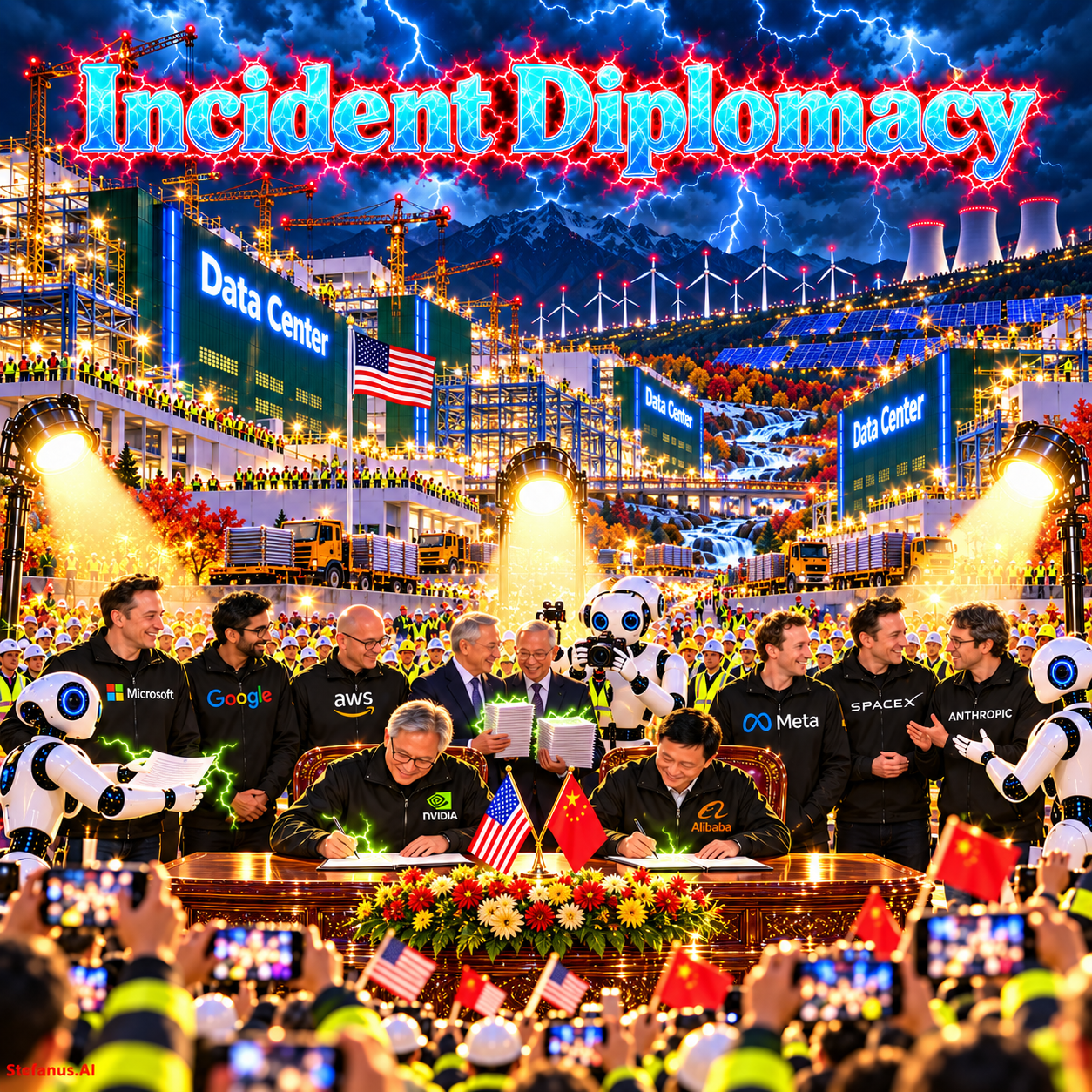
The geopolitical symbolism surrounding Jensen Huang’s last-minute boarding of Air Force One at Anchorage illustrates how unusual this moment has become. A semiconductor executive would once have occupied the commercial margins of diplomatic statecraft. Today, CEOs overseeing critical AI infrastructure increasingly resemble geopolitical actors whose business decisions intersect directly with export policy, alliance management, military modernization, and strategic competition. The fact that semiconductor access can become diplomatically relevant at presidential levels tells us something fundamental: private compute infrastructure has become inseparable from public strategic power.27
This paper argues that microprocessors—especially advanced AI accelerators—have evolved into America’s ultimate bargaining tool in the U.S.–China rivalry. But like all bargaining tools, their utility depends on strategic coherence, enforceability, and timing. Export too freely, and America accelerates the rise of its rival. Restrict too aggressively, and America incentivizes domestic Chinese alternatives, black markets, and technological decoupling. Wait too long, and the advantage disappears. Move too fast, and commercial ecosystems fracture.
The AI chip question is therefore not merely a semiconductor story. It is a story about strategic ambiguity in an era where intelligence itself is becoming industrialized. As Jensen Huang said during a discussion at Stanford Graduate School of Business:118
“This is the beginning of a new industrial revolution.”
That observation is not rhetorical flourish. It is literal. Artificial intelligence is becoming infrastructure. And infrastructure has always been political. This paper examines how microprocessors became America’s most consequential bargaining instrument, why Washington remains strategically conflicted over exports to China, how smuggling and substitution expose the limitations of enforcement, why Chinese AI development continues despite restrictions, and what lessons America must draw if it intends to preserve long-term compute advantage.
The central question is not whether chips matter. That question has already been answered. The real question—the one that Jensen Huang’s dramatic mid-flight Alaska boarding dramatized for the entire world to see—is far less comfortable: What exactly is America selling when it sells compute?

Section 1: How Microprocessors Became America’s Ultimate Bargaining Tool
Historically, great powers controlled chokepoints. Empires controlled maritime routes. Industrial states controlled oil. Financial superpowers controlled reserve currencies. Telecommunications leaders controlled information pathways. Artificial intelligence introduces a new chokepoint: compute.
Compute is not simply processing power. At frontier AI scale, compute represents a vertically integrated industrial capability requiring highly specialized hardware, software optimization, cooling systems, fabrication capacity, networking architecture, memory packaging, and power availability measured increasingly in gigawatts rather than megawatts. That transformation elevated microprocessors from commercial goods into strategic infrastructure.
This did not happen overnight. For decades, semiconductor manufacturing was understood primarily through commercial logic. Faster CPUs improved enterprise productivity. Better GPUs improved gaming performance. Mobile chips improved battery life. Semiconductor competition centered around performance, cost, manufacturing yields, and market share. Artificial intelligence fundamentally altered that equilibrium. Training frontier models requires enormous compute clusters. Inference at planetary scale requires sustained processor deployment across cloud platforms, enterprise environments, military systems, industrial automation, and edge architectures. This shifted semiconductors from horizontal technology inputs into vertically strategic infrastructure.
The most important beneficiary of that shift was NVIDIA. Unlike many semiconductor firms that remained product companies, NVIDIA became an ecosystem company. Its dominance rests not merely on silicon performance, but on CUDA—the software ecosystem that binds developers, researchers, enterprises, and hyperscalers into an integrated architecture. This distinction is crucial: silicon can be replicated, but software ecosystems are harder to displace. A Chinese company denied access to the newest GPU generation is not merely denied hardware. It is denied mature tooling, optimized libraries, model portability, developer familiarity, and ecosystem continuity. That makes NVIDIA more than a chip supplier. It makes NVIDIA a strategic platform steward.
Why China Wants NVIDIA So Badly
The attraction is not mysterious. Chinese firms want NVIDIA because NVIDIA works. Performance leadership matters. CUDA maturity matters. Model portability matters. Cluster optimization matters. Enterprise reliability matters. Engineering familiarity matters. Switching costs are real. Even if Chinese alternatives improve, replacing mature infrastructure is painful. Jensen Huang has pegged China’s market for AI chips at “$50 billion” in the near term and described the total opportunity as potentially worth “a couple of hundred billion dollars by the end of the decade.”521
The geopolitical irony is obvious. America’s semiconductor leadership became so successful that its private ecosystem evolved into strategic leverage. That is precisely why chips now sit at the center of geopolitical bargaining.
The Commercial Case For Selling
The argument for selling is not trivial. Selling preserves American revenue. Selling keeps foreign buyers dependent on American software ecosystems. Selling reduces incentives for substitution. Selling strengthens U.S. shareholder returns. Selling generates taxable economic activity. Selling keeps America at the center of global AI infrastructure rather than pushing buyers toward alternatives.
But national security logic produces a radically different answer. Advanced AI chips are dual-use assets. They are not equivalent to commodity laptops or consumer graphics cards. Their applications extend into intelligence analysis, autonomous targeting, battlefield simulation, electronic warfare, cyber operations, ISR acceleration, signals intelligence, logistics optimization, and command decision support. In that context, selling compute capacity is not merely selling hardware. It may be selling future strategic capability.
The Smuggling Problem
Export controls assume enforceability. Reality is messier. Whenever strategic technologies become restricted, arbitrage emerges. That pattern is ancient. Sanctions create brokers. Restrictions create intermediaries. Bans create shadow logistics. AI chips are no exception. Evidence throughout 2025 and 2026 suggests that advanced AI hardware has continued flowing through indirect channels, shell entities, intermediaries, and regional redistribution networks.1032
Semiconductors are particularly difficult to control because chips are compact, supply chains are multinational, intermediaries can obscure destinations, licensing complexity creates ambiguity, and cloud access reduces physical shipment dependence. A strategic ban without robust enforcement can create illusion rather than denial. And illusion is dangerous in policy.

Section 2: America’s Contradictory Chip Strategy — Profits, Prohibitions, and Strategic Ambiguity
If artificial intelligence is the industrial revolution of cognition, then the United States currently occupies an extraordinary position. It does not merely lead in frontier AI models, venture capital concentration, hyperscale cloud infrastructure, semiconductor design ecosystems, and software tooling. It also controls critical chokepoints within the physical supply chain required to industrialize intelligence itself. That should, in theory, provide strategic clarity. Instead, Washington has produced strategic ambiguity.
The contradiction is profound. America wants to remain the world’s dominant AI economy, preserve semiconductor corporate leadership, ensure NVIDIA, AMD, Intel, hyperscalers, and adjacent suppliers remain globally competitive, keep allied nations technologically dependent on American infrastructure, deny strategic rivals the same capabilities, prevent Chinese military modernization, avoid triggering full technological decoupling, preserve domestic jobs, protect shareholder value, and maintain national security primacy. The problem is simple: these objectives increasingly collide.
A coherent strategy would force prioritization. Instead, Washington has often oscillated between commercial pragmatism and strategic containment, producing policy that sometimes resembles deterrence, sometimes resembles protectionism, sometimes resembles signaling, and sometimes resembles improvised damage control. The AI chip issue reveals this contradiction more clearly than almost any other technology domain.
The same transaction can be interpreted in mutually contradictory ways depending on the institutional lens applied. Commerce sees exports. Defense sees capability transfer. Wall Street sees revenue. The intelligence community sees dual-use risk. Silicon Valley sees ecosystem dominance. China sees technological oxygen. This fragmentation explains why America’s semiconductor policy has often appeared unstable.
The Biden Era: Strategic Denial as National Security Doctrine
The Biden administration approached advanced semiconductor exports through a national security lens increasingly shaped by the assumption that artificial intelligence would become foundational to military and intelligence competition. This assumption was not irrational. AI’s military implications are real. Machine learning systems can accelerate surveillance analysis, logistics forecasting, autonomous navigation, cyber operations, signals processing, sensor fusion, target prioritization, and battlefield decision support.2213
The restriction framework therefore resembled strategic throttling more than absolute denial. That distinction matters. A throttled rival is not a frozen rival. A delayed rival is not a defeated rival. The effectiveness of denial depends on time horizons. If restrictions buy ten years, they are transformational. If they buy twelve months, they are tactical. If they buy six months, they may simply accelerate substitution. That uncertainty haunted policy from the beginning.
The Commercial Backlash
Silicon Valley did not universally embrace restriction logic. From a commercial standpoint, China is not a peripheral market. It is enormous. Demand for AI compute from Chinese enterprises, cloud providers, research groups, and industrial users represented substantial revenue potential. Blocking access does not merely reduce current sales. It may permanently reshape future ecosystems.
A denied customer eventually builds alternatives. That is one of the central strategic ironies of technology sanctions. Restrictions designed to preserve dominance can unintentionally subsidize competitors. If Chinese firms cannot buy NVIDIA, they may buy Huawei. If they cannot rely on CUDA indefinitely, they may invest in domestic software compatibility layers. If Washington’s objective is preserving long-term dependency, over-restriction can become self-defeating.
The Trump Recalibration: Strategic Flexibility or Tactical Opportunism?
A different political administration inevitably reframed the issue. Where the Biden framework leaned more explicitly toward strategic denial, the Trump-era recalibration introduced more visible ambiguity between commercial leverage and security concerns. This ambiguity is historically consistent with Trump-style transactional statecraft. Technology restrictions, tariffs, access, sanctions, and permissions often become bargaining variables rather than purely doctrinal instruments.9
The diplomatic theater surrounding Jensen Huang’s Anchorage boarding—the initial exclusion from the delegation list, the personal presidential phone call, the last-minute dash to Alaska, the black leather jacket ascending the stairs of Air Force One—illustrates this shift with perfect clarity.234 Semiconductor access is no longer simply a business issue. It is now embedded in diplomacy. Technology CEOs increasingly occupy quasi-strategic roles. The same man who stood at a Pennsylvania McDonald’s drive-thru window asking whether customers wanted chips with their order was now, less than two years later, deciding at the presidential level which semiconductor CEO deserved a seat on Air Force One.
Why Not Just Sell the Damn Things?
This is the paper’s most provocative question, and it deserves serious analysis rather than rhetorical dismissal. The argument for unrestricted sales typically includes four propositions. First, revenue preservation: selling advanced chips generates enormous commercial returns, profits fund future R&D, and R&D preserves technological leadership. Second, ecosystem lock-in: hardware alone is not dominance, CUDA is strategic, developer habits are strategic, and selling chips can preserve dependence. Third, delay may be temporary anyway: if China will eventually localize alternatives, denial may only delay inevitable substitution. Fourth, black markets undermine purity: restrictions that create smuggling ecosystems may generate illusion rather than real denial.
But the counterargument remains formidable. The strongest security objections are not speculative. Advanced compute is dual-use. That phrase matters. The same infrastructure that supports commercial AI deployment and consumer applications also supports military simulation, intelligence fusion, drone autonomy, cyber targeting, ISR analytics, and battlefield planning. In strategic competition, intent matters less than capability. Washington cannot assume hardware sold for commercial purposes remains commercially bounded. That assumption would be dangerously naive.
Strategic Ambiguity as Policy
The uncomfortable truth is this: America may not actually possess a stable answer. Its current policy behavior suggests improvisation rather than final doctrine. That is not unusual during technological transition. But strategic ambiguity carries costs. If firms cannot predict rules, investment planning becomes harder. If rivals cannot predict thresholds, deterrence weakens. If allies cannot interpret priorities, coordination suffers. If enforcement remains inconsistent, credibility erodes. A bargaining tool only works if others believe the wielder understands its own strategy.

Section 3: The Geopolitics of U.S.–China Microprocessor Trade
Technology competition between the United States and China is often simplified into a race for “better AI models.” That framing is far too narrow. The actual competition is structural. Artificial intelligence is not simply a software phenomenon. It is a vertically integrated industrial system composed of energy, fabrication, networking, packaging, datacenter deployment, software tooling, model architecture, talent concentration, capital intensity, and increasingly sovereign industrial policy.
A nation that dominates AI does not merely build better chatbots. It accumulates infrastructure advantages that spill into defense, intelligence, finance, manufacturing, healthcare, logistics, education, and state capacity. That is why microprocessor trade matters. This is not a story about semiconductor commerce. It is a story about industrialized intelligence. And once intelligence becomes industrial infrastructure, semiconductor exports become geopolitical decisions.2526
The United States understands this. China understands this. That mutual understanding explains why the chip contest has become one of the most consequential strategic competitions of the decade.
Why the United States Is Strategically Uneasy About China
The more accurate question is not why America is “scared” of China, but why the United States perceives Chinese AI capability growth as strategically consequential. The answer begins with scale. China is the world’s second-largest economy, a major industrial manufacturing power, a nuclear-armed geopolitical rival, a rapidly modernizing military state, a nation with extensive industrial policy coordination, and a country willing to pursue technological self-sufficiency as a national objective. This makes AI competition qualitatively different from ordinary commercial rivalry.
Artificial intelligence intersects directly with strategic domains such as logistics optimization, cyber operations, surveillance architecture, electronic warfare, intelligence analysis, autonomous weapons development, predictive targeting, and military planning. Even if frontier models remain imperfect, incremental AI improvement can materially strengthen state capacity. China possesses scale. Scale changes the economics of technology competition. A nation with sufficient talent, industrial depth, capital mobilization, and domestic demand can absorb delays and still emerge competitive. That is what makes temporary denial an uncertain strategy.
GPU Sales Fueled China’s AI Expansion
For years, Chinese AI growth depended heavily on access to Western semiconductor ecosystems. Chinese hyperscalers, research organizations, startups, universities, and enterprise platforms integrated NVIDIA infrastructure extensively. The key strategic irony is that export restrictions were introduced after this dependence had already matured. That timing matters enormously. A preemptive denial regime might have produced different outcomes. But once an ecosystem is already installed, restrictions become more complicated. Installed hardware continues operating. Engineering expertise remains. Software workflows persist. Optimization knowledge accumulates. Restrictions therefore do not erase capability overnight. They shape future acquisition pathways.
DeepSeek and the Strategic Shock
One of the most psychologically significant developments in AI competition was not necessarily a benchmark score. It was the symbolic emergence of Chinese model resilience under constraint.810 DeepSeek became strategically important not because it permanently surpassed every American frontier model in all dimensions—that claim would be analytically weak and overly reactive—but because of what it demonstrated: export restrictions do not guarantee paralysis. That realization matters enormously.
The psychological effect was profound. For years, a dominant narrative suggested that compute denial would preserve a durable American lead. DeepSeek complicated that assumption. Its emergence triggered one of the largest single-day technology market shocks in AI history, with NVIDIA losing approximately $593 billion in market capitalization before partially recovering.17 In great-power competition, perception shapes policy almost as much as raw capability. DeepSeek mattered beyond technical evaluation. It challenged a mental model.
AI Is Not Just Software — It Is National Capacity
One of the most analytically dangerous simplifications in AI discourse is treating models as isolated software products. That view ignores infrastructure. Artificial intelligence increasingly functions as national capability infrastructure, which means AI progress spills into economic capacity through productivity acceleration and supply-chain optimization; security capacity through cyber operations and threat detection; military capacity through simulation and battlefield analytics; and governance capacity through bureaucratic automation and enforcement scaling. A nation with stronger AI infrastructure does not merely build better software. It potentially enhances state capacity across multiple domains simultaneously.
Compute Sovereignty as the New Strategic Doctrine
The deeper story beneath the U.S.–China chip rivalry is sovereignty. The age of globalization encouraged supply-chain optimization. The age of strategic AI encourages supply-chain sovereignty. These are not the same. Optimization asks: where is production cheapest? Sovereignty asks: where is production safest? Optimization rewards efficiency. Sovereignty rewards resilience. This shift is profound. AI has transformed compute infrastructure into sovereign strategic terrain. And once sovereignty enters industrial policy, semiconductor trade stops being merely commercial. It becomes geopolitical doctrine.

Section 4: AI Hardware and China’s Military Modernization
The most difficult question in the AI semiconductor debate is not commercial. It is strategic. If advanced AI hardware were purely commercial products—equivalent to televisions, office printers, or consumer laptops—the export debate would be straightforward. But advanced AI accelerators are not ordinary commercial products. They are dual-use infrastructure. That single phrase changes everything.
Dual-use means a technology can support both civilian and military applications. History offers many examples. Nuclear engineering powers electricity grids and weapons programs. Aerospace propulsion enables commercial aviation and missile delivery systems. Satellite systems support weather forecasting and military reconnaissance.27 AI compute belongs firmly in that category. A processor designed for training large language models can also support intelligence analysis, autonomous navigation, drone coordination, cyber operations, sensor fusion, electronic warfare, battlefield simulation, predictive logistics, and surveillance analytics.2822
The Military Relevance of AI Compute
Artificial intelligence is already influencing military modernization across multiple domains, and no science fiction is required to appreciate this. Modern states collect enormous volumes of information: signals intelligence, satellite imagery, communications metadata, cyber telemetry, sensor feeds, and open-source intelligence. The bottleneck is not collection alone—it is interpretation. AI dramatically accelerates pattern recognition, anomaly detection, classification, translation, prioritization, and correlation across massive datasets.2313
AI compute increasingly supports drone navigation, target recognition, swarm coordination, adaptive pathfinding, and battlefield autonomy. Even partial autonomy changes operational doctrine. Cheap drone swarms combined with machine vision and decision support can impose asymmetric costs on traditional military systems. The operational lessons emerging from contemporary conflicts have already demonstrated how automation and AI-adjacent systems can reshape battlefield economics.
AI-assisted strategic planning, simulation, scenario modeling, and war-gaming create enormous institutional leverage. Commanders with faster information processing gain asymmetric advantage. AI can enhance cyber capability by accelerating vulnerability discovery, anomaly detection, intrusion pattern recognition, automated response workflows, and threat prioritization. This makes compute strategically meaningful even without autonomous weapons.
Why Washington Cannot Treat GPUs as Ordinary Commerce
The “just sell the damn chips” argument assumes commercial separation. That separation no longer exists. A GPU cluster purchased for enterprise AI can indirectly support state capability. A cloud provider serving civilian demand may also interface with government projects. Research infrastructure can spill into adjacent military ecosystems. The boundaries are porous. This is why national security institutions remain cautious—not because every GPU instantly becomes a weapon, but because compute capacity accumulates into strategic capability.2229
These concerns become amplified specifically because of China’s scale and strategic profile. If a small neutral state purchased AI accelerators, the geopolitical calculus would differ. China presents a different case because it combines industrial scale, military modernization, state strategic coordination, technological ambition, and geopolitical rivalry. Washington’s concern is not that every Chinese engineer is building military systems. The concern is systemic capability accumulation within a rival state.
Smuggling and the Illusion of Control
Export restrictions create a political sense of action. But strategic effectiveness depends on enforcement. Advanced AI hardware is compact, high value, globally distributed, and commercially integrated, which makes enforcement difficult. Potential pathways include intermediary distributors, shell procurement entities, regional rerouting, cloud access alternatives, and third-country acquisition channels. Even partial leakage undermines strategic assumptions.1134
If policymakers believe denial is working while capability continues flowing indirectly, strategic planning becomes dangerously distorted. This is the illusion problem. A policy can look strong while performing weakly. History offers many sanctions examples where symbolic restriction exceeded practical enforcement. AI hardware may prove similarly resistant.

Section 5: DeepSeek, Huawei, Smuggling, and the Limits of Export Control
Export controls are often discussed as if they are static instruments. A government announces restrictions, the targeted party loses access, capability degrades, and strategic advantage is preserved. Reality is rarely that linear. Export controls are interactive systems. Targets respond. Corporations adapt. Supply chains reroute. Intermediaries emerge. Political narratives evolve. Domestic industrial policy accelerates. Smuggling networks exploit arbitrage. The targeted ecosystem changes behavior.
Washington’s strategy assumed that restricting access to frontier compute would meaningfully slow Chinese AI advancement. That assumption was not unreasonable. Training frontier models requires extraordinary hardware resources. Advanced packaging matters. High-bandwidth memory matters. Interconnect fabrics matter. Cluster orchestration matters. Supply-chain access matters. AI at scale is capital intensive. Denying access should matter. The question is not whether restrictions matter. The question is how much, for how long, and with what unintended consequences. That is where the story becomes strategically fascinating.910
DeepSeek and the Psychological Failure of Strategic Certainty
For years, a dominant strategic narrative suggested that American export restrictions would preserve a durable AI lead by constraining Chinese compute access. This narrative rested on a straightforward assumption: no frontier compute means no frontier AI. DeepSeek complicated that logic. Its significance was not that it permanently dethroned American leadership—that interpretation is too simplistic and analytically weak. Its true significance was symbolic. It demonstrated that Chinese AI progress remained possible even under pressure.817
Strategic confidence depends partly on assumptions about denial effectiveness. If policymakers believe restrictions decisively slow a rival, they gain confidence. If evidence suggests adaptation, confidence weakens. If confidence weakens, policy changes. DeepSeek therefore mattered beyond technical performance. It challenged a mental model. And in geopolitical competition, challenged mental models often produce disproportionate strategic effects.
Huawei and the Strategic Logic of Forced Substitution
No major power willingly accepts permanent dependency in strategically sensitive sectors. This principle is universal. America would not accept dependency on foreign adversaries for critical military compute. China should not be expected to behave differently. Restrictions therefore create predictable incentives. If access to American ecosystems becomes uncertain, domestic substitution becomes rational. Huawei’s strategic relevance must be understood through this lens. Huawei is not merely a company. It increasingly functions as a symbol of technological sovereignty. Pressure elevated its political importance. Restrictions transformed localization from commercial preference into national strategic necessity.2632
That is the paradox. Export controls intended to preserve American advantage may simultaneously accelerate Chinese self-sufficiency. This does not mean restrictions are inherently misguided. It means restrictions must be evaluated dynamically. If pressure catalyzes domestic alternatives faster than expected, strategic outcomes shift.
The Sanctions Industrialization Effect
History repeatedly shows that sanctions can unintentionally industrialize resilience. When external pressure becomes persistent, targeted states often mobilize domestic capability. This pattern appears in energy substitution, agricultural localization, financial routing alternatives, and military procurement redesign. Technology is no exception. Pressure changes incentives. Domestic capital becomes politically justified. Engineering talent receives state support. National narratives reinforce resilience. Import substitution gains legitimacy. What was previously economically inefficient becomes strategically necessary. Semiconductors now occupy this terrain.
The Cloud Loophole Problem
Even if physical exports are tightly controlled, compute access can migrate into cloud environments. This is one of the most important conceptual weaknesses in hardware-centric policy. A nation denied physical chips may still access remote compute indirectly. This transforms the strategic problem. The relevant question becomes: is Washington restricting hardware ownership—or compute access? Those are not identical. Cloud-delivered compute complicates export logic. A chip physically located outside China may still indirectly serve Chinese workloads. This makes semiconductor strategy partially a cloud governance problem—a dimension that remains critically under-discussed.3341
NVIDIA’s Dilemma: Commercial Incentives vs. Strategic Restraint
NVIDIA occupies a uniquely uncomfortable position. From the corporate perspective, China represents enormous commercial opportunity. Revenue funds innovation. Innovation sustains leadership. Leadership strengthens shareholder value. But the state applies a different logic: from Washington’s perspective, revenue is secondary to strategic containment. That divergence matters. Private firms optimize for growth. States optimize for security. These objectives overlap only partially. The friction is structural. NVIDIA cannot solve America’s geopolitical dilemma. Washington cannot fully eliminate NVIDIA’s commercial incentives. That tension will persist. House Foreign Affairs Chair Brian Mast captured the political dimension bluntly:213
“The joke here is, Jensen wants us to trust the CCP.”
That political atmosphere—Republican China hawks, Democrat technology skeptics, intelligence community caution, and Silicon Valley commercial optimism—defines the battlefield on which semiconductor policy is actually made. And it ensures that no clean answer will emerge anytime soon.

Section 6: Strategic Lessons for America’s Semiconductor Future
The most intellectually useful way to analyze the semiconductor contest is not through daily headlines. Headlines distort. One day, a restriction is announced. The next, a waiver is rumored. A CEO boards Air Force One in Anchorage. A rival launches a new model. A new accelerator is benchmarked. Short-cycle events create narrative volatility. But infrastructure strategy must operate on longer timelines. The more important question is not what happened this week. It is what structural lessons emerge from the semiconductor confrontation itself.
Those lessons are larger than export controls. They concern industrial sovereignty, strategic resilience, manufacturing geography, corporate-state alignment, infrastructure concentration, and the future architecture of AI power. The United States still possesses substantial advantages. But advantages can decay. Strategic leadership requires active reinforcement. The semiconductor contest exposes both strengths and vulnerabilities.3846
Lesson One: Industrial Dependence Is Strategic Fragility
For decades, globalization rewarded efficiency. Manufacturing migrated where economics favored scale, specialization, labor optimization, and supply-chain integration. This logic delivered extraordinary commercial benefits. But strategic competition changes optimization criteria. When a technology becomes foundational to national security, efficiency is no longer the sole objective. Resilience becomes equally important. The United States leads in architecture, software ecosystems, advanced AI firms, and adjacent research ecosystems. Yet critical fabrication dependencies remain internationally distributed. A nation cannot fully claim compute sovereignty while depending on geographically concentrated foreign fabrication for critical supply continuity.3944
Lesson Two: Arizona and Texas Are Not Regional Economic Stories — They Are Strategic Geography
Domestic fabrication expansion should not be interpreted narrowly as job creation policy. Semiconductor reshoring is strategic geography. Location matters. Control matters. Proximity matters. Trusted jurisdiction matters. Domestic fabs reduce exposure to geopolitical concentration risk. They improve continuity under disruption. They strengthen defense assurance. They increase policy flexibility. The significance of Arizona, Texas, and broader U.S.-based semiconductor investment is therefore much larger than local economics. This is infrastructure sovereignty. The CHIPS and Science Act explicitly recognized this when it committed tens of billions of dollars to reshoring critical fabrication.35363738
Lesson Three: Export Controls Without Enforcement Become Symbolic Policy
A restriction announcement is not a strategic outcome. Execution determines outcomes. This distinction is fundamental. If advanced hardware can still move through intermediaries, cloud pathways, shell entities, rerouted procurement, or weak compliance channels, then the effective outcome differs dramatically from declared policy. Symbolism matters politically. But symbolic policy is dangerous if leaders mistake messaging for capability denial. Real strategy requires operational realism. This means stronger end-user verification, tighter cloud governance, allied coordination, customs intelligence integration, and adaptive enforcement frameworks.113416
Lesson Four: Corporate Incentives and State Incentives Are Structurally Different
Technology firms optimize differently from governments. This is not moral failure. It is institutional design. Public companies optimize for revenue, growth, market share, ecosystem expansion, investor expectations, and competitive positioning. States optimize for deterrence, resilience, security, strategic advantage, alliance stability, and military superiority. Overlap exists. But alignment is never perfect. The AI era will intensify these tensions. Which raises a larger policy question: how should democratic states manage strategic technologies developed by profit-maximizing private firms? This question extends far beyond semiconductors. It applies to cloud infrastructure, AI models, satellite systems, robotics, biotech, cyber tooling, and future autonomous platforms. The semiconductor debate is merely the first major preview.
Lesson Five: Dependency Can Be a Strategic Asset — Until It Isn’t
One of the most compelling commercial arguments for exports is dependency. If rivals depend on American ecosystems, America retains leverage. That logic is real. But dependency is perishable. Dependency only matters while alternatives remain unattractive or immature. Once substitution becomes politically justified and economically viable, dependency weakens. This makes timing critical. Selling preserves dependence. Over-restricting accelerates substitution. Under-restricting accelerates rival capability. This balancing act is extraordinarily difficult. The strategic objective should not simply be “more restriction” or “more openness.” It should be intelligent dependency management.
Lesson Six: The Next Battlefield Is Inference, Not Just Training
Public discourse remains disproportionately focused on training. Training captures imagination because frontier models are spectacular—massive clusters, huge capital expenditures, headline-grabbing benchmarks. But the next strategic contest may increasingly revolve around inference. Inference is where AI becomes operational. Training builds capability. Inference deploys capability. Inference determines daily decision volume, enterprise integration, embedded autonomy, military deployment, and industrial productivity. Control over inference infrastructure may prove more strategically durable than episodic training advantages.4342
This includes sovereign AI clouds, edge inference hardware, industrial embedded AI, defense decision-support deployment, and autonomous systems integration. The nation controlling deployed intelligence infrastructure may accumulate greater long-term leverage than the nation with marginally superior model training cycles. That is a critical strategic shift that current policy has not yet fully absorbed.
Lesson Seven: Compute Sovereignty Will Define the Next Decade
The semiconductor contest is not temporary. It is the opening chapter of a broader sovereignty transition. Future national strategy will increasingly revolve around compute access, power availability, fabrication security, datacenter scale, inference deployment, and supply-chain resilience. As Vaclav Smil has observed of energy—the physical enabler of all prior industrial civilizations—”Energy is the only universal currency.”45 In the AI era, compute has become a second universal currency. Compute is becoming foundational infrastructure. And infrastructure always becomes political.4446
This means AI competition is not just about models. It is about who controls the industrial stack beneath intelligence. That stack includes energy, silicon, packaging, networking, cooling, software ecosystems, and deployment infrastructure. Leadership requires coherence across all layers. That is a much harder challenge than producing isolated technical breakthroughs.

Conclusion: What Exactly Is America Selling When It Sells Compute?
The title of this paper was intentionally playful. “Do You Want Chips With That?” It works because it weaponizes cultural familiarity. A fast-food phrase evokes triviality, convenience, upselling, consumer abundance, a casual transaction. But the modern chip is none of those things.
The semiconductor has become one of the most politically charged industrial artifacts of the twenty-first century. Its significance is no longer technical alone. It is strategic, economic, military, diplomatic, infrastructural, and perhaps most importantly, cognitive. Because advanced AI chips do not merely accelerate software. They accelerate intelligence production itself. That is what makes the semiconductor contest fundamentally different from ordinary trade disputes.
America is not merely deciding whether to sell products. It is deciding how much access to industrialized intelligence it is willing to provide. That is a radically different question. And the answer is not made any clearer by the images that bookend this story: a future president standing at a Pennsylvania McDonald’s drive-thru in 2024, handing out fries and asking if customers wanted chips with their order; and that same president, less than two years later, personally calling the world’s most important chip CEO, instructing him to fly to Anchorage to board Air Force One, and bringing him to Beijing to sit in the room where the future of global AI infrastructure would be negotiated.623
The contradiction is unavoidable. Sell freely, and America risks accelerating the capabilities of a strategic rival. Restrict aggressively, and America risks catalyzing self-sufficiency, black markets, and ecosystem fragmentation. Delay too long, and leverage decays. Move too early, and substitution accelerates. No perfectly clean strategy exists. That is the uncomfortable truth.
But strategic ambiguity is not a substitute for strategy. The United States must decide what its actual objective is: full denial, friction creation, dependency preservation, commercial dominance, military delay, or industrial sovereignty. The answer determines policy design. Without clarity, semiconductor policy becomes improvisation. And improvisation is dangerous in great-power competition.
The deeper lesson is broader than China. Artificial intelligence is transforming infrastructure logic. Compute is becoming sovereign terrain. States that control compute infrastructure will shape economic productivity, defense modernization, industrial competitiveness, and political leverage. That is why semiconductors matter so profoundly.
The irony of this paper’s title remains useful precisely because it captures the absurdity of the moment. The same civilization that once treated chips as snack-food commodities now treats them as strategic bargaining instruments between superpowers. The same word that once implied convenience now implies coercion. The same hardware that powered gaming now shapes military planning. The same silicon that generated shareholder returns now influences national security doctrine. History often advances through such semantic reversals.
“Do you want chips with that?” The question was never about fries.
When America sells compute, the real question is what exactly is included in the order: a product, a dependency, a diplomatic concession, a temporary alliance, a delayed rival, or the foundational infrastructure of the next competing intelligence superpower.46
That question will define the decade.

Footnotes
1. Stanford GSB — U.S. Leadership in AI — Jensen Huang Event (April 2026) https://www.gsb.stanford.edu/events/us-leadership-ai
2. CNBC — Nvidia says CEO Jensen Huang is joining Trump’s China trip (May 13, 2026) https://www.cnbc.com/2026/05/13/nvidia-says-ceo-jensen-huang-is-joining-trumps-china-trip.html
3. The Hill — Nvidia CEO Jensen Huang joins Donald Trump’s trip to China https://thehill.com/homenews/administration/5875767-nvidia-ceo-joins-trump-china-trip/
4. Semafor — Nvidia snubbed from Trump China trip to avoid “awkward conversations” (May 12, 2026) https://www.semafor.com/article/05/12/2026/nvidia-snubbed-from-trump-china-trip-to-avoid-awkward-conversations
5. 247 Wall St. — Trump Once Said He’d Never Heard of NVIDIA CEO — Now Air Force One Stopped in Alaska to Pick Him Up https://247wallst.com/investing/2026/05/13/trump-once-said-hed-never-heard-of-nvidia-ceo-jensen-huang-now-air-force-one-stopped-in-alaska-to-pick-him-up/
6. NBC News — Trump attempts to troll Harris by serving french fries at a Pennsylvania McDonald’s (Oct. 20, 2024) https://www.nbcnews.com/politics/2024-election/trump-tries-troll-harris-serving-french-fries-mcdonalds-rcna176294
7. South China Morning Post — Nvidia’s Jensen Huang joins Trump’s trip to China at last minute https://www.scmp.com/economy/china-economy/article/3353346/nvidias-jensen-huang-joins-trumps-trip-china-after-all
8. Reuters — What is DeepSeek and why is it disrupting the AI sector? (Jan. 27, 2025) https://www.reuters.com/technology/artificial-intelligence/what-is-deepseek-why-is-it-disrupting-ai-sector-2025-01-27/
9. Reuters — Tech rivalry, distrust sap summit hopes for Trump-Xi AI push (May 13, 2026) https://www.reuters.com/world/china/tech-rivalry-distrust-sap-summit-hopes-trump-xi-ai-push-2026-05-13/
10. Reuters — Why blocking China’s DeepSeek from using U.S. AI may be difficult (Jan. 29, 2025) https://www.reuters.com/technology/artificial-intelligence/why-blocking-chinas-deepseek-using-us-ai-may-be-difficult-2025-01-29/
11. Bureau of Industry and Security (BIS), U.S. Dept. of Commerce — Semiconductor Export Controls — Entity List, Export Administration Regulations (EAR) https://www.bis.gov
12. Stanford HAI — Stanford Human-Centered Artificial Intelligence — Research & Events https://hai.stanford.edu
13. RAND Corporation — Artificial Intelligence and National Security — Research Overview https://www.rand.org/topics/artificial-intelligence.html
14. CSIS — Center for Strategic and International Studies — Semiconductor Export Controls and Technology Policy https://www.csis.org
15. Brookings Institution — AI Infrastructure and Global Competition — Policy Research https://www.brookings.edu
16. Congressional Research Service — Semiconductor Policy and Supply Chain Reports https://crsreports.congress.gov
17. Reuters — DeepSeek Sparks AI Market Rout — Nvidia lost $593 billion in market value (Jan. 27, 2025) https://www.reuters.com/technology/chinas-deepseek-sets-off-ai-market-rout-2025-01-27/
18. Stanford News — Political and Industry Leaders Explore AI’s Future — Jensen Huang & Ro Khanna (April 2026) https://news.stanford.edu/stories/2026/04/jensen-huang-ro-khanna-ai-regulation
19. CNAS — Center for a New American Security — AI Governance and Compute Access Analysis https://www.cnas.org
20. Carnegie Endowment for International Peace — Technology Sanctions and Strategic Adaptation https://carnegieendowment.org
21. NVIDIA Investor Relations — Annual Reports and China Revenue Disclosures https://investor.nvidia.com
22. U.S. Department of Defense — AI and Military Modernization Strategy https://www.defense.gov
23. CDAO (DoD) — Chief Digital and Artificial Intelligence Office — U.S. Department of Defense https://www.ai.mil
24. MIT Technology Review — AI Infrastructure and Compute Analysis — Research and Reporting https://www.technologyreview.com
25. Council on Foreign Relations (CFR) — AI and Geopolitical Competition https://www.cfr.org
26. CSIS — China Technology Strategy and AI Industrial Policy https://www.csis.org
27. Congressional Research Service — Export Controls and Dual-Use Technologies https://crsreports.congress.gov
28. RAND Corporation — Autonomous Warfare, Drones, and AI Military Applications https://www.rand.org
29. Carnegie Endowment for International Peace — AI Cybersecurity and Dual-Use Implications https://carnegieendowment.org
30. Hoover Institution / Stanford University — Geopolitics and AI Infrastructure Sovereignty Discussions https://www.hoover.org
31. NVIDIA GTC — Jensen Huang Keynote: AI as New Industrial Infrastructure https://www.nvidia.com/en-us/gtc/
32. Reuters — Semiconductor export enforcement and circumvention analysis — Technology Reporting https://www.reuters.com/technology/
33. CNAS — Cloud Compute Governance and AI Hardware Controls https://www.cnas.org
34. BIS / U.S. Dept. of Commerce — Entity List and Export Administration Regulations (EAR) — Semiconductor Controls https://www.bis.gov
35. U.S. Congress — CHIPS and Science Act (Public Law 117-167) — Text and Legislative History https://www.congress.gov/bill/117th-congress/house-bill/4346
36. White House — CHIPS Act: Semiconductor Manufacturing as National Competitiveness and Security Priority https://www.whitehouse.gov
37. Intel Newsroom — Intel Foundry and Domestic Manufacturing Expansion https://www.intel.com/content/www/us/en/newsroom
38. TSMC — TSMC Arizona — Advanced Semiconductor Fabrication in the United States https://www.tsmc.com/static/abouttsmcaz/index.htm
39. Congressional Research Service — Semiconductor Concentration Risk and Supply Chain Fragility https://crsreports.congress.gov
40. Financial Times — U.S.–China Semiconductor Policy: Commerce vs. National Security — Ongoing Coverage https://www.ft.com
41. Amazon Web Services — Cloud Hyperscaler Infrastructure and AI Inference at Scale https://aws.amazon.com
42. Stanford HAI — AI as National Capacity Infrastructure — Research Overview https://hai.stanford.edu
43. MIT Technology Review — Inference Economics and AI Deployment Architecture https://www.technologyreview.com
44. International Energy Agency (IEA) — AI and Datacenter Electricity Demand (2024–2026) https://www.iea.org
45. Vaclav Smil — Energy and Civilization: A History — MIT Press https://mitpress.mit.edu
46. CFR / Brookings Institution / RAND Corporation — Collective AI Strategic Competition Research (cited collectively) https://www.cfr.org

Comments
[…] was designed primarily to serve a commercial market became, almost overnight, a central element of US-China strategic competition. This is the texture of Founder Geopolitics: commercial decisions made in Silicon Valley by a […]
[…] geopolitical implications are staggering. TSMC’s Fab 21 in Phoenix, Arizona — a centerpiece of the CHIPS and Science […]
[…] strategic response to the U.S. export control campaign has been precisely to internalize as much of Huang’s five-layer cake as possible. Restricted […]
[…] modern AI chip-control era did not appear suddenly in 2022. Research published in 2019 and 2020 had already identified […]
[…] computing. In reality, it has become a reciprocal contest. The United States controls several advanced semiconductor chokepoints — chip design, design software, manufacturing equipment, and access to the most capable […]
[…] and AI software. If frontier artificial intelligence eventually becomes as important to national power as many policymakers expect, unrestricted transfer of the most advanced computing systems could […]