
Introduction: From Garage Dormitories to Gigawatt Corridors — and the Trillion-Dollar Threshold
Not all fifty states in the United States enjoyed the early advantages of high-technology development during the nascent years of the Internet and dotcom boom in the 1990s. While that revolution took root, I was a graduate student at the University of Southern California, working toward my doctorate degree and immersing myself in a rich body of literature about what scholars at the time were calling “clusters” — dense geographic concentrations of interconnected companies, suppliers, research institutions, and universities that together generated a momentum no single firm could replicate in isolation. The scholar who did the most to crystallize and popularize this concept was Harvard Business School professor Michael E. Porter, whose influential work on competitive advantage and industrial clusters provided the intellectual scaffolding for understanding why Silicon Valley in California, the Research Triangle in North Carolina, and the Route 128 / I-95 Technology Corridor outside Boston came to dominate the earliest wave of the digital economy.
Porter’s framework, and the broader cluster literature of that era, consistently pointed to several key enablers: proximity to world-class research universities and their faculty founders, access to concentrations of venture capital, a culture of entrepreneurial risk-taking, and — critically — the enabling conditions created by state governments in the form of tax incentives, research funding, and a regulatory climate hospitable to new enterprise. California in particular understood this arithmetic early. Through a sustained commitment to public research institutions — USC, UCLA, UC Berkeley, Stanford, and Caltech among them — California helped cultivate the intellectual and human capital from which Silicon Valley’s founders drew. The state’s absence of a tax on stock options, combined with its research university ecosystem and favorable venture capital laws, created a reinforcing loop that made the Bay Area the gravitational center of the 1990s Internet era.
That era, in retrospect, was technologically modest by the standards of what we now confront. The original Internet and dotcom revolution was, at its core, a revolution of software running on personal computers: writing code for search engines, building e-commerce websites, standing up online content platforms. The capital requirements were relatively modest — many of the era’s most celebrated companies were founded inside garages, dormitory rooms, and rented offices. The infrastructure demands were light. The political economy of that technological revolution was therefore also relatively light: states did not need to mobilize industrial policy in any particularly heavy-handed way. Providing a good university, a low-tax environment, and permissive zoning was often sufficient.
Today’s AI revolution, by contrast, is a different kind of industrial phenomenon altogether — one that demands a radically different kind of political and economic response. The AI era is defined not by code running on a laptop but by infrastructure at industrial scale. NVIDIA’s founder and CEO Jensen Huang, speaking at the World Economic Forum in Davos in January 2026, offered what has since become perhaps the most clarifying framework for understanding the true nature of AI as an economic force. Huang described AI not as a single technology or a single product but as what he called “a five-layer cake” — a complete industrial system composed of five sequential and interdependent layers: energy at the foundation, then chips, then data center infrastructure, then AI models, and finally applications at the top.
“Every successful application pulls on every layer beneath it, all the way down to the power plant that keeps it alive.”1
— Jensen Huang, CEO of NVIDIA, World Economic Forum, Davos, January 2026
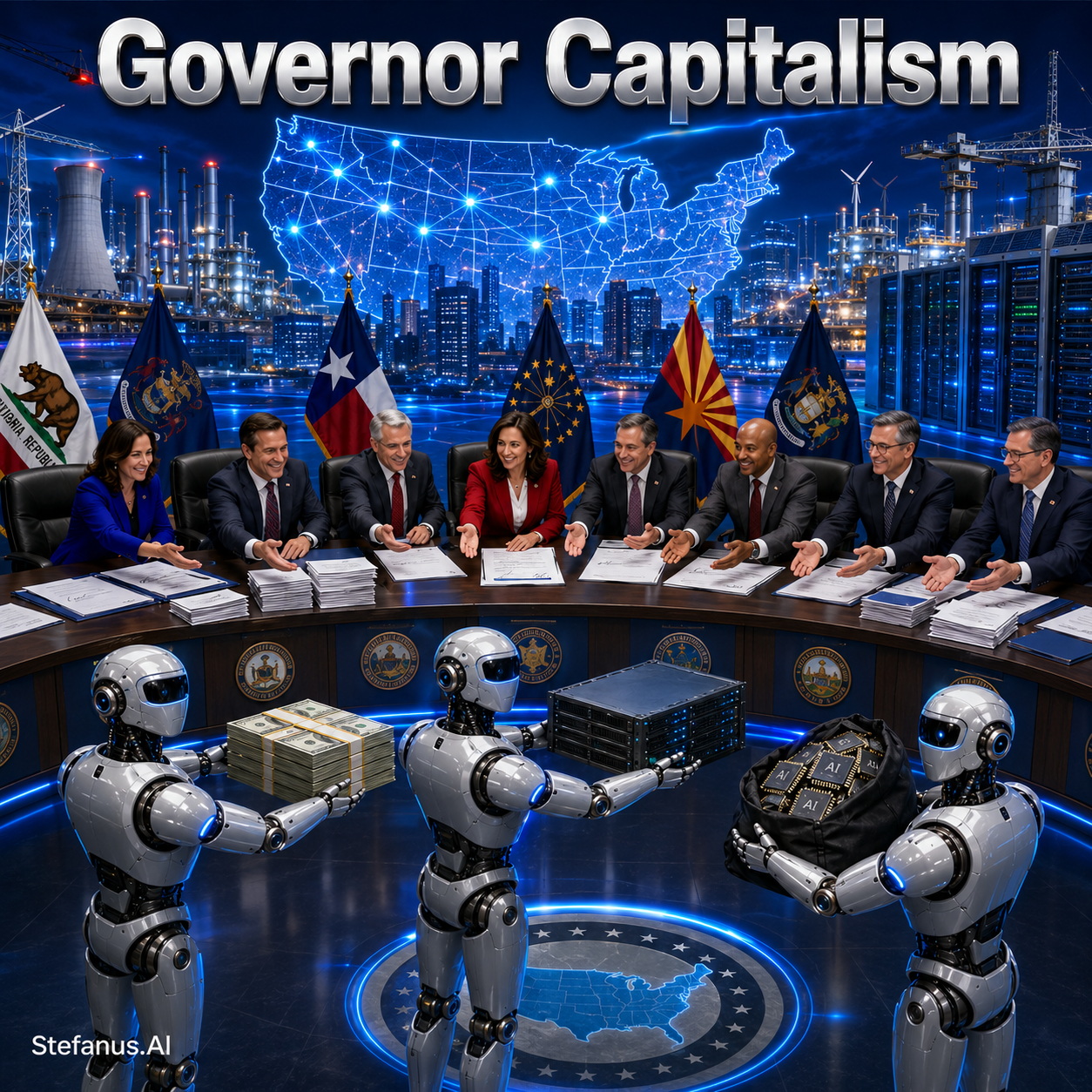
This five-layer framing is not merely descriptive. It is diagnostic. It explains why the AI economy, unlike the Internet economy before it, requires multi-billion dollar physical investments in energy generation, semiconductor fabrication, and data center construction before a single line of application code can be written. It explains why state governors — who control land, permitting, utility regulation, tax policy, and workforce development — have become the decisive actors in determining where America’s AI infrastructure lands. And it explains the central argument of this paper, which I have chosen to frame as “Governor Capitalism“: the thesis that in the current AI industrial era, the governors of America’s fifty states are functioning less like conventional political executives and more like CEOs of competing sovereign investment platforms — attracting, negotiating, and structuring the terms of the largest industrial investment wave in American history.
The Capital Expenditure Supercycle: Approaching the Trillion-Dollar Threshold
The comparison to earlier industrial transformations is not incidental. The United States has seen this pattern before — in the competition for railroad routes in the nineteenth century, in the battle to attract automobile plants in the twentieth century, and in the semiconductor incentive wars of the early 2000s. But the AI infrastructure competition now underway dwarfs all prior precedents in both scale and speed, and nowhere is that more vivid than in the capital expenditure commitments of the world’s largest technology companies. To appreciate why governors have become so central to American economic destiny, one must first grasp the extraordinary financial magnitude of what is being deployed — and where it must physically land.
In 2024, Amazon, Microsoft, Alphabet, and Meta collectively spent $222 billion on capital expenditures — a 62 percent year-over-year increase that set an all-time record. By 2025, that combined figure climbed to an estimated $339 billion. Then, in the opening weeks of 2026, first-quarter earnings guidance shattered prior expectations. When results were reported in late April and early May 2026, the four hyperscalers announced combined 2026 capital expenditure plans of approximately $700 to $725 billion for the Big Four alone, rising to roughly $750 to $775 billion when Oracle is included — a year-over-year increase of more than 100 percent from 2025 levels.
The acceleration is staggering company by company. Amazon committed to approximately $200 billion in 2026 capital expenditure — the largest single corporate infrastructure commitment in American history. Microsoft set its 2026 capex at $190 billion, a figure $55 billion above the average analyst estimate when announced; CFO Amy Hood attributed $25 billion of that to rising memory chip and component costs alone, while noting that even at that spending level the company expects to “remain capacity-constrained through at least 2026.” Alphabet raised its 2026 capex guidance to between $180 and $190 billion, with CFO Anat Ashkenazi flagging “significantly increased” spending planned for 2027. Meta raised its full-year 2026 guidance to $125–$145 billion — nearly double its 2025 actual of $72 billion.2
“We continue to believe AI is a once-in-a-lifetime reinvention of everything we know. The demand is unlike anything we’ve seen before, and our customers, shareholders, and business will be well-served by our investing aggressively now. We are confident in the long-term capex investments we are making.”3
— Andy Jassy, CEO of Amazon, Q1 2026 earnings call, April 2026
“We are increasing our infrastructure capex forecast for this year. Most of that is due to higher component costs, particularly memory pricing. But every sign that we’re seeing in our own work and across the industry gives us confidence in this investment.”4
— Mark Zuckerberg, CEO of Meta, Q1 2026 earnings call, April 2026
“We expect capex spend to increase to over $40 billion as we continue to bring more capacity online. The sequential increase includes roughly $5 billion from higher component pricing. Even with this spending, Microsoft expects to stay capacity constrained through 2026.”5
— Amy Hood, CFO of Microsoft, Q3 FY2026 earnings call, April 2026
“Capex plans are increasing to meet robust demand. Cap-ex keeps climbing, but return on investment is evident via approximately two trillion dollars in backlog and accelerating cloud growth.”6
— Anat Ashkenazi, CFO of Alphabet / Google, Q1 2026 earnings call, April 2026
Table 1 — Hyperscaler Capital Expenditure: From Dotcom Era to the AI Trillion-Dollar Threshold
| Company / Hyperscaler | 2024 Actual ($B) | 2025 Actual ($B) | 2026 Guidance ($B) | 2027 Projection ($B) | YoY Growth 2025→2026 |
| Amazon (AWS) | $85.8 | $105.0 | ~$200 | $230–250† | +90% |
| Microsoft (Azure) | $44.5 | $77.0 | $190 | $210–250† | +147% |
| Alphabet / Google | $52.5 | $85.0 | $180–190 | $200–250† | +118% |
| Meta Platforms | $39.2 | $72.0 | $125–145 | $160–180† | +97% |
| Oracle (OCI) | ~$12.0 | ~$20.0 | ~$50 | $60–80† | +150% |
| Big Four Total (Amazon + Microsoft + Google + Meta) | $222.0 | $339.0 | ~$700–725 | $800–930† | +113% |
| Big Five Total (incl. Oracle) | ~$234 | ~$359 | ~$750–775 | >$1 TRILLION† | +116% |
Sources: Company SEC filings (10-K, 10-Q), Q1 2026 earnings calls (April–May 2026), Bank of America, Evercore, Goldman Sachs, Jefferies analyst notes. † 2027 projections are Wall Street analyst estimates as of April–May 2026 and are subject to revision. Note: Figures in USD billions. “Big Four” = Amazon, Microsoft, Alphabet, Meta. Oracle included in “Big Five” total.
The forward projections are even more arresting than the current figures. Following the April 2026 earnings calls, both Evercore and Bank of America raised their 2027 hyperscaler capex forecasts to levels in excess of $1 trillion — meaning that within a single year, the combined infrastructure spending of the major AI platform companies is expected to cross a threshold that was, a decade ago, the annual GDP of entire economies. Goldman Sachs had earlier projected that total hyperscaler capex from 2025 through 2027 alone would reach $1.15 trillion — more than double the $477 billion spent across the entire 2022–2024 period.7
“Cap-ex continues to soar as demand outpaces supply and pricing increases. Margin leverage holds for the hyperscalers despite AI investments, highlighting structural operating expense discipline. The backlog supports the cap-ex super-cycle.”
— Jefferies equity analysts, research note, April 30, 2026
What these numbers mean, in physical terms, is the largest infrastructure buildout in the history of private enterprise — a construction program involving thousands of acres of land, hundreds of gigawatts of electrical capacity, hundreds of millions of gallons of water, and millions of tons of concrete and steel, spread across dozens of American states. Every dollar of this capital expenditure must be translated into real estate permits, utility interconnection agreements, tax abatement negotiations, environmental approvals, and construction workforce mobilization. And every one of those translations happens at the state and local level — under the authority, or with the active facilitation, of governors.
To put this in comparative perspective: the entire venture capital investment in the original Internet boom from 1995 to 2001 — the sum total of all the dotcom funding that built Netscape, Amazon, Google, eBay, and thousands of other companies — is estimated at roughly $200 billion over six years. Amazon alone is deploying that same sum in a single calendar year of 2026. The garages and dormitory rooms of the 1990s have been replaced by campuses the size of small cities consuming power equivalent to hundreds of thousands of homes. The era of lightweight digital entrepreneurship is over. What has replaced it is a capital-intensive, infrastructure-first, physically anchored industrial revolution that makes the demands of the steel industry or the automobile industry in their heyday look modest by comparison.
It is within this extraordinary financial and industrial context that the framework of Governor Capitalism becomes not merely interesting but essential. This paper proceeds in five sections. Section 1 elaborates the theoretical underpinnings of Governor Capitalism and explains why AI’s five-layer economy makes gubernatorial action so decisive. Section 2 catalogs the specific classes of state incentives that are now the currency of AI infrastructure competition. Section 3 examines, in granular detail, the governors and states that are most aggressively and successfully courting AI investment. Section 4 turns the lens on states whose regulatory postures or structural constraints have made them less competitive. Section 5 derives strategic lessons applicable to any state seeking to position itself in the AI industrial landscape. A conclusion returns to the broader framework of Governor Capitalism and its implications for American federalism.

Section 1: Governor Capitalism — A Framework for the AI Industrial Age
1.1 The Five-Layer AI Economy and the Primacy of Physical Infrastructure
To fully understand why governors have become the decisive actors of the AI economy, one must first understand why AI, as an industrial system, is fundamentally different from the digital technologies that preceded it. Jensen Huang’s “five-layer cake” framework — energy, chips, infrastructure, models, and applications — is not merely a clever metaphor. It is an accurate description of the causal chain through which AI economic value is created, and of the bottlenecks that can throttle that creation at any stage.
At the base of the stack is energy. AI inference and training require enormous volumes of electricity to power GPUs and servers, cool data halls, and maintain the continuous uptime that AI workloads demand. Huang himself has noted that China currently possesses roughly twice the energy generation capacity of the United States, which he identifies as a structural competitive disadvantage for America at the very foundation of the AI stack. He stated plainly at the Center for Strategic and International Studies in December 2025:
“At the energy level, going back to that stack, we’re at about 50 percent. And they’re growing straight up, while we’re basically flat right now.”8
— Jensen Huang, CEO of NVIDIA, CSIS, Washington D.C., December 2025
Above energy comes the chip layer. The processors that power AI — particularly the NVIDIA H100 and B200 GPU families and their successors — are manufactured at the bleeding edge of semiconductor process technology. The United States retains a significant lead in chip design, and NVIDIA’s current GPU architectures are unmatched globally. Yet the manufacturing of those chips depends heavily on TSMC in Taiwan, a geographic concentration that has made domestic semiconductor fabrication a national security priority and a central element of the CHIPS and Science Act.
The third layer is data center infrastructure — what Huang calls “AI factories.” These are purpose-built industrial facilities housing tens of thousands of GPU clusters, consuming hundreds of megawatts or even gigawatts of power, requiring millions of gallons of water for cooling, and occupying hundreds of acres of land. The construction timeline from groundbreaking to operational status in the United States currently runs approximately three years. Huang noted this with characteristic directness:
“Building a data center in the US takes about three years from groundbreaking to operation, while China can build a hospital in a weekend. Their velocity of building things is extraordinarily high.”9
— Jensen Huang, CEO of NVIDIA, CSIS, December 2025
Above infrastructure sit AI models — the large language models, computer vision systems, reasoning engines, and domain-specific AI systems that are the software layer of the AI economy. Model development is primarily the domain of the private sector and research institutions. At the top of the stack are applications — where AI meets end users and generates direct economic value in healthcare, financial services, manufacturing, education, and law. Huang observed at Davos that 2025 was one of the largest years for global venture capital investment on record:
“2025 was one of the largest years for VC funding on record, with most of that capital flowing to what I describe as “AI-native companies.” These companies are building the application layer above, and they’re going to need infrastructure — and investment — to build this future.”10
— Jensen Huang, CEO of NVIDIA, World Economic Forum, Davos, January 2026
1.2 Why Governors Are the New Industrial Policy Actors
The five-layer framework reveals precisely why AI industrial competition plays out at the state level rather than the federal level. Every layer of the AI stack below the model tier — energy, chips, and infrastructure — is deeply entangled with state-level regulatory authority, state-controlled assets, and state fiscal instruments. Energy regulation is largely a matter of state public utility commissions and state-chartered utilities. Land use and zoning are primarily local and state matters. Tax incentives — the most powerful financial tool for attracting industrial investment — are legislative instruments of state government. Workforce development pipelines are institutions substantially funded and governed at the state level.
The federal government, while capable of providing powerful enabling conditions — the CHIPS and Science Act, the Inflation Reduction Act’s energy incentives, and the Trump administration’s July 2025 “America’s AI Action Plan” executive orders among them — cannot easily substitute for the granular, site-specific decisions that governors and their economic development agencies make every day. That proactive attraction posture belongs, fundamentally, to governors.
The competitive dynamics of this system bear a striking resemblance to what scholars of comparative capitalism call “developmental state” governance — the model pioneered by Japan, South Korea, and Singapore in their industrial rise, in which state actors take an active, directive role in identifying, attracting, and supporting strategic industries through targeted policy instruments. The novelty of the American case is that this logic is being applied not at the national level, where it faces constitutional and political constraints, but at the sub-national level, where governors have both the political flexibility and the institutional tools to act rapidly and decisively. This is Governor Capitalism: not socialism, not laissez-faire, but a competitive, market-reinforcing, state-directed industrial activism carried out by fifty entrepreneurial governors competing for the same finite pool of AI infrastructure capital.
The stakes of this competition are enormous and long-lived. AI data centers, semiconductor fabs, and power plants are not footloose investments. They represent generational anchors of economic activity — employment, tax revenue, energy consumption, and technological capability — that will shape the economic geography of American states for decades. A state that attracts a major AI industrial campus today is positioning itself within a self-reinforcing cluster dynamic that will attract additional AI companies, suppliers, researchers, and workers for years to come. This is exactly the clustering logic that Porter described in the 1990s — now being reproduced at industrial scale under state direction.

Section 2: The Toolkit of Governor Capitalism — State Incentive Instruments
Understanding the framework of Governor Capitalism requires understanding the specific policy instruments through which governors exercise their competitive power. These instruments are not merely financial — they are a multidimensional portfolio of tools that collectively determine whether a state is a viable location for AI industrial investment. As of 2024, more than thirty-six states had enacted some form of data center-specific incentive legislation, a dramatic increase from just a decade prior.11
2.1 Tax Credits and Sales Tax Exemptions
The most direct and immediately measurable instrument in a governor’s toolkit is the tax incentive. Sales and use tax exemptions on data center equipment — servers, GPUs, networking hardware, and cooling infrastructure — are the most common form, and their value is enormous. In Virginia, the state waived an estimated $1.9 billion in sales tax revenue from data centers in fiscal year 2025. Texas forgoes more than $1 billion annually through its data center sales and use tax exemption program. These are not incidental policy choices; they represent explicit decisions to treat AI infrastructure as a strategic industry deserving of public subsidy.
Beyond sales tax exemptions, states offer property tax abatements, income tax credits tied to capital investment or job creation, and transferable tax credits that AI companies can sell to third parties to generate immediate liquidity. New Jersey’s 2024 program exemplifies this last category: the Next New Jersey AI Act (S3432), signed into law in July 2024, offers transferable tax credits worth up to $250 million to businesses investing in large-scale AI data centers, with a ten-year carryforward option.12
2.2 Power Deals and Energy Policy
Energy is the most strategically critical dimension of AI infrastructure competition. Data centers at the hyperscale level consume hundreds of megawatts of continuous power. States that can offer stable, competitively priced energy — or that can facilitate dedicated power generation for AI campuses — hold a decisive advantage. Governor-level energy deals take several forms. Some states negotiate directly with utilities to create special tariff structures for large AI customers, ensuring priority interconnection without socializing grid upgrade costs onto residential ratepayers. Others, like Iowa and Michigan, are leveraging nuclear energy — both the restart of idled plants and next-generation small modular reactors — to offer AI customers access to reliable, low-carbon baseload power.
2.3 Land Access and Site Readiness
The sheer physical scale of AI infrastructure — a hyperscale data center campus may require hundreds or even thousands of acres — makes land availability a critical constraint. Governors are now actively identifying and pre-clearing “shovel-ready” AI sites — large parcels where environmental review, zoning, utility interconnection studies, and community engagement have been completed in advance, dramatically reducing time between investment decision and groundbreaking. Pennsylvania’s SITES program, which repurposes former industrial sites including abandoned coal mines, is a model of this approach.
2.4 Water Rights and Resource Management
Water is emerging as a constraint of increasing strategic importance. Modern AI data centers generate substantial heat that must be removed through cooling systems that consume large volumes of water. Estimates suggest that the AI data centers planned for Texas could consume 49 billion gallons of water per year.13 Governors in water-stressed states face growing pressure from agricultural users, municipalities, and environmental advocates, while governors in water-rich states increasingly view their water resources as a competitive asset.
2.5 Permitting Speed
Time is money in the AI capital race. Governors who can offer streamlined, predictable permitting — coordinating state, local, and environmental review processes in parallel rather than sequentially — are offering a form of value that is readily apparent to data center developers who have navigated the contrast between a two-year permitting process and a six-month one. The July 2025 federal “America’s AI Action Plan” explicitly directed agencies to accelerate permitting for qualifying data centers, and states have responded by forming dedicated task forces to synchronize approvals at multiple levels of government.14
2.6 Workforce Packages
The final element of the state incentive toolkit is workforce development. AI infrastructure requires both the construction trades that build the facilities — electricians, ironworkers, HVAC technicians, and civil engineers — and the technical workforce that operates them. States with strong vocational and technical education systems, community colleges with AI-relevant curricula, and research universities that produce STEM graduates are better positioned to attract and retain AI employers. Governor Shapiro in Pennsylvania has extended incentives directly to educational institutions that build curricula to feed the AI talent pipeline, explicitly linking workforce development to the state’s AI attraction strategy.15

Section 3: The Hot Governors — State-by-State Leaders in AI Industrial Competition
Among the fifty states now competing for AI infrastructure investment, a smaller group of governors has distinguished itself through the boldness, coherence, and effectiveness of their AI industrial strategies. These are the states winning the largest deals, attracting the most ambitious projects, and positioning themselves as the long-term anchors of the American AI economy. Examining them in detail reveals both the diversity of successful approaches and the common threads of gubernatorial leadership that underlie them.
3.1 Greg Abbott and Texas: From the Tera Corridor to Terafab — Building the Fullest AI Industrial Stack in America
No governor has been more aggressive, or more successful, in positioning his state as the premier destination for AI infrastructure than Texas Governor Greg Abbott. Under Abbott’s leadership, Texas has been transformed from a state with a strong but conventional tech presence into what may become the undisputed physical center of American AI industrial capacity. The evidence spans every layer of Jensen Huang’s five-layer AI economy — from data center campuses and energy infrastructure to, most recently, a domestic chip manufacturing venture of historic scale that makes Texas the only state in the nation actively competing to own all five layers simultaneously.
The data center layer of Texas’s AI story is staggering in its own right. Google announced a $40 billion investment in three new Texas data center hubs through 2027 — described as Google’s largest investment in any single state. The Stargate AI campus in Abilene, a $500 billion initiative involving OpenAI, Oracle, and SoftBank, is already under construction. Facebook/Meta has announced a $10 billion data center campus near El Paso. When Abbott stood alongside Google CEO Sundar Pichai at the announcement ceremony, he declared:
“We must ensure that America remains at the forefront of the AI revolution, and Texas is the place where that can happen. Texas is the epicenter of AI development, where companies can pair innovation with expanding energy.”16
— Governor Greg Abbott, Texas, announcing Google’s $40 billion investment, November 2025
Abbott’s attraction strategy rests on several mutually reinforcing pillars. At its fiscal core is the state’s sales and use tax exemption for qualified data centers — the state forgoes more than $1 billion annually in sales tax revenue through this program.17 Complementing the sales tax exemption is the Texas Enterprise Fund — a “deal-closing” grant program that Abbott has used for targeted, performance-based incentives when Texas competes against other states for major projects. Local governments layer on property tax abatements through Chapter 312 agreements, further customizing the incentive package at the community level.
Texas’s structural advantages make its financial incentives even more powerful. The state generates more electricity than any other in the United States, producing more than twice as much power as the next-largest state. Its ERCOT grid provides a unique advantage through a deregulated electricity market, allowing hyperscalers and other large industrial users to negotiate directly with power producers, avoid traditional utility pricing structures, and potentially build dedicated generation near their campuses. Combined with no state income tax, relatively light land-use regulation, faster development pathways, and enormous geographic scale capable of supporting massive rural AI campuses, Texas offers one of the most attractive environments in America for large-scale AI infrastructure investment.
On April 14, 2026, we coined this emerging vision as the “Tera Corridor,” marked by the registration of the domain name TeraCorridor.com — a term describing a new AI industrial geography taking shape across Texas’s vast interior, where multi-gigawatt AI campuses are being planned along major transmission corridors with direct access to abundant wind and expanding solar generation.
Texas’s most consequential and forward-looking AI story, however, is not a data center. It is Terafab — the most ambitious domestic semiconductor manufacturing initiative in American history, announced by Elon Musk on March 21, 2026, at a livestream event held at the defunct Seaholm Power Plant in Austin. Terafab is a joint venture between Tesla, SpaceX, and xAI — all three enterprises controlled by Musk — and it represents something that no governor in America has yet attracted: a private-sector attempt to build all five layers of Huang’s AI stack inside a single state. The venture is designed to produce more than one terawatt of AI compute capacity per year, at a scale Musk himself described with characteristic urgency:
“We either build the Terafab, or we don’t have the chips, and we need the chips, so we build the Terafab.”18
— Elon Musk, CEO of Tesla, SpaceX, and xAI, Terafab announcement, Austin, Texas, March 21, 2026
The architecture of Terafab is as audacious as its stated rationale. Unlike conventional chip manufacturing arrangements — in which fabless design companies submit designs to TSMC and receive finished chips back — Terafab is conceived as a fully vertically integrated facility that consolidates every stage of semiconductor production under a single roof: chip design, lithography, fabrication, memory production, advanced packaging, and testing. The goal is to produce chips for Tesla’s Full Self-Driving vehicles and Optimus humanoid robots, for xAI’s large language model workloads, and for SpaceX’s planned orbital AI data center constellation — a portfolio of chip demand that, if Musk’s projections are correct, would make Terafab the world’s largest consumer of its own production. The initial prototype fab is located adjacent to Tesla’s Gigafactory Texas campus in Austin. The larger-scale permanent complex is planned for Grimes County, Texas — near the Gibbons Creek Reservoir, deliberately chosen for water access — where SpaceX has filed for property tax abatement from local authorities.
The Intel partnership, announced on April 7, 2026, gave Terafab its foundational manufacturing technology. Intel CEO Lip-Bu Tan confirmed that Intel would join the project as manufacturing partner, bringing Intel’s most advanced process node — the 14A technology — to the venture. For Intel, the deal marked the first major external anchor customer for its foundry business since CEO Tan took the helm in March 2025 and staked his turnaround strategy on transforming Intel into a world-class contract chipmaker. Tan’s announcement statement was unequivocal:
“Intel is proud to join the Terafab project with SpaceX, xAI, and Tesla to help refactor silicon fab technology. Our ability to design, fabricate, and package ultra-high-performance chips at scale will help accelerate Terafab’s aim to produce 1 TW/year of compute to power future advances in AI and robotics. Terafab represents a step change in how silicon logic, memory and packaging will get built in the future. Elon has a proven track record of reimagining entire industries. This is exactly what is needed in semiconductor manufacturing today.”19
— Lip-Bu Tan, CEO of Intel, on joining Terafab, April 7, 2026
On Tesla’s Q1 2026 earnings call, Musk elaborated on the division of roles within the project: Tesla would construct a $3 billion research fab on the Giga Texas campus, capable of producing “a few thousand wafers per month,” primarily to serve as an innovation and iteration platform. SpaceX would lead the initial phase of the full-scale Terafab facility, using Intel’s 14A process. Musk expressed confidence that Intel’s process would be mature by the time volume production was needed:
“We plan to use Intel’s 14A process, which is state-of-the-art and in fact not yet totally complete. By the time Terafab scales up, 14A will be probably fairly mature or ready for prime time. 14A seems like the right move, and we have a great relationship with Intel, a lot of respect for the CEO, the CTO, and the new team there.”20
— Elon Musk, CEO of Tesla, Q1 2026 earnings call, April 2026
The Terafab financial picture is substantial and still evolving. In May 2026, SpaceX filed documents with Grimes County, Texas seeking a property tax abatement that disclosed investment figures of striking magnitude: an initial phase investment of $55 billion, with total investment across all phases potentially reaching $119 billion — making Terafab, at full build-out, one of the largest single industrial capital commitments in American history.21
The significance of Terafab for Texas and for Governor Abbott’s AI strategy cannot be overstated. Abbott has built a state-level AI industrial policy that is now attracting not just data centers and energy infrastructure — the bottom layers of Huang’s stack — but the chip manufacturing layer itself. Texas is the only state in America with a credible claim to hosting meaningful activity across all five layers of the AI industrial economy: energy production (ERCOT), chip manufacturing (Terafab in Austin and Grimes County), data center infrastructure (Stargate, Google, Meta), AI model development (xAI and its Colossus supercomputer), and AI applications (Oracle cloud, AWS facilities). Whether Terafab succeeds as an engineering and manufacturing venture is a question that will unfold over many years. What it already represents, as a policy and economic development matter, is the most complete expression of Governor Capitalism’s potential that any state has yet achieved.
The Texas story is not without complications. The ERCOT grid’s rapid addition of data center load — the state’s grid operator received 450 GW of large load interconnection requests, roughly 80 percent from data centers — has raised serious concerns about grid reliability, water consumption, and the socialization of infrastructure costs. Walt Baum, the CEO of Powering Texans, testified bluntly before a House committee in May 2025:
“You’ve seen a lot of new announcements in other states and over the last several months and not as much here in Texas. I think everybody right now is in a waiting pattern and I worry that we could be losing to other states while that waiting pattern is happening.”22
— Walt Baum, CEO of Powering Texans, Texas House Committee Hearing, May 2025
Texas’s Legislature passed Senate Bill 6 in June 2025, a comprehensive package of interconnection, cost-sharing, and emergency operations reforms. Communities in drought-prone West Texas worry about water depletion, while rural residents already lacking running water watch billion-dollar campuses rise nearby. Terafab’s Grimes County site itself has raised water-use questions, given its location adjacent to the Gibbons Creek Reservoir. These tensions are real and will require ongoing policy navigation by Abbott and his successors.
3.2 Gretchen Whitmer and Michigan: Industrial Revival Through AI
Few governors have seized the AI moment more opportunistically — or more strategically — than Michigan’s Gretchen Whitmer. Michigan, long associated with the American automobile industry and its painful deindustrialization, has under Whitmer’s leadership positioned itself as a state capable of bridging the legacy industrial economy and the new AI industrial economy. The analogy Whitmer has drawn repeatedly is between Michigan’s historic strength in manufacturing and its emerging strength in AI infrastructure: both require skilled construction trades, both require energy-intensive facilities, and both create the kind of middle-class employment that defines Michigan’s economic identity.
The capstone of Whitmer’s AI strategy came in October 2025 with the announcement of what her office described as “the largest investment in Michigan history” — a multi-billion dollar OpenAI Stargate data center facility in Saline Township, to be built by Oracle and Related Digital on a 250-acre campus. The facility was expected to create more than 2,500 union construction jobs, over 450 permanent on-site positions, and 1,500 additional jobs across Washtenaw County.23 OpenAI itself stated:
“The infrastructure and manufacturing needed to advance AI give us a real chance to reindustrialize the country, and it should happen in places like Michigan. AI will unlock major benefits — from better healthcare to improved public services — and the buildout required to get there will generate significant opportunities along the way.”
— OpenAI, press statement on Saline Township Stargate facility, October 2025
Whitmer’s response was equally direct. Writing to state regulators to demand expedited approval of the utility contracts needed to power the facility, she employed the language of competitive urgency that defines Governor Capitalism at its most activated:
“Right now, time is of the essence. If we do not act, it will cost us thousands of jobs and billions of dollars of investment in our economy. I am grateful to these cutting-edge companies for betting on Michigan, building on our work to compete for and win big projects in next-generation industries from cars and clean energy to semiconductors and batteries.”24
— Governor Gretchen Whitmer, Michigan, letter to the Michigan Public Service Commission, December 2025
Whitmer’s energy strategy for AI is equally significant. Michigan secured a $1.52 billion federal loan to restart the Palisades nuclear power plant, a facility that had ceased operations in 2022. The historic loan, funded through the Inflation Reduction Act’s Energy Infrastructure Reinvestment program, was intended to bring Palisades back online, providing carbon-free baseload power to support Michigan’s data center ambitions while keeping energy costs competitive. Whitmer explicitly linked the nuclear revival to AI’s energy demands:
“Reopening Palisades will keep energy costs low, shore up domestic energy production, and secure Michigan’s competitiveness for future economic development.”25
— Governor Gretchen Whitmer, Michigan, on the Palisades nuclear restart
The Whitmer approach exemplifies a particular model of Governor Capitalism: the use of AI attraction as a vehicle for broader industrial renewal. By explicitly framing AI data centers as a continuation of Michigan’s manufacturing heritage — requiring union construction workers, skilled technical operators, and proximity to major research universities like the University of Michigan and Eastern Michigan University — Whitmer has been able to build a political coalition in support of AI investment that bridges economic development advocates, organized labor, and the tech sector. The Michigan model suggests that AI industrial policy can be structured differently in different political contexts without sacrificing effectiveness.
3.3 Josh Shapiro and Pennsylvania: The Fulcrum of the AI Energy Revolution
Pennsylvania Governor Josh Shapiro has pursued perhaps the most intellectually coherent and strategically ambitious AI industrial policy of any governor in the country. Shapiro’s vision rests on a unique asset combination that no other state can replicate: Pennsylvania is simultaneously one of the nation’s largest energy producers, home to major nuclear facilities including the restarted Three Mile Island (renamed the Crane Clean Energy Center), positioned atop vast Appalachian natural gas reserves, and rich with abandoned industrial sites — former coal mines, steel plants, and manufacturing campuses — that offer large flat parcels with existing utility connections, ideal for data center development.
The centerpiece of Shapiro’s AI attraction effort has been Amazon Web Services’ $20 billion commitment to Pennsylvania — described as the single largest private-sector capital investment in Commonwealth history — to establish multiple advanced data center campuses in Luzerne and Bucks Counties. At the inaugural Pennsylvania Energy and Innovation Summit at Carnegie Mellon University in July 2025 — attended by President Trump, Senator David McCormick, and Shapiro alongside private-sector leaders — participants announced a combined $90 billion investment pledge in AI, energy, and data centers in Pennsylvania.26 Additional commitments included CoreWeave’s $6 billion commitment for a 300-megawatt data center in Lancaster, major nuclear expansion pledges from Constellation, and power distribution modernization investments from FirstEnergy across fifty-six counties. Shapiro was unambiguous:
“I do not want China to beat America in this. I announced the largest private sector investment in the history of the Commonwealth of Pennsylvania just a few months ago, right here in northeastern Pennsylvania. A deal with AWS, Amazon, that’s going to create 10,000 construction jobs, and it’s also, at the same time, going to create over 1,000 permanent jobs.”27
— Governor Josh Shapiro, Pennsylvania, press conference, August 2025
Shapiro’s energy strategy has attracted controversy along with capital. He has explicitly described Pennsylvania’s data center power mix as relying on both nuclear energy and natural gas:
“I want to make sure that we’re using as much clean energy as possible. We think the ability to convert old coal-fire power plants utilizing natural gas, like in Homer City, creates opportunity for new energy to come online — and it’s something that I think is environmentally sustainable.”28
— Governor Josh Shapiro, Pennsylvania, 2025 AI Horizons Summit
Environmental advocates have pushed back on the characterization of natural gas as environmentally sustainable, and community resistance to data center development is growing in several parts of the state. What makes Shapiro’s approach particularly instructive is his institutional innovation: his office offered Amazon “exclusive early access” to a permitting fast-track program before it was available to the public, demonstrating a willingness to negotiate bespoke arrangements with major investors. His GRID program has committed to directing AI infrastructure investment toward the communities that need it most — including former coal country. The DCED’s testimony to the Pennsylvania Senate Majority Policy Committee in August 2025 summarized results: Pennsylvania had been named one of the top three states in the nation for AI readiness, with companies including Google, Microsoft, Blackstone, CoreWeave, and Amazon pledging upwards of $75 billion to establish the Commonwealth as a national hub for AI and energy.29
3.4 Arizona: The Chip Manufacturing Anchor and the TSMC Mega-Cluster
Arizona occupies a distinctive and strategically crucial position in the AI industrial ecosystem — not primarily as a data center destination, but as the emerging center of American advanced semiconductor manufacturing. The state’s AI industrial story is defined above all by TSMC, the Taiwan-based world leader in advanced chip fabrication, whose decision to establish operations in Arizona has been accelerated by federal policy, geopolitical pressures over Taiwan’s security, and the demands of American AI chip customers.
In March 2025, President Trump and TSMC Chairman Dr. C.C. Wei announced a historic expansion of TSMC’s Arizona operations: an additional $100 billion investment to build three new fabrication plants, two advanced packaging facilities, and a major R&D center, bringing TSMC’s total committed investment in Arizona to $165 billion.30 When NVIDIA’s Jensen Huang visited the Phoenix campus as TSMC’s first fab entered volume AI chip production in late 2024, he celebrated the milestone with words that captured its historical significance:
“For the very first time in American history, in recent American history, the single most important chip is being manufactured here in the United States by the most advanced fab at TSMC here in the United States.”31
— Jensen Huang, CEO of NVIDIA, TSMC Arizona campus, late 2024
Arizona Governor Katie Hobbs has championed this semiconductor renaissance as a transformative economic development opportunity, explicitly linking TSMC’s presence to the creation of high-paying jobs in advanced manufacturing that, unlike many technology sector positions, do not require a four-year university degree:
“The semiconductor industry has created opportunities for countless Arizonans to gain access to good-paying, stable jobs. TSMC’s historic announcement cements Arizona as the epicenter of advanced chip manufacturing and innovation in America.”32
— Governor Katie Hobbs, Arizona, on TSMC’s expansion
The economic multiplier effects are already visible: since TSMC’s initial announcement, the Greater Phoenix Economic Council has located thirty-nine semiconductor-related companies to the region, creating more than 7,700 jobs and over $37 billion in economic output.33 Arizona’s position in the AI industrial stack is complementary to rather than directly competitive with the data center-focused states. While Texas, Indiana, and Pennsylvania are racing to host AI “factories,” Arizona is racing to host the “foundries” — the manufacturing facilities that produce the chips those AI factories run. The clustering dynamic is already operating: as TSMC’s Phoenix campus expands, it is attracting a supply chain of semiconductor equipment makers, specialty chemical suppliers, and engineering services firms, creating a self-reinforcing ecosystem of advanced manufacturing that is beginning to resemble, at a grander scale, the original Silicon Valley cluster that Porter described in the 1990s.
Governor Hobbs has also drawn a clear line in Arizona’s pro-AI posture. She vetoed House Bill 2774 in April 2025, which would have exempted data center co-located small modular reactors from environmental compatibility review and local zoning. Her veto message captured a nuanced balance between ambition and caution:
“This bill puts the cart before the horse by providing broad exemptions for a technology that has yet to be commercially operationalized anywhere in this nation.”
— Governor Katie Hobbs, Arizona, veto message for H.B. 2774, April 2025
3.5 Wyoming and the Nuclear Renaissance: TerraPower, Bill Gates, and the SMR Frontier
Wyoming may seem an unlikely entrant in the AI industrial competition — a sparsely populated, fossil-fuel-dependent state better known for coal and natural gas than for high-technology investment. Yet Wyoming is positioned at the frontier of what may be the most consequential energy technology development of the AI era: small modular reactors. The story centers on TerraPower, the nuclear startup co-founded by Bill Gates that broke ground in Wyoming in June 2024 on the Kemmerer Power Station Unit 1 — the first utility-scale advanced nuclear reactor construction in the United States in decades. The Kemmerer plant uses TerraPower’s Natrium design, which pairs a 345-megawatt sodium-cooled fast reactor with a molten-salt energy storage system that can surge output to 500 megawatts for more than five hours — ideally suited for the variable and continuous power demands of AI training workloads. In March 2026, the Nuclear Regulatory Commission issued TerraPower a construction permit, the NRC’s first commercial reactor construction approval in nearly ten years.34
In January 2026, Meta announced a landmark agreement with TerraPower to fund the development of and receive power from two new Natrium reactors, with delivery as early as 2032, and with options for up to six additional reactors — a total of 2.8 gigawatts of nuclear capacity potentially supporting Meta’s AI data center fleet. Meta’s Head of Energy, Urvi Parekh, summarized what the deal meant for America’s AI infrastructure strategy:
“The order strengthens America’s leadership in energy technology.”35
— Urvi Parekh, Head of Energy, Meta Platforms, January 2026
NVIDIA, through its NVentures arm, joined Bill Gates and HD Hyundai in a $650 million funding round for TerraPower in June 2025, explicitly linking the world’s dominant AI chip maker to the nuclear power technology that may ultimately power the AI economy’s most energy-intensive workloads.36 TerraPower CEO Chris Levesque described the Meta agreement’s significance for the entire SMR industry:
“It’s defining our order book. We have other discussions going on too, and we’re trying to scale as quickly as we can. We expect to have about a dozen plants under construction when the Wyoming plant comes online in 2031.”37
— Chris Levesque, CEO of TerraPower, February 2026
Wyoming’s role in this narrative is as an enabling jurisdiction — a state willing to provide land, regulatory accommodation, and political support for advanced nuclear construction that other states have been reluctant to permit. Wyoming’s political culture of resource extraction and industrial tolerance, combined with the economic case for replacing retiring coal-plant communities with nuclear employment, has created a receptive environment for TerraPower’s pioneering work. The state is a living laboratory for the proposition that the nuclear renaissance and the AI revolution can reinforce each other — that the answer to AI’s extraordinary energy demands may lie in the next generation of nuclear technology rather than in the accelerated burning of fossil fuels.
3.6 Indiana: The AWS Blueprint and the Holcomb-Braun Industrial Continuity
Indiana provides a compelling illustration of how a traditionally industrial Midwestern state can reposition itself as an AI infrastructure destination through consistent, bipartisan, institutionally sophisticated economic development policy. In April 2024, then-Governor Eric Holcomb announced that Amazon Web Services had committed to investing $11 billion to build a data center campus in St. Joseph County — the largest capital investment announcement in Indiana’s history at that time.38 Holcomb framed the deal in terms that made explicit the strategy behind it:
“Indiana’s long-term economic strategy is paying dividends for Hoosiers as we cultivate the growth of critical sectors like technology infrastructure. This significant investment solidifies Indiana’s leadership position in the economy of the future, and will undoubtedly have a positive ripple effect on the town of New Carlisle, the north central region and the state of Indiana for years to come.”39
— Governor Eric Holcomb, Indiana, announcing the AWS $11 billion investment, April 2024
The incentive package assembled by the Indiana Economic Development Corporation for the AWS deal was a model of layered, performance-based structuring: data center sales tax exemptions over a fifty-year term; up to $18.3 million in headcount-based tax credits; $5 million in training grants; up to $55 million in Hoosier Business Investment tax credits; and up to $20 million in redevelopment tax credits — totaling nearly $150 million in performance-based incentives, all contingent on AWS making its promised investments.40
Indiana Commerce Secretary David Rosenberg candidly acknowledged the competitive effort behind the deal:
“I think, initially, when the company was starting to look at states, I don’t know that Indiana was at the top of their list. But because of the aggressive nature of how we were pursuing these types of companies — and, also, the Legislature passing really strong legislation created for data centers — that put Indiana in a really strong position to really go after this.”41
— David Rosenberg, Indiana Secretary of Commerce
Holcomb’s successor, Governor Mike Braun, has maintained and extended this trajectory. In November 2025, Amazon announced a $15 billion expansion of its Indiana data center presence, with Amazon pledging to fund an additional 3 gigawatts of new power generation — more than the facilities themselves will consume — in a deal with NIPSCO designed to protect residential ratepayers from energy cost increases.42 Braun declared:
“Amazon’s historic investment shows that Indiana’s business-friendly climate continues to attract world-class employers and drive growth in our state. This project will create more than a thousand jobs while supporting thousands more across the region, further strengthening Indiana’s position in energy dominance and economic leadership.”
— Governor Mike Braun, Indiana, on Amazon’s $15 billion expansion, November 2025
3.7 Iowa and the Nuclear-Data Center Nexus: Governor Reynolds and the Energy Renaissance
Iowa Governor Kim Reynolds has pursued an AI industrial strategy centered on a proposition that is both economically pragmatic and politically significant: that the revival of nuclear energy and the growth of AI data centers are mutually reinforcing developments that can simultaneously revitalize rural communities, strengthen the grid, and position Iowa as a competitive AI infrastructure destination.
The centerpiece of Reynolds’s energy agenda is the potential restart of the Duane Arnold Energy Center, Iowa’s only nuclear power facility, which NextEra Energy shuttered in October 2020 following storm damage. In October 2025, NextEra and Google announced a landmark partnership: Google would purchase power from the 615-megawatt plant for twenty-five years to support its growing cloud and AI infrastructure in Iowa. NextEra CEO John Ketchum summarized the project’s impact:
“Restarting Duane Arnold marks an important milestone for NextEra Energy. Our partnership with Google not only brings nuclear energy back to Iowa — it also accelerates the development of next-generation nuclear technology. Thanks to the leadership of the Trump Administration, Google and NextEra Energy are answering the call of America’s golden age of power demand, creating thousands of jobs, strengthening Iowa’s economy, delivering long-term value to our shareholders and helping power America’s future through innovation and technology.”43
— John Ketchum, Chairman and CEO of NextEra Energy, on the Duane Arnold restart, October 2025
Reynolds responded to the announcement with characteristic directness, framing nuclear and AI as a joint strategic mission:
“Iowa isn’t just a place to build; it’s a place to lead. Today’s exciting announcement from NextEra Energy and Google further cements Iowa’s leadership in powering America’s AI infrastructure. Meeting the demands of emerging technologies requires reliable, clean energy and the Duane Arnold nuclear facility is ideally positioned to deliver it. By advancing nuclear energy and AI innovation together, Iowa is shaping a sustainable digital future that drives economic growth, strengthens communities and keeps America competitive.”44
— Governor Kim Reynolds, Iowa, on the Google-NextEra partnership, October 2025
Reynolds reinforced this energy strategy with structural policy reform. She signed an executive order establishing an Iowa Nuclear Energy Task Force to advise on expanding the state’s nuclear energy portfolio and explore small modular reactor deployment. She proposed legislation to modernize how the Iowa Utilities Board sets rates, to streamline development of new transmission lines, and to create a flexible rates tool enabling utilities to offer competitive electricity pricing to large energy-using customers — specifically designed to improve Iowa’s competitive position for AI data center attraction.45
The data center investment flowing into Iowa has been substantial: Cedar Rapids confirmed a $750 million data center project near a new $529 million Google facility, calling it the largest investment in city history. Iowa’s combination of competitive power rates, large tracts of available land, established data center clusters, and a governor willing to deploy the full toolkit of nuclear energy revival and rate reform represents a model of AI industrial policy particularly well suited to Midwestern states that share Iowa’s energy asset base.

Section 4: The Cautious Governors — Over-Regulated States and Competitive Constraints
Governor Capitalism is not a universal phenomenon. Alongside the states aggressively competing for AI industrial investment, a distinct group of governors presides over states that have adopted — whether by political culture, legislative constraint, or deliberate choice — a more restrictive posture toward AI infrastructure. The costs are not merely symbolic: in a competition where capital flows to the least-friction environments, regulatory caution translates into lost investment, lost jobs, and lost tax revenue.
4.1 Gavin Newsom and California: The Innovation Paradox
California presents the most complex and paradoxical case in the AI industrial landscape. Home to Silicon Valley, the birthplace of the Internet economy, and still host to the largest concentration of AI research institutions, AI companies, and AI talent in the world, California is simultaneously the state most culturally and intellectually central to the AI revolution and increasingly less competitive as a destination for the physical infrastructure that AI requires. This paradox — innovation abundance alongside infrastructure stagnation — defines Newsom’s position in Governor Capitalism.
The departure of major corporations from California has become a defining narrative of the Newsom era. Tesla founder Elon Musk moved both Tesla and SpaceX headquarters to Texas, citing a 2024 bill signed by Newsom regarding gender identity notification in schools as “the final straw” — though California’s high costs, stringent regulations, and tax environment had been accumulating grievances for years. Oracle co-founder Larry Ellison relocated to Hawaii. Oracle itself moved its headquarters to Austin in 2020. Chevron, after 145 years in California, announced its move to Houston in August 2024.46 Newsom’s response to Musk’s departure revealed a tone of competitive indifference that struck many business observers as emblematic of California’s posture toward its most prominent tech critics — a posture that has cost the state materially even as its overall GDP has continued to grow.
Newsom’s approach to AI governance has been characterized by a tension between pro-innovation rhetoric and regulatory activism. He signed executive orders establishing AI guardrails addressing safety and privacy concerns. In framing California’s AI identity, he declared:
“California’s always been the birthplace of innovation. But we also understand the flip side: in the wrong hands, innovation can be misused in ways that put people at risk. California leads in AI, and we’re going to use every tool we have to ensure companies protect people’s rights, not exploit them or put them in harm’s way.”
— Governor Gavin Newsom, California, on AI and innovation
At the same time, he vetoed bills requiring data center operators to report their water use — under pressure from Big Tech lobbyists who argued such requirements would shift data center construction to other states — while other California data center regulation efforts collapsed into a 2027 study mandate. A September 2025 Stanford report warned directly that California risks losing property-tax revenue, union construction jobs, and “valuable AI talent” if data center construction moves out of state due to regulatory uncertainty.
The Newsom paradox is, in some ways, a structural rather than a personal one. California’s progressive political coalition — environmentalists, labor unions, civil liberties advocates, and community groups — has legitimate interests in energy, water, and land use that create genuine tensions with the unconstrained growth demands of AI infrastructure. California can still offer what remains formidable: the human capital of Silicon Valley and its research university ecosystem. But human capital, without physical infrastructure, increasingly flows to where the infrastructure is being built.47
4.2 Kathy Hochul and New York: The Regulatory Ambition
New York Governor Kathy Hochul has staked out a position in the AI governance landscape that prioritizes regulatory leadership over competitive attraction — a choice that reflects both New York’s distinctive political economy and her own assessment of the state’s AI competitive advantages.
The signature achievement of Hochul’s AI governance agenda is the Responsible AI Safety and Education Act (RAISE Act), which she signed into law in December 2025 — making New York the second state, after California, to enact major AI safety legislation. The RAISE Act requires large AI developers to publish information about their safety protocols and report safety incidents to the state within seventy-two hours, with fines of up to $1 million for first violations and $3 million for subsequent violations. Hochul framed the signing as an act of national leadership:48
“This law builds on California’s recently adopted framework, creating a unified benchmark among the country’s leading tech states as the federal government lags behind, failing to implement common-sense regulations that protect the public. By enacting the RAISE Act, New York is once again leading the nation in setting a strong and sensible standard for frontier AI safety, holding the biggest developers accountable for their safety and transparency protocols.”
— Governor Kathy Hochul, New York, on signing the RAISE Act, December 2025
Environmental groups pressed Hochul to go further — calling for a three-year statewide moratorium on new data centers over 20 megawatts — while the data center industry simultaneously descended on upstate New York, attracted by shuttered coal plants, cheap hydropower, and available land. Hochul herself captured the philosophical dilemma in remarks to business leaders in September 2025:
“It is a disruptive technology, but it is here and we can either embrace it or condemn it. I say we embrace it because whoever harnesses the power of AI today will own the next generations of power.”
— Governor Kathy Hochul, New York, remarks to business leaders, September 2025
Amazon’s 2019 decision to abandon its planned HQ2 campus in New York City — under pressure from organized labor and progressive politicians — remains a cautionary reference point for New York’s competitive posture. The lesson New York may be learning is that regulatory ambition and investment attraction are not inherently incompatible, but that they require more careful architectural management than has characterized the state’s approach to date.
4.3 Bob Ferguson and Washington: The Clean-Energy Dilemma
Washington Governor Bob Ferguson inherited a state with some of the most favorable structural conditions for AI data center development in the country: abundant hydropower from the Columbia River providing low-cost, renewable electricity; established data center clusters in Quincy and other communities; and proximity to Microsoft and Amazon. Yet Ferguson’s Washington is a state in the grip of deep political and environmental tensions over data center growth that have produced, rather than policy clarity, a period of contested regulatory evolution.
In one of his first acts as governor, Ferguson established a Data Center Workgroup charged with balancing Washington’s sustainability and economic growth goals. A sweeping data center regulation bill — House Bill 2515 — followed in the 2026 legislative session, proposing requirements for data centers to pay additional utility charges, comply with clean energy mandates, and curtail power during grid emergencies.49 The bill ultimately died in the Senate, killed by sustained lobbying from Microsoft and Amazon. The scale of the underlying problem was summarized by Zach Baker, policy director for the NW Energy Coalition:
“This issue is not going away. This is probably the largest power-sector issue we have right now. The game is changing on data centers before our very eyes. The common sense guardrails in this bill are needed to protect affordability, grid reliability and the environment.”50
— Zach Baker, Policy Director, NW Energy Coalition, Seattle, February 2026
The underlying tensions remain acute. Average household electricity costs in Washington jumped 10.3 percent from 2024 to 2025. Puget Sound Energy proposed three years of rate increases that will drive up residential electricity prices 30 percent by 2029. Data center expansion in the Pacific Northwest is expected to require the equivalent of two to four additional Seattles worth of electricity by 2030 — an enormous burden on a grid whose hydropower supply is already near capacity.51
Microsoft, seeking to arrest the growing backlash, attempted to draw on the success of Quincy, Washington — a small farming town near the Columbia River where the company had been building data centers for twenty years — as a national model for data center community relations. Microsoft President Brad Smith offered this framing in January 2026:
“If you want to visit what’s probably the nicest high school in the state of Washington, you don’t go to the neighborhood where Microsoft’s headquarters is based. You don’t go next door to Amazon. You go to Quincy. The truth is infrastructure buildouts progress only when communities conclude that the benefits outweigh the costs, and we are at a moment in time when people have a lot on their mind. They’re worried about the price of electricity. They wonder what this big data center will mean to their water supply.”
— Brad Smith, President of Microsoft, January 2026
Ferguson’s Washington illustrates a fundamental dilemma of Governor Capitalism: that some states face structural political and resource constraints that make the straightforward competitive model unworkable, requiring instead a more negotiated, conditions-based approach to AI infrastructure attraction. Washington has the power, the land, and the tech ecosystem. What it lacks, so far, is a settled political consensus about the terms on which that AI infrastructure will be welcomed.
4.4 Abigail Spanberger and Virginia: Governing the World’s Data Center Capital
Virginia presents the most intriguing governance challenge in Governor Capitalism. Northern Virginia is already the data center capital of the world — with 6,426 megawatts of operational capacity as of mid-2025 and more than 24,000 megawatts planned — generating more than $9.1 billion in GDP and $5.5 billion in labor income, contributing more than $2 billion in local tax revenue annually.52 The political challenge facing Governor Abigail Spanberger is not whether to attract data centers — they are already there in overwhelming abundance — but how to manage their costs, impose appropriate conditions, and ensure that the extraordinary economic value they generate is distributed equitably.
Spanberger won the governor’s race in November 2025 with a 57–43 percent margin, running on a platform that explicitly called for data centers to “pay their own way” and for reducing energy costs for residential consumers. But the data center industry, which foregoes an estimated $1.6–1.9 billion in annual sales tax revenue under Virginia’s existing exemption framework, pressed hard against any diminution of those incentives. State Senate President Pro Tempore Louise Lucas, who wants to end the exemption entirely to fund social programs, was equally determined. Spanberger navigated this three-way standoff with the ambiguity of a politician whose affordability message is in tension with the pro-business commitments that have defined Virginia’s data center dominance.53
Her most consequential statement came at an April 2026 groundbreaking for a manufacturer of data center equipment, where she made explicit what Virginia’s competitive advantage actually rests on:
“The fact that Virginia is a reliable partner matters as much as the incentives we put on the table, and we intend to protect that reputation aggressively.”
— Governor Abigail Spanberger, Virginia, groundbreaking event, April 9, 2026
As of May 2026, Virginia’s budget remained deadlocked over the data center tax exemption question — a parliamentary standoff that symbolizes the political difficulty of governing the world’s most concentrated AI infrastructure market. The Senate proposed eliminating the $1.9 billion exemption in January 2027; the House moved to preserve it with new environmental and energy requirements. Virginia misses out on an estimated $1.6 billion annually from the exemption, yet analysts have noted that the incentive has attracted projects creating $1.3 billion in local tax revenue just from investments made in fiscal years 2024 and 2025 alone. Spanberger, in mid-April 2026, retreated to deliberate ambiguity:54
“Data centers should pay their fair share, and I think the commonwealth of Virginia should also abide by contracts that we sign. At this step, I’m actively engaging, but I’ll defer to them to answer that question.”
— Governor Abigail Spanberger, Virginia, on the data center tax exemption, April 2026

Section 5: Strategic Lessons for States — The Governance of AI Industrial Competition
The state-by-state survey of AI industrial competition yields a set of strategic lessons that transcend the particulars of any individual governor’s approach. These lessons constitute a practical framework for state leaders — whether currently hot or currently constrained — who seek to position their states more effectively in the AI industrial landscape.
5.1 Build the Infrastructure Stack from the Bottom Up
The most enduring lesson of Governor Capitalism is that AI industrial competition must be approached through the lens of Jensen Huang’s five-layer stack, not the applications lens that dominates most popular discourse about AI. Governors who focus their energy policy, permitting reform, and tax incentives on the bottom three layers — energy, chips, and infrastructure — are investing in assets that will compound in value over decades. Texas under Abbott offers the most complete illustration: by attracting data center infrastructure, energy projects, and now the Terafab chip manufacturing venture, Abbott has positioned Texas as the only state with a plausible claim to hosting meaningful activity across all five layers of the AI industrial economy. States that focus only on AI application companies, without attending to the energy and infrastructure layers, will find themselves hosting the marketing offices of companies whose productive assets are located in states that got the infrastructure right.
5.2 Structure Tax Credits for Long-Term Commitment
The design of tax incentives is as important as their magnitude. Sales tax exemptions and property tax abatements attract initial investment, but performance-based incentive structures — which condition state benefits on actual investment and job creation milestones — are superior instruments for ensuring that public fiscal sacrifice generates promised private investment. States should also attend to the duration of their incentive commitments: data centers are thirty-year assets, and investors making multi-billion dollar capital commitments need regulatory certainty over commensurately long time horizons. Virginia’s data center tax exemption runs through 2035; Arizona has extended its data center tax breaks to equipment certified through December 2033. These long-horizon commitments reduce investment risk and signal the state’s intention to remain a reliable partner.
5.3 Power Deals Are the New Industrial Policy
In the AI industrial era, energy is not merely an input cost — it is a strategic asset and a competitive differentiator. Governors who can offer AI investors a credible, long-term power solution — whether through nuclear plant restarts, small modular reactor development partnerships, natural gas co-generation arrangements, or renewable energy aggregation deals — are offering something no tax credit can substitute for. States should develop explicit AI power strategies that identify the energy sources, transmission infrastructure investments, and utility regulatory frameworks required to support multi-gigawatt AI campuses, and should communicate these strategies clearly to prospective investors as part of their competitive pitch.
5.4 Site Readiness Is a Form of Speed
One of the most powerful competitive tools available to governors is the pre-cleared, shovel-ready site — a large parcel where environmental review, zoning approvals, utility feasibility studies, and community engagement have been completed in advance. In a market where development timelines are a critical competitive variable, offering an investor a site where construction can begin within months rather than years is worth more than a comparably large but unprepared incentive package. Pennsylvania’s SITES program, which repurposes former industrial sites, and Texas’s transmission-adjacent land development programs are models of this approach. Every governor should maintain a portfolio of pre-cleared AI-ready sites of varying sizes, located near adequate transmission infrastructure, as a standing offer to prospective AI investors.
5.5 Water Planning Must Precede Crisis
Water is the sleeper constraint of AI industrial policy. The data centers and semiconductor fabs that states are aggressively competing to attract will impose substantial water consumption demands that are only beginning to be quantified. States in arid regions — Texas, Arizona, Nevada — face the most acute risk, but even water-rich states are beginning to encounter constraints. Governors should require water-use disclosure and long-term planning from AI infrastructure investors as part of the permitting process — not as a punitive regulatory burden but as a responsible risk management tool that protects the state’s water resources and the long-term viability of the AI industry itself. Terafab’s deliberate siting near the Gibbons Creek Reservoir in Texas illustrates that even private-sector actors recognize water as a constraint that must be addressed at the outset.
5.6 Workforce Development Is the Long Game
The competition for AI talent is ultimately more important than the competition for AI capital. Capital is mobile; talent is sticky. States that invest now in building the workforce pipeline — from technical community college programs to advanced university AI research — are making investments whose returns will compound over decades. Governors who, like Shapiro, explicitly link AI infrastructure attraction to workforce development investments — building curricula, launching training academies, partnering with AI employers on apprenticeship programs — are building the foundation for a self-sustaining AI cluster that will outlast any individual deal or incentive package.
5.7 Political Sustainability Requires Community Benefits
The final and perhaps most underappreciated strategic lesson is that aggressive AI industrial policy is politically sustainable only if it is structured to distribute benefits to communities, not merely to corporations. Data center developments that raise electricity prices for residential customers, consume scarce water, generate noise complaints from neighbors, and produce few local jobs beyond the construction phase will generate political backlash — as they are already generating in Virginia, Washington, Texas, and elsewhere. Governors who insist on community investment commitments, local hiring requirements, ratepayer protections, and meaningful community engagement as conditions of AI attraction deals are protecting the political viability of their AI industrial strategies against the civic opposition that threatens to slow or reverse them. The Brookings Institution has emphasized that governors should insist on “a more creative ecosystem-like view of the economic benefits that AI-related centers can deliver” — recognizing that their land, infrastructure, approvals, education systems, and worker training organizations are precious bargaining chips, not just administrative obligations.55

Conclusion: The Governor as Industrial Statesman
I began this paper in the intellectual world of USC’s graduate library stacks in the 1990s, reading Michael Porter on business clusters and thinking about why some regions captured the gains of the Internet revolution while others watched from the periphery. Three decades later, those same questions are alive again, at a larger scale and with higher stakes. The AI revolution is not the Internet revolution. It is not a phenomenon of software and bandwidth and browser wars that plays out primarily in the domain of code. It is a physical, industrial phenomenon — a massive buildout of energy infrastructure, semiconductor factories, and AI computing campuses that will constitute the industrial geography of the American economy for decades.
The numbers alone tell a story that would have seemed like science fiction a decade ago. Four technology companies — Amazon, Microsoft, Alphabet, and Meta — are collectively committing $700 to $725 billion in capital expenditure in a single year, 2026, with Wall Street analysts projecting that the combined figure for those companies and Oracle will surpass the trillion-dollar threshold in 2027. Goldman Sachs projects that total hyperscaler capital expenditure from 2025 through 2027 alone will reach $1.15 trillion — more than double everything spent by these same companies across the entire 2022–2024 period. Jensen Huang’s five-layer cake is being built, layer by layer, with extraordinary financial force. And every layer must land somewhere physical. That physical somewhere is determined, in large measure, by governors.
The framework I have called Governor Capitalism is my attempt to describe the political economy of that buildout accurately. What is happening in the competition for AI industrial investment is not conventional economic development policy dressed up in new language. It is something genuinely new: a form of competitive state capitalism in which America’s governors — Republicans and Democrats alike, in dramatically different states with dramatically different resource endowments and political cultures — are functioning as industrial statesmen, making long-term bets on the physical infrastructure of the AI economy with instruments that are fundamentally gubernatorial in nature.
Jensen Huang’s five-layer cake — energy, chips, infrastructure, models, applications — provides the organizing logic. Governors can act decisively on the bottom three layers: energy through utility regulation, nuclear revival, and power deal architecture; chips through the attraction and support of semiconductor manufacturing, most dramatically exemplified by Arizona’s TSMC mega-cluster in the Phoenix area and by Elon Musk’s Terafab venture in Texas — the two most consequential domestic chip manufacturing commitments in American history, each anchored in a different state by a different competitive logic; and infrastructure through land policy, tax incentives, permitting reform, and site readiness programs. The model layer is primarily a private-sector and research-university domain. The application layer follows where the infrastructure layers are built.
The state-by-state survey of this paper reveals a competitive landscape far more dynamic, more differentiated, and more politically complex than the conventional narrative of “pro-business red states vs. over-regulated blue states” captures. Greg Abbott in Texas is aggressively pro-AI and has attracted the largest individual commitments — including the world-historic Terafab project that, if realized, would make Texas the first state to host meaningful capacity across all five layers of the AI industrial stack. Gretchen Whitmer in Michigan has embraced AI industrial policy with a fervor that might surprise those who expected a Democratic governor to prioritize environmental concerns over economic development. Josh Shapiro in Pennsylvania is the most intellectually complete AI industrial statesman of his generation, having assembled the state’s energy endowments, former industrial land, university ecosystem, and political capital into a national-scale AI investment magnet. Katie Hobbs in Arizona has made her state the chip manufacturing anchor of American AI sovereignty through the TSMC mega-cluster, while exercising the regulatory discretion that separates her approach from the unconstrained ambition of states without Arizona’s industrial discipline. Kim Reynolds in Iowa and the Holcomb-Braun succession in Indiana have demonstrated that patient, institutionally sophisticated economic development policy can transform Midwestern manufacturing states into AI infrastructure destinations of the first order.
On the other side of the ledger, California’s Gavin Newsom is navigating the deepest contradiction of Governor Capitalism: presiding over the world’s most AI-capable state while watching its infrastructure investment flow to jurisdictions with fewer regulatory frictions and lower costs. Kathy Hochul in New York is betting that regulatory leadership can be a competitive asset rather than a liability — a plausible wager, but one whose payoff remains to be demonstrated. Bob Ferguson in Washington is managing a state whose structural advantages — hydropower, tech industry presence, natural beauty — are in tension with the political and environmental costs of the AI buildout those advantages attract. Abigail Spanberger in Virginia is learning that governing the world’s most concentrated AI market is as much about managing success as competing for it.
What none of these governors can do — and what makes the framework of Governor Capitalism so relevant — is wait for Washington to act. The federal government has provided enabling conditions through the CHIPS Act, the Inflation Reduction Act’s energy incentives, and the Trump administration’s 2025 AI executive orders. But federal action moves slowly, is subject to partisan reversal, and cannot substitute for the granular, site-specific, relationship-intensive work of attracting, structuring, and delivering individual AI industrial investments. That work belongs to governors. It always did — in the railroad era, in the automobile era, in the semiconductor era. What is new is the scale, the speed, and the stakes.
The governor who understands that AI infrastructure is not merely economic development — that it is the physical substrate of national competitiveness, the foundation of America’s technological sovereignty, and the industrial platform upon which the next generation of American prosperity will be built — is the governor who will lead rather than follow in the defining industrial competition of the twenty-first century. America’s AI future is increasingly being shaped not by the federal government in Washington, but by fifty competing visions of Governor Capitalism.
“Which governors rise to this historical moment will determine which states their grandchildren live in, work in, and build on.”
— Dr. Stefanus Hadi, Ph.D. (May 18, 2026)

Footnotes and Sources
1 Jensen Huang, NVIDIA Blog, March 10, 2026. Originally presented at the World Economic Forum Annual Meeting, Davos, January 2026. Sources: https://blogs.nvidia.com/blog/davos-wef-blackrock-ceo-larry-fink-jensen-huang/ | https://www.axios.com/2026/03/10/jensen-huang-ais-biggest-buildout-is-still-ahead
2 Tom’s Hardware, “Google, Microsoft, Meta, and Amazon Capex Spending to Hit $725 Billion in 2026, Up 77% from Last Year,” April 30, 2026. Individual company guidance from Q1 2026 earnings calls. Source: https://www.tomshardware.com/tech-industry/big-tech/big-techs-ai-spending-plans-reach-725-billion | Sherwood News, April 30, 2026: https://sherwood.news/tech/alphabet-amazon-microsoft-meta-plan-more-than-700-billion-on-capex-this-year/
3 Andy Jassy, CEO of Amazon, Q1 2026 earnings call, April 2026. Cited in CNBC, “AI Boom: Big Tech Capital Expenditures Now Seen Topping $1 Trillion in 2027,” April 30, 2026. Source: https://www.cnbc.com/2026/04/30/ai-boom-big-tech-capital-expenditures-now-seen-topping-1-trillion-in-2027-.html
4 Mark Zuckerberg, CEO of Meta, Q1 2026 earnings call, April 29, 2026. Cited in CNBC and Yahoo Finance earnings highlights. Source: https://finance.yahoo.com/video/highlights-from-metas-earnings-call-234218673.html
5 Amy Hood, CFO of Microsoft, Q3 FY2026 earnings call, April 29, 2026. Cited in Fortune, “Microsoft, Meta and Google Just Announced Billions More in AI Spending,” April 30, 2026. Source: https://fortune.com/2026/04/29/microsoft-meta-google-ai-capex-spending-billions/
6 Anat Ashkenazi, CFO of Alphabet, Q1 2026 earnings call, April 29, 2026. Jefferies analyst note cited in CNBC, April 30, 2026. Source: https://www.cnbc.com/2026/04/30/ai-boom-big-tech-capital-expenditures-now-seen-topping-1-trillion-in-2027-.html
7 Epoch AI, “Hyperscaler Capex Has Quadrupled Since GPT-4’s Release,” February 26, 2026. Goldman Sachs $1.15T projection (2025–2027) cited in Introl Blog, January 2026. Evercore and Bank of America $1T+ 2027 projections cited in CNBC, April 30, 2026. Sources: https://epoch.ai/data-insights/hyperscaler-capex-trend/ | https://introl.com/blog/hyperscaler-capex-600b-2026-ai-infrastructure-debt-january-2026 | https://www.cnbc.com/2026/04/30/ai-boom-big-tech-capital-expenditures-now-seen-topping-1-trillion-in-2027-.html
8 Jensen Huang, Center for Strategic and International Studies (CSIS), Washington D.C., December 7, 2025. Reported by Global Times and multiple outlets. Source: https://www.globaltimes.cn/page/202512/1349940.shtml
9 Jensen Huang, CSIS, December 2025. Corroborated at YourStory, “Jensen Huang’s 5-Layer AI Stack,” February 17, 2026. Source: https://yourstory.com/2026/02/jensen-huang-ai-five-layer-stack-energy-chips-infrastructure
10 Jensen Huang and Larry Fink, World Economic Forum Annual Meeting, Davos, January 22, 2026. Source: https://blogs.nvidia.com/blog/davos-wef-blackrock-ceo-larry-fink-jensen-huang/
11 Innowave Studio, “Best U.S. States for Data Center Development in 2025,” July 14, 2025. Source: https://www.innowave-studio.com/post/best-u-s-states-for-data-center-development-in-2025-incentives-power-costs-connectivity-and-des
12 EisnerAmper, “Data Center Incentives in the Age of AI,” February 6, 2025. New Jersey Next AI Program (S3432), signed July 25, 2024. Source: https://www.eisneramper.com/insights/real-estate/data-center-incentives-0225/
13 Texas Monthly, “AI Data Centers Are Taking Texas Resources. Residents Without Reliable Water Are Sounding the Alarm,” January 16, 2026. Source: https://www.texasmonthly.com/news-politics/data-centers-sapping-texas-water-electricity/
14 Data Center Frontier, “Incentivizing the Digital Future: Inside America’s Race to Attract Data Centers,” August 5, 2025. Source: https://www.datacenterfrontier.com/site-selection/article/55307797/incentivizing-the-digital-future-inside-americas-race-to-attract-data-centers
15 Pennsylvania DCED Testimony, Senate Majority Policy Committee, August 11, 2025. Source: https://policy.pasenategop.com/wp-content/uploads/sites/140/2025/08/DCED-Testimony-Senate-Majority-Policy-Committee-Hearing-8.11.2025-crc.pdf
16 CoStar News, “Google to Build Three AI Data Center Hubs in Texas as Part of $40 Billion Investment,” November 14, 2025. Source: https://www.costar.com/article/264981791/google-to-build-three-new-ai-data-center-hubs-in-texas-as-part-of-40-billion-investment
17 Merissa Hansen, “Abbott Rewards Technocrats $1B+ in Subsidies for Data Centers,” April 14, 2026. Source: https://www.merissahansen.com/p/abbott-rewards-technocrats-1b-in
18 Elon Musk, Terafab announcement livestream event, Seaholm Power Plant, Austin, Texas, March 21, 2026. Reported by Engadget, Bloomberg, Slashdot, Reuters. Sources: https://www.engadget.com/science/elon-musk-announces-terafab-project-he-claims-will-be-the-largest-chip-manufacturing-facility-ever-171718545.html | https://en.wikipedia.org/wiki/Terafab
19 Intel official statement posted to X (formerly Twitter), April 7, 2026. Intel CEO Lip-Bu Tan X post, April 7, 2026. Reported by Electronics Weekly, Tom’s Hardware, Taipei Times, The Next Web. Sources: https://www.electronicsweekly.com/news/business/intel-hooks-up-with-terafab-2026-04/ | https://www.tomshardware.com/tech-industry/semiconductors/intel-joins-elon-musks-terafab-project | https://thenextweb.com/news/intel-terafab-elon-musk-foundry-partnership
20 Elon Musk, Tesla Q1 2026 earnings call, April 22–23, 2026. Reuters, “Factbox: Elon Musk Lays Out Terafab AI Chip Project Plan,” April 23, 2026. Data Center Dynamics, “Elon Musk Says Tesla Will Use Intel 14A Technology at Its TeraFab Project in Austin,” April 23, 2026. Sources: https://money.usnews.com/investing/news/articles/2026-04-23/factbox-elon-musk-lays-out-terafab-ai-chip-project-plan | https://www.datacenterdynamics.com/en/news/elon-musk-says-tesla-will-use-intel-14a-technology-at-its-20bn-terafab-project-in-austin/
21 CNBC, “Elon Musk’s Terafab Chip Factory in Texas Could Cost Up to $119 Billion, Filing Shows,” May 6, 2026. SpaceX public hearing notice filed in Grimes County, Texas. Sources: https://www.cnbc.com/2026/05/06/elon-musks-spacex-chip-fab-in-texas-to-cost-up-to-119-billion.html | Tech Startups, May 6, 2026: https://techstartups.com/2026/05/06/spacex-files-55b-terafab-chip-factory-plan-in-texas-as-musk-doubles-down-on-ai-chips/
22 Walt Baum, CEO of Powering Texans, Texas House Committee Hearing, May 7, 2025. Reported in Fortune, May–June 2025. Source: https://fortune.com/2025/05/31/state-incentives-data-centers-ai-land-power-water-needs-lawmaker-pushback/
23 CBS News Detroit, “Michigan Selected for OpenAI Stargate Data Center,” October 30, 2025. Source: https://www.cbsnews.com/detroit/news/openai-stargate-data-center-saline-township-michigan
24 WZZM13 / Bridge Michigan, “Whitmer Supports Michigan’s Biggest Investment Ever,” December 3, 2025. Source: https://www.wzzm13.com/article/news/local/whitmer-supports-michigans-biggest-investment-ever-multi-billion-dollar-ai-data-center/69-6e64ba8d-a277-4d2b-bc3b-d475c9253f2e
25 Quartz, “Department of Energy Closes on $1.52 Billion Loan to Holtec Palisades.” Michigan Governor’s statement cited therein. Source: https://qz.com/michigan-palisades-holtec-nuclear-power-plant-reopening-1851661088
26 Reed Smith LLP, “The Data Center Surge in Pennsylvania: Legislative Initiatives,” February 17, 2026. Source: https://www.reedsmith.com/articles/the-data-center-surge-in-pennsylvania-legislative-initiatives/
27 Spotlight PA, “Data Center Growth Sparks State Incentive Wars,” June 2, 2025. Source: https://www.spotlightpa.org/news/2025/06/data-centers-ai-computing-state-incentives/
28 Technical.ly, “Gov. Shapiro Says Natural Gas Is an ‘Environmentally Sustainable’ Source for Data Center Power,” September 11, 2025. Source: https://technical.ly/civics/shapiro-renewable-energy-pennsylvania-ai-data-centers/
29 Pennsylvania DCED Testimony, Senate Majority Policy Committee Hearing, August 11, 2025. Source: https://policy.pasenategop.com/wp-content/uploads/sites/140/2025/08/DCED-Testimony-Senate-Majority-Policy-Committee-Hearing-8.11.2025-crc.pdf
30 TSMC Form 6-K, SEC Filing, March 4, 2025; Arizona Commerce Authority, March 3, 2025. Source: https://www.azcommerce.com/news-events/news/2025/3/president-trump-tsmc-announce-100-billion-investment-in-arizona/
31 Daily Caller, “TSMC Arizona: A Transformative Year Powering America’s Semiconductor Renaissance,” November 6, 2025. Source: https://dailycaller.com/2025/11/05/tsmc-arizona-a-transformative-year-powering-americas-semiconductor-renaissance/
32 Snell & Wilmer, “Building in Arizona’s Data Center Boom,” March 30, 2026; Arizona Commerce Authority press release. Source: https://www.swlaw.com/publication/building-in-arizonas-data-center-boom
33 Daily Caller, “TSMC Arizona: A Transformative Year,” November 6, 2025. Greater Phoenix Economic Council figures. Source: https://dailycaller.com/2025/11/05/tsmc-arizona-a-transformative-year-powering-americas-semiconductor-renaissance/
34 Utility Dive, “NRC Approves Construction of Advanced Nuclear Reactor in Wyoming,” March 5, 2026. Source: https://www.utilitydive.com/news/nrc-approves-terrapower-project-first-utility-scale-advanced-nu/813851/
35 TechCrunch, “Meta Signs Deals with Three Nuclear Companies for 6-Plus GW of Power,” January 9, 2026. Source: https://techcrunch.com/2026/01/09/meta-signs-deals-with-three-nuclear-companies-for-6-plus-gw-of-power/
36 GeekWire / Tom’s Hardware, “Nvidia Goes Nuclear,” June 18, 2025. Source: https://www.tomshardware.com/tech-industry/nvidia-goes-nuclear-company-joins-bill-gates-in-backing-terrapower
37 Fortune, “Next-Gen Nuclear Sees a Tipping Point,” February 8, 2026. Source: https://fortune.com/2026/02/07/next-gen-nuclear-tipping-point-meta-hyperscalers-bill-gates-terrapower-sam-altman-oklo/
38 Indiana Economic Development Corporation (IEDC), “Gov. Holcomb Announces AWS Plans to Invest $11B,” April 25, 2024. Source: https://iedc.in.gov/events/news/details/2024/04/25/gov.-holcomb-announces-amazon-web-services-plans-to-invest-11b-to-create-a-new-data-center-campus-in-northern-indiana
39 State of Indiana, Governor’s Office press release, April 25, 2024. Source: https://events.in.gov/event/gov-holcomb-announces-amazon-web-services-plans-to-invest-11b-to-create-a-new-data-center-campus-in-northern-indiana
40 Indianapolis Business Journal, “Amazon Web Services to Build $11 Billion Data Center Campus near South Bend,” April 25, 2024. Source: https://www.ibj.com/articles/amazon-web-services-to-build-11-billion-data-center-campus-near-south-bend
41 Inside INdiana Business, “Officials Celebrate Collaboration to Bring Amazon Data Center to Indiana,” October 1, 2024. Source: https://www.insideindianabusiness.com/articles/officials-celebrate-collaboration-to-bring-amazon-web-services-data-center-to-indiana
42 Construction Owners Association, “Amazon Plans $15 Billion Indiana Data Center Expansion,” November 25, 2025. Source: https://www.constructionowners.com/news/amazon-to-invest-15b-in-indiana-data-centers
43 KCRG News, “Google, NextEra Energy Partner to Speed Up Restarting Nuclear Energy Plant near Palo,” October 27, 2025. Source: https://www.kcrg.com/2025/10/27/google-nextera-energy-partner-speed-up-restarting-c/
44 Iowa Governor’s Office / KCRG, October 27, 2025. Source: https://www.kcrg.com/2025/10/27/google-nextera-energy-partner-speed-up-restarting-c/
45 Governor Kim Reynolds, Iowa Governor’s Office, “Building on an Affordable, Reliable and Sustainable Energy System for Iowa,” January 2026. Source: https://governor.iowa.gov/vision-iowa-0/energy
46 International Business Times UK, “Chevron, Tesla, Oracle and More: 11 Companies That Have Left California and Why,” July 28, 2025. Source: https://www.ibtimes.co.uk/chevron-tesla-oracle-more-11-companies-that-have-left-california-why-1739462
47 CalMatters / U.S. News, “Big Tech Blocked California Data Center Legislation, Leaving Only a Study Requirement,” December 29, 2025. Source: https://calmatters.org/environment/2025/12/data-center-energy-study-california/
48 New York Governor’s Office, “Governor Hochul Signs Nation-Leading Legislation to Require AI Frameworks for AI Frontier Models,” December 19, 2025. Source: https://www.governor.ny.gov/news/governor-hochul-signs-nation-leading-legislation-require-ai-frameworks-ai-frontier-models
49 KUOW / Washington State Standard, “It’s Lights Out for Washington Legislature’s Effort to Regulate Data Centers,” March 4, 2026. Source: https://washingtonstatestandard.com/?p=13935
50 GeekWire, “Microsoft Urges Major Changes to Washington Data Center Regulations as Bill Nears Final Vote,” February 28, 2026. Source: https://www.geekwire.com/2026/microsoft-urges-major-changes-to-washington-data-center-regulations-as-bill-nears-final-vote/
51 Seattle Met, “The Fight Over Data Centers Next Door,” April 2026. Source: https://www.seattlemet.com/news-and-city-life/2026/04/data-centers-climate-change-washington
52 Broadband Breakfast, “Virginia Lawmakers Deadlocked on Data Center Tax Incentive,” April 24, 2026. Source: https://broadbandbreakfast.com/virginia-lawmakers-deadlocked-on-data-center-tax-incentive/
53 Virginia Mercury, “Spanberger’s Data Center Position Is the Test of Her Affordability Message,” May 5, 2026. Source: https://virginiamercury.com/2026/05/05/spanbergers-data-center-position-is-the-test-of-her-affordability-message/
54 Inside Climate News, “Data Center Tax Exemption Changes Still Holding Up Virginia Budget,” April 24, 2026. Source: https://insideclimatenews.org/news/24042026/data-center-tax-exemption-stalls-virginia-budget/
55 Brookings Institution, “Turning the Data Center Boom into Long-Term, Local Prosperity,” February 12, 2026. Source: https://www.brookings.edu/articles/turning-the-data-center-boom-into-long-term-local-prosperity/



Comments
[…] into the intelligence factory — the user’s data — is increasingly governed by national and regional laws that restrict where it may be processed and stored. Data-sovereignty requirements compel providers […]