
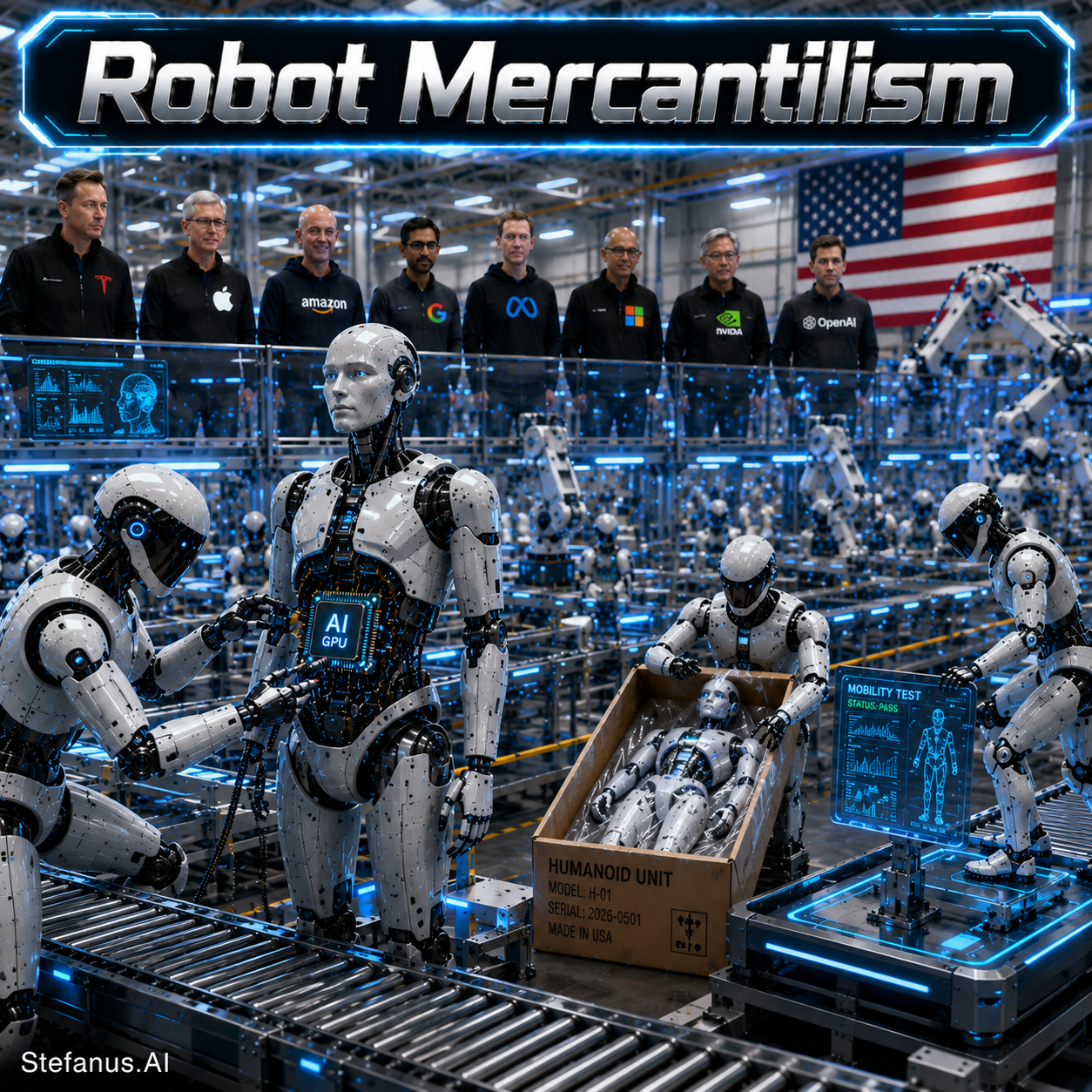

Introduction: The Arrival of Embodied Intelligence
For the past several years, the central conversation in artificial intelligence was dominated by invisible infrastructure. The debates that consumed global attention revolved around large language models, GPU shortages, hyperscale datacenters, electricity bottlenecks, chip export controls, and the extraordinary spectacle of trillion-dollar AI capital expenditure announcements. Intelligence, in this era, was understood as fundamentally disembodied — a phenomenon of servers, latency, and software weights.
In 2026, AI began leaving the screen. It began walking.
Tesla confirmed that its Optimus humanoid production line at Fremont, California — built directly on top of the retired Model S and Model X manufacturing floor — would commence volume output in late July or August of 2026. In Beijing, a humanoid robot crossed the finish line of a half-marathon on April 19, 2026, not as a curiosity but as a programmed demonstration of mechanical endurance at public scale.1 In South Carolina, a Figure AI robot called Figure 02 had already completed eleven consecutive months on the BMW Spartanburg production floor, contributing to the assembly of more than 30,000 BMW X3 vehicles across 1,250 operational hours.5
In Japan, airports integrated logistics automation at scale. In Chinese EV factories, fleets of Unitree robots conducted synchronized material-handling tasks in what state media described as the world’s first multi-humanoid collaboration across multiple industrial scenarios. In Austin, Texas, Apptronik raised more than $935 million in Series A capital and declared, without ambiguity, that its explicit strategic objective was to beat Chinese humanoid robots to market.9
These events, taken individually, are milestones. Taken together, they represent something categorically larger: the emergence of a new industrial order, one in which artificial intelligence is no longer merely cognitive infrastructure but is becoming physical industrial labor. The software moment of AI is giving way, decisively and perhaps irreversibly, to the hardware moment. With that transition comes a new set of strategic imperatives — geopolitical, economic, and military — that neither governments nor corporations can afford to misread.

Defining Robot Mercantilism
This paper proposes a new analytical framework to describe what is happening: Robot Mercantilism.
Robot Mercantilism is the strategic competition among nations to secure dominance in embodied AI manufacturing, supply chains, deployment capacity, and industrial robotics infrastructure as instruments of economic power, geopolitical leverage, and national security. It is, in essence, the application of the oldest logic of great-power economics — that physical productive capacity is strategic power — to the newest and most consequential technology in human history.
The analogy to classical mercantilism is deliberate and precise. The mercantilist states of the sixteenth through eighteenth centuries did not compete merely over trade volumes. They competed over the physical apparatus of production: shipbuilding capacity, naval routes, colonial manufacturing monopolies, and the control of industrial output. The British East India Company was not simply a commercial enterprise — it was a projection of industrial and logistical power that redefined the balance of global influence for two centuries. What made mercantilism powerful was not the accumulation of wealth alone, but control of the physical means by which wealth was created and sustained.
The 21st-century equivalent is now taking shape around a different set of physical assets: semiconductor fabrication capacity, electric motor actuators, precision mechanical components, battery supply chains, sensor arrays, machine vision systems, and the embodied intelligence platforms — humanoid robots — that integrate all of these inputs into autonomous physical labor. The nations and corporations that control this stack will not merely be economically advantaged. They will hold the physical means of future industrial production.
This paper proceeds through eight sections, tracing the key players in embodied AI manufacturing, examining Tesla’s industrial pivot, analyzing China’s structural manufacturing advantages, assessing America’s reindustrialization opportunity, mapping the new supply chain wars, confronting the military crossover from industrial to battlefield robotics, engaging seriously with the political economy of labor displacement, and proposing a four-pillar strategic framework for national competition. The argument culminates in a proposition: that just as compute was the first great strategic resource of the AI age, physical robotic labor is emerging as the second — and the race to control it has already begun.

Section 1: The Key Players in Embodied AI Manufacturing
The embodied AI manufacturing landscape of 2026 is not a monolithic contest between two superpowers. It is a complex, multi-actor ecosystem populated by companies whose technical approaches, capital structures, deployment philosophies, and national contexts differ substantially. Understanding the competitive terrain requires treating each major player on its own terms, because the strategies that will determine sector leadership are not yet converged.
1.1 Tesla Optimus: The Industrial Pivot
Tesla’s Q1 2026 shareholder update, filed with the Securities and Exchange Commission on April 22, 2026, confirmed what had been building beneath the surface of the company’s automotive identity for years: Tesla is undergoing a structural transformation into a robot company.1
The Q1 2026 report disclosed that Tesla had produced ‘several hundred’ Optimus units during the quarter, primarily deployed at Fremont and Giga Texas for internal training-data generation rather than productive commercial work. More significantly, preparations for Tesla’s first large-scale Optimus factory — the converted Model S and Model X production line at Fremont, designed for an eventual annual capacity of one million robots per year — would begin in Q2 2026. A second, higher-volume Optimus factory at Gigafactory Texas is being designed for long-term annual production capacity of ten million robots.12
The company simultaneously confirmed $25 billion in capital expenditure guidance for 2026, covering AI training infrastructure, chip design, the Austin semiconductor research fabrication facility, and the Cybercab and Optimus production ramps. In April 2026, Tesla completed the final chip design of its next-generation AI5 inference processor, and its partnership with SpaceX aims to build what it describes as the largest chip fabrication facility ever constructed, vertically integrating logic, memory, and advanced packaging.4
“It is literally impossible to predict the production rate this year given Optimus has 10,000 unique parts across an entirely new production line. Initial skills for the robots will be simple skills in the factory, and we will build up from there.”
— Elon Musk, Tesla Q1 2026 Earnings Call, April 22, 2026
Tesla’s thesis is compelling in its structural logic. The company spent more than a decade learning to manufacture at scale in one of the most demanding engineering environments on the planet: battery-electric vehicles. The manufacturing expertise, the vertical integration instincts, the real-world reinforcement learning pipelines developed for Full Self-Driving software, the Dojo training supercomputer, the enormous global fleet generating continuous data — all of these represent transferable assets for the Optimus program that no pure-play robotics startup can replicate. Tesla is not entering robotics as a newcomer. It is entering robotics as a company that spent years unknowingly training itself for exactly this challenge.
The question that hangs over the program is whether Musk’s January 2025 prediction of 10,000 Optimus robots doing useful work that year — a prediction he was forced to walk back entirely by January 2026, with zero robots performing useful work — signals a pattern of systematic overconfidence or the inherently nonlinear learning curve of a genuinely unprecedented manufacturing challenge. The honest answer is probably both.3
1.2 Figure AI: Silicon Valley’s Challenger
In November 2025, Figure AI published the results of what has since become the most carefully studied humanoid robot deployment in industrial history: an eleven-month production run of its Figure 02 robot at BMW Group Plant Spartanburg in South Carolina.5
The data is precise and striking. Figure 02 worked five days a week in ten-hour shifts. Over the deployment, it loaded more than 90,000 sheet-metal parts for welding, logged approximately 1,250 operating hours, covered roughly 1.2 million steps, and contributed directly to the production of more than 30,000 BMW X3 vehicles. It achieved greater than 99% placement accuracy per shift and met 84-second cycle-time targets with consistent reliability.7
Figure AI reached a $39 billion post-money valuation in September 2025 following a Series C funding round exceeding $1 billion in commitments, with participation from NVIDIA, Intel Capital, Microsoft, OpenAI Startup Fund, and Brookfield Asset Management. Total funding across all rounds stands at approximately $1.9 billion. The company’s pricing model — approximately $1,000 per robot per month under a Robot-as-a-Service subscription — deliberately converts capital expenditure into operating expenditure to lower enterprise adoption friction.6
With Figure 02 officially retired and Figure 03 entering operational readiness, BMW confirmed in February 2026 that it is expanding humanoid deployments to Plant Leipzig in Germany — the first time Physical AI of this kind has entered a European automotive production environment.8
1.3 Agility Robotics: The Logistics Specialist
Agility Robotics and its Digit platform represent a deliberate strategic logic: deep specialization in warehouse and logistics environments rather than general-purpose manufacturing ambition. Digit began testing at Amazon facilities in 2023, handling tote recycling and material flow tasks, and was formally deployed at a GXO Logistics facility in Atlanta in 2024 — among the first paid commercial humanoid robot deployments anywhere in the world.
Agility’s approach reflects a conscious reduction of scope in the service of reliability. Rather than competing for the most general capabilities, Digit is engineered to master a specific class of tasks in structured warehouses with defined workflows. In 2026, Agility signed a deployment agreement with Toyota Motor Manufacturing Canada following a successful year-long pilot, and Schaeffler AG made a minority investment with plans to deploy Digit robots across its global plant network.
1.4 Apptronik: The NASA-Lineage Industrial Platform
Apptronik’s Apollo carries a distinctive provenance: the company emerged from the Human Centered Robotics Lab at the University of Texas at Austin, and its engineering heritage traces directly to NASA’s Valkyrie robot, developed for extraterrestrial surface operations.9
In February 2026, Apptronik closed more than $520 million in additional Series A funding, bringing the total round to over $935 million and total capital raised to nearly $1 billion. Investors include Google, Mercedes-Benz, B Capital, AT&T Ventures, John Deere, and the Qatar Investment Authority — a roster reflecting both broad industrial interest and the geopolitical undertones of sovereign-wealth participation in robotics infrastructure.9
“We intend to beat Chinese humanoids to market. That is the explicit competitive objective that guides our capital deployment decisions.”
— Jeff Cardenas, CEO, Apptronik, 2026
Apollo’s modular architecture — the robot’s torso can be mounted on bipedal legs, a wheeled base, or a stationary platform using the same core unit — is a deliberate hedge against the unsettled question of which mobility form factor will prove optimal for different factory environments.10
1.5 Unitree: China’s Cost-Disrupting Challenger
Unitree Robotics has, in a remarkably compressed timeline, transformed from a nimble quadruped platform into a full-spectrum humanoid competitor that is reshaping global pricing expectations for the entire sector.13
In March 2026, Unitree filed for a $610 million IPO on the Shanghai Star Market. The 363-page prospectus revealed a company in structural transition: humanoids accounted for 51.5% of Unitree’s core revenue in 2025, compared to just 1.9% in 2023. The average unit price fell from approximately 593,400 yuan ($85,000) in 2023 to 167,600 yuan (approximately $25,000) in 2025 — a compression of more than 70% in two years — while gross margin simultaneously improved to nearly 60%, because Unitree self-develops and manufactures its core components.13
The Unitree H2, the flagship humanoid as of 2026, is positioned below $30,000. That price point — less than the down payment on a luxury automobile — represents a fundamentally different theory of market development than what most American and European robotics companies are currently pursuing.14
1.6 China’s National Champions: An Ecosystem, Not a Company
The single most important analytical error that Western observers make about China’s robotics sector is treating it as if it were populated by discrete competitors analogous to American startups. It is not. China’s humanoid robotics sector is an ecosystem — state-directed, policy-supported, supply-chain-integrated, and operating at a density of capital and engineering talent that has no Western parallel.11
UBTech Robotics, the sector’s most commercially mature Chinese player, reported total 2025 revenue of 2.001 billion yuan — up 53.3% year-on-year. Its full-size industrial humanoid robot segment generated 820 million yuan in revenue, representing a year-on-year surge of more than twenty times. Unit sales of 1,079 industrial humanoid robots made UBTech the first company in the world to deliver more than one thousand industrial humanoid robots in a single year. Deployments span automotive manufacturing, smart logistics, 3C electronics, semiconductor fabrication, and aerospace components.12
Beyond UBTech and Unitree, the ecosystem includes Fourier Intelligence, AgiBot, Galaxy General, Zhiyuan Robotics, and at least fifteen Chinese automakers — including GAC, SAIC, XPeng, Chery, and Xiaomi — that entered humanoid robotics in 2025, leveraging existing supply chains for motors, batteries, and control systems. BYD has already deployed Unitree robots in its production facilities.15
At the end of 2025, China’s Ministry of Industry and Information Technology established a Humanoid Robotics and Embodied Intelligence Standardization Technical Committee. In early 2026, China released its first comprehensive Humanoid Robotics and Embodied Intelligence Standard System, covering the full lifecycle and supply chain — a state action with no equivalent in the United States or Europe.12
1.7 Foxconn: Industrial Embodiment at Scale
No analysis of embodied AI manufacturing is complete without Foxconn, because Foxconn represents something that all humanoid robotics companies are still aspiring to: the demonstrated ability to manufacture extraordinarily complex electronic products at extraordinary scale, with extraordinary precision, in an environment of genuine cost competition.
Foxconn’s ongoing automation transformation — the progressive replacement of its massive human workforce with robotic systems across its global manufacturing facilities — is not merely a corporate efficiency exercise. It is a live laboratory for the question the entire robotics sector is trying to answer: can robotic systems achieve the throughput, flexibility, and cost economics of disciplined human labor in genuine mass-manufacturing contexts? Foxconn’s lessons, drawn from decades of assembling every iPhone Apple has ever sold, represent an industrial wisdom that the emerging humanoid robotics sector will eventually have to absorb or fail.

Section 2: Tesla and the Industrial Pivot from Cars to Robots
To understand what Tesla is attempting with Optimus, it is essential to resist the temptation to evaluate it through the lens of conventional automotive analysis. Tesla is not building a robot as a product extension of a car company. Tesla is using the car company as the industrial university in which it learned everything it will need to build robots at civilizational scale.
The evolutionary arc is both deliberate and coherent. Tesla began as an electric vehicle company, became an AI autonomy company through the relentless development of Full Self-Driving software, is now becoming a robotics company through the Optimus program, and its ultimate destination — if Musk’s vision is taken seriously, and the Q1 2026 capital commitments suggest it must be — is a company that manufactures autonomous physical labor at a scale that dwarfs anything in the automotive industry’s history.
The strategic logic rests on several structural assets. First, Tesla’s FSD software represents one of the most sophisticated real-world reinforcement learning systems ever built, trained on billions of miles of human driving data to parse complex, unstructured environments and make split-second physical decisions. The same architectural logic — collect real-world sensory data, train neural networks to act appropriately in physical space, deploy improved models continuously — is the core technical challenge of general-purpose robotics. Tesla did not need to learn this methodology for Optimus. It spent a decade perfecting it for FSD.
Second, the Dojo supercomputer provides compute capacity for exactly this kind of continuous data-driven improvement. As Optimus units accumulate operational hours, the data they generate feeds back into improved models, pushed to the fleet over the air. The network effect of scale — more robots generating more data generating better models enabling more capable robots — is the same dynamic that has made FSD progressively more capable over time.
Third, Tesla’s manufacturing expertise — its hard-won knowledge of how to design for manufacturability, manage supply chains for complex electromechanical systems, and build production lines that can scale — is directly applicable to robot production. The conversion of the Fremont Model S/X line to Optimus production is not incidental. It is a deliberate transfer of institutional manufacturing knowledge from one product to another.2
The Q1 2026 shareholder update is explicit about the scale of ambition: the first Optimus production line at Fremont is designed for one million robots per year; the second line at Giga Texas for ten million robots per year. For context, the global automotive industry currently produces approximately 85 million vehicles annually — a figure that took more than a century to reach.1
The caveat that must be maintained throughout any analysis of Tesla’s robotics ambitions is the pattern of timeline claims. In January 2025, Musk predicted roughly 10,000 Optimus robots doing useful work in Tesla’s factories by year’s end. By January 2026, he acknowledged that zero were performing useful work. By Q1 2026, ‘several hundred’ units had been produced, primarily for training-data generation. Production targets for 2026 were declined entirely.23
This is not a minor discrepancy. It is a reminder that between a compelling strategic vision and a functioning mass-manufacturing operation lies an enormous body of unglamorous engineering work. The 10,000 unique parts that comprise an Optimus robot represent 10,000 supply chain relationships, 10,000 tolerance specifications, and 10,000 opportunities for cascading delays. History suggests Musk’s timelines should be discounted substantially — while his ultimate strategic directions tend, eventually, to prove correct.

Section 3: China’s Manufacturing Advantage in Embodied AI
There is a structural argument about China’s position in the embodied AI manufacturing race that tends to get lost in the noise of product announcements and competitive valuations. The argument is not primarily about which Chinese company has the most impressive humanoid demonstration. It is about the depth and density of the industrial ecosystem within which Chinese robotics companies operate — an ecosystem that their American and European competitors, however well-funded, cannot replicate through capital alone.
3.1 Industrial Scale and Manufacturing Density
China is the world’s largest manufacturer by virtually every measure that matters to robotics production. It is the world’s largest producer of electric motors, lithium-ion batteries, and precision machined components, and the world’s largest installer of industrial robots — a fact confirmed by the Stanford HAI 2026 AI Index, which notes that China leads the world in industrial robot installations while the United States leads in AI model production and high-impact AI patents.2324
The density of this manufacturing infrastructure creates advantages for Chinese robotics companies that are difficult to overstate. When a Chinese humanoid company needs actuators, it often sources them from suppliers in the same industrial park. When it needs battery cells, China’s domestic battery supply chain — dominated by CATL and BYD — is the most competitive and technically advanced in the world. This proximity advantage compounds into cost advantage. Unitree’s ability to price its H2 below $30,000 while maintaining gross margins approaching 60% is primarily a function of supply chain proximity, vertical integration of key components, and manufacturing scale.13
3.2 Public Demonstrations as Strategic Signaling
The Beijing E-Town Humanoid Robot Half Marathon, held on April 19, 2026, was not purely a technical demonstration. It was a deliberate act of strategic communication — the Chinese state’s way of announcing, to domestic and international audiences simultaneously, that its humanoid robotics sector had achieved a level of mechanical sophistication sufficient to sustain bipedal locomotion across 13.1 miles of competitive urban terrain.
This pattern of public demonstration as strategic signaling has deep roots in Chinese industrial policy. The 2023 Ministry of Industry and Information Technology guidelines calling for humanoid robot production at scale by 2025, followed by the 2025 establishment of the Humanoid Robotics and Embodied Intelligence Standardization Technical Committee, followed by the 2026 release of China’s comprehensive Humanoid Robotics Standard System — this is a state marshaling its full institutional apparatus behind a technology sector, in the way it previously did for solar panels, electric vehicles, and high-speed rail.1215
3.3 The Cost Advantage and Its Implications
The most consequential near-term competitive dynamic in the global robotics market is price compression, and China is driving it. In 2023, the average price of a Unitree humanoid robot was approximately $85,000. By 2025, it had fallen to approximately $25,000. Manufacturing costs across the humanoid robotics sector fell 40% between 2023 and 2024 alone, according to Goldman Sachs data. Bank of America projects that unit costs will fall below $17,000 by 2030.717
The strategic implication is stark: the United States currently leads in AI model development and inference capability — the cognitive layer of embodied intelligence. China may come to lead in embodied production — the physical manufacturing layer that determines how many robots get built, at what cost, and with what supply chain resilience. A world in which American software runs on Chinese-manufactured robot bodies is a world in which the physical industrial leverage belongs to Beijing.
“A true ChatGPT moment for the sector will come when robots, placed in unfamiliar real-world settings, can complete about 80 percent of tasks simply by following voice or text instructions. The direction is clear. The critical breakthrough has yet to arrive — but the gap is closing faster than the outside world understands.”
— Wang Xingxing, Founder and CEO, Unitree Robotics, Hongqiao International Economic Forum, 2025

Section 4: American Reindustrialization Through Robotics
The United States has, for decades, confronted a structural paradox: it is the world’s most advanced technological economy, yet it has progressively hollowed out the manufacturing base that historically provided both economic resilience and the industrial knowledge embedded in physical production. The trade deficits, the deindustrialized communities, the reliance on foreign supply chains for critical components — all are expressions of the same underlying reality: America exited manufacturing too completely and too fast, in pursuit of a service-economy theory that proved more fragile than its architects anticipated.
Robotics offers a historically unusual opportunity to address this paradox. The argument for American reindustrialization through robotics is not romantic — it does not pretend that displaced autoworkers will simply retrain as robotics technicians overnight. It is strategic: robots can perform dangerous, repetitive, and physically demanding manufacturing tasks that American workers are increasingly unwilling or unable to perform, at a cost structure that is becoming genuinely competitive with offshore human labor, in facilities that can be located domestically.
4.1 The Labor Shortage as Strategic Opening
The World Economic Forum’s Future of Jobs Report 2025 projects that 170 million new jobs will be created globally over the next five years while 92 million are displaced — a structural labor market churn of 22% across 1.2 billion formal jobs. The net employment picture is positive, with a projected 7% increase. But the distribution matters enormously: labor shortages in manufacturing, logistics, and care sectors in advanced economies are severe, persistent, and structural.21
The United States faces demographic realities that compound this shortage. An aging workforce, declining birth rates, immigration constraints, and the physical demands of manufacturing work are conspiring to make human labor in certain industrial categories increasingly scarce even as demand for industrial output grows. Pharmaceutical manufacturing requires extreme precision and contamination control. Semiconductor fabrication demands tolerances measured in nanometers. Aerospace assembly involves components too heavy for unassisted human handling. Nuclear facility maintenance exposes workers to radiation hazards. These are environments where robotic capability is not merely economically attractive — it is becoming operationally necessary.
4.2 The Reshoring Imperative
The COVID-19 pandemic, the semiconductor shortage of 2021 through 2023, and the supply chain disruptions catalyzed by the Russia-Ukraine conflict have collectively demonstrated, in ways that economic theory alone could not, that extended supply chains carry genuine strategic risks. The political consensus in the United States has shifted decisively toward domestic manufacturing as a national security priority — expressed in the CHIPS and Science Act, the Inflation Reduction Act, and successive rounds of tariff measures directed at Chinese manufactured goods.
Robotics fits into this reshoring story in a specific and important way. The cost argument for offshore manufacturing has always rested on the differential between American and foreign labor costs. As humanoid robots become capable of performing an expanding range of manufacturing tasks at declining unit costs, that differential compresses. A robot manufacturing facility in Ohio or North Carolina does not benefit from Chinese wages — but neither does its Chinese competitor. The playing field shifts from labor-cost arbitrage to capital-intensity competition, technology access, and energy cost — dimensions on which the United States is far more competitive.
Goldman Sachs Research’s base case projects more than 250,000 humanoid robot shipments in 2030, almost all for industrial use. Morgan Stanley estimates the humanoid market could reach $5 trillion by 2050, by which point China is projected to operate 302.3 million humanoid robots and the United States 77.7 million — a ratio that, if it materializes, would represent a profound reshaping of global manufacturing capacity.1718

Section 5: The New Supply Chain Wars
The geopolitics of the AI age were initially understood as a contest over compute — over the fabrication of leading-edge semiconductors, the allocation of GPU capacity, the control of advanced packaging technologies, and the export-control regimes that determine which nations can access the most capable chips. What is now becoming clear is that embodied AI inherits these semiconductor geopolitics entirely, and then adds an entirely new layer of physical supply chain complexity on top of them.
A humanoid robot is, at its core, a mobile AI inference platform encased in a precision-engineered electromechanical body. It requires high-performance chips for motion control, perception, and decision-making — making it directly exposed to every tension in the global semiconductor supply chain. But it also requires electric motors and actuators, force torque sensors, harmonic gear drives, high-density lithium-ion batteries, machine vision cameras, and a vast array of precision mechanical components that the semiconductor industry’s supply chain map does not capture.
5.1 Semiconductors and the Inference Stack
NVIDIA remains the dominant AI chip supplier for robotics applications, and the Q1 2026 Tesla earnings call made explicit that Tesla’s escalating AI compute investments are a direct boost to NVIDIA’s outlook. The Stanford HAI 2026 AI Index confirms that a single company, TSMC, fabricates almost every leading AI chip, making the global AI hardware supply chain dependent on one foundry in Taiwan — though a TSMC-U.S. fab expansion began operations in 2025, providing a partial domestic alternative.2328
The inference economics of humanoid robots are distinct from those of cloud AI. A robot operating in a factory cannot route every decision through a remote data center with the latency that would imply. Edge inference — fast, low-power, on-device AI processing — is a critical technical capability, and it requires chips optimized for exactly this use case. Tesla’s development of its own AI5 inference processor, and its ambition to build its own chip fabrication capacity, reflect the recognition that strategic dependence on external chip suppliers creates both cost and resilience risks.1
5.2 Actuators, Motors, and the Physical Control Stack
The supply chain for humanoid robot actuators — the devices that convert electrical energy into controlled mechanical motion — is currently dominated by Asian manufacturers, most of them in China. High-performance harmonic gear drives, brushless DC motors, and force-controlled actuator systems are the physical intelligence of a humanoid robot: they are what allow the machine to exert precisely calibrated forces, maintain balance, and handle objects delicately enough to be useful alongside humans.
The World Economic Forum’s analysis of the humanoid supply chain notes that key components including semiconductors, rare-earth materials, and high-precision gear systems rely on geographically concentrated production networks, exposing the industry to geopolitical and trade risks.19
China’s dominance in rare-earth element production is a foundational structural advantage. Electric motors depend on neodymium magnets made from rare-earth elements that China produces in overwhelming global proportion. A humanoid robot supply chain that routes through Chinese rare-earth producers carries Chinese geopolitical leverage embedded within it, regardless of where final assembly occurs.
5.3 Batteries and Energy Density
The battery is the energy constraint that ultimately determines a humanoid robot’s operational utility. Current humanoid robots typically offer two to four hours of operational duration on a charge — a significant limitation for 10-hour manufacturing shifts. Every major robotics company is working against this constraint, and the solutions all ultimately depend on advances in battery cell chemistry that are themselves concentrated in Asian supply chains.
The automotive industry’s hard-won battery supply chain expertise — the same expertise Tesla, BYD, and CATL have developed through electric vehicle production — is now becoming a direct competitive input in the robotics manufacturing race. Companies with established battery supply chains and engineering depth in energy density optimization have a structural advantage that purely software-focused robotics startups lack.

Section 6: Military Crossover — From Industrial Robots to Battlefield Systems
The line between industrial robotics and military robotics is thinner than most civilian analysts appreciate, and it is growing thinner with every advance in embodied AI capability. The same technologies that allow a humanoid robot to navigate a crowded factory floor, manipulate components with precision, and adapt to unexpected obstacles in real time are also, with varying degrees of modification, the technologies that enable autonomous military logistics, perimeter security, mine clearance, and remote presence in denied environments.
6.1 The Hegseth Directive and the Defense Pivot
In July 2025, U.S. Defense Secretary Pete Hegseth issued a landmark memorandum directing all service branches to accelerate the acquisition and fielding of drone and robotic systems. The memo specifically called for the establishment of dedicated robotic units within each service branch by FY2027, the streamlining of procurement pathways for commercial off-the-shelf robotic platforms, a 40% increase in funding for human-machine teaming research, and the creation of interoperability standards so robots from different manufacturers can operate within the same tactical network.26
This directive represents a fundamental institutional shift: robotics moved from ‘innovation experiment’ within the U.S. defense apparatus to core force structure planning. Global defense spending on unmanned and robotic systems is projected to exceed $30 billion annually by 2027, driven by labor shortages in volunteer militaries, the lethality lessons of the Ukraine conflict, and rapid advances in AI-powered autonomy.26
6.2 The Pentagon’s Humanoid Robot Bet
In May 2026, the Pentagon awarded a $24 million contract to Foundation Future Industries for its Phantom MK-1 humanoid robot — a 5-foot-9, 176-pound bipedal platform priced at approximately $150,000 per unit, designed for breach operations, high-risk facility entry, and military logistics in contested environments. The Phantom MK-1 walks at 1.7 metres per second, carries a 44-pound payload, runs on eight cameras without LiDAR, and uses proprietary cycloidal actuators delivering up to 160 newton-metres of torque.25
The strategic logic of the Pentagon contract is inseparable from China competition. China has showcased quadruped robots equipped with firearms for tactical infiltration scenarios. The United States is responding with bipedal platforms capable of operating in human-built environments — buildings, vehicles, tunnels — that wheeled or tracked systems cannot access. Defense technology venture capital hit a record $49.1 billion in 2025, nearly double the prior year.25
6.3 The Ukraine Laboratory
No conflict has done more to validate and pressure-test military robotics doctrine than the war in Ukraine. The battlefield has become a live laboratory for unmanned systems, with drone warfare evolving at a pace that has forced every major military to reassess its assumptions about the future of contested ground operations. The lesson that military observers consistently extract is that expendable, autonomous, networked systems are reshaping the cost calculus of warfare in ways that favor nations capable of manufacturing them at volume and rapidly iterating their designs.
The military robots currently proving most effective in operational environments are predominantly wheeled, tracked, or quadruped — not bipedal humanoids. They succeed because they are mechanically simple, low-cost relative to crewed systems, and expendable. A bipedal humanoid that costs $150,000 and that current technology cannot yet guarantee will remain upright on uneven terrain is not competitive with a $3,000 quadruped carrying the same sensor payload. But the technology is advancing, and the institutional momentum now attached to humanoid military robotics — backed by Pentagon contracts and record defense venture capital — suggests that the competitive window between current limitation and future operational relevance is shorter than skeptics expect.26

Section 7: Global Labor Displacement and the Political Economy of Human Replacement
Any intellectually serious treatment of robot mercantilism must confront the political economy of what it implies for human labor. This is not a matter of technological optimism or pessimism — it is a matter of distributional reality, institutional capacity, and political legitimacy. The arrival of physical AI labor into manufacturing, logistics, warehousing, and eventually care and service sectors will not produce a uniform outcome across populations, regions, or skill levels. It will produce winners and losers, and the geography of that distribution will be politically consequential.
7.1 What the Research Actually Shows
The World Bank’s June 2025 report, Future Jobs: Robots, Artificial Intelligence, and Digital Platforms in East Asia and Pacific, provides one of the most rigorous recent empirical accounts of automation’s labor market effects. Its central finding is counterintuitive to the doomism narrative: between 2018 and 2022, industrial robot adoption created approximately 2 million new jobs for skilled workers while displacing approximately 1.4 million low-skilled workers in routine and manual roles — a net positive in employment terms, though with significant distributional consequences.20
“Today’s innovations, from AI to robotics, can enhance productivity and create better jobs. Realizing these benefits will require a skilled workforce, competitive markets, and policies to mitigate transition costs.”
— Manuela V. Ferro, World Bank Vice President for East Asia and Pacific, Future Jobs Report, June 2025
The World Economic Forum’s Future of Jobs Report 2025 projects that over the next five years, 170 million new jobs will be created globally and 92 million displaced, for a net employment increase of approximately 78 million. The structural churn — 22% of the formal jobs in the study dataset being substantially transformed — is the more operationally significant figure.21
The IMF’s 2026 Staff Discussion Note on New Jobs Creation in the AI Age acknowledges that while AI and automation may create opportunities — particularly for workers who develop and manage technology — they carry displacement risks that fall disproportionately on young workers and workers in occupations with high automation exposure and low complementarity to AI systems.22
7.2 The Distributional Fracture
The most concerning dimension of robot-driven labor displacement is not the aggregate job count — the historical record is reasonably optimistic about net employment over time. It is the distributional fracture: productivity gains from automation accrue primarily to capital owners and highly skilled workers, while displacement costs fall disproportionately on lower-skilled workers, older workers, and workers in geographically concentrated industries with limited alternative employment options.
Oxford Economics has projected that as many as 20 million manufacturing jobs could be replaced globally by 2030. Research from MIT and Boston University estimated that AI-driven robotics had replaced approximately 2 million manufacturing workers globally by 2026. The U.S. trucking industry could lose 1.5 million professional driving positions by 2030. U.S. assembly line employment is projected to decline from 2.1 million in 2024 to 1.0 million by 2030.29
These are not abstract statistics. They are communities: the automotive assembly workers in Michigan and Ohio who lack the technical training to transition into robotics maintenance; the warehouse workers in the logistics hubs of Memphis and Columbus whose roles are precisely the structured, repetitive, high-volume material handling that humanoid robots are being designed to master; the long-haul truckers in rural America whose livelihoods depend on a technology regime that autonomous systems are progressively displacing.
7.3 The Policy Imperative
The political economy of robot mercantilism cannot be separated from the domestic policy apparatus required to manage its human consequences. A national industrial strategy that successfully builds domestic humanoid robot manufacturing capacity while failing to provide meaningful transition support for displaced workers is a strategy that will generate the political backlash necessary to undermine itself. The European Union’s Social Taxonomy, the ILO’s calls for social protection floors, and progressive proposals attached to automation taxes all represent early-stage institutional responses to a challenge that will intensify substantially over the next decade.
The nations that will navigate this transition most successfully are those that manage the tension between technological adoption — which generates the productivity gains that make societies richer and more competitive — and distributional equity — which ensures that those productivity gains are broadly shared enough to sustain the social license for continued technological deployment. This is not a technical problem. It is a political one, and it deserves to be treated with corresponding seriousness.

Section 8: Strategic Lessons — How the United States Competes
The United States enters the era of robot mercantilism with a set of genuine strengths and a set of genuine vulnerabilities. Its strengths are concentrated in the cognitive layer of embodied intelligence: AI model development, software architecture, frontier research capacity, and the venture capital infrastructure that can rapidly fund and scale promising companies. Its vulnerabilities are concentrated in the physical layer: manufacturing capacity, supply chain depth, rare-earth access, and the institutional mechanisms for directing national industrial resources toward strategic objectives.
The following four pillars constitute a framework for American competitive strategy in the embodied AI manufacturing race. They are not the only elements of a coherent strategy, but they are the necessary foundations on which any viable strategy must rest.
Pillar 1 — Industrial Sovereignty in Domestic Robot Manufacturing
The United States cannot afford to allow its humanoid robot sector to develop in a pattern that mirrors what happened with solar panels: American invention followed by Chinese manufacturing dominance followed by the collapse of the domestic industry that could have sustained both economic and strategic value. The lesson of photovoltaics — that inventing a technology and manufacturing it at scale are distinct competitive capabilities, and that the latter is where the durable strategic value resides — must be applied proactively rather than retroactively.
Industrial sovereignty in robot manufacturing means creating the conditions under which American companies can manufacture humanoid robots at competitive cost on American soil. This requires investment in domestic actuator manufacturing capacity, domestic motor production, domestic battery cell production for robotics applications, and the workforce training pipelines that can supply the technicians and engineers that production facilities require. The CHIPS and Science Act model — domestic manufacturing incentives paired with research investment — provides a legislative template that should be extended explicitly to humanoid robotics.
Pillar 2 — Supply Chain Security Across the Full Stack
A domestic robot manufacturing strategy that relies on Chinese actuators, Chinese rare-earth permanent magnets, Chinese battery cells, or Chinese precision gear systems is not a domestic robot manufacturing strategy in any strategically meaningful sense. Supply chain security in embodied AI requires the same multi-layered approach that the semiconductor industry has belatedly begun to pursue: domestic production of critical inputs, allied nation sourcing as a secondary tier, and strategic stockpiling of components with the longest lead times and highest concentration risks.
The rare-earth question is particularly urgent. Neodymium magnets are essential to the high-performance permanent-magnet motors that power humanoid robot joints, and China controls approximately 85% of global rare-earth refining capacity. The Mountain Pass mine in California represents the most significant domestic rare-earth production asset in the United States, but processing and refining capacity remains inadequate. Building a domestic rare-earth processing industry is a multi-year, capital-intensive undertaking that must begin well before the humanoid robot market reaches the volumes at which supply chain concentration becomes operationally critical.
Pillar 3 — National Robotics Infrastructure
South Korea leads the world in AI patents per capita. Germany has established robotics centers of excellence within its Fraunhofer network. China has state-backed robotics industrial parks in which supply chains, manufacturing, research, and deployment are co-located in ways that generate enormous efficiency advantages. The United States has world-leading university robotics research programs — at MIT CSAIL, Stanford, Carnegie Mellon, and elsewhere — but lacks the institutional bridge between university research and commercial manufacturing at scale that its competitors have built.23
A National Robotics Infrastructure initiative should establish state-incentivized robot manufacturing clusters in regions with available industrial real estate, workforce training institutions, and infrastructure capacity. It should fund university-to-industry pipelines that can accelerate the commercialization of academic robotics research. It should create a national testbed network — federally supported physical environments where robotic systems can be evaluated in realistic industrial scenarios — that reduces the cost and time required for commercial deployment qualification.
Pillar 4 — Strategic Defense Integration
The dual-use nature of humanoid robotics technology — the same mobility, manipulation, and AI planning capabilities that make a robot valuable in a factory make it potentially valuable in a battlefield — means that civilian and military robotics development are not separate programs. They are expressions of the same underlying technology base, and they should be managed with that integration explicitly in mind.
DARPA has a long history of funding technologies in their early, pre-commercial phase in ways that create foundational capabilities transitioning into both defense programs and commercial industries. The internet, GPS, and advanced materials science all trace significant portions of their development to DARPA investments made before commercial markets existed. The same model — patient, mission-driven funding of foundational robotics capabilities, with explicit pathways for transition to both defense applications and commercial licensure — is the appropriate framework for embodied AI.
The July 2025 Hegseth directive establishing dedicated robotic units within each service branch by FY2027 is a structural commitment that creates institutional demand for domestically manufactured robotic systems. That demand should be coordinated explicitly with the civilian industrial strategy described in the preceding pillars — not managed as a separate defense procurement exercise running parallel to, but disconnected from, the commercial robotics sector.26

Conclusion: Who Controls Embodied Intelligence?
The AI race was never only about software. This observation, which may seem obvious in retrospect, was systematically obscured by the first phase of the AI revolution — the phase of large language models, inference APIs, and the remarkable demonstration that vast quantities of text and computational training could produce systems that appeared, in an unprecedented range of contexts, to be thinking. That phase produced genuine economic and geopolitical disruption. But it was, in a deep structural sense, a disruption of the cognitive layer of the economy: it affected how information was processed, generated, and applied to decision-making.
What is now unfolding is a disruption of the physical layer: of how things are made, how they are moved, and how physical labor is organized and performed. This is a categorically different kind of disruption, because the physical layer of the economy is where the largest proportion of human labor is still concentrated, where the strategic value of manufacturing capacity has historically resided, and where the geopolitical implications of industrial leadership are most directly expressed.
The historical mercantilists understood this. They did not compete over ideas — they competed over ports, fleets, factories, and the physical apparatus of industrial production. The British Empire was not built on better philosophy. It was built on control of the physical means by which the world’s most valuable goods were produced and transported. The East India Company did not conquer markets with superior arguments. It did so with ships, with trade routes, and eventually with armies.
The 21st-century robot mercantilists are competing over a different physical apparatus, but the strategic logic is remarkably similar. Goldman Sachs projects the humanoid robot market reaching $38 billion by 2035. Morgan Stanley projects $5 trillion by 2050. UBS forecasts 300 million humanoid robots in operation globally by 2050, adding $400 billion to global automation revenue. These are not marginal numbers — they represent a restructuring of global industrial capacity at a scale not seen since the original Industrial Revolution.171827
The nations that build the robots will shape the factories. The nations that control the supply chains for embodied intelligence will hold leverage over the physical productive capacity of the global economy. The nations that successfully integrate civilian robotics with defense applications will have advantages in military capability that may prove decisive in the great-power competition already underway.
As of May 2026, the race has a clear structure. The United States leads in the cognitive architecture of embodied intelligence: in AI model quality, in frontier research, in the software systems that allow robots to perceive, reason, and act. China leads in the physical manufacturing infrastructure: in the supply chains, the component economics, the industrial density, and the state-directed deployment capacity that will determine how many robots get built, at what cost, and with what geopolitical footprint. Tesla is attempting the most ambitious vertical integration in the sector’s brief history, betting that automotive-scale manufacturing expertise can be transferred into robotics production at civilizational scale.23
The question of who controls embodied intelligence is not yet settled. It is, in fact, still in its opening moves. But the opening moves matter — because in technology competition, as in chess, early positional advantages tend to compound. The factories that get built first generate the production data. The supply chains that get established first develop the cost advantages. The robots that get deployed first accumulate the operational learning.
If compute was the first great strategic resource of the AI age, physical robotic labor is emerging as the second. The nations that recognize this early, and that act with the institutional seriousness the recognition demands, will be those best positioned to answer the question that will define the next quarter-century of economic and geopolitical history: Who controls embodied intelligence?
The answer is not yet written. But the pen is in motion.

Footnotes
- Tesla, Inc., Q1 2026 Shareholder Update (SEC Form 8-K Exhibit 99.1). April 22, 2026.
https://www.sec.gov/Archives/edgar/data/0001318605/000162828026026551/exhibit991.htm
Primary SEC filing. Discloses Optimus production status, Fremont 1M-robot/year line, Giga Texas 10M-robot/year design, $25B capex guidance, AI5 chip completion, SpaceX chip fab partnership. - Fred Lambert, Electrek, Tesla Optimus Production Fremont — Q1 2026 Earnings Call Coverage. April 22, 2026.
https://electrek.co/2026/04/22/tesla-optimus-production-fremont-model-sx-line/
Earnings call reporting. Direct Musk statements: production starts late July/August; ‘literally impossible to predict’ rate; ‘several hundred’ units produced Q1; Gen 3 reveal delayed; zero robots doing useful work as of Jan 2026. - Tesla, Inc., Q4 2025 Shareholder Update (SEC Form 8-K Exhibit 99.1). January 2026.
https://www.sec.gov/Archives/edgar/data/0001318605/000162828026003837/exhibit991.htm
Primary SEC filing. Discloses Gen 3 unveil planning for Q1 2026, first production line preparation, 1M robots/year planned capacity, six new production lines across vehicles, robots, and energy. - HeyGoTrade / TechCrunch, Tesla Q1 2026 Earnings Recap: Robotaxi & $25B Capex Pivot. April 2026.
https://www.heygotrade.com/en/blog/tesla-q1-2026-earnings-recap/
Covers $25B capex breakdown: AI training infrastructure, chip design, Austin semiconductor research fab, Cybercab and Optimus ramps. Hardware 3 FSD limitation and fleet monetization constraints. - Figure AI, F.02 Contributed to the Production of 30,000 Cars at BMW. November 19, 2025.
https://www.figure.ai/news/production-at-bmw
Official Figure AI deployment report. 11-month BMW Spartanburg run: 90,000+ parts loaded, 1,250 operating hours, 1.2M steps, 30,000 BMW X3 vehicles. >99% placement accuracy. Figure 02 retired; learnings carried into Figure 03. - Sacra Research, Figure AI Company Profile — Funding, Valuation, Business Model. 2025–2026.
https://sacra.com/c/figure-ai/
$39B post-money valuation (September 2025 Series C); investors: NVIDIA, Intel Capital, Microsoft, OpenAI Fund, Brookfield, Bezos Expeditions. Robot-as-a-Service pricing ~$1,000/robot/month. Total raised ~$1.9B. - IIoT World, Physical AI Deployment ROI: BMW’s 30,000-Car Proof. April 13, 2026.
https://www.iiot-world.com/artificial-intelligence-ml/robotics/physical-ai-deployment-roi-humanoid-robots/
Industry data: 40% humanoid manufacturing cost drop 2023–2024 (Goldman Sachs/Deloitte); $4.3B humanoid-specific funding in 2025 (Crunchbase); Bank of America projects unit costs below $17,000 by 2030; 84-second cycle time targets met. - BMW Group Press Office, First Humanoid Robot Introduced in Plant Leipzig. February 27, 2026.
https://www.bmwgroup.com/en/news/general/2026/humanoid-robot-in-leipzig.html
BMW primary source. First Physical AI deployment in a European automotive plant. AEON (Hexagon Robotics) Leipzig pilot; broader test from April 2026; full pilot summer 2026. Built on lessons from Spartanburg Figure AI deployment. - The Robot Report, Apptronik Brings In Another $520M to Ramp Up Apollo Production. February 11, 2026.
https://www.therobotreport.com/apptronik-brings-in-another-520m-to-ramp-up-apollo-production/
$520M Series A-X extension; total $935M+; total capital raised ~$1B. Investors: B Capital, Google, Mercedes-Benz, AT&T Ventures, John Deere, Qatar Investment Authority. NASA Valkyrie heritage; Jabil manufacturing partnership; Google DeepMind Gemini Robotics partnership. - Technerdo, Humanoid Robots in 2026: Market Leaders, Deployments, and What Comes Next. April 2026.
https://www.technerdo.com/blog/humanoid-robots-market-2026
Competitive landscape. Attributes to Jeff Cardenas (Apptronik CEO): explicit strategic objective is to beat Chinese humanoids to market. - Xinhua News Agency, Yearender: China’s Humanoid Robots Step from Spectacle toward Scalable Industrial Reality. December 31, 2025.
https://english.news.cn/20251231/0a082888ab384fcaa572ee7a11ae7d9d/c.html
Chinese state media yearender. Wang Xingxing (Unitree CEO) quote on ‘ChatGPT moment’ threshold. UBTech VP Jiao Jichao on 2026 commercialization imperative. 10,000-unit/year UBTech factory target. - Humanoid.guide, Ubtech and Unitree Financials Highlight China’s Humanoid Shift. April 4, 2026.
https://humanoid.guide/ubtech-and-unitree-financials-highlight-chinas-humanoid-shift/
UBTech 2025 financials: 2.001B yuan revenue (+53.3% YoY); 820M yuan from humanoid robots (20x YoY); 1,079 units delivered — first company globally to deliver 1,000+ industrial humanoids. MIIT Standardization Committee; 2026 Standard System release. - Rest of World, Unitree Files for $610 Million Shanghai IPO. March 31, 2026.
https://restofworld.org/2026/unitree-china-humanoid-robot-shanghai-ipo/
Based on 363-page Unitree IPO prospectus. Humanoids rose from 1.9% of core revenue (2023) to 51.5% (2025). Avg unit price: 593,400 yuan ($85K) in 2023 → 167,600 yuan (~$25K) in 2025. Gross margin improved to ~60%. Self-developed components cited as cost advantage. - The Next Web, China’s Humanoid Robot Boom Faces Reality Check. May 2026.
https://thenextweb.com/news/china-humanoid-robot-boom-commercialisation-reality-check
Unitree H2 below $30,000; UBTech Walker S2 mass production early 2026, orders >800M yuan; Beijing factory targeting 10,000 units/year. Notes gap between production capacity and verified commercial demand. - Articsledge, AI Humanoid Robots 2026: Technology, Builders & Future. January 3, 2026.
https://www.articsledge.com/post/ai-humanoid-robots
15+ Chinese automakers enter humanoid robotics in 2025 (GAC, SAIC, XPeng, Chery, Xiaomi). World’s first multi-humanoid collaboration at Chinese EV factory (People’s Daily, April 2025). MIIT 2023 guidelines. China market projection: $41.3B by 2035. - China Daily, UBTech Secures Large Humanoid Robots Order. September 9, 2025.
https://global.chinadaily.com.cn/a/202509/09/WS68bf7e39a3108622abc9f971.html
Walker series cumulative contracts ~4B yuan. ‘Manufacturing Talent Development Planning Guide’ projects Chinese manufacturing worker shortage by 2025 as demand driver. Guohai Securities: Chinese humanoid market $5B by 2030. - Goldman Sachs Research, The Global Market for Humanoid Robots Could Reach $38 Billion by 2035. 2024.
https://www.goldmansachs.com/insights/articles/the-global-market-for-robots-could-reach-38-billion-by-2035
Base case: 250,000+ humanoid shipments in 2030, predominantly industrial. ~40% high-spec robot cost drop 2022–2023; continued 15–30% annual reductions anticipated. Blue-sky scenario: up to $154B by 2035. - Adam Jonas, Morgan Stanley Research, Humanoid Robot Market Could Reach $5 Trillion by 2050. 2024.
https://www.morganstanley.com/insights/articles/humanoid-robot-market-5-trillion-by-2050
930M humanoid units by 2050, ~90% industrial/commercial. China: 302.3M units; U.S.: 77.7M. Adoption accelerates in late 2030s–2040s. Consumer humanoids more conservative: 80M in homes by 2050. - World Economic Forum, Humanoid Robots Offer Disruption and Promise. June 2025.
https://www.weforum.org/stories/2025/06/humanoid-robots-offer-disruption-and-promise/
WEF supply chain analysis. Semiconductors, rare-earth materials, and high-precision gear systems identified as geographically concentrated strategic exposures. Goldman Sachs $38B 2035 projection cited. - World Bank (Manuela V. Ferro, VP East Asia & Pacific), Future Jobs: Robots, Artificial Intelligence, and Digital Platforms in East Asia and Pacific. June 17, 2025.
https://www.worldbank.org/en/region/eap/publication/future-jobs
Major institutional study. 2018–2022: 1.4M low-skilled workers displaced; 2M new skilled jobs created. Productivity and scale gains largely offset displacement. Ferro quote on skilled workforce and transition cost policies. - World Economic Forum, Future of Jobs Report 2025. January 2025.
https://reports.weforum.org/docs/WEF_Future_of_Jobs_Report_2025.pdf
170M new jobs created and 92M displaced over 2025–2030; 22% structural labor market churn across 1.2B formal jobs; net +78M jobs (+7%). 40% of employers aim to reduce staff by 40% as AI scales. - International Monetary Fund, New Jobs Creation in the AI Age — Staff Discussion Note SDN/2026/001. 2026.
https://www.imf.org/-/media/files/publications/sdn/2026/english/sdnea2026001.pdf
IMF Staff Discussion Note. Young workers disproportionately concentrated in high-automation-exposure, low-AI-complementarity occupations. References Findeisen, Dauth & Schlenker (2025) on retraining and productivity outcomes. Unionized workers show better displacement outcomes. - Stanford Human-Centered AI Institute (HAI), 2026 AI Index Report. April 13, 2026.
https://hai.stanford.edu/ai-index/2026-ai-index-report
Annual benchmark. China leads in industrial robot installations, publication volume, and patent output. U.S. leads in frontier AI models and high-impact patents. South Korea leads in AI patents per capita. TSMC single-foundry risk; TSMC U.S. fab operational in 2025. - Stanford Human-Centered AI Institute (HAI), 2026 AI Index Report — Technical Performance Chapter. April 2026.
https://hai.stanford.edu/ai-index/2026-ai-index-report/technical-performance
DeepSeek-R1 briefly matched top U.S. model (February 2025); Anthropic leads by 2.7% as of March 2026. Top six frontier models within 80 Arena Elo points. SWE-bench Verified rose from 60% to near 100% in one year. - The Next Web, Foundation Future Industries Wins $24M Pentagon Contracts for Humanoid Robot Soldiers. May 2026.
https://thenextweb.com/news/foundation-humanoid-robot-soldiers-pentagon
Phantom MK-1: 5’9″, 176 lbs, ~$150K/unit, 1.7m/s, 44 lb payload, 160 Nm torque. Defense tech VC hit record $49.1B in 2025. Goldman Sachs: 50,000–100,000 humanoids shipped globally in 2026. UN resolution 156–5 on autonomous weapons negotiations. - Robozaps, Humanoid Robots in Military and Defense — 2026 Guide. May 2026.
https://blog.robozaps.com/b/humanoid-robots-in-military-and-defense
July 2025 Hegseth memorandum: dedicated robotic units per service branch by FY2027; COTS procurement streamlining; 40% increase in human-machine teaming research funding; interoperability standards. Global defense unmanned systems spending projected >$30B/year by 2027. - Humanoids Daily, Humanoid Robot Market Forecasts: A Landscape of High Hopes and Wide Disagreement. November 24, 2025.
https://www.humanoidsdaily.com/news/humanoid-robot-market-forecasts-a-landscape-of-high-hopes-and-wide-disagreement
Comparative forecast analysis. Goldman Sachs 40% high-spec cost drop (2022–2023). 2035 total shipment: ~1.4M units. CAGR forecasts range from 7.7% (2023) to 70%+ (2025 projections). Wide disagreement reflects production scaling uncertainty. - IndexBox Market Intelligence, Tesla Q1 2026 Earnings: Revenue Miss, EPS Beat, and Optimus Robot Expansion Boosts Nvidia Outlook. April 2026.
https://www.indexbox.io/blog/teslas-latest-report-and-strategic-shift-what-it-means-for-nvidia/
Analysis of Q1 2026 and NVIDIA supply implications. Confirms AI inference central to Optimus and Robotaxi. $25B capex covers AI training, chip design, Austin fab, Cybercab/Optimus ramps. - DemandSage / Oxford Economics / MIT & Boston University, AI Job Replacement Statistics 2026. January 3, 2026.
https://www.demandsage.com/ai-job-replacement-stats/
Compilation: Oxford Economics — 20M manufacturing jobs replaced by 2030; MIT/Boston University — ~2M replaced by AI-driven robotics by 2026; U.S. assembly line jobs: 2.1M (2024) → 1.0M (2030); U.S. trucking: 1.5M jobs at risk by 2030. - Robozaps, Market Size for Humanoid Robots — 2026 Comprehensive Data. March 22, 2026.
https://blog.robozaps.com/b/market-size-for-humanoid-robots
2025–2026 deployment mix: manufacturing/automotive ~35%, logistics/warehousing ~25%, research ~15%. Price range: $13,500–$150,000. Synthesizes Goldman Sachs, Morgan Stanley, ABI Research, MarketsandMarkets, Fortune Business Insights.

Comments
[…] brain, the world-model bet of AMI Labs and World Labs—is that whoever solves grounded, embodied intelligence and the data pipelines that feed it will define the next platform, and that vertical integration of […]
[…] and, as 2026 demonstrated, sometimes far beyond it. In parallel, civilian industry is deploying remote robotics into environments too hazardous, too distant, or too expensive for human presence: deep-sea […]
[…] The result was that the humanoid robot stopped being a laboratory curiosity and became a manufacturable product. Approximately 16,000 humanoid robots were installed worldwide in 2025, and China accounted for […]