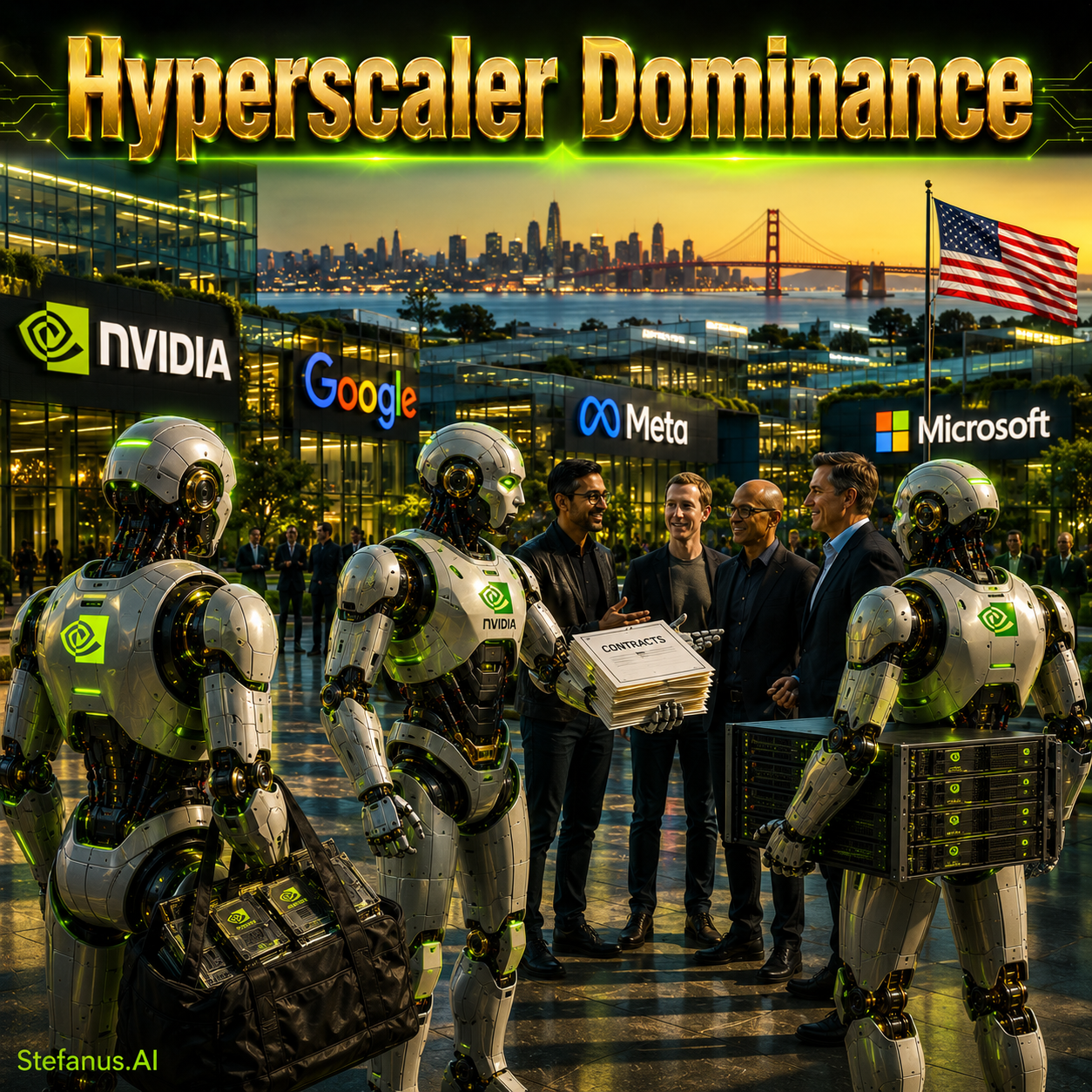

Introduction: The Age of Hyperscaler Dominance
If you survey the world’s top twenty-five largest economies ranked by nominal Gross Domestic Product, the United States stands at the pinnacle — at approximately $32.5 trillion in annual output, it remains the single largest economy on the planet. Yet even against that extraordinary backdrop, an extraordinary comparison now forces itself into view: the combined capital expenditure of the world’s largest technology companies — what this paper calls Hyperscalers — is now projected to approach or exceed $1 trillion in 2026 alone. That figure is equivalent to between three and five percent of the entirety of American GDP in a single calendar year, and it surpasses the total annual economic output of every country ranked below the world’s top twenty.
We are living in a moment that is not only economically extraordinary but historically unprecedented. As the United States prepares to celebrate its 250th Independence Day in the summer of 2026, the sinews of a new kind of power are being woven — not through the authority of elected governments or the armies of nation-states, but through the relentless accumulation of computational infrastructure by a small number of private corporations. This is not merely a story about money, though the money is staggering. It is a story about structural dominance: the capacity of a handful of organizations to determine who may train an artificial intelligence model, who may access planetary-scale computing, who may participate in the emerging digital economy, and on what terms.
This paper introduces and elaborates the concept of Hyperscaler Dominance — a framework for understanding the unprecedented concentration of computational power, energy resources, satellite infrastructure, and AI hardware that has accumulated within a small cluster of American technology companies. The framework examines not only the macroeconomic scale of this phenomenon, but its technological architecture, its geopolitical consequences, its regulatory challenges, and the profound social and environmental costs that are already being borne by communities who have never benefited from the AI revolution but are paying its price with their health, their electricity bills, and their air.
The argument of this paper is direct: Hyperscaler Dominance is not an accident or an emergent property of a neutral market. It is the product of deliberate strategy, enormous capital leverage, decades of technical head start, regulatory arbitrage, and the structural economics of cloud computing — which tend, inexorably, toward concentration. Understanding this dynamic is necessary for any honest reckoning with the digital future.

Section 1: Who Are the Hyperscalers? Definitions, Key Players, and the Scale of Capital
The term hyperscaler entered the technology lexicon as a descriptor for cloud providers capable of expanding their computing infrastructure at enormous scale and speed, deploying hundreds of thousands of servers across global networks of data centers. The canonical list — Amazon Web Services (AWS), Microsoft Azure, and Google Cloud — has long been the triumvirate that commands the landscape. However, this paper adopts a broader and more analytically useful definition, extending the term to encompass any organization that commands capital sufficient to construct and operate planetary-scale digital infrastructure. By this standard, the hyperscaler universe includes: Amazon, Microsoft, Alphabet/Google, Meta, Oracle, and emerging entities such as SpaceX, Tesla, and the newly announced Terafab consortium. Collectively, these entities hold approximately 65% of the world’s cloud computing market share1, effectively functioning as the landlords of the global digital economy.
What distinguishes hyperscalers from other large technology companies is not size alone but the verticality of their integration. They own the physical data centers. They design or procure the AI chips. They operate the global fiber and subsea cable networks. They control the energy supply through long-term power purchase agreements. In some cases, they now own the satellites that carry their data across continents. No previous generation of corporate entities has achieved this degree of control over the complete technological stack — from the raw physics of electricity generation to the software models that shape thought and commerce.
Table 1: Hyperscaler Capital Expenditure — Actuals, Guidance & Projections (USD Billions)
| Company | 2023 Actual | 2024 Actual | 2025 Actual | 2026 Guidance | 2027 Projection | YoY Growth (25→26) |
| Amazon (AWS) | $52.7B | $83.0B | $131.8B | ~$200B | ~$220B+ | +52% |
| Microsoft Azure | $32.3B | $55.7B | $100B+ | ~$120B+ | ~$135B+ | +20% |
| Alphabet (Google) | $32.3B | $52.5B | $91.4B | ~$175–185B | ~$190B+ | +93% |
| Meta | $28.1B | $37.3B | $72.2B | ~$115–135B | ~$140B+ | +68% |
| Oracle | $6.9B | $9.5B | $16B+ | ~$50B | ~$65B+ | +210% |
| BIG-5 TOTAL | $152.3B | $238.0B | $411.4B+ | ~$660–690B | ~$820B | +62% |
Sources: Company earnings filings (SEC), Goldman Sachs Global Investment Research, CreditSights, Futurum Group, Epoch AI, Moody’s Ratings. 2027 figures represent analyst consensus projections.
These figures, staggering as they appear, may still underestimate the true scale of ambition. Goldman Sachs2 projects that combined hyperscaler capital expenditure from 2025 through 2027 alone will reach $1.15 trillion — more than double the $477 billion spent across the entire three-year period of 2022 to 2024. The capital intensity ratios now observed — hyperscalers spending between 45% and 57% of their total revenue on capital expenditures — are ratios previously associated with utility companies and heavy industrial firms, not software businesses. Epoch AI estimates that combined hyperscaler capex has grown at an annualized rate of 72% per year3 since Q2 2023, the quarter immediately following the public release of GPT-4 and the ignition of the generative AI arms race.
1.1 Amazon Web Services (AWS): Cloud Pioneer, Nuclear Patron, and Orbital Operator
Amazon Web Services is not merely the world’s largest cloud provider — it is the template around which the modern cloud industry was architected. Launched in 2006 with a rudimentary set of storage and compute services, AWS has grown into a $107.6 billion annual revenue enterprise4 whose operating income of nearly $40 billion in 2024 makes it the most profitable division within any technology company in the world. Its market dominance — holding approximately 30% of the global cloud infrastructure market5 — reflects two decades of infrastructure investment, developer evangelism, and systematic expansion into every vertical from government to healthcare to financial services.
The scale of Amazon’s current infrastructure ambitions is almost without precedent in peacetime industrial history. In 2025, Amazon announced a $15 billion investment in Northern Indiana6 to construct a new cluster of data center campuses designed to support AI and cloud workloads for enterprise customers. This is not an isolated commitment; Amazon’s total capital expenditure reached $131.8 billion in 2025, with 2026 guidance set at $200 billion. To finance this extraordinary buildout, Amazon returned to bond markets in 2025 with a $12 billion debt offering — one of its largest in recent years.
On the energy frontier, Amazon has executed one of the most consequential infrastructure deals of the decade: a 17-year power purchase agreement with Talen Energy’s Susquehanna nuclear power plant in Pennsylvania, securing 1.92 gigawatts of carbon-free nuclear electricity7 through 2042. Amazon is also investing more than $20 billion in X-energy small modular reactor projects, backing 5 gigawatts of new SMR capacity to be deployed over the coming decade. The ambition is to convert data center campuses into clean-energy anchored AI factories — a radical reimagination of what a technology company looks like.
Perhaps most consequentially for global communications infrastructure, Amazon’s Project Kuiper / Amazon Leo8 satellite constellation has begun full-scale deployment, with the first of more than 80 planned launches commencing in April 2025 using rockets from Arianespace, Blue Origin, SpaceX, and United Launch Alliance. In April 2026, Amazon announced an agreement to acquire Globalstar — the satellite communications company in which Apple holds a 20% stake — in a deal that would give Amazon Leo access to L-band radio frequency spectrum and direct-to-device satellite connectivity capabilities. The integration of Globalstar’s spectrum with Amazon’s constellation represents a fundamental expansion of what AWS can offer: not merely cloud compute, but ubiquitous connectivity for any device on Earth.
Executive Chairman Jeff Bezos’s Blue Origin and related ventures — including Project Sunrise and Terawave communications satellite initiatives — further extend Amazon’s ambitions into space-based infrastructure, blurring the line between cloud provider, telecommunications company, and orbital operator. In Stefanus terms, AWS has ceased to be simply a cloud company; it is becoming a planetary infrastructure enterprise.
1.2 Microsoft Azure: The Columbia River Compact, Three Mile Island, and the OpenAI Alliance
Microsoft’s transformation from a software licensing company into a cloud and AI infrastructure behemoth is one of the most consequential corporate reinventions in technology history. Under the strategic direction of CEO Satya Nadella, Microsoft has deployed Azure across more than 60 announced datacenter regions globally, made a multi-billion-dollar strategic investment in OpenAI that reshaped the competitive landscape of artificial intelligence, and committed to a capital expenditure program that saw the company spend more than $100 billion in fiscal 20259 — with guidance for 2026 tracking toward $120 billion or more. In a single recent quarter alone, Microsoft spent $37.5 billion in capital investment.
Along the Columbia River basin in the Pacific Northwest — a region whose hydroelectric resources have historically attracted data-intensive industries — Microsoft has signed long-term datacenter agreements that leverage the clean energy profile of the region for its Azure infrastructure. This reflects a deliberate strategy: the selection of data center locations is increasingly dictated not by real estate availability or tax incentives alone, but by energy access and the availability of carbon-free electricity.
Perhaps no single energy deal captures Microsoft’s ambition more dramatically than its 20-year Power Purchase Agreement with Constellation Energy to restart Three Mile Island in Pennsylvania10 — the site of America’s most notorious nuclear accident — delivering 835 megawatts of clean baseload power to Microsoft’s data center operations by 2028. This $16 billion contract, signed in late 2024 and confirmed with the appearance of Pennsylvania Governor Josh Shapiro alongside Microsoft and Constellation executives, represents the first restart of a shutdown American nuclear reactor for commercial power generation in decades. The symbolism is extraordinary: the nation’s most cautionary nuclear tale is being resurrected to power the nation’s most ambitious AI infrastructure.
Microsoft’s nuclear strategy extends beyond legacy plant restarts. The company is actively developing a global small modular reactor and microreactor energy strategy, with dedicated program managers tasked with integrating SMR technologies into the power profile of Azure data centers worldwide. In Virginia, Microsoft is already sourcing 24/7 nuclear energy for its Azure cloud regions. The message is consistent: for Microsoft, nuclear energy is not a temporary bridge but a permanent foundation for the compute intensity that modern AI demands.
1.3 Alphabet / Google Cloud: Kairos Power, NextEra, and the Nuclear Data Center Future
Alphabet’s Google Cloud division, with roughly 13% of the global cloud infrastructure market11, is locked in a capital arms race with Amazon and Microsoft that is reshaping the very economics of energy production in the United States. Google has long been a pioneer of corporate renewable energy procurement, but the scale of electricity required by its AI training and inference workloads has pushed the company into the previously uncharted territory of corporate nuclear energy agreements.
In what analysts described as a landmark transaction, Google and Kairos Power12 signed what appears to be the first corporate agreement to develop a fleet of small modular reactors in the United States. The deal covers up to 500 megawatts of nuclear power capacity across six to seven reactors, with the first reactor targeted for 2030 and the full fleet expected to come online through 2035. Google has also partnered with NextEra Energy to restart a nuclear plant in Iowa, further diversifying its clean baseload energy supply. Alphabet’s capital expenditure in 2025 reached $91.4 billion — already well ahead of initial guidance of $75 billion — with 2026 guidance now set at $175 to $185 billion: a 93% year-over-year increase that is among the most dramatic CapEx accelerations in corporate history.
Google’s AI infrastructure ambitions are not merely quantitative but qualitative: the company’s custom Tensor Processing Unit (TPU v7 “Ironwood”) connects 9,216 chips into a single superpod with 9.6 terabits per second of bandwidth — a computing architecture of a density and interconnect speed that no commercially available system can match. This proprietary silicon advantage, combined with Google’s unparalleled data assets and its two-decade investment in global fiber infrastructure, positions Alphabet as both a hyperscaler and a vertically integrated AI chip manufacturer.
1.4 Meta: The 6-Gigawatt Nuclear Handshake, AMD’s $100B Deal, and Personal Superintelligence
Mark Zuckerberg has made no secret of his conviction that the company he founded will be defined, in this decade, by its capacity to deploy artificial intelligence at consumer scale. To that end, Meta has assembled what may be the most aggressive nuclear energy procurement portfolio of any single corporation in history: contracts with Vistra Corp., Oklo, Inc., and TerraPower LLC13 are expected to deliver over 6.6 gigawatts of nuclear power to Meta’s data center operations — enough electricity to supply approximately 5 million homes. This is not a future aspiration; Meta is currently constructing its 1-gigawatt “Prometheus” campus in Ohio, expected to come online in 2026, while a far larger 5-gigawatt “Hyperion” facility in Louisiana is under development with a target completion date of 2028.
On the semiconductor side, in February 2026, Meta executed what industry analysts immediately called the “6-gigawatt handshake”14: a multi-year agreement with Advanced Micro Devices (AMD) to deploy custom Instinct GPU architectures at gigawatt-scale computing power. The first delivery — approximately one gigawatt of custom AMD Instinct MI450-based GPUs optimized for Meta’s AI workloads — is scheduled to begin shipping in the second half of 2026. Unusually, the agreement includes a performance-based warrant for up to 160 million AMD shares, giving Meta potential equity in its chip supplier as milestones are met. Just days before signing the AMD deal, Meta had also announced an expanded multi-year agreement with NVIDIA covering millions of Blackwell and Vera Rubin GPUs.
Meta’s planned 2026 capital expenditure of $115 to $135 billion is supported not only by its approximately $72 billion in 2025 spending, but by what Zuckerberg describes as a vision of “personal superintelligence” — AI systems embedded so deeply into daily digital life, from virtual reality worlds to personal AI assistants, that the infrastructure supporting them becomes as foundational as the electrical grid itself.
1.5 Oracle: Project Stargate, the $300 Billion Cloud Deal, and the AI Cathedral
Of all the hyperscalers, Oracle presents the most dramatic transformation story of the current era. A company whose legacy was built on enterprise database software and on-premise IT infrastructure has, within the space of two years, repositioned itself as the operational backbone of the most ambitious AI infrastructure project in history: Project Stargate.
Announced at the White House alongside President Donald Trump in January 2025, the Stargate project — a joint venture of OpenAI, SoftBank, Oracle, and investment firm MGX — committed to investing $500 billion in American AI infrastructure by 202915, with an initial $100 billion deployed immediately. The project has been compared, in scope and national significance, to the Manhattan Project. Its flagship campus in Abilene, Texas, went live in September 2025, filled with Oracle Cloud Infrastructure and racks of NVIDIA chips.
In July 2025, OpenAI and Oracle entered a specific bilateral agreement to develop up to 4.5 gigawatts of additional Stargate capacity — a partnership that, as reported by the Wall Street Journal and confirmed by Oracle’s own statements, exceeds $300 billion between the two companies over five years16. This contract is among the largest commercial agreements in the history of the technology industry. By April 2026, Stargate had expanded to nearly 7 gigawatts of planned capacity across five states — Texas, New Mexico, Ohio, Michigan, Wisconsin, Wyoming, and Pennsylvania — representing over $400 billion in committed investment over three years.
Oracle CEO Larry Ellison has also disclosed that the company is constructing a gigawatt-scale data center to be powered by three small modular reactors, building permits for which have already been secured. Oracle’s 2026 capital expenditure is projected at $50 billion — a figure that would have been inconceivable for the company as recently as 2022, when it spent less than $7 billion. The phrase being applied to Oracle’s new data center campuses — “the physical soul of AI” — captures something important about the era: these are not warehouses for servers. They are the cathedrals of the computational age.
1.6 Terafab, SpaceX, Tesla, and xAI: Elon Musk’s Parallel Empire
While the canonical hyperscalers have dominated public discourse about AI infrastructure, Elon Musk has quietly — and then very publicly — assembled a parallel empire whose combined capital commitments exceed $120 billion and whose ambitions extend from the Earth’s surface to low Earth orbit and potentially beyond.
In March 2026, Musk unveiled Terafab17: a joint venture between Tesla, SpaceX, and xAI that aims to produce one terawatt of AI computing capacity per year from a semiconductor fabrication facility to be located at Giga Texas in Austin. The scale of the claim is breathtaking — one terawatt of annual compute represents a manufacturing ambition several orders of magnitude beyond any existing chip fabrication facility. On April 7, 2026, Intel announced it would join Terafab as the primary foundry partner18, contributing its 18A process node — currently its most advanced logic manufacturing technology — and its packaging expertise. Intel’s CFO Vaibhav Taneja described the vision as a vertically integrated AI chip production system: “memory, logic, everything in the same place, including mask, because we want to have a quick iteration loop.”
xAI’s Colossus data center facilities in Memphis, Tennessee — discussed at length in Section 5 — represent the current operational face of Musk’s AI infrastructure. SpaceX’s Starlink constellation, with thousands of satellites already in orbit, provides the telecommunications backbone. Tesla’s manufacturing scale and robotics expertise add industrial verticals that no other hyperscaler can claim. And SpaceX is actively developing what Musk has described as a space data center — compute infrastructure in orbit, eliminating latency for satellite-delivered services. The Musk ecosystem is not yet a unified corporation, but its combined computational, aerospace, and energy ambitions make it a hyperscaler by any meaningful definition.

Section 2: Why Hyperscalers Dominate — The Structural Economics of Concentration
To understand Hyperscaler Dominance, one must first understand why the economics of cloud computing tend structurally and inevitably toward concentration. The dynamics at work are not unique to technology; they echo the logic of natural monopolies in railroads, telecommunications, and electricity generation. But in the case of hyperscalers, these dynamics operate across multiple reinforcing dimensions simultaneously, creating a competitive moat that deepens with every passing quarter of investment.
2.1 Economies of Scale and the Capital Barrier
The fundamental economics of hyperscale computing reward size in ways that are not merely advantageous but self-compounding. A hyperscaler deploying $200 billion in capital expenditure in a single year can negotiate chip prices, construction costs, and energy rates that no competitor spending $1 billion — let alone $1 million — can approach. The result is a cost structure so dramatically lower per unit of compute that new entrants find not just competition but existence economically irrational. As Professor Kalpana Tyagi of Maastricht University19 has observed:
“Cloud exhibits certain atypical economic and technical characteristics that work to the advantage of the hyperscalers. These characteristics include path dependence, learning effects, early mover advantage and ecosystem effects in the cloud, which further reinforce the path dependence and learning effects. Additionally, limited data portability, interoperability, low or no ingress but high egress fees, and free cloud credits by the hyperscalers lead to lock-in, raising both switching costs and barriers to entry to the cloud.”
In 2026, each of the Big Five hyperscalers individually exceeds $100 billion in annual capital expenditure. The capital intensity ratio — capex as a percentage of revenue — has risen to 45–57%, levels previously associated only with utility companies, railroads, and oil majors. Amazon’s 2026 capex alone, at $200 billion, exceeds the combined capital expenditure of the entire publicly traded U.S. energy sector.20
2.2 The AI Boom as Structural Accelerant
The release of ChatGPT in November 2022 and GPT-4 in March 2023 did not merely create a new product category. It created a structural reordering of competitive advantage in which the capacity to train and deploy large language models became a primary determinant of corporate value. Because training frontier AI models requires GPU clusters of a density and scale that only hyperscalers can afford to build — a single training run for a frontier model can consume tens of thousands of NVIDIA H100 chips running continuously for months — the hyperscalers became, overnight, the gatekeepers of artificial intelligence itself.
Goldman Sachs observed21 that from the start of both 2024 and 2025, analyst consensus estimates for hyperscaler capex implied approximately 20% annual growth. In reality, capex exceeded 50% in both years. The consistent pattern of underestimation reflects something important: the AI boom is not a temporary surge but a structural shift in the capital requirements of technology. Amazon CEO Andy Jassy articulated the investment logic on CNBC in early 2026:
“We said we were going to spend about $200 billion in capex this year, we have very strong demand signals. The capital we spend in ’26 is for infrastructure that will be put in place 18 to 24 months later. And so, we have very high confidence that we’re going to be able to monetize it.”
2.3 Vertical Integration and Proprietary Hardware
A critical but often underappreciated dimension of Hyperscaler Dominance is the degree to which the major players have moved up the technology stack — from purchasing commodity hardware to designing and manufacturing their own specialized AI chips. Google’s TPU, Amazon’s Trainium and Inferentia, Microsoft’s Maia, and Meta’s MTIA have collectively displaced a significant portion of NVIDIA GPU demand within hyperscaler data centers, delivering cost advantages estimated at 40–65% of total cost of ownership versus merchant chips. This proprietary silicon advantage is self-reinforcing: the data generated by operating at hyperscale trains better models, which attracts more customers, which generates more revenue, which funds more chip development. Economist Cecilia Rikap of University College London22, whose award-winning research on intellectual monopoly capitalism documented this dynamic before the AI era, argues that Big Tech’s real power lies not in its balance sheets but in its control over global knowledge production — a control that the AI revolution has expanded rather than diminished.

Section 3: Infrastructure and Technological Control — Cables, Energy, and Platform Lock-In
The physical infrastructure through which Hyperscaler Dominance is exercised is invisible to most of the world’s population — and therein lies one of its most important characteristics. When a business signs a contract to move its operations to AWS or Azure or Google Cloud, it is not merely choosing a software platform. It is connecting its operations to a global infrastructure of subsea fiber cables, continental data centers, satellite constellations, and energy systems — all of which are owned, operated, or controlled by the hyperscaler. This infrastructure is the material foundation of digital civilization, and it is, in the most literal sense, the infrastructure of power.
3.1 Subsea Cables and Global Network Dominance
The world’s internet traffic travels overwhelmingly through subsea fiber optic cables — approximately 400 of them, carrying roughly 95% of global data. In recent years, hyperscalers have moved aggressively from being users of these cables to being their owners. Google’s Equiano cable links Europe to Africa, its Dunant cable crosses the Atlantic, and its Firmina cable connects the United States to South America. Meta has invested in the 2Africa cable — the world’s longest submarine cable system — and the Marea cable across the Atlantic. Amazon has similarly expanded its network of owned or co-owned subsea cables. This ownership gives hyperscalers not merely bandwidth but routing control: the ability to determine how data moves around the planet and to preferentially route their own traffic in ways that third-party networks cannot match.
3.2 Energy Contracts and the Nuclear Revolution
The energy requirements of hyperscaler AI infrastructure are so enormous that they are reshaping the global electricity industry. Global data center power consumption is projected to expand by 50% to reach approximately 92 gigawatts by 202723, representing a compound annual growth rate of 17% between 2025 and 2028. The International Energy Agency has estimated that data center electricity consumption will grow from 460 terawatt-hours in 2024 to approximately 1,300 terawatt-hours by 2035 — more than tripling within a decade.
To secure this extraordinary power demand, hyperscalers have entered into long-term power purchase agreements that are reorienting the economics of the entire nuclear power industry. The combined nuclear agreements signed by Amazon, Microsoft, Google, and Meta in the 2024–2026 period represent more than 10 gigawatts of new or reactivated nuclear capacity committed by private corporations. The consequences extend far beyond the technology sector: nuclear power plants that were scheduled for retirement are being kept open or restarted; new small modular reactor companies are attracting billions in private capital that regulatory uncertainty had previously kept at bay; and the relationship between utilities and corporate technology customers is being restructured from transactional to strategic and decades-long.
3.3 Platform Lock-In and the Switching Cost Trap
Perhaps the most durable source of Hyperscaler Dominance is what economists call ecosystem lock-in: the accumulated switching costs that make departure from a hyperscaler’s platform progressively more expensive and disruptive the longer an organization has been using it. When an enterprise builds its data architecture, its machine learning pipelines, its developer workflows, and its compliance systems within AWS or Azure, it does not merely consume cloud services — it becomes structurally embedded in that provider’s ecosystem. Migrating to a competitor requires not just technical effort but the retraining of personnel, the renegotiation of contracts, and the reconstruction of architectural patterns that may have taken years to develop.
The European Commission’s own assessment of the cloud market24 identified this dynamic explicitly, noting that “the lack of contestability in cloud is a particular concern given its infrastructural importance, with concentration by hyperscalers threatening innovation, trust, and Europe’s strategic autonomy.” The Commission specifically cited interoperability barriers and data portability restrictions as mechanisms through which hyperscalers maintain dominance — practices that the Digital Markets Act now seeks to address.

Section 4: Regulatory Challenges and the Question of Digital Sovereignty
The concentration of digital infrastructure in a small number of predominantly American corporations has produced a global regulatory reckoning of a scale and intensity not seen since the antitrust actions against Standard Oil and AT&T in the twentieth century. The difference is that the entities now under regulatory scrutiny are simultaneously the most valuable corporations on Earth, the primary suppliers of infrastructure to their own competitors, and the architects of technologies that governments are increasingly dependent upon for their own operations. This creates a regulatory paradox: the very actors that regulators wish to constrain are those on whose infrastructure governments themselves now operate.
4.1 The European Regulatory Offensive: DMA, Data Act, and Sovereignty Washing
The European Union has been the most aggressive regulatory actor in confronting Hyperscaler Dominance. Through its Digital Markets Act (DMA), its Data Act, and its Cloud and AI Development Act (CAIDA), the EU has constructed a regulatory architecture designed to compel hyperscalers to accept interoperability requirements, data portability obligations, and limits on the practices that currently embed customers in proprietary ecosystems. In November 2025, the European Commission opened formal market investigations into whether Microsoft Azure and Amazon Web Services25 should be designated as “gatekeepers” under the DMA — a designation that would subject them to the most stringent obligations in the regulation.
The geopolitical stakes have been sharpened by the extraterritorial reach of American law. The U.S. CLOUD Act can compel American technology companies to provide data to U.S. authorities, including data stored in European data centers — a legal reality that Microsoft’s own General Manager for France, Anton Carniaux, admitted under oath before the French Senate when he testified that he could not guarantee the data sovereignty of French customers in the event of a legally justified American order.26 This admission sent shockwaves through European government procurement, accelerating efforts to develop domestic cloud alternatives.
Yet European efforts to build genuine alternatives face structural obstacles of breathtaking proportions. As analyst Zach Meyers of the Centre on Regulation in Europe (CERRE) observed in late 2025:
“Building a European competitor to Amazon Web Services or Microsoft Azure now, in markets already dominated by hyperscalers with colossal economies of scale, is ‘pie in the sky.’ Trying to decouple wholesale from U.S. cloud risks hurting European competitiveness more than it helps sovereignty.”
In 2024, American hyperscalers controlled approximately two-thirds of the European cloud market27, while European providers’ market share has declined from 22% in 2017 to just 15% in 2024. The hyperscalers’ response to this regulatory pressure — launching “sovereign cloud” offerings with European data centers and local governance structures — has been criticized by European cloud companies as “sovereignty washing”: the adoption of the language of autonomy to entrench dependency. CISPE, the European cloud industry association, has written to the European Commission urging that digital sovereignty be defined by genuine control rather than by whether a provider merely maintains an EU presence.
4.2 The Startup Dilemma: Building on the Infrastructure of Your Competitors
The regulatory challenge is compounded by a structural irony that defines the current AI economy: the startups and AI companies most likely to become competitors to the hyperscalers are, in almost every case, entirely dependent on hyperscaler infrastructure to operate. Anthropic trains its Claude models on Google Cloud’s TPUs — a dependency that led to a $40 billion investment from Google and a commitment of 5 gigawatts of TPU capacity. OpenAI, despite its ambitions through Project Stargate, continued to depend on Microsoft Azure as its primary compute provider throughout the period of Stargate’s construction. Even the most ambitious AI newcomers — Mistral, Cohere, Stability AI — are built on top of infrastructure they do not own and cannot easily replicate.
This creates a structural dynamic that is, in economic terms, monopsonistic as well as monopolistic: hyperscalers are simultaneously the dominant suppliers of compute and the dominant customers for AI model outputs, creating a double dependency that constrains the entire ecosystem of AI innovation. As the Tony Blair Institute for Global Change noted in its 2026 analysis of AI sovereignty:
“Developing and deploying frontier AI requires enormous resources: billions of dollars in compute, data and engineering talent, alongside hyperscale data centers and cutting-edge semiconductors. These capabilities are overwhelmingly concentrated in the United States and China, which together control more than 90 percent of global AI data-center capacity. Most states will never be able to build or sustain frontier AI infrastructure on their own.”

Section 5: Future Outlook, Environmental Costs, and the Communities Left Behind
The future of Hyperscaler Dominance is not static. Even as the Big Five entrench their positions, forces of disruption are emerging from below — in the form of new cloud providers, in advances in AI efficiency that challenge the assumption of infinite compute demand, and in the growing political and social resistance of communities that are bearing the costs of the AI infrastructure boom without sharing in its benefits.
5.1 The Rise of New Cloud and Edge Computing
A new category of cloud provider — variously described as “New Cloud“ — has emerged to fill the gaps that hyperscaler pricing and availability constraints leave open. Companies such as CoreWeave, Nebius, IREN, Lambda, and Crusoe Energy have positioned themselves as GPU-optimized alternatives, offering raw compute capacity at rates 40–70% below hyperscaler list prices through operational efficiency and purpose-built AI infrastructure. The total addressable market they serve — AI training workloads that do not require the full platform services of AWS or Azure — is real and growing.
Meanwhile, edge computing is redistributing some compute workloads from centralized data centers toward the network periphery — into telecommunications infrastructure, into industrial facilities, and into devices themselves. The AI model efficiency gains associated with architectures like mixture-of-experts and speculative decoding are reducing the compute requirements for inference workloads, potentially enabling smaller models to run at the edge without hyperscaler infrastructure. However, the training of frontier models — the true seat of AI capability — remains a hyperscaler-exclusive domain, and is likely to remain so for the foreseeable future.
5.2 AI Beyond Earth: Space-Based Computing and the Orbital Frontier
Among the most consequential future developments in hyperscaler infrastructure is the prospect of compute in orbit. SpaceX has discussed the concept of space-based data centers — facilities in low Earth orbit that could provide compute services with near-zero latency to satellite-connected devices anywhere on the planet. The physics of orbital computing present formidable challenges: heat dissipation in vacuum, radiation hardness of semiconductor components, the logistics of maintenance and upgrade. Yet the ambition is real, and the actors pursuing it — SpaceX, Amazon Leo, and potentially others — have the launch infrastructure to make it plausible.
The integration of the Amazon Leo satellite constellation with Globalstar’s spectrum and the development of Direct-to-Device connectivity suggests a near-term future in which AWS infrastructure extends not just to the network edge but to devices anywhere on Earth’s surface: a smartphone in a rural Indonesian village, a sensor on an Antarctic research station, an autonomous vehicle in a Saharan mining operation. When this vision is realized, the distinction between “online” and “offline” will have effectively ended — and the hyperscaler providing the connectivity will also, in almost every case, be providing the compute and the software.
5.3 The Environmental Cost: Energy, Water, and Carbon
The sustainability costs of Hyperscaler Dominance are not theoretical. Global data center electricity consumption is already estimated at 460 terawatt-hours in 2024 — approximately 2% of global electricity consumption — and is projected to triple by 2035. Goldman Sachs estimates that global data center power demand will rise 175% by 203028 compared to 2023 levels, the equivalent of adding another top-ten power-consuming country to the global grid. In the United States alone, the PJM grid organization — which manages electricity for 67 million people across 13 states — has warned that the rapid growth of data center load is straining transmission infrastructure in ways that could produce higher electricity prices and reliability risks for residential customers.
Water consumption for cooling is an additional environmental burden that receives less public attention than energy but is equally significant. A single large hyperscale data center can consume millions of gallons of water per day for evaporative cooling — water drawn from local aquifers and river systems in regions that, in many cases, face growing water scarcity. The approximately $720 billion in grid infrastructure investment29 needed through 2030 to support new data center power demands represents a cost that will ultimately be borne, in part, by the ratepayers and taxpayers of the communities in which this infrastructure is built.
5.4 Community Costs: Memphis, Northern Virginia, and the New Industrial Sacrifice Zone
The human cost of Hyperscaler Dominance is most visible not in the executive suites of San Francisco or in the policy chambers of Brussels, but in the communities that sit adjacent to the data centers and power generators that support this infrastructure — and who experience its consequences in their lungs, their electricity bills, and their children’s health.
In Memphis, Tennessee, Elon Musk’s xAI company constructed its Colossus supercomputer facility in Boxtown — a 90% Black working-class neighborhood founded by formerly enslaved people after the Civil War, that now hosts 18 Toxics Release Inventory facilities. Cancer rates in Boxtown are already four times higher than the national average30, and residents suffer the state’s highest rate of asthma-related hospital visits. The xAI facility initially operated 35 methane gas turbines without required air permits, collectively capable of powering more than 200,000 homes and dramatically increasing nitrogen oxide and formaldehyde emissions. A Harvard University study estimated that the pollution from permanent turbines at the site would translate to up to $44 million in annual health damage: premature deaths, hospital visits, and lost productivity, concentrated in the most vulnerable ZIP codes.
KeShaun Pearson, Executive Director of Memphis Community Against Pollution, testified:
“We are, unfortunately, a cautionary tale about what will and possibly can happen if you don’t have the right rules and guardrails in place. xAI continues to pollute at a level even higher than our Memphis International Airport. This has been terrible for our region, and it’s terrible for our future, because our community is going to continue to suffer. Our children have the highest rate of ER visits for respiratory illnesses and issues in the state of Tennessee. And it’s only going to continue to get worse.”
Tennessee State Representative Justin J. Pearson, who represents part of the affected area, was unequivocal:
“This is a clean, clear-cut case of environmental racism. Communities that have been historically polluted are consistently being polluted by new entrants and new corporations — that’s the playbook that they’re following. There’s no amount of money that can persuade me to accept pollution killing me and my family.”
In Northern Virginia — the epicenter of the global data center industry, hosting approximately 300 data centers that collectively represent 14% of all data center capacity worldwide31 — residents in Prince William County report data center noise levels that routinely exceed 60 decibels. Nearly one-third of Virginia’s data centers are located within 200 feet of residentially zoned properties. Electricity rate increases driven by data center load growth have prompted state legislative interventions. The pattern is consistent: the communities that bear the physical, environmental, and economic costs of AI infrastructure are rarely the communities that benefit from the AI applications it enables.

Section 6: Strategic Lessons — What Hyperscaler Dominance Teaches Us
Having mapped the architecture of Hyperscaler Dominance — its players, its economics, its infrastructure, its regulatory challenges, and its human costs — we are now positioned to extract the strategic lessons that this framework offers to governments, enterprises, researchers, and citizens.
6.1 Capital Is Now the Primary Determinant of AI Capability
The first and most fundamental lesson is that the ability to deploy AI at the frontier is, for the foreseeable future, a function of capital more than of talent or ideas. A brilliant AI researcher at a university with no access to a GPU cluster will be outperformed by a mediocre engineer at a hyperscaler with access to a 100,000-GPU training run. This is not a statement about human potential — it is a statement about the physics of large language model training. Until and unless there is a fundamental breakthrough in AI architecture that dramatically reduces compute requirements, capital concentration will remain the primary determinant of frontier AI capability.
6.2 Centralization Offers Genuine Benefits — and Genuine Risks
It would be intellectually dishonest to present Hyperscaler Dominance as purely negative. The concentration of AI infrastructure in well-resourced, technically sophisticated organizations has produced real benefits: the rapid scaling of AI capabilities that would have taken decades in a fragmented landscape; the standardization of security and reliability practices that most organizations could not achieve independently; and the democratization of AI access through API pricing that has made frontier models accessible to small businesses and individual developers worldwide.
But the risks are equally real and arguably more consequential at a civilizational scale. A world in which three to five American corporations control the infrastructure on which every economy, every government, and every civil society organization depends is a world in which the failure, political capture, or misaligned incentives of those corporations would be catastrophic. As Oxford Internet Institute researchers Vili Lehdonvirta and Boxi Wu32 have documented, the geopolitics of AI infrastructure increasingly mirror the geopolitics of trade and security — and the countries that are most dependent on American hyperscaler infrastructure are precisely those with the least leverage to negotiate the terms of that dependency.
6.3 Regulation Must Be Structural, Not Behavioral
The regulatory frameworks currently being deployed — antitrust investigations, data portability requirements, interoperability mandates — are behavioral remedies applied to structural problems. They address how hyperscalers behave, without addressing the underlying question of whether any single actor should control the infrastructure on which the digital economy depends. The Open Markets Institute has argued in its 2026 report “Taming the Hyperscalers”33 that effective regulation requires consideration of structural remedies including functional separation of cloud infrastructure from other hyperscaler businesses — a position that, while politically difficult, reflects a serious structural diagnosis.
6.4 Environmental Justice Must Be Embedded in Infrastructure Policy
The Memphis case is not an anomaly. It is a preview. As AI infrastructure continues to expand, the pattern of siting data centers and power generation facilities in communities with the least political capital and the greatest existing environmental burden will repeat itself across America and around the world. The absence of an environmental justice framework in AI infrastructure policy is not a regulatory gap — it is a moral failure. The communities in Boxtown, Memphis, did not create the AI revolution. They should not be required to breathe its byproducts.
6.5 Monopolistic Power Requires Democratic Accountability
Finally, and most broadly, this paper’s framework of Hyperscaler Dominance concludes with an argument about political philosophy as much as technology policy. The computational infrastructure that now underlies modern democratic society — the platforms through which citizens communicate, the cloud systems through which governments operate, the AI models through which decisions are increasingly made — is controlled by entities that are accountable to shareholders and to the market, but not to the democratic public. This is not a sustainable arrangement for a free society. The appropriate analogy is not to software companies but to utilities: entities whose services are essential to public life and whose operations therefore carry public obligations that transcend the preferences of their shareholders.

Conclusion: Why I Call This Framework Hyperscaler Dominance
This paper began with a numerical observation that doubles as a civilizational provocation: a small number of private technology corporations will spend, in 2026 alone, an amount of money equivalent to three to five percent of American GDP — approaching one trillion dollars — on the infrastructure of artificial intelligence. No government below the top twenty in nominal economic output will spend as much in total annual public expenditure as these companies will spend on data centers, nuclear power agreements, satellite constellations, and semiconductor factories in a single year. As the United States celebrates its 250th birthday, the sovereign capacity of the nation-state is being shadowed by a new form of corporate sovereignty that is, in some respects, more durable and more consequential than the political authority it operates alongside.
I chose the name Hyperscaler Dominance not merely as a descriptor but as a conceptual argument. The word dominance is chosen deliberately. It carries more weight than leadership, which implies competition, or concentration, which is merely a statistical fact. Dominance implies the exercise of structural power — the capacity not merely to be larger than others but to shape the conditions under which others must operate. This is what the hyperscalers have achieved: they have become the condition of possibility for the digital economy, in the same way that the control of water infrastructure was the condition of possibility for agriculture in ancient civilizations, or the control of rail networks was the condition of possibility for industrialization in the nineteenth century.
The framework presented in this paper makes six principal arguments.
First: the hyperscalers’ capital expenditure in 2026 is not merely unprecedented — it is historically analogous to the construction of transformative national infrastructure, but executed by private entities without democratic mandate.
Second: the structural economics of cloud computing — path dependence, learning effects, ecosystem lock-in, and proprietary silicon advantages — create self-reinforcing dynamics of concentration that cannot be addressed by behavioral regulation alone.
Third: the physical infrastructure of Hyperscaler Dominance — subsea cables, nuclear-powered data centers, satellite constellations — constitutes a form of global infrastructural sovereignty that supersedes the capacity of most nation-states to influence, regulate, or replicate.
Fourth: the regulatory responses being mounted, particularly in Europe, while necessary, are insufficient to address the structural realities of the market, and risk being coopted by “sovereignty washing” that legitimizes dependency under the language of control.
Fifth: the AI boom is creating a new class of industrial sacrifice zones — communities adjacent to data centers and power generation facilities, disproportionately populated by Black and brown residents, who bear the environmental and health costs of the AI revolution without sharing in its economic benefits.
Sixth: the appropriate response to Hyperscaler Dominance is not hostility toward technology but a democratic insistence that infrastructure of public consequence carry public obligations — in environmental standards, in community investment, in regulatory transparency, and in the structural accountability that comes with operating as a necessary service in a free society.
The story of Hyperscaler Dominance is still being written. The deals announced in 2025 and 2026 will not bear fruit — in terms of operating data centers, trained AI models, and connected satellite constellations — until 2028 and beyond. The regulatory frameworks being debated in Brussels and Washington will not produce binding outcomes for years. The environmental consequences of a decade of AI infrastructure buildout will be felt for decades more. We are, in other words, at the beginning of this story — not its middle, and certainly not its end. Naming the phenomenon precisely, understanding it structurally, and demanding democratic accountability for its consequences: these are the contributions that a framework such as Hyperscaler Dominance is designed to make.
The question that will define the coming generation is not whether artificial intelligence will transform civilization — it already has. The question is who will control the infrastructure on which that transformation depends, and on what terms. The answer to that question is, in the most fundamental sense, a political question. Hyperscaler Dominance is the name of the challenge. Democratic accountability is the name of the response.

Footnotes & Sources
1 European Union Institute for Security Studies. ‘Technical is Political: When a Cloud Certification Scheme Divides Europe.’ November 2025. (Cloud market share data: AWS 30%, Azure 20%, Google 13%.) https://www.iss.europa.eu/publications/briefs/technical-political-when-cloud-certification-scheme-divides-europe
2 Goldman Sachs Global Investment Research. ‘Why AI Companies May Invest More than $500 Billion in 2026.’ December 2025. https://www.goldmansachs.com/insights/articles/why-ai-companies-may-invest-more-than-500-billion-in-2026
3 Epoch AI. ‘Hyperscaler CapEx Has Quadrupled Since GPT-4’s Release.’ February 26, 2026. (72% annualized growth rate, Q2 2023–Q4 2025.) https://epoch.ai/data-insights/hyperscaler-capex-trend/
4 Amazon Q4 2024 Earnings Report. AWS annual revenue $107.6 billion in 2024. Amazon, February 2025. https://www.datacenterdynamics.com/en/news/amazon-2025-capex-to-reach-100bn-aws-revenue-hit-100bn-in-2024/
5 European Union Institute for Security Studies (ibid.). Global cloud market share data, 2025. https://www.iss.europa.eu/publications/briefs/technical-political-when-cloud-certification-scheme-divides-europe
6 Digital Commerce 360. ‘Amazon Accelerates AI and Data Center Spending with Multibillion-Dollar Commitments.’ January 2026. (Northern Indiana $15 billion investment.) https://www.digitalcommerce360.com/2026/01/02/amazon-ai-data-center-multibillion-dollar-commitments/
7 Talen Energy Corporation Form 8-K. ‘Talen and Amazon Enter 17-Year Power Purchase Agreement for 1,920 MW of Nuclear Power.’ June 11, 2025. https://www.sec.gov/Archives/edgar/data/0001622536/000162828025030559/a20250611pressreleasebusin.htm
8 Wikipedia. ‘Amazon Leo.’ Updated May 2026. (Acquisition of Globalstar announced April 2026; Ariane 6, Blue Origin New Glenn launch contracts.) https://en.wikipedia.org/wiki/Amazon_Leo
9 CreditSights. ‘Technology: Hyperscaler Capex 2026 Estimates.’ November 2025. (Microsoft $100B+ FY2025, guidance $120B+ FY2026.) https://know.creditsights.com/insights/technology-hyperscaler-capex-2026-estimates/
10 Introl Blog. ‘Nuclear Power for AI: Inside the Data Center Energy Deals.’ January 2026. (Microsoft Three Mile Island 20-year PPA, 835MW, $16B, targeting 2028.) https://introl.com/blog/nuclear-power-ai-data-centers-microsoft-google-amazon-2025
11 European Union Institute for Security Studies (ibid.). Google Cloud 13% global market share. https://www.iss.europa.eu/publications/briefs/technical-political-when-cloud-certification-scheme-divides-europe
12 Introl Blog (ibid.). Google/Kairos Power: first U.S. corporate SMR fleet deal, 500MW across 6–7 reactors, first reactor targeted 2030. https://introl.com/blog/nuclear-power-ai-data-centers-microsoft-google-amazon-2025
13 Tom’s Hardware. ‘Meta Inks Deals to Supply a Staggering 6 Gigawatts in Nuclear Power for Data Center Ambitions.’ January 2026. https://www.tomshardware.com/tech-industry/artificial-intelligence/meta-inks-deals-to-supply-a-staggering-6-gigawatts-in-nuclear-power-for-data-center-ambitions-enough-wattage-to-supply-5-million-homes
14 Cloud News. ‘AMD and Meta Sign a 6-Gigawatt Deal to Deploy Instinct GPUs.’ February 2026. (Custom AMD Instinct MI450; 160M share warrant; first shipment H2 2026.) https://cloudnews.tech/amd-and-meta-sign-a-6-gigawatt-deal-to-deploy-instinct-gpus-and-scale-their-ai-infrastructure/
15 OpenAI. ‘Announcing The Stargate Project.’ January 21, 2025. ($500B over 4 years; $100B deployed immediately; SoftBank, Oracle, OpenAI, MGX.) https://openai.com/index/announcing-the-stargate-project/
16 OpenAI. ‘OpenAI, Oracle, and SoftBank Expand Stargate with Five New AI Data Center Sites.’ September 23, 2025. ($300B Oracle-OpenAI agreement for 4.5GW.) https://openai.com/index/five-new-stargate-sites/
17 TechCrunch. ‘Intel Signs on to Elon Musk’s Terafab Chips Project.’ April 7, 2026. https://techcrunch.com/2026/04/07/intel-signs-on-to-elon-musks-terafab-chips-project/
18 The Next Web. ‘Intel Joins Terafab as Foundry Partner in $25B Chip Megaproject.’ April 2026. (Intel 18A process node; 1 terawatt/year compute ambition.) https://thenextweb.com/news/intel-terafab-elon-musk-foundry-partnership
19 Tyagi, Kalpana (Professor, Maastricht University). Quoted in: TechPolicy.Press. ‘Can Europe’s Digital Markets Act and Data Act Rein in Cloud Hyperscalers?’ February 2026. https://www.techpolicy.press/can-europes-digital-markets-act-and-data-act-rein-in-cloud-hyperscalers/
20 ALC Capital Advisory. ‘AI Capex Cycle 2026: $725B Hyperscaler Buildout — CFA Analysis.’ April 2026. https://alcapitaladvisory.com/research/intelligence/ai-infrastructure.html
21 Goldman Sachs (ibid.). ‘Consensus capex estimates have proven to be too low for two years running.’ https://www.goldmansachs.com/insights/articles/why-ai-companies-may-invest-more-than-500-billion-in-2026
22 Berkeley Economy & Society Initiative. ‘Digital Sovereignty in the AI Age.’ Talk by Prof. Cecilia Rikap, October 30, 2025. https://besi.berkeley.edu/digital-sovereignty-in-the-ai-age/
23 Goldman Sachs Global Institute. ‘Tracking Trillions: The Assumptions Shaping the Scale of the AI Build-Out.’ May 2026. (92GW by 2027; 175% demand rise by 2030; $7.6T cumulative 2026–2031.) https://www.goldmansachs.com/insights/articles/tracking-trillions-the-assumptions-shaping-scale-of-the-ai-build-out
24 TechPolicy.Press. ‘What the EU’s First Digital Markets Act Review Actually Changes.’ April 2026. (Commission quote: “threatening innovation, trust, and Europe’s strategic autonomy.”) https://www.techpolicy.press/what-the-eus-first-digital-markets-act-review-actually-changes/
25 TechPolicy.Press (ibid.). DMA market investigations into Azure and AWS opened November 2025. https://www.techpolicy.press/what-the-eus-first-digital-markets-act-review-actually-changes/
26 Exoscale Blog. ‘Sovereign Cloud and Data Sovereignty.’ January 2026. (Microsoft France GM Anton Carniaux testimony before French Senate.) https://www.exoscale.com/blog/data-sovereignty/
27 The Register. ‘Europe Gets Serious About Cutting US Digital Umbilical Cord.’ December 2025. (EU cloud market: big three ~65%; European share fell from 27% to 15% since 2017.) https://www.theregister.com/2025/12/22/europe_gets_serious_about_cutting/
28 Goldman Sachs Global Institute (ibid.). Data center power demand to rise 175% by 2030 vs. 2023 baseline. https://www.goldmansachs.com/insights/articles/tracking-trillions-the-assumptions-shaping-scale-of-the-ai-build-out
29 Goldman Sachs / Introl Blog. ~$720B in grid infrastructure investment needed through 2030. https://introl.com/blog/hyperscaler-capex-600b-2026-ai-infrastructure-debt-january-2026
30 NRDC. ‘The AI Boom Is Stressing the Grid — But It Doesn’t Have to Be This Way.’ September 2025. (Boxtown cancer rates 4x national average; highest asthma ER visits in Tennessee.) https://www.nrdc.org/stories/ai-boom-stressing-grid-it-doesnt-have-be-way
31 EESI (Environmental and Energy Study Institute). ‘Communities Are Raising Noise Pollution Concerns About Data Centers.’ March 2026. (Northern Virginia: ~300 data centers, 14% of global capacity.) https://www.eesi.org/articles/view/communities-are-raising-noise-pollution-concernsabout-data-centers
32 Oxford Internet Institute. ‘The Political Geography of AI Infrastructure.’ Prof. Vili Lehdonvirta and Boxi Wu. 2024–2026. https://www.oii.ox.ac.uk/research/projects/the-political-geography-of-ai-infrastructure/
33 Open Markets Institute. ‘Taming the Hyperscalers.’ Report by Max von Thun and George Colville. February 2026. https://www.openmarketsinstitute.org/publications/report-taming-the-hyperscalers
Comments
[…] the best researchers, develop the most capable models, and secure the most GPU capacity would win. Capital expenditure was a secondary consequence of competitive position, not a primary driver of […]
[…] of twenty-first-century power. When the capacity to train and run advanced models is held by a handful of firms domiciled in one country, every other nation faces a structural choice it never consented to: rent […]
[…] tied to continued operation. [58] [57] The practical counterweight is that in the largest hyperscale markets, tax breaks constitute a small share of total project cost, and power and land availability drive […]