
The rapid advancement of artificial intelligence has become one of the defining developments of the 21st century, reshaping nearly every dimension of modern life. Across business, education, science, healthcare, finance, and the creative industries, AI is no longer a distant concept—it is an active force transforming how people work, think, and create. By 2026, intelligent systems are capable of writing detailed reports, generating sophisticated images, summarizing complex legal documents, analyzing medical data, producing software code, and engaging in increasingly natural, human-like conversations. These capabilities are not theoretical—they are real, practical, and accelerating at a pace few could have imagined just a decade ago.
Yet as these technologies advance, they bring with them a deeper and more consequential question—one that reaches beyond engineering and into the core of human identity. As machines take on a growing share of intellectual and creative tasks once considered uniquely human, societies are compelled to reconsider where the boundary truly lies between human capability and artificial intelligence. If AI can replicate reasoning, creativity, and communication with increasing fidelity, what, then, remains distinctly human? This is not merely a technical question; it is a philosophical one, shaping how we understand meaning, value, and our role in a rapidly evolving world.
The answer, while complex, begins with a simple truth: human value has never been defined by speed, memory, or computational power alone. What distinguishes human life is not just intelligence, but the depth and context in which that intelligence operates. Meaning, conscience, empathy, lived experience, courage, and responsibility are not secondary traits—they are the forces that give intelligence direction and purpose. While AI may grow more capable with each passing year, capability alone does not equate to wisdom, and fluency does not equate to humanity.
This distinction is becoming increasingly important as AI systems become embedded in everyday life. Understandably, many people fear displacement or irrelevance in the face of such rapid progress. But the future is not best understood as a competition between humans and machines. Rather, it is a test of whether we, as human beings, will deepen and strengthen the qualities that technology cannot truly replicate. In this sense, the rise of AI does not diminish human importance—it clarifies and intensifies it.
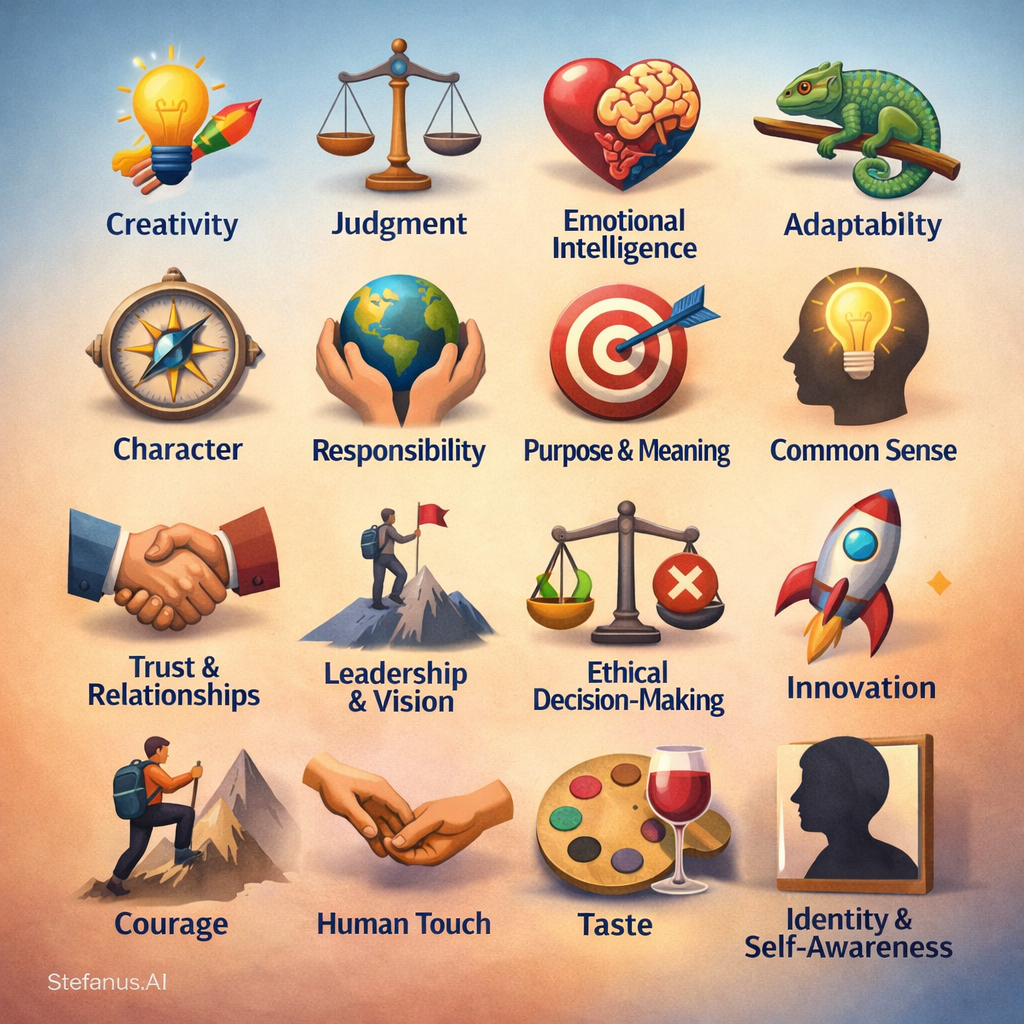
To navigate this future with clarity, we must look beyond what AI can do and focus more carefully on what it cannot be. Among the many human strengths that remain essential, several stand out: creativity, judgment, emotional intelligence, adaptability, character, moral responsibility, purpose and meaning, common sense, trust and relationships, leadership and vision, ethical decision-making, true innovation, physical presence and human touch, courage, taste, and identity and self-awareness. Together, these qualities form what may be called the enduring human edge—an advantage not rooted in processing power, but in the richness of being human itself.

1. Creativity: The Origin of the New
Creativity is often described as producing something new, but true creativity goes far beyond novelty. It is the ability to generate ideas that break away from existing patterns rather than recombine them.
AI can produce thousands of variations of a painting, song, or story. However, those outputs are based on learned data. They are reflections of what already exists. Human creativity, by contrast, often emerges from deeply personal experiences.
Consider a musician composing a song after losing a loved one. The melody, lyrics, and emotion embedded in that piece are not derived from datasets—they are born from lived reality. The result carries emotional truth that cannot be reverse-engineered.
In 2026, as AI-generated content floods digital platforms, audiences are becoming more discerning. They increasingly value originality that feels authentic rather than synthetic. Creativity is no longer about volume—it is about meaningful originality.

2. Judgment: Deciding When It Matters Most
AI can analyze data and suggest options, but it does not decide. Judgment requires choosing a path when there is no clear or perfect answer.
In real-world situations, decisions often involve uncertainty, incomplete information, and competing priorities. A business leader deciding whether to expand into a new market must consider not only financial projections, but also cultural differences, regulatory risks, and long-term brand implications.
Similarly, a physician determining a treatment plan must balance clinical evidence with a patient’s emotional well-being, family context, and quality of life. These decisions cannot be reduced to algorithms.
Judgment is the integration of logic, intuition, and experience—and it remains one of the most critical human capabilities in high-stakes environments.

3. Emotional Intelligence: The Currency of Trust
Emotional intelligence is the ability to understand, interpret, and respond to the emotions of others. While AI can simulate empathetic language, it does not feel or truly understand emotions.
Imagine a manager supporting an employee who is struggling. A data-driven approach might focus on performance metrics. A human with emotional intelligence, however, recognizes stress, burnout, or personal challenges—and responds with empathy.
This ability fosters trust, and in 2026, trust has become a defining currency in both business and society. As interactions increasingly occur through digital channels, people seek those who demonstrate genuine understanding.
Emotional intelligence is not just a communication skill—it is the foundation of human connection.

4. Adaptability: Thriving in the Unknown
AI performs best in structured environments with clear rules and abundant data. Humans excel in uncertainty.
When unexpected disruptions occur—such as economic shifts, technological breakthroughs, or global crises—humans adapt by learning, improvising, and evolving.
For example, professionals across industries are continuously reskilling in response to rapid technological change. A marketer may become a data analyst; a developer may pivot into AI system design. This adaptability is driven by personal motivation and survival instincts.
Adaptability is not merely reacting to change—it is transforming in response to it. This dynamic evolution remains uniquely human.

5. Character: The Foundation of Trustworthiness
Character represents a person’s values, integrity, and moral principles. It is revealed most clearly in difficult decisions.
Consider a salesperson who refuses to mislead a client, even if it means losing a deal. That decision reflects character—a commitment to honesty over short-term gain.
AI cannot make such choices because it does not possess values. It operates based on instructions and optimization goals.
In a world where AI can generate highly convincing but potentially misleading content, character becomes even more important. Individuals and organizations are judged not only by what they can do, but by what they choose to do.

6. Moral Responsibility: Bearing the Consequences
Responsibility is the willingness to be accountable for outcomes. AI does not bear responsibility—humans do.
If an autonomous system causes harm, responsibility lies with the people who designed, deployed, or approved it. This underscores a critical principle: decision-making authority must remain human.
For instance, when companies use AI in hiring, they must ensure fairness and prevent bias. The consequences of those decisions affect real lives, and accountability cannot be delegated to a machine.
Moral responsibility is inseparable from human agency.

7. Purpose and Meaning: The “Why” Behind Everything
AI executes tasks efficiently, but it does not ask “why.” Humans are driven by purpose.
An entrepreneur building a company may be motivated by solving a societal problem, improving lives, or leaving a legacy. This sense of purpose shapes decisions and inspires others.
Without purpose, actions lack direction. AI can optimize processes, but it cannot define what is worth optimizing.
Purpose is what transforms activity into meaning.

8. Common Sense: The Invisible Intelligence
Common sense is the ability to navigate everyday situations without explicit instruction. It is built from experience, culture, and context.
For example, a person knows not to interrupt someone during a sensitive conversation or to adjust their tone based on social cues. AI often struggles with these nuances because they are not easily codified.
This gap becomes especially apparent in real-world interactions where subtle context matters. Common sense is not learned from data alone—it is learned through living.

9. Trust and Relationships: Built Over Time
Relationships are built through consistency, reliability, and shared experiences. They cannot be automated.
A long-term business partnership develops over years of communication, collaboration, and mutual respect. While AI can support interactions, it cannot replace the human bond.
In 2026, as automation increases, human relationships have become a competitive advantage. People prefer to work with those they trust, not just those who are efficient.
Trust is built slowly—but once established, it becomes invaluable.

10. Leadership and Vision: Inspiring the Future
Leadership is not merely about making decisions—it is about inspiring others to follow a vision.
During times of uncertainty, leaders provide clarity, direction, and confidence. They help teams stay aligned and motivated.
AI can analyze trends and generate forecasts, but it cannot inspire belief. Vision requires imagination, conviction, and the ability to communicate meaningfully.
Leadership transforms uncertainty into opportunity.

11. Ethical Decision-Making: Navigating the Gray Areas
Many real-world decisions involve ethical dilemmas with no clear answers.
For example, a company may face a choice between maximizing profits and protecting user privacy. The correct decision depends on values, not just data.
Humans bring empathy, cultural awareness, and moral reasoning to these situations. AI lacks an inherent ethical framework.
As technology advances, ethical decision-making becomes even more critical to ensuring responsible progress.

12. True Innovation: Beyond Patterns
Innovation is not incremental improvement—it is transformation.
When a scientist develops a new theory or a designer creates a groundbreaking product, they are introducing something fundamentally new, not just refining what exists.
AI can assist in research and development, but true innovation often emerges from human curiosity, imagination, and willingness to take risks.
Innovation begins where patterns end.

13. Physical Presence and Human Touch
Certain experiences require physical interaction and presence.
A nurse comforting a patient, a teacher guiding a student, or a craftsman shaping materials all involve a level of human connection that cannot be digitized.
Even as robotics advances, the human touch remains essential in many aspects of life. Presence carries emotional and experiential depth that technology cannot replicate.

14. Courage: Acting Despite Fear
Courage is the ability to act in the face of fear. It is deeply human because it involves emotion, risk, and values.
A whistleblower exposing wrongdoing or an entrepreneur pursuing a bold idea demonstrates courage. These actions are driven by conviction, not calculation.
AI does not feel fear—and therefore cannot overcome it.
Courage defines moments that shape history.

15. Taste: The Art of Knowing What Matters
Taste is the ability to discern quality, style, and meaning. It is shaped by culture, experience, and personal identity.
A designer selecting an aesthetic direction or a curator choosing artwork relies on refined judgment developed over time.
AI can analyze trends, but it does not develop taste. Taste is inherently human—it reflects who we are and what we value.

16. Identity and Self-Awareness
At the core of humanity lies self-awareness—the ability to reflect on one’s own existence.
Humans ask fundamental questions: Who am I? What do I stand for? What is my purpose?
These questions shape decisions, relationships, and life paths. AI does not possess identity or a sense of self—it generates responses without personal experience.
Self-awareness is the foundation of human existence.

Conclusion: The Human Edge in an AI-Driven World
Taken together, these sixteen qualities reveal a larger truth: the human edge does not lie in outperforming machines at machine-like tasks. It lies in bringing conscience to capability, meaning to action, and humanity to power. Creativity gives birth to what does not yet exist, while judgment determines what should be done. Emotional intelligence enables us to care, and adaptability allows us to endure. Character anchors us, responsibility holds us accountable, and purpose gives direction to our efforts. Common sense steadies us in everyday life, while relationships sustain us over time. Leadership provides guidance, ethics imposes discipline, and true innovation expands what is possible. Physical presence comforts and teaches, courage moves us forward despite uncertainty, taste refines what we create, and self-awareness reminds us who is making the choice—and why.
Seen in this light, the future should not be framed as a contest between humans and artificial intelligence. A more constructive vision is one of humans working with AI, guided by values that technology itself cannot generate. Machines may extend our reach and enhance our capabilities, but they must not replace our moral center. When too much is delegated, the risk is not merely dependency—it is the emergence of powerful systems without wisdom. By contrast, when we cultivate the deepest qualities of human life, AI becomes not a substitute for humanity, but a tool that amplifies what is best within it.
This perspective carries particular importance for a global audience. While cultures may differ in how these sixteen qualities are expressed, no society can function without them. Every nation depends on trustworthy leadership. Every family relies on love, courage, and responsibility. Every profession requires sound judgment and strong relationships. And every generation must decide, consciously or not, what kind of future it wants technology to serve. The languages, traditions, and institutions may vary, but the underlying human foundation remains shared across the world.
For that reason, the rise of AI is not merely a technological development—it is a human test. The central question is not only what machines will become, but what people will choose to preserve. If we strengthen the qualities that define our humanity, technology will not diminish us; it will sharpen our sense of purpose. Paradoxically, the more advanced AI becomes, the more essential human depth, responsibility, and wisdom will be.
That is the enduring lesson of this era. Artificial intelligence may transform the tools of civilization, but only human beings can determine the meaning of civilization itself.