
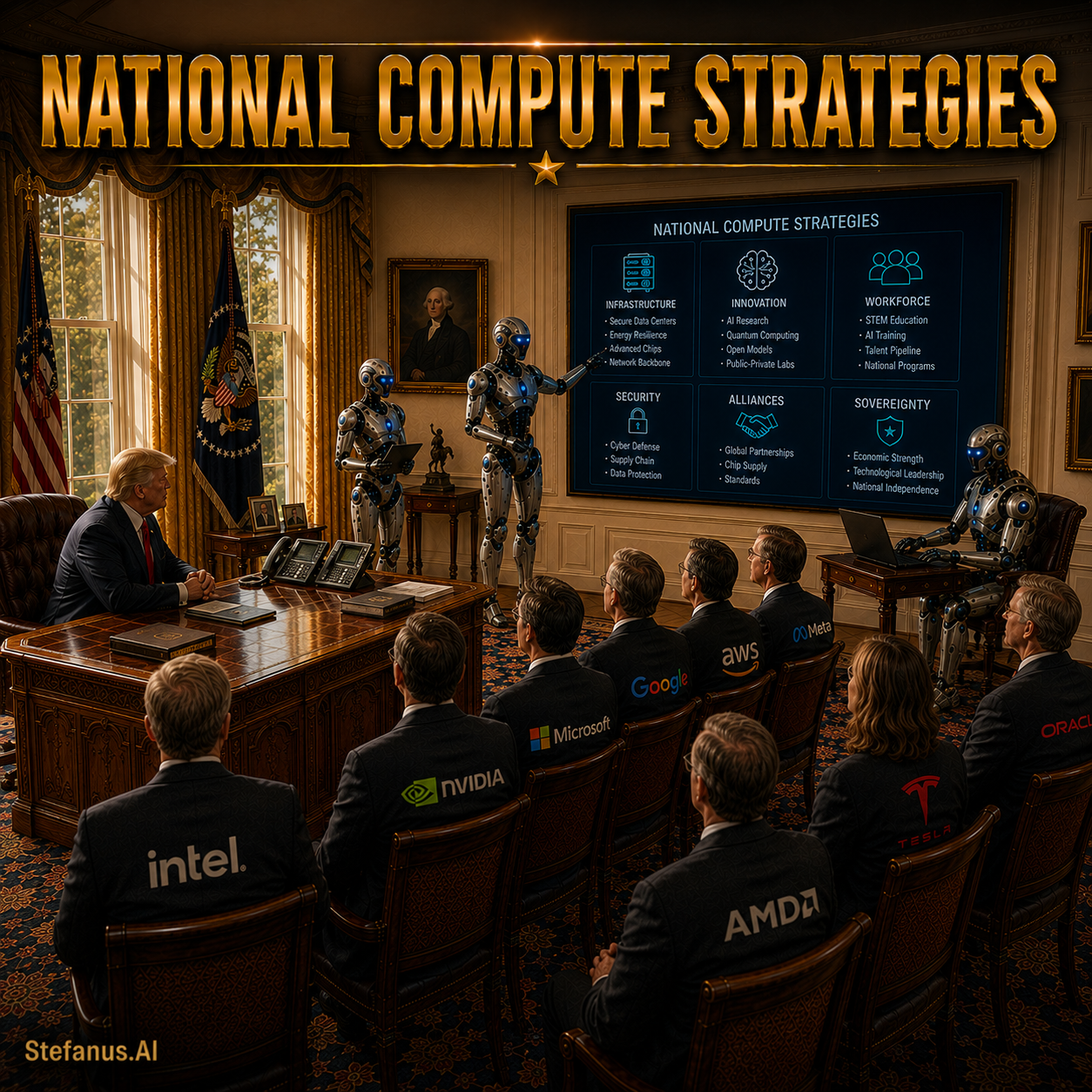

Introduction: Infrastructure Memory, National Continuity, and Why Compute Changes Everything
When I began outlining this paper, memory returned unexpectedly to the earliest years of my career in technology — to a time when the internet was still young, when webhosting was a fragile and exhilarating business, and when the idea that digital infrastructure might be every bit as fragile as a highway bridge or an electrical substation had not yet become conventional wisdom. In the early 2000s, while working for one of the web hosting companies that helped power the first generation of the commercial internet in Los Angeles, I occasionally flew to Fort Lauderdale, Florida, to visit the company’s operational offices and datacenter facility on the East Coast. The experience was routine. The infrastructure felt permanent, invisible, and invulnerable — the way infrastructure always feels, right up until the moment it is not.
Then, in late October 2005, Hurricane Wilma struck South Florida.
What followed was a lesson I have never forgotten. The Florida datacenter absorbed the brunt of the storm. Electricity failed. Transportation networks became paralyzed. Communications grew intermittent and unreliable. And yet — the websites hosted in those facilities still had to remain online. Customers across the country and around the world expected continuity, unaware of and largely indifferent to whatever physical catastrophe was unfolding in the machines that served them. Several technicians and engineers remained inside that datacenter for nearly two weeks under emergency conditions, sustaining uptime with backup generators, redundancy procedures, manual failover protocols, and sheer physical endurance. The people who kept the lights on inside the datacenter were, in their own way, practicing a form of continuity of infrastructure — the unglamorous, essential discipline that separates fragile systems from resilient ones.
At the technology company where I work today, those lessons have been institutionalized. New datacenter deployments are designed from the ground up with redundancy built in at the architectural level — with compute and data mirrored between East Coast facilities in Northern Virginia and West Coast facilities in Portland, Oregon, ensuring that no single regional disaster can sever a customer’s operations. What once required heroic improvisation in the middle of a hurricane is now encoded into engineering standards. The question this paper raises is whether the United States government has achieved anything comparable for the nation’s AI compute backbone.
This memory of infrastructure and fragility leads me, perhaps unexpectedly, to two very different kinds of national continuity planning.
The first is institutional. Older readers will remember — and younger readers should understand — the concept of the Designated Survivor. In the United States government, for every major joint session of Congress — including the State of the Union address — one Cabinet member is deliberately removed from the assembled gathering and placed at an undisclosed secure location. The purpose is stark and sobering: if a catastrophic attack were to kill the President, the Vice President, the Speaker of the House, and the entire Cabinet in a single blow, that one absent official would be constitutionally sworn in as Commander-in-Chief, ensuring that the executive branch of the United States government survives and continues to function. The concept was dramatized memorably in the television series Designated Survivor, in which a low-level Cabinet secretary — played by Kiefer Sutherland — unexpectedly inherits the presidency following the destruction of the Capitol. The show is fiction. The doctrine behind it is not. It is, at its core, a national continuity strategy: a systematic hedge against the worst-case scenario.
The second form of national continuity planning is physical and economic. Since 1975, the United States has maintained the Strategic Petroleum Reserve (SPR) — the world’s largest emergency supply of crude oil, managed by the U.S. Department of Energy, stored in massive underground salt caverns along the Gulf Coast of Texas and Louisiana, capable of holding up to 727 million barrels of crude oil.1 The SPR was not created as a matter of philosophical preference. It was born out of a specific, traumatic national crisis: the 1973 OPEC oil embargo, in which Arab members of the Organization of Petroleum Exporting Countries imposed a punishing embargo on the United States in retaliation for American support of Israel during the Yom Kippur War.2 The embargo sent inflation-adjusted oil prices soaring from roughly $27 per barrel to more than $60 per barrel within months, triggered fuel shortages across the country, sent the economy into recession, and exposed with brutal clarity how deeply a modern industrial economy depended on a single commodity that it did not fully control.3 Congress responded two years later by enacting the Energy Policy and Conservation Act of 1975, which created the SPR as a permanent hedge against future supply shocks — a reserve of last resort capable of releasing more than four million barrels per day to stabilize the market and sustain national operations in the event of another embargo, natural disaster, or deliberate attack.
The logic of the SPR was, at its core, remarkably simple: markets fail under strategic shock. When a vital commodity is concentrated in foreign hands, subject to geopolitical coercion, or vulnerable to physical disruption, the normal mechanisms of the market are insufficient to guarantee continuity of national operations. Only a strategic reserve — a sovereign stockpile maintained by government, outside the reach of market fluctuations and beyond the leverage of foreign powers — could provide true resilience.
This paper argues that the United States faces an analogous situation today — not with oil, but with compute.
In the current era, the U.S. AI economy is dominated by a handful of hyperscale technology companies — Amazon Web Services, Microsoft Azure, Google Cloud — and a cluster of extraordinarily influential individual founders and executives, including Jensen Huang of NVIDIA, Sam Altman of OpenAI, and Elon Musk of xAI. These entities are responsible for the overwhelming majority of the compute capacity that powers American artificial intelligence. Their data centers house the chips. Their cloud platforms provide the inference capacity. Their models increasingly run the automated workflows of business, government, healthcare, logistics, and defense. This concentration of essential infrastructure in private, commercially motivated hands raises a question that this paper places at the center of its argument: in a national emergency — a catastrophic natural disaster, a major cyberattack, a physical strike on critical infrastructure, a geopolitical crisis affecting semiconductor supply — do we want to rely on those hyperscalers and that handful of founders to save the nation?
The United States does have national computing institutions. The National Strategic Computing Initiative (NSCI), established by executive order under President Barack Obama in 2015, created a framework for coordinating federal investment in high-performance computing, focusing heavily on the development of exascale supercomputers.4 The Department of Energy’s national laboratories — Oak Ridge, Argonne, Lawrence Livermore, Los Alamos, and the National Energy Research Scientific Computing Center (NERSC) — house some of the most powerful scientific computing assets in the world. The CHIPS and Science Act of 2022 committed $52.7 billion to domestic semiconductor manufacturing, in a belated recognition that the United States could not allow the entire global supply of advanced chips to remain concentrated in a single, geopolitically vulnerable island in the Taiwan Strait.5
But here is the problem: the NSCI was designed for classical high-performance computing — for scientific simulation, for modeling, for the workloads of the pre-generative-AI era. It was not designed for the explosive, unpredictable, commercially driven scale of the generative AI moment we now inhabit. The national labs hold extraordinary assets, but they are not structured to provide elastic public deployment capacity. The CHIPS Act addresses the supply side of the semiconductor question — getting chips manufactured on American soil — but chips in a fabrication plant in Arizona are not the same as organized, deployable, strategically reserved compute capacity for national emergencies. The defense establishment has its own AI programs, but they are fragmented, classified, and not integrated into any coherent national compute doctrine.
What the United States lacks — and urgently needs — is a National Strategic Compute Reserve (NSCR): a doctrine, a framework, and a physical infrastructure of last resort for AI compute capacity, modeled on the SPR’s logic, adapted to the realities of the Five-Layer AI Economy.
The urgency of this question is not theoretical. On May 20, 2026, NVIDIA reported first-quarter fiscal year 2027 revenue of $81.6 billion — up 85% year over year — with data center revenue alone reaching $75.2 billion, up 92%.6 NVIDIA CEO Jensen Huang told analysts on the earnings call that demand had ‘gone parabolic.’7 Across the hyperscale cloud providers, Microsoft, Alphabet, Meta, and Amazon collectively announced capital expenditure plans for 2026 totaling between $650 billion and $725 billion — the largest concentrated infrastructure investment cycle in the history of technology.8 The International Monetary Fund, in its January 2026 World Economic Outlook update, projected that AI could lift global GDP growth by as much as 0.3 percentage points in 2026 alone, with medium-term upside of 0.1 to 0.8 percentage points per year depending on adoption speed.9 This is no longer a future-facing conversation. The AI economy is here, it is scaling at exponential speed, and the infrastructure that underlies it has become as strategically essential to national security and economic continuity as oil was fifty years ago.
If oil justified a national strategic reserve, compute demands one too.
This paper develops that argument in full. In Section 1, we examine the historical logic of national strategic intervention, with particular attention to the SPR as a precedent for sovereign infrastructure resilience. In Section 2, we map the threat landscape — the natural, deliberate, and structural vulnerabilities that could break the nation’s compute backbone. In Section 3, we assess America’s existing national compute institutions and identify their structural gaps. In Section 4, we present the core framework of this paper: a National Compute Strategy built on the Five-Layer AI Economy — Energy, Chips, Datacenters, Models, and Applications — with a detailed proposal for the National Strategic Compute Reserve. Section 5 addresses the policy architecture required to implement such a strategy, from executive orders to municipal emergency planning. Section 6 looks beyond Earth, to the emerging possibility of orbital and lunar compute infrastructure as the ultimate hedge against terrestrial fragility. Section 7 draws the broader strategic lessons about power, democracy, and the concentration of intelligence. The paper closes with a call to action before the shock arrives.

Section 1: From Strategic Petroleum Reserve to Strategic Compute Reserve
1.1 What Is National Strategy?
National strategy, in the classical sense, is the deliberate and systematic marshaling of a nation’s resources — military, economic, diplomatic, technological — in service of clearly defined national objectives. It is distinguished from ordinary policy by its scope, its time horizon, and its willingness to intervene in systems that markets would otherwise govern, on the ground that certain outcomes are too important to leave entirely to commercial logic. Strategic state intervention is the recognition that there exist categories of resource, capability, or infrastructure whose disruption would be catastrophic enough to justify building redundancy, reserves, and resilience at national expense.
American history is populated with examples of this logic. The Interstate Highway System, authorized by the Federal Aid Highway Act of 1956, was not primarily a transportation convenience — it was a civil defense project, designed explicitly to enable the rapid evacuation of cities and the movement of military forces in the event of nuclear attack. ARPANET, the precursor to the internet, was a Defense Advanced Research Projects Agency project designed to create a communications network that could survive the destruction of any individual node. The Manhattan Project was the most concentrated application of national scientific and industrial capacity in American history — a supreme national effort to develop a strategic weapon before a rival power could. The Defense Production Act of 1950 empowers the President to direct private industry to prioritize national defense contracts, an explicit override of market allocation in favor of strategic necessity.
These examples share a common thread. Each involved a moment of strategic clarity — a recognition that a particular capability, if left to organic development alone, would either develop too slowly, concentrate too dangerously, or prove too fragile under stress. The government stepped in not because government is inherently better at building things, but because the stakes were high enough, and the market failures obvious enough, to justify sovereign intervention.
1.2 The Strategic Petroleum Reserve as Precedent
No precedent in American history maps more precisely onto the compute challenge than the Strategic Petroleum Reserve.
The SPR was born from a specific and humiliating shock. On October 19, 1973, immediately following President Nixon’s request to Congress for $2.2 billion in emergency military aid to Israel during the Yom Kippur War, the Organization of Arab Petroleum Exporting Countries (OAPEC) imposed an oil embargo on the United States.10 The embargo ceased U.S. oil imports from participating nations and initiated a series of production cuts that nearly quadrupled the price of oil from $2.90 a barrel to $11.65 a barrel within months. Cars lined up around city blocks at gas stations. The national speed limit was cut to 55 miles per hour by federal mandate. The U.S. economy entered recession. The episode exposed, in the most visceral terms possible, how completely a modern industrial economy could be paralyzed by the weaponization of a single commodity that it had taken for granted.
As Arthur Burns, then-Chairman of the Federal Reserve, observed at the time, the manipulation of oil supplies came at the worst possible moment — when industrial capacity was already stretched, inflation was already rising, and the U.S. oil industry had no spare capacity to compensate for the sudden cutoff.11 The structural vulnerability had existed for years. It took a strategic shock to make it visible.
The Energy Policy and Conservation Act of 1975, signed by President Gerald Ford, created the SPR in direct response to this shock — authorizing the storage of up to 727 million barrels of crude oil in massive underground salt caverns along the Gulf Coast, capable of being released to the market within 13 days of presidential direction, at a drawdown rate of more than four million barrels per day.12 The SPR was explicitly designed to shield the U.S. economy from future supply shocks, including those engineered by oil-producing countries attempting to coerce U.S. leaders or gain foreign policy concessions.
The strategic logic of the SPR was not that the government should own oil production or refining capacity. It was narrower and more elegant than that: the government should maintain a reserve of last resort — a physical stockpile held outside the reach of market fluctuations and foreign coercion, deployable on sovereign authority in a national emergency. The market would handle normal supply and demand. The SPR would handle the market failures that the market itself could not correct.
1.3 Compute as Strategic Commodity
Oil powered the twentieth century’s economy of mobility, manufacturing, and military projection. Compute is powering the twenty-first century’s economy of intelligence, automation, and information dominance. The parallel is not merely rhetorical — it is structural.
Consider what compute now underlies. Artificial intelligence systems running on large GPU clusters drive drug discovery pipelines at pharmaceutical companies, optimize logistics networks for the retail and transportation sectors, power autonomous systems in defense and intelligence applications, enable real-time threat detection across cybersecurity platforms, model climate systems and pandemic spread scenarios for public health planning, generate code, process legal documents, translate languages, and underwrite financial risk assessments. AI inference capacity is the operational backbone of an economy that has, with astonishing speed, made itself dependent on it.
NVIDIA CEO Jensen Huang has articulated this dependency with uncommon directness. On NVIDIA’s fiscal year 2026 fourth-quarter earnings call, he stated plainly:
“In this new world of AI, compute equals revenues. Without compute, there is no way to generate tokens. Without tokens, there is no way to grow revenues. So in this new world of AI, compute equals revenues.”
13
Huang further elaborated this logic at NVIDIA’s GTC 2026 conference in March of that year, describing three sequential inflection points in AI development — generative AI, reasoning AI, and now agentic AI — and the exponentially escalating compute demands that each transition brings:
“This is the first time in history that every one of these companies need compute — lots and lots of it.”
14
By May 2026, Huang was quantifying that escalation explicitly: agentic AI systems — which must read, reason, use tools, and generate far more tokens in real time than passive generative systems — require compute capacity that has already grown by 1,000% compared to generative AI just two years ago, with Huang himself acknowledging that the actual multiplier could be ‘a couple orders of magnitude’ larger.15
The IMF reinforced the macroeconomic significance of this trajectory in its January 2026 World Economic Outlook update, projecting that AI investment could lift global GDP growth by between 0.1 and 0.8 percentage points per year in the medium term.16 The IMF separately noted that U.S. GDP growth for 2026 was being partly driven by ‘a big push from massive investment in artificial intelligence infrastructure including data centers, powerful AI chips and power.’17
If compute is now the commodity on which national economic output, scientific capability, healthcare delivery, defense operations, and intelligence services depend — if it is, as Jensen Huang argues, directly convertible to revenues and national output — then the strategic logic of the SPR applies to it with full force. A nation that allows its AI compute capacity to concentrate entirely in the infrastructure of three or four private companies, dominated by chips manufactured primarily in a single geopolitically vulnerable location, without any sovereign reserve or emergency deployment doctrine, is repeating the structural vulnerability of 1973 with open eyes.

Section 2: Threat Models — What Can Break the Nation’s Compute Backbone?
2.1 Natural Disasters and Physical Infrastructure Failure
The most immediate threat to AI compute infrastructure is also the most underappreciated: ordinary physical catastrophe. Data centers are not clouds. They are machines — vast, power-hungry, water-cooled, transformer-fed machines that require continuous electricity, stable temperatures, high-bandwidth fiber connectivity, and reliable human access. Every one of these dependencies is vulnerable.
Hurricane Sandy in 2012 flooded dozens of data center facilities in lower Manhattan, knocking major internet infrastructure offline. The February 2021 Texas grid crisis — triggered by winter storms that overwhelmed a power grid that had not been winterized — took down data centers, financial systems, and healthcare networks across the state. California’s wildfire seasons have repeatedly threatened the electrical grid that serves the largest concentration of hyperscale data center capacity in the United States. Drought conditions across the American West are already placing stress on the water cooling systems that keep data center temperatures within operational parameters; some facilities in water-scarce regions have begun exploring air cooling alternatives that are less energy-efficient and more expensive.
The threat of geomagnetic storms is real, if episodic. A Carrington-level solar event — comparable to the 1859 geomagnetic storm that destroyed telegraph systems across North America and Europe — could fry transformers and electrical infrastructure on a continental scale. The long lead times required to manufacture and replace large power transformers (often more than a year, given global supply chain constraints) mean that such an event could leave data center infrastructure offline for months, not days. Volcanic ash events, as demonstrated by the 2010 eruption of Iceland’s Eyjafjallajökull volcano, can shut down air transportation networks on a hemispheric scale — a serious concern for the global supply chains that service data center hardware.
The specific geographic concentration of American data center infrastructure compounds these risks significantly. Northern Virginia — the so-called ‘Data Center Alley’ — houses the world’s densest concentration of AI compute capacity, including the majority of hyperscale cloud infrastructure. A single major electrical grid failure in the PJM Interconnection, which serves that region, would have cascading consequences for AI services across the entire country. Dominion Energy, which serves Northern Virginia, proposed its first base-rate electricity increase since 1992 in early 2025, partly in response to the surging power demand from data centers — a signal of the extreme stress that AI infrastructure growth is already placing on regional grid capacity.18
2.2 Deliberate Attack — Cyberwarfare and Physical Sabotage
The September 11 attacks taught a lesson that has become foundational to American national security doctrine: concentrated infrastructure creates catastrophic vulnerability. When the symbolic and operational centers of American power are clustered together, a single coordinated strike — or even a single individual with sufficient capability and intent — can produce effects far disproportionate to the resources deployed.
AI compute infrastructure is subject to exactly this logic. The major hyperscale data center campuses are known, mapped, and in many cases physically accessible. Nation-state adversaries — China, Russia, Iran — have demonstrated both the willingness and the capability to conduct cyberattacks against critical American infrastructure. The 2021 Colonial Pipeline ransomware attack demonstrated how a single cyber intrusion into industrial control systems could disrupt fuel distribution across the Eastern Seaboard. The SolarWinds attack, attributed to Russian intelligence, compromised the networks of federal agencies and major private-sector companies on a scale that was not fully understood for months. The specific targeting of AI training infrastructure — GPU clusters, model weight repositories, inference endpoints — represents a new and underappreciated attack surface that has not yet been stress-tested under adversarial conditions.
Physical sabotage is an equally serious threat. Undersea fiber optic cables — the physical arteries that carry the vast majority of international data traffic, including AI inference requests — have proven vulnerable to deliberate cutting, as evidenced by multiple incidents involving cables in the Baltic Sea and the Red Sea in recent years. Electromagnetic pulse (EMP) weapons, whether nuclear or non-nuclear, represent a category of attack capable of disabling semiconductor-based infrastructure across wide geographic areas. The growing use of commercial drones in asymmetric warfare has demonstrated that precision strikes on unarmored physical infrastructure are no longer the exclusive province of nation-state actors with advanced military capabilities.
2.3 Supply Chain Warfare — The Semiconductor Chokepoint
Of all the structural vulnerabilities in the American AI compute stack, none is more consequential — or more structurally embedded — than semiconductor supply chain concentration.
Taiwan produces approximately 90% of the world’s most advanced semiconductor chips, with Taiwan Semiconductor Manufacturing Company (TSMC) alone responsible for the fabrication of essentially every cutting-edge GPU, AI accelerator, and advanced processor on which the AI economy runs.19 This concentration is not a recent development — it reflects decades of specialization, enormous capital investment, and the cultivation of a uniquely skilled workforce that cannot be replicated quickly. TSMC’s Arizona facility began mass production of four-nanometer chips in early 2025, and Apple announced in February 2026 it would purchase more than 100 million chips from that facility in the current year.20 TSMC has committed $165 billion to expand its Arizona operations into a cluster of six fabrication plants — an enormous and welcome development, but one that will take years to reach full production at scale.
The geopolitical context is sobering. Tensions between China and Taiwan remain at an elevated level. Bloomberg Economics has estimated that a conflict over Taiwan would cost the global economy $10 trillion in the first year — and that estimate may understate the disruption that a sudden cutoff of advanced chip production would impose on an AI economy that has made itself deeply dependent on that supply.21 As Arati Prabhakar, former Director of the White House Office of Science and Technology Policy, observed in 2024: ‘All of the leading-edge chips that are critical to our infrastructure, to AI, to our national security ambitions, automotive manufacturing even, are being built in one part — a fragile part of the world.’22
Beyond Taiwan, the semiconductor supply chain exhibits additional chokepoints. ASML, a Dutch company, is the sole global producer of extreme ultraviolet (EUV) lithography machines — the equipment required to manufacture chips at the most advanced process nodes. High-bandwidth memory (HBM) critical to AI accelerators is produced in meaningful volume by only a small number of firms. Rare earth materials used in semiconductor manufacturing are predominantly sourced and processed in China. Each of these single points of failure represents a potential lever for strategic coercion or disruption.
The Trump administration’s January 2026 imposition of a 25% tariff on certain high-performance AI chips — including NVIDIA’s H200 and AMD’s MI325X — under a Section 232 national security investigation explicitly acknowledged this vulnerability: ‘The United States currently fully manufactures only approximately 10 percent of the chips it requires, making it heavily reliant on foreign supply chains’ — a situation characterized in the White House proclamation as a ‘significant economic and national security risk.’23
2.4 Corporate Concentration Risk — The Hyperscaler Dependency
The final and perhaps most underappreciated threat model is structural rather than adversarial: the risk that emerges not from enemy action or natural disaster, but from the extreme concentration of AI compute capacity in a small number of private commercial entities.
Consider the following scenario. Amazon Web Services experiences a multi-day outage at its primary Northern Virginia region — an event that has occurred, in lesser form, multiple times in the company’s history. Or Microsoft Azure’s AI infrastructure is taken offline by a ransomware attack targeting its Active Directory authentication systems. Or Google Cloud, responding to a major geopolitical dispute, is directed by a foreign government to cut off services to specific categories of users. Or NVIDIA, facing a catastrophic manufacturing defect in its Blackwell generation of GPUs, is forced to halt production for an extended period while its supply chain partners work through the consequences.
In any of these scenarios, the AI economy of the United States — and with it, significant portions of healthcare delivery, logistics, financial operations, defense systems, and government services — would face disruption on a scale that no existing emergency preparedness framework is designed to address. The Defense Production Act empowers the President to direct private firms to prioritize national security production, but it was not designed to allocate cloud compute capacity in an AI emergency. The Federal Emergency Management Agency has procedures for hurricanes and earthquakes, but not for the failure of a hyperscale cloud provider’s AI inference cluster. There is no playbook.
The Q1 2026 earnings season underscored just how concentrated this dependency has become. The four major hyperscalers — Microsoft, Alphabet, Meta, and Amazon — collectively announced 2026 capital expenditure plans of $650 billion to $725 billion, almost entirely directed at AI infrastructure.24 This is an extraordinary level of private investment in strategic national infrastructure — but it is private investment, governed by commercial logic, accountable to shareholders, and deployable at the discretion of executives who bear no formal responsibility for national continuity of operations.

Section 3: America’s Existing National Compute Institutions — Strengths and Structural Weaknesses
3.1 The National Strategic Computing Initiative
The National Strategic Computing Initiative, established by executive order by President Barack Obama in July 2015, was the most ambitious federal effort to coordinate American high-performance computing strategy since the Cold War.25 Designed as a ‘whole-of-nation effort’ involving ten federal departments and independent agencies, the NSCI established five strategic objectives: delivering an exascale computing system, developing a coherent platform for modeling and simulation, establishing the research foundations for computing beyond the limits of semiconductor scaling, increasing the economic impact of HPC investment, and expanding the HPC workforce.
The NSCI achieved meaningful results within its original mandate. The Department of Energy obligated $2.2 billion for exascale computing between fiscal years 2016 and 2020, producing Oak Ridge National Laboratory’s Frontier system — the world’s first true exascale computer — and positioning the United States at the frontier of scientific HPC.26
But the NSCI was fundamentally a product of its era. It was conceived before GPT-3. Before the generative AI revolution. Before the hyperscale cloud providers became the primary infrastructure layer for AI development. Before agentic AI began placing 1,000-fold escalating demands on inference capacity. The NSCI’s strategic framework centered on simulation, data analytics, and scientific computing — the workloads of the Department of Energy’s national laboratories and the academic research community. It was not designed for the commercial AI economy that has since emerged, and the U.S. Government Accountability Office’s 2021 review found that agencies ‘generally did not receive funding to implement the 2016 strategic plan’ — relying instead on reallocating existing program budgets.27 The NSCI remains technically active, but it has not been substantively updated to address the generative AI inflection point.
3.2 DOE National Laboratories — Elite Compute, Limited Elasticity
The Department of Energy’s network of national laboratories represents one of the crown jewels of American scientific infrastructure. Oak Ridge National Laboratory, home of the Frontier exascale system, has demonstrated computation at a level that was considered science fiction a decade ago. Argonne National Laboratory’s Aurora system further expands that frontier. Lawrence Livermore National Laboratory’s computing assets serve the nation’s nuclear weapons stockpile stewardship mission. The National Energy Research Scientific Computing Center (NERSC) at Lawrence Berkeley National Laboratory provides essential computing resources to the scientific research community across the DOE’s experimental programs.
These are extraordinary assets. But they are not designed for, and cannot serve as, a general-purpose national compute reserve. Their access is governed by allocation processes designed for scientific merit review — not emergency deployment. Their software environments are optimized for specific scientific workloads, not for the broad range of AI inference and training tasks that constitute the national AI economy. Their security classifications limit their utility for many potential emergency applications. And their physical scale — while impressive in absolute terms — is dwarfed by the aggregate compute capacity that a single hyperscale cloud provider deploys for commercial AI workloads in a single quarter.
3.3 The CHIPS and Science Act — Necessary but Insufficient
The CHIPS and Science Act of 2022 was a genuine and significant policy achievement — a bipartisan recognition that the United States could not safely allow the entirety of its advanced semiconductor manufacturing capacity to remain offshore, concentrated in a geopolitically vulnerable geography. The Act committed $52.7 billion to domestic semiconductor manufacturing, research, and workforce development, alongside $24 billion in investment tax credits.28 TSMC’s commitment to invest $165 billion in Arizona fabrication facilities, Apple’s decision to source more than 100 million chips from those facilities in 2026, and the Semiconductor Industry Association’s count of more than $640 billion in announced investments across 30 states as of January 2026 represent meaningful progress toward the goal of domestic semiconductor resilience.29
But chips are not compute. The CHIPS Act addresses Layer 2 of the Five-Layer AI Economy — semiconductor manufacturing — in isolation from the integrated system of energy, infrastructure, models, and applications that constitutes operational AI compute capacity. Chips in a fabrication plant in Arizona cannot be rapidly deployed as emergency AI inference capacity in the way that the SPR’s oil can be released to the market within 13 days. The CHIPS Act, for all its importance, does not constitute a national compute strategy. It is a necessary condition, not a sufficient one.
3.4 The Defense Production Act and Emergency Compute Doctrine
The Defense Production Act of 1950, most recently invoked during the COVID-19 pandemic to direct the production of medical supplies and vaccines, represents the broadest existing statutory authority for presidential intervention in private-sector production decisions. The question of whether and how the DPA could be applied to AI compute allocation — directing cloud providers to prioritize emergency government workloads, or directing chip manufacturers to accelerate production of specific components — is a genuinely interesting doctrinal frontier that has not yet been systematically explored in statute or regulation.
The absence of explicit compute emergency doctrine means that in a genuine AI infrastructure crisis, the President’s legal authority to intervene in commercial compute markets would depend on improvised applications of existing law rather than purpose-built statutory tools. This is precisely the kind of structural gap that the National Strategic Compute Reserve framework proposed in Section 4 of this paper is designed to close.
3.5 Structural Weaknesses — The Sum of the Parts
Assessed collectively, America’s existing national compute institutions exhibit a consistent set of structural weaknesses that prevent them from functioning as genuine strategic resilience infrastructure for the AI era.
First, there is a fundamental mismatch between institutional design and current AI scale. The NSCI, the national labs, and the defense computing programs were designed for an era of classified, specialized, simulation-centric HPC. The national AI economy runs on commercially procured cloud compute, NVIDIA GPU clusters, and hyperscale inference infrastructure. The two worlds are largely separate, and neither has the mandate, the budget, nor the organizational flexibility to backstop the other in an emergency.
Second, there is no unified national compute emergency doctrine. The United States has emergency frameworks for oil supply disruptions (the SPR), for electrical grid failures (NERC reliability standards and federal emergency authorities), for telecommunications disruptions (the National Communications System), and for pandemic supply chains (the Defense Production Act). It has no equivalent framework for AI compute infrastructure disruptions.
Third, hyperscaler dependency has become so deep and so institutionalized — at the federal agency level, at the state and local government level, across the healthcare and financial systems — that a major outage at any of the three major cloud providers would now constitute a de facto national emergency, even in the absence of any hostile action. This dependency has been allowed to develop without any corresponding resilience requirement, reserve capacity, or sovereign fallback.

Section 4: Blueprint — National Compute Strategies Built on the Five-Layer AI Economy
4.1 The Five-Layer AI Economy — A Framework for Sovereign Resilience
The Five-Layer AI Economy is a framework I have developed to describe the full vertical stack of dependencies that underlie operational AI capability. Understanding AI compute strategy requires thinking not about any single layer in isolation, but about the interdependencies across all five layers — because a failure at any layer propagates upward through the entire stack.
Layer 1: Energy Sovereignty — ‘No Power Means No AI’
The foundational layer of the AI economy is energy — specifically, reliable, abundant, and affordable electrical power delivered at the scale that modern AI infrastructure demands. This is not a peripheral concern. It is the most basic physical constraint governing AI compute capacity.
AI data centers are extraordinarily power-hungry. A single modern hyperscale AI training cluster — the kind used to train frontier language models — can consume hundreds of megawatts of continuous power. NVIDIA CEO Jensen Huang has framed AI factories explicitly as ‘power-constrained systems’ in which ‘capacity does not scale with demand, so efficiency becomes decisive.’30 The four major hyperscalers collectively committed more than $710 billion in AI infrastructure capital expenditure for 2026, with a substantial portion of that spend directed at power and cooling infrastructure.
Conditional agreements for small modular reactor (SMR) capacity to power AI data centers have grown from 25 gigawatts to 45 gigawatts as of May 2026, reflecting the industry’s recognition that renewable intermittency and grid congestion make nuclear power the most viable path to the sustained baseload power that AI infrastructure requires.31 Microsoft, Amazon, Google, and Meta have all announced nuclear energy agreements for their data center portfolios, with the tech sector now representing the most significant new customer for nuclear power generation in decades.
A National Compute Strategy must address energy sovereignty at its foundation. Emergency compute reserve capacity is worthless without dedicated, protected power supply infrastructure. A sovereign compute reserve must be paired with dedicated power generation — whether SMR-based or otherwise — that cannot be diverted, curtailed, or disrupted by grid failures affecting commercial data centers. Energy sovereignty is not an option for national compute resilience. It is its precondition.
Layer 2: Semiconductor Sovereignty — ‘Compute Begins with Silicon’
The second layer of the AI economy is semiconductor hardware — the chips that execute AI workloads. This layer has received the most sustained policy attention of any layer in the stack, through the CHIPS Act, export controls on advanced semiconductors to China, and the diplomatic and economic pressure applied to TSMC and other Taiwanese manufacturers to expand operations in the United States.
Taiwan produces roughly 90% of the world’s advanced chip production, and despite the progress catalyzed by the CHIPS Act, the United States is years away from achieving anything approaching semiconductor self-sufficiency at the leading edge.32 ASML’s monopoly on EUV lithography equipment means that even domestic fabrication ultimately depends on Dutch technology and supply chains that could, in theory, be disrupted by geopolitical events. High-bandwidth memory, the critical interface between processors and the memory they need for AI workloads, is produced in meaningful volume by only a handful of South Korean and American firms.
A National Compute Strategy must address semiconductor sovereignty as a multi-decade investment program, not a single legislative act. This includes not just fabrication capacity, but the full supply chain ecosystem: EUV equipment, advanced packaging, HBM production, and the workforce pipeline to staff the facilities the CHIPS Act is funding. Chips in a fab are not compute. Chips in operational systems, maintained in strategic reserve and available for emergency deployment, are.
Layer 3: Infrastructure Sovereignty — ‘Compute Requires Physical Fortification’
The third layer is datacenter infrastructure — the physical facilities, cooling systems, power distribution equipment, networking fabric, and interconnect infrastructure that houses and connects the chips. This layer is the one most directly analogous to the salt caverns of the Strategic Petroleum Reserve: the physical vessel into which the strategic reserve is placed.
A National Strategic Compute Reserve would require dedicated datacenter infrastructure — physically hardened, geographically distributed, and maintained to operational readiness standards analogous to military installations — that exists outside the commercial hyperscale cloud ecosystem. Such facilities would need to be located with deliberate attention to geographic hazard avoidance: not concentrated in Northern Virginia’s Data Center Alley, subject to PJM grid risk; not clustered in California, subject to wildfire and seismic risk; but distributed across multiple regions with diverse power sources, diverse natural hazard profiles, and physically protected against both natural and deliberate threats.
The transformer shortage that has become a significant constraint on datacenter expansion — with lead times for large power transformers stretching to 18 months or more in recent years — illustrates how a single equipment category can become a critical bottleneck for infrastructure deployment. A national compute strategy must address the full stack of physical infrastructure dependencies, not just the headline hardware.
Layer 4: Model Sovereignty — ‘Owning Infrastructure Without Models Is Incomplete Sovereignty’
The fourth layer is AI models — the trained neural networks that constitute the intellectual core of AI capability. This is a layer that national compute strategy has largely ignored, focusing instead on hardware and infrastructure while treating model development as a purely commercial matter.
That approach is strategically incomplete. The frontier AI models that drive the most consequential applications — in defense, intelligence, healthcare, scientific research, and autonomous systems — are currently owned by a small number of private companies: OpenAI, Anthropic, Google DeepMind, Meta AI, and xAI. These companies operate under commercial incentives, governance structures, and legal frameworks that do not include any formal obligation to maintain model availability for national emergency use. A compute reserve that lacks access to operational AI models is hardware without software — functional potential without deployable capability.
A National Compute Strategy must include a model sovereignty component: the development and maintenance of open-weight, government-accessible AI models capable of serving critical national functions — healthcare triage, emergency logistics, defense intelligence, infrastructure monitoring — that can operate on sovereign compute infrastructure without dependency on proprietary commercial model APIs. This is not a call to nationalize AI development. It is a call to ensure that the government’s emergency compute reserve is actually usable when activated.
Stanford’s Fei-Fei Li, widely recognized as the ‘godmother of AI’ for her foundational work on ImageNet and computer vision, has argued compellingly that AI infrastructure must be approached as a matter of national public investment. In her work with the National Artificial Intelligence Research Resource (NAIRR) Task Force for the White House Office of Science and Technology Policy and the National Science Foundation, Li helped develop the framework for a public AI research infrastructure that could democratize access to compute and models beyond the private hyperscale ecosystem.33 The model sovereignty layer of a national compute strategy builds on this work, extending it from research access to emergency operational resilience.
Layer 5: Application Sovereignty — ‘National Productivity Depends on Applied Compute Access’
The fifth and highest layer of the Five-Layer AI Economy is applications — the specific operational uses of AI that drive national productivity, public welfare, and defense capability. These include healthcare diagnosis and triage, emergency logistics coordination, defense intelligence analysis, autonomous systems operation, infrastructure monitoring and resilience, climate modeling, pandemic response, and the administrative functions of government itself.
Application sovereignty is the goal that all four lower layers exist to serve. A sovereign compute reserve, powered by sovereign energy, built on sovereign semiconductor supply chains, physically housed in sovereign infrastructure, and loaded with sovereign models, ultimately exists to ensure that these critical national applications continue to function when the commercial cloud ecosystem is unavailable.
Erik Brynjolfsson, Director of the Stanford Digital Economy Lab and one of the most rigorous analysts of AI’s economic impact, has described the AI moment as representing ‘the most transformative General Purpose Technology since the Industrial Revolution.’34 That characterization implies national-scale stakes. General Purpose Technologies that underpin an entire economy’s productivity are, by definition, too important to be left entirely to commercial infrastructure resilience.
4.2 The National Strategic Compute Reserve — A Formal Proposal
Drawing on the Five-Layer AI Economy framework and the SPR precedent, this paper proposes the establishment of a National Strategic Compute Reserve (NSCR): a sovereign, federally maintained reserve of AI compute capacity, physically distributed across multiple secure facilities, maintained to operational readiness, and deployable on presidential authority in a national emergency.
The NSCR would be organized around five reserve categories, corresponding to the five principal national functions that require AI compute resilience:
Emergency Inference Reserve. A sustained baseline of GPU inference capacity, maintained in hardened facilities at multiple geographic locations, capable of supporting the AI-dependent operations of federal agencies, critical infrastructure operators, and emergency response systems for a sustained period — analogous to the SPR’s 90-day supply requirement — without dependency on commercial cloud availability.
Public Sector Compute Allocation Reserve. Dedicated compute capacity maintained for federal, state, and local government operations that have become dependent on commercial AI services, with priority allocation protocols for healthcare networks, emergency management systems, and critical communications infrastructure.
Defense Compute Reserve. Classified compute infrastructure maintained under DoD authority for defense AI workloads, intelligence analysis, autonomous systems operations, and cyber defense applications that cannot safely depend on commercially operated infrastructure.
Pandemic and Public Health Simulation Reserve. Dedicated capacity for the large-scale epidemiological modeling, genomic analysis, and logistics optimization that modern pandemic response requires — a capability that was improvised under extreme pressure during COVID-19 and should never again be improvised.
Climate and Disaster Modeling Reserve. High-performance compute capacity maintained specifically for the extreme weather modeling, wildfire behavior prediction, flood simulation, and catastrophe response planning that increasingly depends on AI-accelerated scientific computing.
The NSCR would be managed by a newly established National Compute Reserve Office within the Department of Energy — consistent with that department’s existing role managing both the SPR and the DOE national laboratories — with coordination authorities over DoD, FEMA, HHS, and the intelligence community for emergency deployments. Its operational standards, readiness requirements, and drawdown procedures would be established by regulation, with annual readiness reviews analogous to the SPR’s regular drawdown tests.

Section 5: Policy Architecture — Roles from the President to the Mayor
5.1 The Executive — Presidential Authority and Doctrine
The National Compute Strategy requires presidential leadership as its foundation. The historical precedents are instructive: the SPR was created by an act of Congress but required sustained presidential commitment — from Ford through multiple administrations — to build, maintain, and deploy effectively. The NSCI was established by executive order. The CHIPS Act required presidential signature and executive branch implementation. National compute strategy begins at the top.
A presidential executive order establishing National AI Infrastructure Emergency doctrine would accomplish three essential things. First, it would define AI compute infrastructure as national critical infrastructure, extending the legal protections and emergency authorities that currently apply to electrical grids, telecommunications networks, and financial systems to AI data centers, cloud platforms, and semiconductor supply chains. Second, it would establish the legal framework for the National Compute Reserve Office and the NSCR, providing the administrative architecture for the reserve’s creation and maintenance. Third, it would direct federal agencies to begin mapping their dependencies on commercial AI infrastructure and developing emergency transition protocols to sovereign reserve capacity.
Fast permitting for critical AI infrastructure — including the streamlined approval of new data center sites, power transmission upgrades, and semiconductor fabrication facilities — represents a second important executive priority. The current permitting environment for major infrastructure has become a significant constraint on the speed at which AI infrastructure can be built; in a national security context, that constraint is a strategic liability.
5.2 The Congress — Legislative Architecture
Congressional action is required to create the statutory authorities, funding mechanisms, and oversight structures that the NSCR and a broader National Compute Strategy require. The legislative agenda this paper proposes has three principal components.
The National Strategic Compute Reserve Act would establish the NSCR as a permanent federal program, analogous to the Energy Policy and Conservation Act’s creation of the SPR. It would authorize the construction and maintenance of sovereign compute facilities, establish funding mechanisms — potentially including a small levy on commercial cloud revenue analogous to oil royalties — and define the conditions under which presidential drawdown authority can be invoked.
The Compute Resilience Act would establish minimum resilience requirements for AI infrastructure designated as nationally critical — including geographic diversification mandates, backup power requirements, cybersecurity standards for AI systems operating in critical sectors, and mandatory incident reporting that would give the government visibility into commercial cloud failures before they become national emergencies.
The AI Infrastructure Investment Act would provide sustained, dedicated federal funding for the five-layer sovereign compute stack: energy infrastructure for AI facilities, domestic semiconductor supply chain investment beyond the CHIPS Act, infrastructure grants for distributed federal AI facilities, open-weight model development at national labs, and applications development for priority national use cases.
5.3 Governors and States — Regional Resilience Architecture
States play an essential role in the physical infrastructure of AI compute — through land use and zoning authority over data center siting, through energy regulatory commissions that govern power supply to data centers, through state emergency management agencies that will be first responders in any regional compute infrastructure failure, and through the economic development authorities that are actively competing to attract AI infrastructure investment.
A National Compute Strategy should include a state resilience component: federal-state compacts that align state energy planning and emergency management frameworks with national compute resilience requirements, grant programs for states to develop regional AI emergency infrastructure plans, and interoperability standards that allow state-operated computing resources to be integrated into a national emergency compute network when needed.
5.4 Mayors and Cities — The Last Mile of Compute Resilience
The municipal level may seem distant from questions of national AI compute strategy, but cities are where AI compute infrastructure physically sits. Data center facilities require building permits, fire protection, reliable water supply, police security, and emergency access corridors. Cities like Ashburn, Virginia; Portland, Oregon; Dallas, Texas; and Phoenix, Arizona have become major nodes in the national AI infrastructure map precisely because of decisions made at the municipal level about land use, utility access, and economic development incentives.
A national compute resilience framework must integrate city-level emergency planning — ensuring that municipalities that host critical compute infrastructure have the resources, the training, and the interoperability protocols to protect those facilities and maintain their operations through local emergencies. The technicians who stayed inside a Fort Lauderdale datacenter for two weeks during Hurricane Wilma were operating within a municipal emergency context. Getting that context right matters.

Section 6: AI Beyond Earth — Orbital, Lunar, and Cislunar Compute
6.1 Orbital Datacenters — The Ultimate Geographic Distribution
National compute strategy, in its most ambitious formulation, need not be bounded by Earth’s surface. The emergence of commercial launch economics — driven by SpaceX’s reusable rocket program, which has reduced the cost of placing a kilogram of payload in low Earth orbit by an order of magnitude — has opened a genuinely new frontier for compute infrastructure deployment.
Orbital data centers have been discussed as a theoretical concept for years. The practical barriers have historically been prohibitive: radiation hardening requirements for semiconductor components in the space environment, thermal management without the atmosphere-assisted cooling that ground-based data centers rely on, the latency penalties of communicating between orbital and terrestrial infrastructure, and the enormous capital costs of launch. But as launch economics continue to improve, as radiation-hardened chip designs mature, and as the geopolitical arguments for compute infrastructure beyond the reach of terrestrial adversaries grow stronger, orbital compute becomes an increasingly serious strategic option.
The energy economics of orbital compute are intriguing. Solar power in low Earth orbit is abundant and continuous — without atmospheric absorption or the day-night cycle that limits terrestrial solar installations. An orbital data center positioned in the right orbit could in principle harvest several times the solar energy per unit of panel area available at Earth’s surface, with 24-hour generation continuity. The engineering challenges are real, but so is the strategic appeal of compute infrastructure that no nation-state adversary can physically destroy without an act of war in space.
6.2 Lunar Compute — Extreme Resilience and Sovereignty Beyond Earth
The Moon represents a more speculative but more strategically compelling option for ultra-resilient compute infrastructure. A lunar facility, located in one of the permanently shadowed craters at the lunar poles — where water ice has been confirmed and temperatures remain stable — would be physically inaccessible to any terrestrial threat. It could, in principle, maintain model weights, critical data archives, and minimal AI inference capability through any terrestrial catastrophe, providing the ultimate Designated Survivor for national AI capability.
The latency challenge is significant — round-trip communication time between Earth and Moon is approximately 2.6 seconds — making lunar compute unsuitable for real-time inference applications. But for archival purposes, for model weight preservation, and for the kind of long-horizon scientific and strategic planning that requires access to large data stores rather than low-latency responses, lunar compute represents a genuinely unique strategic asset. As launch costs continue to fall and as the Artemis program builds the logistical infrastructure for sustained lunar operations, the concept moves from science fiction toward engineering challenge.
6.3 Cislunar Infrastructure — The Next Strategic Domain
The cislunar domain — the volume of space between Earth’s surface and the Moon — is rapidly becoming a zone of strategic competition. China’s accelerating lunar program, the expansion of commercial lunar missions, and the growing military interest in cislunar space as a domain for surveillance and communication relay all point toward a future in which the strategic logic of compute sovereignty extends beyond Earth’s atmosphere.
A forward-looking national compute strategy should begin developing the policy frameworks, technical standards, and international governance structures for cislunar compute infrastructure — not because these capabilities will be needed in the next five years, but because the time to establish doctrine is before capabilities are deployed, not after. The lesson of the oil era is precisely that nations which wait for a crisis to develop strategic doctrine find themselves improvising under pressure. The lesson of 1973 is the lesson of space compute: build the reserve before you need it.

Section 7: Strategic Lessons — Power, Democracy, and the Concentration of Intelligence
7.1 Do We Want to Rely on Hyperscalers to Save the Nation?
The question posed in this paper’s introduction deserves a direct answer: no. Not because the hyperscalers are unreliable, incompetent, or hostile to national interests — they are none of these things. But because the answer to a question of national strategic resilience cannot be ‘we will rely on commercial entities whose primary legal obligation is to their shareholders.’ The Strategic Petroleum Reserve was not created because the oil companies were untrustworthy. It was created because the stakes of failure were too high to be managed by commercial risk calculations alone.
The hyperscalers are building extraordinary infrastructure at extraordinary speed. Microsoft’s commitment to $190 billion in calendar 2026 capital expenditures, Amazon’s $200 billion commitment for the same year, Google’s $180-190 billion guidance, and Meta’s $125-145 billion — together representing the most concentrated private investment in infrastructure in human history — are genuine contributions to national compute capacity.35 But private investment, however enormous, is not a national strategic reserve. It is governed by commercial logic, deployable at commercial discretion, and subject to commercial failure modes.
7.2 Do We Want to Rely on Founders?
The concentration of AI capability and vision in a small number of individual founders — Jensen Huang of NVIDIA, Sam Altman of OpenAI, Elon Musk of SpaceX and xAI, Mark Zuckerberg of Meta, Sundar Pichai of Alphabet (CEO) — represents a different but equally important governance question. These individuals have made decisions about AI development, compute allocation, and strategic direction that have affected the national AI economy at a scale that exceeds the economic impact of many sovereign governments.
Nobel laureate economist Daron Acemoglu of MIT has raised important questions about the distributional and democratic consequences of AI concentration, noting cautiously that AI’s productivity gains, while real, are ‘just disappointing relative to the promises that people in the industry and in tech journalism are making’ — a reminder that the gap between private commercial incentives and broad national benefit is not guaranteed to close without deliberate policy intervention.36
National compute strategy is not an argument against founders or against private enterprise. It is an argument that certain infrastructure decisions are too consequential for national security and democratic accountability to be left exclusively to the judgment of private individuals, however brilliant and well-intentioned they may be.
7.3 What Does Concentrated Compute Ownership Do to Democracy?
The concentration of AI compute capacity is not merely an economic or security issue. It is a democratic one. When the infrastructure that processes information, makes recommendations, and increasingly makes decisions is owned by a small number of private entities, the question of who controls the information environment — and on what terms — becomes a question of democratic governance, not just market competition.
The analogy to media ownership concentration is imperfect but instructive. The concern about concentrated media ownership was never primarily about the quality of the content produced — it was about the structural power to shape public information that concentrated ownership confers. AI compute concentration raises an analogous concern at a deeper level: the infrastructure layer, not just the content layer, of public information and decision-making is becoming concentrated in a small number of private hands.
A national compute strategy that builds sovereign reserve capacity, maintains public-interest AI models, and establishes democratic accountability frameworks for AI infrastructure governance is, in part, a democratic resilience strategy — an effort to ensure that the cognitive infrastructure of democratic society cannot be monopolized, weaponized, or simply failed at private discretion.
7.4 What Does Infrastructure Fragility Teach Us?
The datacenter technicians who spent two weeks inside a Fort Lauderdale facility during Hurricane Wilma, running on backup generators, sustaining uptime by hand — they understood something about infrastructure that policy makers often forget: technology systems are only as resilient as their weakest physical dependency. Every cloud is, ultimately, a building with a power feed. Every AI model is, ultimately, calculations on chips that need cooling and electricity and human operators.
The fragility lesson is consistent across historical examples. The 1973 oil embargo revealed the fragility of an industrial economy that had assumed energy security. September 11 revealed the fragility of a security posture that had not anticipated asymmetric attacks on concentrated infrastructure. The COVID-19 pandemic revealed the fragility of global supply chains that had optimized for efficiency rather than resilience. The AI era is presenting the same choice: optimize for efficiency and accept fragility, or invest in resilience and accept redundancy costs.
7.5 Can Compute Become Strategic Coercion?
The most forward-looking strategic lesson of this analysis is also the most concerning. OPEC’s 1973 oil embargo was, at its core, an act of strategic coercion: the weaponization of a commodity on which the target economy depended, deployed in pursuit of specific political objectives. The United States created the SPR precisely to deny future adversaries the leverage that supply concentration provided.
As AI compute becomes the strategic commodity of the twenty-first century, the question of whether it can be weaponized in analogous ways becomes urgent. A China that dominates advanced semiconductor manufacturing could, in extremis, impose a compute embargo on the United States far more damaging than any oil embargo — not by cutting off petroleum flows, but by cutting off the chip supply on which the AI economy runs. A hyperscale cloud provider that decides, for any reason, to terminate services to specific government customers or to specific categories of AI workload, wields leverage over national operations that has no clear precedent in the history of commercial services.
The answer to strategic coercion is always the same: build sovereign capacity that cannot be coerced. The SPR was that answer for oil. The National Strategic Compute Reserve is that answer for AI.

Conclusion:
America did not wait for a second oil embargo before understanding the necessity of energy strategy. The Strategic Petroleum Reserve was built not in the middle of a crisis, but in the aftermath of one — as a deliberate, sovereign commitment to ensure that the structural vulnerability exposed by 1973 could never again be exploited to cripple the national economy and constrain American foreign policy. The SPR was not an expression of fear. It was an expression of strategic maturity: the recognition that certain commodities are too important to national survival to be left entirely to the mercy of market forces, commercial decisions, or foreign coercion.
The United States now faces an analogous moment with compute. NVIDIA’s Q1 FY2027 revenue of $81.6 billion — growing at 85% year over year — signals not a technology trend but a structural transformation of national economic infrastructure. The $650-725 billion that the four major hyperscalers committed to AI infrastructure capital expenditures in 2026 alone signals not an investment cycle but a remaking of the physical substrate of national capability. The IMF’s projection that AI could lift global GDP growth by 0.1 to 0.8 percentage points annually in the medium term signals not a productivity improvement but a generational shift in the sources of national economic power.37
And yet — the United States has no National Strategic Compute Reserve. It has no AI infrastructure emergency doctrine. It has no sovereign model repository for critical national functions. It has no integrated framework connecting energy sovereignty, semiconductor sovereignty, infrastructure sovereignty, model sovereignty, and application sovereignty into a coherent national compute strategy. It has brilliant private companies building extraordinary private infrastructure, and a set of national institutions designed for an earlier era of computing, and a growing dependency on commercial AI infrastructure that no emergency preparedness framework is designed to backstop.
The lesson of the ‘Designated Survivor’ doctrine is not merely about the continuity of a human being in the line of presidential succession. It is about the deeper principle that resilient systems must be designed with their failure modes in mind — must designate the backup before the primary fails, not after. The lesson of the Strategic Petroleum Reserve is not merely about oil. It is about the strategic logic of sovereign reserves: that certain critical dependencies are too important to leave to the mercy of market disruption, foreign coercion, or commercial failure.
The National Compute Strategy proposed in this paper — built on the Five-Layer AI Economy, anchored in the National Strategic Compute Reserve, supported by the legislative and executive architecture described in Section 5, and extended toward the long-term possibility of orbital and lunar compute resilience — is the twenty-first century application of that timeless strategic logic.
“Computing demand is growing exponentially. The agentic AI inflection point has arrived.” — Jensen Huang, NVIDIA CEO, Q1 FY2027 Earnings Call, May 20, 2026
38
If demand is growing exponentially, the strategic consequences of compute failure are growing exponentially too. The time to build the reserve is before the shock arrives. The time to design the Designated Survivor is before the Capitol is destroyed. The time to create the Strategic Petroleum Reserve is the year after the oil embargo, not the year before the next one.
America built the SPR. It is time to build the National Strategic Compute Reserve.

Footnotes / Endnotes:
1. U.S. Department of Energy. ‘Strategic Petroleum Reserve.’ Energy.gov. Managed in underground salt caverns along the Texas and Louisiana coasts with capacity of up to 727 million barrels. https://www.energy.gov/sites/prod/files/2020/04/f73/Strategic%20Petroleum%20Reserve%20%28final%29.pdf
2. Council on Foreign Relations. ‘How Does the U.S. Government Use the Strategic Petroleum Reserve?’ The EPCA was signed by President Ford in 1975 to shield the U.S. economy from supply shocks including those engineered by oil-producing countries. https://www.cfr.org/backgrounders/how-does-us-government-use-strategic-petroleum-reserve
3. Federal Reserve History. ‘Oil Shock of 1973–74.’ Inflation-adjusted oil prices rose from $27.17/barrel in October 1973 to $60.81/barrel in March 1974. https://www.federalreservehistory.org/essays/oil-shock-of-1973-74
4. White House Office of Science and Technology Policy. ‘National Strategic Computing Initiative.’ Executive Order by President Barack Obama, July 2015. https://www.nitrd.gov/nsci/
5. PIIE. ‘The CHIPS Act Already Puts America First.’ $52.7 billion committed to domestic semiconductor manufacturing, research, and workforce development. https://www.piie.com/blogs/realtime-economics/2025/chips-act-already-puts-america-first-scrapping-it-would-poison-well
6. Yahoo Finance / NVIDIA Investor Relations. ‘NVIDIA Q1 FY2027 Earnings.’ Revenue of $81.6 billion, up 85% YoY; Data Center revenue $75.2 billion, up 92% YoY. May 20, 2026. https://finance.yahoo.com/markets/stocks/articles/nvidia-q1-fy2027-earnings-record-214649637.html
7. CNBC. ‘Nvidia (NVDA) Q1 2027 Earnings Report: Live Updates.’ Jensen Huang: ‘This was an extraordinary quarter. Demand has gone parabolic. The reason is simple: Agentic AI has arrived.’ May 20, 2026. https://www.cnbc.com/2026/05/20/nvidia-nvda-earnings-report-q1-2027.html
8. Statista. ‘Big Tech’s AI Spending to Reach $725 Billion in 2026.’ Microsoft, Alphabet, Meta, and Amazon collectively expected to invest up to $725 billion, most of it on AI infrastructure. May 2026. https://www.statista.com/chart/35046/capital-expenditure-of-meta-alphabet-amazon-and-microsoft/
9. International Monetary Fund. World Economic Outlook Update, January 2026. ‘Global growth may be lifted by as much as 0.3 percentage points in 2026 and between 0.1 and 0.8 percentage points per year in the medium-term, depending on the speed of adoption and improvements in AI readiness globally.’ https://www.imf.org/-/media/files/publications/weo/2026/january/english/text.pdf
10. U.S. Department of State, Office of the Historian. ‘Oil Embargo, 1973–1974.’ On October 19, 1973, OAPEC imposed an oil embargo on the United States following President Nixon’s request for emergency military aid to Israel. https://history.state.gov/milestones/1969-1976/oil-embargo
11. Federal Reserve History. ‘Oil Shock of 1973–74.’ Arthur Burns, Federal Reserve Chairman, 1974: ‘The manipulation of oil prices and supplies by the oil-exporting countries came at a most inopportune time for the United States.’ https://www.federalreservehistory.org/essays/oil-shock-of-1973-74
12. U.S. Department of Energy. ‘History of the Strategic Petroleum Reserve.’ The Energy Policy and Conservation Act signed by President Ford in late 1975 established the SPR; salt cavern locations chosen for their security and proximity to refineries. https://www.energy.gov/articles/history-strategic-petroleum-reserve
13. YourStory / NVIDIA Investor Relations. ‘NVIDIA’s Jensen Huang on Compute as a New Economic Engine.’ Q4 FY2026 Earnings Call, February 2026: ‘In this new world of AI, compute equals revenues. Without compute, there is no way to generate tokens. Without tokens, there is no way to grow revenues.’ https://yourstory.com/ai-story/nvidia-jensen-huang-compute-equals-revenues-ai-drives-strong-fiscal
14. GeneEngNews / NVIDIA GTC 2026. Jensen Huang Keynote, March 2026: ‘This is the first time in history that every one of these companies need compute — lots and lots of it.’ https://www.genengnews.com/topics/artificial-intelligence/nvidia-gtc-2026-agentic-ai-inflection-hits-healthcare-and-life-sciences/
15. Glitchwire. ‘Jensen Huang Says Agentic AI Requires 1,000x More Compute Than Generative AI.’ ServiceNow Knowledge 2026 conference, May 5, 2026. https://glitchwire.com/news/jensen-huang-says-agentic-ai-requires-1000x-more-compute-than-generative-ai-here/
16. IMF World Economic Outlook Update, January 2026. AI global GDP uplift projection of 0.1 to 0.8 percentage points per year in the medium term. https://www.imf.org/-/media/files/publications/weo/2026/january/english/text.pdf
17. The Business Standard / IMF. January 2026: ‘The IMF estimated US growth for 2026 at 2.4%, due in part to a big push from massive investment in artificial intelligence infrastructure including data centers, powerful AI chips and power.’ https://www.tbsnews.net/world/global-economy/imf-sees-steady-global-growth-2026-ai-boom-offsets-trade-headwinds-1338291
18. 24/7 Wall St. ‘The Staggering Number Jensen Huang Just Revealed Changes Everything About AI.’ Dominion Energy’s first base-rate increase since 1992 partly driven by data center power demand surge in Northern Virginia. https://247wallst.com/investing/2026/05/16/the-staggering-number-jensen-huang-just-revealed-changes-everything-about-ai/
19. The Hilltop. ‘Taiwan Strait Tensions Push Countries to Diversify Semiconductor Supply Chains.’ Taiwan produces roughly 90% of the world’s advanced chip production. April 2026. https://thehilltoponline.com/2026/04/13/taiwan-strait-tensions-push-countries-to-diversify-semiconductor-supply-chains/
20. The Hilltop. ‘TSMC’s Arizona facility began mass production of four-nanometer chips in early 2025, and Apple announced in February 2026 that it would purchase more than 100 million chips manufactured at the site this year.’ https://thehilltoponline.com/2026/04/13/taiwan-strait-tensions-push-countries-to-diversify-semiconductor-supply-chains/
21. CSIS. ‘A World of Chips Acts: The Future of U.S.-EU Semiconductor Collaboration.’ Bloomberg Economics estimates a war over Taiwan would cost the global economy $10 trillion in the first year. https://www.csis.org/analysis/world-chips-acts-future-us-eu-semiconductor-collaboration
22. CSIS. Former OSTP Director Arati Prabhakar, January 2024: ‘All of the leading-edge chips that are critical to our infrastructure, to AI, to our national security ambitions, automotive manufacturing even, are being built in one part — a fragile part of the world [Taiwan].’ https://www.csis.org/analysis/world-chips-acts-future-us-eu-semiconductor-collaboration
23. Finviz News. ‘Trump Targets Taiwan, China Supply Chains: President Slaps 25% Tariffs On Nvidia, AMD AI Chips Under National Security Order.’ White House proclamation, January 14, 2026: ‘The United States currently fully manufactures only approximately 10 percent of the chips it requires, making it heavily reliant on foreign supply chains.’ https://finviz.com/news/276928/trump-targets-taiwan-china-supply-chains-president-slaps-25-tariffs-on-nvidia-amd-ai-chips-under-national-security-order
24. The Next Web. ‘Q1 2026 Big Tech Earnings: $650 Billion in AI Capex and Compute Constraints.’ Combined 2026 AI capex from MSFT, GOOGL, META, and AMZN tracking $650-700 billion, the largest concentrated infrastructure cycle in tech history. https://thenextweb.com/news/alphabet-amazon-meta-q1-2026-earnings-ai-cloud
25. Wikipedia / NITRD. ‘National Strategic Computing Initiative.’ Executive order by President Barack Obama, July 29, 2015. Ten U.S. government departments and independent agencies involved. https://www.nitrd.gov/nsci/
26. U.S. Government Accountability Office. ‘High-Performance Computing: Advances Made Towards Implementing the National Strategy.’ GAO-21-104500. DOE obligated $2.2 billion for exascale computing from FY2016 through FY2020. https://www.gao.gov/products/gao-21-104500
27. HPCwire. ‘GAO Assesses National Strategic Computing Initiative Progress.’ October 2021. Agencies ‘generally did not receive funding to implement the 2016 strategic plan.’ https://www.hpcwire.com/2021/10/05/gao-assesses-national-strategic-computing-initiative-progress/
28. European Chips Act website. ‘U.S. CHIPS Act.’ $52.7 billion directly to semiconductor manufacturing, research, and workforce development, alongside $24 billion in investment tax credits. https://www.european-chips-act.com/USA_Semiconductor_Legislation.html
29. Semiconductor Industry Association / The Hilltop. ‘Companies in the semiconductor ecosystem have announced more than $640 billion in investments across 30 states as of January 2026.’ https://thehilltoponline.com/2026/04/13/taiwan-strait-tensions-push-countries-to-diversify-semiconductor-supply-chains/
30. Global Data Center Hub. ’19 Key Takeaways from Jensen Huang’s NVIDIA GTC 2026 Keynote.’ Huang: ‘AI factories are fundamentally power-constrained systems. Capacity does not scale with demand, so efficiency becomes decisive.’ https://www.globaldatacenterhub.com/p/19-key-takeaways-from-jensen-huangs-f2c
31. 24/7 Wall St. Conditional agreements for small modular reactor capacity grew from 25 gigawatts to 45 gigawatts as tech companies committed more than $710 billion in AI infrastructure capital expenditures for 2026. https://247wallst.com/investing/2026/05/16/the-staggering-number-jensen-huang-just-revealed-changes-everything-about-ai/
32. The Hilltop. ‘Taiwan Strait Tensions Push Countries to Diversify Semiconductor Supply Chains.’ Taiwan produces roughly 90% of the world’s advanced chip production. April 2026. https://thehilltoponline.com/2026/04/13/taiwan-strait-tensions-push-countries-to-diversify-semiconductor-supply-chains/
33. Wikipedia / DTIC / Stanford HAI. Dr. Fei-Fei Li — Sequoia Professor in Computer Science, Stanford University, and Founding Co-Director of Stanford’s Human-Centered AI Institute. Member, National AI Research Resource Task Force for the White House OSTP and NSF, 2021–2022. https://csiac.dtic.mil/articles/stanford-professor-discusses-future-of-visually-intelligent-machines-and-human-ai-collaboration
34. Stern Strategy Group. ‘Erik Brynjolfsson — AI and Economist Speaker.’ Director, Stanford Digital Economy Lab: ‘AI represents the most transformative General Purpose Technology since the Industrial Revolution.’ https://sternstrategy.com/speakers/erik-brynjolfsson/
35. CNBC / InsiderFinance / Fortune. Microsoft $190 billion 2026 capex; Amazon $200 billion 2026 capex; Alphabet $180-190 billion 2026 capex; Meta $125-145 billion 2026 capex guidance. https://www.cnbc.com/2026/04/29/microsoft-msft-q3-earnings-report-2026.html
36. Fortune. ‘Thousands of CEOs Admit AI Had No Impact on Employment or Productivity.’ Nobel laureate Daron Acemoglu (MIT), April 2026: ‘I don’t think we should belittle 0.5% in 10 years. That’s better than zero. But it’s just disappointing relative to the promises that people in the industry and in tech journalism are making.’ https://fortune.com/article/why-do-thousands-of-ceos-believe-ai-not-having-impact-productivity-employment-study/
37. IMF World Economic Outlook Update, January 2026. Medium-term AI GDP uplift projection. https://www.imf.org/-/media/files/publications/weo/2026/january/english/text.pdf
38. CNBC. ‘Nvidia (NVDA) Q1 2027 Earnings Report: Live Updates.’ Jensen Huang closing statement: ‘This was an extraordinary quarter. Demand has gone parabolic. The reason is simple: Agentic AI has arrived.’ May 20, 2026. https://www.cnbc.com/2026/05/20/nvidia-nvda-earnings-report-q1-2027.html

Comments
[…] inward — disabling its own most capable models, as the Anthropic directive demonstrates, on national-security grounds it could not fully articulate. The methods a nation builds to constrain its rival become, […]
[…] transmission inheritance of isotope separation is being re-tasked to token generation. And fifth, national-security geography is reused for a new technological contest with China: the sites chosen for AI campuses […]