
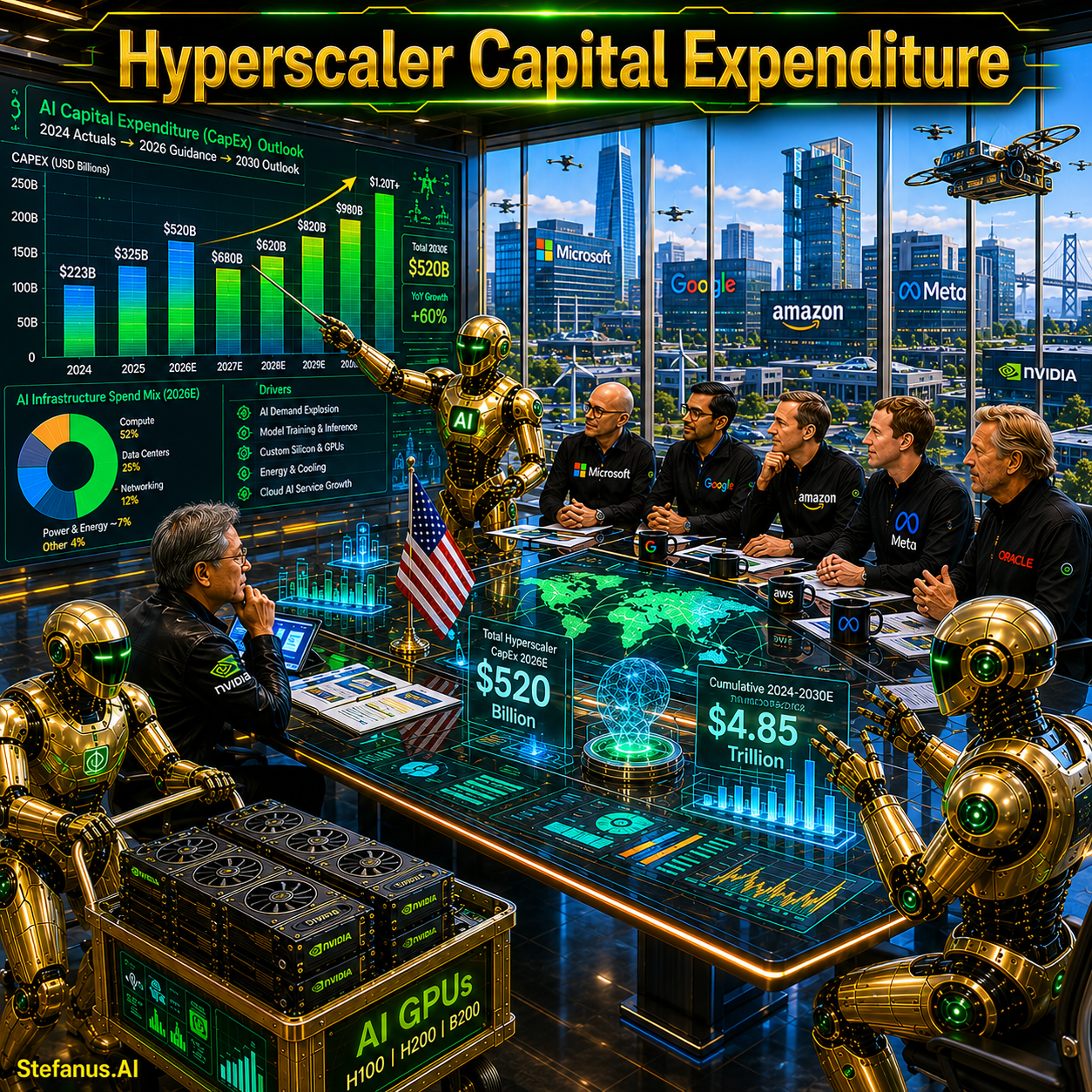

Introduction: Why the Word “Hyperscaler” Matters
To read the technology press in 2026 is to encounter the word “big tech” deployed as a catch-all descriptor for entities as structurally distinct as a social network, a global cloud utility, a sovereign-scale compute allocator, and a GPU architecture firm. The imprecision is not merely semantic. It obscures one of the most consequential economic phenomena of our era: the transformation of a handful of private corporations into de facto infrastructure sovereigns, financing and deploying capital at a scale and speed previously reserved for nation-states engaged in wartime industrial mobilization.
This paper adopts the term “hyperscaler” with deliberate precision. A hyperscaler is not a large technology company. It is an infrastructure operator capable of deploying compute, storage, networking, energy systems, and chip supply chains at planetary scale, with economic leverage that compounds across each layer of the stack. In 2026, the hyperscaler category has expanded beyond its cloud-era definition to encompass Microsoft, Alphabet, Amazon, Meta, Oracle, and, as an architectural enabler, Nvidia. It is also beginning to absorb new entrants such as xAI and CoreWeave, whose ambitions are hyperscale even if their balance sheets are not yet.
The central thesis of this analysis is stark but defensible: artificial intelligence is forcing private corporations to behave like sovereign infrastructure planners. The capital expenditure decisions being made in 2026 do not resemble ordinary corporate investment cycles. They resemble national industrial mobilization. When Amazon commits approximately $200 billion in capital expenditure for a single calendar year1 — a figure exceeding the annual defense budgets of most sovereign states — the analytical framework of “corporate spending” no longer suffices. Something categorically different is occurring.
“Our AI business surpassed an annual revenue run rate of $37 billion, up 123% year-over-year.”
— Satya Nadella, Chairman & CEO, Microsoft — Q1 FY2026 Earnings, April 29, 2026²
In the first earnings season of calendar year 2026, four hyperscalers — Microsoft, Alphabet, Amazon, and Meta — reported simultaneously on April 29 and collectively updated their annual capital expenditure guidance to a combined $650–$725 billion for 2026 alone.3 That figure, according to data compiled by the Financial Times from those earnings reports, represents a 77% increase over the prior year’s already-record $410 billion in combined capital expenditure.4 The IMF, in its March 2026 Finance & Development analysis, noted that AI-related investment has already begun to materially shift macroeconomic growth accounting, with U.S. investment in information-processing equipment and software growing 16.5% year-over-year in Q3 2025.5
This paper traces the origins, anatomy, competitive logic, physical constraints, skeptical challenges, and strategic implications of that extraordinary capital deployment cycle across seven sections and a forward scenario framework extending to 2030. Section 1 establishes the definitional and historical framework. Section 2 presents the CapEx scoreboard across the principal actors. Section 3 distills the executive narratives from the earnings calls. Section 4 examines the skeptics’ case with the seriousness it deserves. Section 5 argues that capital is not, in fact, the binding constraint. Section 6 draws the strategic lessons. Section 7 models the scenarios for 2027–2030.

Section 1: Defining the Framework
1.1 What Is a Hyperscaler?
The term “hyperscaler” entered the technology lexicon in the early 2010s to describe cloud providers capable of scaling their infrastructure elastically — adding compute, storage, and networking capacity in near-real-time to meet demand fluctuations. In its original meaning, hyperscaling was a property of architecture: systems designed to expand horizontally without the bottlenecks that constrained traditional enterprise data centers. Amazon Web Services, Microsoft Azure, and Google Cloud were the canonical cases.
That definition has been superseded by the reality of 2026. Hyperscaling now describes something far grander and more consequential: the capacity to deploy industrial civilization’s most resource-intensive infrastructure — electrical substations, high-voltage transmission lines, fiber networks, cooling systems, custom silicon fabrication partnerships, and multi-gigawatt campuses — at global scale, with a speed and capital intensity that exceeds the construction programs of most sovereign governments. The IEA reported in April 2026 that the pipeline of conditional power offtake agreements between data center operators and small modular reactor projects had grown from 25 gigawatts at end-2024 to 45 gigawatts, driven almost entirely by hyperscaler demand.6
The current hyperscaler cohort comprises six principal actors. Microsoft (Azure) and Amazon (AWS) remain the dominant cloud providers by revenue, with Azure growing 40% year-over-year in Q1 FY20267 and AWS posting 28% growth to a $150 billion annualized run rate.8 Alphabet (Google Cloud) accelerated to 63% growth in Q1 2026, crossing the $20 billion quarterly revenue threshold for the first time.9 Meta operates differently: it is not a third-party cloud provider but rather an internal infrastructure builder deploying compute at hyperscale to power its own products and models. Oracle has repositioned itself as a second-wave hyperscaler — a landlord of AI infrastructure for entities that lack balance sheet scale. Nvidia, while not a data center operator, is the indispensable architectural layer enabling all of the above.
“Every nation that wants to be prosperous in the AI age must have AI infrastructure. That is the new electricity.”
— Jensen Huang, Founder & CEO, Nvidia — World Economic Forum, Davos, January 2026³
1.2 What Is AI Capital Expenditure?
Traditional corporate capital expenditure — expenditure on long-lived physical assets recorded on the balance sheet — has historically encompassed warehouses, office buildings, factories, logistics networks, and manufacturing equipment. For a retailer like Amazon in 2015, CapEx was primarily fulfillment center construction and fleet expansion. For Microsoft in 2010, it was campus facilities and server hardware for internal operations. That world has been fundamentally restructured.
AI capital expenditure in 2026 is a categorically different phenomenon. It encompasses GPU clusters (with individual Nvidia H100 and Blackwell GPU servers costing in excess of $250,000 per unit), custom silicon programs (Amazon’s Trainium, Google’s TPUs, Meta’s MTIA), liquid cooling infrastructure capable of managing thermal loads from density-packed server racks, electrical substations and transformer procurement (now subject to multi-year delivery queues), power purchase agreements with nuclear operators and renewable energy developers, land acquisition and banking in power-rich corridors, multi-gigawatt campus construction, fiber backbone expansion, and long-cycle capital pre-commitments to TSMC for advanced semiconductor packaging. TrendForce reported DRAM contract prices rising approximately 95% quarter-over-quarter in Q1 2026, with a further 58–63% increase projected for Q2 — driving Microsoft alone to attribute approximately $25 billion of its infrastructure budget to increased memory and chip input costs.10
The conceptual distinction matters enormously. Traditional CapEx is operational maintenance and capacity growth. AI CapEx is pre-commitment to future intelligence production capacity. When Amazon’s Andy Jassy writes in his 2026 annual shareholder letter that the company is “not investing approximately $200 billion in capex in 2026 on a hunch,”11 he is describing a claim on future economic value that does not yet exist in revenue terms. The capital is being deployed years before the revenue it is intended to generate will arrive. This is infrastructure economics, not product economics.
1.3 Why This Is Historically Different
Every major computing transition has generated a capital investment cycle. The railroad buildout of the nineteenth century consumed capital at a rate unprecedented in its era and required the invention of new financial instruments — the railroad bond — to intermediate between the long capital horizon of infrastructure and the shorter patience of investors. The oil supermajors of the twentieth century built global extraction, refining, and distribution networks over decades. The telecom fiber boom of the late 1990s saw over $500 billion deployed into fiber optic infrastructure globally — most of which was stranded when demand failed to materialize on the expected timeline, producing the largest peacetime capital destruction in telecommunications history.12 Cloud 1.0, spanning roughly 2005–2018, required tens of billions annually but remained manageable within ordinary corporate treasury frameworks.
The AI capital cycle of 2025–2030 differs from all prior precedents in three structural ways. First, the temporal compression is without historical analogy: $650–$725 billion in a single calendar year is not a multi-decade buildout but an instantaneous industrial mobilization. Second, the concentration of deployment is extreme: four to six firms account for the overwhelming majority of global AI infrastructure investment, creating a corporate oligopoly with sovereign-scale balance sheet power. Third, the interdependencies are uniquely tight: AI infrastructure requires simultaneous coordination across semiconductor supply chains (dominated by a single Taiwanese foundry), electrical grid capacity (constrained by decades of underinvestment), cooling technology (at the frontier of thermal physics), and human capital in power engineering and chip architecture (inherently scarce). As the IMF’s April 2026 research note observed, access to AI-specific resources — chips, data, and infrastructure — is rapidly becoming a source of structural global inequality, cementing the advantage of economies that already possess robust AI infrastructure.13

Section 2: The Great AI Balance Sheet Expansion
2.1 The Hyperscaler CapEx Scoreboard
The table below synthesizes verified capital expenditure data from Q1 2026 earnings reports filed with the SEC, updated annual guidance from those same earnings calls, and authoritative industry estimates for firms that do not report CapEx on a quarterly basis.14 These are not analyst projections. They are numbers that corporate executives have committed to publicly, under oath, in SEC filings and earnings calls.
| Company | 2024 CapEx (est.) | 2025 CapEx (actual) | 2026 Guidance | Strategic Note |
| Microsoft | ~$57B | ~$90B | ~$190B | Azure + Copilot; AI runs at $37B ann. run rate |
| Alphabet / Google | ~$52B | ~$70B | $180–$190B | Cloud backlog $460B; Q1 CapEx $35.7B |
| Amazon / AWS | ~$59B | ~$100B | ~$200B | Q1 CapEx $44.2B; AWS backlog $364B |
| Meta Platforms | ~$37B | $72.2B | $125–$145B | Internal AI infra; workforce cut 10% |
| Oracle | ~$7B | $21.2B | ~$50B | Stargate landlord; OCI +66% YoY |
| Nvidia | ~$3B | ~$4.5B | ~$6B | Enabler not builder; $75B FY26 data center rev. |
| xAI / OpenAI / Stargate | N/A | ~$10B | $100B+ (initial) | $500B Stargate 4-yr plan; Oracle/SoftBank/OpenAI |
The aggregate numbers require a moment of contextual pause. The combined 2026 guidance range of $650–$725 billion from the major hyperscalers is larger than the annual GDP of Switzerland, the Netherlands, or Saudi Arabia. It exceeds the total annual defense expenditure of the United States. KKR’s infrastructure research team noted in November 2025 that in the first half of that year, AI-related CapEx had contributed more to U.S. GDP growth than consumer spending — a structural inversion that had not occurred in any prior technology cycle.15
The Stargate initiative, jointly announced by OpenAI, SoftBank, Oracle, and MGX in January 2025, represents the largest single infrastructure commitment in technology history: a $500 billion program to build AI data centers across the United States over four years, with $100 billion committed for immediate deployment.16 Oracle’s role as the primary infrastructure landlord for Stargate has repositioned it from legacy enterprise software vendor to a hyperscale infrastructure partner, driving OCI revenue growth of 66% year-over-year and accelerating CapEx from $7 billion in fiscal 2024 to a guided $50 billion or more in fiscal 2026.17

Section 3: Listening to the Architects
3.1 Microsoft — The Agentic Computing Era
Microsoft reported its fiscal third quarter 2026 results on April 29, 2026. Revenue reached $82.89 billion, up 18% year-over-year. Operating income climbed to $38.4 billion. Azure and other cloud services grew 40%, or 39% in constant currency — continuing the acceleration trend that began when AI workloads became material in fiscal 2024.18 But the numbers that defined the narrative were not revenue figures. They were infrastructure commitments.
“We are focused on delivering cloud and AI infrastructure and solutions that empower every business to eval-max their outcomes in the agentic computing era.”
— Satya Nadella, Chairman & CEO, Microsoft — Q3 FY2026 Earnings, April 29, 2026¹⁸
CFO Amy Hood confirmed that Q3 alone absorbed $31.9 billion in capital expenditure, with two-thirds of that spending directed at GPUs and CPUs for Azure and Copilot infrastructure.19 Hood also confirmed that full-year 2026 CapEx guidance had been raised to approximately $190 billion, approximately $55 billion above prior analyst consensus — and she noted that CapEx growth in fiscal 2026 would exceed fiscal 2025’s already elevated rate. The market’s response was unambiguous: Microsoft shares slipped approximately 2.5% after hours, not because the results disappointed, but because the spending trajectory implied multi-year compression of free cash flow.
Microsoft’s AI business reached a $37 billion annualized revenue run rate in Q1 FY2026, representing 123% year-over-year growth.20 Hood described the dynamic with characteristic understatement at the Q1 FY2026 call: capacity will “remain tight throughout 2026,” with demand consistently exceeding the company’s ability to deploy infrastructure at sufficient speed. This supply-demand asymmetry — in which the constraint on revenue is not demand but installed compute capacity — is the most consequential operating reality in the hyperscaler economy. When the binding constraint is infrastructure rather than customers, the strategic imperative is unambiguous: build faster.
3.2 Alphabet — The Cloud Backlog Doubles
Alphabet’s Q1 2026 results, reported on April 29, represented what one analysis described as a quarter that did not merely beat expectations but “reframed the entire narrative.”21 Total revenue came in at $109.9 billion, up 22% year-over-year — the fastest growth rate since 2022. Google Cloud crossed $20 billion in quarterly revenue for the first time, growing 63% year-over-year. Net income reached $62.6 billion, up 81% year-over-year. Capital expenditure for the quarter totaled $35.7 billion, representing a 107% year-over-year increase.22
“2026 is off to a terrific start. Our AI investments and full-stack approach are lighting up every part of the business.”
— Sundar Pichai, CEO, Alphabet — Q1 2026 Earnings, April 29, 2026²²
CFO Anat Ashkenazi updated full-year 2026 CapEx guidance to $180–$190 billion, up from the prior $175–$185 billion range, and made the forward-looking statement that fiscal 2027 CapEx will “significantly increase” compared to 2026.23 The signal embedded in that statement is extraordinary: a company already committing $180–$190 billion in a single year is projecting a further step-up the following year. The compounding logic of infrastructure pre-commitment, which requires years-ahead capital deployment to meet demand that is only partially contracted, creates a structural ratchet in which CapEx guidance can be revised upward but almost never downward without signaling a strategic retreat.
Perhaps the single most remarkable data point from Alphabet’s quarter was the Google Cloud backlog: contracted but not yet recognized revenue that nearly doubled quarter-over-quarter to exceed $460 billion.24 For context, Google Cloud’s full-year 2025 revenue was $58.7 billion. A backlog of $460 billion represents nearly eight years of full-year 2025 revenue. This is not speculative demand. These are signed enterprise and hyperscaler commitments to Google Cloud infrastructure for years to come. Enterprise AI solutions, as CEO Sundar Pichai noted on the call, had “become our primary growth driver for cloud for the first time in Q1,” with Gemini Enterprise’s paid monthly active users growing 40% quarter-over-quarter.25
3.3 Amazon — Not on a Hunch
Amazon’s Q1 2026 results arrived with a headline number that rewrote the record books: cash capital expenditure of $43.2 billion in a single quarter, up 77% year-over-year, primarily directed at AWS and generative AI infrastructure.26 AWS revenue reached $37.6 billion, up 28% year-over-year and the fastest growth in 15 quarters, on a $150 billion annualized run rate. Earnings per share came in at $2.78 against a $1.62 consensus estimate — a 61% beat. Total revenue of $181.5 billion grew 17% year-over-year.
“We’re not investing approximately $200 billion in capex in 2026 on a hunch.”
— Andy Jassy, CEO, Amazon — 2025 Annual Shareholder Letter, April 9, 2026²⁶
On the Q1 earnings call, Jassy directly addressed the return-on-investment question that has animated analyst concern throughout the CapEx supercycle. He stated that of the AWS CapEx Amazon intends to spend in 2026, “much of which will be installed in future years, we have high confidence this will be monetized” with “customer commitments for a substantial portion of it,” yielding “compelling operating margins and ROIC.”27 The backlog provides the evidence: $364 billion in contracted AWS commitments as of Q1, with the recently announced Anthropic deal for over $100 billion not yet included in that figure.28
Amazon’s custom silicon strategy deserves extended treatment. Jassy confirmed that nearly all next-generation Trainium chip supply is already allocated, and that much of the following generation is pre-reserved — a supply scarcity signal that simultaneously validates the demand thesis and limits Amazon’s own near-term capacity expansion. The company has committed over $225 billion in Trainium revenue backlog alone, and OpenAI has committed to 2 gigawatts of Trainium capacity beginning in 2027.29 Amazon’s CapEx strategy is therefore not merely infrastructure construction. It is vertical integration into the silicon layer — a strategic move that, if successful, would give Amazon structural cost advantages over rivals dependent on Nvidia pricing.
3.4 Meta — The Internal Compute Empire
Meta occupies a structurally distinct position in the hyperscaler landscape. Unlike Microsoft, Amazon, and Google, Meta does not sell third-party cloud services. Its capital expenditure is directed entirely at internal infrastructure: the compute required to train and serve its recommendation AI systems, generative ad tools, Llama models, and forthcoming agent platforms. This distinction matters for how investors interpret the numbers — and for why Meta’s stock declined approximately 7% after hours following its Q1 2026 earnings.30
The Q1 results themselves were strong: revenue of $56.31 billion, up 33% year-over-year — the fastest quarterly growth since 2021. Net income hit $26.8 billion. But the CapEx guidance revision was what dominated the post-earnings conversation. Meta raised its full-year 2026 CapEx guidance from $115–$135 billion to $125–$145 billion, with CFO Susan Li citing higher component costs and additional data center costs to support future-year capacity.31 Q1 capital expenditure alone reached $19.84 billion.
“We basically have two major cost centers in the company: compute infrastructure and people-oriented things.”
— Mark Zuckerberg, CEO, Meta Platforms — Company Town Hall, May 2026³²
Zuckerberg’s statement at a company town hall in May 2026, explaining the rationale for laying off approximately 8,000 employees (roughly 10% of Meta’s workforce) while simultaneously raising CapEx guidance, crystallizes the substitution logic at work across the hyperscaler ecosystem: as AI infrastructure becomes the defining competitive asset, human capital is being reallocated toward that infrastructure. CFO Susan Li told investors that she could not predict Meta’s optimal long-term workforce size given how quickly AI capabilities are evolving — a remarkable acknowledgment from a senior executive of structural uncertainty at the intersection of labor economics and AI.33
3.5 Oracle — The Infrastructure Landlord
Oracle’s repositioning from legacy enterprise software vendor to hyperscale AI infrastructure landlord is one of the more dramatic strategic transformations in the current cycle. OCI — Oracle Cloud Infrastructure — grew 66% year-over-year in Oracle’s most recently reported quarter, making it the fastest-growing major cloud provider in percentage terms. Oracle has committed to build 5 gigawatts of U.S. data center capacity for OpenAI-related training workloads by end-2026 — what TD Cowen has described as the largest single-source AI data center requirement ever publicly disclosed.34
“Oracle will build more cloud infrastructure data centers than all our competitors combined.”
— Larry Ellison, CTO and Co-Founder, Oracle — Q4 FY2025 Earnings Call³⁴
The Stargate initiative, for which Oracle serves as the primary infrastructure contractor, represents a $500 billion multi-year commitment with initial equity funders including SoftBank, OpenAI, Oracle, and MGX.35 Oracle’s Phase 2 buildout in Abilene, Texas — where six hyperscale buildings are under construction, each supporting 12,500 Blackwell GPUs — will ultimately house more than 75,000 GPUs at that single site.36 Oracle’s financial position has been stretched by this commitment: the company raised $30 billion in debt and equity financing in early 2026 and guided to $50 billion in fiscal 2026 CapEx, while its stock has traded down approximately 24% year-to-date amid investor concerns about the timeline for cash flow conversion.37
3.6 Nvidia — The AI Factory Architect
Nvidia occupies a unique position in the hyperscaler economy: it is the indispensable supplier to all of the builders. Its fiscal year 2026 data center revenue reached a record $60.4 billion in compute alone, up 77% from the prior year, with data center networking revenue of $14.8 billion up 199%.38 Jensen Huang’s conceptual framing of “AI factories” — data centers purpose-built for intelligence production rather than data storage or transaction processing — has become the dominant architectural metaphor of the era.
“Computing demand is growing exponentially — the agentic AI inflection point has arrived. Enterprise adoption of agents is skyrocketing. Our customers are racing to invest in AI compute — the factories powering the AI industrial revolution and their future growth.”
— Jensen Huang, Founder & CEO, Nvidia — Fiscal Q4 FY2026 Earnings, February 2026³⁸
At Davos in January 2026, Huang characterized the current infrastructure buildout as “the largest infrastructure build-out in human history,” explicitly framing it as a response to exponential demand growth rather than speculative overbuild.39 He acknowledged the binding constraints candidly: “We need more energy,” he stated, adding that the industry requires more land, power, trade scale, and specialized workers. His concept of “sovereign AI” — the idea that every nation with economic ambitions must develop its own AI infrastructure rather than remaining dependent on foreign cloud providers — has become a framework adopted by governments from the European Union to Saudi Arabia to Japan.40
Nvidia’s Grace Blackwell platform and the forthcoming Vera Rubin platform, announced in the Q4 FY2026 earnings, extend Nvidia’s architectural leadership. The company has entered into a collaboration with CoreWeave to accelerate the buildout of more than 5 gigawatts of AI factories by 2030.41 Nvidia’s strategic position is structurally advantaged but not unassailable: the emergence of custom silicon programs at Amazon (Trainium), Google (TPUs), Meta (MTIA), and Broadcom (for OpenAI and Anthropic) represents the most serious long-cycle challenge to Nvidia’s data center dominance since the GPU era began.

Section 4: Not Everyone Is Buying the Frenzy
Intellectual honesty requires this section. A paper that catalogues $700 billion in CapEx commitments without seriously engaging the skeptical case is not analysis — it is advocacy. The skeptics’ arguments deserve careful treatment, because some of them are correct, and because the history of infrastructure investment cycles contains cautionary lessons that are easily dismissed by those intoxicated by the scale of the current moment.
4.1 The Utilization Question
The most consequential near-term question in the hyperscaler economy is not “How much is being spent?” but rather “How fully are the clusters being utilized?” An idle GPU is not merely a missed revenue opportunity — it is a capital asset generating depreciation charges without offsetting returns. The depreciation math is unforgiving: a $250,000 GPU cluster depreciated over three to five years generates annual depreciation of $50,000–$83,000 per unit, independent of whether it is running inference workloads or sitting dark in a half-commissioned data center.
The financial evidence in Q1 2026 suggests that, for the largest cloud providers, utilization is high enough to justify current spending — but the margin pressure signals are visible. Microsoft’s cloud gross margin slipped to 68%, with the drag attributed explicitly to AI infrastructure capacity and AI feature adoption still in scaling mode.42 Alphabet’s trailing twelve-month free cash flow declined 14% to $64.4 billion even as revenue grew, with Q1 free cash flow falling 47% year-over-year to $10.1 billion as CapEx consumed a larger proportion of operating cash flow.43 Amazon’s free cash flow for the trailing twelve months compressed to $1.2 billion — a 95% decline year-over-year — as AI infrastructure spending accelerated.44
4.2 Echoes of Prior Bubbles
The comparison to the dot-com fiber overbuild is the most frequently cited skeptical analogy, and it is not without merit. In the late 1990s, the telecommunications industry deployed over $500 billion in fiber optic infrastructure — building capacity far exceeding any plausible near-term demand forecast.45 When the demand ramp failed to materialize on schedule, the result was the largest peacetime capital destruction in the industry’s history, with companies like WorldCom, Global Crossing, and 360networks filing for bankruptcy. The fiber itself persisted — eventually becoming the backbone of the internet — but the investors who financed its early deployment were largely wiped out.
Sam Altman, CEO of OpenAI, suggested in 2025 that “investors as a whole are overexcited about AI,” while simultaneously maintaining that AI is “the most important thing to happen in a very long time.”46 JPMorgan’s Jamie Dimon has warned that “some AI money will be wasted.” The DeepSeek shock of January 27, 2025 — when a Chinese AI laboratory released a frontier-comparable model reportedly trained for $5.6 million, causing Nvidia to lose $588.8 billion in market value in a single day, the largest single-day loss for any stock in history — momentarily raised the possibility that the efficiency frontier in AI training was advancing faster than the CapEx cycle could accommodate.47
STL Partners’ infrastructure research noted in November 2025 that “spending on AI-related infrastructure is estimated to exceed $7 trillion in the next ten years,” while acknowledging that “the question is whether demand and spend will continue to grow at the rate required to justify investments in this infrastructure.”48 KKR’s own infrastructure team — a firm with substantial direct exposure to AI data center assets — concluded in its November 2025 analysis: “Yes, there’s froth. Yes, there will be a shake-out.” But it maintained that “the capacity they create endures,” pointing to the historical pattern whereby infrastructure built during speculative booms ultimately becomes the productive foundation of the next economic era.49
4.3 The Stargate Execution Risk
The Stargate initiative combines the ambition of the Manhattan Project with the execution complexity of building a nationwide electrical grid — and it must be accomplished faster than either of those historical precedents. The initiative’s financing structure involves multiple sovereign-wealth-backed entities, private equity, and operating company balance sheets in a configuration that has no clean prior template. Oracle’s stock’s approximate 24% decline from 2025 highs reflects investor concern that the gap between contracted commitments and cash flow generation is uncomfortably wide.50
Energy bottlenecks represent the most acute execution risk. Grid interconnection queues in the United States exceeded 1,500 gigawatts as of 2025, according to Lawrence Berkeley Laboratory data, with new high-capacity grid connections in major data center hubs facing four-to-seven year wait times.51 The Department of Energy’s SPARK program to expand transmission capacity will not be fully operational until at least late 2026 or early 2027. Permitting complexity at the state level, water-use requirements for cooling, and the nuclear regulatory framework for SMR deployment add further delays that no amount of capital can compress below certain physical and institutional minimums.

Section 5: Money Is Not the Bottleneck
This section makes an argument that runs against the dominant narrative of the AI capital cycle. The dominant narrative holds that capital deployment — who can spend most, fastest — is the defining competitive variable. That narrative is not wrong, but it is incomplete and, in the most strategically important respect, misleading. Capital is, in fact, the most abundant resource in the current AI infrastructure race. The real bottlenecks are physical, material, and human — and they are far harder to resolve with a larger balance sheet.
5.1 Energy: The Primary Constraint
The electricity constraint is not a problem that money can solve on a short horizon. The United States faces a shortfall of approximately 44 gigawatts of electrical capacity over the next three years — equivalent to New York State’s entire summertime electricity consumption.52 The challenge is structural: the U.S. electrical grid was designed for a load profile that bore no relationship to the dense, continuous, high-intensity consumption of AI data centers running at 99%+ utilization.
The IEA’s April 2026 report documented that data center electricity use “surged” in 2025 even as tightening bottlenecks drove a scramble for solutions.53 The tech sector accounted for approximately 40% of all corporate power purchase agreements for renewables signed in 2025 and has become a primary source of commercial momentum for the nuclear and advanced geothermal industries. The pipeline of conditional power offtake agreements between data center operators and SMR projects grew from 25 gigawatts at end-2024 to 45 gigawatts by April 2026 — but SMR projects require 5–10 years from permitting to operation, meaning the nuclear solution will not materially relieve the power constraint before 2030.54
Meta’s January 2026 partnership with Oklo to develop a 1.2 gigawatt power campus in Pike County, Ohio — housing 16 Aurora Powerhouse reactors across 206 acres — illustrates both the ambition and the timeline challenge. Meta is providing prepayments to secure nuclear fuel and expedite Phase 1, which aims to deliver 150 megawatts. But “expedite” in nuclear development terms still means years.55
5.2 Chips: Concentration and Scarcity
The semiconductor constraint operates at two levels. At the manufacturing level, the concentration of advanced logic fabrication at TSMC — which produces essentially all leading-edge AI chips, including Nvidia’s Blackwell architecture, Apple’s custom silicon, and AMD’s Instinct accelerators — creates a single-point-of-failure risk for the global AI infrastructure program. TSMC’s capacity expansion, while ongoing, operates on multi-year timelines and requires the most advanced packaging technology on earth. Advanced packaging — the process of combining multiple chiplets into integrated packages using CoWoS and SoIC technology — has itself become a bottleneck, constraining the speed at which even fully funded chip orders can be fulfilled.
At the memory level, HBM (High Bandwidth Memory) scarcity has become a defining constraint. The 95% quarter-over-quarter increase in DRAM contract prices in Q1 2026 reflects a market where demand from AI training workloads has outpaced the capacity of Samsung, SK Hynix, and Micron to manufacture HBM at the required specification.56 Andy Jassy’s acknowledgment on the Q1 earnings call that “everybody knows that the cost of these components, particularly memory, has skyrocketed” and that “we’re just in a stage where there’s just not enough capacity for the amount of demand”57 is a candid admission that the world’s largest infrastructure builder cannot simply purchase its way out of a supply-constrained market.
5.3 Cooling: The Thermal Frontier
The transition from traditional air-cooled server racks to liquid cooling is not merely a technical evolution — it is a physical necessity driven by the thermal density of AI accelerators. A rack of Nvidia Blackwell GPUs generates heat loads that air-cooled data centers are architecturally incapable of managing. Liquid cooling — whether direct-to-chip or immersion cooling — requires specialized facility design, water management infrastructure, and engineering expertise that is in limited global supply. The deployment of AI factories at the scale envisioned by 2030 presupposes a cooling infrastructure buildout that is itself on the critical path.
5.4 Land and Permitting
Suitable data center land is defined by a convergence of factors that cannot be manufactured: proximity to fiber backbone, access to reliable high-voltage power, zoning permissions, adequate water supply for cooling, and reasonable seismic risk. Northern Virginia — the world’s largest data center market — has become constrained on multiple dimensions simultaneously, driving hyperscalers to land-bank in alternative corridors including West Texas, Ohio, Wyoming, Pennsylvania, and international markets. The permitting timelines for large industrial facilities in the United States, even with regulatory prioritization, rarely fall below 18 to 36 months.
5.5 Talent: The Human Capital Scarcity
The least-discussed constraint is arguably the most durable. The hyperscaler infrastructure program requires power engineers capable of designing electrical systems for gigawatt-scale campuses, data center operators trained in liquid cooling and high-density rack management, chip architects capable of designing custom silicon competitive with Nvidia, and nuclear engineers for the SMR partnerships that will define post-2028 power strategy. These are not skills that can be created on a short timeline. Jensen Huang acknowledged at Davos that the United States “has lost its workforce population in many ways over the past 20 to 30 years,” and that Europe represents “an extraordinary opportunity” for distributed AI infrastructure deployment by virtue of its industrial engineering tradition.58
The IMF’s April 2026 research note on AI’s global economic implications noted that the transition from technological capability to economic impact is constrained primarily by “institutional and organizational frictions” including “regulatory uncertainty, compliance burdens, organizational inertia, and trust issues.”59 The human and institutional constraints, in other words, are not merely bottlenecks on the supply side of AI infrastructure. They are also friction on the demand side — slowing the pace at which AI capability, once deployed, translates into the enterprise adoption and productivity gains required to justify the capital already committed.

Section 6: Strategic Lessons from the AI CapEx Supercycle
Pillar 1 — AI Has Become Industrial Policy by Other Means
The first and most structurally important lesson from the hyperscaler CapEx supercycle is that private capital has assumed a function previously reserved for sovereign industrial policy. When Microsoft, Amazon, and Google collectively commit $600 billion to AI infrastructure in a single year, they are making decisions about the location of compute capacity, the allocation of energy resources, the direction of semiconductor development, and the geographic distribution of AI capability that have profound national security and geopolitical implications. These decisions are being made by corporate boards accountable to shareholders, not legislatures accountable to citizens.
The IMF’s January 2024 analysis, noting that AI will “transform the global economy,” warned that “access to AI-specific resources — chips, data, and infrastructure — risks becoming a further source of global inequality.”60 The IMF’s April 2025 working paper confirmed that the technology gap between nations with advanced AI infrastructure and those without is “halving TFP growth” in economies lacking AI access.61 The private CapEx decisions of six American corporations are, in effect, determining the distribution of economic growth capacity for the global economy through the 2030s.
Pillar 2 — Corporate Treasury Is Becoming a Weapon System
The balance sheets of the major hyperscalers — characterized by multi-hundred-billion-dollar cash reserves, investment-grade credit ratings enabling debt issuance at low spreads, and equity valuations that provide acquisition currency — are functioning as geopolitical instruments. Microsoft’s investment in OpenAI has been described in national security contexts as a way of anchoring frontier AI development within a U.S.-aligned corporate structure. Amazon’s $50 billion investment in the OpenAI March 2026 funding round, alongside Nvidia’s $30 billion and SoftBank’s $30 billion, represents capital deployment at a scale that shapes the strategic trajectory of frontier AI development.62
The U.S. government’s January 2025 export controls on advanced AI chips, and the European Commission’s request that member states review outbound investments in semiconductors and AI, reflect the recognition by sovereign governments that the infrastructure of AI is a strategic asset requiring geopolitical management.63 Corporate CapEx is the mechanism through which that strategic asset is being built. The line between industrial investment and national security infrastructure has effectively dissolved.
Pillar 3 — The AI Race Is an Energy Race
Every data center GPU generates heat. Every training run consumes electricity. Every inference call draws power. The AI economy’s ultimate constraint is not capital, chips, or even talent — it is energy. The IEA projects that data center electricity consumption will continue to surge through 2030, driving new demand at a scale that the existing electrical grid in the United States, Europe, and Asia is structurally unprepared to serve. The IMF noted in its 2025 energy analysis that AI adoption would increase greenhouse gas emissions by 1.2% between 2025 and 2030 under existing energy policies, with the social cost of those emissions “minor compared with the expected economic gains from AI” but “still adding to the worrisome buildup of emissions.”64
The hyperscalers’ energy acquisition strategy — encompassing renewable PPAs, nuclear partnerships, SMR commitments, and direct investment in advanced geothermal — amounts to the most significant transformation of the energy procurement landscape since the deregulation of electricity markets in the 1990s. A data center company is, in the energy context, a distributed utility — and the largest ones are acquiring energy assets with the intensity of integrated energy companies.
Pillar 4 — Hyperscalers Are Becoming Infrastructure Sovereigns
The concept of “infrastructure sovereignty” — the ability to control the foundational systems upon which economic and social activity depends — has historically applied to nation-states controlling their electricity grids, transportation networks, and communications infrastructure. The hyperscaler CapEx supercycle is producing a new category of infrastructure sovereign: private corporations that control the compute infrastructure upon which an increasing fraction of global economic activity will depend.
This is not a trivial observation. A hospital system that runs its diagnostic AI on Azure is dependent on Microsoft’s infrastructure decisions. A financial institution using AWS for risk modeling is exposed to Amazon’s operational continuity. A government agency running intelligence analysis on Google Cloud is, in a real sense, depending on Alphabet’s infrastructure sovereignty. The geopolitical implications of this dependency structure are only beginning to be worked through in regulatory and national security frameworks.
Pillar 5 — Not Every Dollar Creates Durable Advantage
The final pillar of strategic lessons is a disciplinary one, and it applies as much to the firms deploying CapEx as to the investors financing them. The history of infrastructure investment cycles contains abundant evidence that capital deployed at the peak of a cycle frequently generates negative risk-adjusted returns, even when the underlying infrastructure proves enduringly valuable. The fiber networks built during the telecom bubble became the backbone of the modern internet — but the companies that built them were largely bankrupted in the process.
As BlackRock’s recent market outlook observed, the AI boom will likely be “initially inflationary before eventually turning deflationary” — meaning that the current period of constrained supply and elevated pricing will give way to a period of abundance and compressed margins as the CapEx cycle completes.65 The hyperscalers that emerge with durable competitive advantage from the current cycle will be those that convert infrastructure pre-commitment into proprietary customer lock-in — through custom silicon, software platforms, and data network effects — rather than those that simply build the most capacity.

Section 7: The Next Four Years: 2027–2030 Scenarios
The CapEx supercycle does not end in 2026. Alphabet has already signaled that its 2027 spending will “significantly increase” relative to 2026’s already record level. Amazon’s infrastructure commitments extend across a multi-year horizon, with much of the 2026 CapEx not generating billed revenue until 2027 or 2028. The scenario framework below outlines four plausible trajectories for the 2027–2030 period, ranging from orderly compounding to structural disruption.
Scenario A — Managed Expansion (Base Case)
In the base case, AI revenue — cloud consumption, enterprise AI platform fees, agent-based service billing, and AI-enhanced advertising — scales at a rate that maintains broad alignment with infrastructure investment across the major hyperscalers. Google Cloud’s $460 billion backlog provides a concrete revenue horizon for Alphabet. Amazon’s $364 billion AWS backlog does the same for Amazon. Microsoft’s $37 billion AI annualized run rate, growing at triple-digit year-over-year rates, provides the monetization trajectory for its infrastructure spend. In this scenario, the hyperscalers achieve adequate return on invested capital through 2028–2030, the energy constraint is partially relieved by gas turbine capacity additions and renewable expansions, and SMRs begin reaching commercial viability at the tail end of the decade.
Scenario B — Compute Oversupply
In the adverse case, the efficiency frontier in AI training advances faster than the CapEx cycle can accommodate — the DeepSeek scenario playing out at full scale. If models of comparable capability can be trained and served at a fraction of the compute cost projected in 2025–2026, the installed base of expensive GPU infrastructure becomes a stranded asset. Write-downs, falling GPU pricing, and compressed cloud margins follow. The firms most exposed in this scenario are those with the most concentrated dependence on current-generation GPU economics: Oracle (as infrastructure landlord) and Nvidia (as chip supplier) face the greatest downside, while Microsoft and Amazon’s software and platform layers provide partial insulation.
Scenario C — Energy Nationalism
The state intervention scenario deserves serious attention. As AI data centers become the largest single industrial consumers of electricity in multiple jurisdictions — competing with households, hospitals, and traditional industry for constrained grid capacity — the political pressure for regulatory intervention grows. Texas SB6 has already established that grid operators can curtail power to data centers during emergencies.66 A scenario in which multiple U.S. states or European governments impose priority access rules, energy rationing regimes, or moratoriums on new data center grid connections would fundamentally restructure the geography of AI infrastructure investment, potentially accelerating the migration of compute to energy-abundant regions in the Middle East (UAE, Saudi Arabia), Southeast Asia (Malaysia, Singapore), and Latin America.
Scenario D — Infrastructure Consolidation
The final scenario is an oligopoly intensification dynamic in which the capital requirements of competitive hyperscale infrastructure become so large that all but the three to five firms with the strongest balance sheets are progressively squeezed out of the market. CoreWeave, xAI, and smaller cloud providers that depend on capital markets — rather than operating cash flow — to fund their infrastructure programs face existential exposure to any sustained tightening of credit conditions or decline in AI sector valuations. In this scenario, the hyperscaler market converges toward a pure oligopoly of Microsoft, Amazon, and Alphabet, with Meta and Oracle occupying specialized niches, and the broader AI infrastructure market becomes as structurally concentrated as the semiconductor manufacturing market.

Conclusion: Balance Sheet Warfare and the New Infrastructure Sovereignty
We return, at the end of this analysis, to the title. “Hyperscaler” because scale changed the category. These are not large technology companies operating within the framework of ordinary corporate economics. They are infrastructure sovereigns, deploying capital at a scale and speed that exceeds the industrial programs of most nation-states, making decisions whose geopolitical and economic consequences extend far beyond their shareholder bases. The transformation of Amazon, Microsoft, Alphabet, Meta, Oracle, and Nvidia from technology companies into infrastructure sovereigns is the defining corporate-historical event of the early twenty-first century.
“AI Capital Expenditure” because this is not ordinary corporate spending. When $725 billion flows into GPU clusters, custom silicon, electrical substations, nuclear power agreements, and data center campuses in a single calendar year — growing 77% from the prior year’s already-record level — the analytical categories of corporate finance are no longer adequate. This is industrial policy. It is energy policy. It is national security policy. It happens to be financed and executed by private corporations rather than governments, but the structural reality is that of sovereign infrastructure mobilization.
The IMF’s estimate that AI will boost global GDP by approximately 0.5% annually between 2025 and 2030 — representing trillions of dollars in cumulative global output — provides the macro-economic justification for the investment thesis.67 But that aggregate figure masks a distribution question: who captures the gains? The answer, at least in the near-to-medium term, is those who control the infrastructure. The hyperscalers that successfully convert CapEx into proprietary platforms, software moats, and customer lock-in will capture disproportionate shares of the AI economy’s value creation. Those that build capacity without converting it into durable competitive advantage will discover that infrastructure, however valuable in the aggregate, can be a poor investment at the margin.
What comes next? The next competitive frontier is not model quality alone, though model quality will always matter. It is who can finance, power, cool, and sustain intelligence production at industrial scale across a decade-long horizon. It is who can navigate the energy constraint without ceding geographic positioning. It is who can develop the custom silicon layer to achieve structural cost advantages over commodity GPU procurement. It is who can translate infrastructure pre-commitment into the enterprise relationships and platform lock-in that generate the long-cycle returns necessary to justify the capital deployed. The AI race is, in the deepest sense, a balance sheet war waged on a physical battlefield of land, power, and silicon. The corporations that understand this are already building. The question for 2027–2030 is whether they are building the right things, in the right places, at a pace that the physical world can sustain.

Endnotes & Sources
1. Andy Jassy, CEO of Amazon.com, 2025 Annual Shareholder Letter, April 9, 2026: “We’re not investing approximately $200 billion in capex in 2026 on a hunch.” GeekWire. https://www.geekwire.com/2026/not-on-a-hunch-andy-jassy-defends-amazons-200b-spending-spree/
2. Satya Nadella, Microsoft Corporation, FY2026 Q3 Earnings Press Release (Form 8-K filed with SEC), April 29, 2026. https://www.sec.gov/Archives/edgar/data/0000789019/000119312526191457/msft-ex99_1.htm
3. The Next Web, “Q1 2026 Big Tech Earnings: $650 Billion in AI Capex and Compute Constraints,” April 29, 2026. https://thenextweb.com/news/alphabet-amazon-meta-q1-2026-earnings-ai-cloud
4. Tom’s Hardware, “Skyrocketing Component Prices Push Big Tech Capex to Record $725 Billion,” citing Financial Times analysis of Q1 2026 earnings reports. https://www.tomshardware.com/tech-industry/big-tech/microsoft-attributed-25-billion-of-its-record-ai-budget-to-memory-chip-costs
5. Marcello Estêvão, IMF Finance & Development, “AI Can Lift Global Growth,” March 2026, citing Bureau of Economic Analysis data. https://www.imf.org/en/publications/fandd/issues/2026/03/point-of-view-ai-can-lift-global-growth-marcello-estevao
6. International Energy Agency (IEA), “Data Centre Electricity Use Surged in 2025,” April 16, 2026. https://www.iea.org/news/data-centre-electricity-use-surged-in-2025-even-with-tightening-bottlenecks-driving-a-scramble-for-solutions
7. Microsoft FY2026 Q3 Earnings, Form 8-K, SEC filing, April 29, 2026. Azure and other cloud services revenue growth of 40%. https://www.sec.gov/Archives/edgar/data/0000789019/000119312526191457/msft-ex99_1.htm
8. Amazon.com Q1 2026 Earnings Call Transcript, Motley Fool, April 29, 2026. AWS revenue $37.6B, up 28% year-over-year. https://www.fool.com/earnings/call-transcripts/2026/04/29/amazon-amzn-q1-2026-earnings-call-transcript/
9. CNBC, “Alphabet Q1 2026 Earnings: Google Cloud Revenue Up 63%,” April 29, 2026. https://finance.yahoo.com/markets/stocks/articles/alphabet-q1-2026-earnings-google-202101883.html
10. Tom’s Hardware citing TrendForce, DRAM contract prices rising ~95% QoQ in Q1 2026, with 58-63% further increase projected for Q2 2026. https://www.tomshardware.com/tech-industry/big-tech/microsoft-attributed-25-billion-of-its-record-ai-budget-to-memory-chip-costs
11. Andy Jassy, 2025 Amazon Annual Shareholder Letter, published April 9, 2026, as reported by GeekWire. https://www.geekwire.com/2026/not-on-a-hunch-andy-jassy-defends-amazons-200b-spending-spree/
12. STL Partners, “Lessons from the Dot-Com Bubble for the AI Era,” November 26, 2025. Over $500 billion deployed into fiber in the late 1990s. https://stlpartners.com/articles/ai/ai-bubble/
13. IMF Working Paper WP/25/76, “The Global Impact of AI: Mind the Gap,” April 2025, pp. 12–15. https://www.imf.org/-/media/Files/Publications/WP/2025/English/wpiea2025076-print-pdf.ashx
14. Company earnings releases Q1 2026: Microsoft (SEC 8-K), Alphabet (SEC 8-K), Amazon (SEC 8-K), Meta (CNBC/SEC). Oracle: Global Data Center Hub analysis of Oracle FY2026 guidance. https://www.globaldatacenterhub.com/p/oracles-25b-cloud-gambit-why-ellison
15. KKR Global Macro & Asset Allocation, “Beyond the Bubble: Why AI Infrastructure Will Compound Long After the Hype,” November 2025. https://www.kkr.com/insights/ai-infrastructure
16. OpenAI, “Announcing The Stargate Project,” January 2025. $500 billion over four years; $100 billion immediate deployment. https://openai.com/index/announcing-the-stargate-project/
17. Global Data Center Hub / Oracle FY2025 Q4 earnings analysis; FinancialContent, “The Stargate Pivot: A Deep Dive into Oracle’s $175 Billion AI Infrastructure Bet,” February 2026. https://markets.financialcontent.com/stocks/article/finterra-2026-2-9-the-stargate-pivot-a-deep-dive-into-oracles-175-billion-ai-infrastructure-bet
18. Microsoft FY2026 Q3 Earnings Press Release (SEC Form 8-K), April 29, 2026. https://www.sec.gov/Archives/edgar/data/0000789019/000119312526191457/msft-ex99_1.htm
19. HeyGoTrade, “Microsoft Azure Grows 39%: Is MSFT Still a Core Holding for 2026?” citing Amy Hood earnings commentary, Q3 FY2026. https://www.heygotrade.com/en/blog/microsoft-azure-grows-39-msft-core-holding-2026/
20. Microsoft FY2026 Q3 Form 8-K (SEC). “Our AI business surpassed an annual revenue run rate of $37 billion, up 123% year-over-year.” https://www.sec.gov/Archives/edgar/data/0000789019/000119312526191457/msft-ex99_1.htm
21. Investing.com, “Alphabet Earnings Didn’t Just Beat—They Changed the Story,” April 29, 2026. https://www.investing.com/analysis/alphabet-earnings-didnt-just-beatthey-changed-the-story-200679479
22. Investing.com / Yahoo Finance, Alphabet Q1 2026: CapEx $35.7B, up 107% YoY. Revenue $109.9B, Net income $62.6B, up 81%. https://finance.yahoo.com/markets/stocks/articles/alphabet-q1-2026-earnings-google-202101883.html
23. Futurum Research, “Alphabet Q1 FY2026: AI Demand Surges as Cloud Capacity Caps Growth,” citing Anat Ashkenazi guidance update. https://futurumgroup.com/insights/alphabet-q1-fy-2026-ai-demand-surges-as-cloud-capacity-caps-growth/
24. Investing.com, “Alphabet Earnings Didn’t Just Beat,” April 2026: Google Cloud backlog nearly doubled QoQ to over $460 billion. https://www.investing.com/analysis/alphabet-earnings-didnt-just-beatthey-changed-the-story-200679479
25. CNBC, “Alphabet Q1 2026 Earnings,” quoting Sundar Pichai: “Our enterprise AI solutions have become our primary growth driver for cloud for the first time in Q1.” https://www.cnbc.com/2026/04/29/alphabet-googl-q1-2026-earnings.html
26. 24/7 Wall St. / Yahoo Finance, “Amazon CEO Andy Jassy Just Made a $200 Billion Bet on AI,” May 2026. Q1 cash capex $43.2B, up 77% YoY. https://finance.yahoo.com/sectors/technology/articles/amazon-ceo-andy-jassy-just-172558385.html
27. Amazon Q1 2026 Earnings Call Transcript, Motley Fool, April 29, 2026. Jassy on high confidence of monetization. https://www.fool.com/earnings/call-transcripts/2026/04/29/amazon-amzn-q1-2026-earnings-call-transcript/
28. Yahoo Finance / Amazon Q1 2026 Earnings Call: backlog $364B; Anthropic deal “for over $100 billion” not included. https://finance.yahoo.com/markets/stocks/articles/amazon-com-q1-earnings-call-232328651.html
29. 24/7 Wall St., “Amazon CEO Andy Jassy Just Made a $200 Billion Bet on AI,” May 6, 2026: $225B Trainium commitments; OpenAI 2GW capacity from 2027. https://247wallst.com/investing/2026/05/06/amazon-ceo-andy-jassy-just-made-a-200-billion-bet-on-ai-heres-how-hell-win/
30. CNBC, “Meta Q1 2026 Earnings Report,” April 29, 2026. Shares fell about 7% after hours. https://www.cnbc.com/2026/04/29/meta-q1-earnings-report-2026.html
31. Fortune, “Meta Just Bumped Its 2026 Capex Forecast Up to as Much as $145 Billion,” April 29, 2026. https://fortune.com/2026/04/29/meta-zuckerberg-145-billion-ai-spending-roi/
32. Tom’s Hardware, “Mark Zuckerberg Says Meta Is Cutting 8,000 Jobs to Pay for AI Infrastructure,” citing Reuters reporting of company town hall, May 2026. https://www.tomshardware.com/tech-industry/big-tech/mark-zuckerberg-says-meta-is-cutting-8000-jobs-to-pay-for-ai-infrastructure
33. Tom’s Hardware: Q1 capital expenditure $19.84B; CFO Susan Li on inability to predict optimal workforce size. https://www.tomshardware.com/tech-industry/big-tech/mark-zuckerberg-says-meta-is-cutting-8000-jobs-to-pay-for-ai-infrastructure
34. Global Data Center Hub, “Oracle’s $25B Cloud Gambit: Why Ellison Is Betting Everything on AI Infrastructure,” June 2025. TD Cowen analysis of Stargate requirement. https://www.globaldatacenterhub.com/p/oracles-25b-cloud-gambit-why-ellison
35. OpenAI, “Announcing The Stargate Project,” January 2025. https://openai.com/index/announcing-the-stargate-project/
36. Global Data Center Hub: Abilene, Texas — six buildings, 12,500 Blackwell GPUs each, ultimately 75,000+ GPUs. https://www.globaldatacenterhub.com/p/oracles-25b-cloud-gambit-why-ellison
37. IntuitionLabs, “Oracle & OpenAI’s $300B Deal: AI Infrastructure Analysis,” April 11, 2026. Oracle stock down ~24% YTD; $30B debt/equity raised. https://intuitionlabs.ai/articles/oracle-openai-300b-deal-analysis
38. Nvidia Corporation, Fiscal Q4 FY2026 Earnings Press Release (SEC Form 8-K). Data Center compute revenue $60.4B, up 77% YoY; networking $14.8B, up 199% YoY. https://www.sec.gov/Archives/edgar/data/0001045810/000104581026000019/q4fy26pr.htm
39. Fortune, “Jensen Huang Says AI Bubble Fears Are Dwarfed by ‘the Largest Infrastructure Build-Out in Human History’,” January 21, 2026. https://fortune.com/2026/01/21/jensen-huang-on-ai-bubble-largest-infrastructure-buildout-history/
40. Fortune, January 21, 2026: Huang urged nations to engage in “sovereign AI” by building domestic infrastructure. https://fortune.com/2026/01/21/jensen-huang-on-ai-bubble-largest-infrastructure-buildout-history/
41. Nvidia FY2026 Q4 Earnings Release (SEC Form 8-K): collaboration with CoreWeave to accelerate buildout of 5+ GW of AI factories by 2030. https://www.sec.gov/Archives/edgar/data/0001045810/000104581026000019/q4fy26pr.htm
42. HeyGoTrade, “Microsoft Azure Grows 39%,” citing Microsoft Cloud gross margin at 68%, drag from AI infrastructure. https://www.heygotrade.com/en/blog/microsoft-azure-grows-39-msft-core-holding-2026/
43. Investing.com (Alphabet Q1 2026 slides): Trailing twelve-month FCF declined 14%; Q1 FCF fell 47% YoY to $10.1B. https://www.investing.com/news/company-news/alphabet-q1-2026-slides-cloud-surges-63-ai-investments-accelerate-93CH-4654872
44. The Next Web, April 29, 2026: Amazon trailing twelve-month FCF compressed 95% to $1.2B. https://thenextweb.com/news/alphabet-amazon-meta-q1-2026-earnings-ai-cloud
45. STL Partners, “Lessons from the Dot-Com Bubble for the AI Era,” November 26, 2025. https://stlpartners.com/articles/ai/ai-bubble/
46. IntuitionLabs, “AI Bubble vs. Dot-Com Bubble: A Data-Driven Comparison,” March 2026, citing Altman 2025 comments as reported by The Verge. https://intuitionlabs.ai/articles/ai-bubble-vs-dot-com-comparison
47. IntuitionLabs, March 2026: DeepSeek shock January 27, 2025; Nvidia lost $588.8B in market value in one day. https://intuitionlabs.ai/articles/ai-bubble-vs-dot-com-comparison
48. STL Partners, “Lessons from the Dot-Com Bubble,” November 2025: $7 trillion estimated AI infrastructure spend over 10 years. https://stlpartners.com/articles/ai/ai-bubble/
49. KKR Global Macro & Asset Allocation, “Beyond the Bubble,” November 2025. https://www.kkr.com/insights/ai-infrastructure
50. IntuitionLabs, “Oracle & OpenAI’s $300B Deal,” April 2026. https://intuitionlabs.ai/articles/oracle-openai-300b-deal-analysis
51. TechPlusTrends, “AI Data Center Power Requirements 2026: The Grid-to-Chip Guide,” April 19, 2026. Lawrence Berkeley Lab: interconnection queues exceeded 1,500 GW. https://techplustrends.com/ai-data-center-power-requirements-2026-guide/
52. Construction Dive, citing Stout analysis, “Why the AI Boom Is Different Than the Dot-Com Bubble,” February 5, 2026. 44 GW U.S. shortfall over 3 years. https://www.constructiondive.com/news/ai-boom-not-dot-com-bubble/811043/
53. IEA, “Data Centre Electricity Use Surged in 2025,” April 16, 2026. https://www.iea.org/news/data-centre-electricity-use-surged-in-2025-even-with-tightening-bottlenecks-driving-a-scramble-for-solutions
54. IEA, April 2026: SMR pipeline grew from 25 GW (end-2024) to 45 GW. SMR projects require 5–10 years permitting-to-operation. https://www.iea.org/news/data-centre-electricity-use-surged-in-2025-even-with-tightening-bottlenecks-driving-a-scramble-for-solutions
55. iRecruit / SMR Data Center Developments, May 2026: Meta–Oklo January 2026 partnership; 1.2 GW campus, 16 Aurora Powerhouse reactors, 206 acres, Pike County Ohio. https://www.irecruit.co/insights/smr-nuclear-powered-data-center-developments
56. Tom’s Hardware, citing TrendForce: DRAM contract prices up ~95% QoQ in Q1 2026. https://www.tomshardware.com/tech-industry/big-tech/microsoft-attributed-25-billion-of-its-record-ai-budget-to-memory-chip-costs
57. Amazon Q1 2026 Earnings Call Transcript, Investing.com, April 29, 2026: Andy Jassy on memory price increases. https://www.investing.com/news/transcripts/earnings-call-transcript-amazons-q1-2026-results-exceed-expectations-93CH-4647388
58. Fortune, “Jensen Huang on AI Bubble,” January 21, 2026: U.S. workforce commentary; Europe as AI opportunity. https://fortune.com/2026/01/21/jensen-huang-on-ai-bubble-largest-infrastructure-buildout-history/
59. IMF Note INSEA2026/002, “Global Economic and Financial Implications of Artificial Intelligence,” April 4, 2026: “transition from a technological capability to an economic impact is constrained primarily by institutional and organizational frictions.” https://www.imf.org/-/media/files/publications/imf-notes/2026/english/insea2026002.pdf
60. IMF Blog, “AI Will Transform the Global Economy. Let’s Make Sure It Benefits Humanity,” January 14, 2024 / updated January 2026. https://www.imf.org/en/blogs/articles/2024/01/14/ai-will-transform-the-global-economy-lets-make-sure-it-benefits-humanity
61. IMF Working Paper WP/25/76, “The Global Impact of AI: Mind the Gap,” April 2025, p. 18: shortage of AI infrastructure halves TFP growth in emerging markets. https://www.imf.org/-/media/Files/Publications/WP/2025/English/wpiea2025076-print-pdf.ashx
62. IntuitionLabs, “Oracle & OpenAI’s $300B Deal,” April 2026: March 2026 funding round $122B; Amazon $50B, Nvidia $30B, SoftBank $30B. https://intuitionlabs.ai/articles/oracle-openai-300b-deal-analysis
63. IMF Working Paper WP/25/76, April 2025: U.S. chip export restrictions; EC review of outbound AI investment. https://www.imf.org/-/media/Files/Publications/WP/2025/English/wpiea2025076-print-pdf.ashx
64. World Economic Forum / IMF, “IMF Says AI Economic Boost Outweighs Emissions Cost,” May 2025: AI raises GHG emissions 1.2% over 2025-2030; social cost $50.7–66.3B. https://www.weforum.org/stories/2025/05/imf-ai-economics-digital-technology-stories/
65. Benzinga, “Meta’s $125 Billion AI Bet,” May 2026, citing BlackRock outlook on AI being initially inflationary then deflationary. https://www.benzinga.com/markets/tech/26/05/52756871/meta-125-billion-ai-bet-capex-trap
66. TechPlusTrends / TradingKey, April 2026: Texas SB6 grants grid operators authority to curtail data center power during emergencies. https://techplustrends.com/ai-data-center-power-requirements-2026-guide/
67. World Economic Forum, citing IMF: “AI will boost global GDP by approximately 0.5% annually between 2025 and 2030.” May 2025. https://www.weforum.org/stories/2025/05/imf-ai-economics-digital-technology-stories/

Comments
[…] and middle-class voters who are experiencing electricity bill increases while reading about trillion-dollar technology company market capitalizations in the same news cycle. The phrase “ratepayer socialism, shareholder capitalism” captures the […]
[…] United States is home to the world’s most advanced AI research institutions, the largest and most generously capitalized robotics startups, the dominant providers of edge-computing silicon, and the global leaders in […]
[…] AI economy reflect this reality. Hyperscalers have collectively planned more than $600 billion in capital expenditures for 2026, with roughly three-quarters of that spend tied to AI infrastructure.[9] Grid equipment […]
[…] announced projected capital expenditure of $200 billion for the full year 2026 — a figure that positions it as the most aggressive single […]
[…] the clearest picture yet of how seriously the world’s largest technology companies are committed to AI infrastructure investment. The numbers were not merely large — they were large and rising, in some cases materially above […]
[…] Microsoft, Amazon, and Oracle — were projected to spend more than $450 billion in AI-specific capital expenditure. [17] Add the investments of OpenAI, Anthropic, xAI, and others, and the annual figure exceeds the […]
[…] guidance without reasoning about the grid, the fab, and the wolf of velocity. The combined guided 2026 capital expenditure for the big four hyperscalers tells the story in a single column of […]
[…] AI market does not exist for it — even as the January 2026 rule notionally reopened that market. Hyperscaler capital expenditure projections exceeding a trillion dollars for 2027 filled the gap and then some, but the structural […]
[…] of Palo Alto: a capital-devouring, energy-hungry, physically enormous industrial complex whose combined 2026 construction budget — roughly $725 billion across Alphabet, Amazon, Meta, and Microsoft alone, up 77 percent from the […]
[…] Microsoft, Alphabet, and Meta—collectively guided approximately $725 billion of capital expenditure for calendar 2026, up roughly 77 percent from the record $410 billion of 2025.[14] Goldman Sachs […]
[…] Stefanus AI. “Hyperscaler Capital Expenditure: The Infrastructure Arms Race Behind the AI Economy 2026-2030.” Stefanus.ai, 2026. This analysis provided the combined annual guidance for Microsoft, Alphabet, Amazon, and Meta at $650–$725 billion for 2026, and highlighted the evolution from AI experimentation to a full-scale infrastructure race. https://stefanus.ai/hyperscaler-capital-expenditure-the-infrastructure-arms-race-behind-the-ai-econo… […]
[…] corporate arithmetic explicit: Microsoft, Alphabet, Amazon, and Meta guided combined calendar-2026 capital expenditure toward roughly $700 billion—approximately $725 billion on some tallies—up from about $410 […]
[…] Amazon, Microsoft, Alphabet, and Meta have collectively guided toward approximately $725 billion in capital expenditures for calendar year 2026—up roughly 77 percent from the already record-breaking $410 billion […]