
Over the past few years, following the widespread adoption of AI tools such as ChatGPT, Google Gemini, and Microsoft Copilot, the conversation around artificial intelligence and the future of work has intensified rapidly. Across boardrooms, universities, and public discourse, opinions have become increasingly polarized. Some view AI as a powerful engine for productivity and new opportunity, while others warn of large-scale job displacement.
Yet in 2026, the most consequential shift is not the one dominating headlines.
It is quieter, less visible—and far more structural.
The real transformation is taking place at the very beginning of the career journey.
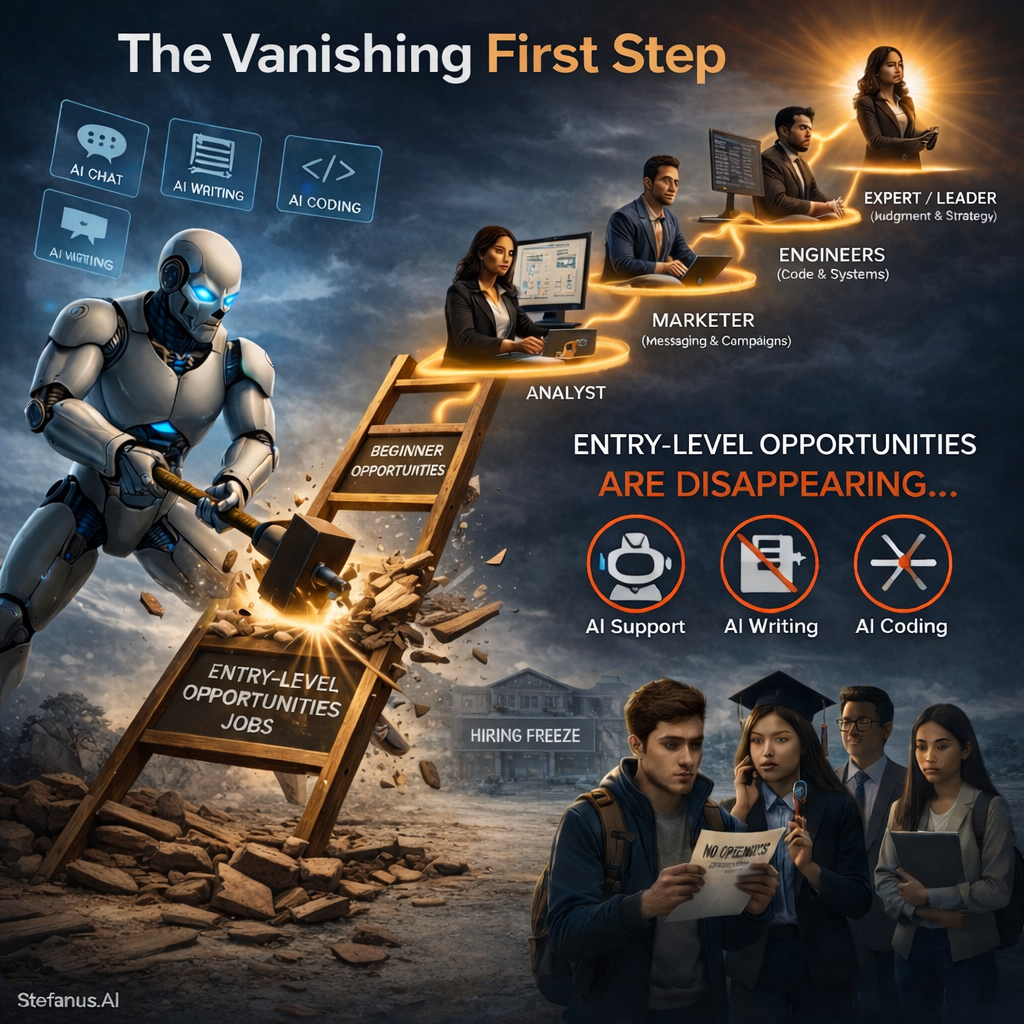
AI is no longer simply changing how work is done. It is reshaping how careers begin. This paper describes this emerging phenomenon as “The Vanishing First Step”—a structural shift in which the traditional entry point into professional work is gradually eroding.
As this paper explores, the implications are significant, particularly for the 2026 graduating workforce. Entry-level roles—the foundation upon which experience, judgment, and expertise are built—are becoming less available across multiple industries.
And as those first opportunities narrow, so too does the pathway into the future workforce.

The Shift No One Is Talking About
At first glance, the labor market does not appear to be collapsing. Many companies are still hiring. Productivity is rising. In some sectors, performance metrics have even improved.
But beneath that surface, something more subtle is unfolding.
The issue is no longer about how many jobs exist. It is about which jobs are no longer being offered to new entrants.
Recent data reflects this shift clearly:
- Entry-level job postings have declined by more than 35% since 2023, with AI-exposed roles dropping by over 40%¹
- Hiring has slowed for younger workers (ages 22–25) in AI-heavy fields²
- Recent graduates are facing rising unemployment and underemployment³
Taken together, these signals point to a structural change. Companies are not eliminating entire professions—they are narrowing the doorway into them.
And that distinction matters.

Why Entry-Level Jobs Are Disappearing First
To understand why this is happening, it helps to look at how entry-level roles have always been designed.
At their core, these roles were built around repetition and learning through doing:
- writing first drafts
- cleaning and organizing data
- answering common customer questions
- fixing small, routine issues
- preparing internal reports
These tasks were never the destination. They were the training grounds where judgment, context, and experience began to form.
Today, those same tasks align almost perfectly with what AI systems do best.
Research from Anthropic shows that coding-related work alone accounts for roughly 35% of AI usage in professional settings⁴. Beyond coding, AI tools are now widely used for writing, summarization, customer interaction, and analysis.
This leads to a critical shift:
AI is not replacing the profession. It is replacing the practice stage.
And when the practice stage disappears, the pathway into the profession becomes unclear.

The Hidden Risk: Breaking the Career Ladder
This is where the long-term risk begins to emerge.
Organizations are preserving expertise—but removing the mechanism through which expertise is built.
Every experienced professional was once a beginner:
- Analysts learned by preparing reports and checking numbers
- Marketers learned by writing imperfect drafts and refining messaging
- Engineers learned by fixing small bugs and observing system behavior
- Support agents learned by handling repetitive questions and understanding customer needs
These early experiences were not just tasks. They were the foundation of judgment.
Without them, something essential is lost.
Harvard Business Review has warned that replacing entry-level roles with AI may weaken the development of future leaders⁵. Similarly, the Financial Times has described the current environment as a “graduate job drought,” reflecting how difficult it has become for new entrants to secure their first opportunity⁶.
In other words, the issue is no longer just economic. It is structural.

How This Is Already Happening Across Industries
This shift is not theoretical—it is already visible across multiple sectors.
In marketing and content creation, AI tools now generate first drafts of campaigns, articles, and reports. As a result, fewer junior writers are needed to produce initial versions.
In software development, AI coding assistants can handle routine programming tasks, reducing the need for junior developers to work on basic assignments.
In customer support, AI chat systems are increasingly capable of resolving Tier 1 inquiries. Companies are responding by reducing frontline roles. Even Microsoft has emphasized AI agents as a solution for handling support workflows⁷.
In finance and analytics, AI systems automate data cleaning, summarization, and reporting—tasks that were once central to entry-level analyst roles.
Across all these industries, the pattern is consistent:
The bottom layer is thinning.
And with it, the opportunity to learn by doing is fading.
The Long-Term Consequences Few Are Planning For
In the short term, these changes look like progress. Organizations become leaner. Workflows become faster. Costs are reduced.
But over time, the consequences begin to accumulate.
When entry-level roles decline, organizations face:
- Weaker talent pipelines — fewer individuals developing into future leaders
- Loss of institutional knowledge — fewer people deeply familiar with systems and processes
- Overreliance on senior talent — increasing costs and reduced scalability
- Shallower expertise — fewer professionals trained from the ground up
A 2026 CFO survey indicates that companies expect AI to shift demand away from routine work toward higher-skill roles⁸. While this shift may improve efficiency, it also raises a fundamental question:
If no one starts at the bottom, who becomes the expert later?
This is not a future problem. It is already beginning.

A Broader Economic and Social Impact
Beyond individual organizations, this trend carries broader implications.
Entry-level jobs have historically served as:
- gateways into the middle class
- starting points for young professionals
- engines of upward mobility
When these roles shrink, access to opportunity becomes more limited.
Global institutions are already signaling concern. The Organisation for Economic Co-operation and Development has warned that young workers face increasing competition from AI in entry-level roles⁹. The International Labour Organization has also highlighted risks to youth employment in AI-exposed sectors¹⁰.
Over time, this could lead to deeper structural inequality—not because jobs disappear entirely, but because access to those jobs becomes more restricted.
The Strategic Mistake Companies Are Making
At the core of this issue is a misunderstanding.
Many organizations view entry-level roles as low-value, easily replaceable functions.
But they are something else entirely.
They are development infrastructure.
A junior employee is not just completing tasks. They are:
- learning how decisions are made
- developing judgment through experience
- absorbing organizational culture
- building the foundation for future leadership
Removing this stage assumes that expertise can be acquired without experience.
It cannot.

Rethinking Entry-Level Work in the AI Era
The solution is not to return to the past.
Entry-level roles should evolve—but they must not disappear.
In an AI-driven workplace, the role of early-career professionals should shift toward:
- supervising and validating AI outputs
- interpreting results within context
- managing exceptions that AI cannot resolve
- engaging in human-centered communication
- developing judgment earlier in their careers
McKinsey & Company describes the future of work as a partnership between humans and AI—not a replacement¹¹.
But for that partnership to succeed, it must begin at the entry level—not only at the senior level.

Final Thought
The conversation about AI and jobs often focuses on what is being lost.
But in 2026, the deeper issue is what is no longer being built.
We are not eliminating work.
We are eliminating the path into work.
And that shift carries long-term consequences that are easy to overlook—but difficult to reverse.
Because once the first step disappears, the entire career ladder becomes unstable.
And without that ladder, the future workforce may become more efficient—but far less developed.

Footnotes
- Revelio Labs, Is AI Responsible for the Rise in Entry-Level Unemployment?, 2026
- Anthropic, Labor Market Impacts of AI, 2026
- Federal Reserve Bank of New York, Labor Market Report, 2025
- Anthropic, Economic Index Report, March 2026
- Harvard Business Review, 2025
- Financial Times, 2026
- Microsoft, Work Trend Index, 2025–2026
- Federal Reserve CFO Survey, 2026
- Organisation for Economic Co-operation and Development, 2026
- International Labour Organization, 2026
- McKinsey & Company, 2026



Comments
[…] entry-level labor is replaced by automation […]