
Across the last century, global influence has largely been shaped by control over tangible assets—land, energy, people, and the industrial systems that transform them into economic and military strength. Even as digital technologies emerged and expanded, the underlying structure did not fundamentally change: governments remained the central actors, and the reach of power was still largely defined by geographic boundaries.
Artificial intelligence is now breaking that assumption.
Unlike previous technologies, AI is not bound to factories, supply chains, or even physical infrastructure alone. It exists as computation, models, and network entities that can be distributed globally, accessed remotely, and scaled almost without regard to borders. As a result, intelligence itself—the ability to generate insight, make decisions, and influence outcomes—is becoming detached from geography.
At the same time, political authority remains territorial. Governments legislate within borders, enforce laws within jurisdictions, and project power through institutions that were designed for a world in which control was local and observable.
This creates a structural divergence:
Intelligence is becoming global. Power remains national.
The early signs of this transformation are already visible:
“We have offered to work directly with the Department of War on R&D … The Department of War has stated they will only contract with AI.” — Dario Amodei¹
“SpaceX has restricted Starlink usage for offensive military operations… citing fears of escalating to ‘World War Three.’” — referring to decisions by Elon Musk²
These are not anomalies. They are indicators of a deeper shift:
private actors are beginning to exercise influence over strategic decisions traditionally reserved for states.
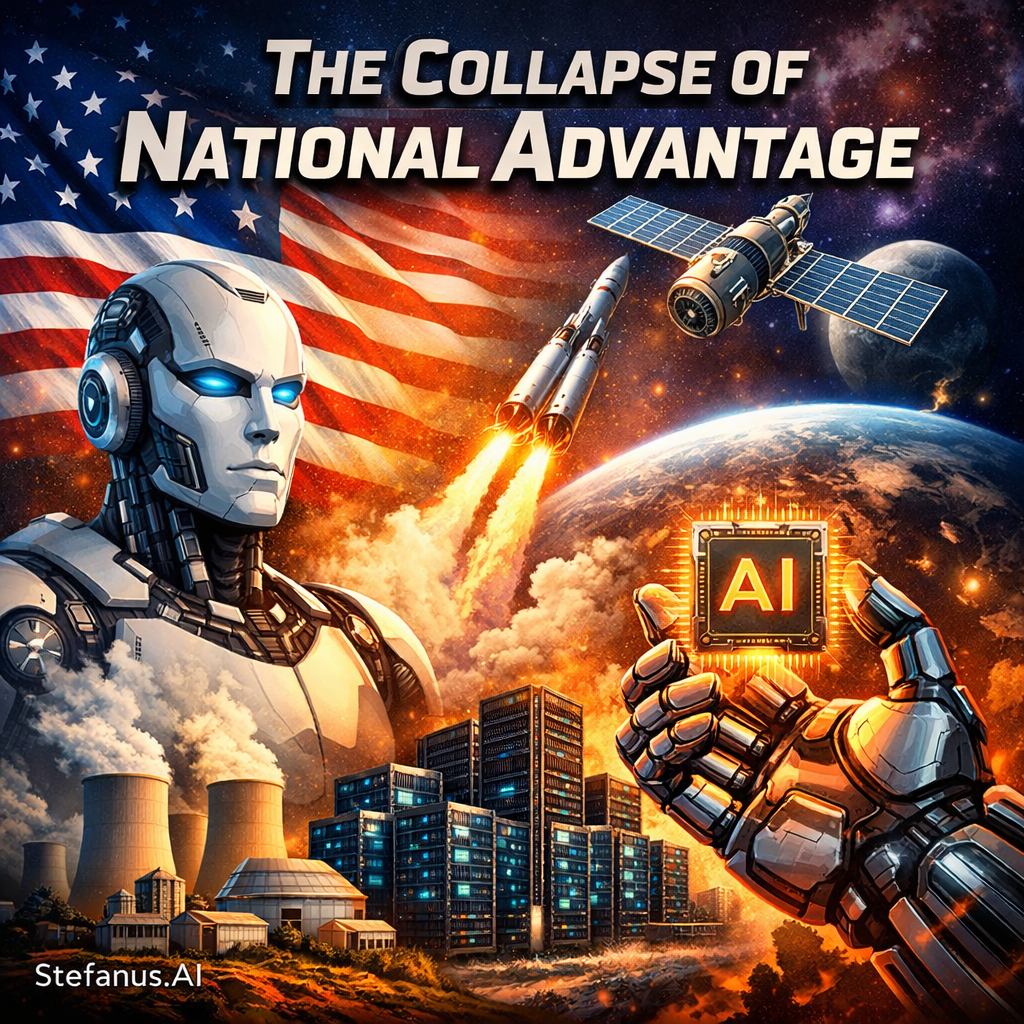
This paper explores the implications of that shift—specifically, how artificial intelligence is not simply enhancing national power, but undermining the very structure through which national advantage has historically been defined.

Why This Title: “The Collapse of National Advantage”
The phrase “collapse of national advantage” reflects a structural transformation rather than a sudden event.
Historically, national advantage depends on the alignment of three elements:
- Territory — where resources and infrastructure are located
- Population — the labor force and human capital
- Control — the state’s ability to govern and direct both
Artificial intelligence weakens each of these simultaneously.
First, territory becomes less decisive when intelligence can be produced and deployed anywhere, often independent of physical location. A model trained in California can influence decisions in Europe, Asia, or Africa instantly.
Second, population becomes less central as AI reduces reliance on human labor, particularly in knowledge-intensive domains. The International Monetary Fund estimates that up to 60% of jobs in advanced economies are exposed to AI-driven transformation³.
Third, and most critically, control becomes fragmented. Strategic infrastructure—cloud computing, AI systems, satellite networks—is increasingly owned by corporations rather than states.
As Stanford Institute for Human-Centered Artificial Intelligence highlights, AI development is highly concentrated within a small number of private organizations, even as its impact spreads globally⁴.
This leads to a fundamental breakdown:
Nations retain sovereignty over territory, but not over intelligence.
The “collapse” is therefore the erosion of the mechanisms through which nations convert territorial assets into power.
I. The Decoupling of Intelligence from Territory
Artificial intelligence represents the first major technological system in which the primary unit of value—intelligence itself—is not tied to geography.
Unlike industrial production, which depends on physical inputs and location-specific infrastructure, AI operates through:
- Distributed computation
- Global data flows
- Networked systems
According to the Stanford Institute for Human-Centered Artificial Intelligence, global AI investment has reached unprecedented levels, with the United States alone accounting for over $100 billion annually⁴. At the same time, these systems are deployed worldwide, influencing decisions far beyond their origin.
The World Bank notes that digital technologies, including AI, are enabling “new forms of economic activity that are less dependent on geography and more dependent on connectivity”⁵.
This creates a structural paradox:
- Intelligence is location-independent
- Authority is location-bound
As a result, the traditional relationship between territory and capability begins to dissolve.

II. The Rise of Corporate Sovereignty
As intelligence detaches from geography, it does not disperse evenly—it concentrates.
This concentration is increasingly found within a small number of corporations that control:
- Advanced AI models
- Cloud computing infrastructure
- Data ecosystems
- Satellite communication networks
Legal scholars have begun to describe this phenomenon as the rise of “technology oligarchs,” entities whose influence extends beyond markets into governance and geopolitical decision-making⁶.
1. Private Control Over Strategic Infrastructure
The actions of Elon Musk in restricting Starlink’s use in military contexts illustrate a new reality: a private company can shape the operational capabilities of a nation during conflict².
2. Private Control Over Intelligence Systems
Similarly, tensions between AI companies and government agencies—highlighted by statements from Dario Amodei—demonstrate that access to advanced intelligence systems is increasingly mediated by corporate decisions¹.
As noted in recent reporting, this dynamic has been described as a “power struggle between democratic governments and AI companies”⁷.
3. The Expansion into Space
Companies such as SpaceX are building satellite networks that form the backbone of global communication systems. These infrastructures are not only commercial, they are strategic, and they operate beyond the effective jurisdiction of any single state.
This leads to a new form of power:
Corporate sovereignty—where private entities control systems that states depend on.

III. The United States Advantage: Freedom as a Structural Multiplier
Despite the erosion of national advantage, the United States currently maintains a dominant position in the global AI landscape.
This advantage is rooted in freedom.
1. Freedom of Inquiry
Institutions such as Stanford University and Massachusetts Institute of Technology emphasize that innovation depends on environments where ideas can be explored without excessive constraint⁸.
Open research ecosystems, academic collaboration, and entrepreneurial experimentation create conditions in which breakthroughs are more likely to occur.
2. Talent Attraction
The United States continues to attract global talent, reinforcing its position as the primary hub of AI development.
3. Capital and Infrastructure
The concentration of venture capital, cloud infrastructure, and research institutions creates a self-reinforcing ecosystem.
As the International Monetary Fund notes, AI-driven investment is increasingly concentrated in advanced economies, particularly the United States³.
This suggests that:
Freedom is not just a political value—it is a competitive advantage in the production of intelligence.
IV. The Limits of Competing Systems
For competing nations, particularly those with more centralized systems, the challenge is structural.
1. Constraints on Innovation
Restrictions on information flow, censorship, and centralized control may limit exploratory research and unconventional thinking.
2. Talent Mobility
Highly skilled individuals tend to migrate toward environments that maximize opportunity and freedom.
3. Institutional Rigidity
The World Bank highlights that institutional quality is a key determinant of digital and AI-driven growth⁵.
This creates a divergence:
- Open systems → higher innovation, lower control
- Closed systems → higher control, lower innovation
V. A New Power Layer Above the State
The convergence of these trends leads to the emergence of a new structural layer of power.
This layer consists of:
- AI laboratories
- Cloud providers
- Satellite networks
- Data platforms
These systems are:
- Globally distributed
- Privately controlled
- Strategically indispensable
As geopolitical analysts have noted, AI is becoming a “geopolitical tool” shaping global power dynamics⁹.
The hierarchy shifts from:
- State → Corporation
to:
- State ↔ Corporation ↔ Intelligence Networks
In this environment:
Control over intelligence becomes more important than control over territory.

VI. Looking Beyond 2026: The Future Trajectory
Looking forward, the implications of this transformation extend far beyond current geopolitical frameworks, pointing toward a future in which the structure of power becomes increasingly fluid, layered, and decoupled from traditional institutions.
First, governments may evolve into dependent consumers of intelligence, relying on private AI systems for decision-making, cybersecurity, military planning, and economic forecasting, creating a condition in which sovereign authority is mediated through systems that are not fully controlled by the state, like how modern governments depend on private financial markets, but with far greater strategic implications.
Second, technology leaders may emerge as de facto geopolitical actors, where decisions made by individuals such as Elon Musk or Dario Amodei influence not only corporate outcomes but international relations, conflict dynamics, and global stability, particularly when their companies control infrastructure that is essential for communication, intelligence, and coordination.
Third, sovereignty itself may become fragmented, with authority distributed across overlapping systems of governance, including nation-states, corporations, and transnational networks, leading to a world in which no single entity has complete control, and where power is negotiated across multiple layers rather than exercised from a single center.
Fourth, the expansion of space-based infrastructure, including satellite constellations and potential orbital data centers—may create a domain of intelligence that operates beyond terrestrial jurisdiction, further weakening the ability of states to regulate or control the systems that underpin global communication and computation.
Fifth, the development of recursive intelligence, in which AI systems contribute to their own improvement, may accelerate the pace of technological change beyond the capacity of traditional institutions to respond, reinforcing the gap between innovation and governance¹⁰.
Finally, global inequalities in access to AI may deepen, as advanced capabilities remain concentrated in a small number of regions and organizations, reinforcing asymmetries in power and influence across the international system¹⁰.
Conclusion: Power Remains National, Intelligence Does Not
Artificial intelligence is not simply a new technology—it is a structural force that redefines the relationship between intelligence and power.
By decoupling intelligence from territory, concentrating it within private networks, and distributing its effects globally, AI undermines the traditional foundations of national advantage.
For the United States, this transformation reinforces leadership while simultaneously diffusing control. For competing nations, it presents systemic challenges that extend beyond technology into governance, culture, and institutional design.
The central insight remains:
Power remains national. Intelligence does not.
And as this divergence deepens, the future of global order will be shaped not only by states, but by the networks of intelligence that operate beyond them.

Footnotes & Sources
- Dario Amodei – AI safeguards and Pentagon discussions (2025–2026 reporting)
- Elon Musk – Starlink usage restrictions in Ukraine conflict (Reuters, NYT coverage)
- International Monetary Fund AI and labor market impact: https://www.imf.org
- Stanford Institute for Human-Centered Artificial Intelligence: https://hai.stanford.edu/ai-index
- World Bank Digital development report: https://www.worldbank.org
- Fordham Law Review – Technology oligarchs and governance: https://ir.lawnet.fordham.edu
- Business Insider – AI vs government power struggle: https://www.businessinsider.com
- Research from Stanford University and Massachusetts Institute of Technology on innovation ecosystems
- Bloomberg / WEF – AI as geopolitical tool: https://www.bloomberg.com
- AI adoption and inequality research (Anthropic / arXiv): https://arxiv.org