
Artificial intelligence is often described as a breakthrough in software.
That description is incomplete.
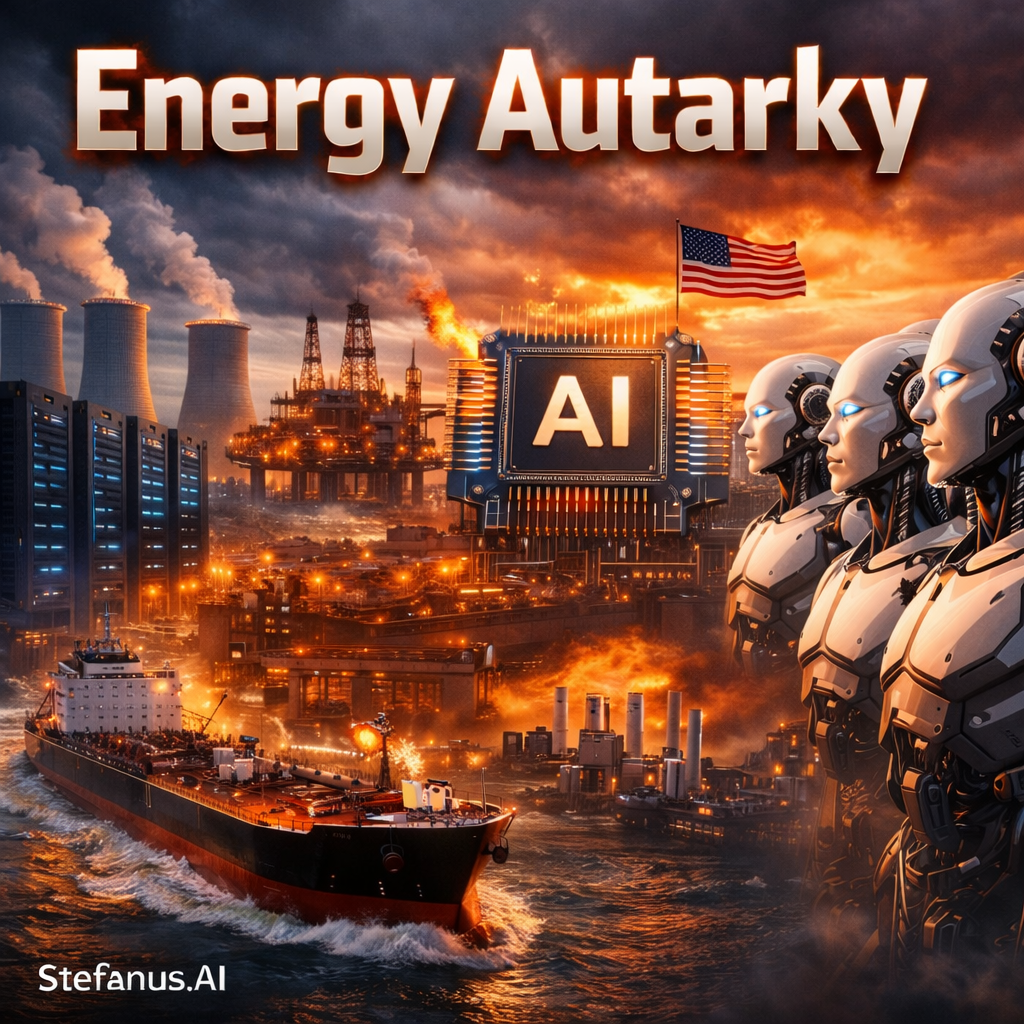
What is unfolding is a transformation of infrastructure—one that shifts the foundation of intelligence from code to current, from models to megawatts.
The defining constraint of this era is no longer algorithmic capability.
It is electricity.
Why This Term: “Energy Autarky”
I deliberately chose the term Energy Autarky over the more commonly used “energy security.”
Because the two are not the same.
Energy security assumes:
- interconnected markets
- diversified supply chains
- managed interdependence
It belongs to the logic of globalization.
Energy autarky, by contrast, represents something far more radical.
The word autarky originates from the Greek:
autarkeia (αὐτάρκεια) — meaning self-sufficiency, self-rule, independence from external systems
Historically, it has been used to describe economic systems designed to operate without reliance on external trade or supply.
In the context of artificial intelligence, the meaning evolves:
Energy Autarky is the condition in which a nation, corporation, or compute-sovereign entity can generate, control, and sustain its own energy supply—independently of external systems—to power intelligence infrastructure.
This is not a semantic shift.
It is a structural one.

Why Now
The transition toward Energy Autarky did not begin in theory.
It was forced by reality.
The geopolitical disruptions of early 2026—particularly instability surrounding critical energy corridors such as the Strait of Hormuz—exposed a truth that had long been underestimated:
AI systems may be digital, but their survival depends on physical infrastructure that is fragile, localized, and politically exposed.
The “Iran Shock” did not create vulnerability.
It revealed it.
As Prof. Meghan L. O’Sullivan (Harvard Kennedy School) explains:
“The world has never escaped the reality of oil geopolitics… governments are increasingly pulled toward energy autarky.” [1]
At the same time, AI systems have evolved into:
- continuous systems
- global systems
- real-time systems
They cannot pause.
They cannot degrade.
They require uninterrupted energy.
This creates a fundamental asymmetry:
Digital systems operate continuously.
Energy systems remain constrained by geography and politics.
The result is inevitable:
The bottleneck of intelligence has shifted—from compute to power.
I. The End of Digital Globalization
For decades, the digital economy was built on a powerful assumption:
Infrastructure can be global.
Risk can be distributed.
Systems can remain online.
This assumption no longer holds.
The events of 2026 demonstrated that energy systems are not globally resilient, and AI infrastructure cannot tolerate instability in the way traditional industries can.
Large-scale AI clusters now consume energy at the scale of small nations.
They are not flexible.
They are fixed, high-density, always-on systems.
As a result:
Compute is no longer portable. It is anchored to energy.
This marks the beginning of a structural shift:
- The internet remains global
- But compute becomes regional
- And energy becomes sovereign
Digital globalization does not disappear.
It fragments.
II. The Triple Convergence: AI, Energy, Geopolitics
We are witnessing the convergence of three systems that were previously treated as separate:
- Artificial Intelligence
- Energy Infrastructure
- Geopolitical Power
The World Economic Forum describes this as the “Triple Transition”:
“AI, energy systems, and geopolitics are converging… compute scarcity is emerging as a real risk.” [2]
This convergence creates a new operating environment.
AI requires:
- continuous uptime
- massive compute density
- stable, predictable energy
Energy systems are:
- regionally constrained
- infrastructure-heavy
- politically exposed
Geopolitics introduces:
- supply disruptions
- infrastructure targeting
- strategic competition
At Stanford, this shift is reframed:
“AI infrastructure is defined not by scale alone, but by power density, location, and resilience.” [3]
The axis of competition has moved.
From software → to infrastructure
From models → to energy
From innovation → to control

III. The 1-Gigawatt Frontier: Data Centers as Power Systems
By 2026, we have entered the era of Gigawatt Infrastructure.
Leading AI clusters now require:
- ~1 gigawatt of power per facility
- continuous operation
- dedicated energy supply
This is equivalent to nuclear-scale demand.
According to the Financial Times:
“The biggest constraint is not compute—it is power… without it, AI cannot scale.” [4]
This has triggered a structural transformation.
AI Companies Are Becoming Energy Companies
Major players are now:
- building behind-the-meter generation systems
- investing in nuclear (SMRs), gas, hydrogen
- co-locating compute with power infrastructure
This is not optimization.
It is necessity.
The International Energy Agency (IEA) reinforces this:
“Data center electricity consumption is expected to surge significantly, driven by AI workloads.” [8]
The implication is clear:
Control of electricity is now control of intelligence.
IV. The Global Divide: Energy as the New Inequality
AI does not distribute evenly.
It concentrates where energy is abundant, stable, and controllable.
The International Monetary Fund (IMF) warns:
“AI-driven growth may increase divergence between nations able to power these systems and those that cannot.” [5]
This creates a new hierarchy:
Energy-Compute Sovereigns
- United States
- China
- Gulf States
Strategic Middle Powers
- Germany
- Japan
- United Kingdom
Energy-Constrained Economies
- much of the developing world
As Daron Acemoglu (MIT) notes:
“Technological change can amplify inequality when complementary infrastructure is uneven.” [9]
Energy is now that infrastructure.
V. Middle Powers and Selective Autonomy
Not all nations can achieve full energy autarky.
But dependence is increasingly unacceptable.
According to Chatham House:
“The goal is not scale dominance, but the ability to choose and adapt without strategic dependency.” [6]
This leads to a hybrid model:
Selective Autonomy
- decentralized energy systems
- renewable-heavy grids
- modular AI infrastructure
- controlled interdependence
At Oxford, this is framed as:
“Technological sovereignty through strategic independence, not isolation.” [10]

VI. The Scientific Constraint: The Power Bottleneck
At the level of physics, the constraint is absolute.
AI requires:
- energy
- continuity
- density
Research from MIT Energy Initiative and Morgan Stanley shows:
“AI energy demand is approaching national-scale consumption levels.” [7]
Further:
“The electricity required must be stable, localized, and high-density—beyond what traditional grids can deliver.” [7]
This creates a mismatch:
| AI Systems | Energy Systems |
| Continuous | Intermittent |
| High-density | Distributed |
| Predictable | Variable |
The conclusion:
The grid is no longer sufficient.
VII. The Sovereign Stack: Redefining Power
Power is being redefined.
Historically:
- sovereignty = territory + military + economy
Now:
The Sovereign Stack
- Compute
- Data
- Algorithms
- Energy
Without energy:
None of the above can function.
As Ursula von der Leyen states:
“Energy independence is essential to sovereignty.” [12]
In the AI era:
Energy independence is intelligence sovereignty.
VIII. Efficiency as Strategy
Energy is finite.
Efficiency becomes strategic.
Reducing:
- energy per token
- compute per inference
- cooling load
Is no longer about cost.
It is about:
capacity, survivability, and control
As Jensen Huang (NVIDIA) emphasizes:
“Efficiency determines how much intelligence you can generate per watt.” [15]
Conclusion: The Operating Logic of 2026
The transition to Energy Autarky is not gradual.
It is structural.
The old model:
- global
- interconnected
- optimized for efficiency
The new model:
- regional
- sovereign
- optimized for resilience
The governing principle is simple:
Artificial intelligence is infrastructure.
Infrastructure is power.
Power is electricity.
And therefore:
Electricity is intelligence.
Final Principle
AI can replace labor.
AI can replace decisions.
AI can replace processes.
But it cannot replace its own foundation.
AI cannot replace power.
And in 2026:
Power is no longer a utility.
It is sovereignty itself.

Footnotes & Accessible Sources
[1] Meghan L. O’Sullivan & Jason Bordoff (Harvard Kennedy School),
The Iran Shock: Once Again, Energy Is Power, Foreign Affairs, 2026
https://www.russiamatters.org/news/russia-analytical-report/russia-analytical-report-march-30-april-6-2026
[2] Gayle Markovitz & Maxwell Hall (World Economic Forum),
3 Lessons on Energy Transition in Crisis, 2026
https://www.weforum.org/stories/2026/04/3-lessons-energy-transition-age-of-crisis/
[3] Tabitha Saw (Stanford HAI Affiliate),
AI Trends 2026: Power Bottleneck, 2026
https://www.mofo.com/resources/insights/260205-ai-trends-for-2026-power-not-compute
[4] Financial Times,
The Power Crunch Threatening AI, 2026
https://ig.ft.com/ai-power/
[5] International Monetary Fund (IMF),
World Economic Outlook, 2026
https://www.imf.org/-/media/files/publications/weo/2026/january/english/text.pdf
[6] Chatham House,
AI and Middle Power Strategy, 2026
https://www.chathamhouse.org/2026/02/how-middle-powers-can-weather-us-and-chinese-ai-dominance
[7] Morgan Stanley & MIT Energy Initiative,
Powering AI, 2026
https://www.morganstanley.com/insights/articles/powering-ai-energy-market-outlook-2026
[8] International Energy Agency (IEA),
Electricity 2026 Report
https://www.iea.org/reports/electricity-2026
[9] Daron Acemoglu (MIT),
AI and Inequality, NBER
https://www.nber.org/papers
[10] Oxford University,
Technological Sovereignty Studies
https://www.ox.ac.uk
[11] Stanford HAI,
AI Index Report 2025–2026
https://aiindex.stanford.edu
[12] Ursula von der Leyen (European Commission),
Energy Sovereignty Speech
https://ec.europa.eu
[13] Bank for International Settlements (BIS),
AI and Productivity, 2025–2026
https://www.bis.org
[14] Harvard Business School,
Generative AI and Productivity, 2024–2025
https://www.hbs.edu
[15] Jensen Huang (NVIDIA),
Keynote Statements on AI Efficiency, 2025–2026
https://www.nvidia.com
Comments
[…] infrastructure is energy infrastructure. If conflict in the Middle East disrupts oil supply, energy prices rise. If energy prices rise, […]
[…] share of the world’s lifeblood must flow, and whose closure would convulse the global system. For oil, it was the Strait of Hormuz. For compute, it is the island of Taiwan, and more precisely the […]
[…] operations against Iran. Iran retaliated where it could hurt the industrialized world most: in the Strait of Hormuz, the narrow waterway through which roughly twenty percent of global oil supply — approximately […]