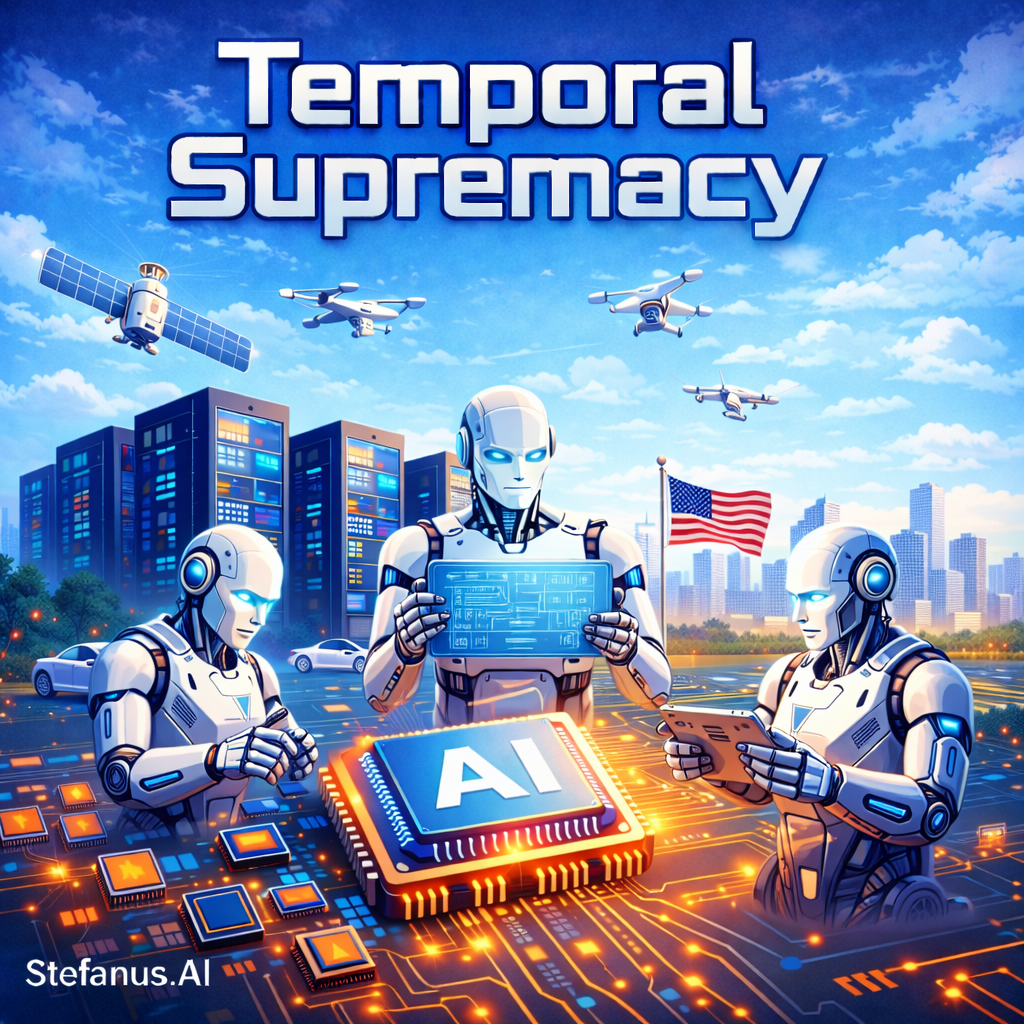

The defining competition of the 21st century is no longer determined solely by territory, capital, or even technological capability. It is increasingly defined by time, specifically, the ability to operate, decide, and act faster than competing systems. The term “Temporal Supremacy” is therefore not metaphorical. It describes a structural shift in how power is acquired and exercised: those who dominate time dominate outcomes.
Temporal Supremacy refers to the condition in which actors—whether corporations, states, or autonomous systems—gain decisive advantage by compressing the interval between signal, decision, and execution. Artificial intelligence is the first technology in history that meaningfully collapses this interval toward near-zero.
This paper adopts the term deliberately. “Supremacy” historically referred to dominance in domains such as land, sea, air, or nuclear capability. Today, the domain is temporal. The battlefield is not geography, it is latency.
To understand how this transformation emerged, it is necessary to examine the history of the internet and digital platforms. Over the past three decades, supremacy has repeatedly shifted—not because one company was permanently superior, but because another operated faster, adapted quicker, and scaled sooner.
What follows is not merely a chronology of technological change, but a deeper pattern:
supremacy is temporary—but speed determines who holds it.

2. The Historical Pattern: Supremacy as a Function of Speed
2.1 AOL to EarthLink: Access Speed Defines Power
In the early 1990s, AOL dominated internet access with dial-up connectivity, amassing millions of subscribers. Its supremacy was rooted in accessibility and early network effects.
However, the emergence of EarthLink in 1994, based in Pasadena, introduced faster connectivity through early broadband and DSL. This marked a critical shift:
- Supremacy moved from who connected people → to who connected them faster
The lesson: infrastructure speed—not just availability—redefines dominance.
2.2 BlackBerry to iPhone: Interface Speed and Experience
Devices like BlackBerry Limited once held corporate supremacy due to secure email and physical keyboards.
This changed dramatically when Steve Jobs introduced the iPhone in 2007. While initially dismissed by Steve Ballmer, the iPhone redefined interaction speed:
- Touch interface
- App ecosystem
- Real-time responsiveness
Consumer behavior proved decisive—thousands lined up globally. Supremacy shifted not because BlackBerry lacked capability, but because Apple accelerated user interaction cycles.
2.3 Intel to Platform Ecosystems: Hardware Supremacy Erodes
For decades, Intel dominated computing through its Pentium and Core processors. However, the rise of integrated ecosystems redistributed power.
Compute supremacy moved from:
- Raw processor speed → to system-level optimization + integration speed
2.4 Yahoo to Google: Information Retrieval Speed
Search engines such as Yahoo once led the web. This changed with Google, which optimized:
- Ranking algorithms
- Page load speeds
- Query relevance in milliseconds
As Stanford economist Erik Brynjolfsson explains:
“Digital technologies are characterized by rapid scalability and near-zero marginal cost, allowing leaders to pull far ahead once they gain an edge.”¹
2.5 Internet Explorer to Chrome: Execution Speed
Internet Explorer once held ~90% market share. Its decline came with Google Chrome, which prioritized:
- Faster rendering
- Frequent updates
- Performance optimization
Supremacy shifted because iteration cycles accelerated.
2.6 Skype to Zoom: Crisis-Time Acceleration
Skype dominated early video communication. During COVID-19, Zoom overtook due to:
- Faster onboarding
- Lower friction usability
- Real-time scalability
A crisis compressed time—and Zoom won by operating faster within that compressed window.
2.7 Facebook to TikTok: Algorithmic Time Control
Platforms like Facebook once dominated attention. The rise of TikTok and Instagram introduced:
- Algorithm-driven content delivery
- Continuous real-time adaptation
As UC Berkeley professor Hany Farid notes:
“Algorithms now shape not just what we see, but when we see it.”²
2.8 Enterprise Communication: Slack vs Legacy Systems
Traditional tools like MSN Messenger evolved slowly. Slack gained dominance through:
- Real-time collaboration
- API integration speed
Corporate productivity itself became time-optimized.
2.9 AI Competition: ChatGPT → Gemini → Claude
The launch of ChatGPT in 2022 triggered a new acceleration cycle:
- Google Gemini rapidly followed
- Claude introduced alternative architectures
According to the Stanford AI Index:
“The pace of AI model development has accelerated dramatically, with performance improving in shorter timeframes.”³

3. Temporal Supremacy in Markets and Infrastructure
Financial markets already operate under Temporal Supremacy conditions.
The Bank for International Settlements observes:
“High-frequency trading firms compete on speed measured in microseconds.”⁴
The Financial Times notes:
“Latency has become a competitive frontier in global finance.”⁵
At Massachusetts Institute of Technology, economist Daron Acemoglu warns:
“The direction of technological change shapes power distribution in society.”⁶
What distinguishes the current phase is not merely speed, but the compression of economic decision cycles into machine time. Markets that once operated on human reaction now function on automated response systems, where algorithms anticipate, decide, and execute in fractions of a second.
This transformation is expanding beyond financial markets into:
- logistics optimization
- energy grid balancing
- autonomous supply chains
- predictive infrastructure systems
As compute becomes embedded across systems, time itself becomes the core economic variable.

4. Policy Lag: The Structural Weakness of Governments
The acceleration of AI systems has exposed a fundamental asymmetry:
machines operate in real time, governments operate in procedural time.
The United Nations states:
“AI governance frameworks lag significantly behind technological development.”⁷
At Harvard University, political philosopher Danielle Allen argues:
“Democratic institutions are not designed for rapid, continuous decision-making.”⁸
From Stanford University, AI leader Fei-Fei Li notes:
“Technology moves fast, but human-centered governance requires deliberation.”⁹
The International Monetary Fund reinforces:
“Technological change is outpacing policy adaptation in many economies.”¹⁰
At California Institute of Technology, AI researcher Anima Anandkumar highlights:
“AI systems are evolving at a pace that outstrips traditional oversight mechanisms.”¹¹
Academic research further suggests that governance systems rely on assumptions that fail under real-time technological conditions, creating persistent regulatory gaps.¹²
The result is structural:
- AI systems operate continuously
- governments respond intermittently
- innovation cycles accelerate
- policy cycles remain fixed
This is not a temporary delay—it is a permanent temporal mismatch.
5. Deepfakes, Social Harm, and Human-Time Limits
Deepfakes represent the clearest example of Temporal Supremacy in practice.
At University of California, Berkeley, Hany Farid warns:
“We are entering an era where seeing is no longer believing.”²
At University of Southern California, Emilio Ferrara explains:
“Information spreads faster than our ability to verify its authenticity.”¹³
The World Bank states:
“Digital risks evolve faster than institutional safeguards can respond.”¹⁴
From Oxford University, philosopher Nick Bostrom observes:
“Technological progress can outpace the evolution of our institutions.”¹⁵
At MIT Media Lab, researchers emphasize:
“Synthetic media collapses the time between creation and global distribution.”¹⁶
The asymmetry is clear:
- creation → instantaneous
- distribution → global
- harm → immediate
- response → delayed
Efforts to regulate misuse—including advocacy associated with Melania Trump—highlight growing awareness, yet remain structurally reactive.

6. West Coast Acceleration: The Geography of Time Advantage
Temporal Supremacy is geographically concentrated.
Silicon Valley and the US West Coast host:
- OpenAI
- Anthropic
- Nvidia
At Stanford University, Erik Brynjolfsson states:
“AI is amplifying productivity by accelerating decision-making processes.”¹
From University of California, Berkeley, Stuart Russell warns:
“We are building systems whose capabilities may exceed our ability to control them.”¹⁷
At University of California, Los Angeles, Sebastian Edwards notes:
“Technological leadership is increasingly tied to regional innovation ecosystems.”¹⁸
From Harvard University, Kenneth Rogoff observes:
“The speed of technological change is reshaping global economic competition.”¹⁹
This creates a compounding dynamic:
speed → advantage → scale → more speed
The geography of compute becomes the geography of time advantage.
7. Conclusion: Temporal Supremacy as the New Axis of Power
The examples presented—from AOL to AI—demonstrate a consistent pattern:
- supremacy is not permanent
- it shifts to those who move faster
- speed compresses advantage into decisive dominance
The term “Temporal Supremacy” is therefore not rhetorical—it is descriptive of a new order.
In previous eras:
- power was territorial
- then industrial
- then informational
Now, power is temporal.
Artificial intelligence accelerates decision-making beyond human capability, creating systems that:
- operate continuously
- adapt instantly
- act autonomously
Governments, constrained by deliberation, cannot match this speed. Institutions, designed for stability, struggle in an environment defined by acceleration.
This is why the title fits:
the central variable across all examples is time.
Those who control time—through faster computation, faster networks, and faster decisions—will define outcomes across:
- economics
- geopolitics
- governance
Temporal Supremacy is not the future.
It is already underway.

Footnotes:
- Erik Brynjolfsson, Stanford — https://www.gsb.stanford.edu/faculty-research/faculty/erik-brynjolfsson
- Hany Farid, UC Berkeley — https://people.eecs.berkeley.edu/~farid/
- Stanford AI Index — https://aiindex.stanford.edu/report/
- BIS — https://www.bis.org/publ/work1115.htm
- Financial Times — https://www.ft.com
- Daron Acemoglu, MIT — https://economics.mit.edu/people/faculty/daron-acemoglu
- UN AI Advisory — https://www.un.org/en/ai-advisory-body
- Danielle Allen, Harvard — https://scholar.harvard.edu/danielleallen
- Fei-Fei Li, Stanford — https://profiles.stanford.edu/fei-fei-li
- IMF — https://www.imf.org/en/Publications
- Anima Anandkumar, Caltech — https://www.cms.caltech.edu/people/anima
- AI governance research — https://arxiv.org/abs/2501.10384
- Emilio Ferrara, USC — https://viterbischool.usc.edu/directory/faculty/Ferrara/Emilio
- World Bank — https://www.worldbank.org/en/topic/digitaldevelopment
- Nick Bostrom, Oxford — https://www.oxfordmartin.ox.ac.uk/people/nick-bostrom
- MIT Media Lab — https://www.media.mit.edu
- Stuart Russell, Berkeley — https://people.eecs.berkeley.edu/~russell/
- Sebastian Edwards, UCLA — https://www.anderson.ucla.edu/faculty/sebastian.edwards
- Kenneth Rogoff, Harvard — https://scholar.harvard.edu/rogoff