
Introduction: The Forgotten Foundation of Artificial Intelligence
There is a question that almost no one asks when they discuss artificial intelligence, yet it contains within it the entire logic of the AI era. Before the transformer architecture, before the GPU cluster, before the trillion-parameter model, before the autonomous agent that may one day reshape labor and capital — what was needed? The answer is not engineering talent, not venture capital, not geopolitical ambition, though all of these matter. The first requirement is electricity.
Artificial intelligence does not begin with models. Artificial intelligence begins with electricity.
The modern discourse on AI has been, understandably, dominated by the drama of the model layer — ChatGPT’s rise, DeepSeek’s disruption, the race to GPT-5, the trillion-parameter frontier. It has been shaped by the semiconductor wars, the export controls on NVIDIA H100s, TSMC’s dominance of sub-3nm fabrication, and the geopolitical confrontation over chips. What has received far less sustained intellectual attention is the foundational layer beneath all of these: the physical infrastructure of electricity generation, transmission, and delivery that makes every byte of intelligence possible.
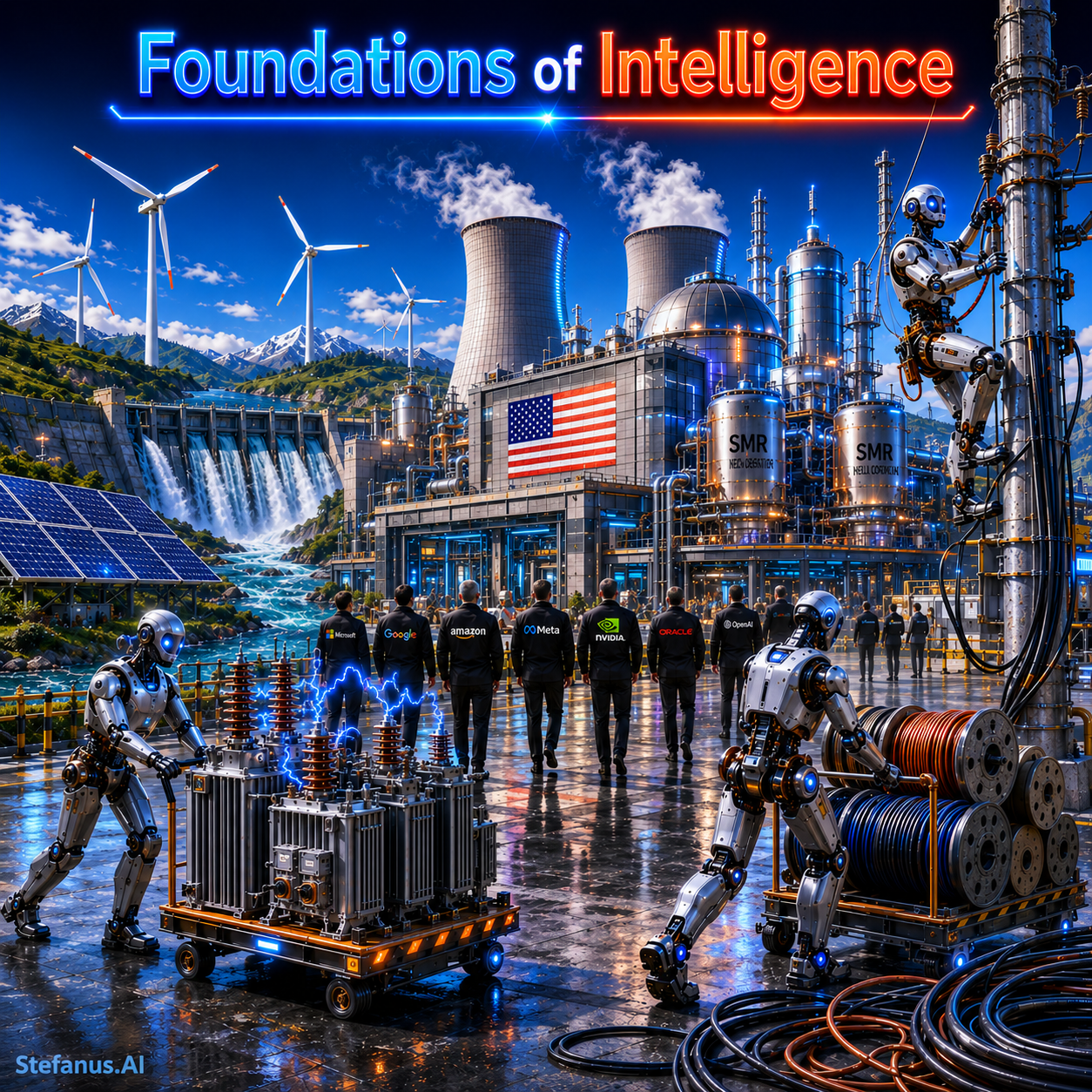
This paper introduces a framework I call Foundations of Intelligence. The thesis is simple in form but profound in implication: energy is not merely one input among many into the AI production stack. Energy is the layer upon which all other layers depend. It is the precondition for semiconductors to operate, for datacenters to run, for models to be trained, for agents to infer. Without a sufficient, reliable, and strategic supply of electricity, the entire architecture of the AI economy collapses — not metaphorically, but physically.
The framework situates this argument within what I call the Five-Layer AI Economy:
Layer 1 — Energy: Power generation, grid infrastructure, transmission, and storage
Layer 2 — Chips: Semiconductors, GPUs, TPUs, and AI accelerators
Layer 3 — Datacenters: Physical facilities, cooling, rack density, and interconnect
Layer 4 — Models: Foundation models, training runs, and inference platforms
Layer 5 — Applications and Agentics: Products, autonomous agents, and economic output
Each layer depends on those beneath it. The chip cannot run without the datacenter. The datacenter cannot operate without the grid. The grid cannot deliver electrons without generation. This dependency chain means that Layer 1 is not simply the first layer chronologically — it is the layer that determines the ceiling of every layer above it. Nations, corporations, and research institutions that fail to secure sufficient electricity will find that their ambitions at Layers 2 through 5 are constrained in ways no amount of software brilliance can overcome.
The evidence for this thesis has arrived in recent years with the force of industrial reality rather than theoretical argument. In April 2026, the International Energy Agency (IEA) published updated projections showing that global electricity consumption from AI-focused data centers grew 50% in 2025 alone — and that the broader data center sector is on track to nearly double its power consumption from 485 TWh in 2025 to 950 TWh by 2030.[1]
In the United States, the numbers are equally striking. U.S. data centers consumed 183 TWh of electricity in 2024 — more than 4% of total national electricity consumption, roughly equivalent to the entire annual demand of Pakistan.[2] A January 2026 report by Bloom Energy projected that U.S. data centers’ total combined energy demand would nearly double between 2025 and 2028, jumping from 80 to 150 gigawatts.[3] Project Stargate — the $500 billion AI infrastructure initiative announced by OpenAI, Oracle, and SoftBank in January 2025 — targets alone 10 gigawatts of planned capacity across the continental United States.[4]
This paper proceeds in four sections. Section 1 builds the theoretical architecture of Foundations of Intelligence, explaining the energy-to-computation conversion chain and the historical and structural reasons why AI resembles the industrial electricity buildouts of the early twentieth century. Section 2 profiles the key corporate builders of the energy layer — the utilities, independent power producers, nuclear operators, grid equipment manufacturers, and hyperscalers who are defining the new energy-AI nexus. Section 3 examines the central structural tension of the current moment: the mismatch between the intermittent nature of renewable energy and the always-on demands of AI inference. Section 4 draws together eight strategic pillars that define what civilizations, corporations, and investors must understand to navigate the coming decades of intelligence competition.
The thesis of Foundations of Intelligence is ultimately simple, even if its implications are vast: the future race for AI leadership may be decided not in the model laboratory, not in the chip fabrication plant, not in the venture capital boardroom, but in the power plant, the substation, and the transmission corridor. Those who control the electrons will exercise disproportionate influence over those who control the algorithms.

Section 1: Foundations of Intelligence — Energy as the First Layer of the AI Economy
1.1 What Does ‘Foundations of Intelligence’ Mean?
To speak of the foundations of intelligence is to insist on a form of attention that is rare in technology discourse: attention to what lies beneath. The dominant habit of thought in AI analysis focuses on the model — its capabilities, its benchmarks, its emergent behaviors, its commercial applications. This is understandable. The model is visible, legible, and exciting. It speaks. It writes. It codes. It reasons, after a fashion.
What the model does not do is generate its own energy. Every forward pass, every backpropagation step, every token of inference output is ultimately the product of electrons flowing through silicon. Intelligence, as we have constructed it in the form of large language models, diffusion models, and multimodal systems, is a physical process. It consumes watts. It generates heat. It requires cooling. It depends on substations, transformers, cables, and the vast infrastructure of the electrical grid.
The framework of Foundations of Intelligence rests on a claim about the nature of modern AI that differs meaningfully from the way it is commonly described. AI is almost always described as software — as code running on hardware. This description is accurate as far as it goes, but it obscures the industrial character of what has actually been built. AI training at the frontier scale is not a software project in any meaningful sense. It is an industrial undertaking, requiring the kind of physical infrastructure coordination that was last seen during the construction of the electrical grid itself, or the railway networks of the nineteenth century, or the petroleum infrastructure of the twentieth.
The IEA’s 2025 report Energy and AI recognized this industrial character explicitly, noting that AI-focused data centers can draw as much electricity as power-intensive factories such as aluminum smelters, but are far more geographically concentrated.[5] This comparison is not casual. An aluminum smelter consuming 500 MW of power is classified by energy economists as heavy industry. A hyperscaler data center consuming an equivalent amount is still often described in public discourse as a technology facility — a misclassification with significant implications for policy, planning, and strategic analysis.
The hierarchy of dependency in the Five-Layer AI Economy makes this industrial character unavoidable. Chips cannot operate without power. Datacenters cannot cool their racks, power their servers, or maintain their connectivity without electricity. Models cannot be trained without the compute that datacenters provide. Applications and agentic systems cannot deliver inference at scale without models. Each layer is causally dependent on the layer below it, meaning the strength of the entire stack is limited by the strength of its weakest foundational component — and the foundational component is energy.
When we speak of Foundations of Intelligence, we are therefore speaking about the physical infrastructure of intelligence itself: the generation facilities, the grid connections, the substations, the cooling systems, the transmission lines, and the strategic relationships between energy producers and AI consumers that collectively determine the maximum possible scale of machine cognition. To build intelligence at civilization scale is, first and foremost, a problem of energy infrastructure.
1.2 The Energy-to-Intelligence Conversion Chain
There is a conversion chain at the heart of artificial intelligence that is worth tracing with care because its logic has profound implications for economic analysis, strategic planning, and public policy. The chain runs as follows:
Primary Energy → Generation → Transmission → Delivered Electricity
→ Compute → Model Inference → Token → Economic Output
Every step in this chain involves a transformation, and every transformation involves losses. Coal must be combusted to produce steam; steam must drive a turbine to produce electricity; electricity must be transmitted across the grid, losing a percentage to resistance; delivered electricity must power servers, losing further energy to heat; servers must run the mathematical operations of the model, consuming watts per FLOP; and the aggregated FLOPs of a training run or inference step produce the economic output — the completed task, the answered question, the generated image.
This conversion chain has a crucial implication: the marginal cost of intelligence is ultimately denominated in energy. As models become more capable, as the tasks they are asked to perform become more complex, and as the volume of inference requests scales with user adoption, the energy demands of the AI economy grow in direct proportion. The intellectual work of AI is physical work, measured in watts.
There is, however, an important and often misunderstood distinction between training and inference in this energy calculus. Training is episodic and extremely energy-intensive per event — running a single large frontier model training run can consume electricity equivalent to the annual consumption of tens of thousands of households. Inference, by contrast, is continuous, distributed, and increasingly the dominant driver of AI energy consumption as deployment scales.
MIT Technology Review’s 2025 analysis confirmed this transition precisely: as AI features are embedded into daily life across products and services, inference has become the primary driver of energy usage at hyperscalers, eclipsing training in aggregate consumption terms.[6] This matters for infrastructure planning because inference energy is not periodic or predictable — it scales with user engagement, with product adoption, and ultimately with the number of intelligent tasks the global economy assigns to machines.
The IMF Working Paper WP/25/81, Power Hungry: How AI Will Drive Energy Demand, published in April 2025 by Melina, Pescatori, and Thube, modeled three scenarios for AI-driven energy demand growth and found that under current policies, AI expansion will cause manageable but significant increases in electricity prices and emissions — and that the magnitude of these effects depends critically on whether energy infrastructure investment keeps pace with model deployment.[7]
“The development and deployment of large language models like ChatGPT across the world requires expanding data centers that consume vast amounts of electricity. Our analysis of national accounts reveals AI-producing sectors in the U.S. have grown nearly triple the rate of the private non-farm business sector, with firm-level evidence showing electricity costs for vertically integrated AI companies nearly doubled between 2019–2023.”
— Melina, Pescatori & Thube, IMF Working Paper WP/25/81, April 2025[7]
This data point — electricity costs for AI companies nearly doubling in four years — is one of the most revealing indicators of the transition we are living through. It is the fingerprint of industrialization, the moment when an activity that was once peripheral to energy markets becomes central to them.
1.3 The Industrialization of Intelligence
The history of general-purpose technologies — technologies whose applications are broad enough to reshape entire economies rather than individual industries — reveals a consistent pattern. In the early phases of a GPT’s development, it is understood as a tool. In its intermediate phases, as it becomes more capable and cheaper, it becomes infrastructure. And in its mature phases, the GPT and the physical systems that support it become inseparable from the economic order itself. Electricity followed this path. The railroad followed it. The internal combustion engine followed it. AI is following it now.
What distinguishes AI’s industrialization from prior GPTs is the specificity and scale of its energy dependency. A textile mill in 1810 needed water power or steam. A steel mill in 1880 needed coal. A semiconductor fab in 2000 needed electricity — but the electricity demands of a TSMC fab were measured in hundreds of megawatts. The AI hyperscaler of 2026 is being designed at gigawatt scale. Project Stargate targets 10 GW of planned capacity.
The World Economic Forum’s January 2026 analysis captured the structural reality with precision.[8]
“The next phase of global growth will be shaped by digital intelligence and the energy infrastructure that supports it. These two systems are interacting more every day. From artificial intelligence to advanced manufacturing, progress now requires digital and energy infrastructure to evolve in harmony to remain reliable, affordable and trusted.”
— World Economic Forum, January 2026[8]
The industrial actors in the AI economy reflect this reality. Hyperscalers have collectively planned more than $600 billion in capital expenditures for 2026, with roughly three-quarters of that spend tied to AI infrastructure.[9] Grid equipment manufacturers — particularly GE Vernova, whose Q1 2026 orders surged 71% year-over-year to $18.3 billion — have become among the fastest-growing companies in the entire industrial economy. This is what the industrialization of intelligence looks like from the inside: not a software revolution, but a capital infrastructure cycle of the kind that has historically taken decades to build and has permanently reshaped the geography, economics, and politics of every nation it has touched.
1.4 The Power Generation Stack for AI
Understanding the energy layer requires understanding the supply-side diversity and technical characteristics of the generation assets being deployed or considered in service of AI infrastructure. The power generation stack for AI is not monolithic — it is a portfolio problem, and the composition of that portfolio determines cost, reliability, carbon profile, and strategic risk simultaneously.
Nuclear — The Baseload Crown Jewel
Nuclear power occupies a special position in the AI energy portfolio because of its combination of characteristics that no other generation source replicates: it operates at very high capacity factors (typically 90%+), produces zero direct carbon emissions, generates power continuously regardless of weather or time of day, and — critically for the AI use case — provides the kind of 24/7 dispatchable baseload that inference-scale computing demands.
The existing U.S. nuclear fleet, operated primarily by Constellation Energy and Vistra Corp., has become the most sought-after energy asset in America. Constellation’s three-decade-long position as the largest nuclear operator in the United States has been transformed by the AI demand surge into a strategic monopoly: hyperscalers that need guaranteed carbon-free baseload have nowhere else to go at scale.
The signature transaction of this era was Constellation Energy’s 20-year Power Purchase Agreement with Microsoft — finalized in March 2025 — for 835 MW of 24/7 power from the restarted Three Mile Island nuclear plant, now renamed the Crane Clean Energy Center. The deal was supported by a $1 billion DOE loan commitment, representing the first time the Department of Energy finalized a nuclear loan for a hyperscaler-facing project.[10] It marked a structural turning point: a nuclear plant that had been shut down in 2019 due to poor economics was restarted because the economics of AI power demand had transformed the entire calculus.
In parallel, Small Modular Reactors (SMRs) have emerged as a medium-term bet on nuclear scalability. SMRs offer a radically different deployment model than conventional large reactors: factory-built, modular, deployable at the site of demand rather than requiring grid interconnection, and expandable incrementally as demand grows. Google signed a deal with Kairos Power for the first corporate SMR fleet in the United States — 500 MW across six to seven reactors through 2035. Oklo, the Sam Altman–backed micro-reactor company, is targeting first commercial operation of its Aurora reactor at Idaho National Laboratory in 2027 or 2028.
“There’s major risk if nuclear doesn’t happen. Oklo’s advanced fission power plants offer data centers a path to energy independence — one that avoids bottlenecks in the grid and competition for energy with local communities.”
— Jacob DeWitte, CEO of Oklo, Fortune, February 2026[11]
Natural Gas — The Dispatchable Bridge
Natural gas-fired generation currently supplies over 40% of electricity for U.S. data centers, and its role is unlikely to diminish significantly before 2030 despite carbon commitments. Gas offers the flexibility — rapid ramp-up and ramp-down capability — that renewables cannot provide and that nuclear, with its high capital costs and long lead times, cannot deploy quickly enough to fill.
The U.S. Department of Commerce selected NextEra Energy Resources to build 9.5 GW of new gas-fired generation in Texas and Pennsylvania under the U.S.-Japan trade framework — a direct acknowledgment that gas expansion is now considered national strategic infrastructure in the AI era.[12]
Renewables — The Scale Story
Solar, wind, and hydropower dominate the volume of new energy capacity being contracted by hyperscalers through power purchase agreements. Microsoft has surpassed Amazon as the largest buyer of clean power, with 34.7 GW contracted as of end-September 2025. U.S. data centers have collectively contracted more than 80 GW of clean energy — roughly half of all U.S. corporate clean energy procurement.[13] Yet the structural limitation of renewables in the AI energy context is not about scale or cost — solar and wind have become among the cheapest sources of new electricity generation in history. The limitation is reliability. Wind does not blow at a constant rate. Solar panels do not produce at night. And AI inference — unlike manufacturing, which can schedule energy-intensive operations during low-demand hours — cannot be deferred. The model must respond when the user asks.
Grid Infrastructure — The Invisible Bottleneck
Perhaps the most consequential and least visible element of the energy layer is grid infrastructure: the substations, transformers, switchgear, and transmission lines that connect generation to load. Grid constraints have emerged as the binding bottleneck in AI infrastructure deployment, with interconnection queue wait times extending to seven to twelve years in some regions of the United States.
The World Economic Forum’s 2025 analysis made the strategic implication explicit.[14]
“The real bottleneck and opportunity lies in the grid. Modern power systems are no longer just about generation. Meeting this surge sustainably will require massive upgrades in grid intelligence, flexibility and interoperability — none of which can happen without large-scale, forward-looking investment.”
— World Economic Forum, September 2025[14]
GE Vernova’s $163 billion backlog as of Q1 2026 — representing approximately 2.5 years of forward revenue — is perhaps the single most concrete financial indicator of the grid investment cycle that AI has unleashed. That backlog grew by $13 billion in a single quarter, with the $200 billion target pulled forward to 2027.
1.5 Renewable Energy and the New Energy Portfolio Question
The question of whether renewables alone can support AI infrastructure is one of the most consequential open questions in energy policy today. The empirical evidence from the current build-out points toward a hybrid answer: renewables will provide the largest share of new energy supply, but reliable 24/7 computing at the required scale will require a portfolio approach that includes nuclear baseload, gas dispatchability, and battery storage as a buffer.
The WEF stated the competitive implication plainly in its December 2025 analysis.[15]
“Locations able to offer cheap, reliable and clean electricity at scale will have a structural advantage in attracting AI-driven investment. All of this sets up 2026 as a year less about new promises and more about competing for advantage in a messy, politicized energy landscape.”
— World Economic Forum, December 2025[15]

Section 2: The Builders of the Energy Layer — Key Players Powering the AI Economy
The energy layer of the AI economy is being constructed by a coalition of actors that would have seemed improbable even five years ago: regulated electric utilities that had never considered a data center operator as a customer, independent power producers signing multi-gigawatt contracts with the world’s largest technology companies, nuclear operators who had been writing off their aging fleets as economically unviable, grid equipment manufacturers who had spent a decade managing slow decline, and the hyperscalers themselves, who are increasingly building or acquiring the energy infrastructure they once simply purchased. Understanding who these builders are, what they are doing, and how the partnerships among them are evolving is essential to understanding the current state of the energy layer.
2.1 NextEra Energy — The Renewable Supercycle
NextEra Energy is the largest renewable energy company in the world and the owner of Florida Power & Light (FPL), one of the largest regulated utilities in the United States. Its positioning at the intersection of scale, diversification, and regulatory moat makes it the most comprehensive single platform for capturing the AI-driven energy cycle.
NextEra’s Q1 2026 financial results provided a definitive snapshot of the energy supercycle in action. The company reported adjusted EPS of $1.09 — a 12.37% beat against analyst consensus of $0.97 — and added 4 GW to its renewables and storage backlog in a single quarter, bringing the total backlog to approximately 33 GW.[16] Q1 2026 revenue reached $6.701 billion, up from $6.25 billion in the prior year, and GAAP net income jumped to $2.182 billion from $833 million — a more than 160% year-over-year increase in reported earnings.[17]
The most strategically significant disclosure in NextEra’s Q1 2026 call was its Florida Power & Light subsidiary’s data center request pipeline: 21 GW of active requests from data center operators seeking electricity supply — a figure that exceeds the entire output of many national energy systems. CEO John Ketchum framed the company’s strategic position directly: “NextEra Energy builds all forms of energy infrastructure and has experience across the entire energy value chain at massive scale with a balance sheet to back it up.”
The scale of NextEra’s ambition became even clearer in May 2026, when the company announced an all-stock acquisition of Dominion Energy in a deal valued at approximately $67 billion — which would create the world’s largest regulated electric utility by market capitalization, serving roughly 10 million customers across four southeastern states.[18] Adding Dominion’s PJM footprint positions the combined company to serve over 30 active data center hubs, with a goal of reaching 40 by year-end.
2.2 Constellation Energy — The Nuclear Anchor
Constellation Energy is the largest producer of carbon-free electricity in the United States, and the single most important provider of the baseload nuclear power that hyperscalers have determined they cannot operate without. Constellation’s 90%-plus carbon-free generation portfolio and its unique position as the operator of the largest nuclear fleet in the country have made it the defining company of the AI energy era.
The company’s strategic transformation was crystallized by its 20-year Microsoft PPA for the restarted Three Mile Island nuclear plant. Constellation has since reported over 5,650 MW of long-term clean energy agreements with hyperscalers, and plans approximately 1 GW of nuclear uprates with $3.9 billion in supporting capital spending.[19]
The Calpine acquisition — valued at $26.6 billion — extended the company’s competitive power generation portfolio into natural gas, providing the dispatchable complement to its nuclear baseload. The combination of carbon-free nuclear and flexible gas positions Constellation as a full-service clean energy partner for hyperscalers that need round-the-clock reliability.
“We’re continuing to do well in our discussions and negotiations with data center companies. The simple fact is that data centers are coming and they’re essential to America’s national security and economic competitiveness. And it’s absolutely critical that the U.S. not fall behind it. Time is of the essence.”
— Joe Dominguez, CEO of Constellation Energy, Q2 2024 Earnings Call[20]
2.3 Vistra Corp. — The Merchant Power Contender
Vistra Corp. represents a structurally different bet on the AI energy cycle than Constellation. Where Constellation is primarily a nuclear story, Vistra blends nuclear with a deep portfolio of natural gas plants and a significant retail electricity presence in Texas — giving it exposure to the energy price upside that accompanies demand surges in competitive electricity markets.
Vistra’s Q1 2026 results validated this positioning with extraordinary clarity. The company reported adjusted EBITDA of $1.494 billion for the quarter — up approximately 20% from Q1 2025 and nearly 85% from Q1 2024 — driven by higher realized energy and capacity prices in both the ERCOT and PJM markets.[21] Net income swung to $980 million from a loss of $317 million in the same quarter a year ago. Revenue rose to $5.64 billion, a 43.4% year-over-year increase.[22]
Most remarkably, Vistra’s full-year 2026 adjusted EBITDA guidance of $6.8 billion to $7.6 billion does not include any contribution from its January 2026 20-year PPAs with Meta for approximately 2,600 MW of nuclear power across three PJM-region plants. The company’s $4 billion senior notes offering in April 2026 provides the capital to fund infrastructure investment in anticipation of that transition.
2.4 Oklo — The Long-Term Nuclear Optionality
Oklo occupies a unique position in the energy layer taxonomy: it is not yet generating revenue, but it represents a potential structural solution to the most intractable problem in AI energy — the need for modular, co-locatable, always-on clean power that can be deployed directly at data center sites without dependence on grid interconnection.
As of Q1 2026, Oklo reported $2.5 billion in cash following a $1.18 billion equity raise, against $80 to $100 million in full-year burn guidance.[23] Its Aurora reactor at Idaho National Laboratory targets first commercial operation in late 2027 or early 2028. The company signed an agreement with the U.S. Department of Energy in January 2026 for a radioisotope pilot plant, marking the transition from planning to active execution.
The strategic significance of Oklo’s technology is not its near-term revenue but its architectural premise: small fast fission reactors capable of producing up to 15 MW and operating for ten years without refueling, deployable at the site of demand. For a hyperscaler building a 100 MW data center campus in a location with constrained grid access, a cluster of Oklo reactors provides energy independence in a way that no PPA can match.
2.5 GE Vernova — The Invisible Infrastructure Giant
GE Vernova is perhaps the most underappreciated strategic actor in the AI economy. The company does not operate data centers. It does not train models. It does not sell electricity. What it does is manufacture and service the equipment that generates, transmits, and distributes the electricity upon which all of the above depends — gas turbines, wind turbines, transformers, switchgear, and grid software.
GE Vernova’s Q1 2026 earnings were among the most impressive industrial results of the year. Revenue of $9.34 billion exceeded consensus estimates, while adjusted EPS of $2.06 crushed expectations of $1.88. Most critically, orders surged 71% year-over-year on an organic basis to $18.3 billion — expanding the total backlog to $163 billion, up roughly $13 billion from the prior quarter.[24]
The GE Vernova Q1 2026 earnings call noted that 20% of the company’s 100 GW gas turbine order backlog explicitly supports data center infrastructure, and that the Electrification segment recorded quarterly data center orders that surpassed the previous full-year total.[25] Management raised full-year 2026 guidance and pulled forward the $200 billion backlog target to 2027, reflecting confidence that AI-driven infrastructure demand is structural rather than cyclical.
Grid equipment lead times, transformer availability, and data center power interconnection queues are running years long. This has shifted pricing power decisively toward the companies building the physical layer of AI — making GE Vernova one of the highest-quality industrial franchises of the decade.
2.6 The Regulated Utility Corridor — Dominion, Duke, and Southern Company
The regulated utility sector represents the portion of the energy layer operating under state-granted franchise monopolies. Three players are of particular strategic significance: Dominion Energy, Duke Energy, and Southern Company. Dominion is the dominant utility serving Virginia, which hosts the highest concentration of data center capacity in the United States — approximately 70% of global internet traffic passes through Northern Virginia data centers. Duke Energy controls the Southeast datacenter corridor. Southern Company, owner of the Vogtle nuclear units, provides both regulated electricity and a reference point for the economics of large-scale new nuclear construction.
2.7 The Hyperscalers as Energy Companies
The most consequential structural shift in the energy layer is the transformation of hyperscalers from energy consumers into energy builders. BCG estimates an 80 GW gap between projected round-the-clock data center power demand and available generating capacity in the United States by 2030. No combination of PPAs and grid interconnection requests can close this gap on the required timeline. The result: hyperscalers are building power plants.
Microsoft’s 20-year, 835 MW nuclear PPA with Constellation was the opening act. Google acquired Intersect Power for $4.75 billion in March 2026 — making Google the first hyperscaler to own a major clean energy generation platform outright.[26] Amazon has invested $20 billion converting the Susquehanna nuclear campus into an AI data center complex. Meta issued an RFP for 1 to 4 GW of new nuclear power. In January 2026, Google executed a $9.9 billion power purchase agreement accounted for as a lease, representing future payments between 2027 and 2047.[27]
“We will increase our total AI capacity by over 80% this year and roughly double our total data center footprint over the next two years, reflecting the demand signals we see.”
— Satya Nadella, CEO of Microsoft, Q1 FY2026 Earnings Call[28]
In April 2026, Google, Amazon, Meta, Microsoft, Oracle, OpenAI, and xAI signed the White House Ratepayer Protection Pledge — a voluntary commitment to coordinate with grid operators, state governments, and utilities to help offset electricity cost increases as data center buildouts continue.[29]
2.8 Emerging Ecosystem Maps — Energy × AI Partnership Architecture
The most revealing structural development in the current AI economy is the architecture of partnership ecosystems forming between energy companies and technology companies. These are not transactional relationships — they are multi-decade strategic alignments structured as 20-year PPAs, co-location agreements, joint development ventures, and outright acquisitions. A nuclear operator provides 24/7 baseload power to a hyperscaler under a 20-year PPA; the hyperscaler co-locates its data center adjacent to the nuclear plant; GE Vernova supplies the grid connection infrastructure; an SMR developer is engaged for the next generation of modular capacity; and the entire arrangement is made bankable by DOE loan guarantees and federal tax incentives.
These partnership maps are beginning to exhibit the characteristics of industrial ecosystems rather than bilateral contracts. They are increasingly exclusive — a nuclear plant under a 20-year Microsoft PPA is not available to Amazon. They are capital-locking, creating multi-decade asset commitments. And they are geopolitically significant — the question of which hyperscaler has secured electricity supply in which region is becoming a question of technological sovereignty with national security implications.

Section 3: Structural Mismatch — Intermittent Renewables vs. Always-On Intelligence
The single most important unresolved tension in the energy layer of the AI economy is the mismatch between the supply characteristics of the dominant source of new electricity generation and the demand characteristics of artificial intelligence. Renewable energy — solar and wind — is intermittent. AI inference is continuous. This mismatch is not a temporary problem to be solved by incremental engineering improvements. It is a structural feature of the two systems that will require sustained architectural innovation, policy alignment, and capital investment to bridge.
3.1 The Physics of Intermittency
Capacity factor is the ratio of actual electricity output over a period of time to the maximum possible output if a generation source operated continuously. For utility-scale solar in the United States, the capacity factor is approximately 20 to 25%. For onshore wind, it is 30 to 40%. For natural gas combined-cycle plants, it is 50 to 60%. For nuclear, it is approximately 90 to 95%.
These numbers encode a fundamental asymmetry. A 1 GW solar farm produces, on average, the electricity equivalent of 200 to 250 MW of continuous power. A 1 GW nuclear plant produces the electricity equivalent of 900 to 950 MW of continuous power. For an AI data center that requires 300 MW of continuous, uninterruptible power to sustain its inference workload, a solar farm is not a primary supply solution — it is a supplement. The 75 to 80% of hours when the sun is not producing at full output must be covered by something else.
Curtailment — the deliberate reduction of generation output when supply exceeds demand — reveals the inefficiency of intermittent supply matched against constant demand. In regions with high solar penetration, midday curtailment rates can exceed 20% during peak generation periods, while evening demand peaks require dispatchable backup capacity held in reserve. The cost of this reserve capacity is embedded in the effective cost of renewable electricity for always-on applications.
3.2 The Always-On Requirement of AI Inference
The demand side of the AI energy equation has a characteristic that makes the intermittency problem particularly acute: AI inference cannot be deferred, scheduled, or interrupted in the way that most industrial energy loads can be. A steel mill can schedule its most energy-intensive operations during off-peak hours. An aluminum smelter can reduce output for hours at a time during demand response events. An AI inference cluster cannot do these things without degrading the user experience — a chatbot that goes dark during cloudy afternoons is not commercially viable.
The economics of AI inference require sustained, high utilization rates to justify the capital investment in data center infrastructure. A hyperscaler’s AI factory is profitable only if it is running near capacity around the clock. This is the utilization logic of industrial infrastructure applied to intelligence: idle compute is wasted capital, and capital at these scales — hundreds of billions of dollars — cannot afford to sit idle.
As AI inference scales toward the IEA’s projected 950 TWh by 2030,[1] the challenge of serving this demand while maintaining grid stability becomes one of the central engineering and policy problems of the decade.
3.3 Who Is Solving This?
Battery Storage at Scale
Battery storage — primarily lithium-ion at current technology scale — is the most rapidly deployable solution to short-duration intermittency. NextEra added 1.3 GW of battery storage to its backlog in Q1 2026 alone. The economic case for storage has improved dramatically as battery costs have fallen 90% over the past decade. But the fundamental limitation of current battery technology for AI infrastructure is duration: lithium-ion systems are optimized for four to eight hours of storage, not the days-long backup capability needed to sustain data center operations through extended periods of low wind or solar generation.
Nuclear Baseload Pairing
The dominant solution emerging in practice is the pairing of nuclear baseload with renewable supplementation. Nuclear provides the 90%+ capacity factor continuous generation that anchors the data center’s power supply; renewables and storage provide peak supplementation and carbon offset. This is the architecture being implemented in the Microsoft-Constellation Three Mile Island deal, in Vistra’s Meta agreements, and in Amazon’s Susquehanna nuclear campus. The advantage of nuclear baseload pairing is that it solves the intermittency problem at the source: there is no intermittency to manage when the base generation source operates at 90%+ capacity factor.
Natural Gas as the Bridge
In the near and medium term — through approximately 2030 — natural gas will continue to function as the primary bridge between intermittent renewable supply and the constant demand of AI inference. The strategic tension in this approach is the carbon commitment problem: hyperscalers have publicly committed to 100% renewable electricity procurement and net-zero emissions targets. Amazon’s carbon footprint reached 68.25 million metric tons in 2024 — 33% above 2019 levels, despite net-zero commitments. Google and Microsoft face the same structural gap: AI infrastructure is outpacing the clean power procurement curve.
3.4 Competing Futures — Three Scenarios
Scenario A: Renewables + Storage Dominance
In this scenario, the dramatic cost improvements in solar, wind, and battery storage continue at their recent rate, and long-duration storage technology matures sufficiently to provide 24/7 clean power at competitive cost. The environmental outcome is optimal, but the technology required for this scenario to fully materialize is not yet commercially proven at the required scale.
Scenario B: Nuclear + Gas Reliability Foundation
In this scenario, the intermittency problem proves insolvable at the required scale with renewables and storage alone, and the energy layer settles into a portfolio dominated by nuclear baseload and gas dispatchability. This scenario has the highest operational reliability and the most predictable cost structure. Its limiting factors are capital intensity, construction timeline, and the political feasibility of nuclear expansion in various jurisdictions.
Scenario C: The Hybrid Coordinated Stack
The most likely realized scenario is a hybrid architecture that draws on all sources in proportion to their comparative advantage: nuclear and gas for baseload and dispatchable backup; renewables and storage for new capacity addition and carbon offset; SMRs as modular expansion capability as they come to commercial scale in the early 2030s. This is the scenario that current investment patterns and corporate strategies most closely approximate, and it demands the most sophisticated coordination among utilities, grid operators, independent power producers, technology companies, and regulators.
3.5 The Compute Paradox
The energy economics of AI produce an irony that deserves explicit acknowledgment: the cheaper intelligence becomes, the more electricity civilization consumes. This is Jevons’ Paradox applied to cognition. The IEA’s April 2026 update confirmed this dynamic precisely: software and hardware advances have resulted in the energy use per AI task dropping by at least an order of magnitude annually in recent years, yet global data center electricity consumption from AI-focused facilities still grew 50% in 2025.[1] Efficiency gains and consumption growth are not alternatives — they are complements. The more efficient intelligence becomes, the more intelligence is demanded, and the more energy that demand consumes in aggregate.
For the energy layer, the compute paradox implies that the demand trajectory for AI electricity is structurally open-ended. There is no natural saturation point at which the AI economy has consumed enough electricity. As long as the marginal cost of intelligence continues to fall, new applications will emerge that consume the freed capacity and more. The energy infrastructure being built today will likely prove insufficient for the workloads of 2030, and the infrastructure of 2030 will likely prove insufficient for 2035. Nations that invest ahead of the demand curve will define the geography of intelligence in the coming decades.

Section 4: Strategic Lessons — The Eight Pillars of the Foundations of Intelligence
The analysis in the preceding three sections yields a set of strategic propositions about the AI economy and the role of energy within it. These propositions are structural observations about the enduring relationship between energy and intelligence, grounded in the evidence of the current build-out and in the logic of the conversion chain that runs from primary energy to economic output. I formalize these propositions as eight pillars of the Foundations of Intelligence framework.
Pillar 1 — Energy Is Strategy
The most important shift in how we must think about AI competition is the recognition that energy is not a procurement function — it is a strategic function. Corporations and nations that treat electricity as a utility to be purchased at market rates, rather than as a strategic asset to be secured, developed, and defended, will find themselves increasingly constrained in their ability to deploy intelligence at scale.
Microsoft restarted a nuclear plant under a 20-year contract. Google acquired a renewable energy company. Meta signed 20-year nuclear contracts for 2,600 MW. These are strategic infrastructure decisions, not procurement transactions. They are decisions about securing a foundational resource for decades, at the cost of capital commitment and exclusivity, because dependency on an uncertain and constrained grid is strategically untenable.
The Atlantic Council’s January 2026 analysis stated the sovereign dimension plainly.[30]
“Nations are seeking sovereign AI to strengthen their domestic economies, protect national security, mitigate geopolitical shocks, and reflect national values.”
— Atlantic Council, January 2026[30]
What this framing makes clear is that sovereign AI requires sovereign energy. A nation cannot maintain AI sovereignty if its AI infrastructure depends on electricity that can be interrupted, priced arbitrarily, or made unavailable by a foreign supplier or a domestic grid bottleneck.
Pillar 2 — Electricity Becomes the New Compute Currency
In the economics of the AI era, the ultimate unit of account for intelligence production is not the dollar — it is the kilowatt-hour. The cost of intelligence at scale is determined first by the cost of electricity, second by the efficiency of the chips consuming it, and only third by the sophistication of the software running on those chips. This hierarchy inverts the conventional assumption that software value dominates hardware cost, which dominates energy cost.
As model training and inference become increasingly commoditized, the competitive advantage in AI production will increasingly accrue to those who can produce intelligence at lower energy cost. The IMF’s working paper modeled scenarios in which constraints on transmission and distribution infrastructure cause U.S. electricity prices to increase by 8.6% under AI-driven demand growth.[7] In a world where electricity is the primary input cost for intelligence, an 8.6% increase in electricity prices is an 8.6% increase in the cost of intelligence — affecting every AI application, every model training run, and every inference query at scale.
Pillar 3 — The Winners Are Coordinators, Not Producers
A crucial insight from studying the AI energy ecosystem is that the highest-value strategic positions are occupied not by the generators of electricity or the consumers of compute, but by the coordinators — the entities that successfully integrate across the energy-chip-datacenter-model supply chain and orchestrate the alignment of infrastructure, capital, and policy that makes AI at civilization scale possible.
NextEra’s strategic rationale for acquiring Dominion is not primarily about adding generation capacity — it is about becoming the dominant coordinator of energy supply across the data center geography of the American Southeast and Mid-Atlantic. Google’s acquisition of Intersect Power was about controlling an integrated energy park model that co-locates data centers with generation and storage, bypassing grid interconnection delays that now run seven to twelve years in constrained regions.
Pillar 4 — Grid Capacity Becomes National Capacity
The grid constraints that have emerged as the primary bottleneck for AI infrastructure deployment are not merely engineering problems — they are national capacity constraints with strategic consequences. A nation whose grid cannot support the addition of multi-gigawatt AI data center loads without decade-long interconnection queue delays is a nation whose AI ambitions are effectively rationed by its grid operator.
The 2026 academic study on AI data center grid stress documented this vulnerability quantitatively: regions such as Oregon, Virginia, and Ireland may experience Power Stress Index values exceeding 0.25, indicating local grid vulnerability.[31] Virginia already consumes 26% of all state electricity in data centers. Grid investment is therefore not merely an energy sector decision — it is a national security decision.
Pillar 5 — Utilities Become Technology Companies
The institutional identity of the regulated electric utility is undergoing a transformation as profound as any in the sector’s history. For a century, the utility’s value proposition was straightforward: build generation, operate transmission, and deliver electrons at regulated rates. The AI economy has made this value proposition obsolete for utilities large enough and strategically positioned to participate in the new paradigm.
NextEra’s Q1 2026 earnings call featured discussions of AI-driven operational software called “Rewire,” a Google Cloud partnership for digital transformation, and a 21 GW data center request pipeline at Florida Power & Light. These are not the disclosures of a traditional regulated utility — they are the disclosures of an infrastructure technology platform. NextEra’s Q1 2026 stock reaction — a 6.93% single-day gain — reflects this revaluation in real time.
Pillar 6 — Energy Partnerships Become Geopolitical Alliances
The energy partnerships being formed between AI infrastructure operators and energy producers are taking on geopolitical characteristics that transcend commercial relationships. A 20-year nuclear PPA is not merely a commercial contract — it is a multi-decade alignment of interests between a technology company and an energy producer that has implications for national security, regional economic development, and technological sovereignty.
The ORF analysis of AI geopolitics articulated the underlying structural logic.[32]
“Unlike oil or territory, AI’s strategic value lies in intangibles: data, computing power, talent, and algorithmic innovation. These are the new currencies of influence. Control over AI ecosystems — cloud infrastructure, semiconductor supply chains, regulatory standards — has become synonymous with digital sovereignty. The geopolitical map, therefore, is being redrawn not through shifting borders but through control of code and compute.”
— Observer Research Foundation, February 2026[32]
When the United States negotiated AI infrastructure partnerships with Saudi Arabia and the UAE in 2025 that included energy supply and data center co-location provisions, this was not a commercial transaction — it was a geopolitical alignment. When Stargate Norway chose a facility powered by renewable hydropower, the choice was simultaneously an energy decision and a geopolitical statement.
Pillar 7 — Compute Sovereignty Begins with Power Sovereignty
The concept of compute sovereignty — the ability of a nation or jurisdiction to control its own AI infrastructure, independent of foreign technology companies or foreign supply chains — has become a central concern of AI governance in 2026. What is less frequently acknowledged is that compute sovereignty is unachievable without power sovereignty. A national AI infrastructure that depends on electricity generated by foreign-owned assets, delivered through a grid with single points of failure, or priced by energy markets outside the nation’s control is not truly sovereign.
The academic analysis of geopolitical ecologies of cloud capitalism published in Sage Journals in 2026 documented how this plays out in practice.[33]
“As computing power becomes central to geopolitical rivalry, cloud infrastructure is increasingly framed as critical to national security, economic resilience and technological sovereignty. Current debates often focus on global competition — especially between the U.S. and China — highlighting strategic investments, export controls and infrastructure diplomacy abroad.”
— Kollar & Stokols, Sage Journals, 2026[33]
The practical implication is that nations serious about compute sovereignty must also be serious about domestic electricity generation, grid resilience, and the strategic management of their energy mix. The countries that will achieve genuine AI independence are those that build the energy infrastructure to power intelligence at scale, on their own soil, under their own regulatory control.
Pillar 8 — The Future of Intelligence Will Be Measured in Gigawatts
The final and most fundamental pillar of the Foundations of Intelligence framework is this: in the coming decades, the primary metric of a nation’s or corporation’s AI capacity will not be the number of parameters in its largest model, the size of its GPU cluster, or the sophistication of its agentic systems. It will be the number of gigawatts of reliable, continuous electricity it can deliver to its AI infrastructure.
This is not a reductive claim — it does not deny the importance of models, chips, data, or talent. It is a claim about the binding constraint. When electricity is constrained, no amount of algorithmic sophistication matters: the model cannot run. When electricity is abundant, reliable, and cheap, every other element of the AI stack can be optimized over time.
The largest AI infrastructure investments in history — Stargate’s $500 billion, the hyperscalers’ combined $600+ billion in 2026 capital expenditures, Constellation’s nuclear restart, NextEra’s $67 billion Dominion acquisition — are all, ultimately, investments in securing electricity. The companies that will define the AI economy of 2035 are, today, defining their electricity supply for 2035. The nations that will lead the AI economy of the 2040s are, today, making decisions about energy infrastructure that will either enable or constrain that leadership.

Conclusion: Why I Named This Framework ‘Foundations of Intelligence’
Naming matters in intellectual work. The name of a framework is a claim about what is essential, what is prior, what endures when everything derivative has been stripped away. I named this framework Foundations of Intelligence because I wanted to insist on something that is easy to forget in the excitement of the model layer: that intelligence, as we have built it, is a physical structure resting on a physical foundation.
Artificial intelligence appears to be built from software — from equations, from matrix multiplications, from learned weights that encode the statistical structure of human knowledge. But software itself rests upon hardware, and hardware rests upon electricity, and electricity rests upon primary energy, and primary energy must be extracted or captured from the physical world, converted, transmitted, and delivered to the point of consumption. The entire edifice of machine intelligence rests, ultimately, on this physical foundation.
The analysis in this paper has documented the ways in which this truth is being recognized — tardily but decisively — by the corporations and governments that are building the AI economy. Microsoft’s decision to restart Three Mile Island was a recognition that the electricity foundation of its AI ambitions could not be secured through conventional procurement. Google’s acquisition of Intersect Power was a recognition that grid interconnection queues were a binding constraint. The IMF’s working paper on AI energy demand was a recognition that macroeconomic analysis of AI must incorporate the energy infrastructure that makes AI possible.
The IEA’s projected doubling of data center electricity consumption from 485 TWh to 950 TWh by 2030[1] is not an abstract projection about a distant future. It is a description of infrastructure that must be built, at cost and at scale, within the next four years. The hyperscalers’ combined $600+ billion in annual capital expenditures is not a technology bet — it is an infrastructure construction program of unprecedented historical scale, with electricity as its single most critical input.
The eight pillars of Foundations of Intelligence converge on a common thesis: Energy is strategy. Electricity is the new compute currency. Grid capacity is national capacity. Power sovereignty is the precondition for compute sovereignty. The future of intelligence will be measured in gigawatts.
Civilizations that generate, transmit, and allocate electricity more effectively and more strategically than their competitors will accumulate disproportionate intelligence capacity. They will be able to train larger models, run more inferences, support more agentic systems, and embed machine intelligence more deeply into their economic and social fabric.
Before chips.
Before datacenters.
Before models.
Before applications.
Before agents.
The foundation is electricity.
In the Five-Layer AI Economy, energy is not simply Layer One. Energy is the layer that makes Layers Two through Five possible. The future race for AI leadership will ultimately be decided in power plants, substations, and transmission corridors — in the physical infrastructure of intelligence that most analysts have not yet learned to read.

Endnotes and References
[1] IEA (International Energy Agency). “Key Questions on Energy and AI: Executive Summary.” April 2026. Global electricity demand from AI-focused data centres grew 50% in 2025; projected to nearly double from 485 TWh to 950 TWh by 2030. https://www.iea.org/reports/key-questions-on-energy-and-ai/executive-summary
[2] Pew Research Center. “What We Know About Energy Use at U.S. Data Centers Amid the AI Boom.” October 2025. U.S. data centers consumed 183 TWh in 2024, over 4% of national electricity — roughly equivalent to Pakistan’s annual demand. https://www.pewresearch.org/short-reads/2025/10/24/what-we-know-about-energy-use-at-us-data-centers-amid-the-ai-boom/
[3] Consumer Reports / Bloom Energy. “AI Data Centers: Big Tech’s Impact on Electric Bills, Water, and More.” March 2026. U.S. data center energy demand projected to jump from 80 to 150 GW between 2025 and 2028. https://www.consumerreports.org/data-centers/ai-data-centers-impact-on-electric-bills-water-and-more-a1040338678/
[4] OpenAI. “Announcing The Stargate Project.” January 21, 2025. $500 billion commitment to build AI infrastructure in the United States, targeting 10 GW of planned data center capacity. https://openai.com/index/announcing-the-stargate-project/
[5] IEA (International Energy Agency). “Energy and AI: Executive Summary.” 2025. AI-focused data centres can draw as much electricity as aluminium smelters; global data centre consumption set to more than double to ~945 TWh by 2030. https://www.iea.org/reports/energy-and-ai/executive-summary
[6] MIT Technology Review. “The State of AI: Welcome to the Economic Singularity.” December 2025. Inference has become the dominant driver of AI energy usage as AI features are embedded into daily life across products and services, eclipsing training in aggregate consumption. https://www.technologyreview.com/2025/12/01/1127872/the-state-of-ai-welcome-to-the-economic-singularity/
[7] Melina, Pescatori & Thube — IMF. “Power Hungry: How AI Will Drive Energy Demand (IMF Working Paper WP/25/81).” April 2025. Electricity costs for vertically integrated AI companies nearly doubled between 2019 and 2023. AI-producing sectors grew nearly triple the rate of the private non-farm business sector. https://www.imf.org/-/media/Files/Publications/WP/2025/English/wpiea2025081-print-pdf.ashx
[8] World Economic Forum. “Encouraging Energy Transition Innovation and Investment.” January 2026. Digital intelligence and energy infrastructure must evolve in harmony; AI is progressing from pilots to daily operations across supply chains and public services. https://www.weforum.org/stories/2026/01/innovation-digital-energy-transition/
[9] TipRanks / GE Vernova Q1 2026. “Inside the AIPO ETF: What GE Vernova and Vertiv’s Q1 Earnings Just Revealed About the AI Power Trade.” April 2026. GE Vernova Q1 2026 orders surged 71% organically YoY to $18.3 billion; backlog expanded to $163 billion. Consensus 2026 hyperscaler capex: $602–700 billion. https://www.tipranks.com/news/inside-the-aipo-etf-what-ge-vernova-and-vertivs-q1-earnings-just-revealed-about-the-ai-power-trade
[10] Introl Blog / Utility Dive. “Nuclear Power for AI: Inside the Data Center Energy Deals.” January 2026. Microsoft 20-year PPA with Constellation Energy for 835 MW from Three Mile Island; DOE finalized $1 billion nuclear loan — first of its kind for a hyperscaler-facing project. https://introl.com/blog/nuclear-power-ai-data-centers-microsoft-google-amazon-2025
[11] Fortune. “Next-gen Nuclear Sees a Tipping Point as Meta and Hyperscalers Start Dealmaking.” February 2026. Oklo CEO Jacob DeWitte on nuclear as the path to data center energy independence. Aurora reactor targeted for 2027/2028 commercial operation at Idaho National Laboratory. https://fortune.com/2026/02/07/next-gen-nuclear-tipping-point-meta-hyperscalers-bill-gates-terrapower-sam-altman-oklo/
[12] 24/7 Wall St.. “AI Data Centers Are About to Break the Grid. One Company Just Spent $67 Billion to Fix It.” May 2026. U.S. Department of Commerce selected NextEra to build 9.5 GW of gas-fired generation in Texas and Pennsylvania; Q1 2026 revenue $6.701 billion. https://247wallst.com/investing/2026/05/21/ai-data-centers-are-about-to-break-the-grid-one-company-just-spent-67-billion-to-fix-it/
[13] S&P Global Sustainable1. “Hyperscaler Procurement to Shape US Power Investment.” December 2025. Microsoft surpassed Amazon as the largest buyer of clean power at 34.7 GW; U.S. data centers contracted more than 80 GW of clean energy. https://www.spglobal.com/sustainable1/en/insights/special-editorial/hyperscaler-procurement-to-shape-us-power-investment
[14] World Economic Forum. “Financing Smart Power Systems Is the Next Strategic Frontier.” September 2025. IEA projects power use from data centres, AI, and crypto could more than double to 1,000 TWh by 2026. The real bottleneck lies in grid modernization. https://www.weforum.org/stories/2025/09/financing-smart-power-infrastructure-next-strategic-frontier/
[15] World Economic Forum. “Global Energy in 2026: Growth, Resilience and Competition.” December 2025. Global energy investment in 2025 passed $3.3 trillion with $2.2 trillion in clean energy. Locations offering cheap, reliable, and clean electricity will have a structural advantage. https://www.weforum.org/stories/2025/12/global-energy-2026-growth-resilience-and-competition/
[16] Investing.com / NextEra Energy Q1 2026. “NextEra Energy Q1 2026 Slides: EPS Beats Amid Record Renewables Backlog.” April 23, 2026. Adjusted EPS $1.09 vs. consensus $0.97 (12.37% beat); 4 GW added in Q1; total backlog ~33 GW; FPL data center request pipeline 21 GW. https://www.investing.com/news/company-news/nextera-energy-q1-2026-slides-eps-beats-amid-record-renewables-backlog-93CH-4633331
[17] 24/7 Wall St.. “AI Data Centers Are About to Break the Grid. One Company Just Spent $67 Billion to Fix It.” May 2026. NextEra Q1 2026: revenue $6.701 billion; GAAP net income $2.182 billion vs. $833 million prior year; adjusted EPS $1.09 vs. $0.99. FY2025 revenue $27.412 billion. https://247wallst.com/investing/2026/05/21/ai-data-centers-are-about-to-break-the-grid-one-company-just-spent-67-billion-to-fix-it/
[18] Simply Wall St.. “NextEra Energy (NYSE:NEE) — Stock Analysis.” May 2026. NextEra agreed to acquire Dominion Energy in an all-stock deal valued at approximately $67 billion, creating the world’s largest regulated electric utility by market cap. https://simplywall.st/stocks/us/utilities/nyse-nee/nextera-energy
[19] Yahoo Finance / Simply Wall St.. “AI Data Center Power Deals and Nuclear Expansion Could Be A Game Changer For Constellation Energy.” April 2026. Constellation: 5,650+ MW of long-term clean energy agreements; ~1 GW nuclear uprates planned; $3.9 billion supporting capex. Calpine acquisition valued at $26.6 billion. https://finance.yahoo.com/sectors/energy/articles/ai-data-center-power-deals-181559704.html
[20] Constellation Research Inc.. “Constellation Energy, Microsoft Ink Nuclear Power Pact for AI Data Center.” September 2024. CEO Joe Dominguez Q2 2024 earnings call on the urgency of data center energy supply and U.S. national security and economic competitiveness. https://www.constellationr.com/blog-news/insights/constellation-energy-microsoft-ink-nuclear-power-pact-ai-data-center
[21] TIKR.com. “Vistra Q1 2026 Earnings Beat Hides a Bigger Story.” May 2026. Vistra Q1 2026 adjusted EBITDA $1.494 billion — up ~20% from Q1 2025 and ~85% from Q1 2024. Full-year 2026 EBITDA guidance $6.8–7.6 billion excludes Meta PPA contribution. https://www.tikr.com/blog/vistra-q1-2026-earnings-beat-hides-a-bigger-story-the-power-demand-case-has-not-been-priced-in
[22] Quiver Quantitative. “Vistra Corp. Stock (VST) Opinions on Nuclear Energy Momentum.” 2026. Vistra Q1 2026 revenues $5.64 billion, up 43.4% year-over-year. Net income swung to $980 million from a loss of $317 million in Q1 2025. https://www.quiverquant.com/news/Vistra+Corp.+Stock+%28VST%29+Opinions+on+Nuclear+Energy+Momentum
[23] HeyGoTrade. “Oklo (OKLO) Stock Analysis: The High-Risk High-Reward SMR Bet Backed by Sam Altman.” 2026. Oklo Q1 2026: $2.5 billion in cash after $1.18 billion equity raise; $80–100 million full-year burn; Aurora-INL commercial operation targeted late 2027/early 2028. https://www.heygotrade.com/en/blog/oklo-oklo-stock-analysis-the-high-risk-high-reward-smr-bet-backed-by-sam-altman/
[24] Intellectia.ai. “GE Vernova Stock Analysis 2026: Q1 Earnings Beat and AI Infrastructure Demand.” April 2026. Q1 2026 revenue $9.34 billion; adjusted EPS $2.06 (beat $1.88 est.); orders $18.3 billion (+71% organic); backlog $163 billion. Full-year guidance raised. https://intellectia.ai/blog/ge-vernova-stock-analysis-2026
[25] Yahoo Finance / GE Vernova. “GE Vernova Inc. Q1 2026 Earnings Call Summary.” April 2026. 20% of GE Vernova’s 100 GW gas turbine order backlog explicitly supports data center infrastructure. Electrification segment quarterly data center orders surpassed prior full-year total. https://finance.yahoo.com/sectors/energy/articles/ge-vernova-inc-q1-2026-164633523.html
[26] Introl Blog / PV Tech. “Google’s $4.75B Intersect Power Acquisition Marks New Era.” March 2026. Google closed $4.75 billion acquisition of Intersect Power — first hyperscaler to own a major clean energy developer outright. https://introl.com/blog/google-intersect-power-acquisition-energy-vertical-integration-january-2026
[27] Alphabet Inc.. “SEC Form ARS Annual Report FY2025.” 2025. In January 2026, Alphabet executed a power purchase agreement with future payments of $9.9 billion between 2027 and 2047, accounted for as a lease. https://www.sec.gov/Archives/edgar/data/0001652044/000130817926000344/goog014907-ars.pdf
[28] CIO Dive. “Hyperscalers Will Own Two-Thirds of Data Center Capacity by 2031.” April 2026. Satya Nadella on Q1 FY2026 earnings call: will increase total AI capacity by over 80% this year and roughly double data center footprint over the next two years. https://www.ciodive.com/news/hyperscalers-two-thirds-data-center-capacity-2031/817016/
[29] PV Tech. “Google Finalises Intersect Acquisition to Bring Data Centre Power In-House.” March 2026. Google, Amazon, Meta, Microsoft, Oracle, OpenAI, and xAI signed the White House Ratepayer Protection Pledge to coordinate with grid operators, states, and utilities. https://www.pv-tech.org/google-finalises-intersect-acquisition-to-bring-data-centre-power-in-house/
[30] Atlantic Council. “Eight Ways AI Will Shape Geopolitics in 2026.” January 2026. Nations are seeking sovereign AI to strengthen domestic economies, protect national security, and mitigate geopolitical shocks. https://www.atlanticcouncil.org/dispatches/eight-ways-ai-will-shape-geopolitics-in-2026/
[31] arXiv — AI-Energy Coupling Framework Study. “Concentrated Siting of AI Data Centers Drives Regional Power-System Stress Under Rising Global Compute Demand.” 2026. Power Stress Index values exceeding 0.25 identified for Virginia, Oregon, and Ireland. Six leading firms’ aggregate electricity projected to grow from ~118 TWh in 2024 to 239–295 TWh by 2030. https://arxiv.org/pdf/2604.06198
[32] Observer Research Foundation. “The Geopolitics of AI: Power, Rivalry, and the Remaking of Global Order.” February 2026. Geopolitical map redrawn through control of code and compute; digital sovereignty synonymous with control over AI ecosystems, semiconductor supply chains, and regulatory standards. https://www.orfonline.org/research/the-geopolitics-of-ai-power-rivalry-and-the-remaking-of-global-order
[33] Kollar & Stokols — Sage Journals. “Geopolitical Ecologies of Cloud Capitalism: Territorial Restructuring and the Making of National Computing Power in the U.S. and China.” 2026. Cloud infrastructure framed as critical to national security, economic resilience, and technological sovereignty; U.S. and China build national computing power as strategic resource. https://journals.sagepub.com/doi/10.1177/0308518X251369704
Comments
[…] scale shift in AI energy demand is unprecedented and accelerating. Traditional enterprise datacenters consumed 5 to 20 megawatts. […]
[…] most consequential difference between the laboratory era and the factory era is the shape of the electrical load. A training run, however massive, is a burst. It draws enormous power for a finite period — weeks […]
[…] first and most consequential difference is power. A single large-scale AI training facility now requires between one hundred and one thousand […]
[…] intelligence layer of the AI economy runs on a physical substrate that most of the public never has reason to think about until a bill, […]
[…] most important macro-fact in Layer One of the AI economy: the return of sustained, structural electricity-demand growth to the developed world after two decades of stagnation. The drivers are cumulative and mutually […]