
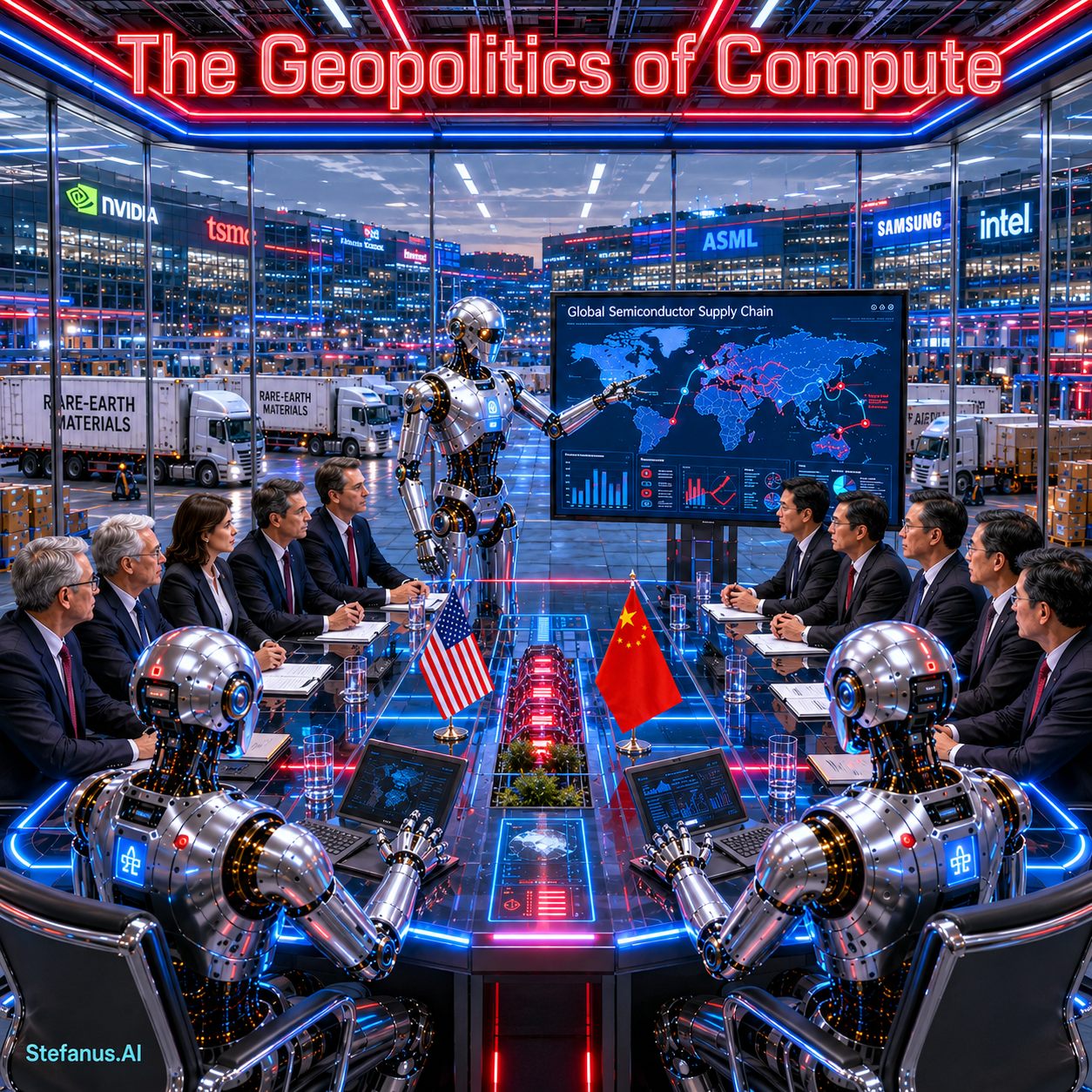

Introduction: The Infrastructure of Intelligence
We have entered an era in which the most consequential geopolitical competition on earth is not fought with missiles, not resolved through currency reserves, and not decided in election cycles. It is fought in fabs. It is decided in packaging lines, export control lists, rare-earth processing facilities, and the sprawling campuses of hyperscale data centers consuming electricity in quantities that would have strained the imaginations of twentieth-century grid planners. The central resource being contested is not oil, not food, not gold — it is compute. And the countries, companies, and institutions that control the physical infrastructure of computation are in the process of determining who will generate, deploy, and ultimately own the intelligence that defines the twenty-first century.
On May 13, 2026, President Donald Trump boarded Air Force One bound for Beijing, carrying a delegation of seventeen American chief executives including Elon Musk, Tim Cook, Larry Fink, and Kelly Ortberg. The stated agenda covered trade, Taiwan policy, and commercial aviation. Yet the man who came to symbolize the entire summit was not a cabinet secretary or an ambassador. He was a semiconductor executive who had not originally been invited at all. Jensen Huang, founder and chief executive of NVIDIA Corporation — the company whose graphics processing units have become the essential physical infrastructure of global artificial intelligence — was called personally by President Trump after news of his exclusion generated immediate media scrutiny, and subsequently flew to Alaska to board the aircraft mid-journey. NVIDIA’s market capitalization responded to the news by adding approximately $160 billion in a single session.
That sequence of events — exclusion, exposure, reinstatement, and a $160 billion market response — captures the entire geopolitical architecture of this paper in miniature. The fate of the world’s most strategically important technology company, and by extension the fate of the AI hardware ecosystem that underpins modern military, commercial, and scientific capability, was being adjudicated not through normal diplomatic channels but through the personal intervention of a head of state responding to press coverage. The CEO of a chip company briefly outranked the Secretary of State in terms of geopolitical visibility. This is not a peripheral development. It is the defining condition of the age.
This paper integrates eight original research papers published on Stefanus.AI throughout May 2026 into a single, unified analytical framework structured around three strategic pillars: AI GPU Infrastructure (Section 1), Robotics Supply Chains (Section 2), and Strategic Lessons for a Bifurcated AI World (Section 3). Together, these eight papers form what I describe as the intellectual architecture underlying The Geopolitics of Compute—a broader framework that examines how compute capacity, industrial production systems, and geopolitical competition are increasingly converging to shape the future trajectory of the global AI economy.
The central thesis of this paper can be stated with precision: the bifurcation of the US–China technology ecosystem is no longer a political aspiration or a corporate risk scenario. It is an operating reality, embedded in the physical infrastructure of chip fabrication, robotics supply chains, rare-earth processing networks, export control regimes, and diverging AI governance frameworks. That reality creates both profound systemic risks and historically unprecedented strategic opportunities — for nations, corporations, and investors who understand the architecture of the intelligence economy well enough to navigate it.
“The buildout of AI factories — the largest infrastructure expansion in human history — is accelerating at extraordinary speed. Agentic AI has arrived, doing productive work, generating real value, and scaling rapidly across companies and industries.”
— Jensen Huang, Founder and CEO, NVIDIA — Q1 FY2027 Earnings Statement, May 20, 2026 [12]
Three empirical anchors ground the theoretical framework that follows. First, NVIDIA’s Q1 FY2027 results — filed with the SEC on May 20, 2026 — reported record revenue of $81.6 billion, up 85% year-over-year, with Data Center revenue of $75.2 billion representing 92% annual growth.[12] A single company’s quarterly results carrying the economic weight of a medium-sized national GDP tells us something fundamental about the concentration of value in the compute stack. Second, the International Monetary Fund’s April 2026 scenario-planning synthesis on the global implications of artificial intelligence warned, with unusual directness for a multilateral institution, that effective international coordination is critical to preventing global bifurcation and managing power asymmetries.[15] Third, the Department of Justice’s unsealing of the Supermicro indictment in March 2026 — charging three individuals with orchestrating a $2.5 billion scheme to route NVIDIA-powered servers to China through a sham Southeast Asian company[18] — confirmed that export controls are not preventing the flow of restricted compute into adversary hands. They are merely rerouting it through opaque channels and increasing its cost.
Together, these three data points describe a world in which the United States’ most powerful strategic tool is simultaneously being monetized at unprecedented scale, warned against by its own multilateral institutions, and circumvented by the adversary it was designed to contain. That is the world this paper maps. It proceeds from AI GPU infrastructure through robotics supply chains to ten strategic lessons, drawing on the full intellectual architecture of the eight source papers while maintaining the long-form narrative discipline, the theoretical ambition, and the institutional citation depth that define the Stefanus approach to strategic analysis.

Section 1: AI GPU Infrastructure
The six papers synthesized in this section address the full architecture of AI GPU infrastructure — from the theoretical foundations of why the AI economy creates structural interdependence among technology firms, through the semiconductor supply chain’s four-layer geography, to the practical mechanisms through which export controls are enforced, evaded, and ultimately contested at the highest levels of state diplomacy. Together they constitute a comprehensive mapping of the physical and political terrain on which the world’s most consequential industrial competition is being conducted in real time.
1.1 Strategic Interdependence: The Designer and the Tailor
The first paper in the AI GPU Infrastructure section, Strategic Interdependence: Balancing Intellectual Property and Shared Innovation Among Tech Rivals in the Epicenter of the AI Revolution, opens with a deliberately unexpected metaphor: the Hollywood red carpet. When a leading actress descends the Academy Awards staircase in a Dior gown, the cameras capture the designer’s glory. What they never show is the tailor who spent weeks adjusting millimeters of silk and stitching seams with surgical precision. The designer receives the credit. The tailor makes the garment possible. This relationship — simultaneously interdependent and asymmetric, collaborative and hierarchical, celebrated and invisible — is presented as the conceptual foundation for the most consequential business dynamic of the AI era: the relationship between NVIDIA and TSMC.
NVIDIA designs the world’s most advanced AI accelerators. TSMC fabricates them. But this clean formulation understates the depth of the dependency. NVIDIA’s Q1 FY2027 earnings — $81.6 billion in revenue, $75.2 billion from data centers, 85% and 92% year-over-year growth respectively — were achieved without NVIDIA manufacturing a single chip.[12] Every Blackwell GPU, every NVLink switch, every CoWoS-packaged multi-chip module bearing the NVIDIA name was physically created by TSMC, a company headquartered on an island of 23 million people located 160 kilometers from mainland China. This is not merely a supply chain dependency. It is the structural condition of the AI economy. TSMC’s Q1 2026 revenue grew 35.1% year-over-year for its ninth consecutive quarter of growth, with March 2026 monthly revenue alone reaching NT$415.19 billion ($13.07 billion), a 45.2% year-over-year jump.[13]
The paper’s central thesis is straightforward but far-reaching: in the AI era, no single company can succeed entirely alone, regardless of financial resources, technical brilliance, or strategic aggression. The complexity of the technology stack is too vast, the capital requirements too enormous, and the ecosystem dependencies too deeply interwoven for any single firm to build the full value chain from scratch. The firms that learn to balance intellectual property protection with strategic collaboration will be best positioned for the decade ahead. This is what the author terms Strategic Interdependence — a condition in which the decisions and investments of one technology company directly and materially influence the strategic options available to all other firms within the same ecosystem.
The theoretical scaffolding draws on three intellectual traditions. Ronald Coase’s theory of the firm established that companies exist to minimize transaction costs, making external cooperation preferable to vertical integration whenever those costs fall sufficiently. Michael Porter’s Diamond Model of Competitive Advantage explains why Taiwan’s dense industrial ecosystem — with its supporting industries, related firms, and accumulated engineering talent — has made it so difficult to replicate elsewhere.[6] Most directly relevant is the co-opetition framework developed by Harvard Business School Professor Adam Brandenburger and Yale School of Management Professor Barry Nalebuff:
“Businesses can become more competitive by cooperating. The fate of one player is interdependent with the other; the move one person makes influences the moves the other person will make.”
— Adam M. Brandenburger (Harvard Business School) & Barry J. Nalebuff (Yale School of Management), Co-opetition, Crown Business, 1996 [7]
The Brandenburger-Nalebuff Value Net framework maps not only competitors and customers but also suppliers and complementors — the full web of actors whose cooperation grows the total value available to an industry before competition determines how that value is distributed. In 2026, this framework has become operationally indispensable. More recent computational work by Professors Vik Pant and Eric Yu of the University of Toronto’s Faculty of Information extended this logic, demonstrating through more than 22,000 experimental trials that structural interdependence coefficients can reliably predict value appropriation dynamics between co-competing firms.[8]
The paper documents nine landmark cases of Strategic Interdependence active in May 2026 alone. The Colossus 1 leasing arrangement — where xAI agreed to lease more than 220,000 NVIDIA GPUs to Anthropic for $1.25 billion per month through May 2029, with potential total revenue exceeding $40 billion — brought together two organizations whose principals had publicly disparaged each other on social media.[3][4] Meta’s $200 million Tesla Megapack partnership for Wyoming data center power brought together two firms with no obvious commercial overlap, united by the energy scarcity that is one of the defining constraints of the AI buildout.[5] Apple’s decision to pay Google approximately $1 billion annually to power Siri with Gemini united the consumer electronics company most identified with privacy against the search company most identified with data monetization.[11]
Jensen Huang’s declaration at the NVIDIA Constellation groundbreaking in Taipei — where NVIDIA committed NT$40 billion to a 50-year campus lease housing 4,000 employees when complete — crystallized the Taiwanese dimension of this interdependence.[1] His description of Taiwan as “the epicenter of the AI revolution” was not rhetorical hyperbole. The Taiwanese ecosystem spanning TSMC’s foundry services, the CoWoS advanced packaging capabilities that make Blackwell architectures function, Foxconn and Quanta Computer’s server assembly capacity, MediaTek’s networking silicon, and the precision component manufacturers of the Hsinchu Science Park constitutes a degree of industrial concentration that no other geography can replicate at competitive yields within any strategically relevant timeline.
The paper’s most important analytical contribution is the distinction between the old paradigm of Strategic Independence — self-reliance, vertical integration, purely adversarial competitor relationships, and internal R&D as the only legitimate source of innovation — and the emergent paradigm of Strategic Interdependence, in which ecosystem reliance, network integration, shared innovation, and competitor relationships that are simultaneously adversarial and cooperative define the operating environment. This is not a normative argument for altruism in corporate strategy. It is a structural observation: the AI technology stack is too complex and too capital-intensive for any single firm to build from scratch, and the most strategically sophisticated actors in the ecosystem have internalized this reality and are acting accordingly.
1.2 Silicon Scarcity, Algorithmic Power: The US–China Bifurcation Framework
The second paper, Silicon Scarcity, Algorithmic Power: How the US–China Bifurcation is Reshaping AI Governance, Semiconductor Supply Chains, and the Global Balance of Compute Power, introduces the most analytically complete framework in the entire body of work: the US–China bifurcation model. It opens with a statement of historical discontinuity that carries the weight of genuine geopolitical rupture: the assumption of irreversible economic integration that characterized the post-Cold War era is dead. We are not entering a new Cold War — a phrase that implies familiar ideological symmetry and the geopolitical grammar of the twentieth century. We are entering something structurally different: a global competition for AI supply-chain dominance whose stakes are nothing less than the distribution of intelligence itself.
The paper’s central argument is that the US–China bifurcation has created a profound and self-reinforcing feedback loop between hardware scarcity and software sovereignty. By weaponizing semiconductor supply chains through export controls, the United States has triggered an AI chips war aimed at denying China the computational foundation required for frontier AI development. China’s response — accelerating domestic hardware substitution and constructing a distinct regulatory model — has in turn accelerated the fragmentation of global AI governance into two incompatible ecosystems characterized by conflicting algorithmic rules, divergent technical standards, and increasingly fragmented compute resources. The theoretical foundation is Farrell and Newman’s weaponized interdependence framework:
“States that control economic chokepoints can weaponize networks to gather information or choke off economic access to adversaries, transforming the architecture of globalization into an instrument of coercion.”
— Henry Farrell (Johns Hopkins SAIS) and Abraham L. Newman (Georgetown University), “Weaponized Interdependence: How Global Economic Networks Shape State Coercion,” International Security, Vol. 44, No. 1, 2019 [14]
The semiconductor supply chain’s four-layer architecture is mapped with precision. At the design layer, American firms control the EDA software — Synopsys, Cadence, and Mentor Graphics — without which no advanced chip can be designed anywhere in the world, creating the deepest and most durable American chokepoint. At the machinery layer, ASML’s absolute monopoly on extreme ultraviolet lithography equipment — each machine containing approximately 100,000 components and costing roughly €350 million — represents a Dutch stranglehold on the sub-7-nanometer manufacturing threshold that defines frontier AI silicon. Under sustained American pressure, the Dutch government has blocked EUV exports to China, a single policy decision more strategically consequential than any tariff measure yet enacted.
“Constructing a single advanced wafer fab requires tens of billions of dollars in investment, thousands of top-tier engineers, the coordinated operation of hundreds of precision instruments, and a construction timeline of three to five years. These extraordinarily high technological barriers and capital intensity mean that semiconductor manufacturing is not an industry one can simply decide to enter — it is more akin to a national-level capability that takes decades to accumulate.”
— Prof. Hung-Yi Chen, National Taiwan University — Semiconductor Geopolitics in 2026: Taiwan’s Strategic Choices in the Chip War, February 2026 [16]
At the fabrication layer, TSMC’s concentration of over 90% of the world’s advanced logic chip capacity on a single island 160 kilometers from the Chinese mainland represents the most extreme geographic concentration of strategic industrial capacity in modern history. The paper notes that TSMC’s Fab 21 in Phoenix, Arizona — the centerpiece of the CHIPS and Science Act’s reshoring ambition — began high-volume 4-nanometer production in early 2025, with yields reportedly surpassing comparable Taiwan facilities by approximately four percentage points by late 2025. Yet Arizona remains a hedge rather than a replacement: the ten fabs and five backend facilities in Taiwan still produce the most advanced designs, and TSMC’s total Arizona commitment exceeding $65 billion represents roughly one-third of what the company has invested in its Taiwan ecosystem over decades.
The IMF’s April 2026 scenario-planning note on AI implications issued its most pointed warning about the bifurcation risk:
“International cooperation on AI standards and taxation is pivotal to avoid bifurcation. Rapid AI diffusion risks concentrating production, capital, and rents in a subset of economies with strong infrastructure and AI capabilities. Cross-border spillovers — through capital flows, mobile rents, and fragmented standards — make cooperation on taxation principles and interoperable assurance frameworks particularly important, especially for emerging and developing economies seeking to avoid being locked into low-diffusion equilibria.”
— International Monetary Fund, Global Economic and Financial Implications of Artificial Intelligence, IMF Notes Vol. 2026, Issue 002, April 2026 [15]
China’s strategic counteroffensive is analyzed with comparable rigor. The National Integrated Circuit Industry Investment Fund — the Big Fund — has committed capital exceeding $100 billion across multiple tranches, representing the largest state-directed semiconductor subsidy in history. Beijing’s coalition of eight government bodies has sponsored a nationwide adoption of the open-source RISC-V instruction set architecture, creating a design pathway that circumvents American intellectual property controls. SMIC’s surprise production of 7-nanometer-class chips using older DUV equipment — disclosed through reverse engineering of Huawei’s Mate 60 Pro processor — demonstrated that China’s domestic semiconductor capability is advancing faster than export control architects anticipated, even if it remains behind the performance frontier.
For Southeast Asia, the bifurcation creates an existential strategic dilemma. Malaysia’s Penang corridor, Singapore’s advanced packaging ecosystem, Vietnam’s rapidly expanding assembly capacity, and the Philippines’ four-decade ATP heritage all sit at the intersection of American and Chinese supply chain ambitions. US export control guardrail regulations increasingly scrutinize transshipment through these hubs, with draft restrictions targeting Malaysia and Thailand over suspected chip diversion to China reported as recently as mid-2025. Nations that have built their economic models on serving both superpowers simultaneously are now being asked, implicitly and increasingly explicitly, to choose.
1.3 Do You Want Chips With That? — The Bargaining Tool Paradox
The third paper, Do You Want Chips With That? — How Microprocessors Became America’s Ultimate Bargaining Tool in the U.S.–China AI Race, is the most narratively distinctive in the body of work. It opens not with theory or market data but with a scene: October 2024, Bucks County Pennsylvania, the future forty-seventh President in a paper apron at a McDonald’s drive-thru window, scooping french fries. The juxtaposition is intentional and analytically precise. While candidate Trump distributed bags of chips at a Pennsylvania fast-food counter, a different kind of chips was quietly restructuring the entire geopolitical order — and in less than two years, the CEO of the most strategically important chip company in the world would be boarding Air Force One at the President’s personal invitation. The fast-food pun is the vehicle for a serious argument: the United States has built an extraordinary strategic instrument in its semiconductor ecosystem, and it is struggling with fundamental coherence about how to use it.
The paper’s central argument is that microprocessors — particularly advanced AI accelerators — have evolved into America’s ultimate bargaining instrument in its rivalry with China, comparable in strategic significance to oil embargoes in the twentieth century or financial sanctions in the early twenty-first. But like all bargaining instruments, their utility depends on strategic coherence, enforceability, and timing. The contradiction at the heart of American chip policy is presented with uncomfortable directness: Washington simultaneously wants commercial profit from NVIDIA’s global dominance, technological leadership through ecosystem lock-in, alliance leverage through selective access, and national security insulation through denial. These objectives increasingly conflict with each other at the operational level, producing policy inconsistencies that adversaries can exploit and allies find difficult to navigate.
NVIDIA’s strategic dominance extends beyond silicon performance to the CUDA software ecosystem — the accumulated libraries, optimized tools, model portability frameworks, and developer familiarity that represent NVIDIA’s deepest competitive moat. Silicon can be replicated given sufficient time and capital. Software ecosystems built over two decades of community investment are far more resistant to displacement. This distinction is crucial: when a Chinese AI company is denied access to NVIDIA’s newest GPU generation, it is not merely denied hardware. It is denied an entire ecosystem of mature tooling, optimized inference libraries, and engineering continuity. Jensen Huang has characterized China’s AI chip market as a “$50 billion” near-term opportunity and a potentially “$200 billion” decade-scale opportunity. The commercial case for engagement is not trivial.
The drama of Jensen Huang’s Alaska intercept crystallized what policy analysts had been observing in classified settings for years: semiconductor executives now occupy a geopolitical position closer to that of cabinet ministers than commercial vendors. NVIDIA’s stock adding approximately $160 billion in market capitalization on news of Huang’s inclusion in the Beijing delegation means that equity markets are correctly pricing individual diplomatic access as a measurable variable in regulatory outcome probabilities. Private compute infrastructure has become inseparable from public strategic power.
The paper engages seriously with the case for selling advanced chips to China. Selling preserves American revenue, sustains ecosystem lock-in, reduces incentives for domestic substitution, strengthens shareholder returns, and generates taxable economic activity at scale. The national security counterargument — that advanced AI chips are dual-use assets whose applications extend into military simulation, autonomous weapons, surveillance infrastructure, cyber operations, and biological modeling — produces a fundamentally different calculus. When a nation exports advanced GPUs, it does not merely export hardware. It exports the industrial capacity to manufacture machine intelligence. That distinction is what separates AI chips from ordinary technology products and makes the bargaining tool paradox analytically genuine rather than rhetorical.
1.4 Chip Smuggling: The Shadow Architecture of Restricted Markets
The fourth paper, Chip Smuggling: The Deceptive Supply Chains Feeding Restricted AI Markets in the New Semiconductor Cold War, performs a service that few academic or policy analyses have been willing to undertake: it takes the phenomenon of illicit semiconductor movement seriously as a structural feature of AI geopolitics rather than treating it as a collection of isolated legal violations. The paper opens with a deliberately provocative historical parallel — in earlier centuries, scarcity rarely eliminated demand for valuable goods; it simply changed their logistics — and proceeds to argue that the intelligence age has added advanced AI chips to the long historical list of strategic commodities that develop shadow distribution networks whenever lawful access becomes sufficiently constrained.
The evidentiary foundation is concrete and recent. In December 2025, the Department of Justice announced the dismantling of Operation Gatekeeper, a Houston-based smuggling network that had exported or attempted to export at least $160 million worth of NVIDIA H100 and H200 GPUs to China between October 2024 and May 2025.[17] In March 2026, federal prosecutors charged Yih-Shyan “Wally” Liaw, co-founder of Super Micro Computer, with orchestrating a scheme to route $2.5 billion in NVIDIA-powered servers to China through a sham Southeast Asian company, employing dummy hardware to fool compliance auditors and US export control officers.[18]
“Operation Gatekeeper has exposed a sophisticated smuggling network that threatens our Nation’s security by funneling cutting-edge AI technology to those who would use it against American interests.”
— U.S. Attorney Nicholas J. Ganjei, Southern District of Texas, December 2025 [17]
These are not isolated incidents. Researchers at the Center for a New American Security estimate that between 10,000 and several hundred thousand AI chips were smuggled into China in 2024 alone, with a median estimate of approximately 140,000 — enough to constitute between one and forty percent of China’s AI training compute capacity.[19] Epoch AI’s independent analysis corroborates these findings, adding that NVIDIA’s next-generation Blackwell chips have already entered Chinese black-market channels.[20] Chinese technology firms had collectively placed orders for more than two million H200 units for 2026 delivery prior to restriction, demonstrating the extreme commercial pressure that generates illicit acquisition incentives when legal channels close.
The paper introduces a rigorous typology of shadow semiconductor supply chains, organized as a six-stage architecture. Stage One involves fully lawful origin: a manufacturer transfers hardware to an approved geography with correct documentation. The legitimacy of this stage is essential — it provides the paper trail that subsequent stages will exploit. Stages Two through Six involve progressively more sophisticated routing, relabeling, shell company structures, end-user certification falsification, and jurisdictional arbitrage that collectively transform a lawful product into a restricted delivery without any single transaction necessarily being illegal in isolation. This is the mechanism described in detail in the Supermicro indictment, in the Operation Gatekeeper case, and in the Bloomsbury Intelligence and Security Institute’s April 2026 analysis of recurring Southeast Asian intermediary patterns.
The economic logic of chip smuggling follows from the same principles that govern every strategic commodity black market in history. AI accelerators possess nearly ideal characteristics for illicit trade: extremely high value density, compact physical form factor, cross-border portability, and persistent strategic demand from buyers willing to pay substantial premiums. More importantly, an advanced GPU generates intelligence output through AI training, inference deployment, and compute monetization. A buyer is not purchasing a commodity asset. A buyer is purchasing strategic acceleration — time to train competitive models, time to close capability gaps, time to avoid technological lag in the most consequential industrial race of the era. That temporal premium can exceed acquisition cost premiums dramatically, which explains why sophisticated buyers willingly accept the costs and legal risks of illicit acquisition.
Harvard Kennedy School political economist Dani Rodrik’s framework on state intervention in strategic industries explains why export controls necessarily generate circumvention infrastructure: whenever governments restrict commercially indispensable goods on national security grounds, they create the precise scarcity conditions that make black markets economically inevitable.[41] The paper argues that Washington’s own internal contradictions — simultaneously enacting restrictions and negotiating selective reopening of H200 sales to approved Chinese customers in January 2026, while no shipments had materialized by May 2026 — amplify rather than resolve the incentives for illicit acquisition and confirm to market participants that the restriction regime is politically negotiable.
1.5 Chip, Baby, Chip: The US Reindustrialization Agenda
The fifth paper, Chip, Baby, Chip: The Relentless Race to Reindustrialize AI Semiconductor Power in the United States, takes its title from a deliberate echo of the energy politics slogan “drill, baby, drill” and advances a structural argument: the United States’ response to semiconductor vulnerability is, at its most honest and direct, a doctrine of industrial urgency. Just as “drill, baby, drill” expressed the conviction that national power could be expanded through accelerated domestic production of the hydrocarbon-age resource, “Chip, Baby, Chip” expresses the conviction that AI-era national power can be secured through accelerated domestic production of the computational-age resource.
The paper invokes Vaclav Smil’s observation that energy is the only universal currency,[21] and extends the argument to chips: in the AI economy, chips are the conversion mechanism through which electricity becomes computation, computation becomes models, models become applications, and applications become the agentic systems that are beginning to reshape every sector of economic and military life. This places chips at the second layer of Jensen Huang’s Five-Layer AI Economy — above energy but below everything else — making their scarcity the primary constraint that propagates upward through the entire stack.
“No product is more central to international trade than semiconductors.”
— Chris Miller, Tufts University Fletcher School, Chip War: The Fight for the World’s Most Critical Technology, Scribner, 2022 [22]
The paper’s empirical anchor is the extraordinary energy arithmetic of AI infrastructure. The International Energy Agency’s 2026 analysis documented that global electricity demand from data centers grew by 17% in 2025, while electricity consumption from AI-focused data centers surged by 50%.[23] The IEA projects that data-center electricity consumption could roughly double by 2030 to approximately 945 terawatt-hours — nearly 3% of global electricity consumption. This means the AI chip race is not only a semiconductor race. It is simultaneously a grid race, an energy race, a cooling race, a land race, a permitting race, and a geopolitical race for the right to consume electricity at industrial AI scale.
The competitive landscape is charted with precision. NVIDIA dominates the AI accelerator market through GPU performance and the CUDA software ecosystem. TSMC remains the dominant advanced foundry. ASML remains the indispensable EUV lithography supplier. Google is deepening its TPU investment into the agentic AI era. Amazon Web Services is expanding Trainium and Inferentia for inference workloads. Meta is accelerating its MTIA custom silicon roadmap. Intel is attempting to reenter advanced foundry competition through its 18A and 14A process nodes. Tesla’s Terafab vision — integrating Tesla, SpaceX, and Intel into a vertically unified compute, manufacturing, and deployment architecture — represents perhaps the most ambitious attempt at semiconductor vertical integration since IBM’s mainframe era.
The CHIPS and Science Act is evaluated with intellectual honesty. The Commerce Department has allocated over $32 billion in proposed funding across sixteen states for domestic semiconductor factories and programs.[24] TSMC’s Arizona commitment exceeds $65 billion. Intel’s 18A process is receiving substantial federal support. These are genuine achievements of industrial policy, representing a meaningful reversal of the offshore manufacturing concentration trend that has characterized the US semiconductor industry since the 1980s. The paper’s warning, however, is equally genuine: subsidy alone cannot overcome the deeper physics of the semiconductor stack. Fabs require decades of accumulated process knowledge, clusters of specialized suppliers, skilled engineering labor, stable regulatory environments, water, and power that cannot be created through legislative appropriation on any commercially relevant timeline.
The paper’s central distinction is between a doctrine of urgency and a doctrine of sovereignty. “Chip, Baby, Chip” as urgency means building more accelerators faster. “Chip, Baby, Chip” as sovereignty means securing the entire materials, machinery, fabrication, packaging, memory, and energy supply chain that makes accelerators possible. The United States cannot claim semiconductor sovereignty while remaining dependent on ASML’s EUV machines, TSMC’s most advanced processes, South Korean HBM memory stacks, Chinese rare-earth processing, and Southeast Asian assembly capacity. Industrial urgency is necessary but not sufficient. What is required is a generational investment in the full vertical architecture of compute sovereignty — and the patience to recognize that multi-decade industrial capability cannot be built on venture-capital timelines.
1.6 Compute Nationalism: The Five-Layer AI Economy and the Intelligence War
The sixth and most theoretically ambitious paper in the AI GPU Infrastructure section, Compute Nationalism: The New Geopolitics of AI Infrastructure, introduces the body of work’s capstone conceptual framework: Compute Nationalism, defined as the doctrine under which nation-states treat computational infrastructure — including semiconductor design, advanced manufacturing ecosystems, datacenters, power systems, rare earth supply chains, AI accelerators, inference capacity, and sovereign cloud infrastructure — as strategic national assets to be protected, expanded, subsidized, weaponized, or denied in pursuit of geopolitical power.
The paper opens with the May 2026 Beijing summit sequence in full detail, presenting Jensen Huang’s last-minute inclusion as a living demonstration of the doctrine it develops. The central theoretical contribution is the systematic differentiation of Compute Nationalism from adjacent but inadequate frameworks. Digital sovereignty addresses data governance; Compute Nationalism addresses the industrial machinery required to train the models that make sense of that data. Techno-nationalism encompasses domestic technology policy broadly; Compute Nationalism focuses specifically on intelligence-producing infrastructure — systems whose output is not a product but a sovereign capability. Economic nationalism prioritizes employment, trade balances, and domestic production; Compute Nationalism addresses strategic intelligence capacity. AI nationalism concerns the model layer; Compute Nationalism concerns the entire five-layer stack without which no model layer can exist.
“AI is no longer a single breakthrough or application — it is essential infrastructure. Every company will use it. Every nation will build it. From energy and chips to infrastructure, models and applications, every layer of the stack is advancing at once.”
— Jensen Huang, NVIDIA GTC 2026 Keynote Address [25]
Harvard political scientist Graham Allison’s Thucydides Trap framework — which predicts that the structural competition between a rising power and an established hegemon generates pressures toward conflict that are difficult for either side to fully control — is applied to the specific terrain of AI infrastructure competition.[26] Allison warned that the US-China relationship would constitute a “ruthless rivalry across nearly every dimension — tech, trade, industry, military, and global influence.” Artificial intelligence has become the most contested terrain within that rivalry, and the contest over NVIDIA’s chips its most visible operational front.
The Five-Layer AI Economy framework — energy, chips, infrastructure, models, applications — is developed with structural precision. Each layer depends on the layers below it. Applications are the visible tip; energy is the invisible foundation. NVIDIA sits at the second layer but radiates strategic influence upward through every layer above it, because whoever controls chips shapes the economics, security, and strategic autonomy of the infrastructure, model, and application layers. This structural logic explains why the Beijing summit carried such extraordinary commercial and geopolitical weight: the most important question on the table was not which AI models existed but who controlled the physical machinery of the second layer.
The paper traces America’s Compute Nationalism containment architecture through the escalating export control sequence: initial October 2022 restrictions on A100 and H100 exports, subsequent tightening in 2023, further restrictions in 2024, and continued evolution through 2025 and into 2026. It notes with analytical precision that NVIDIA excluded any assumption of Data Center compute revenue from China in its Q4 FY2026 guidance — a $0 China assumption embedded in the quarterly outlook of the world’s most valuable company, reflecting the policy uncertainty that renders forward planning impossible.
China’s Compute Nationalism counteroffensive is mapped across multiple vectors: the Huawei Ascend AI accelerator program, SMIC’s DUV-based 7-nanometer-class fabrication, the nationwide RISC-V architecture adoption campaign, sovereign cloud infrastructure investment, and a Beijing AI governance framework that explicitly positions Chinese regulatory standards as alternatives to American-influenced multilateral norms. Neither superpower’s Compute Nationalism strategy is fully coherent: America’s simultaneous commercial dependencies and security restrictions produce policy contradictions that adversaries exploit; China’s domestic substitution programs, while impressive in ambition, face genuine performance gaps and software ecosystem deficits that no subsidy regime can resolve on any short-to-medium term horizon.

Section 2: Robotics Supply Chains
The two papers synthesized in this section address the physical extension of AI into the material world — what the second paper calls the “hardware moment” of the AI revolution, the moment when intelligence stopped being purely disembodied and began to walk. Where Section 1 concerned the infrastructure of machine intelligence in data centers and semiconductor supply chains, Section 2 examines the infrastructure of embodied machine intelligence: the robotics supply chains, critical mineral networks, precision mechanical component ecosystems, and competitive dynamics that determine who will control the physical robotic labor emerging as the second great strategic resource of the AI age.
2.1 Robotics Supply Chains: America’s Software Dominance Meets a Hardware Reckoning
The first robotics paper, Robotics Supply Chains: How America’s Software Dominance Meets a Hardware Reckoning, opens with a statement of civilizational scope: we are living through what may be the most consequential industrial transformation since the mechanization of agriculture. The convergence of artificial intelligence with robotics has produced a new class of machine — not merely automated, but adaptive; not merely programmable, but perceptive; not merely precise, but — in the language of the industry’s most ambitious practitioners — embodied. This qualitative leap creates strategic dependencies of a kind that America’s software leadership cannot address without a fundamental rethinking of its industrial base.
The market data grounds the analysis in commercial reality. The International Federation of Robotics documented 542,000 industrial robot installations worldwide in 2024 — more than double the figure from a decade earlier — with the global operational stock reaching 4.664 million units, an increase of 9% year-over-year.[28] IFR President Takayuki Ito noted this marked the second-highest annual installation count of industrial robots in history. The global robotics market, valued at approximately $51.5 billion in 2025, is projected by Boston Consulting Group to reach between $160 billion and $260 billion by 2030 depending on the pace of humanoid and service robotics commercialization.[30] GlobalData forecasts a compound annual growth rate of 15% from $90.2 billion in 2024 to $205.5 billion by 2030. The IMF’s April 2026 World Economic Outlook, meanwhile, revised its 2026 global growth forecast downward to 3.1%, noting that supply chain fragmentation is among the primary drags on economic activity.[31]
The paper’s central paradox is stated with uncomfortable clarity: the United States is home to the world’s most advanced AI research institutions, the largest and most generously capitalized robotics startups, the dominant edge-computing silicon providers, and the global leaders in robotic systems integration and software. NVIDIA’s Omniverse and Isaac platforms are the de facto standards for digital-twin simulation in robotics development. American EDA software firms control the tooling without which no advanced chip can be designed anywhere in the world. In algorithm, simulation, software architecture, and chip design, the United States leads decisively. Yet when one examines the physical bill of materials for a modern robot, the picture reverses almost entirely.
Zero-backlash harmonic drive gearboxes — the precision mechanical components that give robot joints their accuracy — are manufactured almost exclusively by two Japanese firms, Harmonic Drive Systems and Nabtesco, with no meaningful American alternative at commercial scale. Rare-earth permanent magnets, essential for the brushless motors that power robotic actuators, depend on neodymium, dysprosium, and praseodymium refined almost entirely in China, which produced an estimated 300,000 tons of NdFeB magnets per year in 2024 compared to the United States’ nascent production of under 1,000 tons from MP Materials. Battery cells for mobile robotics are dominated by Chinese firms CATL and BYD, which together supplied approximately 55% of global EV battery installations in 2024. And the logic chips that orchestrate robotic perception and decision-making are fabricated almost exclusively at TSMC.
“The balance of modern power hinges on a semiconductor supply chain crossing geopolitical fault lines. America’s edge is deteriorating dangerously. It’s a lead that’s fragile and much smaller than its advantage in AI chips.”
— Prof. Chris Miller, Fletcher School at Tufts University — U.S. Senate Foreign Relations Subcommittee Testimony, December 2025 [33]
This is the paradox that defines American robotics strategy in 2026: software dominance built atop hardware dependency. The paper advances a thesis that is simultaneously an observation and a warning: to secure its technological sovereignty against escalating geopolitical rivalries, the United States must transition from a software-centric model of robotics leadership to a vertically integrated national strategy that directly addresses its profound foreign dependencies in hardware components, precision mechanical assemblies, and critical mineral refining. Without this transition, American algorithms risk having nothing to run on — intelligence starved of the physical substrate it requires to operate in the world.
The upstream supply chain analysis is geological as well as industrial. The robotics supply chain begins in the earth itself: in the rare-earth mineral deposits of Inner Mongolia and Jiangxi Province, in the lithium brine flats of Chile’s Atacama Desert, in the cobalt mines of the Democratic Republic of Congo. At the midstream level, raw materials undergo chemical processing and refining. At the downstream level, components become sub-systems, and sub-systems become complete robotic platforms. The vulnerability of this supply chain lies not in its length but in its concentration: single points of failure where the entire global industry’s ability to function depends on the uninterrupted output of one country — sometimes one company — operating in a jurisdiction that may at any moment choose to weaponize its position, as China demonstrated with rare-earth export controls in 2025.
Asia’s 74% share of new industrial robot deployments in 2024 — against 16% in Europe and 9% in the Americas — illustrates how manufacturing concentration and robotics adoption have reinforced each other in ways that compound Western supply chain disadvantage. The World Economic Forum’s Global Value Chains Outlook 2026 warned that in 2025 alone, tariff escalations between major economies reshuffled more than $400 billion in global trade flows, and that supply chain disruption in 2026 will be “constant and structural.”[32]
“Supply chain disruption in 2026 will be constant and structural. Geopolitical fragmentation, shifting trade rules and labour shortages are all redefining how value is created and moved. For supply leaders, the priority is no longer forecasting disruption, but redesigning operating models to function under permanent uncertainty.”
— Per Kristian Hong, Partner, Kearney / World Economic Forum Global Value Chains Outlook 2026, January 2026 [32]
The World Bank’s landmark Future Jobs study provided important counterweight to the most alarmist labor-displacement narratives. Its analysis of eighteen emerging East Asian and Pacific economies found that between 2018 and 2022, robot adoption created approximately 2 million new jobs for skilled workers while displacing approximately 1.4 million low-skilled workers in routine manual occupations.[34] Net employment effects were positive, but the distributional consequences — favoring skilled workers while accelerating displacement of routine labor — demand active policy responses around education, retraining, and social protection that most governments have not yet operationalized at the required scale.
“Today’s innovations, from AI to robotics, can enhance productivity and create better jobs. Realizing these benefits will require a skilled workforce, competitive markets and policies to mitigate transition costs.”
— Manuela V. Ferro, Vice President for East Asia and Pacific, World Bank — Future Jobs Report Launch, June 17, 2025 [35]
2.2 Robot Mercantilism: The Global Race for Embodied AI Manufacturing Dominance
The second robotics paper, Robot Mercantilism: The Global Race for Embodied AI Manufacturing Dominance, introduces one of the body of work’s most distinctive conceptual contributions: the Robot Mercantilism framework, defined as the strategic competition among nations to secure dominance in embodied AI manufacturing, supply chains, deployment capacity, and industrial robotics infrastructure as instruments of economic power, geopolitical leverage, and national security. The paper’s opening proposition is that in 2026, AI began leaving the screen. It began walking.
The empirical opening is striking. Tesla confirmed that its Optimus humanoid production line at Fremont, California — built on the retired Model S and Model X manufacturing floor — would commence volume output in late July or early August 2026.[36] A second, higher-volume Optimus factory at Gigafactory Texas is designed for long-term annual production capacity of ten million robots. The company simultaneously confirmed $25 billion in capital expenditure guidance for 2026 covering AI training infrastructure, chip design, and the Cybercab and Optimus production ramps. In Beijing, a humanoid robot crossed the finish line of a half-marathon on April 19, 2026 — not as a publicity stunt but as a programmed demonstration of mechanical endurance at public scale. In South Carolina, Figure AI’s Figure 02 had completed eleven consecutive months on the BMW Spartanburg production floor, contributing to the assembly of more than 30,000 BMW X3 vehicles.[38]
The Robot Mercantilism framework draws a deliberate and precise analogy to classical mercantilism. The mercantilist states of the sixteenth through eighteenth centuries did not compete merely over trade volumes. They competed over the physical apparatus of production: shipbuilding capacity, naval routes, colonial manufacturing monopolies, and industrial output. The British East India Company was not simply a commercial enterprise — it was a projection of industrial and logistical power that redefined the global balance of influence for two centuries. The twenty-first century equivalent is taking shape around a different set of physical assets: semiconductor fabrication capacity, electric motor actuators, precision mechanical components, battery supply chains, sensor arrays, machine vision systems, and the embodied intelligence platforms — humanoid robots — that integrate all of these inputs into autonomous physical labor.
The competitive landscape analysis examines six major players with the granularity that strategic assessment demands. Tesla’s Optimus program is treated not as an automotive diversification but as a structural transformation of corporate identity. Tesla spent a decade learning to manufacture at scale in one of the most demanding engineering environments on earth — battery-electric vehicles — and is now deploying that manufacturing expertise, vertical integration instinct, Full Self-Driving reinforcement learning pipeline, Dojo training infrastructure, and global fleet data into bipedal robotic systems.
“It is literally impossible to predict the production rate this year given Optimus has 10,000 unique parts across an entirely new production line. Initial skills for the robots will be simple skills in the factory, and we will build up from there.”
— Elon Musk, Tesla Q1 2026 Earnings Call, April 22, 2026 [37]
Figure AI’s eleven-month BMW Spartanburg deployment stands as the most carefully studied humanoid robot production run in industrial history. Figure 02 worked five days a week in ten-hour shifts, loaded more than 90,000 sheet-metal parts for welding, logged approximately 1,250 operating hours, contributed to the production of more than 30,000 BMW X3 vehicles, achieved greater than 99% placement accuracy per shift, and met 84-second cycle-time targets with consistent reliability.[38] Following Figure 02’s retirement, BMW confirmed expansion of humanoid deployments to Plant Leipzig in Germany — the first Physical AI of this kind deployed in a European automotive manufacturing environment. Figure AI reached a $39 billion post-money valuation in September 2025.
Apptronik’s Apollo platform, emerging from NASA’s Valkyrie program and the Human Centered Robotics Lab at the University of Texas at Austin, raised over $935 million in Series A capital from investors including Google, Mercedes-Benz, John Deere, and the Qatar Investment Authority — a roster reflecting both broad industrial interest and the geopolitical undertones of sovereign-wealth participation in robotics infrastructure.[39]
“We intend to beat Chinese humanoids to market. That is the explicit competitive objective that guides our capital deployment decisions.”
— Jeff Cardenas, CEO, Apptronik, 2026 [39]
The most disruptive competitive dynamic in the humanoid market is being driven not by an American firm but by China’s Unitree Robotics. The company’s March 2026 IPO prospectus on the Shanghai Star Market revealed a pricing compression of more than 70% in two years: average unit price falling from approximately $85,000 in 2023 to approximately $25,000 in 2025, while gross margin simultaneously improved to nearly 60% — the signature economics of a company that self-develops and manufactures its own core components.[40] A humanoid robot priced below the down payment on a luxury automobile represents a fundamentally different theory of market development than what Western firms are pursuing. Unitree’s cost architecture threatens to replicate the Chinese EV industry’s pricing disruption in a market that American companies were treating as safely premium — a mistake that the automotive industry made with EVs and is still paying for.
The paper’s military crossover analysis is among the most sobering in the body of work. The same actuators, sensors, power systems, locomotion algorithms, and perception architectures that make a robot useful on a BMW production floor also make it potentially deployable in contested military environments. China’s deployment of robotics in military contexts — from logistics and reconnaissance to weapons-carrying platforms — has advanced faster and with less public visibility than American defense analysis has consistently anticipated. The civilian-military boundary in embodied AI is not merely porous. In certain applications, it has already dissolved.

Section 3: Strategic Lessons — Ten Pillars of the Bifurcated AI World
The eight papers synthesized in this work converge on a set of structural insights that transcend any single industry, any single policy debate, and any single corporate strategy. These ten pillars are analytical conclusions — observations about the deep structure of the intelligence economy that will remain valid regardless of which specific companies lead, which specific export controls are enacted, or which specific diplomatic summits produce temporary accommodations. Each pillar draws on the single most important and non-repetitive insight from the corresponding body of analysis, distilled for maximum strategic utility to policymakers, corporate executives, investors, and serious analysts.
Pillar 1: Hardware Is the New Geopolitics
The most important insight emerging across the full body of work is simultaneously the most counterintuitive for an industry that has spent a decade asserting that software eats the world: in the AI era, hardware is the new geopolitics. Physical compute infrastructure — chip fabrication capacity, packaging ecosystems, rare-earth supply chains, energy grids, cooling systems, and precision mechanical components — has become the primary terrain on which great-power competition is conducted. NVIDIA’s $81.6 billion quarterly revenue[12] did not flow from software licenses. It flowed from physical silicon fabricated by TSMC, packaged in CoWoS structures, deployed in hyperscale data centers consuming gigawatts. Software determines what intelligence can do. Hardware determines who can produce it at sovereign scale.
Pillar 2: The Five-Layer Stack Cannot Be Owned by One Actor
No single company and no single nation controls all five layers of the AI economy simultaneously. Energy, chips, infrastructure, models, and applications each require distinct industrial capabilities, capital structures, and supply chain architectures. The most dangerous strategic error in this environment is the assumption that dominance at one layer translates automatically into security across the full stack. NVIDIA dominates chips but is entirely dependent on TSMC for fabrication. The United States leads at design and models but faces profound vulnerabilities at rare-earth processing, EUV machinery, and advanced assembly. China leads at certain manufacturing and critical mineral processing segments but faces fundamental gaps at design tools, EUV access, and frontier model capabilities. Strategic security requires acknowledging and systematically addressing each layer’s dependencies rather than celebrating strength at one layer while ignoring fragility at others.
Pillar 3: Export Controls Create Shadow Architectures, Not Denial
The chip smuggling analysis makes a finding that export control architects must confront honestly: when advanced semiconductors become commercially indispensable, strategically restricted, and physically compact, export controls do not eliminate demand. They transform the distribution architecture. The median estimate of 140,000 AI chips smuggled into China in 2024 alone[19] demonstrates that the gap between policy intent and policy outcome is substantial. This finding argues not against export controls but for a realistic assessment of their limits, and for enforcement architectures adequate to the operational sophistication of the circumvention networks they face. Controls that create shadow infrastructure without achieving denial objectives may simultaneously impose costs on American commercial interests and fail to prevent the adversary capability development they were designed to constrain.
Pillar 4: Strategic Interdependence Is Permanent, Not Transitional
The most seductive narrative in both US industrial policy and Chinese technology strategy is the narrative of eventual self-sufficiency. The Strategic Interdependence analysis demonstrates this narrative is structurally false at the frontier of AI development. TSMC’s competitive advantage is not merely a matter of having the newest EUV machines. It is the product of sixty years of accumulated process knowledge, yield learning, talent development, and customer trust that cannot be purchased or legislated into existence. The appropriate strategic posture for both nations and firms is not to pursue total independence but to diversify critical dependencies, build resilience at identified bottlenecks, and maintain the collaborative relationships that provide mutual insurance against disruptions in a bifurcating world.
Pillar 5: The Robotics Supply Chain Is the Next Semiconductor Supply Chain
The robotics supply chain is exhibiting the same geographic concentration, single-point-of-failure characteristics, and strategic fragility that made the semiconductor supply chain so vulnerable when geopolitical competition intensified. Harmonic drive gearboxes concentrated in two Japanese firms. Rare-earth permanent magnets concentrated in Chinese processing. Battery cells concentrated in CATL and BYD. TSMC’s monopoly on advanced robotic perception chips. These are structural features of an architecture built under peaceful globalization assumptions that has not been redesigned for strategic competition. The window for proactive supply chain diversification is closing. The US government’s belated recognition of semiconductor dependency in 2022 — and the decade-scale recovery timeline that followed — should serve as a cautionary precedent for robotics supply chain policy.
Pillar 6: Compute Nationalism Is the Operating Framework of State Competition
The Compute Nationalism framework describes the operational reality in which both the United States and China are currently behaving. Every Chinese subsidy to domestic semiconductor fabrication, every American export control update, every CHIPS Act appropriation, every rare-earth export restriction, and every sovereign cloud infrastructure investment reflects the implicit logic of Compute Nationalism even when policymakers use different language. Corporations that build strategies on the assumption of stable market access to compute infrastructure across geopolitical lines will face structural disruptions for which pure commercial optimization is insufficient preparation. Understanding Compute Nationalism as the operating framework — not as an exceptional crisis posture — is the first requirement of strategic competence in the AI economy.
Pillar 7: The Humanoid Robot Is the Next Great Geopolitical Asset
The general-purpose humanoid robot is a strategic asset class whose geopolitical significance is not yet fully priced by governments, investors, or corporate strategists. A bipedal robot capable of operating in human-designed environments is not merely a labor cost reduction tool. It is a physical force multiplier with commercial, industrial, logistical, and military applications that compound over time. China’s Unitree pricing at approximately $25,000 per unit[40] — achieved through vertical integration and aggressive manufacturing learning curves — threatens to replicate the Chinese EV industry’s pricing disruption in humanoid robotics before American competitors achieve comparable cost structures. The competitive window for humanoid manufacturing sovereignty is open but narrowing at pace.
Pillar 8: The Bifurcation Is Real, but Its Boundaries Are Negotiable
Despite the structural forces driving US-China technological decoupling, the bifurcation is not yet total and its boundaries are being actively negotiated. The May 2026 Beijing summit itself illustrates that both superpowers retain commercial incentives for selective engagement even amid strategic competition. Third countries, multinational corporations, and international institutions retain meaningful agency in shaping where the boundaries fall and which flows remain permissible. That agency will diminish over time as both ecosystems deepen their internal integration. Acting on it now — while the architecture is still being established — is the defining strategic opportunity of the decade for countries and corporations outside the two principal combatants.
Pillar 9: Energy Is the Hidden Constraint on AI Sovereignty
Energy appears across the full body of work not as a background condition but as an active strategic constraint shaping the competitive landscape of AI development. The IEA’s documentation of 50% growth in AI-focused data center electricity consumption in 2025[23] means that the ability to provision reliable and abundant electricity at scale is becoming as strategically significant as the ability to manufacture advanced chips. Nations with abundant, inexpensive electricity — or with the infrastructure, regulatory frameworks, and capital markets to build it — will possess structural advantages in the AI economy that pure semiconductor policy cannot compensate for. Matching the AI compute buildout’s energy demands against the existing grid’s transmission constraints and permitting timelines requires policy coordination that is not yet happening at the required scale.
Pillar 10: Strategic Coherence Is America’s Scarcest Commodity
America’s greatest strategic vulnerability in the AI competition is not technological, not industrial, and not financial. It is coherence. The contradiction between commercial objectives and security restrictions in chip export policy. The tension between alliance management and domestic reindustrialization. The mismatch between the velocity of AI development and the tempo of democratic policy formation. The gap between CHIPS Act ambitions and the pace of permitting, labor development, and supply chain localization. The inconsistency between treating NVIDIA as a national champion and excluding its CEO from presidential delegations. Each contradiction is individually explicable. Collectively, they describe a policy ecosystem struggling to generate the strategic coherence that the complexity and urgency of the AI competition demand. China’s Compute Nationalism strategy, however imperfect in execution, benefits from a degree of policy continuity and long-term planning horizon that democratic systems find inherently difficult to match. Closing this coherence gap is the most important governance challenge that American AI strategy faces.

Conclusion: What This Moment Means, and Why It Will Not Repeat
On May 27, 2026, Jensen Huang stood before one thousand NVIDIA employees at a groundbreaking ceremony in Taipei and declared Taiwan the epicenter of the AI revolution.[1] The same month, a Department of Justice indictment described a $2.5 billion scheme to route NVIDIA chips through fake Southeast Asian companies to Chinese buyers.[18] The same month, NVIDIA reported $81.6 billion in quarterly revenue.[12] The same month, Tesla confirmed preparations to launch the world’s first high-volume humanoid robot factory.[36] And the same month, the IMF warned that without international coordination, the global AI economy faces a structural bifurcation whose consequences will be most severe for the nations least equipped to navigate them.[15] These events did not happen sequentially. They happened simultaneously, in the same thirty-day window, driven by the same structural forces that the eight papers synthesized in this work have spent hundreds of pages analyzing.
What have we learned from this synthesis? The question deserves a direct and substantive answer. We have learned that the AI economy is fundamentally a hardware economy that has learned to present itself as a software economy. The chatbot interface is the visible output of an industrial process beginning in rare-earth mines, proceeding through chemical processing facilities, semiconductor fabs, packaging lines, and hyperscale data centers, and ending in inference servers consuming electricity at rates that stress national power grids. Decision-makers who do not understand the hardware layer will consistently misdiagnose the strategic situation and consistently underestimate the risks embedded in supply chain concentration.
We have learned that the US–China bifurcation is not a temporary disruption that diplomatic creativity can easily reverse. It is a structural outcome of the weaponization of interdependence — of the deliberate American decision to exploit the geometric concentration of semiconductor supply chain chokepoints as an instrument of great-power coercion. That decision has triggered domestic substitution programs in China that are producing capable alternatives to American technology, accelerated the construction of two parallel technological ecosystems, and created shadow supply chains that demonstrate the limits of enforcement in a world where the most strategically valuable manufactured object can fit in a FedEx package.
We have learned that the robotics supply chain is the semiconductor supply chain’s structural twin — a system built for efficiency rather than resilience, concentrated at its most critical nodes, and increasingly exposed to the same weaponized interdependence dynamics that have already disrupted global chip supply. The window for proactive action on robotics supply chain sovereignty is open but narrowing as deployment scale creates lock-in effects and as Chinese manufacturers accelerate their cost compression toward price points that American producers will struggle to match without equivalent vertical integration.
We have learned that Compute Nationalism is not a choice. It is a description of what nation-states are already doing, simultaneously and in full awareness of each other’s actions. Policymakers who resist the Compute Nationalism framing because it sounds too confrontational or too mercantilist are not offering an alternative framework. They are offering a description that will be overtaken by events. The CHIPS Act, the Big Fund, the EUV export controls, Japan’s Rapidus program, the EU Chips Act, India’s semiconductor incentive package — all reflect the same underlying logic: computational infrastructure has become too strategically important to leave to pure market allocation.
We have learned that Strategic Interdependence is permanent — not a transitional condition awaiting resolution, but the structural reality of the AI technology stack. TSMC’s advantage is sixty years of accumulated knowledge. NVIDIA’s moat is two decades of CUDA community investment. These cannot be replicated through legislative appropriation or subsidy on any commercially relevant timeline. The appropriate response is not the pursuit of total independence but the construction of resilient, redundant, and well-understood interdependencies that provide insurance against the strategic weaponization of any single dependency.
And we have learned something about this specific moment. May 2026 is a non-reproducible point in the architecture of the AI economy. The bifurcation is real but not yet irreversible. The shadow supply chains are operational but not yet so entrenched that enforcement is impossible. The humanoid robot market is emerging but not yet dominated. The energy constraints are binding but not yet catastrophic. The policy contradictions are severe but not yet unresolvable. The window for strategic action — for governments and corporations alike — is open. The decisions made in the next two to five years about semiconductor industrial policy, robotics supply chain sovereignty, export control architecture, energy infrastructure, and international governance frameworks will determine the structure of the intelligence economy for decades to come.
The designer and the tailor, to return to where this synthesis began, need each other. Jensen Huang needs TSMC. TSMC needs NVIDIA. The AI economy needs energy, materials, chips, infrastructure, models, and applications — and none of these can be provided by any single actor. The task of the current moment is not to achieve independence from the global system that has made the AI revolution possible. It is to build the resilience, the redundancy, and the institutional capacity to ensure that the inevitable disruptions of a bifurcating world do not translate into catastrophic failures of the systems on which modern civilization increasingly depends. That task is urgent. This synthesis is written in the conviction that intellectual clarity about the architecture of the challenge is the first and most important step toward meeting it.

Footnotes and Endnotes
1. Jensen Huang, CEO, NVIDIA — Groundbreaking Ceremony, Nvidia Constellation Campus, Taipei, Taiwan, May 27, 2026. NVIDIA Newsroom. https://nvidianews.nvidia.com/news/nvidia-opens-headquarters-taiwan-2026
2. Reuters. “Taiwan stocks rise to record after Jensen Huang’s NT$40bn campus pledge.” May 27, 2026. https://www.reuters.com/technology/nvidia-constellation-taipei-taiex-record-2026-05-27/
3. The Wall Street Journal. “xAI to Lease Colossus Memphis Data Center to Anthropic for $1.25B/month.” May 2026. https://www.wsj.com/tech/xai-anthropic-colossus-lease-2026
4. Bloomberg. “Musk’s xAI Signs $40B Revenue Deal with Anthropic over GPU Infrastructure.” May 2026. https://www.bloomberg.com/news/articles/2026-05-xai-anthropic-colossus-deal
5. Financial Times. “Meta Partners with Tesla Megapack for Wyoming AI Datacenter Power.” May 2026. https://www.ft.com/content/meta-tesla-megapack-wyoming-2026
6. Michael E. Porter. The Competitive Advantage of Nations. New York: Free Press, 1990. https://www.hbs.edu/faculty/Pages/item.aspx?num=193
7. Adam M. Brandenburger and Barry J. Nalebuff. Co-opetition. New York: Crown Business, 1996. https://www.penguinrandomhouse.com/books/566/co-opetition-by-adam-m-brandenburger-and-barry-j-nalebuff/
8. Vik Pant and Eric Yu, University of Toronto Faculty of Information. “Computational Foundations of Strategic Coopetition.” Technical Report, December 2025. https://www.ischool.utoronto.ca/research/strategic-coopetition-2025
9. Aiman Ezzat, CEO, Capgemini. World Economic Forum, Davos, January 2025. https://www.weforum.org/agenda/2025/01/aiman-ezzat-capgemini-ai-ecosystem/
10. Elon Musk. Statement on Colossus/Anthropic deal rationale, May 2026. https://x.com/elonmusk/status/xai-anthropic-2026
11. The Verge. “Apple to Pay Google $1B Annually to Power Siri with Gemini.” 2025. https://www.theverge.com/2025/apple-siri-gemini-google
12. NVIDIA Corporation. Form 8-K, First Quarter Fiscal 2027 Results. Filed May 20, 2026. SEC EDGAR. https://www.sec.gov/Archives/edgar/data/0001045810/000104581026000051/q1fy27pr.htm
13. TSMC. Monthly Revenue Report, March 2026. Taiwan Stock Exchange Filing. https://www.tsmc.com/investor-relations/monthly-revenue
14. Henry Farrell (Johns Hopkins SAIS) and Abraham L. Newman (Georgetown University). “Weaponized Interdependence: How Global Economic Networks Shape State Coercion.” International Security, Vol. 44, No. 1 (2019). https://direct.mit.edu/isec/article/44/1/42/12237/Weaponized-Interdependence
15. International Monetary Fund. “Global Economic and Financial Implications of Artificial Intelligence.” IMF Notes Vol. 2026, Issue 002 (April 2026). https://www.elibrary.imf.org/view/journals/068/2026/002/article-A001-en.xml
16. Prof. Hung-Yi Chen, National Taiwan University. “Semiconductor Geopolitics in 2026: Taiwan’s Strategic Choices in the Chip War.” February 2026. https://www.ntu.edu.tw/research/semiconductor-geopolitics-2026
17. U.S. Attorney Nicholas J. Ganjei, Southern District of Texas. Statement on Operation Gatekeeper, December 2025. U.S. Department of Justice. https://www.justice.gov/usao-sdtx/pr/operation-gatekeeper-chip-smuggling-2025
18. U.S. Department of Justice. Indictment: United States v. Yih-Shyan Liaw et al. (Supermicro). Filed March 2026. https://www.justice.gov/opa/pr/supermicro-nvidia-smuggling-indictment-2026
19. Center for a New American Security (CNAS). “Compute Security and AI Chip Smuggling: Estimating the Scale of Illicit Semiconductor Diversion to China.” 2025. https://www.cnas.org/publications/reports/compute-security-chip-smuggling
20. Epoch AI. “Blackwell GPU Market Analysis and Chinese Black-Market Channels.” 2025. https://www.epochai.org/blackwell-china-analysis-2025
21. Vaclav Smil. Energy and Civilization: A History. Cambridge, MA: MIT Press, 2017. https://mitpress.mit.edu/9780262535533/energy-and-civilization/
22. Chris Miller, Tufts University Fletcher School. Chip War: The Fight for the World’s Most Critical Technology. New York: Scribner, 2022. https://www.simonandschuster.com/books/Chip-War/Chris-Miller/9781982172008
23. International Energy Agency. “Electricity 2026: Analysis and Forecast to 2030.” IEA, 2026. https://www.iea.org/reports/electricity-2026
24. U.S. Department of Commerce. CHIPS for America Program Update, 2026. https://www.nist.gov/chips/chips-for-america-funding-updates
25. Jensen Huang, CEO, NVIDIA. GTC 2026 Keynote Address. March 2026. https://www.nvidia.com/en-us/on-demand/session/gtc2026-keynote/
26. Graham Allison, Harvard Kennedy School. Destined for War: Can America and China Escape Thucydides’s Trap? Boston: Houghton Mifflin Harcourt, 2017. https://www.houghtonmifflinharcourt.com/titles/destined-for-war
27. Chris Miller, Fletcher School at Tufts University. Testimony to U.S. Senate Foreign Relations Subcommittee on Technology and Competitiveness. December 2025. https://www.foreign.senate.gov/hearings/miller-chips-testimony-2025
28. International Federation of Robotics (IFR). World Robotics 2025 Report. IFR Statistical Department, 2025. https://ifr.org/ifr-press-releases/news/world-robotics-2025
29. Astute Analytica. Global Robotics Market Forecast 2025-2035. 2025. https://www.astuteanalytica.com/industry-report/robotics-market
30. Boston Consulting Group (BCG). “The Coming Wave of Robotics.” BCG Henderson Institute, 2025. https://www.bcg.com/publications/2025/humanoid-robotics-market-outlook
31. International Monetary Fund. World Economic Outlook, April 2026. https://www.imf.org/en/Publications/WEO/Issues/2026/04/
32. Per Kristian Hong, Partner, Kearney. World Economic Forum Global Value Chains Outlook 2026. January 2026. https://www.weforum.org/reports/global-value-chains-outlook-2026
33. Prof. Chris Miller, Fletcher School at Tufts University. US Senate Foreign Relations Subcommittee Testimony, December 2025. https://www.foreign.senate.gov/hearings/miller-chips-testimony-2025
34. World Bank. Future Jobs: Robots, Artificial Intelligence, and Digital Platforms in East Asia and Pacific. World Bank Publications, 2025. https://www.worldbank.org/en/region/eap/publication/future-jobs-robots-ai-east-asia
35. Manuela V. Ferro, Vice President for East Asia and Pacific, World Bank. Future Jobs Report Launch, June 17, 2025. https://www.worldbank.org/en/news/press-release/2025/06/17/future-jobs-robotics-east-asia
36. Tesla, Inc. Q1 2026 Shareholder Update. Filed with the U.S. SEC, April 22, 2026. https://ir.tesla.com/sec-filings/annual-reports/content/0000950170-26-000001
37. Elon Musk, CEO Tesla. Q1 2026 Earnings Call, April 22, 2026. https://ir.tesla.com/news-releases/news-release-details/tesla-q1-2026-earnings-call
38. Figure AI. “Figure 02 at BMW Spartanburg: Eleven-Month Production Deployment Report.” November 2025. https://www.figure.ai/bmw-spartanburg-deployment-report-2025
39. Jeff Cardenas, CEO, Apptronik. Public statement on competitive objectives, 2026. https://www.apptronik.com/news/series-a-round-2026
40. Unitree Robotics. IPO Prospectus, Shanghai Star Market, March 2026. https://sse.com.cn/unitree-ipo-prospectus-2026
41. Dani Rodrik, Harvard Kennedy School. “Industrial Policy for the Twenty-First Century.” Working Paper, 2025. https://www.hks.harvard.edu/publications/industrial-policy-21st-century
42. NVIDIA Corporation. Form 10-Q, First Quarter Fiscal 2027. Filed May 20, 2026. https://www.sec.gov/Archives/edgar/data/0001045810/000104581026000052/nvda-20260426.htm

Comments
[…] AI is geopolitical influence. Nations that export AI platforms, models, and infrastructure are not merely selling technology; […]
[…] emergency restriction in under five months, the AI economy moved from industrial metaphor to geopolitical battlefield faster than any policy architecture could anticipate or […]