
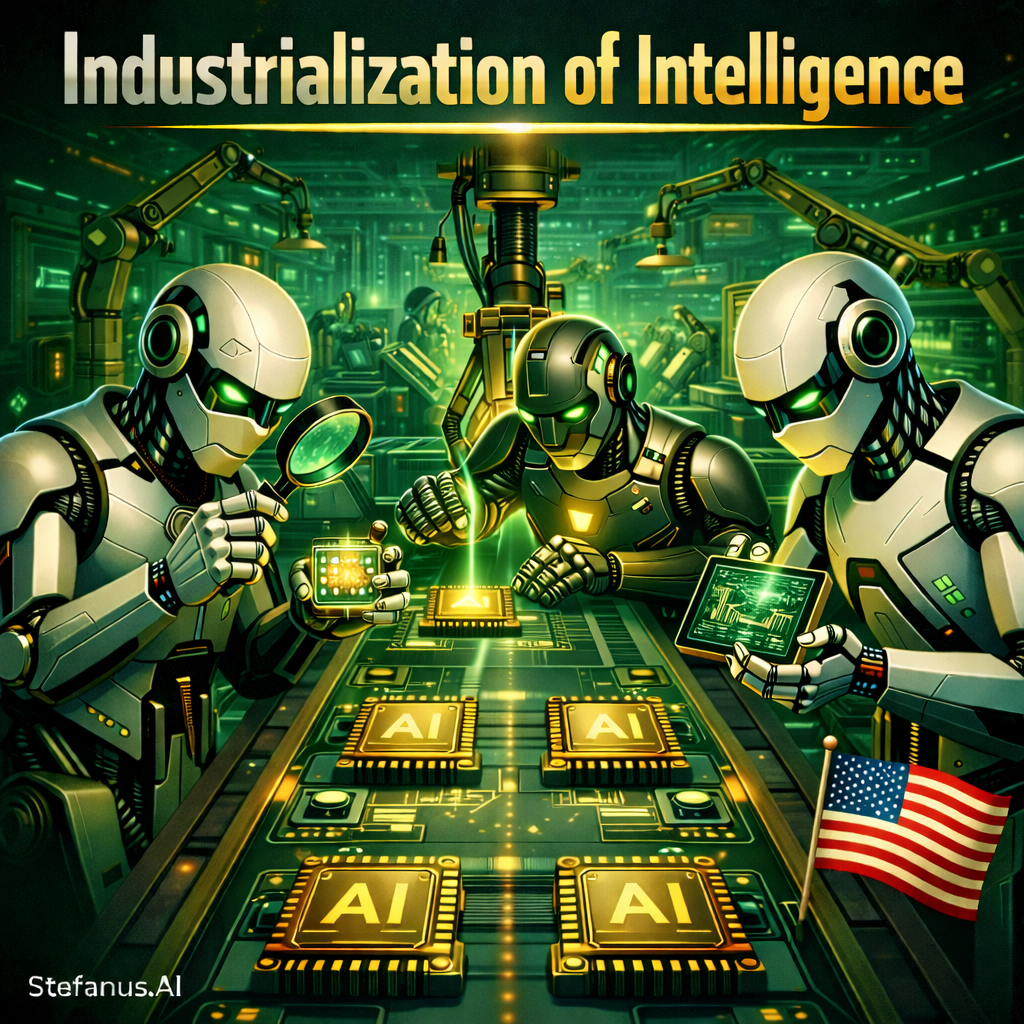

On April 16, 2026, at the Stanford Graduate School of Business, Jensen Huang articulated what may ultimately be recognized as one of the defining frameworks of the modern era: intelligence is no longer merely engineered—it is being industrialized.
He described five foundational layers—energy, chips, data centers, models, and applications—that together form the infrastructure of a new economic system. At first glance, this appears to be a technical stack. But embedded within his remarks—particularly around agentic systems, the evolution of work, and the importance of global talent—was something deeper: this system does not run on infrastructure alone.
It runs on people.
This paper does not replace Huang’s framework. It completes it.
Industrialization of Intelligence is the transformation of cognition into a vertically integrated, capital-intensive, talent-driven industrial system.
The title reflects both structure and inevitability:
- The Five-Layer AI Economy defines the architecture
- The Race Toward a Trillion Lines of Code defines the scale
But the race itself is not autonomous. It is driven by human capability operating at machine speed.
Jensen Huang:
“Agentic AI will work with us, not replace us—it will accelerate our capabilities.”
Andrew Ng:
“AI is the new electricity.”¹
Erik Brynjolfsson:
“AI is a general-purpose technology that will reshape every industry.”²
Fei-Fei Li:
“AI is not just a technological revolution, but a human one.”³
This is the critical insight:
Every layer—no matter how industrialized—remains dependent on talent.
Thus, the central thesis expands:
The future will not be determined by who builds intelligence, but by who industrializes it across the full stack—and who commands the talent to operate it.
What follows, therefore, is not a paper about software in the narrow sense. It is a paper about a new industrial order. Energy becomes the first input of cognition. Chips become its scarce engines. Data centers become the factories where intelligence is produced. Models become the cognitive core. Applications become the monetization layer through which intelligence enters daily life and economic systems. And talent, though less visible than the other layers, becomes the animating force that allows the entire structure to function, scale, and evolve.
This is not simply a technological shift. It is a reorganization of production, capital, labor, and power.

Section 1 — Energy: The First Constraint of Intelligence
Every industrial revolution has been bounded by energy. Coal powered the first. Oil powered the second. Electricity powered the third. Artificial intelligence, despite its abstract nature, is no exception.
Training frontier AI models now consumes vast amounts of electricity—often measured in gigawatt-hours. Hyperscale data centers increasingly resemble industrial power plants, requiring dedicated energy infrastructure, advanced cooling systems, and proximity to reliable grids. What appears, at the surface, to be a software boom is in fact a deep physical expansion into power systems, land use, cooling, and electrical transmission.
According to the International Energy Agency, global data center electricity consumption could surpass 1,000 TWh annually.⁴ That figure alone is enough to force a conceptual correction. Intelligence is no longer merely a product of code; it is increasingly a product of power availability.
Vaclav Smil:
“Energy is the only universal currency.”⁵
This observation becomes literal in the AI era. Intelligence can no longer be discussed without referencing gigawatts, grid stability, and energy sourcing.
The implication is profound: the growth of intelligence is physically constrained by energy availability. Nations and companies that secure abundant, stable, and cheap energy gain a structural advantage in AI development. This is why hyperscalers are no longer behaving like software firms alone; they are moving like utilities, industrial operators, and infrastructure investors.
The Financial Times has reported that hyperscalers are securing nuclear and renewable energy at unprecedented scale.⁶ This is not incidental. It is a recognition that the next era of AI competition will be won not only through better algorithms, but through superior access to electricity.
Energy abundance without talent is inert capacity. Talent without energy is constrained potential.
Thus, energy is the first layer because it is the precondition for every layer that follows. Before intelligence can be trained, deployed, monetized, or scaled, it must first be powered.

Section 2 — Chips: The Scarcity Engine of Intelligence
If energy is the fuel, chips are the engines.
The modern AI economy is built on specialized semiconductors, particularly GPUs and AI accelerators. The dominance of NVIDIA in this domain has transformed it from a hardware vendor into a central actor in global power dynamics.
Jensen Huang:
“AI factories will be the most important infrastructure of the future.”⁷
These factories are powered by chips that remain scarce, expensive, and geopolitically sensitive. The supply chain spans continents—design in the United States, fabrication in Taiwan, equipment and materials sourced globally. This fragmentation introduces structural fragility into the very center of the AI system.
Chris Miller:
“Semiconductors are the foundation of modern power.”⁸
That statement is no longer metaphorical. Export controls, trade restrictions, and geopolitical tensions have transformed chips into instruments of statecraft. Access to cutting-edge semiconductors increasingly determines not only corporate competitiveness but national capability.
The Wall Street Journal has noted that AI chip demand has triggered one of the largest capital investment cycles in semiconductor history.⁹ This investment wave reflects more than market enthusiasm. It reflects recognition that chips are not interchangeable components in a commodity chain. They are bottlenecks. They are chokepoints. They are leverage.
The semiconductor layer is also deeply talent-constrained. Advanced chip design requires elite engineers, fabrication demands decades of process expertise, and innovation depends on dense research ecosystems built over long periods of time. This means that semiconductor leadership is not simply a function of money or fabrication capacity; it is also a function of accumulated human capital.
Chips are no longer components.
They are gatekeepers of intelligence.

Section 3 — Datacenters: The Factories of Intelligence
If chips are the engines of the AI economy, then data centers are its factories—the physical sites where raw compute is transformed into usable intelligence at industrial scale. This is the layer where abstraction collapses into infrastructure, where algorithms meet electricity, and where capital becomes operational capacity.
Hyperscale data centers are no longer auxiliary IT infrastructure supporting digital services; they are now the primary production environments of intelligence itself. The scale of these facilities reflects this shift. Entire campuses spanning millions of square feet are being constructed not for storage or hosting, but for continuous, high-intensity computation. These are facilities designed not to serve users directly, but to train, refine, and deploy models that will eventually serve billions.
Satya Nadella:
“Every company will become an AI company.”¹⁰
This statement is often interpreted at the application layer, but its deeper implication is infrastructural: every company will become dependent on AI factories, whether they build them or rent access to them.
Urs Hölzle:
“Data centers are the factories of the digital age.”¹¹
These facilities integrate multiple systems into a single, tightly optimized environment:
- High-density power distribution capable of sustaining continuous loads at unprecedented levels
- Advanced cooling architectures, including liquid cooling and immersion systems, designed to manage thermal outputs from dense GPU clusters
- Ultra-low-latency networking infrastructure connecting thousands to millions of processing units
- Software orchestration layers that dynamically allocate workloads across distributed systems
This convergence transforms data centers into something fundamentally new: industrial plants for cognition production.
But the existence of these facilities does not guarantee output. Their efficiency, utilization, and performance are deeply dependent on human expertise. Engineers must design workload distribution systems. Operators must manage uptime across complex, interdependent subsystems. Researchers must translate abstract model requirements into executable compute workflows.
Without talent, data centers are stranded capital—expensive, underutilized, and inefficient. With talent, they become continuously optimizing systems capable of producing intelligence at scale.
Thus, the data center is not just a facility. It is a coordination layer between energy, chips, and models, activated by human intelligence.

Section 4 — Models: The Cognitive Core
If data centers are factories, then models are the products they produce—but unlike traditional goods, these products are not static outputs. They are evolving systems of cognition, capable of learning, adapting, and generating new forms of knowledge.
Models represent the point at which infrastructure becomes intelligence. They transform electricity and silicon into reasoning, language, prediction, and increasingly, decision-making capabilities. In this sense, they are not merely software artifacts; they are compressed representations of human knowledge and machine-learned patterns at planetary scale.
Dario Amodei:
“The progress of AI is driven by scaling compute, data, and models.”¹²
This scaling dynamic is not linear. It is exponential and compounding. As compute increases, models grow larger. As models grow larger, their capabilities expand. As capabilities expand, demand increases—driving further investment into compute. This feedback loop is the engine of the industrialization of intelligence.
Research from MIT and other institutions has demonstrated that model performance follows predictable scaling laws, tying capability directly to resource input.¹³ This creates a new economic paradigm: intelligence can be scaled through capital expenditure.
Geoffrey Hinton:
“Neural networks are a new way of capturing knowledge.”¹⁴
Yet, despite this industrialization, models remain fundamentally dependent on human input at critical stages:
- Architecture design
- Training strategy
- Alignment and safety constraints
- Evaluation and deployment decisions
This creates a paradox at the heart of the AI economy: intelligence is being industrialized, but its direction remains human-defined.
Models are therefore both industrial outputs and human-guided systems—the cognitive core of the entire stack.

Section 5 — Applications and Agentics: The Monetization Layer
If models are cognition, then applications are action. This is the layer where intelligence becomes economically meaningful—where abstract capabilities are translated into real-world outcomes.
Historically, software applications were tools: static interfaces designed to execute predefined functions. In the age of industrialized intelligence, applications are becoming dynamic systems—capable of reasoning, adapting, and acting autonomously.
This transition is captured in the emergence of agentic AI.
Jensen Huang:
“Agentic AI will work with us, not replace us—it will accelerate our capabilities.”
Agentic systems do not merely respond to inputs; they initiate actions, manage workflows, and collaborate with humans in real time. They represent a shift from software as a tool to software as a partner.
This transformation has profound implications for the structure of work:
- Tasks are no longer executed sequentially by humans
- Workflows become distributed between humans and AI agents
- Decision-making becomes augmented by machine-generated insights
Sam Altman:
“Compute is going to be the currency of the future.”¹⁵
But compute alone does not generate value. It must be deployed through applications that solve real problems—automating processes, enhancing productivity, and creating new forms of economic output.
Applications close the loop of the industrial stack:
Energy → Chips → Datacenters → Models → Applications → Revenue → Reinvestment
They are the layer where industrialized intelligence becomes visible, measurable, and monetizable.
Section 6 — The Stack Integration Problem
While each layer of the AI economy is powerful on its own, the true strategic advantage emerges from integration across layers. The industrialization of intelligence is not simply about building components—it is about orchestrating a system.
Companies that operate across multiple layers gain compounding advantages. They can optimize interactions between layers, reduce dependency on external suppliers, and capture value at multiple points in the stack.
Sundar Pichai:
“AI is one of the most important things humanity is working on.”¹⁶
This importance is not confined to innovation—it extends to control. Integration determines who controls the flow of intelligence from energy input to application output.
Ben Thompson:
“The companies that control the stack control the market.”¹⁷
This creates a shift in competitive dynamics:
- From horizontal competition within a layer
- To vertical competition across the stack
The winners of the AI era will not be those who dominate a single layer. They will be those who coordinate and optimize the entire system.
This is the emergence of full-stack intelligence companies—entities that do not merely participate in the AI economy, but define its structure. NVIDIA moves upward through software ecosystems and platform control. Microsoft connects cloud, enterprise software, and model deployment. Google operates across research, infrastructure, models, and consumer applications. The logic of the era increasingly favors integration over specialization.
Integration is not purely technical. It is also organizational and human. To align all layers of the stack requires interdisciplinary talent capable of moving between infrastructure, research, software, operations, and productization. The stack only becomes a system when its layers are coordinated by people who can see across them.

Section 7 — Geopolitics of the Intelligence Stack
The industrialization of intelligence extends beyond corporations. It is now a defining feature of global geopolitics.
Nations are increasingly recognizing that control over AI infrastructure translates into economic power, military capability, and geopolitical influence. As a result, governments are investing heavily in domestic capabilities across all layers of the stack.
Jensen Huang:
“The United States needs to attract the world’s best talent to lead in AI.”
This statement highlights a critical dimension of the AI race: it is not only about infrastructure—it is about people.
Joseph Nye:
“Power in the modern world includes the ability to shape technology.”¹⁸
The competition between the United States and China illustrates this dynamic. It is not a traditional arms race, but a compute race—a contest over who can build, control, and scale the infrastructure of intelligence.
Key dimensions of this competition include:
- Semiconductor supply chains
- Data center expansion
- Energy security
- Talent acquisition and retention
This transforms AI into a strategic resource, comparable to oil in the 20th century, but arguably more consequential because it compounds across economic sectors, military systems, scientific discovery, and state capacity.
The geopolitical question is no longer merely who invents the best model. It is who controls the conditions under which intelligence can be industrialized at national scale.

Section 8 — The Trillion Lines of Code Thesis
At the apex of the industrialization of intelligence lies a transformative idea: the emergence of a world with a trillion lines of code (Jensen Huang).
This is not simply a measure of scale. It represents a fundamental shift in how software is created.
Satya Nadella:
“Software is being fundamentally transformed by AI.”¹⁹
Code is no longer written line by line by human developers. It is generated by models, refined through iteration, and deployed at scale. This creates a new mode of production:
- Machines generate code
- Humans guide and validate
- Systems continuously improve
This transforms code into a new form of capital—accumulated, leveraged, and deployed at industrial scale.
A trillion lines of code implies a world where intelligence is abundant, but its production is controlled by those who own the infrastructure. It also implies a transition in the economics of software itself. The bottleneck moves away from manual coding labor alone and toward system design, supervision, integration, security, and deployment.
Code becomes not merely instruction, but industrial output. It becomes the reproducible substance through which intelligence spreads into every sector of the economy.
In that world, software is no longer a narrow technical category. It becomes a macroeconomic force.

Section 9 — Talent: The Invisible Layer of Industrialized Intelligence
Talent is the invisible layer that activates the entire stack.
Fei-Fei Li:
“AI is not just a technological revolution, but a human one.”³
Erik Brynjolfsson:
“The key to productivity growth lies in how we combine technology with human capital.”²
Talent performs three essential functions:
- Creation — designing chips, models, and systems
- Integration — connecting layers into unified platforms
- Direction — determining how intelligence is deployed
Without talent, the stack fragments.
With talent, it becomes a system.
Unlike energy, chips, or data centers, talent is not easily scaled through capital expenditure alone. It depends on education systems, research institutions, immigration policy, corporate culture, and the capacity of a society to attract and retain exceptional people from around the world.
This is why talent cannot be treated as a secondary issue or an afterthought. It is the invisible layer because it is less tangible than the others, but it is no less foundational. Every machine in the stack, every model, every application, every AI factory, is ultimately downstream of human capability.
The industrialization of intelligence is therefore not a purely technological phenomenon. It is a human-technical co-evolution system.
Conclusion: From Software to Infrastructure Civilization
The Industrialization of Intelligence is not a future possibility—it is a present transformation unfolding across interconnected layers of infrastructure and human capability.
What began as a five-layer framework—energy, chips, data centers, models, and applications—reveals itself, upon closer examination, as a six-layer system. Talent is the force that binds and activates every other layer.
Jensen Huang:
“We are building systems that amplify human potential.”
This is the defining characteristic of this era. Intelligence is not replacing humans; it is amplifying them, embedding their capabilities into scalable systems, and extending their reach through infrastructure.
The coherence across all sections leads to a single conclusion:
Intelligence is no longer written—it is manufactured.
But unlike previous industrial systems, this one remains deeply human at its core.
The winners of this new era will not simply build better models or faster chips. They will:
- Integrate the full stack
- Scale infrastructure globally
- Secure energy and compute
- And most critically, attract and empower talent
This is not the evolution of software.
This is the emergence of an infrastructure civilization built on industrialized intelligence.

Footnotes
- Andrew Ng, Stanford University. “AI is the new electricity.” Stanford profile and related public talks: https://www.stanford.edu/~ang/
- Erik Brynjolfsson, Stanford Graduate School of Business. Faculty profile and research: https://www.gsb.stanford.edu/faculty-research/faculty/erik-brynjolfsson
- Fei-Fei Li, Stanford Human-Centered AI. Public statements and profile: https://hai.stanford.edu/
- International Energy Agency. Data center and electricity demand analysis: https://www.iea.org/
- Vaclav Smil. Public writings and profile: https://vaclavsmil.com/
- Financial Times. Reporting on hyperscaler energy procurement and AI infrastructure: https://www.ft.com/
- Jensen Huang, NVIDIA. Public statements and company materials: https://www.nvidia.com/
- Chris Miller, Chip War. Book and author materials: https://www.simonandschuster.com/books/Chip-War/Chris-Miller/9781982172008
- Wall Street Journal. Reporting on AI chip demand and semiconductor investment: https://www.wsj.com/
- Satya Nadella, Microsoft. Public statements and company materials: https://www.microsoft.com/
- Urs Hölzle, Google Research and infrastructure leadership materials: https://research.google/
- Dario Amodei, Anthropic. Public statements and company materials: https://www.anthropic.com/
- MIT. Research and public materials related to AI scaling and model performance: https://www.mit.edu/
- Geoffrey Hinton. University of Toronto profile and public materials: https://www.cs.toronto.edu/~hinton/
- Sam Altman, OpenAI. Public statements and company materials: https://openai.com/
- Sundar Pichai, Alphabet/Google. Public statements and company materials: https://abc.xyz/
- Ben Thompson, Stratechery. Analysis on platform and stack control: https://stratechery.com/
- Joseph S. Nye Jr., Harvard Kennedy School. Faculty profile and writings: https://www.hks.harvard.edu/faculty/joseph-s-nye-jr
- Satya Nadella, Microsoft. Public statements on AI and software transformation: https://www.microsoft.com/

Comments
[…] This paper connects SIXF directly to the Five-Layer AI Economy: […]
[…] Five-Layer AI Economy reveals a new kind of […]