
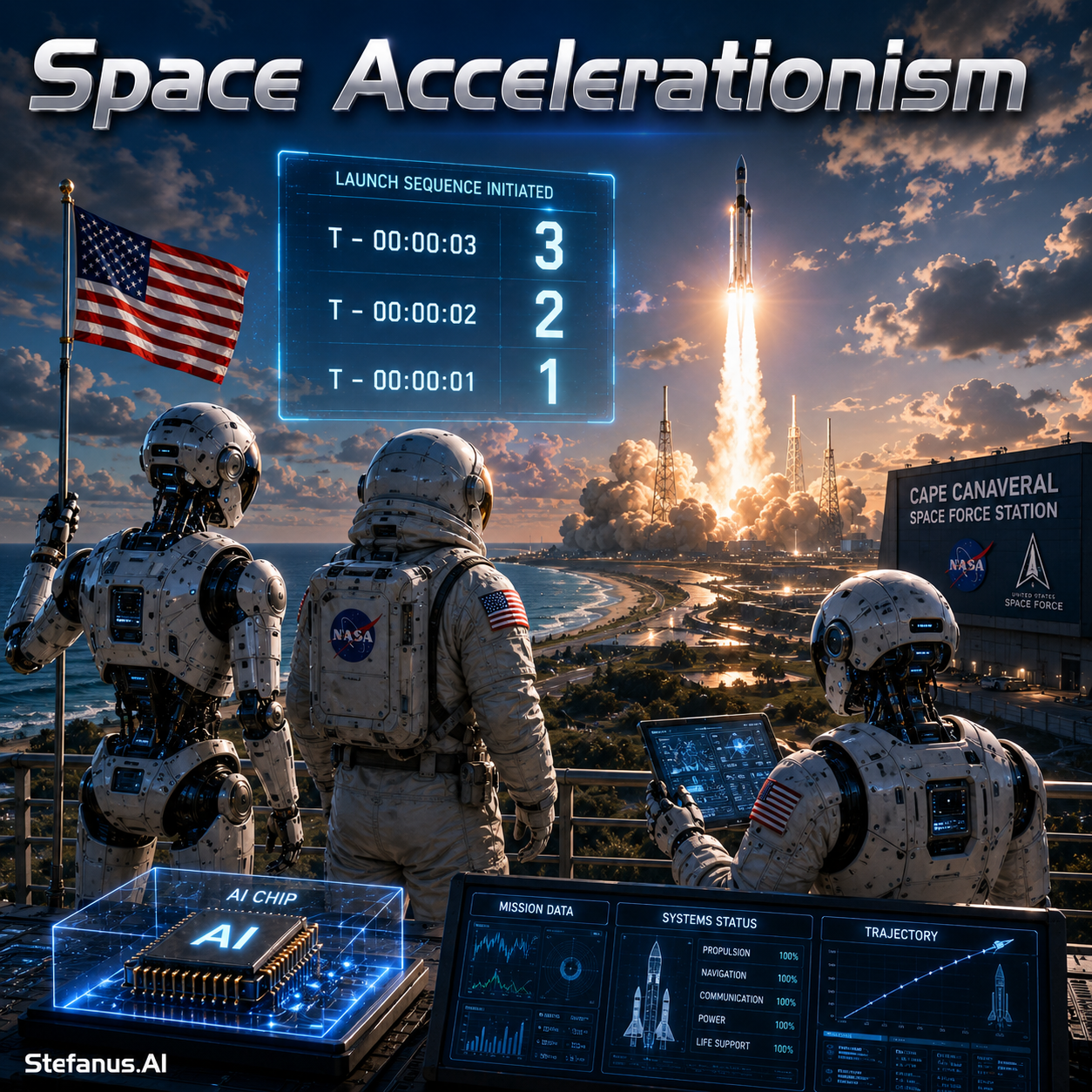

Artificial intelligence is beginning to outgrow the ordinary geography of computing. What once lived inside office campuses, server rooms, and cloud regions now presses against the limits of power grids, cooling systems, land markets, permitting regimes, and national infrastructure. The AI cloud is no longer an invisible layer above the economy; it is becoming a physical empire of energy, heat, chips, cables, satellites, and strategic territory.
Microsoft’s Project Natick was one early sign of this transition. The experiment placed a sealed data center module under the sea, not as spectacle, but as an infrastructure question: could compute be moved into a naturally cold, isolated, renewable-energy-adjacent environment? Microsoft described the project as research into “subsea datacenters powered by offshore renewable energy,” and its later report said the underwater data center concept had proved feasible and practical.¹ (natick.research.microsoft.com)
“Project Natick seeks to understand the benefits and difficulties in deploying subsea datacenters worldwide.”¹
That single experiment matters because it changed the imagination of compute geography. If data centers could go underwater, then compute was no longer tied to the conventional office park, the desert campus, or the suburban industrial zone. It could be submerged, sealed, moved, insulated, and placed near renewable power. From there, the logic extends naturally to colder geographies: northern U.S. states such as Michigan, Arctic territories, and renewable-rich islands such as Iceland. Iceland’s appeal is not only its cool climate; it is the combination of renewable energy, cold ambient air, and geopolitical stability, all of which make it attractive as an infrastructure site for energy-intensive digital systems.²
The same logic explains why Greenland now appears in the strategic imagination of AI infrastructure. Greenland should not be treated carelessly as a rumor about one billionaire buying land. Greenland’s land system and sovereignty politics are more complicated than that, and recent reporting emphasizes that Greenland is not simply a normal private real-estate market. But Greenland has clearly become a symbol of Arctic infrastructure ambition: cold climate, critical minerals, geopolitical location, and possible data-center suitability. Reuters has reported on Greenland’s strategic value in minerals and Arctic geopolitics, while other reporting has connected its cold climate and renewable resources to data-center discussion.³ (Reuters)
The deeper pattern is clear. First, compute looked underwater. Then it looked north. Then it looked to renewable islands. Then it looked to the Arctic. Finally, it looked upward.
This is why I call this paper Space Accelerationism. The phrase describes the moment when AI capitalism stops merely optimizing the Earth and begins treating space as the next layer of industrial expansion. It is not only a space race. It is not only a satellite race. It is not only a hyperscaler race. It is a race to relocate the physical burdens of intelligence—energy, heat, storage, inference, communications, and sovereignty—into orbit.
Joseph Schumpeter gives us the economic foundation. Capitalism does not politely preserve old arrangements. It reorganizes them through destruction, replacement, and acceleration.
“This process of Creative Destruction is the essential fact about capitalism.”⁴
David Harvey gives us the geography. Capitalism expands spatially when old spaces become constrained.
“Capitalism, we might say, is addicted to geographical expansion.”⁵
Vaclav Smil gives us the energy realism. Power density is not a secondary engineering detail; it is the hidden structure beneath industrial civilization.
“Power density is a key determinant of the nature and dynamics of energy systems.”⁶
Paul Virilio gives us the politics of speed. Modern power belongs not only to whoever owns territory, but to whoever controls acceleration, movement, transmission, and real-time command.
“Real time prevailed over real space.”⁷
Space Accelerationism is the synthesis of these ideas. It is Schumpeterian destruction applied to terrestrial data centers; Harvey’s spatial fix extended beyond Earth; Smil’s energy realism converted into orbital solar ambition; and Virilio’s politics of speed transformed into a hyperscaler race for real-time intelligence above the planet.

Section 1: What Space Accelerationism Means
Space Accelerationism means the intensification of technological capitalism through the frontier of space, driven by the belief that terrestrial limits should not slow AI expansion but should instead accelerate the search for extra-terrestrial infrastructure. It is not merely “space technology.” It is the conversion of space into an extension of the AI stack.
The word accelerationism matters because the movement is not cautious, slow, or purely scientific. It is fast, capital-intensive, founder-driven, and future-obsessed. Silicon Valley’s Effective Accelerationism, or e/acc, argues that technological progress should be intensified rather than restrained. Its cultural energy comes from the belief that human flourishing, economic growth, and civilization-scale progress depend on accelerating technology through existing barriers rather than submitting to them.
Marc Andreessen’s techno-optimist manifesto captures the spirit of this worldview.
“Technology is the glory of human ambition and achievement, the spearhead of progress.”⁸
Space Accelerationism takes that attitude and gives it a new domain. If AI needs more power, it looks to space-based solar energy. If data centers need more cooling, it imagines orbital thermal systems. If land is politically contested, it looks beyond land. If regulations delay construction, it searches for jurisdictions above jurisdictions. If terrestrial grids cannot keep pace, it imagines compute that does not depend on terrestrial grids at all.
This is why Space Accelerationism is not simply about placing servers in orbit. It is about a civilizational change in the geography of intelligence. The first cloud era centralized software in terrestrial data centers. The AI era is beginning to ask whether intelligence itself must become planetary, orbital, lunar, and eventually interplanetary.
In this sense, space becomes the ultimate “spatial fix.” Harvey’s theory is essential here because capitalism often resolves internal crises by moving into new spaces. Industrial capitalism moved across oceans, railways, ports, colonies, suburbs, oil fields, logistics corridors, and financial zones. Digital capitalism moved into fiber networks, cloud regions, app stores, semiconductor supply chains, and platform ecosystems. AI capitalism is now moving into energy corridors, nuclear sites, deserts, oceans, Arctic zones, and orbit.
Space Accelerationism is therefore not science fiction. It is the next logical move of an economic system that treats constraints as invitations to expand.

Section 2: Key Events Since January 2026
Since January 2026, Space Accelerationism has moved from speculative theory into a visible industrial sequence. The key events are not isolated. They form a pattern: SpaceX, Blue Origin, Amazon, NVIDIA, Google, Starcloud, Lonestar, Aetherflux, China, and Europe are all moving toward a future in which space becomes part of the compute and communications stack.
The major events include SpaceX’s FCC filing for up to one million satellites to support solar-powered AI data centers; Blue Origin’s announcement of TeraWave, a 5,408-satellite network for enterprise, data-center, and government customers; Amazon’s agreement to acquire Globalstar for Amazon Leo direct-to-device services; Arianespace’s Ariane 6 deployment of Amazon Leo satellites; NVIDIA’s announcement of the Space-1 Vera Rubin Module for orbital data centers; Google’s Project Suncatcher; Starcloud’s H100-equipped satellite; Lonestar’s lunar and orbital data-storage ambitions; Aetherflux’s orbital data-center plan; and China’s “Space Cloud” strategy.⁹ (Reuters)
The timeline matters because it shows acceleration in the literal sense. These announcements are clustered, competitive, and mutually reinforcing. One company proposes orbital AI data centers. Another announces enterprise orbital networking. A chip company announces space-grade AI hardware. A cloud company buys satellite communications capacity. A launch provider places more constellation satellites into orbit. A state competitor announces space-based AI infrastructure. The result is not a single project; it is an emerging system.
Space Accelerationism is born when multiple actors begin solving the same problem from different layers of the stack: launch, network, chip, cloud, data storage, solar power, defense, and sovereignty.

Section 3: SpaceX and Elon Musk — The Million-Satellite Imagination
The SpaceX proposal is the most dramatic expression of Space Accelerationism because it shifts the satellite constellation from communications infrastructure into AI infrastructure. Starlink already changed the global imagination of low-Earth orbit by making satellite broadband feel like an operational platform rather than a distant promise. But the January 2026 FCC filing moved the conversation into a new category: satellites not merely as relays for internet traffic, but as nodes for orbital computation.
Reuters reported that SpaceX sought FCC approval for a constellation of one million satellites that would orbit Earth and harness solar energy to power AI data centers.¹⁰ (Reuters)
“SpaceX wants to launch a constellation of 1 million satellites.”¹⁰
The strategic logic is clear. AI data centers on Earth face severe energy and cooling constraints. Solar energy in orbit is more continuous than solar energy on Earth because it avoids night cycles, weather interruption, cloud cover, and many terrestrial siting disputes. A satellite-based AI system would not need to negotiate with every county zoning board, every utility interconnection queue, every water district, or every state-level permitting authority.
This does not mean the engineering is easy. Space has its own constraints: radiation, launch cost, debris risk, thermal management, maintenance difficulty, orbital congestion, and communications latency. But the ideological significance is already enormous. SpaceX is effectively saying that AI scale may require a compute geography beyond Earth.
The Muskian dimension matters because Elon Musk frequently frames infrastructure in civilizational terms. His companies do not merely build cars, rockets, tunnels, satellites, or AI systems; they build narratives of species-level transition. In the language of Space Accelerationism, the one-million-satellite proposal becomes more than a filing. It becomes a declaration that artificial intelligence is pushing humanity toward a new energy regime.
The Kardashev Type II reference is important here. A Type II civilization can harness the energy of its star. Space-based AI data centers are not a Dyson sphere, but they borrow from the same imagination: when planetary energy is insufficient, intelligence turns toward the sun directly.
This is the first pillar of Space Accelerationism: AI demand converts orbital solar energy into strategic infrastructure.

Section 4: AWS, Blue Origin, Globalstar, and Amazon Leo — Bezos’s Orbital Stack
If SpaceX represents the dramatic founder-led leap into orbital AI scale, the Bezos ecosystem represents a more layered infrastructure strategy. Jeff Bezos’s space ambitions are distributed across Blue Origin, Amazon, AWS, Amazon Leo, satellite connectivity, launch capability, and now Globalstar. This is not one company pursuing one project. It is an orbital stack.
Blue Origin announced TeraWave in January 2026 as a space-based network optimized for enterprise, data-center, and government customers. The company says deployment will begin in the fourth quarter of 2027, and Reuters reported that the planned network would include 5,408 satellites with speeds of up to 6 Tbps.¹¹ (Blue Origin)
“TeraWave is optimized for enterprise, data center, & government customers.”¹¹
This phrase is important because it tells us the customer is not the household alone. The customer is the state, the corporation, the hyperscaler, the defense agency, and the data infrastructure operator. TeraWave is not being framed as a consumer internet service only. It is being framed as backbone infrastructure for a world in which cloud connectivity, government communication, and data-center traffic increasingly require space-based redundancy.
Amazon’s acquisition of Globalstar adds another layer. Amazon announced in April 2026 that it would acquire Globalstar to help Amazon Leo add direct-to-device services to its low-Earth-orbit network and extend cellular coverage beyond terrestrial networks.¹² (Amazon News)
“Amazon will acquire Globalstar, enabling Amazon Leo to add direct-to-device services.”¹²
The significance is not merely the purchase price. It is the architecture. Amazon can connect cloud, satellite, direct-to-device communications, enterprise customers, and launch ecosystems. In a terrestrial cloud era, AWS built regions and availability zones. In a space-accelerated era, Amazon may seek orbital network zones, satellite-based service layers, and direct-to-device coverage that extends the cloud’s reach into previously unreachable geographies.
Arianespace’s April 30, 2026 launch of another batch of Amazon Leo satellites with Ariane 6 shows that the orbital infrastructure race is not purely American in launch execution. Europe’s launch sector is part of the deployment machinery for U.S. hyperscaler constellations. This makes the Amazon case especially important geopolitically: private American cloud ambition depends on launch capacity, orbital rules, spectrum management, and international space logistics.
The Bezos stack therefore teaches a second lesson of Space Accelerationism: space-based intelligence will not be built by rockets alone; it will be built by vertically integrated cloud, launch, satellite, spectrum, and enterprise systems.

Section 5: NVIDIA and the Hardware Sovereignty of Space Intelligence
No orbital AI future can exist without chips that can survive the orbital environment. The space data-center race therefore depends not only on rockets and satellites, but on semiconductor architecture. This is why NVIDIA’s March 16, 2026 announcement is central to this paper.
NVIDIA announced the Space-1 Vera Rubin Module as part of its accelerated platform for space. The company said the Rubin GPU on the module delivers up to 25 times more AI compute than the H100 for space-based inferencing, enabling orbital data centers, geospatial intelligence processing, and autonomous space operations.¹³ (NVIDIA Newsroom)
“The Rubin GPU on the module delivers up to 25x more AI compute.”¹³
This is not just a product announcement. It is the arrival of a space-native AI hardware layer. Terrestrial AI infrastructure depends on GPUs, networking, power delivery, liquid cooling, and data-center architecture. Orbital AI infrastructure requires a different system: radiation tolerance, thermal cycling resilience, low-power operation, autonomous management, fault tolerance, and minimal physical servicing.
Jensen Huang’s broader industrial vision has been that AI is not simply software but a full-stack industrial transformation. In the space context, that full stack becomes literal. AI requires chips. Chips require energy. Energy requires infrastructure. Infrastructure requires territory. When territory becomes orbital, chips must become orbital too.
NVIDIA’s role is therefore structurally similar to its role on Earth, but strategically more concentrated. On Earth, NVIDIA provides the accelerated compute layer for data centers. In orbit, NVIDIA aims to provide the accelerated compute layer for satellites, autonomous spacecraft, geospatial intelligence, orbital data centers, and perhaps military sensing systems. That makes NVIDIA not only a chip company, but a supplier of intelligence infrastructure beyond Earth.
This is the third lesson of Space Accelerationism: whoever controls space-grade AI chips controls the computational nervous system of orbital intelligence.

Section 6: Google, Starcloud, Lonestar, and Aetherflux — The Expanding Space Compute Ecosystem
The most important sign that Space Accelerationism is real is that it is not limited to SpaceX, Amazon, or NVIDIA. A wider ecosystem is forming around orbital AI, lunar data storage, space solar power, and prototype space-based compute.
Google’s Project Suncatcher is particularly important because it brings the TPU architecture into orbit. Reporting on the project describes Google’s plan to begin testing solar-powered space data centers in 2027, using small satellite prototypes and advanced chips.¹⁴ (Business Insider)
Google’s role matters because the company has long built its AI infrastructure around custom Tensor Processing Units. If NVIDIA represents GPU-led orbital AI, Google represents TPU-led orbital AI. The competition therefore is not only between companies; it is between compute architectures.
Starcloud is another crucial actor. The company says Starcloud-1 launched in November 2025 with the first NVIDIA H100 GPU in space and trained the first LLM in orbit.¹⁵ (starcloud.com)
“Starcloud-1 launched in November 2025 with the first Nvidia H100 GPU in space.”¹⁵
This is symbolically powerful because the H100 is one of the defining chips of the terrestrial AI boom. Sending it into orbit is more than a technical demonstration. It is a declaration that AI hardware is no longer confined to Earth’s data-center geography.
Lonestar Data Holdings points the movement toward the Moon. Sidus Space said in April 2026 that it was building a StarVault payload for Lonestar, scheduled no earlier than fall 2026 aboard LizzieSat-4, as part of a broader orbital data-storage architecture.¹⁶ (Sidus Space, Inc.)
Aetherflux adds the energy-compute layer. The company says it is building an orbital data-center satellite using solar power in space to address AI’s energy needs, with its first commercial data-center node targeted for Q1 2027.¹⁷ (Aetherflux)
“The first data center node for commercial use is targeted for Q1 2027.”¹⁷
Together, these companies reveal an ecosystem logic. Google tests orbital TPUs. Starcloud tests orbital GPUs. Lonestar explores lunar and orbital storage. Aetherflux links space solar power with compute. NVIDIA supplies hardware. SpaceX supplies scale. Blue Origin supplies enterprise orbital networking. Amazon supplies cloud integration.
This is how new infrastructure eras form: not through one invention, but through the alignment of many layers that suddenly make one another more plausible.

Section 7: China, Europe, and the Geopolitics of Orbital Sovereignty
Space Accelerationism is not only a corporate movement. It is also a geopolitical transition. Once intelligence infrastructure moves into orbit, the question becomes: who governs the orbital cloud, who protects it, who launches it, who powers it, who connects it, and who denies access to rivals?
China has already recognized this strategic direction. Reuters reported in January 2026 that China plans to create a “Space Cloud” by launching space-based AI data centers over the next five years, with China Aerospace Science and Technology Corporation calling for “gigawatt-class space digital-intelligence infrastructure.”¹⁸ (Reuters)
“China also plans to create a ‘Space Cloud.’”¹⁸
This is a major geopolitical signal. China is not treating orbital AI infrastructure as fantasy. It is integrating space-based solar power, AI computing, and national planning into the next stage of state industrial policy. In the same period, China is also pursuing a crewed lunar landing by 2030, supported by the Long March 10 rocket, Mengzhou spacecraft, and Lanyue lander architecture.¹⁹ (AP News)
The Moon matters because it is not only a destination. It is a logistics platform, a symbolic high ground, a scientific base, and potentially a data, energy, and communications node. A state that builds lunar infrastructure can shape standards, navigation, resource access, and strategic presence beyond low-Earth orbit.
Europe’s role is different but still important. Arianespace is not necessarily leading the orbital AI narrative, but it is part of the deployment infrastructure. Its launch of Amazon Leo satellites with Ariane 6 shows how European launch capacity may become essential to the constellation economy. In the space-based intelligence era, launch providers become geopolitical infrastructure providers, not merely contractors.
This is the fourth lesson of Space Accelerationism: orbital compute will become a sovereignty domain.
The U.S. will not be competing only company against company. It will be competing stack against stack: American private hyperscalers and launch companies against Chinese state-industrial planning, European launch capacity, emerging lunar infrastructure, and other sovereign strategies.

Section 8: Strategic Lessons for Hyperscalers and the U.S. Government
The first lesson is that AI growth is now inseparable from energy strategy. The largest AI companies cannot rely only on software optimization to solve the compute problem. They need power generation, transmission access, cooling innovation, nuclear partnerships, solar integration, grid modernization, and perhaps orbital energy systems. Vaclav Smil’s insight about power density becomes central here because AI infrastructure is ultimately a spatial-energy problem. Low-density energy systems require large areas; high-density computation requires concentrated power. The mismatch produces political conflict.
The second lesson is that geography is becoming programmable. For decades, software seemed to erase geography. The cloud made location feel abstract. But AI has reversed the illusion. Now geography is everything: where chips are fabricated, where data centers are built, where electricity is generated, where water is available, where cables land, where satellites orbit, where rockets launch, and where states permit construction.
The third lesson is that orbital infrastructure will be dual-use from the beginning. Any system that can support AI inference, geospatial intelligence, autonomous space operations, and global communications will have commercial and military relevance. NVIDIA’s own language links orbital data centers with geospatial intelligence and autonomous operations.¹³ This means the space compute race will not remain a private technology race. It will become a defense, intelligence, and national-security issue.
The fourth lesson is that the U.S. government cannot treat space-based AI infrastructure as science fiction. If SpaceX, Amazon, NVIDIA, Google, Starcloud, Lonestar, and Aetherflux are all pursuing pieces of the stack, and China is planning “Space Cloud” infrastructure, then public policy must catch up. Spectrum, launch cadence, orbital debris, military protection, export controls, chip supply, satellite cybersecurity, lunar governance, and space traffic management all become AI policy.
The fifth lesson is that the hyperscaler race beyond Earth may reproduce old inequalities in a new domain. If the orbital cloud is controlled by a small number of companies and states, then compute sovereignty may become even more concentrated. The same concerns that apply to terrestrial cloud concentration—market power, dependence, censorship, surveillance, pricing, national security, and unequal access—may become stronger when the infrastructure is physically located above the planet.
Erik Brynjolfsson’s warning about digital technologies concentrating power applies directly here.
“Machines, platforms and the crowd can concentrate power and wealth.”²⁰
Space Accelerationism therefore requires both ambition and restraint. The goal should not be to slow technological progress into paralysis, but to understand that the orbital AI stack will become part of the political economy of the twenty-first century.
Conclusion: Why Space Accelerationism
We began with underwater servers, northern data centers, Icelandic cooling, and Greenland’s Arctic strategic imagination. These examples were not random. They were early signals that AI infrastructure is trying to escape the ordinary geography of computing. The cloud first moved into warehouse-scale data centers. AI then pushed those data centers toward power plants, water systems, cold climates, nuclear reactors, and remote land. Now the same pressure is pushing compute toward orbit.
Space Accelerationism names this movement.
It names the moment when hyperscalers, founders, chipmakers, launch companies, and states begin to treat space not merely as exploration, but as infrastructure. It names the acceleration of capitalism through the final frontier. It names the shift from Earth-based cloud computing to orbital intelligence. It names the possibility that AI’s material demands may become so large that the next data-center region is not Virginia, Oregon, Michigan, Iceland, or Greenland, but low-Earth orbit.
The impact will be enormous. If successful, orbital data centers could reshape energy demand, satellite regulation, cloud architecture, national security, geospatial intelligence, and the balance of power between the United States and China. If poorly managed, they could intensify orbital debris, light pollution, monopoly power, militarization, and infrastructure inequality.
This is why the phrase Space Accelerationism matters. It is not simply poetic. It is diagnostic. It captures the speed, ideology, capital, and civilizational ambition behind the movement. It explains why underwater data centers, Arctic investment, orbital chips, satellite constellations, lunar storage, space solar power, and AI geopolitics are not separate stories. They are one story.
AI is no longer only asking what intelligence can become.
It is asking where intelligence can live.
And increasingly, the answer from the most powerful companies and states is: beyond Earth.

Footnotes
1. Microsoft Research / Microsoft News, “Project Natick Phase 2” and “Microsoft finds underwater datacenters are reliable, practical and use energy sustainably.”
https://natick.research.microsoft.com/
https://news.microsoft.com/source/features/sustainability/project-natick-underwater-datacenter/
2. Government and industry discussions on Iceland’s renewable-energy and cold-climate data-center appeal; see also Iceland’s public renewable-energy profile and data-center industry materials.
https://www.government.is/
3. Reuters, “Sustainable Switch: Trump, Greenland and critical minerals,” January 9, 2026; Reuters, “No one owns our Arctic land,” January 29, 2026.
https://www.reuters.com/sustainability/sustainable-switch-trump-greenland-critical-minerals-2026-01-09/
https://www.reuters.com/world/no-one-owns-our-arctic-land-we-share-it-say-greenlands-inuit-2026-01-29/
4. Joseph Schumpeter, quoted in Econlib, “Creative Destruction.”
https://www.econlib.org/library/Enc/CreativeDestruction.html
5. David Harvey, “Globalization and the ‘Spatial Fix.’”
https://d-nb.info/1217929630/34
6. Vaclav Smil, Power Density: A Key to Understanding Energy Sources and Uses, MIT Press.
https://mitpress.mit.edu/9780262029148/power-density/
7. Paul Virilio, “Speed Pollution,” Wired, May 1996.
https://www.wired.com/1996/05/virilio
8. Marc Andreessen, “The Techno-Optimist Manifesto,” Andreessen Horowitz, October 16, 2023.
https://a16z.com/the-techno-optimist-manifesto/
9. Reuters, Blue Origin, Amazon, NVIDIA, Google, Starcloud, Sidus Space, Aetherflux, public announcements and reporting on 2025–2026 orbital compute and satellite infrastructure.
https://www.reuters.com/business/aerospace-defense/spacex-seeks-fcc-nod-solar-powered-satellite-data-centers-ai-2026-01-31/
https://www.blueorigin.com/news/blue-origin-introduces-terawave-space-based-network-for-global-connectivity
https://www.aboutamazon.com/news/company-news/amazon-globalstar-apple
https://nvidianews.nvidia.com/news/space-computing
10. Joey Roulette, Reuters, “SpaceX seeks FCC nod for solar-powered satellite data centers for AI,” January 31, 2026.
https://www.reuters.com/business/aerospace-defense/spacex-seeks-fcc-nod-solar-powered-satellite-data-centers-ai-2026-01-31/
11. Blue Origin, “Blue Origin Introduces TeraWave”; Reuters, “Bezos’ Blue Origin to deploy thousands of satellites,” January 21, 2026.
https://www.blueorigin.com/news/blue-origin-introduces-terawave-space-based-network-for-global-connectivity
https://www.reuters.com/science/bezos-blue-origin-deploy-thousands-satellites-new-terawave-communications-2026-01-21/
12. Amazon, “Amazon to acquire Globalstar; partners with Apple,” April 2026.
https://www.aboutamazon.com/news/company-news/amazon-globalstar-apple
13. NVIDIA, “NVIDIA Launches Space Computing, Rocketing AI Into Orbit,” March 16, 2026.
https://nvidianews.nvidia.com/news/space-computing
14. Business Insider / Space.com reporting on Google Project Suncatcher, 2025–2026.
https://www.businessinsider.com/google-project-suncatcher-sundar-pichai-data-centers-space-solar-2027-2025-11
https://www.space.com/technology/data-centers-in-space-will-2027-really-be-the-year-ai-goes-to-orbit
15. Starcloud, “Starcloud-1”; NVIDIA Blog, “How Starcloud Is Bringing Data Centers to Outer Space.”
https://www.starcloud.com/starcloud-1
https://blogs.nvidia.com/blog/starcloud/
16. Sidus Space, “Sidus Space Expands Existing Agreement with Lonestar Data Holdings,” April 15, 2026.
https://investors.sidusspace.com/news-events/press-releases/detail/279/sidus-space-expands-existing-agreement-with-lonestar-data
17. Aetherflux, “Space Solar Power / Orbital Data Center”; Data Center Dynamics, “Aetherflux orbital data center to be operational by Q1 2027.”
https://www.aetherflux.com/
https://www.datacenterdynamics.com/en/news/aetherflux-orbital-data-center-to-be-operational-by-q1-2027/
18. Reuters, “China vows to develop space tourism, explore deep space,” January 29, 2026; Reuters, “Why does Elon Musk want to put AI data centers in space?” January 29, 2026.
https://www.reuters.com/science/china-vows-develop-space-tourism-explore-deep-space-it-races-us-2026-01-29/
https://www.reuters.com/sustainability/climate-energy/why-does-elon-musk-want-put-ai-data-centers-space-2026-01-29/
19. Associated Press, “China says it’s on track to land astronauts on the moon by 2030”; South China Morning Post, “China’s Mengzhou spacecraft passes key test.”
https://apnews.com/article/0a9834bb0790c7f57a6bb8bbf4bcdcb3
https://www.scmp.com/news/china/science/article/3343144/chinas-mengzhou-spacecraft-passes-key-test-2030-crewed-moon-mission-long-march-10-rocket
20. Erik Brynjolfsson, interview with ORF, “The Erik Brynjolfsson Interview,” August 7, 2018.
https://www.orfonline.org/expert-speak/43096-the-erik-brynjolfsson-interview


Comments
[…] the coming Starship; the maturation of satellite-to-satellite optical communication links; and the explosive demand for inference at the edge created by the AI revolution on […]