
Introduction:
Much of the discourse surrounding the US-China bifurcation of the global intelligence economy has rightly focused on the contest between the two superpowers — on export controls, chip wars, data regulation, and the race to artificial general intelligence. What has received comparatively less attention, however, is the texture of the world that exists beyond this binary: the vast space of allied coexistence where the United States and its strategic partners have forged technology ecosystems that depend on one another precisely because they trust one another. It is in this space — between the adversarial and the fully cooperative — that the most consequential architecture of the modern AI and robotics economy is being quietly assembled.
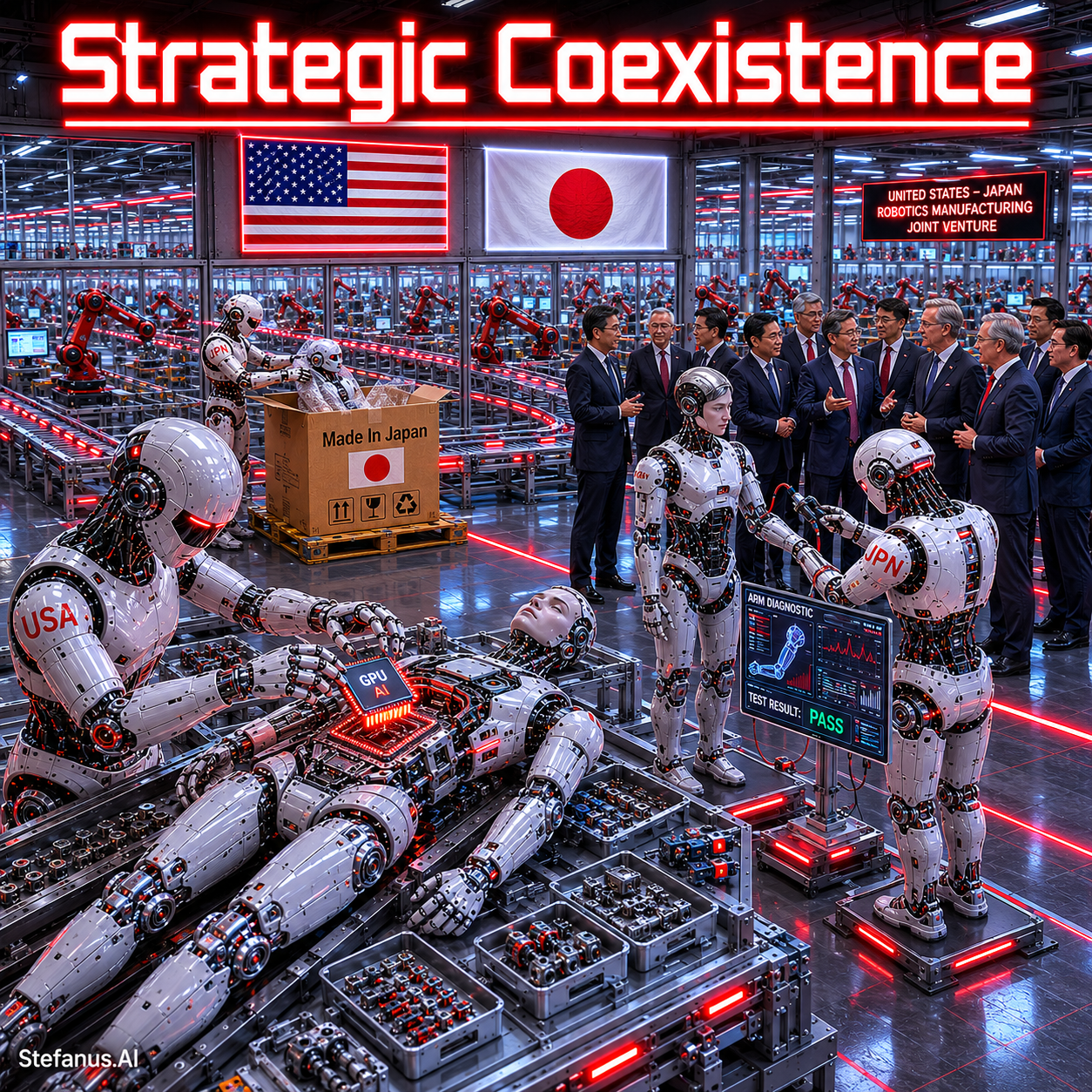
This paper is named Strategic Coexistence for reasons that will become apparent across its four sections. The term is not borrowed from classical international relations theory alone, but is meant to capture something more specific and more immediate: the operating logic of allied nations and competing corporations that have chosen interdependence over isolation, and shared infrastructure over sovereign autarky, in the pursuit of long-term technological dominance. Strategic Coexistence is the recognition that no single nation — not even the United States — can independently control the full stack of the robotics and AI economy. It requires allies. It requires trust. And above all, it requires the structural incentives that make mutual dependency more rational than mutual destruction.
The most revealing contemporary example of this dynamic is the global industrial robotics industry. For more than three decades, Japanese firms have dominated it. FANUC Corporation, headquartered in Yamanashi Prefecture, and Yaskawa Electric Corporation, based in Kitakyushu, collectively account for a significant share of the world’s industrial robot installations. ABB Robotics of Switzerland — now acquired by Japan’s SoftBank Group in a landmark $5.375 billion transaction announced in October 2025 — brings one of the world’s most storied industrial robotics franchises into an increasingly Japan-anchored ecosystem.[1]
Simultaneously, the US government has spent the years from 2024 through 2026 systematically erecting walls against Chinese technology: banning Chinese AI platforms like DeepSeek from government devices, prohibiting Chinese-connected vehicle software and hardware from American roads, and — most recently in March 2026 — introducing the American Security Robotics Act to bar Chinese-made humanoid robots from federal facilities.[2] The United States has not been doing this in isolation. It has been doing this while investing deeply in allied technology capacity — signing the October 2025 Technology Prosperity Deal with Japan, committing to co-develop AI, quantum computing, 6G, and space infrastructure, and welcoming a notional $550 billion Japanese investment pledge into American industries.[3]
This is not a paradox. This is Strategic Coexistence in action. The United States blocks enemies and embraces allies. In the robotics industry — perhaps more than any other sector — the consequences of this architecture are now materializing in market structure, supply chains, data governance, and national security doctrine. This paper examines these consequences in depth.

Section 1: Definitions — What Is Strategic Coexistence?
Before examining the geopolitical and industrial landscape, it is necessary to establish the theoretical ground on which this paper stands. Strategic Coexistence is not a term that has received systematic treatment in the policy literature. Yet as a descriptive concept — and increasingly as a prescriptive framework — it captures a real and consequential operating mode that neither classical realism nor liberal institutionalism fully accounts for. Classical realism posits that states act primarily to maximize power in a zero-sum environment; liberal institutionalism posits that shared institutions reduce the incentive for conflict. Strategic Coexistence sits between these poles: it is realist in its acknowledgment that rivalry is structural and persistent, and institutionalist in its recognition that managed interdependence produces outcomes superior to unconstrained competition.
1.1 — The Geopolitical Dimension: Competing While Surviving
In its geopolitical form, Strategic Coexistence describes a condition in which opposing nations compete for global influence, economic dominance, and technological supremacy, while simultaneously cooperating on matters of mutual interest and abiding by informal norms designed to prevent their rivalry from escalating into open warfare. The concept is distinct from classical détente, which implies a deliberate relaxation of hostilities, and from engagement, which implies a normative commitment to integration. Strategic Coexistence is more transactional and more structural: nations coexist not because they like one another, but because the costs of destroying the other would outweigh the benefits of dominance. It is a framework of rational mutual restraint.
The World Economic Forum, writing in mid-2025, captured the underlying tension with precision, observing:
“As of mid-2025, the geopolitics of AI stands at a crossroads. On one path, the world could slide further into fragmentation, with a digital iron curtain separating US-led and China-led tech spheres.” [4]
New technology alliances are emerging that reflect exactly this logic of coexistence-through-structure. The “Chip 4” alliance — comprising the US, Japan, Taiwan, and South Korea — coordinates semiconductor strategy not out of idealism, but because each member recognizes that supply chain dependence on a single adversarial state represents an unacceptable vulnerability.[4] The alliance does not eliminate competition among its members; it simply channels competition into arenas that do not threaten collective technological sovereignty. This is the institutional expression of Strategic Coexistence: shared infrastructure that enables rivalry on the terms that matter most, while preventing the kind of catastrophic dependence that would make rivalry existentially risky.
The Atlantic Council, in its January 2026 report on the geopolitical trajectories of AI, reinforced this view with a stark assessment:
“As 2026 begins, rapid AI integration threatens to inject even more unpredictability into an already fragmented global order.” [5]
Stanford’s Colin H. Kahl, Co-Director of the Center for International Security and Cooperation, has argued that the structural risk in this environment is not simply interstate competition — it is the destabilizing potential of asymmetric AI development, where some nations race ahead while others fall behind, creating windows of vulnerability that aggressive actors may exploit.[6] Strategic Coexistence, in this reading, is the framework that prevents those windows from opening — through deliberate alliance management, shared standards, and coordinated export policy.
1.2 — The Corporate Dimension: Strategic Alliances Among Rivals
In the business and corporate world, Strategic Coexistence — or what practitioners often call a “strategic alliance” — describes a condition where rival companies operating in the same market choose to collaborate on specific projects, share infrastructure, or coordinate on standards, even while competing for customers and market share. This is not merger; it is not full partnership. It is the functional acknowledgment that in complex technology ecosystems, no firm can control the entire value chain, and that selective cooperation produces outcomes superior to zero-sum competition.
In the robotics industry, this form of coexistence is visible in the relationships between Japanese industrial robot manufacturers and their American technology customers. American manufacturers — from Tesla’s Gigafactories to Amazon’s fulfillment centers — depend on Japanese robotic arms, Japanese servo motors, and Japanese precision engineering. The Japanese firms, in turn, depend on American AI software, American semiconductor designs, and American market access. Neither side can defect without destroying value for both. This mutual dependency is not a weakness. It is the architecture of Strategic Coexistence — a carefully balanced interdependency that benefits both parties and that neither party can afford to rupture.

Section 2: Why the United States and Japan Can Get Along — The Anatomy of Allied Technology Trust
A useful entry point into the US-Japan technology relationship is a simple observation that carries enormous geopolitical weight: the United States allows Japanese-made automobiles to enter its market freely, while it has moved aggressively to ban Chinese-made connected vehicles from American roads. This asymmetry is not accidental. It encodes decades of alliance management, trust-building, and shared security interest into a regulatory posture that has profound consequences for the global technology economy. To understand this asymmetry is to understand the architecture of Strategic Coexistence as it operates in practice.
2.1 — The Chinese Technology Blockade: From Vehicles to AI to Robots
Beginning in September 2024 and finalized in January 2025, the Biden administration issued a sweeping rule prohibiting Chinese software and hardware in connected vehicles on American roads. The rule, emanating from the Department of Commerce, covers Vehicle Connectivity Systems — including telematics, Wi-Fi, satellite, and cellular functions — as well as Automated Driving System software. The software prohibition took effect in January 2026; hardware prohibitions will follow in January 2029.[7] Sales of connected cars with VCS and ADS systems tied to China — even if manufactured domestically within the United States — were banned as of that date.
The rationale was explicit and unambiguous. Commerce Secretary Gina Raimondo articulated the concern in terms that went beyond standard protectionism:
“You can imagine the most catastrophic outcome theoretically if you had a couple million cars on the road and the software were disabled.” [8]
President Biden, ordering the national security investigation in February 2024, was equally direct: “China’s policies could flood our market with its vehicles, posing risks to our national security. I’m not going to let that happen on my watch.”[9] The logic is straightforward: a connected vehicle is not merely a transportation device. It is a data collection platform equipped with cameras, GPS, microphones, and connectivity to cloud infrastructure. In the hands of a state-influenced technology company reporting to a government whose data laws require corporate cooperation with national intelligence agencies, such a vehicle becomes, potentially, a mobile surveillance node.
The same logic that drove the connected-vehicle ban has animated the broader campaign against Chinese AI platforms. In January 2025, DeepSeek — a Chinese AI startup that had released a large language model matching the capabilities of GPT-4 at a fraction of the training cost — immediately triggered a national security response. The Department of Commerce, the US Navy, NASA, and multiple state governments banned the application from government devices.[10] Canadian cybersecurity firm Feroot Security discovered that DeepSeek’s web login page contained obfuscated code revealing connections to China Mobile — a state-owned telecommunications company that the FCC had already barred from operating in the United States on national security grounds.[11]
Senators Jon Husted (R-Ohio) and Jacky Rosen (D-Nevada) introduced bipartisan legislation in February 2025 to prohibit DeepSeek on all government devices and networks. As Senator Husted stated in the Senate:
“DeepSeek is a tool that perpetuates Communist China’s agenda — full stop. It exposes Americans’ data to our adversary’s government, lies to its users and exploits American workers’ AI advances. We can’t afford for U.S. officials to play into Beijing’s hands by hosting this hostile bot on their devices.” [12]
Meanwhile, China had long since made its own position clear through the architecture of the Great Firewall. OpenAI’s ChatGPT, Google’s Gemini, and Anthropic’s Claude are all inaccessible to ordinary Chinese internet users behind China’s comprehensive internet censorship apparatus. As BGR observed in January 2025, the reciprocity argument cuts sharply in both directions: China does not allow US AI products to compete on its soil, yet expects its own AI exports to receive open-market treatment in American jurisdictions.[13] This asymmetry is itself a geopolitical statement. It reflects a Chinese strategic calculation that domestic AI market protection serves national interests, while expecting foreign markets to remain open to Chinese products represents an acceptable double standard. The US legislative response to DeepSeek was, in part, a refusal to accept that double standard.
By March 2026, the anti-Chinese-technology legislative arc had extended fully into the robotics sector. Senators Tom Cotton and Chuck Schumer introduced the American Security Robotics Act, targeting unmanned ground vehicle systems — humanoid robots, quadrupeds, and remote surveillance vehicles — made by foreign adversaries. The bill reflected documented evidence that Chinese-made robots were transmitting sensor data to servers in China and potentially harboring backdoor access capabilities for remote control.[2]
2.2 — The Japanese Exception: Why Allied Technology Receives Different Treatment
The contrast with Japan is instructive, and it is rooted in something deeper than mere trade policy. Japan is not simply a preferred trade partner. It is a treaty ally, a democratic peer, a co-signatory of international security agreements, and increasingly a co-architect of the global semiconductor and AI supply chain. The asymmetry in how the United States treats Japanese and Chinese technology is, fundamentally, an asymmetry in trust — and trust, in the modern technology economy, is a strategic asset of the first order. It takes decades to build, and it cannot be manufactured through diplomatic rhetoric alone.
The October 2025 Technology Prosperity Deal (TPD) between the United States and Japan formalized this trust into policy architecture. Signed on October 28, 2025, during President Trump’s Asia tour, the deal committed the two governments to deep collaboration on AI research and development, quantum computing, semiconductor manufacturing, biotechnology, space, 6G, and fusion energy.[14] Japan simultaneously pledged $550 billion in investment directed toward US industries — a commitment representing more than ten percent of Japan’s entire GDP, directed at energy, semiconductor fabrication, and advanced manufacturing.[15]
White House Director of the Office of Science and Technology Policy Michael Kratsios, speaking at the signing, articulated the broader strategic logic:
“The Trump Administration is redefining American technological leadership by driving bilateral collaborative partnerships with allies like Japan and Korea. Each Technology Prosperity Deal offers great opportunities to accelerate scientific discovery and lead the world into a new era of innovation driven by the US and our partners.” [3]
The White House’s March 2026 fact sheet on the broader US-Japan Alliance further documented the scale of Japanese investment commitments:
“In addition to the first tranche of three major Japanese investments under the 2025 U.S.-Japan Strategic Trade and Investment Agreement… worth $36 billion, the United States welcomes a second tranche of Japanese investments, including up to $40 billion from GE Vernova Hitachi in Tennessee and Alabama to build small modular reactor power plants and up to $33 billion in natural gas generation facilities in Pennsylvania and Texas.” [16]
TechCrunch, reporting on the TPD at the time of signing, captured the strategic logic succinctly: “The U.S. is effectively locking in partnerships to tap Japan and Korea’s expertise — Japan leads in advanced materials, robotics, and space technologies.”[17] This observation crystallizes the logic of Strategic Coexistence as applied to the US-Japan dyad: the United States is not merely tolerating Japanese technological leadership in robotics. It is actively deepening it, because Japanese robotics expertise embedded within a treaty alliance represents a strategic asset that China cannot easily replicate or contest.
CSIS scholars, writing in April 2026, noted that the new economic security agenda between Washington and Tokyo is “taking shape with framework agreements on emerging technology and critical mineral supply chains,” and that Japan’s updated National Security Strategy — due by the end of 2026 — will further embed the country as a primary security actor in America’s Indo-Pacific defense posture.[18] The Brookings Institution, in its detailed analysis of Japan’s semiconductor reindustrialization project, identified Japan’s national investment of 0.71% of GDP in semiconductor infrastructure between 2022 and 2025 — a rate significantly higher than Germany (0.41%), the United States (0.21%), or France (0.2%) — as a “national project” designed to ensure Japan remains “strategically essential and strategically independent amid the conflict for technological hegemony between the United States and China.”[19]

Section 3: The Key Players — Japanese Dominance, Allied Machinery, and the New Robotics Economy
To understand why the geopolitical architecture described in Section 2 matters for the robotics industry in practical terms, it is necessary to examine the companies that actually build the machines. The global industrial robotics and personal robotics ecosystem is not distributed evenly across nations. It is, to a remarkable and underappreciated degree, a Japanese-dominated industry — with critical contributions from Switzerland and, increasingly, from US-based AI and software firms that integrate Japanese hardware into intelligent autonomous systems.
3.1 — Market Overview: Scale, Structure, and the Allied Advantage
The global robotics market was valued at approximately $46.57 billion in 2024 and is projected to grow to $54.49 billion in 2025, reaching $191.33 billion by 2033 at a compound annual growth rate of 17%.[20] Within the industrial robotics subsegment specifically, Precedence Research calculates the market at $26.98 billion in 2025, growing to approximately $93.31 billion by 2035 at a CAGR of 13.21%.[21] Asia-Pacific dominates this market, accounting for more than 65% of revenue in 2025, with Japan and China together constituting the overwhelming majority of both production and consumption of industrial robots worldwide.
The principal players commanding global market share include FANUC Corporation of Japan, Yaskawa Electric Corporation of Japan, ABB Robotics of Switzerland (undergoing acquisition by Japan’s SoftBank Group), KUKA AG of Germany (majority-owned by China’s Midea Group), Kawasaki Heavy Industries, Mitsubishi Electric, Denso, Boston Dynamics (owned by Korea’s Hyundai Motor Group), and Universal Robots (owned by Teradyne of the United States). The structural composition of this list is itself a form of geopolitical commentary: the dominant industrial robot manufacturers are either Japanese, or they are owned by Japanese or allied capital. The notable exception — KUKA, majority-owned by China’s Midea since 2016 — has been the subject of ongoing regulatory scrutiny in both Europe and the United States precisely because of its Chinese ownership.
Technology strategist Sudip Saha, Principal Consultant for Industrial Automation, writing in a comprehensive 2026 market analysis, described the current moment as “a demand inflection driven by three converging forces: AI capability reaching production-grade reliability, cloud platforms enabling fleet-scale deployment economics, and structural labor shortages creating non-discretionary automation demand.”[22] This convergence is not occurring in a geopolitical vacuum. It is occurring in precisely the environment described in Sections 1 and 2: one in which the United States and its allies are building integrated technology systems while systematically excluding adversarial components from their supply chains.
3.2 — FANUC Corporation: The Quiet Giant of Global Automation
FANUC Corporation (TSE: 6954) is, by most measures, the single most important industrial robotics company in the world. Founded in 1950 and headquartered in Yamanashi Prefecture at the foot of Mount Fuji — a location chosen deliberately for its isolation and operational security — FANUC manufactures industrial robots, computerized numerical control (CNC) systems, servo motors, and compact machining centers that are installed in automobile factories, semiconductor facilities, and electronics manufacturing plants across every major economy on earth.
As of March 31, 2026, FANUC reported a trailing twelve-month revenue of $5.69 billion.[23] The company’s fiscal Q1 2026 earnings (for the quarter ending June 30, 2025) reflected quarterly revenue of $1.34 billion, with an EPS of $0.14 — beating the consensus analyst estimate of $0.13, though marginally below revenue expectations of $1.35 billion.[24] For the full fiscal year ending March 2026, analyst consensus projected revenues of approximately ¥819.6 billion, roughly in line with trailing performance, with 22 analysts tracking the company.[25] FANUC’s market capitalization as of May 2026 stood at approximately $47.5 billion.
FANUC is notable not merely for its scale but for its philosophy. The company maintains unusually tight control over its intellectual property, conducts the overwhelming majority of its research internally, and has historically resisted the kind of external partnerships that might dilute its technological sovereignty. Its deliberate physical isolation in Yamanashi — away from the corporate headquarters culture of Tokyo and Osaka — reflects a deeply Japanese institutional ethos: precision, continuity, and the subordination of financial optics to technical excellence. These qualities are precisely the ones that make FANUC an ideal partner for allied nations constructing secure automation ecosystems.
In January 2026, FANUC America launched the CRX series collaborative robots with advanced force-sensing technology, enabling safer human-robot interactions in electronics manufacturing while boosting throughput in high-mix production settings.[26] This product line reflects the broader industry trajectory toward collaborative robots (cobots) that can work alongside human operators without extensive safety barriers — a key requirement for the next generation of manufacturing environments that combines human dexterity with robotic precision.
From a geopolitical standpoint, FANUC’s importance to US manufacturing is difficult to overstate. Tesla’s Gigafactories use FANUC robots. The US semiconductor industry — increasingly located in TSMC’s Arizona fabrication facilities and Intel’s Ohio expansion — will require FANUC precision automation for wafer fabrication at volumes previously unseen outside East Asia. In a world where the United States has excluded Chinese automation equipment from strategic facilities, FANUC is not simply a vendor. It is a trusted infrastructure provider whose reliability is protected by the same treaty architecture that secures American military bases in Japan.
3.3 — Yaskawa Electric Corporation: Motion Control and the Physical AI Future
Yaskawa Electric Corporation (TSE: 6506), founded in 1915 in Kitakyushu, is the oldest and in some respects the most philosophically ambitious of Japan’s major robotics companies. Where FANUC dominates through CNC systems and industrial precision, Yaskawa has built its identity around motion control — the science of making machines move with exactly the right velocity, torque, and positional accuracy at every moment of operation. Its MOTOMAN industrial robot line has been one of the most widely deployed robotic platforms in global manufacturing history, installed in automotive, pharmaceutical, food processing, and electronics plants across more than one hundred countries.
Yaskawa’s most recent full-year fiscal 2026 results (for the year ending February 2026) reported revenue of ¥542.1 billion (approximately $3.7 billion), flat relative to the prior year, with net income of ¥35.2 billion — a decline of 38% year-over-year, largely reflecting the normalization from elevated FY2025 margins rather than structural deterioration.[27] The company’s fiscal Q1 2026 (ending May 2025) revenues came in at approximately $869.63 million, with EPS of $0.37.[28] Yaskawa’s trailing twelve-month revenue as of August 2025 was approximately $3.6 billion, with 32 analysts covering the company.[29]
What is strategically significant about Yaskawa in the 2025-2026 period is not merely its financial performance but its technological direction. In November 2025, Yaskawa Electric and SoftBank Corp. announced a strategic collaboration to implement what they termed “Physical AI” on a social scale.[30] The partnership combines Yaskawa’s MOTOMAN NEXT autonomous robots with SoftBank’s AI-RAN communication infrastructure to enable real-time, low-latency decision-making for robotic systems operating in dynamic environments. This is not an incremental product extension — it is a philosophical reorientation of what a robot fundamentally is. Rather than a programmed tool executing predetermined sequences, the Physical AI robot is an agent: capable of perception, adaptation, and decision-making in unstructured environments.
Yaskawa further demonstrated this direction in February 2026, when it released the HC20DT humanoid collaborative robot with dual-task capabilities, incorporating vision-guided AI for semiconductor assembly, significantly improving yield rates in precision electronics production.[31] The HC20DT is designed for the manufacturing environments that represent the highest-value applications of robotics — applications that are simultaneously the most geopolitically sensitive, given that semiconductor fabrication is at the very heart of the US-China technology contest.
3.4 — ABB Robotics and the SoftBank Acquisition: The Japanese Consolidation of Global Automation
Perhaps the most consequential single event in the global robotics industry during the 2025-2026 period was the October 8, 2025 announcement that Japan’s SoftBank Group would acquire ABB’s Robotics division from Switzerland’s ABB Ltd. for $5.375 billion. The transaction, expected to close in mid-to-late 2026 pending regulatory approvals in the European Union, China, and the United States, effectively brings one of the three largest industrial robotics businesses in the world under Japanese ownership.[32]
ABB Robotics, headquartered in Zurich with US manufacturing operations in Auburn Hills, Michigan, employs approximately 7,000 people and generated $2.3 billion in revenue in 2024 — representing approximately 7% of ABB Group’s total revenues, with an operational EBITDA margin of 12.1%.[33] Its product portfolio encompasses industrial automation systems, force- and power-limited collaborative robot arms, and autonomous mobile robots (AMRs) — a comprehensive range that complements Yaskawa’s motion control expertise and FANUC’s CNC and precision manufacturing focus.
ABB’s decision to sell, rather than pursue the independently listed IPO it had planned for 2026, reflected several converging pressures: declining orders and revenues from 2023 to early 2025, limited synergies between robotics and ABB’s core electrification and automation businesses, and the compelling valuation offered by SoftBank — approximately 2.3x revenue, a premium that acknowledged the long-term strategic value of robotics leadership even through a cyclical downturn in orders.[34]
From SoftBank’s perspective, the acquisition is the centerpiece of what founder Masayoshi Son has described as the company’s “Physical AI” strategy: the integration of artificial superintelligence with physical robotic systems that can operate in the real world. Son stated upon the announcement:
“Together with ABB Robotics, we will unite world-class technology and talent under our shared vision to fuse Artificial Super Intelligence and robotics — driving a ground-breaking evolution that will propel humanity forward.” [35]
The SoftBank-ABB transaction is not merely a business deal. It is a geopolitical event. It means that the three dominant forces in global industrial robotics — FANUC, Yaskawa, and ABB Robotics — are now either Japanese firms or Japanese-owned entities. In the context of the US-Japan Technology Prosperity Deal and the systematic exclusion of Chinese technology from American supply chains, this consolidation positions Japan as the indispensable intermediary of the physical AI economy. The robots that will build America’s semiconductors, assemble its electric vehicles, and stock its warehouses in the 2030s will, in very large measure, be machines built or controlled by Japanese capital.
3.5 — The Home Robotics Security Problem: Why Allied Machinery Matters in Every Room
The geopolitical anxiety about Chinese technology in the robotics sector is not confined to the factory floor. It has migrated into the home, and it has done so in ways that expose the full breadth and intimacy of the data surveillance problem. In 2025, security researchers published findings that Unitree Robotics’ humanoid and quadruped robots — affordable Chinese-made systems increasingly deployed in research labs, universities, law enforcement agencies, and private homes — were quietly transmitting audio, video, and sensor data to servers in China without user knowledge or consent.[36]
The academic report Cybersecurity AI: Humanoid Robots as Attack Vectors, authored by Víctor Mayoral-Vilches and co-researchers, documented an exploit known as UniPwn that provides attackers with total control of Unitree’s Go2 and B2 quadrupeds and G1 and H1 humanoids. The researchers documented:
“MQTT connections to servers at 43.175.228.18:17883 and 43.175.229.18:17883 transmit sensor fusion data at 1.03 Mbps and 0.39 Mbps respectively, with auto-reconnect ensuring continuous surveillance.” [37]
The legislative response was rapid and bipartisan. On March 26, 2026, Senators Tom Cotton (R-Arkansas) and Senate Minority Leader Chuck Schumer (D-New York) introduced the American Security Robotics Act. Schumer’s statement captured the breadth of the concern:
“The Chinese Communist Party has shown that they are willing to lie and cheat to get ahead at the expense of the American people and our national security. They are running their standard playbook, this time in robotics, trying to flood the U.S. market with their technology, which presents real security risks and threats to Americans’ privacy and American research and industry.” [39]
This legislative moment mirrors precisely the logic that drove the connected-vehicle software ban in 2024-2025 and the DeepSeek bans in early 2025. The pattern is entirely consistent: Chinese technology operating in networked, sensor-equipped, AI-driven systems is viewed as a vector for data collection and potential remote manipulation, regardless of its nominal consumer or industrial application. In each case, the US response has been not simply to restrict the Chinese product, but to deepen reliance on allied alternatives — Japanese, South Korean, or European systems whose data governance architecture is accountable to democratic legal frameworks.
The consumer robotics dimension deserves particular attention because it extends the surveillance concern into the most intimate sphere. Robot vacuums equipped with cameras and LIDAR sensors now map the interior layouts of millions of American homes. Chinese manufacturer Roborock, commanding approximately 46.5% of South Korea’s robot vacuum market and a dominant share of global premium segments, updated its privacy policy in March 2025 to specify that data collected through its smartphone application may be processed in China — reversing a prior commitment that Korean customer data would be stored at Amazon’s US data centers.[40] This is not a minor technical adjustment. It is the disclosure of a data architecture in which the interior geometry of private homes flows to servers subject to the jurisdiction of the Chinese state.
Cybersecurity authority Daniel J. Lohrmann, writing in February 2026, described the cumulative threat landscape of AI-enabled home devices with an observation that captures the slow-building nature of the risk:
“As we move toward 2030, more and more smart devices are quietly being added to our lives — bringing up a frog boiling in the pot scenario where we all experience gradual changes in smart devices all around us.” [41]
It is against this backdrop — home robots transmitting data to Chinese servers, humanoid robots embedded with surveillance capabilities, robot vacuums mapping domestic interiors — that the importance of allied machinery becomes not merely an industrial preference but a matter of deeply personal security. When a robot enters your home, the question of who manufactured it, where its data goes, and which government has legal access to that data is no longer abstract. It is intimate.
The Stanford Emerging Technology Review, in its 2026 edition released in January, listed robotics as one of ten frontier technologies “pivotal to shaping societies, economics, and geopolitics today and into the future,” noting:
“Breakthroughs in artificial intelligence, biotechnology, quantum science, advanced materials, and space technologies are reshaping economies, societies, and geopolitics at breathtaking speed.” [42]

Section 4: Lessons Learned, Implications, and the Five Pillars of Strategic Coexistence
The preceding three sections have traced a coherent arc: from the theoretical framework of Strategic Coexistence (Section 1), through the geopolitical anatomy of the US-Japan technology alliance and the structural exclusion of Chinese technology from American systems (Section 2), to the corporate reality of a Japanese-dominated robotics industry navigating the intersection of market forces and geopolitical imperatives (Section 3). This final analytical section synthesizes the lessons of that journey into five pillars — structural principles that organize how nations and firms operate in the era of Strategic Coexistence.
Pillar 1: You Cannot Trust Your Enemy — National Security Is the Master Variable
The most fundamental lesson of the US-China technology contest is that national security, once invoked, supersedes market logic. A Chinese AI model that performs as well as GPT-4 at a fraction of the cost — as DeepSeek demonstrably did in January 2025 — would, in a pure market framework, represent an irresistible competitive proposition. The US government’s response was not to embrace the cost efficiency. It was to ban the product from government devices, investigate its infrastructure connections, and introduce legislation to remove it from official use entirely.[43]
The same logic applies to connected vehicles, to telecommunications equipment, and now to robots. As Brookings Institution sociologist Kyle Chan told a Congressional hearing on April 16, 2026:
“I see the robots and the routers as being the latest in a long line of growing tech security concerns in the U.S. vis-à-vis Chinese technology.” [45]
The implication for businesses and policymakers is that no product category involving networked intelligence — AI, vehicles, robots, routers, telecommunications infrastructure — can be evaluated on performance and price alone when the manufacturer is headquartered in an adversarial nation. The master variable is not cost-efficiency or technical capability. It is the data governance architecture of the country in which the product was made, and the legal obligations of that country’s corporations to its state intelligence apparatus. In this environment, mistrust is not a prejudice. It is a policy grounded in evidence and structural logic.
Pillar 2: Rely on Allied Machinery, Motors, and Data Collections for Security
The second pillar follows directly from the first: if you cannot trust your enemy’s machines, you must build your technological future on your allies’ machines. This is not merely a negative injunction — it is an affirmative construction project that requires sustained policy commitment, industrial investment, and diplomatic management. The US-Japan Technology Prosperity Deal of October 2025, the $550 billion Japanese investment commitment, the Yaskawa-SoftBank Physical AI collaboration, and the SoftBank-ABB Robotics acquisition are all chapters of the same book: the deliberate construction of an allied industrial-robotics ecosystem whose data flows are subject to allied governance norms.[46]
CIO Magazine, writing in November 2025 on the geopolitics of AI and robotics, articulated this strategic logic explicitly:
“While China’s state-led model excels at monolithic software-hardware integration, a US-Japan alliance holds a different strategic advantage: the ability to foster an open and distributed global ecosystem.” [47]
Allied machines can enter American factories, American homes, and American government facilities precisely because their data architecture is subject to the same legal frameworks that govern American data. That legitimacy — earned through decades of alliance management and institutionalized in formal agreements — is the product of Strategic Coexistence. It is also a competitive advantage that China’s robotics industry, however technically capable, cannot easily replicate, because it requires not merely good hardware but trustworthy governance.
Pillar 3: Do Not Waste Resources on Warfare — Strategic Coexistence Is an Economic Doctrine
The third pillar of Strategic Coexistence is perhaps the most underappreciated: the framework is, at its core, a doctrine of economic rationality. Nations and firms that choose structured interdependence over adversarial competition are not being idealistic. They are calculating that the costs of sustained technological warfare — in terms of supply chain disruption, market fragmentation, lost innovation spillovers, and the diversion of capital from productive investment to defensive posturing — exceed the benefits of any plausible strategic victory.
The Atlantic Council, in its January 2026 analysis of AI geopolitics, identified the costs of fragmentation precisely, noting that a complete US-China tech decoupling “could force other countries to navigate two separate technology universes with incompatible standards and restricted flows of hardware and data.”[48] Such an outcome would not only reduce efficiency for all parties — it would diminish the pace of global AI development by eliminating the cross-pollination of ideas that has historically driven technological breakthroughs.
Japan’s $550 billion investment commitment to the United States is itself an expression of this logic. Japan is not investing in American industries out of altruism. It is investing because the alternative — a decoupled global economy in which Japan must choose between its American security guarantee and its Chinese market access — is far more costly than the price of deepening interdependence with Washington. Strategic Coexistence, in this reading, is the rational choice for a medium power that cannot afford the luxury of choosing sides in a zero-sum contest between its two most consequential economic relationships.
Pillar 4: Grow Together to Become Dominant — The Coalition Imperative
The fourth pillar articulates the affirmative case for Strategic Coexistence: allied nations that pool their technological capabilities and coordinate their industrial policies can achieve dominance that no single nation can achieve alone. The United States has unmatched AI software capability, the world’s deepest capital markets, and the most innovative startup ecosystem on the planet. Japan has unmatched precision manufacturing capability, decades of robotics expertise, and the supply chain discipline to produce reliable hardware at scale. Together, these complementary strengths constitute a competitive position that China — despite its massive state investment and manufacturing capacity — cannot easily replicate or contest.
The “Chip 4” alliance exemplifies this coalition logic.[49] By coordinating semiconductor strategy among the US, Japan, Taiwan, and South Korea, the alliance effectively denies China access to the leading-edge fabrication technology required for next-generation AI chips — while simultaneously accelerating the allied nations’ collective capability through shared investment and research. In the robotics sector, the coalition imperative manifests in the integration of Japanese motion control hardware with NVIDIA’s physical AI platforms. In November 2025, Teradyne’s Universal Robots launched an AI Accelerator toolkit at NVIDIA’s GTC 2025 conference, integrating NVIDIA Isaac libraries into the PolyScope X platform for cobot programming — a combination of American AI infrastructure and allied robotics hardware that neither party could deliver independently.[50]
Pillar 5: A New Era of AI Economy — The Physical AI Revolution and the Architecture of the Future
The fifth and most forward-looking pillar recognizes that the robotics industry is not evolving along a linear trajectory from mechanical automation to smarter mechanical automation. It is undergoing a categorical transformation — from programmed tools to agentic systems — that represents a genuinely new phase of economic history. Masayoshi Son’s vision of “Physical AI”: the fusion of artificial superintelligence with physical robotic embodiment, is not science fiction. It is an investment thesis backed by $5.375 billion in committed capital, two decades of SoftBank portfolio strategy, and the combined robotics expertise of ABB, Yaskawa, and the company’s previous ownership of Boston Dynamics.
The stakes of this transition are enormous. Physical AI robots — systems capable of perceiving their environment, making decisions, and taking physical actions in unstructured real-world conditions — represent the convergence of the most sensitive data streams in modern life: home mapping, behavioral pattern recognition, physical access, and biometric information. The question of which nation’s robots occupy the homes, factories, hospitals, and public spaces of the 2030s is therefore not merely a commercial question. It is a question about who controls the sensory infrastructure of modern civilization.
Stanford HAI Co-Director James Landay, reflecting on the 2026 Davos AI discussions, noted that “people are still optimistic — but they’re more realistic,” with leaders pressing for “tangible impact and clearer responsibility” from AI deployments.[51] The allied robotics ecosystem is uniquely positioned to meet these demands precisely because its data governance architecture is accountable to democratic legal frameworks, and because the trust that underlies it has been built over generations of shared security commitment — not merely shared commercial interest.
The AI economy of the 2030s will be built on physical infrastructure — robots, sensors, actuators, and the networks that connect them. The nations and firms that control this infrastructure will exercise leverage over the global economy comparable to that which oil-producing nations exercised in the twentieth century. Strategic Coexistence is the framework that determines which nations gain access to this infrastructure, which are excluded, and how the benefits and risks of physical AI are distributed across the international system.

Conclusion: What Have We Learned, and Why This Paper Is Called Strategic Coexistence
This paper has traveled a considerable distance — from theoretical framework to corporate earnings data, from treaty architecture to home robot surveillance, from servo motor supply chains to the Physical AI ambitions of Japan’s most visionary technology investor. The through-line connecting all of these domains is the concept of Strategic Coexistence: the operating logic of a world in which nations and firms navigate deep interdependency and structural rivalry simultaneously, neither fully trusting one another nor willing to absorb the costs of complete decoupling.
What have we learned? First, that the US-China technology contest is not simply a bilateral rivalry. It is the organizing principle of a new global technology architecture, in which every nation and every firm must choose, at a structural level, whose data governance norms it will operate under, whose supply chains it will depend on, and whose security commitments it will trust. The United States’ actions — banning DeepSeek, prohibiting Chinese connected-vehicle technology, introducing the American Security Robotics Act — are not isolated reactions to specific provocations. They are iterations of a consistent strategic logic: adversarial technology must be excluded from systems where data sovereignty matters.
Second, we have learned that Japan occupies a uniquely privileged position in the post-adversarial technology economy. FANUC, Yaskawa, and the soon-to-be Japanese-owned ABB Robotics together constitute a dominant position in global industrial automation that has been accumulated over three decades of patient technical development, and that is now buttressed by the US-Japan treaty alliance, the October 2025 Technology Prosperity Deal, and $550 billion in Japanese investment commitments to American industries. This is not coincidence. It is the structural outcome of Strategic Coexistence: allied nations with complementary capabilities grow together because the alternative — technological isolation or adversarial competition — is more expensive than cooperation.
Third, we have learned that the robotics industry is becoming the most geopolitically sensitive sector of the AI economy. Robots that enter homes, hospitals, factories, and public spaces carry with them not just actuators and sensors, but data governance architectures that either protect or expose the privacy, behavioral patterns, and physical environments of the people they serve. The surveillance capabilities embedded in Chinese-made humanoid robots — documented by researchers, acknowledged by legislators, and partially restricted by the American Security Robotics Act — represent the most intimate expression of the data sovereignty problem. A robot in your home knows more about you than almost any other device you own. The question of whose laws govern that robot’s data is therefore a question of extraordinary personal and national consequence.
This paper is called Strategic Coexistence for reasons that should now be fully apparent. The term captures a condition that is neither peace nor war, neither full integration nor complete decoupling. It describes the world as it actually is: a world in which the United States and China are simultaneously the world’s two largest trading partners and its two most serious geopolitical rivals; a world in which Japanese robotics companies derive significant revenue from Chinese factories even as their home government deepens its security alliance with Washington; a world in which the machines that build our semiconductors, assemble our electric vehicles, and increasingly share our living spaces are the products of a carefully managed interdependency between nations that trust each other just enough to build the future together, and distrust each other just enough to ensure they are never fully dependent on those they cannot control.
Strategic Coexistence is not a comfortable doctrine. It requires the tolerance of ambiguity, the management of contradictions, and the acceptance that the lines between competition and cooperation, between ally and rival, between integration and sovereignty, are never fixed and never clean. But it is the doctrine that most accurately describes the world in which the robotics industry — and the AI economy more broadly — is being built. Understanding it is not merely an academic exercise. It is the prerequisite for navigating the technology economy of the next century.

Footnotes and Endnotes
[1] SoftBank Group Corp. (2025, October 8). “Acquisition of ABB Ltd’s Robotics Business.” SoftBank Group Press Release. https://group.softbank/en/news/press/20251008
[2] The Hill (2026, March 26). “Senators Introducing Ban on Government Use of Chinese Robots.” https://thehill.com/policy/technology/5801982-schumer-cotton-chinese-robotics/
[3] White House Office of Science and Technology Policy (2025, October 28-29). Michael Kratsios, Director, OSTP. “The United States Signs Technology Prosperity Deals with Japan and Korea.” https://www.whitehouse.gov/releases/2025/10/the-united-states-signs-technology-prosperity-deals-with-japan-and-korea
[4] World Economic Forum (2025, July). “AI Geopolitics and Data in the Era of Technological Rivalry.” https://www.weforum.org/stories/2025/07/ai-geopolitics-data-centres-technological-rivalry/
[5] Atlantic Council (2026, January 15). Tess deBlanc-Knowles, Senior Director of Atlantic Council Technology Programs. “Eight Ways AI Will Shape Geopolitics in 2026.” https://www.atlanticcouncil.org/dispatches/eight-ways-ai-will-shape-geopolitics-in-2026/
[6] Stanford Graduate School of Business. Colin H. Kahl, Co-Director, Stanford Center for International Security and Cooperation. “Exploring the Human Side of Artificial Intelligence.” https://www.gsb.stanford.edu/insights/exploring-human-side-artificial-intelligence
[7] The Record from Recorded Future News (2024-2025). “US Issues Final Rule Barring Chinese, Russian Connected Car Tech.” Rule effective January 2026 (software) and January 2029 (hardware). https://therecord.media/us-issues-rule-banning-chinese-russian-car-tech
[8] NBC News / Reuters (2024, September). Commerce Secretary Gina Raimondo, statement during Biden administration connected vehicle rulemaking proceeding. https://www.nbcnews.com/news/world/biden-proposes-banning-chinese-technology-connected-cars-us-roads-rcna172381
[9] NBC News (2024). President Joe Biden, White House statement on connected vehicle national security investigation. https://www.nbcnews.com/news/world/biden-proposes-banning-chinese-technology-connected-cars-us-roads-rcna172381
[10] Conference Board / CED (2025, March 21). “State and Federal Governments Move to Ban DeepSeek on Government Devices.” https://www.conference-board.org/research/CED-Newsletters-Alerts/state-and-federal-governments-deepseak-ban
[11] State of Surveillance (2026, January 27). Ivan Tsarynny, Feroot Security. “DeepSeek Banned: How a Chinese AI Chatbot Triggered a Global Privacy Panic.” https://stateofsurveillance.org/news/deepseek-china-ai-global-bans-privacy-2026/
[12] U.S. Senate (2025, February 27). Sen. Jon Husted (R-Ohio), press release introducing bipartisan DeepSeek legislation. https://www.husted.senate.gov/press-releases/husted-rosen-lead-effort-to-protect-us-government-devices-from-communist-chinese-controlled-ai-bot-deepseek
[13] BGR Tech (2025, January 28). Chris Smith. “ChatGPT Isn’t Available in China, So Should the US Ban DeepSeek?” https://www.bgr.com/tech/chatgpt-isnt-available-in-china-so-should-the-us-ban-deepseek/
[14] TechCrunch (2025, October 29). Kate Park. “US Signs Collaboration Agreements with Japan and South Korea for AI, Chips, and Biotech.” https://techcrunch.com/2025/10/29/us-signs-collaboration-agreements-with-japan-and-south-korea-for-ai-chips-and-biotech/
[15] Eastern Herald (2025, November 22). “Trump’s Asia Tour Secures $550 Billion AI and Tech Investment Deals, Reinforcing US-Japan Strategic Alliance.” https://easternherald.com/2025/11/22/trump-550-billion-japan-ai-investment-deal-technology-prosperity/
[16] White House (2026, March 20). “Fact Sheet: President Donald J. Trump Strengthens U.S.-Japan Alliance for the Benefit of All Americans.” https://www.whitehouse.gov/fact-sheets/2026/03/fact-sheet-president-donald-j-trump-strengthens-u-s-japan-alliance-for-the-benefit-of-all-americans/
[17] TechCrunch (2025, October 29). Op. cit. [14].
[18] CSIS (2026, April 7). “Deepening Strategic Alignment: Priorities for the U.S.-Japan Alliance.” https://www.csis.org/analysis/deepening-strategic-alignment-priorities-us-japan-alliance
[19] Brookings Institution (2024, June 3). Mathieu Duchatel. “The Renaissance of the Japanese Semiconductor Industry.” https://www.brookings.edu/articles/the-renaissance-of-the-japanese-semiconductor-industry/
[20] SkyQuestt (2026). “Global Robotics Market Share Report — Global Analysis 2033.” Market valued at $46.57B in 2024, projected $191.33B by 2033 at 17% CAGR. https://www.skyquestt.com/report/robotics-market
[21] Precedence Research (2026, February 13). Shivani Zoting. “Industrial Robotics Market Size to Hit USD 93.31 Billion by 2035.” https://www.precedenceresearch.com/industrial-robotics-market
[22] Future Market Insights (2026). Sudip Saha, Principal Consultant for Industrial Automation. “Robot Market — Global Market Analysis Report — 2036.” https://www.futuremarketinsights.com/reports/robot-market
[23] PitchBook (2026, May 15). “Fanuc 2026 Company Profile: Stock Performance & Earnings.” Trailing 12-month revenue $5.69B as of March 31, 2026; market cap $47.5B. https://pitchbook.com/profiles/company/59620-42
[24] MarketBeat (2025). “Fanuc (FANUY) Earnings Date, Estimates & Call Transcripts.” Q1 FY2026 reported July 25, 2025: EPS $0.14 vs. consensus $0.13; revenue $1.34B vs. estimate $1.35B. https://www.marketbeat.com/stocks/OTCMKTS/FANUY/earnings
[25] Simply Wall St (2025, November 3). “Fanuc Corporation Just Beat EPS by 13%: Here’s What Analysts Think Will Happen Next.” 22 analysts; FY2026 consensus revenue ¥819.6B. https://simplywall.st/stocks/jp/capital-goods/tse-6954/fanuc-shares/news/fanuc-corporation-just-beat-eps-by-13-heres-what-analysts-th
[26] OpenPR / DataM Intelligence (2026, April 10). “Global Industrial Robotics Market Expected to Hit US$47.16 Billion by 2033 as Automation Demand Surges Worldwide.” FANUC America CRX series launch, January 2026. https://www.openpr.com/news/4462435/global-industrial-robotics-market-expected-to-hit-us-47-16
[27] Simply Wall St (2026, May). “YASKAWA Electric (TSE:6506) — Stock Analysis.” Full Year 2026 results: Revenue ¥542.1B, net income ¥35.2B (down 38% YoY), margin 6.5%. https://simplywall.st/stocks/jp/capital-goods/tse-6506/yaskawa-electric-shares
[28] MarketBeat (2025). “Yaskawa Electric (YASKY) Earnings Date, Estimates & Call Transcripts.” Q1 FY2026 reported July 4, 2025: revenue $869.63M, EPS $0.37. https://www.marketbeat.com/stocks/NYSE/YASKY/earnings
[29] PitchBook (2025). “Yaskawa Electric 2025 Company Profile.” Trailing 12-month revenue $3.6B as of August 31, 2025; 32 analysts covering. https://pitchbook.com/profiles/company/55436-05
[30] GM Insights (2026, February). “AI-Powered Industrial Robot Market Trends, 2026-2035.” Yaskawa-SoftBank Physical AI collaboration announced November 2025. https://www.gminsights.com/industry-analysis/ai-powered-industrial-robot-market
[31] OpenPR / DataM Intelligence (2026, April 10). Op. cit. [26]. Yaskawa Motoman HC20DT humanoid collaborative robot released February 2026.
[32] SoftBank Group Corp. (2025, October 8). Op. cit. [1]. Transaction expected to close mid-to-late 2026 pending regulatory approvals in the EU, China, and the United States.
[33] Metrology News (2025, October 13). “ABB to Divest Robotics Division to SoftBank Group for $5.4 Billion.” Revenue $2.3B in 2024; 7,000 employees; EBITDA margin 12.1%. https://metrology.news/abb-to-divest-robotics-division-to-softbank-group-for-5-4-billion/
[34] AI Magazine (2025, October 9). “Explained: Why ABB Sold Its Robotics Business to SoftBank.” https://aimagazine.com/news/why-abb-is-selling-its-global-robotics-division-to-softbank
[35] AI Magazine (2025, October 9). Masayoshi Son, CEO & Founder, SoftBank Group. Ibid.
[36] ZME Science (2025, September 27). “Cybersecurity Experts Say These Humanoid Robots Secretly Send Data to China and Let Hackers Take Over Your Network.” Research by Victor Mayoral-Vilches, Makris, and Kevin Finisterre. https://www.zmescience.com/science/news-science/cybersecurity-experts-say-these-humanoid-robots-secretly-send-data-to-china-and-let-hackers-take-over-your-network/
[37] Mayoral-Vilches, V., Makris, K., and Finisterre, K. (2025). “Cybersecurity AI: Humanoid Robots as Attack Vectors.” Published findings quoted in ZME Science (2025). Ibid.
[38] The Hill (2026, March 26). Op. cit. [2]. American Security Robotics Act introduced by Senators Cotton and Schumer and Representative Elise Stefanik.
[39] Senate Minority Leader Chuck Schumer (D-N.Y.) (2026, March 26). Statement on the American Security Robotics Act, quoted in Fox News (2026, April 2). “US Targets Chinese Robots over Security Fears.” https://www.foxnews.com/tech/us-targets-chinese-robots-over-security-fears
[40] KED Global (2025, July 3). Ui-Myung Park, Jeong-Soo Hwang, and Chae-Yeon Kim. “Roborock’s Privacy Policy Fuels Data Leak Fears over Chinese Goods.” https://www.kedglobal.com/tech,-media-telecom/newsView/ked202507030017
[41] GovTech / Lohrmann on Cybersecurity (2026, February 15). Daniel J. Lohrmann. “Your Smart Home Is Watching You: Privacy in the Age of AI Robots.” https://www.govtech.com/blogs/lohrmann-on-cybersecurity/your-smart-home-is-watching-you-privacy-in-the-age-of-ai-robots
[42] Stanford News (2026, January 26). “Emerging Technology Review 2026: Innovations in AI, Robotics, Biotech, Space.” Stanford Emerging Technology Review 2026 Edition. https://news.stanford.edu/stories/2026/01/emerging-technology-review-innovations-ai-robotics-biotech-space
[43] Fortune (2025, February 6). “A New Bill Would Ban DeepSeek from Government Devices Because Hidden Code Reveals the AI App Could Send Data to a Chinese Telecom.” https://fortune.com/2025/02/06/deepseek-ban-congress-china-mobile-us-ai-tiktok/
[44] DLA Piper (2024, October 15). “US Department of Commerce Issues Proposed Rule Limiting Imports of Chinese and Russian Connected Vehicles and Equipment.” https://www.dlapiper.com/en-us/insights/publications/2024/10/us-commerce-department-proposes-rule-limiting-imports-of-connected-vehicles
[45] IEEE Spectrum (2026, April 24). Kyle Chan, Brookings Institute. “US Ban on Chinese Robots Could Reshape Supply Chains.” Congressional testimony, April 16, 2026. https://spectrum.ieee.org/chinese-robots-us-ban
[46] WireUnwired Research (2025, October 29). “U.S.-Japan Technology Prosperity Deal Strengthens Semiconductor Leadership.” https://wireunwired.com/u-s-japan-technology-prosperity-deal-strengthens-semiconductor-leadership/
[47] CIO Magazine (2025, November 11). “The Geopolitics of AI and Robotics: China, the US and Japan.” https://www.cio.com/article/4087450/the-geopolitics-of-ai-and-robotics-china-the-us-and-japan.html
[48] World Economic Forum (2025, July). Op. cit. [4].
[49] Brookings Institution (2024, June 3). Op. cit. [19]. “Chip 4” alliance comprising US, Japan, Taiwan, and South Korea.
[50] GM Insights (2026, February). Op. cit. [30]. Teradyne Universal Robots AI Accelerator toolkit launched at NVIDIA GTC 2025, November 2025.
[51] Stanford HAI (2026, January 28). James Landay, Co-Director Stanford HAI. “What Davos Said About AI This Year.” https://hai.stanford.edu/news/what-davos-said-about-ai-this-year