
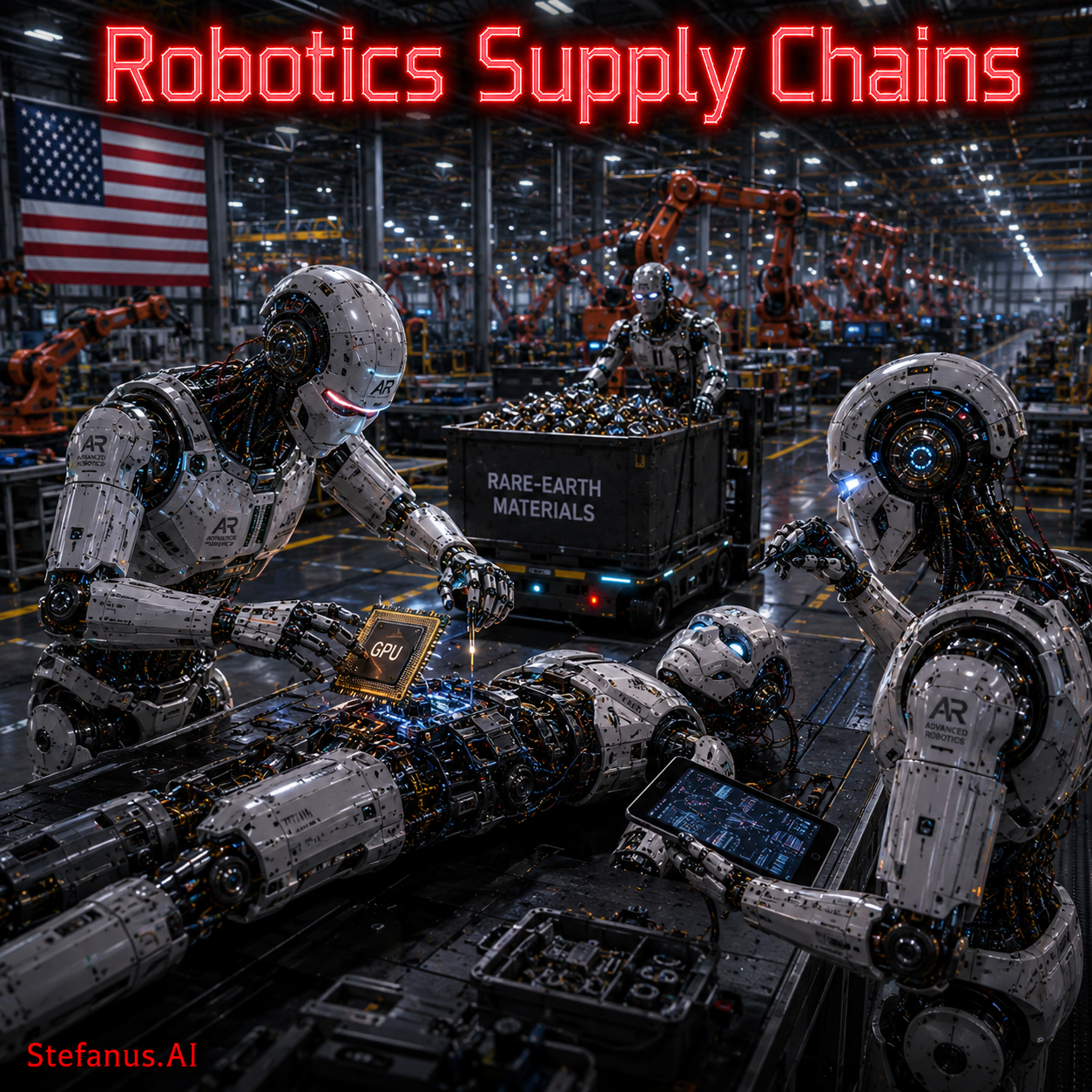

Introduction: The Convergence of Intelligence and Metal
We are living through what may be the most consequential industrial transformation in human history since the mechanization of agriculture. The rapid convergence of artificial intelligence with robotics has produced a new class of machine: not merely automated, but adaptive; not merely programmable, but perceptive; not merely precise, but — in the language of the industry’s most ambitious practitioners — embodied. Where earlier generations of industrial robots were elaborate servo-controlled fixtures executing the same arc of motion ten thousand times per shift without variation or judgment, today’s robotic systems perceive their environment through multi-modal sensor arrays, reason about uncertainty through neural network architectures running on edge-computing chips, and adapt their behavior to unstructured inputs in ways their engineers did not explicitly program. This is a qualitative leap, not merely a quantitative one.
The International Federation of Robotics, in its World Robotics 2025 Report, documented that 542,000 industrial robots were installed worldwide in 2024 — more than double the number installed a decade earlier — with the global operational stock reaching 4,664,000 units, an increase of 9% year-on-year. IFR President Takayuki Ito stated that this marked ‘the second-highest annual installation count of industrial robots in history.’ Robot installations are projected to grow 6% to 575,000 units in 2025, surpassing 700,000 units annually by 2028.[1]
The economic scale is staggering. The global robotics market, valued at approximately US$51.5 billion in 2025, is projected to reach as high as US$199.5 billion by 2035 at a CAGR of 14.5%, according to Astute Analytica.[2] Boston Consulting Group projects the market could attain between US$160 billion and US$260 billion by 2030, depending on the pace of humanoid and service robotics commercialization.[3] GlobalData forecasts a CAGR of 15% from $90.2 billion in 2024 to $205.5 billion by 2030.
The IMF’s April 2026 World Economic Outlook — published against a backdrop of intensified geopolitical tensions — revised its 2026 global growth forecast downward to 3.1%, down from 3.4% in 2025, noting that ‘trade and uncertainty shocks’ and supply chain fragmentation are among the primary drags on economic activity.[4]
The strategic and national security implications of this transition are not abstract. Nations that control the design, production, and supply chains of robotic systems will exercise decisive advantages in economic productivity, military capability, and geopolitical leverage that compound over decades. Nations that do not will face a form of structural dependency that can, in the worst cases, be weaponized against them — as 2025 demonstrated with vivid and costly clarity.
The World Economic Forum’s Global Value Chains Outlook 2026, developed in collaboration with Kearney, found that in 2025 alone, tariff escalations between major economies reshuffled more than $400 billion in global trade flows. Kearney partner Per Kristian Hong declared:
“Supply chain disruption in 2026 will be constant and structural. Geopolitical fragmentation, shifting trade rules and labour shortages are all redefining how value is created and moved. For supply leaders, the priority is no longer forecasting disruption, but redesigning operating models to function under permanent uncertainty.”
— Per Kristian Hong, Partner, Kearney / World Economic Forum Global Value Chains Outlook 2026, January 2026
[5]
The Paradox at the Heart of American Robotics
The paradox this paper investigates can be stated with uncomfortable clarity. The United States is home to the world’s most advanced AI research institutions, the largest and most generously capitalized robotics startups, the dominant providers of edge-computing silicon, and the global leaders in robotic systems integration and software. NVIDIA’s Omniverse and Isaac platforms are the de facto standards for digital-twin simulation in robotics development. American firms control the EDA software tools — from Synopsys and Cadence — without which no advanced chip can be designed anywhere in the world. In algorithm, in simulation, in software architecture, and in chip design, the United States leads. And yet, when one examines the physical bill of materials for a modern robot, the picture reverses almost entirely.
Zero-backlash harmonic drive gearboxes are manufactured almost exclusively by two Japanese firms — Harmonic Drive Systems and Nabtesco — with no meaningful American alternative at commercial scale.[6] Rare-earth permanent magnets depend on neodymium, dysprosium, and praseodymium refined almost entirely in China, which produced an estimated 300,000 tons of NdFeB magnets per year in 2024 compared to the United States’ nascent production of under 1,000 tons from MP Materials.[7] Battery cells for mobile robotics are dominated by CATL and BYD of China, which together supplied approximately 55% of global EV battery installations in 2024.[8] And the logic chips that orchestrate the perception and decision-making of autonomous systems are fabricated almost exclusively at Taiwan Semiconductor Manufacturing Company in Taiwan — the single most concentrated point of fragility in the entire global technology supply chain.
This is the paradox that defines American robotics strategy in 2026: software dominance built atop hardware dependency. Professor Chris Miller of Tufts University’s Fletcher School of Law and Diplomacy, whose book Chip War became the definitive account of semiconductor geopolitics, warned US Senate Foreign Relations Committee members in December 2025:
“The balance of modern power hinges on a semiconductor supply chain crossing geopolitical fault lines. America’s edge is deteriorating dangerously. It’s a lead that’s fragile and much smaller than its advantage in AI chips.”
— Prof. Chris Miller, Fletcher School at Tufts University — US Senate Foreign Relations Subcommittee Testimony, December 2025
[9]
Thesis and Structure
This paper advances the following thesis: To secure its technological sovereignty against escalating geopolitical rivalries — chief among them the systematic challenge posed by the People’s Republic of China — the United States must transition from a software-centric model of robotics leadership to a vertically integrated national strategy that directly addresses its profound foreign dependencies in hardware components, precision mechanical assemblies, and critical mineral refining. Without this transition, the United States risks finding that its algorithms have nothing to run on — that its intelligence has been starved of the physical substrate it requires to operate in the world. The paper proceeds in six sections following this Introduction, culminating in the Bifurcation Thesis and a set of actionable policy prescriptions.

Section 1: Definitions — The Robotics Industry and Supply Chains
1.1 What Is the Robotics Industry?
To analyze the robotics supply chain with the precision this subject demands, one must first define with some care what the robotics industry actually encompasses, for it is a term that has expanded in meaning as dramatically as the field itself has expanded in capability. At its most fundamental level, the robotics industry comprises the design, manufacture, integration, sale, servicing, and programming of machines that are capable of autonomous or semi-autonomous action — machines that sense their environment, process that sensory input through computational logic, and execute physical motion or intervention in response.
Industrial robotics — the elder and still dominant branch — refers to the fixed or semi-fixed robotic arms used in manufacturing environments. These systems, epitomized by the articulated robot arm with its six axes of freedom, perform tasks including welding, painting, material handling, assembly, and quality inspection with speed, repeatability, and precision that no human worker can match at scale. Asia accounted for 74% of new industrial robot deployments in 2024, compared with 16% in Europe and 9% in the Americas — a geographic concentration of manufacturing capability that has profound supply chain implications for Western robotics producers.
Mobile robotics constitutes the fastest-growing segment, encompassing autonomous mobile robots (AMRs) for warehouse logistics, unmanned ground vehicles for defense and inspection, and the increasingly prominent category of humanoid robots — bipedal, multi-limbed systems capable of operating in human-designed environments. The humanoid segment, still at early commercial stage but accelerating rapidly, is where the most intense geopolitical competition is developing, as both the United States and China recognize that general-purpose humanoid robotics could be the defining industrial technology of the next two decades.
The World Bank’s landmark 2025 report Future Jobs: Robots, Artificial Intelligence, and Digital Platforms in East Asia and Pacific concluded that contrary to popular fears, the adoption of industrial robots, AI, and digital platforms has broadly boosted employment due to stronger productivity and scale effects — though the benefits have been starkly uneven, favoring skilled workers while displacing less-skilled ones. Between 2018 and 2022, robot adoption created approximately 2 million new jobs for skilled workers while displacing about 1.4 million low-skilled workers in routine manual occupations.[10]
World Bank Vice President for East Asia and Pacific Manuela V. Ferro, releasing the Future Jobs report in June 2025, stated:
“Today’s innovations, from AI to robotics, can enhance productivity and create better jobs. Realizing these benefits will require a skilled workforce, competitive markets and policies to mitigate transition costs.”
— Manuela V. Ferro, Vice President for East Asia and Pacific, World Bank — Future Jobs Report Launch, June 17, 2025
[11]
1.2 What Is a Supply Chain?
The concept of a supply chain, when applied to the robotics industry, must be understood in its full upstream-to-downstream complexity rather than in the simplified linear representation that popular usage often implies. A robotics supply chain is a network — sprawling, layered, geographically dispersed, and often remarkably fragile at precisely the nodes that appear most robust.
At the upstream end, the robotics supply chain begins in the earth itself: in the rare-earth mineral deposits of Inner Mongolia and Jiangxi Province; in the lithium brine flats of Chile’s Atacama Desert; in the cobalt mines of the Democratic Republic of Congo; in the silicon mines feeding the semiconductor industry’s insatiable demand. At the midstream level, raw materials undergo chemical processing and refining: rare-earth oxides become permanent magnets; lithium becomes battery electrolyte; silicon becomes wafers; wafers become chips. At the downstream level, components are assembled into sub-systems, and sub-systems into complete robotic platforms.[12]
What makes this supply chain uniquely vulnerable in the current geopolitical moment is the extraordinary geographic concentration that characterizes several of its most critical nodes. Unlike the supply chains of most mature industries — where decades of competition and redundancy investment have distributed production across multiple viable geographies — the robotics supply chain features single points of failure: places where the entire global industry’s capacity to function depends on the uninterrupted output of a single country, or in some cases a single company, operating in a jurisdiction whose geopolitical alignment cannot be assumed to be permanent.
Gita Gopinath, First Deputy Managing Director of the IMF and former Chief Economist — one of the world’s foremost macroeconomists and a Harvard economics professor — addressed the structural shift underpinning this vulnerability at the IMF Conference on Geoeconomic Fragmentation:
“These changes have ushered in the beginning of a new paradigm in the global economic order — one that shifts away from decades of global economic integration and in which inward- and alliance-oriented policies are gaining traction. The number of trade and FDI restrictions has increased three-fold since 2018. FDI flows are increasingly concentrated among geopolitically aligned countries — 2.5 times higher than expected — particularly in strategic sectors.”
— Gita Gopinath, First Deputy Managing Director, IMF / Professor, Harvard University — IMF Conference on Geoeconomic Fragmentation, May 25, 2023
[13]
Understanding the robotics supply chain means mapping not just flows but vulnerabilities: identifying where concentration exceeds safe thresholds, where alternatives do not yet exist at commercial scale, and where geopolitical developments could trigger cascading disruptions that software excellence alone cannot repair. In 2025 and 2026, those disruptions ceased to be theoretical.

Section 2: Key Players and Global Market Structure
A Forensic Account of the Industry’s Architecture
The global robotics industry does not resemble a competitive marketplace in the classical economic sense. It is, instead, a constellation of near-monopolies, oligopolies, and duopolies organized across different sub-segments and geographies, each commanding the kind of market share and institutional knowledge that makes competitive entry by newcomers extraordinarily difficult. Understanding who these players are, where their power derives from, and how their recent financial performance reflects the larger dynamics of the industry is indispensable to any serious supply chain analysis.
2.1 Industrial Automation and Robotic Systems Giants
The Big Four Industrial Monopolies
The industrial robotics sector has for three decades been dominated by the Big Four: FANUC Corporation of Japan, Yaskawa Electric Corporation of Japan, ABB Ltd. of Switzerland, and KUKA AG of Germany. Together, these four firms have historically accounted for over 55% of global industrial robotics market revenue. Firms such as ABB, FANUC, and Yaskawa achieve operating margins above 20% on automation software and aftermarket services.[14]
FANUC Corporation (TYO: 6954, OTC: FANUY), headquartered in Oshino, Yamanashi Prefecture, Japan, is widely regarded as the most profitable robotics company in the world, operating with legendary margin discipline and manufacturing efficiency. In fiscal year 2026 (year ended March 31, 2026), FANUC reported revenue of ¥857.83 billion (~$5.69 billion), an increase of 7.62% year-on-year, with earnings of ¥166.54 billion, up 12.87%. The company’s market capitalization stood at approximately $45–47 billion as of May 2026. FANUC’s products span CNC systems, servo drives, and industrial robots — and its robotics division is characterized by reliability so extreme that FANUC robots are known to operate for years without a single failure, a quality standard no American or European competitor has matched at scale.[15]
Yaskawa Electric Corporation (TYO: 6506), headquartered in Kitakyushu, Fukuoka Prefecture, commands approximately 12% of the global robotics market through its Motoman robotics division. For FY2025, Yaskawa’s Robotics segment showed revenue growth in China and Asia but faced forex headwinds and profit pressure from a mix-shift toward lower-margin large projects. In FY2026 annual guidance (year ending February 2026), management forecast a near-doubling of operating profit, driven by AI and semiconductor-related demand. Yaskawa acquired Tokyo Robotics Inc. in 2025 to accelerate humanoid robot actuator development, and broke ground on a new US campus consolidating headquarters, R&D, and industrial robot manufacturing.[16]
ABB Ltd. (NYSE: ABB) made the most consequential structural move in the Big Four’s recent history when, in October 2025, it announced the divestment of its Robotics division to SoftBank Group for an enterprise value of $5.375 billion — abandoning its earlier plan to spin off the unit as a separately listed company. The Robotics division generated revenues of $2.3 billion in 2024, representing roughly 7% of ABB Group revenues, with an operational EBITA margin of 12.1%. ABB CEO Morten Wierod had noted explicitly that limited synergies with ABB’s other businesses and the unit’s volatility made divestment preferable to IPO. SoftBank’s Masayoshi Son declared:[17]
“Together with ABB Robotics, we will unite world-class technology and talent under our shared vision to fuse Artificial Super Intelligence and robotics — driving a ground-breaking evolution that will propel humanity forward.”
— Masayoshi Son, CEO & Founder, SoftBank Group — ABB Robotics Acquisition Announcement, October 8, 2025
[18]
KUKA AG, originally a venerable German robotics manufacturer founded in 1898 and headquartered in Augsburg, Bavaria, was acquired by China’s Midea Group in a controversial 2016 takeover that gave Chinese state-linked capital effective control over one of Europe’s flagship industrial technology companies. Midea now holds approximately 94.55% of KUKA’s shares, with FY2025 revenues of approximately €3.6 billion. The acquisition remains a reference case in European debates about Chinese industrial policy and technology transfer.[19]
| Company | HQ / Exchange | Market Cap (May 2026) | FY2025/2026 Revenue | YoY Revenue Change | Global Install Share |
| FANUC | Japan / TYO:6954 | ~$45–47B | ¥857.8B (~$5.69B) FY2026 | +7.6% | ~22% |
| Yaskawa | Japan / TYO:6506 | ~$9B | ¥508B (~$3.4B) FY2025 | Flat; FY2026 recovery forecast | ~12% |
| ABB Robotics* | Divesting to SoftBank | $5.4B deal EV | $2.3B (2024) | Prior yr: –39% profit | ~11% |
| KUKA (Midea) | Germany (CN-owned) | Private | ~€3.6B (FY2025 est.) | ~+5% | ~10% |
Table 2.1: Big Four Robotics Manufacturers — Financial Metrics (Q1 2026). *ABB Robotics classified as discontinued operations from Q4 2025; SoftBank transaction pending mid-to-late 2026 regulatory approvals.
The US System Integration Ecosystem: Rockwell Automation and Teradyne
The United States does not produce a Big Four competitor in industrial robotics hardware. Instead, American firms have built their competitive positions in the higher-value layers of the robotics stack: in software, systems integration, controls architecture, and the ecosystem of services that surround the physical robot. This is strategically significant, because it means that American commercial success in robotics is architecturally dependent on foreign hardware that American firms integrate and add value to — but do not manufacture.
Rockwell Automation (NYSE: ROK), headquartered in Milwaukee, Wisconsin, is the dominant American firm in industrial automation controls and software. With full-year FY2025 revenues of $8.3 billion (+1% YoY), Rockwell reported Q2 FY2026 revenues of $2.2 billion, up 12% year-on-year, with CEO Blake Moret noting strong demand across warehouse automation, data center, semiconductor equipment, and energy automation. Rockwell guides for FY2026 (ending September 30) sales growth of 5–9%, with operating margin of 21.5%. Its autonomous mobile robot business (ClearPath) grew double-digits in FY2025, and the company expects ClearPath to turn profitable in FY2026.[20]
Teradyne, Inc. (NASDAQ: TER), headquartered in North Reading, Massachusetts, is the parent company of Universal Robots (UR) — the Danish collaborative robot pioneer acquired for $285 million in 2015 — and Mobile Industrial Robots (MiR). Teradyne Robotics reported Q1 2026 revenue of $91 million, up 32% year-on-year, marking its fourth consecutive quarter of sequential growth despite Q1 historically being the weakest quarter. Universal Robots has sold over 110,000 collaborative robots worldwide since 2008; MiR over 11,000 AMRs globally. Teradyne plans to open a US manufacturing operation for its robotics products and expects year-over-year growth across all business groups in 2026.[21]
2.2 Precision Hardware and Actuation Specialists
Gearboxes and Strain Wave Gears: Harmonic Drive Systems and Nabtesco
Below the systems integrators lies the most strategically important — and least publicly discussed — stratum of the robotics supply chain: the precision hardware specialists whose components are embedded in virtually every high-performance robot manufactured anywhere in the world. Two Japanese companies — Harmonic Drive Systems (TYO: 6324) and Nabtesco Corporation (TYO: 6268) — together supply the critical joint reduction gear components to the overwhelming majority of the global robot industry. There is no American, European, or Chinese company producing these components at equivalent quality and commercial scale. The lock-in is deep: robot OEMs cannot switch gearbox suppliers mid-production run without re-engineering their entire joint architecture, with qualification cycles measured in years.[22]
Independent robotics supply chain analyst Jared Watkins, in his detailed 2026 research on Nabtesco’s supply chain position, documented the systemic nature of this dependency:
“The combination of Nabtesco RV reducers (large joints) and Harmonic Drive gearboxes (small joints) is so standard in industrial robot design that a supply chain disruption at either company creates system-level delivery risk across the entire industry simultaneously.”
— Jared Watkins, Independent Robotics Supply Chain Analyst — Nabtesco Corporation Research Note, 2026
[23]
The Global Robot Harmonic Drive Reduction Gear Market was valued at $1.85 billion in 2025 and is projected to grow at a CAGR of 7.8% through 2035. Chinese competitors including LeaderDrive and Shuanghuan have captured approximately 20-25% of China’s domestic market for mid-range precision reducers — a development that reduces China’s own exposure to Japanese supply constraints but does nothing to address America’s.
Precision Miniature Motors: Maxon Motor and Faulhaber
For applications requiring precision at very small scale and extremely high power-to-weight ratios — surgical robotics, prosthetics, drone actuators, and the delicate joints of humanoid robots — two European private firms sit at the summit: Maxon Motor AG (Sachseln, Switzerland) and Dr. Fritz Faulhaber GmbH & Co. KG (Schönaich, Germany). Maxon’s brushless DC motors are found in NASA Mars rovers, deep-sea exploration vehicles, and the most demanding surgical robotic systems in the world. Their combined market leadership in precision miniature drives is a reminder that strategic hardware dependencies extend well beyond the US-China axis to include European allies whose production capacity is limited and whose re-shoring to the United States would require years of sustained investment in tooling, workforce development, and process qualification.
2.3 Perception, Sensing, and Compute Infrastructure
NVIDIA: Edge AI Processing and the Physical AI Stack
If the gearbox is the robot’s muscle, the edge AI processor is its brain — and here the United States holds genuine, deep, and for the moment defensible competitive advantage. NVIDIA Corporation (NASDAQ: NVDA) has established itself as the foundational infrastructure provider for the AI revolution across both cloud and edge computing. In Q1 FY2027 (quarter ended April 26, 2026), NVIDIA reported record revenue of $81.6 billion, up 85% year-on-year and 20% sequentially. Its automotive and robotics segment generated $567 million in Q1 FY2026 revenue — up 72% year-on-year — and a record $2.3 billion for full-year FY2026 (up 39% YoY).[24]
At NVIDIA’s Q1 FY2027 earnings on May 20, 2026, founder and CEO Jensen Huang declared:
“The buildout of AI factories — the largest infrastructure expansion in human history — is accelerating at extraordinary speed. Agentic AI has arrived, doing productive work, generating real value and scaling rapidly across companies and industries. NVIDIA is uniquely positioned at the center of this transformation as the only platform that runs in every cloud.”
— Jensen Huang, CEO & Founder, NVIDIA — Q1 FY2027 Earnings Call, May 20, 2026
[25]
NVIDIA’s Isaac platform, Cosmos world foundation models, Jetson AGX Thor compute modules, and Omniverse simulation environment collectively constitute the most comprehensive AI-to-robotics development stack available globally. The company announced collaborations with Agility Robotics, Amazon Robotics, Figure AI, Foxconn, Toyota, TSMC, and Wistron as part of America’s reindustrialization with physical AI. This is the dimension of the robotics supply chain where American strategic position is strongest — and where it must remain strong as hardware gaps are addressed.
TSMC: The Single Point of Failure
The concentration of advanced semiconductor fabrication at Taiwan Semiconductor Manufacturing Company (NYSE: TSM) represents what this author considers the most consequential single point of failure in the entire global technology supply chain. TSMC reported Q1 2026 net revenue of NT$1.134 trillion (~US$35.9 billion), up 35.1% year-on-year, with advanced technologies at 7nm and below accounting for 74% of total wafer revenue. Its 3nm process accounted for 25% of revenue, and 5nm 36%. TSMC guided Q2 2026 revenue of US$39.0–40.2 billion, with gross margins of 65.5–67.5%.[26]
There is no other company anywhere in the world that can produce these nodes at commercial volume. Not Samsung, not Intel, not SMIC in China — and certainly not any American foundry operating today. The edge AI chips that power autonomous mobile robots, the microcontrollers that manage motor control loops, and the specialized ASICs enabling real-time sensor fusion all require advanced fabrication nodes that only TSMC can produce at scale. Professor Chris Miller, in his Tufts University interview on chip supply chain geography, explained the structural inescapability of this dependency:
“Certain companies are in certain countries, which means that other countries have very little control of what happens in the supply chain. The production of chips is decidedly not global. There is only a small number of mega-centres for chip production in existence. This has huge implications for security of supply, while allowing governments to politicise supply chains in a number of different ways.”
— Prof. Chris Miller, Fletcher School at Tufts University — Interview, Chip War, Tufts Russia Program
[27]
LiDAR, Sensors, and Data Sovereignty
The sensor systems that allow robots to perceive their environments present a different kind of dependency. Chinese firms, most notably Hesai Technology, have leveraged massive domestic manufacturing scale and aggressive pricing — reflecting both genuine efficiency and heavy state subsidies — to capture significant global LiDAR market share. Their systems are now embedded in warehouse robots, autonomous vehicles, and smart city infrastructure across the United States, Europe, and Asia. The strategic risk is not merely supply disruption but data sovereignty: LiDAR systems that map physical environments in real time, deployed in sensitive facilities, represent potential intelligence collection vectors the US intelligence community has flagged with growing urgency. The global semiconductor market for robots is projected to grow from $11.23 billion in 2025 to $41.24 billion by 2030, a CAGR of 29.7%.[28]
2.4 Energy and Power Storage: CATL, BYD, and the Chinese Battery Monopoly
The power systems of the modern robotics economy are overwhelmingly concentrated in China. CATL (Shenzhen Stock Exchange) holds an estimated 37–38% of the global EV battery market — a share that has held steady or grown in each of the past eight consecutive years. BYD holds approximately 17% of the global market. Together, CATL and BYD supplied approximately 55% of global EV battery installations in 2024, accounting for roughly 852 GWh of a global total of approximately 1,155 GWh. Chinese firms poured $143 billion into foreign EV and battery ventures between 2014 and 2025, according to Rhodium Group.[29]
In January 2025, the US Department of Defense added CATL to its list of ‘Chinese military companies,’ citing concerns over China’s military-civil fusion strategy. CATL vehemently denied any military affiliation. The listing does not constitute a flat ban on commercial activity but triggers heightened CFIUS scrutiny for US-CATL joint ventures and limits defense procurement relationships. The robotics industry’s specific battery requirements — high cycle-life, compact form-factor, high-discharge-rate cells for mobile platforms — fall largely outside the optimization profile of US gigafactories built primarily for EV applications, creating a structural supply gap that no current legislation adequately addresses.[30]

Section 3: Anatomy of a Robot — Us vs. Foreign Supplier Dependency
Mapping the Domestic Gap Across Every Sub-System
To understand the depth of the United States’ hardware dependency in robotics, one must perform what might be called an anatomical analysis of the robot itself: examining each major sub-system, identifying the current supplier landscape, and assessing the gap between domestic production capability and the commercial-scale requirements of a rapidly growing industry. This section conducts that examination across four major categories: actuation and precision motion control; energy storage; sensing and communication; and structural materials.
Nobel Prize-winning MIT economist Professor Daron Acemoglu — whose 2024 Sveriges Riksbank Prize was awarded for research on institutions, technology, and prosperity — has argued in his most recent work that the challenge is not the algorithm but the apparatus. His research with David Autor and Simon Johnson, published through Brookings in February 2026, called explicitly for ‘building pro-worker artificial intelligence’ that sustains rather than hollows out domestic industrial capacity. His foundational observation on the hardware challenge is direct:
“With robots, it is the hardware and not the software that will be the hurdle. Many of the recent technologies have been of the replacing kind. We need to look to the past in the face of modern innovations in machine learning, robotics, artificial intelligence, big data, and beyond. We haven’t lived through it. People at institutions like MIT must learn more about what is going on so that we are better prepared to understand the future.”
— Prof. Daron Acemoglu, Elizabeth and James Killian Professor of Economics, MIT — 2024 Nobel Laureate in Economics
[31]
3.1 Actuation, Micro-Motors, and Precision Motion Control
The Mechanical Bottleneck
The defining characteristic of a high-performance robot — the quality that distinguishes a reliable industrial system from a research prototype — is the precision of its mechanical actuation. Every joint in a robot arm, every wheel drive in a mobile robot, every finger segment in a dexterous manipulator requires a combination of a servo-motor, a precision encoder measuring its position, and a gearbox translating motor output into controlled mechanical motion. The servo-motor and encoder ecosystem is internationally distributed, with capable suppliers in Japan (Fanuc, Yaskawa, Panasonic), Germany (Siemens, Bosch Rexroth), and to a lesser extent the United States (Kollmorgen, Parker Hannifin). The gearbox sector is not.
The absence of American-origin precision gearbox manufacturing at commercial robotics scale is not new, but its consequences are becoming more acute as the domestic robotics industry scales. The US does not have a company producing precision strain-wave or RV cycloid gearboxes in volumes, quality levels, and size ranges comparable to Harmonic Drive Systems or Nabtesco. American robot manufacturers importing these components from Japan accumulate lead times, cost structures, and geopolitical dependencies that would be unacceptable in any serious national security analysis. Chinese competitors including LeaderDrive and Shuanghuan have captured approximately 20-25% of China’s domestic market for mid-range precision reducers, but this development reduces China’s own Japanese supply exposure without addressing America’s.[32]
The Japanese Monopoly in High-Torque Motion
Japanese dominance of precision reduction gear manufacturing is not accidental. It is the product of decades of sustained investment in materials science, precision machining capability, metallurgical quality control, and a culture of engineering excellence that produces tolerances measured in microns and quality assurance processes that can identify a bearing anomaly before it becomes a failure. This institutional knowledge is embedded in the workforce, tooling, process documentation, and supplier relationships — and it cannot be replicated by decree or capital infusion alone. It requires generational time, not quarterly time. This is precisely why the CHIPS Act model — sustained, long-duration, generous incentives — must be extended to this domain.
3.2 Energy Storage and Power Infrastructure
The Battery Chemistry Gap
The power requirements of robotics systems differ meaningfully from those of electric vehicles. Where EV batteries are optimized for range, robotic batteries must be optimized for cycle life, power density, thermal management, and form-factor flexibility. Chinese battery manufacturers — CATL, BYD, and their tier-two suppliers — have developed battery chemistries that serve these parameters well, particularly through the maturation of lithium iron phosphate (LFP) technology. In 2024, Chinese firms accounted for over 75% of global lithium-ion battery output, approximately 1,155 GWh. The United States’ gigafactories are almost entirely configured for automotive-format battery packs. There is no meaningful American commercial production of the small-format, high-cycle, power-dense battery cells optimized for mobile robotics platforms.[33]
3.3 Sensory and Communication Architecture
The sensory ecosystem of modern robots — cameras, depth sensors, force-torque sensors, LiDAR systems, IMUs, and communication infrastructure — presents a more mixed supply picture than actuation or energy. American firms, including Texas Instruments, Luminar Technologies, and Qualcomm, maintain competitive positions in several important niches. The most strategically concerning trend is in LiDAR, where Chinese firms have aggressively undercut American and European competitors on price. Hesai’s systems are now embedded in warehouse robots, autonomous vehicles, and smart city infrastructure across the United States, Europe, and Asia — creating data collection and sovereignty concerns analogous to those raised by Huawei’s telecommunications infrastructure. The wiring, connectors, and high-flex cabling carrying data through a robot’s body are largely sourced from Mexico and Southeast Asia, representing logistics disruption vulnerability rather than geopolitical weaponization, but vulnerability nonetheless.
3.4 Advanced Structural Materials
The physical frame and structural components of advanced robots employ aerospace-grade materials: 6061 and 7075 aluminum alloys, carbon fiber composite panels, titanium fasteners, and specialized engineering plastics such as PEEK and Ultem. American producers (Alcoa, Kaiser Aluminum, Hexcel) maintain meaningful positions in aluminum and carbon fiber. However, in several critical subsets of engineering plastics and specialty polymers, supply is concentrated in Germany (Evonik, BASF) and Japan (Toray, Mitsubishi Chemical), with limited American alternatives at equivalent quality grades. The integration of these materials into robotic structures also requires precision machining capabilities that American manufacturing has allowed to atrophy over decades of offshoring, creating a workforce and tooling gap requiring sustained investment — measured in years, not budget cycles — to close. The KPMG 2025 Industrial Manufacturing CEO Outlook identified securing critical resources and supply chain resilience as the defining competitive challenges, specifically citing battery components and critical minerals as the most acute concerns.[34]

Section 4: The Rare-Earth Weaponization and Geopolitical Tensions
When Supply Chain Becomes a Strategic Weapon
Of all the supply chain vulnerabilities examined in this paper, none is more acute, more immediately consequential, or more clearly weaponized as a deliberate instrument of state power than China’s control over the rare-earth element supply chain. The events of 2025 and early 2026 have moved this concern from the realm of theoretical risk to demonstrated operational reality, and the robotics industry — along with defense, automotive, semiconductor, and renewable energy sectors — has been shaken in ways that cannot be undone without sustained investment and strategic patience.
4.1 The Chinese Rare-Earth Oxide Monopoly
Upstream Dominance and the Magnet Problem
China accounted for approximately 60% of global mining output of magnet rare earths — neodymium, praseodymium, dysprosium, and terbium — in 2024, according to the IEA.[35] But mining is the least strategically significant part of the chain. China processes over 70% of global rare earth elements through its domestic refining industry, and in the permanent magnet segment — the finished product that robot motor manufacturers actually buy — China’s production of NdFeB magnets reached an estimated 300,000 tons in 2024, compared to the United States’ nascent production of under 1,000 tons from MP Materials’ Fort Worth, Texas facility.[36]
The NdFeB permanent magnet is not peripheral to a robotic motor; it is the foundational element of the motor’s operating principle. NdFeB magnets are required in every high-efficiency brushless DC servo-motor used in robotic actuation, in the linear actuators of exoskeletons, in the voice-coil actuators of surgical robotics, and in the traction motors of mobile robotic platforms. There is no current magnet technology offering equivalent performance without these rare-earth elements: the laws of physics, not corporate preferences, dictate this requirement. Dysprosium and terbium — the heavy rare-earth additions that allow NdFeB magnets to maintain their properties at elevated temperatures — are found in economically extractable quantities primarily in China’s southern ionic clay deposits, with essentially no meaningful alternative sources at commercial scale anywhere in the world.
The European Parliament Think Tank’s January 2026 analysis documented the EU’s total dependency with precision: the EU sources 100% of its heavy REEs, 85% of its light REEs, and 98% of its rare-earth magnets from China, and scientists have concluded it is difficult — and often impossible — to replace REEs because of their unique physical properties.[37]
4.2 Geopolitical Friction and Supply Weaponization
The April 2025 Export Controls: Weaponization Made Real
The theoretical risk of rare-earth weaponization became operational reality on April 4, 2025, when the Chinese Ministry of Commerce introduced export controls on seven heavy rare-earth elements — samarium, gadolinium, terbium, dysprosium, lutetium, scandium, and yttrium — along with all related compounds, metals, and magnets, citing national security grounds. The timing was unmistakable: the controls arrived two days after US President Donald Trump’s ‘Liberation Day’ tariff announcements on April 2, 2025.[38]
ORF America’s analysis characterized the fallout as one of the most consequential industrial shocks of the decade:
“China already processes over 70% of global rare earth elements; this move translated market dominance into geopolitical leverage. What initially appeared to be a targeted trade measure quickly evolved into one of the most consequential industrial shocks of the decade, exposing the vulnerability of a number of sectors built on high-performance permanent magnets, from electric vehicles and wind turbines to semiconductors and precision-guided defense systems.”
— ORF America — China’s Rare Earth Export Restrictions Triggered Diversification, January 6, 2026
[39]
The impact was immediate and severe. Chinese rare-earth magnet exports fell by approximately 75% in the two months following the controls. Automotive manufacturers in the United States, Europe, and Japan scrambled for alternatives. Several European suppliers temporarily suspended production. Japanese automakers slowed assembly operations. Defense contractors and wind turbine manufacturers faced acute shortages of dysprosium and terbium. The IEA documented that even after trade volumes partially recovered, European rare earth prices reached up to six times those prevailing in China — directly eroding the cost competitiveness of rare earth-based products manufactured outside China.[40]
The December 2025 Extraterritorial Controls: A New Doctrine
China’s Ministry of Commerce Announcement No. 61 of 2025, implementing controls beginning December 1, 2025, represented an escalation to a qualitatively new level. CSIS described these as ‘the strictest rare earth and permanent magnet export controls to date’ — and, critically, the first time China applied the foreign direct product rule (FDPR) to its rare-earth exports.[41]
The FDPR mechanism — a legal instrument the United States has long used to extend export control jurisdiction extraterritorially — meant that foreign companies manufacturing rare-earth products outside of China using Chinese-origin input materials were required to obtain an export license from China’s Ministry of Commerce. China was asserting sovereign jurisdiction over the global permanent magnet supply chain based on the origin of the raw material — a move without precedent in the history of resource geopolitics.
CSIS’s May 2026 follow-up analysis, one year after the initial restrictions, documented the asymmetric impact with stark clarity:
“These export patterns show that even if China continues to suspend its export restrictions going into 2027, it is not a reliable export partner to the United States during times of heightened geopolitical tensions. Diversifying rare earth supply chains is therefore a national security imperative to ensure defense, semiconductor, automotive, and aerospace industries are not persistently exposed to disruption.”
— CSIS — Rare Earth Export Restrictions One Year Later, May 2026
[42]
The Chokepoint Risk: Modeling a Full Embargo
What would a complete and sustained Chinese ban on rare-earth and permanent magnet exports look like in practice? The answer, based on current production alternatives, is deeply uncomfortable. MP Materials was producing approximately 1,000 tons of NdFeB magnets by end-2025 — less than 1% of China’s 300,000-ton annual production. Total non-Chinese magnet production capacity — accounting for MP Materials, Lynas Rare Earths’ US subsidiary, Neo Performance Materials in Estonia, and new projects in South Korea and Vietnam — represents a small fraction of global demand. The robotics industry, in a full embargo scenario, would face motor component shortages within months that no software innovation or design workaround could resolve. China’s historical playbook is documented: it first weaponized rare earths in 2010 against Japan over a fishing trawler dispute; between 2023 and 2025, it escalated to restrict gallium, germanium, antimony, graphite, and tungsten. Each restriction followed the same pattern: tie the action to a bilateral dispute, time the announcement for maximum diplomatic pressure, allow partial easing to preserve coercive leverage, and retain the infrastructure of controls even when exports nominally resume.[43]
4.3 Collateral Tensions: The Taiwan Strait Risk Profile
The rare-earth vulnerability exists alongside an equally serious concentration risk at the semiconductor level. TSMC’s Q1 2026 revenue of $35.9 billion, up 40.6% year-on-year, with 74% of wafer revenue from 7nm and below nodes, underscores the extraordinary, irreplaceable nature of this concentration. Any scenario in which Chinese military action disrupts TSMC’s operations would produce semiconductor supply shocks halting advanced robotics production globally within weeks.[44]
In November 2025, Chinese government actions against Dutch chipmaker Nexperia’s operations triggered a semiconductor shortage that forced Bosch — one of Europe’s largest automotive suppliers — to partially suspend production at three European plants, demonstrating how quickly concentrated critical inputs can cascade into widespread industrial disruption. Benjamin Selwyn of the London School of Economics, writing on geopolitics and supply chains in September 2025, observed that ‘China’s rise to the tech frontier poses a dual threat to American dominance — economically and militarily,’ and that US-China competition ‘will likely continue to shape global supply chains’ in ways that make resilience-building a strategic imperative rather than a commercial option.[45]

Section 5: State Intervention — Us Government Reactions and Retaliations
From Policy Awareness to Industrial Mobilization
The United States government’s engagement with robotics supply chain vulnerabilities has evolved substantially across the Biden and Trump administrations, though the pace of policy development has consistently lagged the pace of geopolitical threat. What began under Biden as largely defensive legislative interventions has evolved under Trump into a more explicitly confrontational posture combining aggressive tariff escalation with a novel willingness to use direct government equity investment in strategic industrial assets. Whether this combination of legislative legacy and executive assertiveness constitutes an adequate response to the challenges described in the preceding sections is the central question this section addresses.
5.1 Legislative Mandates and Domestic Subsidies
The CHIPS and Science Act of 2022
The CHIPS and Science Act of 2022 authorized and appropriated approximately $280 billion in new spending through FY2027, with $39 billion dedicated to semiconductor manufacturing incentives and $13 billion for R&D.[46] The Act’s explicit goal was to reduce American dependence on foreign-fabricated semiconductors — with TSMC’s concentration in Taiwan as the primary concern — and to rebuild domestic advanced logic chip fabrication capacity.
The CHIPS Act has produced genuine and significant stimulus. Semiconductor companies and supply chain partners announced investments totaling over $327 billion in the United States over a ten-year horizon, according to Semiconductor Industry Association calculations. Construction of semiconductor manufacturing facilities surged fifteen-fold from pre-Act baselines. Professor Chris Miller, whose CHIPS Act analysis for the Financial Times tracked this investment boom, observed that ‘the US government has now spent over half its $39bn in Chips Act incentives, driving an unexpected investment boom.’[47]
However, the Act faces serious headwinds. President Trump, in remarks to a joint session of Congress in early 2025, called the CHIPS Act a ‘horrible, horrible thing’ and called for its elimination — alarming Republican senators from semiconductor-heavy states who argued, correctly, that CHIPS funding is directly linked to national security. The advanced manufacturing investment tax credit (Section 48D) is scheduled to expire in 2026 without renewal, creating investment uncertainty precisely when the semiconductor supply chain requires long-term capital commitment.[48]
The Inflation Reduction Act and Defense Production Act
The Inflation Reduction Act of 2022 provided substantial tax incentives for domestic critical mineral processing and battery assembly. More directly targeted interventions have come through the Defense Production Act (DPA). In July 2025, the Department of Defense invested $400 million in equity into MP Materials — making the US government the company’s largest shareholder — accelerating Fort Worth magnet manufacturing. Lynas Rare Earths received $30.4 million in DPA Title III grants for a US separation facility and a further $120 million for a heavy REE processing facility. Noveon Magnetics announced a memorandum of understanding with Lynas to establish a scalable domestic supply chain for rare-earth permanent magnets in the United States.[49]
These are meaningful steps, but the scale remains orders of magnitude below what would be required to achieve genuine supply chain independence from Chinese refining and magnet production. The IMF Working Paper by Gopinath, Gourinchas, Presbitero, and Topalova, Changing Global Linkages: A New Cold War? (2024), provided the analytical framework that should inform US supply chain policy: FDI flows are 2.5 times higher among geopolitically aligned countries in strategic sectors — suggesting that the gravitational pull toward allied-country supply chains is real, but requires active policy acceleration to overcome China’s incumbency advantages in critical materials processing.[50]
5.2 Trade Deterrence and National Security Controls
Tariffs, Entity Lists, and the American Security Robotics Act
Section 301 tariffs on Chinese-origin machinery, lithium batteries, and electronics have been substantially increased, with robotics components now facing tariff rates exceeding 25% in some categories. The BIS Entity List has been aggressively expanded to include Chinese robotics companies, AI hardware developers, and semiconductor firms whose access to American EDA software represents a meaningful constraint on China’s ability to develop next-generation robotic systems. Restrictions preventing Chinese robotics labs from accessing Synopsys and Cadence EDA tools — without which advanced chip design is essentially impossible — represent one of the most surgically targeted elements of US technology control strategy.
The American Security Robotics Act, a bipartisan bill introduced in March 2026 by Senators Tom Cotton and Chuck Schumer and Representative Elise Stefanik, proposes to limit US government use of Chinese ground robots on national security grounds. Sociologist Kyle Chan of the Brookings Institution, testifying before Congress on April 16, 2026, stated: ‘I see the robots and the routers as being the latest in a long line of growing tech security concerns in the US vis-à-vis Chinese technology.’ However, IEEE Spectrum’s analysis noted the fundamental limitation: ‘American robot makers still need Chinese-made components’ — crystallizing the dilemma that legislative prohibition of Chinese finished products cannot resolve as long as American robots contain Chinese-origin sub-components.[51]
5.3 Geopolitical Re-alignment Strategies
Friend-shoring, Near-shoring, and the Minerals Security Partnership
Beyond tariffs and export controls, the US government has pursued geographic diversification through ‘friend-shoring’ and ‘near-shoring.’ Mexico, benefiting from its USMCA relationship and geography, has attracted substantial robotics assembly investment. Eastern Europe has emerged as an alternative assembly hub for European robotics companies. China’s 15th Five-Year Plan, launched in 2026, explicitly prioritizes indigenous robotics supply chains, humanoid robot commercialization, and AI-driven manufacturing — accelerating the race for supply chain self-sufficiency on both sides of the bifurcation. The IMD Business School’s April 2026 analysis described Beijing’s posture as ‘making tech self-reliance real’ rather than merely aspirational, with the 15th Plan’s New Quality Production Forces framework putting indigenous R&D and supply chain resilience ‘front and center.’[52]
The Minerals Security Partnership (MSP), a US-led coalition including the EU, Australia, Canada, Japan, South Korea, and the UK, represents the most ambitious long-term response to Chinese critical mineral dominance. The IEA’s analysis noted that building a rare-earth mine from discovery to production takes 10–15 years under the best circumstances, and that planned capacity for permanent magnet manufacturing outside China is notably lower than for mining and refining — making the MSP’s success a multi-decade commitment, not a near-term solution.[53]

Section 6: Strategic Lessons and Policy Recommendations
What This Framework Has Taught Us
The analysis presented in the preceding five sections converges on a set of strategic lessons that are as uncomfortable as they are clear. The United States has spent three decades building a world-leading robotics software ecosystem on a hardware foundation it did not control, could not rapidly replicate, and in several cases actively chose not to defend through industrial policy. The intellectual freedom of open markets produced extraordinary consumer welfare gains and generated the software brilliance that America legitimately leads. But it also created structural vulnerabilities that adversaries have studied carefully and are now deliberately exploiting.
The Pace University International Law Review’s November 2025 analysis captured the stakes precisely:
“The geopolitical competition for Artificial Intelligence supremacy between the United States and China is far more than a race about the AI algorithm quality but rather a multifaceted struggle relying on the physical foundations of energy infrastructure and secure supply chains for microchips and critical minerals. The nation that most effectively secures these resources will unlock AI’s full potential. This struggle for technological supremacy will also define the future global balance of power.”
— Francesca Dumont — Technological Dominance: The AI Arms Race Between the United States and China, Pace International Law Review, November 2025
[54]
6.1 Material and Technological Substitution
The first and most technically demanding lesson is that the United States must invest aggressively in fundamental R&D aimed at reducing or eliminating its dependence on rare-earth elements in robotic motors. Synchronous reluctance motors, which eliminate rare-earth permanent magnets entirely and instead use precisely shaped iron rotors, offer substantially lower performance per unit weight but are manufacturable entirely from domestically abundant materials. For applications where performance-to-weight ratio is not a hard constraint — many industrial robot configurations — synchronous reluctance motors represent a viable substitution path. Federal investment in advanced motor R&D — through DARPA, DOE’s ARPA-E program, and the NSF — should be substantially increased and specifically directed toward high-performance alternatives to rare-earth-dependent motor architectures.
6.2 Industrial Base Expansion
The CHIPS Act has demonstrated something profoundly important: when the United States government provides clear, generous, long-duration financial incentives for domestic manufacturing, private capital follows. The $327 billion in announced semiconductor investments against $39 billion in direct government support represents better than an eight-to-one leverage ratio. This model should be explicitly replicated for the precision mechanical hardware sector. This paper recommends the creation of a Precision Robotics Hardware Initiative (PRHI) modeled structurally on the CHIPS Act but targeted at precision gearbox manufacturing, servo-motor production, and the associated precision machining capabilities these require. The goal: to bring to commercial scale, within ten years, at least two American companies capable of producing precision harmonic drive and cycloid gearboxes at quality and volume levels competitive with Harmonic Drive Systems and Nabtesco. This is achievable; it requires will and capital, not scientific breakthroughs.
6.3 Strategic Stockpiling and Regulatory Mandates
The National Defense Stockpile should be significantly expanded to include not merely raw materials but finished robotic sub-assemblies: precision gearboxes, permanent magnet motor modules, battery management systems, and edge-computing modules representing the key components whose absence in a supply disruption scenario would halt domestic robot production. ‘Build America’ or ‘Buy Allied’ procurement clauses should be extended and strengthened specifically for robotic systems in critical infrastructure, logistics, and defense applications. The federal government’s purchasing power across DOD, DHS, USPS, the VA health system, and the national laboratories represents a market of sufficient scale to drive significant domestic investment if consistently directed toward domestically or ally-manufactured systems.
Finally, a mandatory hardware bill of materials (HBOM) requirement — specifying the origin country, company, and supply chain tier for every major sub-component in a robotic system deployed in critical infrastructure — would provide the government visibility necessary to identify and address concentration risks before they crystallize into crises. The American Security Robotics Act is a beginning, but it addresses only finished products. What is needed is supply chain transparency all the way to the component level.

Conclusion: The Bifurcation Thesis and The Imperative of Action
Software Brilliance Cannot Overcome a Starved Hardware Supply Network
This paper opened with a paradox — that the nation leading the world in robotics software, AI algorithms, and system architecture is simultaneously and profoundly dependent on foreign ecosystems for the physical components that give that leadership its material expression. It closes with a synthesis: that this paradox is not permanent, that it is not irreversible, and that it is not acceptable as a strategic posture for a nation that intends to remain technologically sovereign in the era of mass automation. But correcting it will require the kind of deliberate, long-horizon, mission-driven industrial policy that does not come naturally to market economies — and that must be defended against the pressure of quarterly earnings, free-trade orthodoxy, and the temptation to assume that supply chains are someone else’s problem until they suddenly and catastrophically become your own.
The events of 2025 demonstrated with visceral clarity that these dependencies are not theoretical. China’s April 2025 rare-earth export controls reduced magnet exports by approximately 75% within two months, shuttered European production lines, slowed Japanese automotive assembly, and rattled every defense contractor that depends on NdFeB magnets. The December 2025 extraterritorial controls extended Beijing’s jurisdictional reach over the global permanent magnet supply chain in ways that have no precedent in the history of resource geopolitics. TSMC’s continued concentration of 3nm and below node fabrication — at $35.9 billion in Q1 2026 revenue — underscores that the silicon vulnerability has not been meaningfully reduced by CHIPS Act investments to date.
The Bifurcation Thesis
The deepest conclusion of this paper is the Bifurcation Thesis: the emerging structural reality that the global robotics market is fracturing into two mutually incompatible technological and supply chain ecosystems. The first is a Chinese-led ecosystem characterized by state-directed investment, vertically integrated supply chains spanning from rare-earth mining to finished robot assembly, massive economies of scale in battery and motor production, aggressive pricing enabled by industrial policy subsidies, and an increasingly closed technical standard environment. The second is an emerging Western-allied ecosystem characterized by higher cost structures, more distributed supply chains, democratic governance of technology standards, greater emphasis on data sovereignty and security, and — if the policy recommendations in Section 6 are implemented — increasing self-sufficiency in critical hardware components.
Researchers at Bruegel — the Brussels-based economics think tank — have framed this dynamic with precision: ‘The US and China seem to be bifurcating towards two technological ecosystems, admittedly only for a few key technologies, but once the process of building alliances starts, it is hard to stop.’ For the robotics industry, the critical window — during which the trajectory of this bifurcation can still be meaningfully shaped by policy — is now.[55]
China’s 15th Five-Year Plan, launched in 2026, explicitly prioritizes indigenous robotics supply chains, humanoid robot commercialization, and AI-driven manufacturing as national strategic imperatives backed by the full coercive and financing capacity of the Chinese state. This is not a commercial competitor; it is a state-directed industrial strategy operating at civilizational scale. The Western response must be proportionate.
Why This Paper Is Called Robotics Supply Chains
The title of this paper was chosen to insist on a truth that comfortable narratives about American technological leadership tend to obscure: that technology is not merely an intellectual achievement. It is a physical object. An algorithm must run on a chip. A chip must be fabricated in a foundry. A foundry must be supplied with rare-earth chemicals processed in a refinery. A refinery must be fed by a mine. A mine must be licensed, developed, and operated in a jurisdiction whose government is, at minimum, not actively hostile to the nation that depends upon its output. The supply chain is not the background to the story of robotics; it is the story.
Final Outlook
The imperative is clear and the timeline is compressed. The United States government, working in concert with the private sector, must simultaneously accelerate domestic manufacturing capacity in precision hardware; invest in material substitution R&D to reduce rare-earth dependency; expand the National Defense Stockpile to cover finished robotic sub-assemblies; implement procurement mandates directing government purchasing power toward domestic and allied-origin systems; mandate hardware supply chain transparency through HBOM requirements; and deepen the Minerals Security Partnership to build non-Chinese critical mineral supply chains at the scale and speed the strategic situation demands.
The age of mass automation is not coming; it is here. The robots are already on the factory floors, in the warehouses, on the highways, and increasingly in the streets and homes of the world’s most automated societies. The question this paper has sought to answer is not whether the robotics revolution will transform the world — that question is settled. The question is whether the United States will be a sovereign architect of that transformation, or merely a sophisticated consumer of an infrastructure built on someone else’s supply chain. The answer depends on decisions that must be made now, with clarity of purpose and urgency of action, before the window that is currently open closes.

Endnotes and Sources:
[1] International Federation of Robotics (IFR). World Robotics 2025 Report. Press Release, September 25, 2025. 542,000 industrial robots installed in 2024 — more than double 10 years ago; operational stock 4,664,000 units (+9% YoY); 575,000 units projected 2025; 700,000/year by 2028. IFR President Takayuki Ito quote included. https://ifr.org/ifr-press-releases/news/global-robot-demand-in-factories-doubles-over-10-years
[2] Astute Analytica. Robotics Market Projected to Reach US$199.50 Billion by 2035. Globe Newswire, January 13, 2026. Global market: US$51.51B in 2025; CAGR 14.5% through 2035. https://finance.yahoo.com/news/robotics-market-projected-reach-us-123000827.html
[3] Boston Consulting Group / ABI Research / GlobalData. BCG Robotics Outlook 2030 (2021): $160B–$260B by 2030. ABI Research, The Global Robotics Market Outlook, July 31, 2025: nearly $50B in 2025, $111B by 2030 at 14% CAGR. GlobalData: 15% CAGR from $90.2B (2024) to $205.5B (2030). https://www.abiresearch.com/blog/global-robotics-market-outlook
[4] International Monetary Fund (IMF). World Economic Outlook Update, April 2026. Global growth forecast revised to 3.1%, down from 3.4% in 2025. Reported via World Economic Forum, April 17, 2026. https://www.weforum.org/stories/2026/04/imf-downgrades-global-growth-and-other-finance-news-to-know/
[5] World Economic Forum / Kearney. Global Value Chains Outlook 2026: Orchestrating Corporate and National Agility. WEF Press Release, January 19, 2026. Direct quote from Per Kristian Hong, Partner, Kearney. Tariff escalations in 2025 reshuffled more than $400B in global trade flows. https://www.weforum.org/press/2026/01/global-supply-chains-enter-era-of-structural-volatility-world-economic-forum-report-finds/
[6] Jared Watkins, Independent Robotics Supply Chain Analyst. Nabtesco Corporation Research Note, The Infinite Unknown Research, April 2026. No American gearbox manufacturer at equivalent quality/commercial scale; qualification cycles of years. https://www.jaredwatkins.com/research/robotics/actuators/nabtesco/
[7] CSIS. The Consequences of China’s New Rare Earths Export Restrictions. April 16, 2025. China FY2024 NdFeB production ~300,000 tons; MP Materials end-2025 target ~1,000 tons. https://www.csis.org/analysis/consequences-chinas-new-rare-earths-export-restrictions
[8] MDPI / World Economic Forum. MDPI: Circular Economy and Sustainability in Lithium-Ion Battery Development, October 2025. CATL ~37%; BYD ~17%; combined ~55% of global EV battery installations. WEF: Future of EV Supply Chain, January 2025. https://www.mdpi.com/2032-6653/16/10/578
[9] Prof. Chris Miller, Fletcher School at Tufts University / AEI. Quote from CNBC coverage of US Senate Foreign Relations Subcommittee testimony, December 10, 2025. Author of Chip War: The Fight for the World’s Most Critical Technology (Scribner, 2022). AEI Nonresident Senior Fellow. https://www.cnbc.com/amp/2025/12/10/china-connection-newsletter-us-china-ai-talent-race-chris-miller-chip-war-computing-brain-power-electricity.html
[10] Arias, O., Fukuzawa, D., Le, D.T., and Mattoo, A. (World Bank). Future Jobs: Robots, Artificial Intelligence, and Digital Platforms in East Asia and Pacific. World Bank EAP Development Studies, Washington DC, 2025. Between 2018 and 2022: ~2M new skilled jobs created; ~1.4M low-skilled workers displaced. https://www.worldbank.org/en/region/eap/publication/future-jobs
[11] Manuela V. Ferro, World Bank. World Bank Vice President for East Asia and Pacific. Direct quote from World Bank Press Release, June 17, 2025, announcing the Future Jobs report. https://www.worldbank.org/en/news/press-release/2025/07/01/new-technologies-have-boosted-employment-in-east-asia-and-pacific-but-reforms-needed-to-ensure-continued-job-creating-gr
[12] International Energy Agency (IEA). With New Export Controls on Critical Minerals, Supply Concentration Risks Become Reality. IEA Commentaries, 2025. Full upstream-to-downstream supply chain mapping for rare-earth and battery supply chains. https://www.iea.org/commentaries/with-new-export-controls-on-critical-minerals-supply-concentration-risks-become-reality
[13] Gita Gopinath, First Deputy Managing Director, IMF; Professor, Harvard University. Opening Remarks at the IMF Conference on Geoeconomic Fragmentation, May 25, 2023. Full speech transcript. Key facts: trade/FDI restrictions tripled since 2018; FDI 2.5x higher among geopolitically aligned countries in strategic sectors. https://www.imf.org/en/news/articles/2023/05/25/sp052523-fdmd-ggopinath-geoeconomic-fragmentation
[14] Global Growth Insights. Top 10 Industrial Robot Companies 2025. 2025 Market Report. Big Four market share >55% globally; top firms achieve operating margins above 20% on software and aftermarket services. https://www.globalgrowthinsights.com/blog/industrial-robot-companies-993
[15] FANUC Corporation / StockAnalysis.com / PitchBook. FY2026 Results (year ended March 31, 2026). Revenue: ¥857.83B (+7.62% YoY); Earnings: ¥166.54B (+12.87%). Market cap ~$45–47B as of May 15, 2026. PitchBook: trailing 12-month revenue $5.69B as of March 31, 2026. https://stockanalysis.com/quote/otc/FANUY/
[16] Yaskawa Electric Corporation. FY2025 and FY2026 Results Briefing, April 10, 2026. Robotics H1 FY2025: +6.4% revenue to ¥119.2B. FY2026 forecast: near-doubling of operating profit. Tokyo Robotics acquisition; new US campus construction; Robot Factory No.5 completed. https://www.yaskawa-global.com/wp-content/uploads/2026/04/20260410_haifu_en.pdf
[17] ABB Ltd. / The Robot Report. ABB to Divest Robotics Division to SoftBank Group. ABB Press Release, October 8, 2025. Enterprise value: $5.375B; 2024 revenues: $2.3B (7% of ABB Group); EBITA margin 12.1%; ~7,000 employees. Close expected mid-to-late 2026. https://www.therobotreport.com/abb-group-sells-abb-robotics-softbank-5-3b/
[18] Masayoshi Son, CEO, SoftBank Group. Direct quote from ABB Robotics acquisition announcement, October 8, 2025. Reported by ABB press release, Technology Magazine, AI Magazine. https://technologymagazine.com/news/why-abb-is-selling-its-global-robotics-division-to-softbank
[19] Statista / KUKA AG. KUKA Group Revenue FY1999 to FY2025, Statista, March 12, 2026. Midea Group ownership ~94.55% of KUKA shares. https://www.statista.com/statistics/264075/revenue-of-kuka-group/
[20] Rockwell Automation, Inc.. Q4 FY2025 Earnings (November 6, 2025) and Q2 FY2026 Earnings (April 2026). Full-year FY2025: $8.3B (+1%); Q2 FY2026: $2.2B (+12% YoY). FY2026 guidance: 5–9% growth; 21.5% operating margin. Source: SEC Form 8-K filings and Manufacturing Dive coverage. https://www.manufacturingdive.com/news/tesla-rockwell-teradyne-q1-earnings-2026-automation-demand-uncertainty/819320/
[21] Teradyne, Inc. / The Robot Report. Q1 2026 Robotics Revenue: $91M (+32% YoY), fourth consecutive quarter of growth. Full-year 2025: 13% company-wide growth. 110,000+ cobots sold since 2008; 11,000+ AMRs. CEO Greg Smith quote. Source: The Robot Report, April 2026, and SEC 10-K. https://www.therobotreport.com/teradyne-robotics-revenue-rises-start-2026/
[22] Jared Watkins, Independent Analyst / Asian Robotics Review. Nabtesco Research Note, 2026: combined Nabtesco/Harmonic Drive dominance of robot joint reduction gears. Asian Robotics Review: four precision reduction gear ‘kingpins’ all Asian; market working 24×7 and still falling short of demand. https://asianroboticsreview.com/home224-html
[23] Jared Watkins. Nabtesco Corporation Research Note, 2026. Direct quote on systemic industry risk of combined supply disruption at Nabtesco and Harmonic Drive Systems. https://www.jaredwatkins.com/research/robotics/actuators/nabtesco/
[24] NVIDIA Corporation. SEC Form 8-K Q4 FY2026 (January 2026) and Q1 FY2026 (2025). FY2026 Automotive and Robotics full-year revenue: $2.3B (+39% YoY); Q1 FY2026: $567M (+72% YoY); Q4 FY2026: $604M. Q1 FY2027: total revenue $81.6B (+85% YoY). https://www.sec.gov/Archives/edgar/data/1045810/000104581026000051/q1fy27pr.htm
[25] Jensen Huang, CEO & Founder, NVIDIA. Q1 FY2027 Earnings Call, May 20, 2026. Reported by Al Jazeera and NVIDIA SEC Form 8-K. Data center revenue $75.2B (+92% YoY); Edge Computing $6.4B (+29% YoY). https://www.aljazeera.com/economy/2026/5/21/nvidia-posts-record-profit-and-revenue-amid-ai-chip-boom
[26] Taiwan Semiconductor Manufacturing Co. Ltd. (TSMC). Q1 2026 Earnings Presentation. SEC Form 6-K, April/May 2026. Net revenue: US$35.9B (+40.6% YoY); 3nm: 25%; 5nm: 36%; advanced nodes (7nm+): 74%. Q2 2026 guidance: US$39.0–40.2B; gross margin 65.5–67.5%. https://www.sec.gov/Archives/edgar/data/1046179/000104617926000199/a1q26presentatione.htm
[27] Prof. Chris Miller, Fletcher School at Tufts University. Interview on Chip War, Tufts University Russia Program. Direct quotes on geographic concentration of chip production and implications for supply chain security. See also McKinsey interview on global semiconductor influence. https://sites.tufts.edu/fletcherrussia/interview-chris-miller-author-of-chip-war/
[28] MarketsandMarkets. Semiconductor Market for Robots: $11.23B in 2025, projected $41.24B by 2030 at 29.7% CAGR. 2025 Market Report. AI chips, power-efficient processors, sensor integration key growth drivers. https://www.marketsandmarkets.com/Market-Reports/semiconductor-market-for-robots-115553523.html
[29] MDPI / Rhodium Group / World Economic Forum. MDPI: Chinese firms ~75% of global LIB output; CATL+BYD ~852 GWh of ~1,155 GWh total (2024). Rhodium Group via Rest of World: CATL and BYD poured $143B into foreign EV/battery ventures 2014–2025. WEF: CATL ~37% global battery market. https://restofworld.org/2025/china-ev-investment-global-expansion/
[30] ORF (Observer Research Foundation) / Council on Strategic Risks. CATL in the Crossfire: How US Rules Are Rewriting EV Supply Chains. ORF Expert Speak, October 4, 2025. DOD blacklisted CATL January 7, 2025. Council on Strategic Risks: The Devil is in the Details, May 30, 2025. https://www.orfonline.org/expert-speak/catl-in-the-crossfire-how-us-rules-are-rewriting-ev-supply-chains
[31] Prof. Daron Acemoglu, MIT / Acemoglu, Autor, and Johnson. Elizabeth and James Killian Professor of Economics, MIT. 2024 Nobel Prize in Economic Sciences. MIT 3Q interview on technology and future of work, 2018. Building Pro-Worker Artificial Intelligence (with David Autor and Simon Johnson), Brookings Institution, February 2026. Publications list through January 2026 via MIT Economics. https://news.mit.edu/2018/3q-daron-acemoglu-technology-and-future-work-0201
[32] Asian Robotics Review / IntelMarketResearch. Asian Robotics Review: four precision reduction gear ‘kingpins’: Nabtesco, Nidec, Harmonic Drive, Sumitomo — all Asian; market working 24×7 and still falling short. IntelMarketResearch: Robot Harmonic Drive Reduction Gear Market Outlook 2026–2034, May 2026. https://www.intelmarketresearch.com/robot-harmonic-drive-reduction-gear-market-43594
[33] MDPI / Kleinman Center, University of Pennsylvania. Circular Economy and Sustainability in Lithium-Ion Battery Development in China and the USA. MDPI Energies, October 2025. Chinese firms ~75% of global LIB output. Battling for Batteries: Li-ion Policy and Supply Chain Dynamics in the US and China. Kleinman Center, UPenn, October 28, 2025. https://kleinmanenergy.upenn.edu/research/publications/battling-for-batteries-li-ion-policy-and-supply-chain-dynamics-in-the-u-s-and-china/
[34] KPMG International. 2025 Industrial Manufacturing and Automotive CEO Outlook. KPMG, 2025. Supply chain resilience and securing critical resources as defining competitive challenges; battery components and critical minerals as acute concerns. https://assets.kpmg.com/content/dam/kpmgsites/xx/pdf/2026/01/kpmg-2025-industrial-manufacturing-and-automotive.pdf.coredownload.inline.pdf
[35] International Energy Agency (IEA). With New Export Controls on Critical Minerals, Supply Concentration Risks Become Reality. IEA Commentaries, 2025. China: ~60% of global mining output for magnet rare earths (Nd, Pr, Dy, Tb) in 2024. https://www.iea.org/commentaries/with-new-export-controls-on-critical-minerals-supply-concentration-risks-become-reality
[36] CSIS / ORF America. CSIS: Consequences of China’s New Rare Earths Export Restrictions, April 16, 2025. China NdFeB production ~300,000 tons/year (2024); MP Materials target ~1,000 tons by end-2025. ORF America: China processes >70% of global REEs. https://orfamerica.org/orf-america-comments/chinas-rare-earth-export-restrictions-triggered-diversification
[37] European Parliament Think Tank (EPRS). China’s Rare-Earth Export Restrictions. European Parliamentary Research Service, January 29, 2026. EU sources: 100% of heavy REEs, 85% of light REEs, 98% of rare-earth magnets from China. Second wave of controls October 9, 2025 added five more REEs. https://epthinktank.eu/2025/11/24/chinas-rare-earth-export-restrictions/
[38] European Parliament Think Tank (EPRS). Ibid. Controls introduced April 4, 2025, covering seven heavy REEs plus all related compounds, metals, and magnets. Followed US ‘Liberation Day’ tariffs of April 2, 2025. https://epthinktank.eu/2025/11/24/chinas-rare-earth-export-restrictions/
[39] ORF America. China’s Rare Earth Export Restrictions Triggered Diversification. ORF America Commentary, January 6, 2026. Direct quote. Chinese magnet exports fell ~75% in two months; European production suspended; Japanese automakers slowed assembly. https://orfamerica.org/orf-america-comments/chinas-rare-earth-export-restrictions-triggered-diversification
[40] IEA (2025, cited at [35]). European rare earth prices reached up to six times Chinese domestic prices. US, European, and Japanese carmakers forced to cut utilization rates or temporarily shut down factories. Some projects accelerating in US (MP Materials), Estonia (Neo Performance Materials), Korea, Vietnam, Germany. https://www.iea.org/commentaries/with-new-export-controls-on-critical-minerals-supply-concentration-risks-become-reality
[41] CSIS. China’s New Rare Earth and Magnet Restrictions Threaten U.S. Defense Supply Chains. CSIS Analysis, October 14, 2025. Announcement No. 61 (December 2025 controls); first-ever application of FDPR to rare-earth exports; licensed agreement reached in London, June 11, 2025 between US Treasury Secretary Scott Bessent and Chinese counterparts. https://www.csis.org/analysis/chinas-new-rare-earth-and-magnet-restrictions-threaten-us-defense-supply-chains
[42] CSIS. Rare Earth Export Restrictions One Year Later. CSIS Report, May 2026. Direct quote. US imports never recovered to pre-restriction levels; European imports rebounded more fully; asymmetric impact confirmed. https://www.csis.org/analysis/rare-earth-export-restrictions-one-year-later
[43] CSIS (May 2026, cited at [42]). Historical pattern: China weaponized REEs in 2010 (Japan, fishing dispute). 2023–2025: gallium, germanium, antimony, graphite, tungsten restrictions. February 2026: yttrium exports at 20 tons vs. January 2025 baseline of 66 tons. China eased restrictions November 2025; magnet exports +13%, but US imports still below pre-restriction levels. https://www.csis.org/analysis/rare-earth-export-restrictions-one-year-later
[44] TSMC (Q1 2026, cited at [26]). TSMC Q1 2026: $35.9B revenue (+40.6% YoY); 74% of wafer revenue from advanced nodes; 3nm: 25%; 5nm: 36%. Only TSMC can produce these nodes at commercial volume. https://www.sec.gov/Archives/edgar/data/1046179/000104617926000199/a1q26e_withguidancexfinal.htm
[45] Benjamin Selwyn, London School of Economics (LSE) / Sourceability. Geopolitics Isn’t Killing Global Supply Chains — It’s Powering Them. LSE, September 19, 2025. Quote on China’s dual threat. Sourceability: Geopolitics Reshaping Semiconductor Supply Chain Risk in 2026, April 3, 2026. Nexperia/Bosch disruption: DirectIndustry e-Magazine, January 19, 2026. https://blogs.lse.ac.uk/usappblog/2025/09/19/geopolitics-isnt-killing-global-supply-chains-its-powering-them/
[46] The Conference Board CED. The Future of the CHIPS and Science Act. Policy Backgrounder, March 13, 2025. CHIPS Act: ~$280B authorized through FY2027; $39B manufacturing incentives; $13B R&D. Trump remarks calling Act ‘horrible.’ https://www.conference-board.org/research/ced-policy-backgrounders/the-future-of-the-CHIPS-and-Science-Act
[47] Prof. Chris Miller, Tufts University / Semiconductor Industry Association. CHIPS Act investment boom: $327B in announced investments; 15-fold increase in semiconductor manufacturing facility construction. FT analysis via Mailman ANU, April 2024. SIA Chip Incentives & Investments policy page. https://mailman.anu.edu.au/pipermail/link/2024-April/041608.html
[48] Semiconductor Industry Association (SIA). Chip Incentives & Investments policy page, July 2025. Section 48D expiring 2026; trajectory at risk. Turning the Tide for Semiconductor Manufacturing in the US. STAR Act (H.R. 802) extension proposal. https://www.semiconductors.org/chips/
[49] CSIS. China’s New Rare Earth and Magnet Restrictions, October 14, 2025. DOD $400M equity investment in MP Materials, July 2025, making US government the company’s largest shareholder. Noveon Magnetics/Lynas MOU, 2025. CSIS: Consequences (April 16, 2025): Lynas DPA grants $30.4M (2021) and $120M (2022). https://www.csis.org/analysis/chinas-new-rare-earth-and-magnet-restrictions-threaten-us-defense-supply-chains
[50] Gopinath, G., Gourinchas, P.-O., Presbitero, A.F., and Topalova, P. (IMF). Changing Global Linkages: A New Cold War? IMF Working Paper WP/2024/076, April 2024. FDI flows 2.5 times higher among geopolitically aligned countries in strategic sectors. https://www.imf.org/en/Publications/WP/Issues/2024/04/05/Changing-Global-Linkages-A-New-Cold-War-547357
[51] Kyle Chan, Brookings Institution / IEEE Spectrum. US Ban on Chinese Robots Could Reshape Supply Chains. IEEE Spectrum, April 24, 2026. Kyle Chan (Brookings) testimony April 16, 2026. American Security Robotics Act introduced March 2026 by Senators Cotton, Schumer and Rep. Stefanik. https://spectrum.ieee.org/chinese-robots-us-ban
[52] IMD Business School. China’s 2026 Playbook: Redefining Global Tech Industry and Governance. IMD i by IMD, April 22, 2026. China’s 15th Five-Year Plan priorities: indigenous R&D, AI, robotics, quantum, biomanufacturing, 6G. https://www.imd.org/ibyimd/asian-hub/chinas-2026-playbook-redefining-global-tech-industry-and-governance/
[53] IEA (2025, cited at [35]). France-Japan REE cooperation in Lacq, France. Building rare-earth mines: 10–15 years from discovery to production. Planned magnet manufacturing capacity outside China notably lower than for mining/refining. https://www.iea.org/commentaries/with-new-export-controls-on-critical-minerals-supply-concentration-risks-become-reality
[54] Francesca Dumont, Pace University International Law Review. Technological Dominance: The AI Arms Race Between the United States and China. Pace International Law Review (PILR), November 25, 2025. Direct quote on AI competition as physical infrastructure contest. https://pilr.blogs.pace.edu/2025/11/25/technological-dominance-the-ai-arms-race-between-the-united-states-and-china/
[55] Alicia García-Herrero and Michal Krystyanczuk, Bruegel. China and the US Might Not Be Decoupling But Their Technologies Are Bifurcating. Bruegel Newsletter, November 2025. Direct quote on technological bifurcation vs. full decoupling. https://www.bruegel.org/newsletter/china-and-us-might-not-be-decoupling-their-technologies-are-bifurcating



Comments
[…] is not distributed evenly across nations. It is, to a remarkable and underappreciated degree, a Japanese-dominated industry — with critical contributions from Switzerland and, increasingly, from US-based AI and software […]
[…] is not a hypothetical torn from science fiction. Every element of the scenario above is drawn from supply chains, regulatory actions, and commercial deployments that exist today, in July 2026. The literature of […]