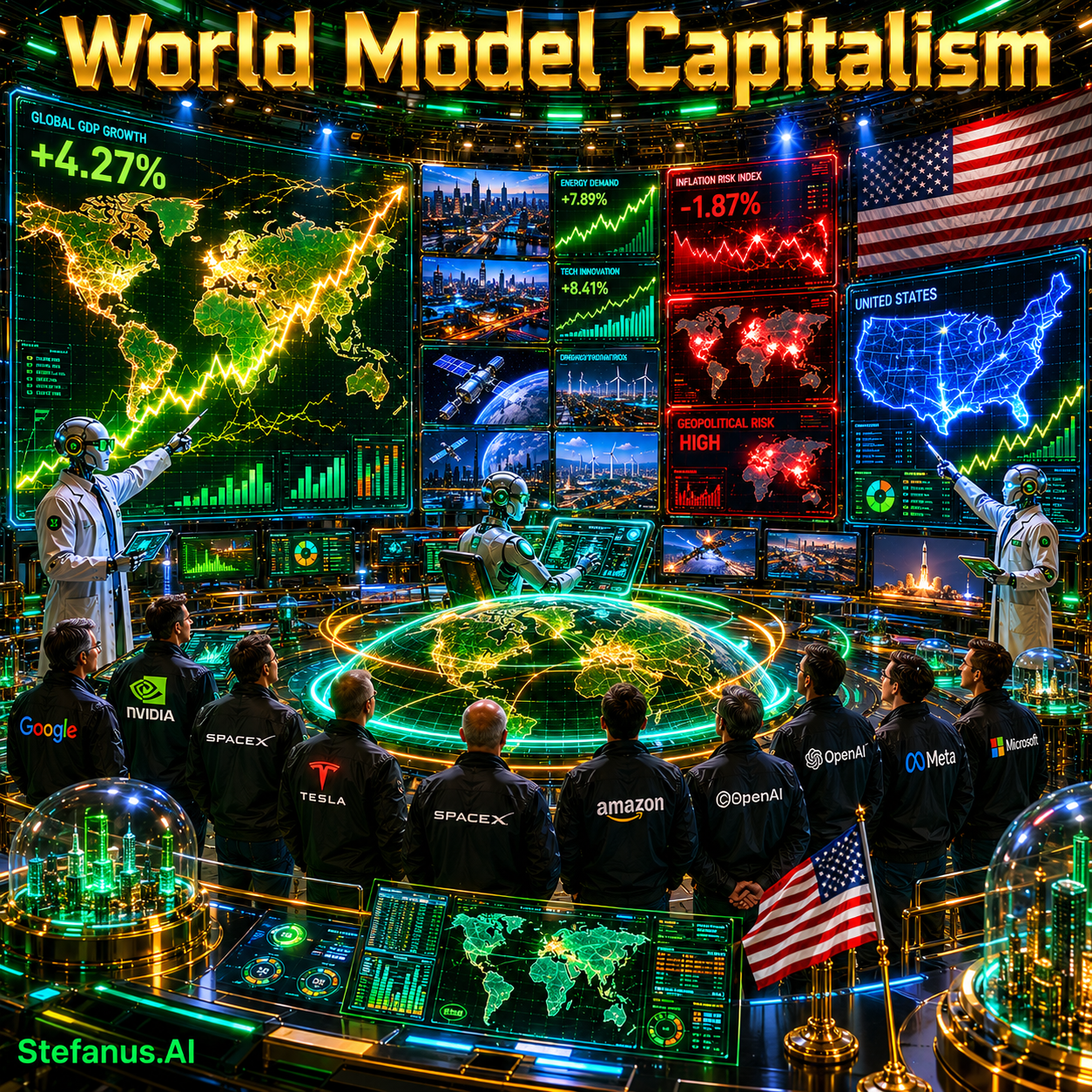

Introduction: From Forecasting to Simulation
When I attended my graduate-school commencement at the University of Southern California many years ago, the university held a full rehearsal the day before the actual ceremony. The purpose of that rehearsal was to simulate every aspect of the event — where the speakers would stand, how each graduate would walk across the stage to receive a diploma, and even the precise moment when graduates would move the tassel from one side of the cap to the other.
The rehearsal covered the sequence of opening remarks, the keynote address, the seating arrangements, and the paths that students and faculty would take through the hall. Every detail was planned and practiced in advance. What began as a simulation during rehearsal became reality on graduation day, and because reality had already been rehearsed, the ceremony unfolded smoothly and exactly as intended. Nothing was left to chance, because the future had been run once already, in miniature, the day before.
Hold that image, because it is the whole argument of this paper compressed into a single afternoon. A modern enterprise is beginning to treat the future the way that university treated its commencement: as something to be rehearsed before it is lived. The contemporary chief executive no longer asks only, “What will happen next quarter?” Increasingly, she asks her AI systems to simulate ten thousand versions of next quarter — then to walk her through the handful that matter. Forecasting hands you a number. Simulation hands you a rehearsal you can step inside, interrogate, and change before a single dollar is spent.
Capitalism has always depended on prediction. Sales forecasts, market forecasts, military intelligence estimates, weather models, supply-chain projections, actuarial tables, and discounted-cash-flow spreadsheets are all instruments for guessing at a future that has not yet arrived. For two centuries, the firm that guessed best won. But world models change the underlying logic of the contest. They allow corporations, governments, militaries, and investors not merely to estimate the future as a probability distribution, but to construct it as a navigable environment — to build a factory, a customer base, a battlefield, a logistics route, an energy market, or an entire city in software, and to let consequences play out there first. The decision is no longer a bet against an unknown. It is a choice among rehearsed outcomes.
This is the shift this paper names and examines: the migration from prediction-based capitalism to simulation-based capitalism. And the central claim can be stated in one sentence.
World Model Capitalism is the economic system that emerges when institutions compete by simulating reality faster, cheaper, and more accurately than their rivals.
The next phase of AI will not simply answer questions, draft text, or automate a workflow. It will let organizations simulate possible futures before committing capital, labor, energy, supply chains, or military force. The signals that this transition is already underway are no longer speculative; they are arriving as product launches, balance-sheet line items, and venture rounds. In June 2026, NVIDIA launched Cosmos 3, which it describes as an open world foundation model for physical AI that unifies vision reasoning, world simulation, and action generation in a single system. [1] Google DeepMind’s Genie 3 generates interactive, navigable worlds in real time. [4] And on 17 June 2026, the world-model startup Odyssey closed a $310 million round at a $1.45 billion valuation, backed by Amazon, GV, AMD Ventures, EQT, and the U.S. intelligence community’s venture arm In-Q-Tel. [6] The market is voting, with capital, on the proposition that simulating the world is the next platform after describing it.
The remainder of this paper develops that proposition in full. Section 1 defines the world model and distinguishes it from the language model that preceded it. Section 2 maps the corporate simulation machine — factories, supply chains, customers, and capital allocation rehearsed before they are real. Section 3 connects world models to the coming wave of physical AI and robotics. Section 4 turns to geopolitics, where simulated wars, simulated supply shocks, and the new doctrine of simulation sovereignty are already reshaping national strategy. Section 5 offers a structural framework — the Five-Layer AI Economy Simulator. Section 6 distills the argument into a set of durable pillars. We then return, at the close, to that rehearsal hall in Los Angeles.

Section 1: What Is a World Model?
Before we can describe an economy built on simulation, we need a precise and unglamorous definition of the machine doing the simulating. A world model is an artificial-intelligence system that learns how an environment behaves and then generates or simulates that environment’s future states. Where a language model predicts the next word in a sequence of text, a world model predicts the next condition of a physical, economic, social, or strategic environment — what the scene will look like a moment from now, how an object will move, how a market will respond, how a crowd, a convoy, or a power grid will behave when something changes. The output is not a sentence. It is a possible world, rendered with enough fidelity that an agent can act inside it and learn from the consequences.
This distinction sounds technical, but it is the hinge on which the entire argument turns. A language model is a master of description; it has read the library and can talk about anything. A world model is a master of dynamics; it has watched the world move and can show you what happens next. Google DeepMind frames the matter cleanly: a world model is a system that uses its understanding of an environment to simulate aspects of it, predicting both how that environment will evolve and how an agent’s own actions will change it. [4] That second clause — how your actions change the world — is what makes a world model a decision instrument rather than a mere generator of pretty video.
1.1 From Language Models to Reality Models
It helps to see the present moment as the latest step in a single arc. The field moved from the language model, which manipulates symbols, to the multimodal model, which fuses text with images, audio, and video; from there to the agentic model, which plans and takes actions across tools and software; and now toward the physical-AI model and the world model, which must reason about mass, friction, occlusion, momentum, and cause and effect in three dimensions. Each step did not discard the last; it absorbed it. A world model still reads text and still uses language to take instruction, but its native medium is the unfolding of events in space and time.
No one has articulated the stakes of this transition more forcefully than Fei-Fei Li, the Stanford computer scientist often called a godmother of modern AI for her role in building ImageNet, and now co-founder of the spatial-intelligence company World Labs. In her 2025 manifesto she argues that today’s large language models, for all their eloquence, are ungrounded — fluent about a world they cannot perceive or touch — and that the next capability gap is spatial.
“Spatial intelligence is the frontier beyond language — the capability that links imagination, perception and action.”
— Dr. Fei-Fei Li, Stanford University / World Labs [7]
Her colleagues in the academy frame the same shift in evolutionary terms. Vincent Sitzmann, an assistant professor at MIT who studies world modeling, suggests we should think of today’s impressive AI video generators as an intermediate form — not yet true world models, but their immediate ancestors.
“We can think of video models as proto-world models.”
— Vincent Sitzmann, Massachusetts Institute of Technology [9]
The progression from proto-world model to world model is precisely the progression from a system that can render a plausible-looking next frame to a system that can render a causally consistent next state — one where, if you push the glass, it falls; if you reroute the shipment, the cost changes; if the pedestrian steps out, the vehicle must yield. That causal consistency is what turns a generative novelty into an economic instrument.
1.2 Why World Models Matter Now
Three developments in particular explain why this is a 2026 story rather than a someday story. The first is NVIDIA’s Cosmos line. Launched as an open frontier model at NVIDIA’s GTC event in Taipei in June 2026, Cosmos 3 is built on a mixture-of-transformers architecture that pairs a reasoning block with a generation block, so that the system interprets a scene before it generates what happens next. NVIDIA reports it was trained on roughly twenty trillion tokens of multimodal data — including hundreds of millions of real and synthetic videos and, crucially, action data describing how machines and people actually move. [2] The company’s framing of the moment is characteristically immodest, and characteristically clarifying.
“The big bang of physical AI is just around the corner.”
— Jensen Huang, Founder & CEO, NVIDIA [1]
The second development is the arrival of real-time, interactive worlds. Google DeepMind’s Genie 3 generates navigable three-dimensional environments from a text prompt at twenty-four frames per second, holding visual consistency for several minutes — long enough to train an agent or walk a stakeholder through a scenario. [4] DeepMind’s research director put the leap plainly when the model was unveiled.
“Genie 3 is the first real-time interactive general-purpose world model.”
— Shlomi Fruchter, Google DeepMind [3]
The economic seriousness of this was illustrated, almost comically, by the market’s reaction when DeepMind opened Project Genie to the public in early 2026: shares of video-game makers fell sharply on the day, with several large publishers dropping by double digits, as investors absorbed the implication that explorable worlds might one day be conjured rather than hand-built. [21] Within weeks, Waymo had adopted a fine-tuned variant to simulate rare and dangerous driving scenarios — sudden weather, unexpected obstacles — that are costly or impossible to capture safely on real roads. [21] A research preview had become a piece of safety-critical industrial infrastructure in a single quarter.
The third development is capital. Odyssey’s $310 million Series B at a $1.45 billion valuation is the headline, but it sits inside a broader rush: Fei-Fei Li’s World Labs has raised roughly $1.23 billion in total, anchored by a $200 million commitment from Autodesk — that company’s largest startup investment ever — [20], and Yann LeCun’s new venture has reportedly raised on the order of half a billion euros to pursue the same thesis. [22] Odyssey’s founders describe the inflection in a phrase the whole field has adopted.
“We believe the field is approaching the GPT-3 moment for world models.”
— Oliver Cameron, Co-founder & CEO, Odyssey [5]
When a credible operator says an entire category is approaching its GPT-3 moment, the prudent reading is not that the technology is finished but that the cost curve has bent far enough for an industry to organize itself around it. That is exactly what is happening.
1.3 The New Simulation Stack
To make the rest of this paper legible, it helps to lay out the pipeline by which raw reality becomes a rehearsable future. We propose the following Stefanus.AI simulation stack, which we will return to and expand in Section 5:
Data → Synthetic Data → Digital Twin → World Model → Agentic Execution → Real-World Action
Reality is captured as raw data from sensors, cameras, satellites, and logs. Where real data is scarce, dangerous, or expensive, it is amplified into synthetic data — generated scenes, simulated motion, manufactured edge cases. That data is assembled into a digital twin, a faithful replica of an existing system. The twin is then driven forward by a world model that simulates what the system could do next under different decisions. Finally, agentic execution lets autonomous systems act on the simulated outcome, closing the loop back into real-world action. Each arrow in that chain is a place where a company can build a moat. The firms that win will not own only the best chatbot; they will own the most trustworthy pipeline from sensor to decision.

Section 2: The Corporate Simulation Machine
If Section 1 described the engine, this section describes what corporations will do with it. The core corporate use of a world model is disarmingly simple to state and profound in its consequences: simulate the operation before you spend the money. Every major category of corporate expenditure — building a plant, committing to a supply route, launching a product, allocating capital — has historically been a leap taken on the strength of a forecast. World models convert each of these leaps into a rehearsal. The forecast becomes a thing you can walk around inside, stress, and break, at the cost of compute rather than concrete.
2.1 Simulated Factories
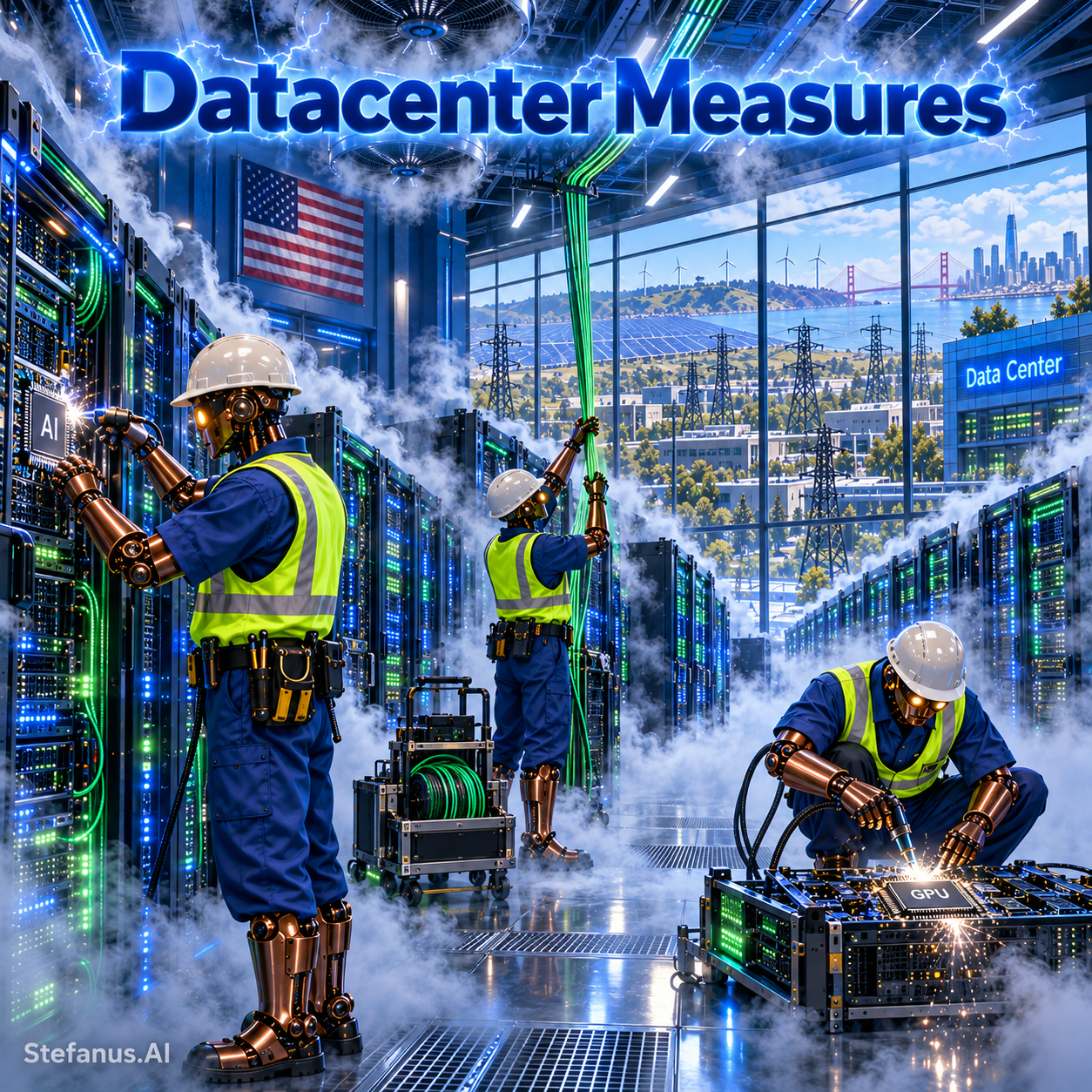
The factory is the first and clearest case, because NVIDIA has already turned it into product. At its GTC event in March 2026 the company released the Vera Rubin DSX reference design alongside the general availability of its Omniverse DSX blueprint, which lets builders construct physically accurate digital twins of gigawatt-scale “AI factories” — simulating power draw, thermal behavior, electrical loading, and token throughput before a single beam is erected. [11] An ecosystem of heavy-industry names — Siemens, Schneider Electric, Cadence, Dassault Systèmes, Vertiv, and others — is contributing the simulation-ready assets that make such twins trustworthy. The strategic logic is captured in NVIDIA’s own slogan for the era.
“Intelligence tokens are the new currency, and AI factories are the infrastructure.”
— Jensen Huang, Founder & CEO, NVIDIA [11]
The scale behind this is not theoretical. In its first quarter of fiscal 2027, reported in May 2026, NVIDIA posted record revenue of $81.6 billion, with data-center sales of $75.2 billion — up ninety-two percent year over year — as the buildout of what the company calls AI factories accelerated. [10] When the infrastructure that generates intelligence is itself being constructed at that pace, the ability to rehearse each gigawatt of it in a simulator before pouring concrete is not a luxury but a survival requirement.
The deeper point generalizes well beyond data centers. When a factory can be designed, validated, and optimized in a simulator that respects the physics of heat and power, construction stops being the first test of a design and becomes the last one. Mistakes that once cost a quarter and a write-down are now caught in a render. The plant is rehearsed, like a ceremony, before it is built.
2.2 Simulated Supply Chains
Supply chains are the corporate nervous system, and they are exactly the kind of complex, interdependent, shock-prone system that world models are built to interrogate. A simulated supply chain is a living digital model in which a company can inject the disruptions that keep operators awake at night — a tariff regime, a port closure, an energy shortage, a labor strike, a chip bottleneck, a Red Sea shipping risk, a Taiwan-related interruption — and watch the consequences propagate before any of them happen. Instead of discovering the fragility of a single-source dependency during a crisis, the firm discovers it on a Tuesday, in a simulation, and re-routes in advance.
This is not merely defensive. The same machinery lets a company design for resilience: testing whether a second supplier, a re-shored component, or a larger buffer of inventory actually pays for itself across thousands of simulated futures rather than across one anxious forecast. The supply chain becomes a hypothesis that can be falsified cheaply.
2.3 Simulated Customers
Perhaps the most commercially immediate frontier is the simulated customer. Retailers, banks, insurers, and software companies are beginning to create synthetic populations — digital twins of customer segments — to test pricing, messaging, product design, churn, and demand before any of it touches a real person. The economics are striking. A feature in the Harvard Business Review in early 2026 argued that generative-AI simulation tools, built around synthetic personas and customer digital twins, are poised to disrupt the roughly $140 billion market-research industry, allowing firms to test ideas and predict reactions without the cost and delay of conventional surveys and focus groups. [12] The same analysis cited projections that the broader digital-twin market could grow from roughly $13–$16 billion in 2023 to between $138 billion and $195 billion by 2030 — annual growth approaching forty-five percent. [12] A fast-food chain can rehearse a new menu against simulated diners; a streaming service can forecast engagement against simulated viewers; a bank can model how clients will react to a new product before it is offered. The focus group of the future may contain no humans at all — a prospect that carries real epistemic risks, since a simulated customer can only be as honest as the data and assumptions baked into it.
2.4 Simulated Capital Allocation
All of this culminates in the boardroom, where the deepest change occurs. The traditional capital-allocation meeting compares a small number of plans — build A or build B, enter market X or market Y — each defended by a forecast and a champion. In a simulation-first firm, executives instead compare distributions of outcomes generated by running each plan thousands of times across varied conditions. The question shifts from “Which forecast do we believe?” to “Which decision performs best across the widest range of futures we can simulate?” That is a fundamentally more robust way to bet a balance sheet — and it returns us to the chief executive of the introduction, who no longer approves a single plan but selects among ten thousand rehearsed quarters.

Section 3: World Models and Physical AI
World models matter most where bits meet atoms. Robotics, autonomous vehicles, drones, warehouses, factories, and humanoids all share a brutal constraint: the real world is an expensive, slow, and dangerous classroom. A robot that learns only by acting in reality breaks things, hurts itself, and gathers data one painful trial at a time. The world model dissolves that constraint by giving the machine a place to practice that is cheap, fast, safe, and infinitely repeatable. This is why the same technology that lets a CEO rehearse a quarter lets a humanoid rehearse a grasp.
3.1 Robots Need Worlds Before They Need Bodies
It is tempting to think the hard part of robotics is the hardware — the actuators, the joints, the hands. In practice, the binding constraint is experience. A robot needs to have encountered a situation, ideally thousands of times, before it can handle that situation gracefully in the real world. Capturing those encounters physically is slow and often unsafe: you cannot stage ten thousand near-collisions to teach a forklift-safety system, and you should not let a surgical robot learn anatomy by trial and error. NVIDIA positions Cosmos squarely at this problem, describing it as a foundation for physical-AI development that lets robots, vehicles, and vision agents learn to generalize from limited real data by training inside generated worlds. [23] The body, in other words, comes last. The world comes first — a conviction Fei-Fei Li extends all the way to the definition of intelligence itself.
“Our dreams of truly intelligent machines will not be complete without spatial intelligence.”
— Dr. Fei-Fei Li, Stanford University / World Labs [8]
3.2 Synthetic Data Becomes Industrial Fuel
If world models are the engine of physical AI, synthetic data is the fuel — and it is becoming an industrial input in its own right. Generated video, simulated motion, manufactured environments, and physics-aware edge cases are now produced at scale specifically to train machines. Cosmos 3 is designed to generate not only photorealistic scenes but action data — the joint angles, gripper positions, and trajectories that describe how a robot should actually move — and to manufacture precisely the rare and dangerous scenarios that are hardest to collect in reality. [2] A decade ago, data was something you gathered. In the world-model economy, data is something you generate, deliberately and at volume, to teach a fleet of machines the situations their designers most fear.
3.3 The Rise of Simulation-First Robotics
The competitive consequence is that robotics companies will increasingly compete on the quality of their simulated worlds as much as on their physical engineering. NVIDIA, Tesla, Figure AI, Boston Dynamics, Google DeepMind, and a wave of startups are converging on a simulation-first development loop, and NVIDIA has explicitly organized an industry coalition — including robotics and AI labs such as Agile Robots, Black Forest Labs, Generalist, Runway, and Skild AI — to advance open world models as shared infrastructure. [1] When the training ground is software, the firm with the most faithful, most varied, most physically honest simulator can iterate faster than a rival constrained by the speed of the physical world. The simulator becomes the factory floor.
3.4 From Digital Twin to World Twin
It is worth drawing a distinction that the rest of the industry often blurs, because it is central to this paper. A digital twin replicates an existing system — this turbine, this plant, this city block — and mirrors its current state. A world model simulates what that system could do next under decisions that have not yet been taken. The twin answers “what is happening?”; the world model answers “what would happen if?” We might call the fusion of the two a world twin: a live replica of a real system, driven forward by a world model that can branch it into thousands of counterfactual futures. Fei-Fei Li’s own taxonomy gestures at the same structure when it separates the renderer that depicts a world, the simulator that evolves it, and the planner that acts within it — three functions that, joined in a loop, constitute spatial intelligence. The world twin is where monitoring becomes decision-making.

Section 4: The Geopolitics of Simulated Reality
World models will not stop at the factory gate. The same capability that lets a company rehearse a product launch lets a state rehearse a conflict, a sanctions regime, an energy shock, or an arms race. This is where simulation stops being a productivity tool and becomes an instrument of national power — and where the analysis of World Model Capitalism must turn from the boardroom to the situation room. The strategic prize is the ability to test the future before an adversary experiences it.
4.1 Simulated Wars
AI-enabled wargaming is moving from the margins to the center of military planning. In an analysis of how NATO might prevail in an era of algorithmic warfare, the Atlantic Council describes a concrete role for generative AI in training and exercises: such models can serve as the engine of war games, filling synthetic theaters with credible enemies.
“They populate synthetic environments with plausible adversarial actors and behaviors.”
— Atlantic Council [13]
The acceleration is dramatic. The Johns Hopkins Applied Physics Laboratory describes a new class of “generative wargaming” that fuses generative AI, simulation, and human judgment, with a striking claim about tempo: it lets analysts build and run war games in days rather than months and examine dozens of alternative futures at once. [14] When the cost of running a serious strategic rehearsal collapses from months to days, the number of rehearsals a nation can afford explodes — and so, potentially, does the quality of its decisions under pressure. The risk, which serious practitioners stress, is over-trust: a simulated adversary is only as wise as the model behind it, and a confident simulation of a war is not a war.
4.2 Simulated China Risk
For multinational corporations, the most consequential simulations may be geopolitical rather than operational. A firm deciding where to build its next plant can now model, in software, the scenarios that would render that decision catastrophic: a disruption to Taiwan, an expansion of export controls, a restriction on rare-earth exports, a chip-supply shock, an escalation in U.S.–China relations. Rather than treating such risks as an unquantifiable cloud over a twenty-year investment, the simulation-first firm can run the investment through each scenario and ask which choices remain sound across the widest set of geopolitical futures. The boardroom and the situation room begin to share a toolkit.
4.3 Simulated Energy Politics
Energy is where the abstract becomes physical, and where simulation is already operational. The same Omniverse DSX work that lets companies design AI factories has drawn in energy leaders — GE Vernova, Hitachi, Siemens Energy — who are using the reference architecture to model grid capacity and power delivery for gigawatt-scale compute before it is connected. [11] Governors, utilities, and hyperscalers face genuinely hard choices about grid stress, nuclear restarts, transmission bottlenecks, and the explosive load growth of AI data centers; world models let them rehearse those choices against demand they can simulate rather than merely forecast. This is not hypothetical urgency. The IMF has warned that AI’s appetite for power is itself a macroeconomic variable, requiring policies to expand electricity supply and contain price surges. Energy policy is becoming an exercise in simulation.
4.4 Simulation Sovereignty
All of this produces a new and, we think, important concept. If a nation’s most consequential decisions are increasingly rehearsed inside world models, then whose world models a nation uses becomes a question of sovereignty. A country that depends on foreign simulation infrastructure depends, quietly, on foreign assumptions about reality — foreign data, foreign physics, foreign priors about how a conflict or a market will unfold. We call the alternative simulation sovereignty: the capacity of a nation or corporation to simulate its own future using trusted models, domestic data, and aligned strategic assumptions.
This is not a fringe idea; it is becoming explicit policy. The 2025 America’s AI Action Plan frames AI leadership as a race with national-security stakes, arguing that whoever commands the largest AI ecosystem will set global standards and reap the economic and military benefits. [18] Its authors are blunt about the stakes.
“Winning the AI Race is non-negotiable.”
— Marco Rubio, U.S. Secretary of State [19]
The same logic is driving a wave of “sovereign AI” investment worldwide, and the appearance of In-Q-Tel — the U.S. intelligence community’s venture arm — in Odyssey’s investor syndicate is a quiet signal that the national-security establishment regards world models as strategic infrastructure rather than entertainment. [6] In the era of World Model Capitalism, the ability to simulate your own future, on your own assumptions, becomes as much a measure of national power as the ability to manufacture your own chips or generate your own electricity.

Section 5: The World Model Capitalism Framework
It is time to give the argument a structure that an operator or a policymaker can actually use. We propose that the emerging simulation economy be understood as a stack of five layers, each of which is a distinct market, a distinct capability, and a distinct place to build advantage. We call it the Five-Layer Simulation Economy. It expands the linear pipeline of Section 1 into a layered architecture, because in practice these are not merely sequential steps but separable businesses, and a firm may dominate one layer while renting the others.
| Layer | Name | What it contains |
| 1 | Physical Data | Factories, streets, warehouses, satellites, sensors, robots, vehicles, and grids — the raw signal of the real world. |
| 2 | Synthetic Data | AI-generated training environments, simulated video, manufactured events, and artificial edge cases that amplify scarce real data. |
| 3 | Digital Twins | Faithful replicas of factories, data centers, cities, logistics networks, and power systems, synchronized to their real counterparts. |
| 4 | World Models | Systems that simulate future states — causal interactions, motion, risk, behavior, and strategy — branching the twin into many possible futures. |
| 5 | Agentic Execution | AI agents, robots, autonomous systems, and decision engines that act in the real world on the basis of simulated outcomes. |
Read from the bottom up, the stack is a value chain: physical data feeds synthetic data, which populates digital twins, which are driven by world models, whose outputs guide agentic execution back into the physical world. Read strategically, it is a map of moats. NVIDIA today is unusual in reaching across nearly all five layers — capturing sensor data, generating synthetic data with Cosmos, building twins with Omniverse, simulating futures with world foundation models, and powering agentic systems on its own silicon. Most firms will specialize. The decisive question for any executive is not “Do we have an AI strategy?” but “Which of these five layers do we intend to own, and which will we rent — knowing that whoever owns Layer 4 sets the assumptions everyone else simulates against?”

Section 6: What Have We Learned? The Pillars
World Model Capitalism teaches a single lesson with many faces: the next decisive advantage may belong to organizations that can test the future before others are forced to live it. The winners of this era will not merely have better chatbots. They will have better simulated realities. We distill the argument into seven pillars.
Pillar 1: Simulation Becomes Strategy
The strongest firms will not merely forecast demand, disruption, competition, and regulation — they will simulate them, comparing thousands of rehearsed futures rather than defending a single plan. Strategy stops being a document and becomes an environment you can enter.
Pillar 2: Synthetic Data Becomes Capital
Synthetic data graduates from a workaround for scarcity into a productive asset in its own right — generated deliberately, at volume, like oil, compute, chips, or electricity. The firm that can manufacture the edge cases its machines most fear holds a balance-sheet advantage, not just a technical one.
Pillar 3: Digital Twins Become Decision Engines
Twins evolve from passive monitoring dashboards into active decision systems. When a replica can be branched forward into counterfactual futures, watching a system and steering it become the same act, and the line between observing reality and choosing it begins to blur.
Pillar 4: Physical AI Requires World Models
Robots, autonomous vehicles, drones, and smart factories cannot safely learn in reality alone. They need rehearsed worlds before they earn real bodies, which is why competition in robotics is migrating from hardware toward the fidelity of the simulator — the world comes first, the body comes last.
Pillar 5: Simulation Sovereignty Becomes National Power
Nations, states, and corporations that control their own simulation infrastructure — trusted models, domestic data, aligned assumptions — gain strategic independence. Those that rent it inherit someone else’s assumptions about their own future, which is a quiet but profound form of dependence.
Pillar 6: The Cost of Being Wrong Collapses
The deepest economic shift is that simulation moves the price of a mistake from the physical world to the digital one. A flawed factory, a brittle supply chain, or a doomed product can fail in a render rather than on a balance sheet. When error becomes cheap, experimentation becomes abundant — and the organizations that experiment most, learn most.
Pillar 7: Epistemic Discipline Becomes a Survival Skill
A simulation is only as honest as its data and assumptions, and a confident rendering of the future is not the future. As world models proliferate, the scarce skill will be the discipline to know what a model can and cannot be trusted to tell you — to treat a thousand rehearsed quarters as a sharpening of judgment, never a replacement for it. The institutions that pair simulation with humility will outlast those seduced by their own renders.

Conclusion: The Company That Simulates First Wins First
Return, finally, to that rehearsal hall in Los Angeles. The University of Southern California did not predict its commencement; it rehearsed it. It built a small, faithful model of the next day and let the ceremony unfold inside that model first, so that when reality arrived, it arrived as something already known. Every tassel turned on cue because every tassel had already turned, once, in simulation.
That is precisely the posture the world-model economy makes available to the firm and the state. The future company will not wait for reality to unfold and then react to it. It will rehearse reality in advance — the factory before the concrete, the product before the launch, the supply chain before the shock, the conflict before the crisis — and arrive at each decision having already lived through its consequences a thousand times. The chief executive of our introduction, weighing ten thousand rehearsed quarters, is doing nothing stranger than what that university did with its graduation: running the future once, in miniature, before committing to it for real.
World Model Capitalism is, at its core, a series of migrations — in how institutions relate to the future itself:
Forecasting → Simulating
Planning → Rehearsing
Reacting → Pre-testing
Automation → Autonomous experimentation
Decision-making → Simulated decision execution
It would be a mistake to read all of this as a purely corporate story. The same force that lets a firm rehearse a quarter is reshaping labor and growth at the level of whole economies. The International Monetary Fund estimates that, with the right measures, AI could lift global productivity by up to 0.8 percentage points per year [16] — even as it warns that the technology is arriving faster than institutions can absorb it. Its managing director chooses a deliberately physical metaphor.
“It is like a tsunami hitting the labor market.”
— Kristalina Georgieva, Managing Director, International Monetary Fund [15]
None of this dissolves uncertainty; the world remains stubbornly real, and the IMF’s reminder that we operate inside “more fog” and more uncertainty is well taken — tellingly, the Fund itself now meets that fog with scenario-planning exercises, simulating the macroeconomic futures of AI rather than merely forecasting them. [17] The lesson is not that simulation makes anyone omniscient. It is that, in a contest among institutions, the advantage flows to those who can rehearse more futures, more cheaply, and more faithfully than their rivals — and who retain the judgment to act wisely on what they see.
In the AI economy, the most powerful institutions may not be those that know the future. They may be those that can simulate more futures than everyone else — and choose among them with open eyes.

Footnotes & Endnotes:
[1] Jensen Huang, quoted in “NVIDIA Launches Cosmos 3, the Open Frontier Foundation Model for Physical AI,” NVIDIA Newsroom, 1 June 2026. https://nvidianews.nvidia.com/news/nvidia-launches-cosmos-3-the-open-frontier-foundation-model-for-physical-ai
[2] Ina Fried, “Nvidia’s Cosmos 3 open AI world model helps robots, autonomous vehicles” (training scale; Ming-Yu Liu), Axios, 1 June 2026. https://www.axios.com/2026/06/01/nvidia-ai-push-cosmos-3-world-model
[3] Shlomi Fruchter, Google DeepMind, quoted in “Genie 3: A New Frontier for World Models,” Google DeepMind, 2025–26. https://deepmind.google/blog/genie-3-a-new-frontier-for-world-models/
[4] Google DeepMind, “Genie 3: A New Frontier for World Models” (real-time interactive world model; specifications). https://deepmind.google/blog/genie-3-a-new-frontier-for-world-models/
[5] Oliver Cameron, “Our $310 Million Fundraise to Accelerate World Simulation,” Odyssey, June 2026. https://odyssey.ml/our-series-b
[6] Julie Bort, “World model maker Odyssey nabs $1.45B valuation backed by Amazon and other big names,” TechCrunch, 17 June 2026. https://techcrunch.com/2026/06/17/world-model-maker-odyssey-nabs-1-45b-valuation-backed-by-amazon-and-other-big-names/
[7] Dr. Fei-Fei Li, “From Words to Worlds: Spatial Intelligence is AI’s Next Frontier,” Substack, 10 November 2025. https://drfeifei.substack.com/p/from-words-to-worlds-spatial-intelligence
[8] Fei-Fei Li, quoted in “World Labs speeds up the world model race with Marble,” TechCrunch, 12 November 2025. https://techcrunch.com/2025/11/12/fei-fei-lis-world-labs-speeds-up-the-world-model-race-with-marble-its-first-commercial-product/
[9] Vincent Sitzmann (MIT), quoted in “Inside Fei-Fei Li’s Plan to Build AI-Powered Virtual Worlds,” TIME, 13 April 2026. https://time.com/7339513/ai-fei-fei-li-virtual-worlds/
[10] “NVIDIA Announces Financial Results for First Quarter Fiscal 2027” (record revenue $81.6B; Data Center $75.2B), NVIDIA / SEC Form 8-K, 20 May 2026. https://www.sec.gov/Archives/edgar/data/0001045810/000104581026000051/q1fy27pr.htm
[11] Jensen Huang, quoted in “NVIDIA Releases Vera Rubin DSX AI Factory Reference Design and Omniverse DSX Digital Twin Blueprint,” NVIDIA Newsroom, 16 March 2026. https://nvidianews.nvidia.com/news/nvidia-releases-vera-rubin-dsx-ai-factory-reference-design-and-omniverse-dsx-digital-twin-blueprint-with-broad-industry-support
[12] Jeremy Korst, Stefano Puntoni & Olivier Toubia, on AI simulation in market research (digital-twin market projections), via SUCCESS, 27 January 2026. https://www.success.com/ai-simulation-marketing-technology-2026
[13] “How NATO Can Integrate AI to Prevail in Future Algorithmic Warfare,” Atlantic Council, 30 March 2026. https://www.atlanticcouncil.org/in-depth-research-reports/report/how-nato-can-integrate-ai-to-prevail-in-future-algorithmic-warfare/
[14] “Generative Wargaming (GenWar),” Johns Hopkins University Applied Physics Laboratory. https://www.jhuapl.edu/work/expertise/generative-wargaming
[15] Kristalina Georgieva, “Leveraging Artificial Intelligence and Enhancing Countries’ Preparedness” (AI as a “tsunami”; 60%/40% of jobs), IMF, 3 February 2026. https://www.imf.org/en/news/articles/2026/02/03/md-speech-leveraging-artificial-intelligence-and-enhancing-countries-preparedness
[16] Kristalina Georgieva, on AI lifting global productivity by up to 0.8 percentage points per year, IMF, 3 February 2026. https://www.imf.org/en/news/articles/2026/02/03/md-speech-leveraging-artificial-intelligence-and-enhancing-countries-preparedness
[17] Karim Barhoumi et al., “Global Economic and Financial Implications of Artificial Intelligence: Lessons from a Scenario-Planning Exercise,” IMF Note 2026/002, April 2026. https://www.imf.org/-/media/files/publications/imf-notes/2026/english/insea2026002.pdf
[18] “Winning the Race: America’s AI Action Plan,” The White House, July 2025. https://www.whitehouse.gov/wp-content/uploads/2025/07/Americas-AI-Action-Plan.pdf
[19] Marco Rubio, quoted in “White House Unveils America’s AI Action Plan,” The White House, 23 July 2025. https://www.whitehouse.gov/releases/2025/07/white-house-unveils-americas-ai-action-plan/
[20] “Fei-Fei Li’s World Labs Splits World Model Into Three Types” (funding; $200M Autodesk anchor), TechTimes, 6 June 2026. https://www.techtimes.com/articles/317927/20260606/feifei-lis-world-labs-splits-world-model-three-types-marble-targets-simulation-linchpin.htm
[21] “Genie (world model)” (Project Genie public launch; game-publisher stock reaction; Waymo World Model), Wikipedia, 2026. https://en.wikipedia.org/wiki/Genie_(world_model)
[22] “World Models Race 2026” (Yann LeCun / AMI Labs; field overview), Introl, January 2026. https://introl.com/blog/world-models-race-agi-2026
[23] “NVIDIA Cosmos: World Foundation Models Powering Physical AI” (platform overview), NVIDIA, 2026. https://www.nvidia.com/en-us/ai/cosmos/