
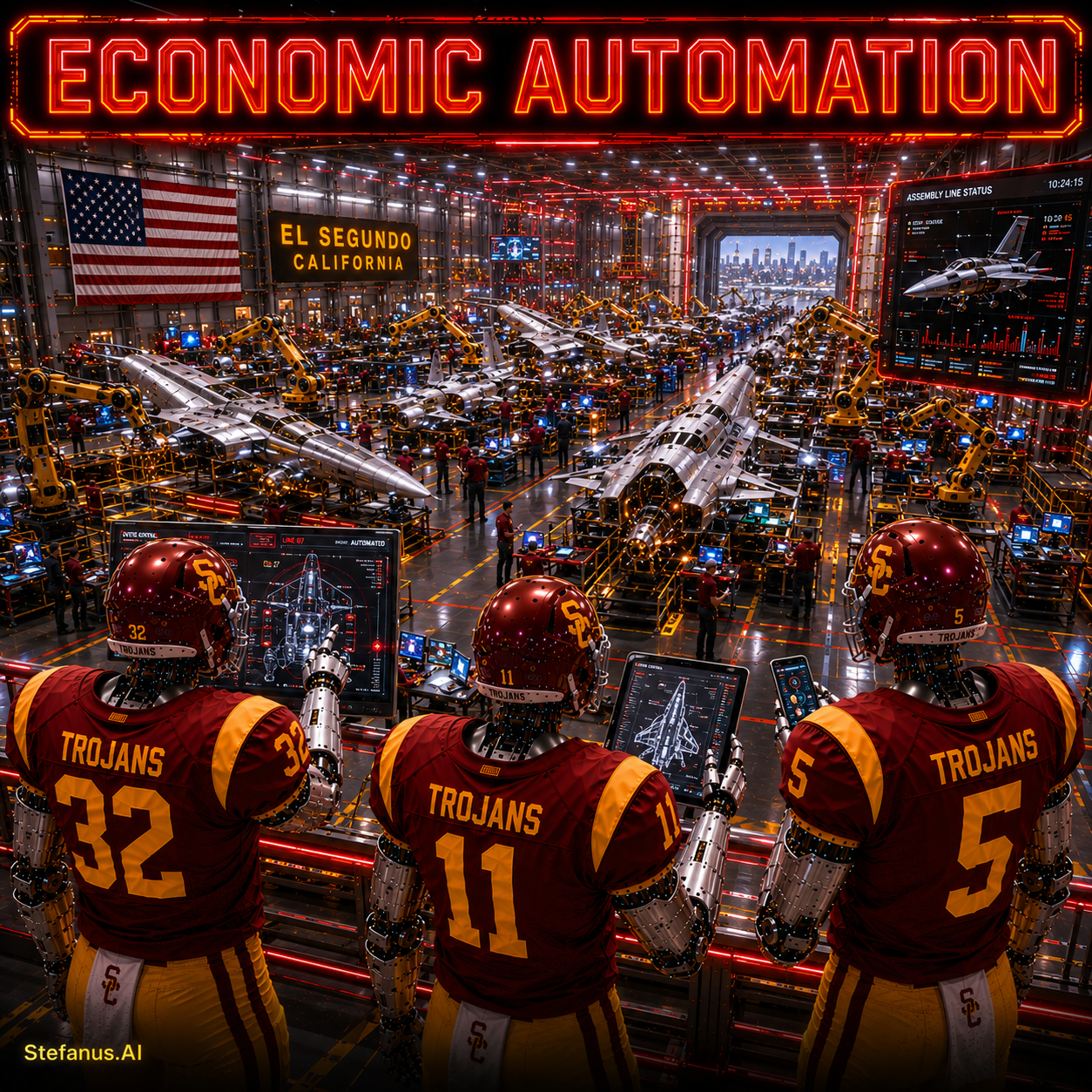

Introduction:
Every general-purpose technology arrives twice: first as an invention confined to laboratories and screens, and then—often a decade or more later—as an operating principle woven into the physical machinery of production. The story of the modern economy is largely the story of that second arrival. It is worth beginning with the network that made all of this possible, because the lineage matters. The foundational connection that became the Internet was forged in 1969 when the ARPANET linked a small constellation of research campuses, and regional networks soon bridged the University of Southern California—my alma mater—with neighboring institutions such as UCLA and Stanford. The Internet pioneer Jon Postel, working at USC, helped catalyze that evolution; in 1983 Postel and his colleagues gave the network its address book through the Domain Name System. Six years later, in 1989, Tim Berners-Lee at the CERN physics laboratory proposed marrying the Internet with hypertext so that scientists could link and share documents freely.
The leap from Postel’s plumbing to Berners-Lee’s Web is the leap from underlying mechanics to a consumer-facing application—from the network as infrastructure to the network as everyday experience. Postel supplied the foundations; Berners-Lee built the interface we now call the Web. Information that once lived in libraries became instantly accessible from anywhere on Earth, and that single shift seeded an entire generation of hyperscale fortunes that still shape the AI economy of the 2020s: Jeff Bezos opened an online bookstore in the early 1990s that became Amazon and later AWS; Larry Page and Sergey Brin built a search engine in the late 1990s that became Google and later Google Cloud; Bill Gates rode Windows 95 into the top tier of global wealth; Elon Musk co-founded the online payments company that became PayPal before launching SpaceX and Tesla; and Mark Zuckerberg built Facebook from a Harvard dormitory. Each fortune was, in the end, an act of deploying a new substrate of intelligence into ordinary economic life.
In late November 2022, when OpenAI released ChatGPT to the public, a new era opened. Generative artificial intelligence transformed knowledge work by allowing machines to produce text, images, software code, video, and chains of reasoning once thought to be exclusively human. Yet these developments may represent only the beginning. The next transformation is not occurring inside computer screens. It is occurring in warehouses, factories, power plants, construction sites, farms, hospitals, ports, logistics hubs, retail floors, and transportation networks. Artificial intelligence is leaving the digital world and entering the physical economy.
For decades, machines automated repetitive physical tasks while humans retained responsibility for perception, judgment, coordination, and adaptation. That distinction is now dissolving. The convergence of advanced AI models, robotics, sensors, computer vision, autonomous systems, edge computing, and high-performance chips is producing something genuinely new—a phenomenon I have chosen to name Economic Automation. The choice of name is deliberate. Earlier waves automated discrete tasks; what is emerging now automates portions of cognition, coordination, and execution across whole systems—and therefore touches the structure of the economy itself. Just as the Industrial Revolution automated muscle, Economic Automation seeks to automate slices of judgment and operation across entire industries.
The scale of the bet is no longer theoretical; it is the largest concentrated capital cycle in the history of technology. In the first quarter of calendar 2026, the largest American technology companies collectively raised their artificial-intelligence infrastructure budgets to a combined figure now tracking between roughly $650 billion and $700 billion for the year alone.[2] The capital markets have repriced the entire economy around this thesis. NVIDIA, the company supplying the engines of the buildout, became in late October 2025 the first company ever to reach a five-trillion-dollar market capitalization—having crossed one trillion only in mid-2023—and by mid-2026 traded near that level as the world’s most valuable company, worth more than the annual economic output of every nation on Earth except the United States and China.[3, 29] Its founder disclosed more than half a trillion dollars in chip orders booked through the end of 2026, describing a degree of forward visibility no technology company had ever possessed:
“The first technology company in history to have visibility into half a trillion dollars.”
— Jensen Huang, Founder & CEO, NVIDIA [3]
In its most recent quarter, ending in April 2026, NVIDIA reported record revenue of $81.6 billion, with data-center revenue of $75.2 billion, up 92 percent from a year earlier.[1] Its leader framed the moment in language that could serve as an epigraph for this entire paper:
“The buildout of AI factories — the largest infrastructure expansion in human history.”
— Jensen Huang, Founder & CEO, NVIDIA [1]
Such numbers invite a fair objection: is this a generational platform shift or a late-cycle bubble? The question is not idle. Veteran market strategists describe NVIDIA’s single-session moves—adding a quarter-trillion dollars of value in a day—as “mind-bogglingly large,” and warn that index-level concentration leaves investors exposed to an outsized downturn if sentiment shifts.[5] This paper takes that risk seriously and returns to it in Section 4. Its central argument, however, is structural rather than speculative: that the next AI race may not be decided by who possesses the smartest model, but by who deploys intelligence most effectively into the real economy—and by who can supply the electricity, the chips, the robots, and the institutional readiness that deployment demands. The implications extend far beyond labor productivity, reaching into national competitiveness, industrial strategy, capital allocation, energy demand, infrastructure planning, and geopolitical power. The World Economic Forum frames the labor stakes plainly, projecting that structural shifts will create 170 million new roles and displace 92 million by 2030—a net gain of 78 million jobs, but a churn equivalent to 22 percent of all employment.[7]

Section 1: The Evolution of Intelligence
To understand where Economic Automation is heading, it helps to trace the three waves through which machine intelligence has matured. Each wave did not replace the one before it; rather, each absorbed its predecessor and extended intelligence into a new domain of action. The first wave taught machines to communicate; the second taught them to act within digital workflows; the third is teaching them to perceive and act in the physical world. The economic stakes rise sharply at each step, because the closer intelligence moves to physical execution, the larger the share of GDP it can touch. The waves are also cumulative in capital: each has demanded an order of magnitude more compute, energy, and investment than the last, which is why the story of intelligence and the story of infrastructure (Section 3) have become inseparable.
1.1 Language AI
The first wave centered on language. Large Language Models transformed communication, search, writing, coding, customer service, education, and knowledge work, and adoption moved with startling speed: the share of businesses using AI in at least one function rose from 55 percent in 2022 to 88 percent by the latest estimates.[7] Yet intelligence in this wave remained confined to screens, and humans still performed physical execution. The economic footprint, while real, was concentrated in tasks that could be expressed in words—precisely the domain where the codified knowledge taught in classrooms overlaps most heavily with what the models had absorbed. That overlap, as Section 4 documents, turned out to have measurable and uneven consequences for the youngest workers.
1.2 Agentic AI
The second wave introduced autonomous agents. Instead of merely generating answers, systems began to plan and execute multi-step workflows: conducting research, generating reports, writing software, managing business processes, and coordinating digital operations. The AI became an actor rather than a tool. By 2026 this shift had moved from demonstration to revenue. PwC’s survey of executives found that 79 percent reported AI agents already adopted in their companies, and two-thirds of those said the agents were delivering measurable productivity gains.[42] Amazon told investors its agentic and generative-AI revenue was growing at triple-digit rates year over year, defending a strategy of investing deliberately ahead of demand.[15] Stanford’s Erik Brynjolfsson, surveying the productivity data, identified a small but telling cohort of “power users” automating end-to-end workstreams with agents—completing in hours what once took weeks.[13]
1.3 Physical AI
The third wave extends intelligence into physical environments, combining robotics, computer vision, sensors, edge computing, and real-world reasoning. Its expressions include autonomous factories, humanoid robots, warehouse robots, agricultural robotics, and autonomous logistics. The machine no longer merely observes the world; it participates in it. No one has articulated the intellectual gap this wave must close more sharply than Stanford’s Fei-Fei Li, who argues that today’s language models, for all their fluency, lack any grounding in physical reality:
“They remain wordsmiths in the dark; eloquent but inexperienced, knowledgeable but ungrounded.”
— Dr. Fei-Fei Li, Stanford University & World Labs [9]
Li calls the missing capability spatial intelligence—the ability to perceive, reason about, and act within the three- and four-dimensional physical world—and frames it as the foundation for any system expected to operate beyond a screen.[9, 10] Remarkably, the same conviction has now drawn one of the field’s founders out of the largest AI lab in the world. In November 2025, Yann LeCun—a Turing Award laureate and Meta’s chief AI scientist for twelve years—departed to found AMI Labs, raising more than a billion dollars to build the “world-model” alternative he argues language models structurally cannot reach.[11, 12] His diagnosis is blunt:
“LLMs are incredibly useful but are mostly information retrieval systems.”
— Yann LeCun, Turing Award laureate; Founder, AMI Labs [12]
Whether LeCun’s world models or today’s scaled transformers ultimately power Physical AI is an open empirical question, and one with enormous capital riding on each side—his own funding syndicate notably includes NVIDIA, whose revenue depends on whichever paradigm prevails.[12] But the strategic point for this paper is independent of that contest. Both camps agree that the economic value of artificial intelligence has so far been throttled by its confinement to language, and that the next, larger tranche of value will be unlocked only as intelligence learns to move through warehouses, operating rooms, and assembly lines as fluently as it now moves through text.

Section 2: The Rise of Economic Automation
Economic Automation is best understood not as a faster version of past automation but as a change in its unit of analysis. Where earlier automation optimized individual tasks—a weld, a sort, a calculation—Economic Automation targets entire systems: supply chains, manufacturing ecosystems, transportation networks, utility operations, and healthcare workflows. The distinction matters because systems exhibit emergent behavior that tasks do not. When intelligence is embedded across a whole operation rather than bolted onto one step, the operation can begin to sense, decide, and adapt as a coordinated whole. This section traces how that shift is already visible in three places: in corporate capital plans, in the closed-loop architectures now being adopted as national strategy, and in the emergence of a new organizational form, the autonomous enterprise.
2.1 Beyond Task Automation
The shift from task to system is written plainly in the balance sheets of the largest enterprises. Amazon spent $43.2 billion on capital expenditures in a single quarter, the overwhelming majority tied to AWS and generative-AI infrastructure, and reaffirmed a target near $200 billion in capital spending for 2026—even as its trailing free cash flow compressed by roughly 95 percent under the weight of that buildout.[16, 18] Microsoft’s Azure and other cloud services grew 40 percent year over year as the company guided toward roughly $190 billion in 2026 capital expenditure.[17] Alphabet’s Google Cloud grew 63 percent, and its chief executive told analysts the company was compute-constrained in the near term—demand was outrunning the capacity being built.[30] These are not the budgets of firms automating a task; they are the budgets of firms attempting to automate the operating substrate of the economy, and accepting near-term cash-flow pain to do it.
2.2 Autonomous Economic Loops
At the heart of Economic Automation is a repeating cycle—observe, analyze, decide, execute, learn, and repeat—that, once closed, becomes self-improving. This pattern has now migrated from software into sovereign strategy. The United States government’s November 2025 Genesis Mission directs the Department of Energy to build what it explicitly calls a “closed-loop AI experimentation platform” linking the national laboratories’ supercomputers, data, and robotic laboratories into a single system for scientific discovery, with the stated aim of doubling the productivity of American science within a decade.[19] When a sovereign state adopts the observe-decide-execute-learn loop as industrial policy and likens it to the Manhattan Project, the loop has ceased to be a software pattern and has become an instrument of national economic power.
2.3 The Autonomous Enterprise
Projected forward, these loops imply a new organizational form: the autonomous enterprise, staffed by a thin layer of human executives setting objectives, a layer of AI agents coordinating digital operations, robotic workers performing physical tasks, and autonomous logistics systems moving goods. Tesla offers an early, contested glimpse of the model. In April 2026 the company confirmed it would end production of the Model S and Model X to convert its Fremont plant into a humanoid-robot factory, with plans for a first-generation line designed to build one million Optimus robots a year.[23, 24] The ambition is enormous and the timeline uncertain—Elon Musk acknowledged production would be “quite slow” at first as the company solves more than ten thousand unique parts—but the strategic intent is unmistakable: a carmaker is rebuilding itself, quite literally, around autonomous physical labor.[24] The financing of that transition is equally telling. Tesla’s capital expenditure is rising sharply and free cash flow is expected to turn negative for the remainder of 2026 as it competes for AI compute alongside the hyperscalers—the autonomous enterprise, it turns out, is extraordinarily capital-hungry before it is profitable.[23]

Section 3: The Infrastructure Behind Economic Automation
Every economic revolution rests on a physical substrate that is easy to overlook precisely because it is so fundamental. The steam economy needed coal and iron; the electric economy needed dynamos and copper; the Internet economy needed fiber and silicon. Economic Automation needs all of these at once—compute, connectivity, sensors, and, above all, electricity—fused into a single integrated system. This section argues that the binding constraint on Economic Automation is shifting from algorithms to atoms: from the cleverness of models to the availability of power, the resilience of supply chains, and the integration of infrastructure. The companies and nations that understand this earliest are already racing to secure generation, grid capacity, and critical components years ahead of demand.
3.1 Intelligence Factories
Datacenters are becoming production facilities for intelligence. Just as a steel mill converts ore and energy into beams, an “intelligence factory” converts data and electricity into inferences, predictions, and decisions. NVIDIA’s leadership has adopted exactly this industrial vocabulary, and the financial gravity is staggering: full fiscal-2026 revenue reached $215.9 billion, up 65 percent, generating $96.6 billion of free cash flow, with Wall Street expecting more than $400 billion of free cash flow over the following two years.[25, 29] The intelligence factory is no longer a metaphor; it is the most profitable manufacturing operation on Earth.
3.2 Physical Intelligence Networks
The new economy requires fiber, compute, energy, connectivity, and sensors woven together, so that intelligence itself becomes infrastructure rather than an application running on top of it. The scale of forward commitment is the clearest evidence: a single hyperscaler’s cloud backlog stood at more than $460 billion in the first quarter of 2026, nearly double the prior quarter, and the OpenAI-led Stargate venture has targeted up to $500 billion of datacenter investment and ten gigawatts of capacity across the United States.[30, 22] To wire these networks together, the chip-makers are reaching upstream into glass and power: NVIDIA struck a partnership with Corning to expand domestic manufacturing of optical connectivity and tied up with infrastructure developers to deploy multi-gigawatt AI campuses.[4] Intelligence, in other words, is being poured into concrete, copper, and glass before the demand to fill it has fully arrived.
3.3 Power Becomes Strategic
Here the argument turns physical in the most literal sense. Every robotic worker, every inference, every autonomous decision ultimately resolves into demand for electricity, and electricity therefore becomes a direct input into productivity. The International Energy Agency projects that global datacenter electricity consumption will roughly double to around 945 terawatt-hours by 2030—slightly more than Japan’s entire electricity use today—with demand from AI-optimized datacenters set to more than triple over the same period.[26] In the United States, datacenters are on course to consume more electricity by 2030 than the production of aluminum, steel, cement, chemicals, and all other energy-intensive goods combined.[26] The IEA’s executive director reduced the entire dynamic to a single sentence:
“There is no AI without energy.”
— Dr. Fatih Birol, Executive Director, International Energy Agency [27]
That observation reframes Economic Automation as fundamentally an energy story. Datacenter electricity demand rose 17 percent in 2025, more than five times faster than overall global demand growth, even as the energy used per AI task fell at a rate the IEA called unprecedented in energy history.[27] Efficiency is improving and consumption is still soaring—because deployment is scaling faster than efficiency can offset. The response is a scramble for every available electron: technology companies signed roughly 40 percent of all corporate renewable power-purchase agreements in 2025, the pipeline of conditional agreements with small modular nuclear reactors nearly doubled from 25 to 45 gigawatts in a year, and chip-makers struck nuclear-power deals directly with operators.[27] Whoever controls the generation, the grid, the transformers, and the cooling will hold a strategic chokepoint on autonomous productivity—which is precisely why the IEA now describes AI as not only an “energy taker” but an emerging “energy maker.”[27]

Section 4: Winners and Losers of Economic Automation
Transformations of this magnitude do not lift all participants equally. They redistribute advantage—among firms, among regions, and among nations—according to who supplies the scarce inputs and who can absorb the new capabilities fastest. This section maps the emerging distribution of gains and losses across four levels: the corporate, the entrepreneurial, the state, and the national. It does so with deliberate intellectual honesty, because the most serious economists studying this question do not agree on how large the gains will ultimately be, and because the same capital intensity that produces the winners also concentrates a systemic risk that no honest reader should ignore.
4.1 Corporate Winners
The clearest beneficiaries are the firms supplying the intelligence layer and the machines that embody it—NVIDIA, Tesla, Figure AI, Amazon, Google, Meta, OpenAI, and Anthropic among them. Their results in the first quarter of 2026 read like a single coordinated wager. Amazon posted $181.5 billion in revenue, up 17 percent, with AWS growing 28 percent—its fastest pace in three years.[16] Alphabet delivered roughly $109.9 billion in revenue, with Google Cloud up 63 percent.[30] Yet the same quarter exposed the risk inside the wager: Meta’s shares fell about 6 percent after it raised its 2026 capital-expenditure guidance toward $125–$145 billion, a reminder that investor patience for spending ahead of returns is finite.[2] Amazon’s leadership defended the strategy directly:
“These investments are being made ahead of revenue and will take time to monetize.”
— Andy Jassy, President & CEO, Amazon [15]
4.2 The Capital Markets and the Private Frontier
Beneath the public winners sits a private financing event without historical parallel. The two leading model laboratories raised roughly $300 billion between them in a span of months. OpenAI closed a $122 billion round at an $852 billion post-money valuation in March 2026, anchored by SoftBank, NVIDIA, and a multibillion-dollar Amazon commitment, while its run-rate revenue climbed toward roughly $24 billion.[20, 22] Weeks later, Anthropic closed a $65 billion Series H at a $965 billion valuation—briefly the most valuable private company in the world—on the strength of a revenue run-rate that had reached $47 billion, up from $10 billion a year earlier, driven by its coding assistant Claude Code.[21] The entanglement is unprecedented: Amazon and Google together committed up to roughly $33 billion and $40 billion respectively to Anthropic, functioning simultaneously as its investors, its cloud suppliers, and its competitors.[20] Nor is the frontier limited to two firms. Elon Musk’s xAI merged into SpaceX in an all-stock deal that valued the combined entity at more than a trillion dollars, while Europe’s Mistral and a cohort of robotics labs raised billions more.[31]
This is also where the bubble question becomes unavoidable. OpenAI recalibrated its headline infrastructure ambition from a publicly cited figure near $1.4 trillion to roughly $600 billion of compute spend through 2030, and its principal infrastructure partner, Oracle, took on tens of billions in debt and drew a shareholder lawsuit over the strategy’s projected returns.[33] HSBC has estimated that OpenAI alone could face a funding gap on the order of $200 billion by 2030.[50] Even bullish observers concede the multiples assume a future that has not yet arrived; as one prominent macro investor put it, the implied valuation is
“Priced for a monopoly outcome that does not yet exist.”
— Greg Jensen, Co-Chief Investment Officer, Bridgewater Associates [32]
4.3 The Robotics Vanguard
If language models are the intelligence layer, humanoid robots are the limbs through which Economic Automation will touch the physical world—and capital has begun to price that future aggressively. Figure AI reached a $39 billion valuation in its September 2025 Series C, a fifteen-fold step-up in eighteen months, after its Figure 02 robots logged more than 1,250 operating hours at BMW’s Spartanburg plant, handling over 90,000 parts and contributing to more than 30,000 vehicles built.[34, 35] Its founder’s posture captures the moment’s confidence:
“The team’s in place, the robots are built, and the path ahead is clear.”
— Brett Adcock, Founder & CEO, Figure AI [34]
The vanguard is broader than any one firm. Skild AI, building a single “omni-bodied” foundation model to control any robot, raised $1.4 billion at a valuation above $14 billion; capital is now flowing into the robot “brain” as readily as the body; and enterprise buyers—Amazon, BMW, Mercedes-Benz, GXO Logistics, and John Deere among them—have moved from pilots to deployments.[36] The decisive insight emerging from these firms is one of vertical integration: as Adcock argued in explaining Figure’s break from an external model provider, solving embodied AI at scale requires owning the hardware, the model, and the factory together.[35]
4.4 State-Level and National Winners
Within the United States, the states that attract energy generation, datacenters, semiconductor fabrication, and robotics manufacturing are positioned to emerge as economic leaders—Texas, Arizona, Virginia, Pennsylvania, Indiana, and Michigan prominent among them. The logic is the energy logic of Section 3 made geographic: capacity flows to where power, land, and permitting align. Amazon’s commitment to bring 2.4 gigawatts of compute capacity to northern Indiana, layered atop earlier multibillion-dollar regional commitments, illustrates how the map of Economic Automation is being drawn one substation and one datacenter campus at a time.[18] At the national level, the decisive variable is the ability to integrate four capabilities at once—artificial intelligence, energy, manufacturing, and robotics—and the United States has elevated that integration to explicit federal strategy. Its 2025 AI Action Plan identifies more than ninety federal actions across innovation, infrastructure, and international diplomacy, framed without euphemism:[37]
“America’s AI Action Plan charts a decisive course to cement U.S. dominance in artificial intelligence.”
— Michael Kratsios, Director, White House Office of Science and Technology Policy [37]
4.5 The Losers, and the Question of Inequality
National advantage in productive capacity is not the same as broadly shared prosperity, and here the international institutions sound a deliberate counterpoint. The United Nations Secretary-General has warned repeatedly that the gains of AI are concentrated in a few companies and countries, and that the central governance task is to keep the technology from hardening into a permanent divide:
“We must prevent a world of AI ‘haves’ and ‘have-nots’.”
— António Guterres, Secretary-General, United Nations [38]
The World Bank frames the same risk in developmental terms. Its chief economist has warned that, absent a course correction, the 2020s are on track to become “a lost decade” for far too many developing economies—while also arguing that the forces now gathering, AI and energy transformation among them, could unlock transformative progress in the decade that follows if preparation begins now.[41] The United Nations Development Programme has given this divergence a name, warning that uneven AI readiness could set in motion a “Next Great Divergence” in inequality between countries, with AI usage already exceeding two-thirds of people in some high-income economies while remaining near five percent in many low-income ones.[40] And the IMF’s managing director has quantified the labor exposure with a deliberately visceral metaphor, estimating that AI will affect about 40 percent of jobs worldwide and as many as 60 percent in advanced economies—the subject to which Section 6 returns.[6]

Section 5: The Economic Automation Era
If the preceding sections describe the mechanics, this section describes the destination. The Economic Automation Era is not defined by any single robot or model but by the simultaneous coordination of millions of intelligent systems across industries and infrastructure. It arrives unevenly—first in the domains where environments are well-defined and errors are manageable, and only later in the messy, open-ended settings that resist automation. Understanding that sequencing is essential to seeing the era clearly, and to avoiding both the breathless over-promising and the reflexive dismissal that have characterized so much commentary.
5.1 Autonomous Industries
The industries likely to be transformed first are those with structured, repetitive, physically constrained operations: warehousing, logistics, manufacturing, energy, agriculture, and defense. These are the settings where spatial AI will land earliest—domain-specific deployments where the environment is bounded and the cost of error is contained—rather than as a sudden, universal shift.[10] The market data bear this out. The State of Robotics survey for 2026 found that twelve commercial humanoid platforms became available for purchase or lease, up from three two years earlier, with full bipeds priced between roughly $28,000 and $245,000 and lease programs beginning near $3,500 a month; the binding constraint, tellingly, has shifted from hardware to training data, whose cost per high-quality teleoperation hour fell by more than half between early 2024 and late 2025.[46] The field has crossed, in other words, from research into early market formation.
5.2 Autonomous Infrastructure
Beyond individual industries lies the prospect of infrastructure that manages itself: self-balancing power grids, autonomous ports, autonomous freight corridors, and autonomous industrial parks. The energy system is the leading edge here, both as consumer and as beneficiary, as the IEA’s “energy maker” framing makes clear: AI is accelerating next-generation nuclear, flexible datacenters that can modulate their own load, and long-duration storage, with as much as 20 to 25 gigawatts of battery storage potentially installed in datacenters by 2030.[27] The same closed-loop logic that defines the autonomous enterprise is being applied to the grid itself.
5.3 Autonomous Economies
The ultimate destination is not a single autonomous machine but an economy in which millions of intelligent systems coordinate simultaneously—so that Economic Automation becomes a national capability rather than a corporate feature. Whether that capability materializes as forecast is the central empirical question of the decade, and it is here that the scholarly disagreement is sharpest. MIT’s Daron Acemoglu, the 2024 Nobel laureate in economics, has produced the most influential skeptical estimate, calculating that AI’s macroeconomic effects over the next ten years will be real but bounded:
“Nontrivial but modest — no more than a 0.71% increase in total factor productivity over 10 years.”
— Prof. Daron Acemoglu, Massachusetts Institute of Technology [47]
Acemoglu’s caution rests on a structural argument: AI is automating the “easy,” codifiable tasks while the hard, context-dependent work where most economic value resides remains stubbornly human, and broad prosperity historically arrives only when automation is paired with new tasks for workers—what he calls the reinstatement effect.[48, 49] The optimistic camp counters that today’s limitations are temporary and that compute scaling will eventually reach the complex tasks. The gap is extraordinary: leading scholars publishing through the same prestigious working-paper series differ in their ten-year projections by more than an order of magnitude, from Acemoglu’s sub-one-percent productivity gain to scenarios of double-digit annual growth.[46] The honest position, which this paper adopts, is that the outcome is not yet determined; it will be settled in labor markets and on factory floors, not in forecasts. Encouragingly, the early aggregate signal has begun to favor the optimists: Brynjolfsson argues U.S. productivity roughly doubled its decade-average pace in 2025 as the economy moved from an investment phase into a “harvest phase.”[13]

Section 6: What Have We Learned — The Five Pillars
Economic Automation is not simply another technology cycle. It represents the convergence of artificial intelligence, robotics, energy systems, infrastructure, and industrial policy into a new economic operating model. The most important question is no longer how intelligent the models are; it is how effectively that intelligence can be deployed into the physical economy. The evidence assembled in this paper distills into five pillars—each a lever of advantage, and each grounded in the data and testimony of 2025–2026. Before stating them, it is worth naming the empirical tension that runs through all five, because it is the single most important thing a serious reader should carry away: the same labor data that excites the optimists alarms the institutions charged with protecting workers.
On one side stands a body of evidence that AI is already raising productivity and wages. PwC’s analysis of close to a billion job advertisements found that productivity growth nearly quadrupled in the industries most exposed to AI between 2018 and 2024, that those industries now show three times the growth in revenue per employee of the least exposed, and that workers with AI skills command a wage premium that reached 56 percent.[42] Its 2026 follow-up found the most AI-exposed companies tripling their lead in workforce productivity, with the top quintile achieving an extraordinary 163 percent productivity growth on average—while raising both wages and headcount.[43] PwC’s leadership summarized the finding without hedging:
“The power of AI to deliver for businesses is already being realised.”
— Carol Stubbings, Global Chief Commercial Officer, PwC [42]
On the other side stands the displacement. The clearest near-term evidence comes from Stanford’s Digital Economy Lab, whose payroll analysis of millions of American workers found a roughly 13 percent relative decline in employment for early-career workers in the most AI-exposed occupations since generative AI became widespread—while employment for older, more experienced workers in the same roles held steady or grew.[14] The IMF’s managing director places that finding in global perspective with her now-famous metaphor:
“This is like a tsunami hitting the labor market.”
— Kristalina Georgieva, Managing Director, International Monetary Fund [6]
Both things are true at once. The World Economic Forum’s reconciliation—170 million jobs created, 92 million displaced, a net gain of 78 million, and 39 percent of core skills transformed by 2030—captures the shape of a transition that is simultaneously creative and destructive, and whose burden falls hardest on the young, the routine, and the unprepared.[7] With that tension in view, the five pillars follow.
Pillar 1 — Intelligence Deployment
Competitive advantage comes from deploying intelligence, not merely developing it. The firms and nations pulling ahead in 2026 are those converting frontier models into running operations—half-trillion-dollar cloud backlogs, triple-digit agentic revenue, and sovereign closed-loop platforms—rather than those merely publishing benchmarks. Deployment, not invention, is the new moat. [30, 19]
Pillar 2 — Physical AI
Robotics transforms digital intelligence into economic output. The leap from “wordsmiths in the dark” to spatially intelligent machines is the leap that unlocks the larger, physical tranche of GDP. The humanoid market crossed from research into early commercial formation in 2026, validated by real factory deployments and priced by a robotics financing boom. [9, 46]
Pillar 3 — Energy Capacity
Electricity becomes the foundational fuel of autonomous systems. Datacenter demand is set to double by 2030; in the United States it will soon outstrip all heavy manufacturing combined. There is no autonomous economy without an electricity buildout—and a grid, transformer, and nuclear pipeline—to match. [26, 27]
Pillar 4 — Infrastructure Integration
Compute, networks, sensors, and logistics must be tightly interconnected. Intelligence becomes infrastructure only when these layers fuse; the half-trillion-dollar backlogs, the $650–$700 billion annual capital cycle, and the reach of chip-makers upstream into glass and power are the price of that integration. [2, 4]
Pillar 5 — Autonomous Productivity
Nations and corporations able to scale autonomous productivity gain durable advantage. Whether the gain proves to be Acemoglu’s modest 0.7 percent or the optimists’ order-of-magnitude larger figure, the relative winners will be those who scaled deployment first—and who shared the gains widely enough to keep the transition legitimate. [47, 42]

Section 7: Strategic Implications — A Reader’s Guide
A framework earns the label “reference” only if different readers can act on it. This section translates the preceding analysis into distinct implications for the five audiences most affected by Economic Automation. The translations share a common spine—deployment over invention, atoms over algorithms, and the management of a creative-destructive labor transition—but they diverge in what each reader should do about it.
7.1 For Investors
The investment case rests on a single structural fact and a single structural risk. The fact is that value is migrating from model development toward deployment and the physical inputs that enable it—compute, energy, grid components, robotics, and the unglamorous “picks and shovels” of the buildout, where NVIDIA’s rise from roughly $345 billion to more than $5 trillion in five years is the archetype.[29] The risk is concentration and circularity: a handful of names now drive index returns, the frontier labs are funded by their own customers, and HSBC-scale funding gaps imply further capital raises ahead.[32, 50] The disciplined posture is to distinguish firms monetizing AI in the present income statement—expanding cloud margins, rising revenue per employee—from those whose valuations, in Bridgewater’s phrase, are priced for a monopoly outcome that does not yet exist.[32] Energy and infrastructure exposure, long treated as a sleepy adjacency, may prove the most durable way to own the theme.
7.2 For Practitioners and Enterprises
For operating companies, the PwC data deliver an unambiguous instruction: AI exposure correlates with higher productivity, higher revenue per employee, and higher wages, and the firms capturing the largest gains use AI to amplify human performance and enter new markets rather than merely to cut costs.[42, 43] The practical implications are to treat AI as a growth strategy rather than an efficiency program, to prioritize agentic deployment where two-thirds of adopters already report measurable value, and to invest continuously in workforce skills, since the competencies required in the most exposed roles are changing more than twice as fast as elsewhere.[42] The enterprises that lose will be those that buy tools without redesigning the operating model around them.
7.3 For Government Officials
Governments face a twin mandate that the institutions in this paper articulate in tension. On one side is the competitiveness imperative captured by the United States’ AI Action Plan and Genesis Mission: secure energy, accelerate permitting, build the closed-loop research infrastructure, and treat compute and power as strategic assets.[19, 37] On the other is the equity imperative voiced by the UN, the World Bank, and the IMF: build social safety nets and retraining programs, widen access so the technology does not harden into a world of “haves” and “have-nots,” and coordinate internationally so that developing economies are not consigned to a lost decade.[38, 41, 6] The grid is where these mandates meet most concretely: the IEA warns that without timely investment, roughly a fifth of planned datacenter projects face connection delays, and that datacenter load can strain electricity affordability for ordinary consumers unless integrated thoughtfully.[27] Energy policy, in the age of Economic Automation, is AI policy.
7.4 For Founders and Startups
The startup opportunity is widest precisely where the incumbents are weakest: in the physical layer. The lesson of the robotics vanguard—Figure’s factory deployments, Skild’s omni-bodied brain, the world-model bet of AMI Labs and World Labs—is that whoever solves grounded, embodied intelligence and the data pipelines that feed it will define the next platform, and that vertical integration of hardware, model, and manufacturing is the emerging winning structure.[34, 35, 12] The capital is available: AI absorbed the overwhelming majority of venture deployment in early 2026, and robotics financing reached multi-year highs.[31] The discipline that separates durable companies from the casualties of the cycle is the one Figure’s and Amazon’s leaders both name—revenue and real deployment first, narrative second.[34, 15]
7.5 For Educators and Workers
For the individual, the data resolve into a clear, if uncomfortable, strategy. The entry-level erosion documented by Stanford is real, and it falls hardest on young workers whose codified, classroom knowledge overlaps most with what models already do.[14] Yet the same data show that workers who use AI to augment their judgment command large and growing wage premiums, that physical and care trades less exposed to automation are expanding quickly, and that the durable human skills—analytical thinking, creativity, leadership, and adaptability—are rising fastest in demand.[42, 7] Educators who reorganize curricula around the human-plus-AI complement, rather than around tasks AI already performs, will serve their students best in the Economic Automation Era.

Conclusion:
I chose the name Economic Automation because the phenomenon it describes is not the automation of a task or even of a job, but the gradual automation of the economy’s operating logic—the loops of sensing, deciding, and acting that, until now, required human hands and human judgment at every consequential step. The first phase of artificial intelligence taught machines to communicate. The second taught them to reason through digital work. The third is teaching them to act in the physical world. Economic history suggests that transformative technologies create their greatest impact not at the moment of invention but at the moment they become integrated into everyday production. Artificial intelligence is now approaching that threshold.
The future will not be defined solely by larger models or faster chips. It will be defined by the ability to convert intelligence into economic output—and that conversion runs through electricity, robotics, infrastructure, and the institutional readiness of nations. Factories will become intelligent. Supply chains will become autonomous. Infrastructure will become adaptive. Organizations will become increasingly self-operating. The transition from Language AI to Agentic AI, and from Physical AI to Economic Automation, may ultimately rank among the most important economic transformations of the twenty-first century.
But the evidence of 2025–2026 counsels both ambition and humility, and a serious reader should hold every number in this paper in that double light. The capital is real—$650 to $700 billion committed in a single year, and the first five-trillion-dollar company in history.[2, 3] The energy constraint is real—datacenter demand doubling by 2030, soon to exceed all American heavy manufacturing combined.[26] The productivity gains are real—quadrupled growth and a 56 percent wage premium in the most exposed industries.[42] The labor disruption is equally real—a measurable retreat in entry-level hiring and a net churn touching nearly a quarter of all jobs.[14, 7] The financial risk is real—valuations priced for monopolies that do not yet exist, and funding gaps measured in the hundreds of billions.[32, 50] And the disagreement among the most serious economists about the ultimate size of the prize is also real, spanning more than an order of magnitude.[46] The United Nations is surely right that the central task is to keep this transformation from hardening into a world of haves and have-nots.[38]
The next industrial revolution may not be powered by steam, electricity, or the Internet. It may be powered by autonomous intelligence operating at economic scale—and the societies, enterprises, and individuals that prepare for it deliberately, rather than merely marvel at it, will be the ones that capture its gains. That preparation is the purpose of this framework, and the invitation of this paper.

Footnotes & Endnotes:
[1] NVIDIA Corporation. Financial Results for the First Quarter of Fiscal 2027 (quarter ended April 26, 2026); remarks of Jensen Huang. https://www.sec.gov/Archives/edgar/data/0001045810/000104581026000051/q1fy27pr.htm
[2] The Next Web. Q1 2026 Big Tech earnings: $650 billion in AI capex and compute constraints (April 30, 2026). https://thenextweb.com/news/alphabet-amazon-meta-q1-2026-earnings-ai-cloud
[3] Fortune. Nvidia is officially the world’s first $5 trillion company; Jensen Huang on ‘half a trillion dollars’ in revenue (Oct. 29, 2025). https://fortune.com/2025/10/29/nvidia-first-5-trillion-company-ceo-jensen-huang-500-billion-revenue-blackwell-rubin-gpus-china/
[4] CNBC. Nvidia stock closes at record, pushing market cap past $5 trillion (April 24, 2026). https://www.cnbc.com/2026/04/24/nvidia-stock-closes-at-record-pushing-market-cap-past-5-trillion.html
[5] Morningstar. As Nvidia Crosses $5 Trillion, 5 Charts on the Tech Rally; remarks of Dave Sekera (Oct. 2025). https://www.morningstar.com/markets/nvidia-crosses-5-trillion-5-charts-unstoppable-tech-rally
[6] IMF — Kristalina Georgieva. Remarks: Leveraging Artificial Intelligence and Enhancing Countries’ Preparedness, World Governments Summit, Dubai (Feb. 3, 2026). https://www.imf.org/en/news/articles/2026/02/03/md-speech-leveraging-artificial-intelligence-and-enhancing-countries-preparedness
[7] World Economic Forum. Future of Jobs Report 2025: 170 million new jobs, 92 million displaced by 2030 (Jan. 7, 2025). https://www.weforum.org/press/2025/01/future-of-jobs-report-2025-78-million-new-job-opportunities-by-2030-but-urgent-upskilling-needed-to-prepare-workforces/
[8] CNBC. Amazon (AMZN) Q1 earnings report 2026 (April 29, 2026). https://www.cnbc.com/2026/04/29/amazon-amzn-q1-earnings-report-2026.html
[9] Dr. Fei-Fei Li (Stanford University & World Labs). From Words to Worlds: Spatial Intelligence is AI’s Next Frontier (Nov. 10, 2025). https://drfeifei.substack.com/p/from-words-to-worlds-spatial-intelligence
[10] PYMNTS — Fei-Fei Li. AI Progress Now Depends on Physical Context (Feb. 4, 2026). https://www.pymnts.com/artificial-intelligence-2/2026/fei-fei-li-says-ai-progress-now-depends-on-physical-context/
[11] The Decoder — Yann LeCun. ‘You certainly don’t tell a researcher like me what to do’: LeCun exits Meta for his own startup (Jan. 3, 2026). https://the-decoder.com/you-certainly-dont-tell-a-researcher-like-me-what-to-do-says-lecun-as-he-exits-meta-for-his-own-startup/
[12] StartupHub.ai — Yann LeCun. LeCun left Meta to put $1.03B behind his LLM critique; AMI Labs and the India AI Impact Summit (June 2026). https://www.startuphub.ai/ai-news/ai-figures/2026/figure-yann-lecun-llm-position-evolution-2026-06-16
[13] Fortune (Jason Ma) — Erik Brynjolfsson. Stanford economist says the AI productivity take-off has begun; the ‘harvest phase’ (Feb. 15, 2026). https://fortune.com/2026/02/15/ai-productivity-liftoff-doubling-2025-jobs-report-transition-harvest-phase-j-curve/
[14] TIME (Andrew R. Chow) — Brynjolfsson, Chandar & Chen, Stanford Digital Economy Lab. ‘Canaries in the Coal Mine?’ Six Facts on AI’s Employment Effects (Aug. 26, 2025). https://time.com/7312205/ai-jobs-stanford/
[15] Alpha Spread — Andrew Jassy. Amazon Q1 2026 Earnings Call transcript and highlights. https://www.alphaspread.com/security/nasdaq/amzn/investor-relations/earnings-call/q1-2026
[16] CNBC. Amazon Q1 2026 results: AWS +28%, ~$200B 2026 capex, free cash flow compression (April 29, 2026). https://www.cnbc.com/2026/04/29/amazon-amzn-q1-earnings-report-2026.html
[17] CNBC. Microsoft Q3 fiscal-2026 earnings: Azure +40%, ~$190B 2026 capex (April 29, 2026). https://www.cnbc.com/2026/04/29/microsoft-msft-q3-earnings-report-2026.html
[18] RBN Energy. Q1 2026 Earnings Calls: Amazon’s AI spending boom and 2.4 GW Indiana commitment (May 1, 2026). https://rbnenergy.com/daily-posts/analyst-insight/q1-2026-earnings-calls-amazons-ai-spending-boom-signals-massive-energy
[19] The White House. Executive Order: Launching the Genesis Mission (Nov. 24, 2025). https://www.whitehouse.gov/presidential-actions/2025/11/launching-the-genesis-mission/
[20] Pinggy / CNBC. Racing to a Trillion: OpenAI and Anthropic funding history; Stargate; OpenAI $852B round (2026). https://pinggy.io/amp/blog/openai_anthropic_funding_history/
[21] CNBC. Anthropic tops OpenAI as most valuable AI startup; $65B Series H at $965B valuation, $47B revenue run-rate (May 28, 2026). https://www.cnbc.com/2026/05/28/anthropic-open-ai-startup-value.html
[22] IG International. SpaceX, OpenAI, Anthropic: 2026 IPOs to watch; Stargate $500B / 10 GW; revenue run-rates (May 20, 2026). https://www.ig.com/en/news-and-trade-ideas/spacex-openai-anthropic-2026-ipo-deals-260520
[23] CNBC. Tesla (TSLA) Q1 2026 earnings report; Optimus factory and one-million-unit line (April 22, 2026). https://www.cnbc.com/2026/04/22/tesla-tsla-q1-2026-earnings-report.html
[24] Electrek (Fred Lambert). Tesla pushes Optimus V3 reveal; Fremont robot production timeline (April 22, 2026). https://electrek.co/2026/04/22/tesla-optimus-production-fremont-model-sx-line/
[25] NVIDIA Corporation. Financial Results for the Fourth Quarter and Fiscal 2026 (Feb. 25, 2026). https://nvidianews.nvidia.com/news/nvidia-announces-financial-results-for-fourth-quarter-and-fiscal-2026
[26] International Energy Agency. Energy and AI — Executive Summary: data-centre electricity demand to ~945 TWh by 2030. https://www.iea.org/reports/energy-and-ai/executive-summary
[27] International Energy Agency — Fatih Birol. Data-centre electricity use surged in 2025; ‘no AI without energy’; SMR pipeline 25→45 GW (April 16, 2026). https://www.iea.org/news/data-centre-electricity-use-surged-in-2025-even-with-tightening-bottlenecks-driving-a-scramble-for-solutions
[28] The Next Web. Alphabet Q1 2026: Google Cloud +63%; Pichai ‘compute constrained in the near term’ (April 30, 2026). https://thenextweb.com/news/alphabet-amazon-meta-q1-2026-earnings-ai-cloud
[29] Yahoo Finance / 24-7 Wall St.. Nvidia hits $5.5 trillion — worth more than the GDP of every country but the U.S. and China (May 13, 2026). https://finance.yahoo.com/news/nvidia-hits-5-5-trillion-155206232.html
[30] The Next Web. Alphabet, Amazon, Meta Q1 2026 cloud and capex detail (April 30, 2026). https://thenextweb.com/news/alphabet-amazon-meta-q1-2026-earnings-ai-cloud
[31] Pinggy. OpenAI & Anthropic funding history: xAI–SpaceX merger ($250B → $1.25T), Mistral, Cohere, round terms (2026). https://pinggy.io/amp/blog/openai_anthropic_funding_history/
[32] Tech Insider — Greg Jensen (Bridgewater). OpenAI’s $122B raise at $852B; ‘priced for a monopoly outcome that does not yet exist’ (April 2026). https://tech-insider.org/openai-122-billion-funding-round-852-billion-valuation-2026/
[33] TechTimes. OpenAI cut Stargate’s spending pledge from $1.4 trillion to $600 billion; Oracle debt and lawsuit (May 19, 2026). https://www.techtimes.com/articles/316807/20260519/openai-cut-stargates-spending-pledge-14-trillion-600-billion-now-renting-what-it-vowed-build.htm
[34] The Robot Report. Figure AI passes $1B Series C at $39B valuation; Brett Adcock remarks (Sept. 19, 2025). https://www.therobotreport.com/figure-ai-raises-1b-in-series-c-funding-toward-humanoid-robot-development/
[35] Sacra / TSG Invest. Figure AI profile: $39B valuation, BMW Spartanburg deployment, Helix VLA, vertical integration (2026). https://sacra.com/c/figure-ai/
[36] AI Funding Tracker. Top humanoid robotics startups funded in 2026: Figure, Skild AI ($14B), 1X, enterprise deployments (May 20, 2026). https://aifundingtracker.com/top-humanoid-robotics-startups-funded/
[37] The White House — Michael Kratsios (OSTP). Winning the AI Race: America’s AI Action Plan (July 23, 2025). https://www.whitehouse.gov/releases/2025/07/white-house-unveils-americas-ai-action-plan/
[38] United Nations (UNSDG) — António Guterres. Great Power, Greater Responsibility: remarks at the AI Action Summit (Feb. 2025). https://unsdg.un.org/latest/announcements/great-power-greater-responsibility-un-secretary-general-calls-shaping-ai-all
[39] UN News — António Guterres. Science-led governance of AI can help power sustainable development (Feb. 20, 2026). https://news.un.org/en/story/2026/02/1167011
[40] United Nations Development Programme. The Next Great Divergence: Why AI may deepen inequality between countries. https://www.undp.org/asia-pacific/next-great-divergence
[41] World Bank — Indermit Gill (Chief Economist). Global Economic Prospects, Foreword: the risk of a ‘lost decade’ (June 2026). https://www.worldbank.org/en/publication/global-economic-prospects
[42] PwC. 2025 Global AI Jobs Barometer: 4x productivity growth, 56% wage premium, 3x revenue per employee; remarks of Carol Stubbings (June 3, 2025). https://www.pwc.com/gx/en/news-room/press-releases/2025/ai-linked-to-a-fourfold-increase-in-productivity-growth.html
[43] PwC. 2026 Global AI Jobs Barometer: superstar 163% productivity growth; the two-track labour market. https://www.pwc.com/gx/en/services/ai/ai-jobs-barometer.html
[44] Stocktwits. NVDA first to $5.5T market cap; Corning and IREN AI-infrastructure partnerships (May 13, 2026). https://stocktwits.com/news-articles/markets/equity/nvda-becomes-first-company-to-hit-5-5-trillion-market-cap-bof-a-thinks-2026-to-be-year-of-accelerating-ai-sales/cZXLNLPReKe
[45] State of Robotics 2026 (Robotics Center of Silicon Valley) / AI Frontiers. Twelve commercial humanoid platforms; the ‘quadrillion-dollar disagreement’ (Acemoglu vs. Korinek) (2026). https://ai-frontiers.org/articles/the-quadrillion-dollar-disagreement-on-ai-and-the-economy
[46] MIT Sloan — Daron Acemoglu. A new look at the economics of AI: ‘nontrivial but modest’ (‘The Simple Macroeconomics of AI’). https://mitsloan.mit.edu/ideas-made-to-matter/a-new-look-economics-ai
[47] MIT Technology Review — Daron Acemoglu. A Nobel laureate on the economics of artificial intelligence: 1.1–1.6% GDP over a decade (Feb. 25, 2025). https://www.technologyreview.com/2025/02/25/1111207/a-nobel-laureate-on-the-economics-of-artificial-intelligence/
[48] Metaintro — Daron Acemoglu. Three AI developments to watch; the reinstatement effect (May 12, 2026). https://www.metaintro.com/blog/nobel-economist-three-ai-things-watch
[49] CMC Markets. OpenAI IPO 2026: HSBC projects a ~$207B funding gap by 2030; competitive landscape (June 2026). https://www.cmcmarkets.com/en-gb/ipo-trading/open-ai-ipo

Comments
[…] in isolated data centers. We have entered the era of the agentic world: an environment populated by autonomous AI agents, distributed machine-learning pipelines, and vast fleets of physical robots that […]