
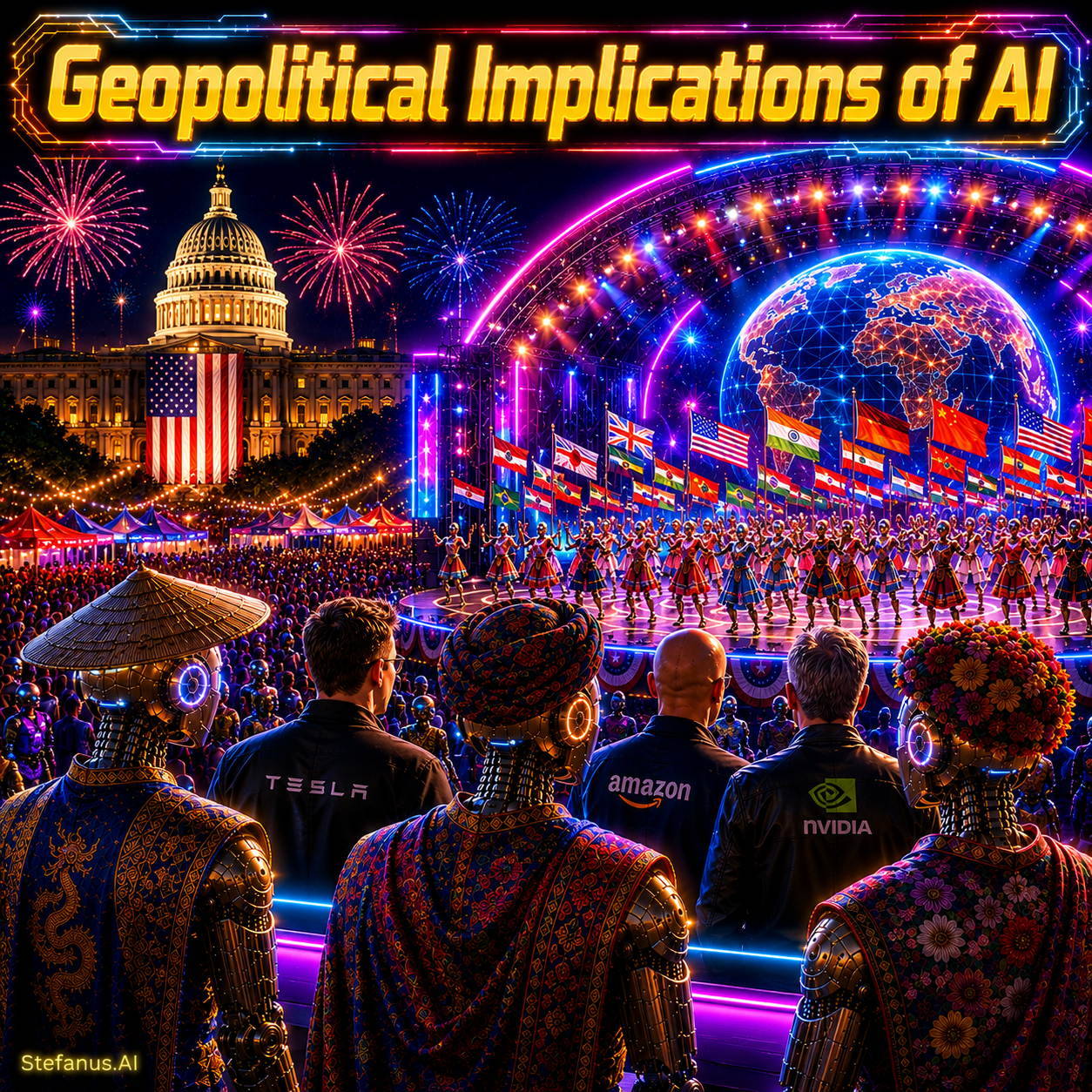

Introduction: Why “Geopolitical Implications of AI”
The title of this paper was chosen with deliberate precision. The word “geopolitical” is not mere ornamentation; it captures the fundamental shift now underway in how nations organize their power, define their sovereignty, and imagine their futures. For most of the twentieth century, geopolitics was primarily understood through the prism of territory, military force, energy resources, and trade. In the twenty-first century, a new and profoundly significant dimension has been added: the control of artificial intelligence systems, the data upon which they train, the chips that power them, the energy that feeds them, and the applications through which they reshape every domain of human civilization.
The phrase “Geopolitical Implications of AI” is therefore both descriptive and analytical. It describes the observable reality that AI has ceased to be merely a commercial technology and has become a matter of national strategy. It is analytical in the sense that it asks the reader to look beyond model benchmarks and quarterly earnings reports and to examine what is at stake when nations become dependent — or alternatively, sovereign — in their intelligence infrastructure.
The paper’s subtitle — “The Rise of Cultural AI Sovereignty and the Five-Layer AI Economy” — situates this geopolitical argument within a specific framework. Cultural AI Sovereignty is the paper’s central conceptual contribution. The Five-Layer AI Economy is the analytical architecture through which the competition for sovereignty is understood. Together, these two concepts form the spine of this paper’s intellectual argument.
The coherence between this introduction and the paper’s conclusion is intentional. The conclusion returns to the question of civilization itself — not merely economic competitiveness or national security, but whether the languages, memories, laws, and moral traditions of diverse human societies will survive in an age when the systems that process, interpret, and generate knowledge are increasingly designed elsewhere, by others, for purposes that may not align with local values. That is the deepest implication of AI for geopolitics, and it is the question this paper is ultimately about.

Section 1: The Rise of Cultural AI Sovereignty
1.1 AI as a New Instrument of National Power
Artificial intelligence is rapidly transitioning from a commercial asset into an instrument of national power. This transformation follows a pattern that students of geopolitics will recognize: technologies that begin in the laboratory eventually reshape the balance of power between states. The printing press reorganized religious authority in Europe. The steam engine determined which nations could industrialize and which could not. Nuclear energy and nuclear weapons redrew the map of great-power competition for an entire century. Artificial intelligence is poised to be the defining technology of the next fifty to one hundred years, and its implications for national power are already becoming legible to those who choose to look.
National power in the age of AI operates across several registers that are distinct from, though related to, the traditional instruments of power. First, AI is infrastructure. Just as electricity was the enabling layer for the industrial economy — the invisible substrate upon which factories, communications, and urban life depended — AI is becoming the enabling layer of the digital and cognitive economy. Decisions about where AI infrastructure is located, who owns it, what legal regime governs it, and whose energy powers it are as strategically important today as decisions about electrical grids were in the 1920s and 1930s.
NVIDIA founder and CEO Jensen Huang stated this plainly at the World Economic Forum Annual Meeting in Davos in January 2026:
“AI is infrastructure. Every country should treat AI like electricity or roads. You should have AI as part of your infrastructure. Develop your AI, continue to refine it and have your national intelligence be part of your ecosystem.” [1] — Jensen Huang, CEO, NVIDIA, Davos, January 2026
Second, AI is a governance tool. Governments around the world are deploying AI systems in public administration, judicial processes, social benefit distribution, and law enforcement. When a government uses a foreign AI system to make administrative decisions affecting its citizens, questions of accountability, transparency, and sovereignty become urgent. Whose interpretive assumptions are embedded in the system? Whose legal tradition defines what counts as a valid evidentiary claim? Whose cultural norms shape what the system treats as normal, anomalous, or threatening?
Third, and most profoundly for the argument of this paper, AI is cultural infrastructure. Language models trained on data from one cultural tradition encode the assumptions, metaphors, historical references, social norms, and epistemic frameworks of that tradition. They are not neutral. Every language model is a compressed representation of the civilization that produced the data on which it was trained. When nations adopt foreign AI systems for education, media, legal interpretation, and government administration, they are, in effect, allowing their citizens to process the world through a cognitive lens built elsewhere.
Fourth, AI is geopolitical influence. Nations that export AI platforms, models, and infrastructure are not merely selling technology; they are embedding their assumptions about what knowledge is, what truth looks like, and what questions are worth asking into the cognitive ecosystems of other societies. This is a form of influence that is more subtle, more pervasive, and in some respects more durable than traditional forms of soft power, precisely because it operates at the level of cognition rather than at the level of persuasion.
1.2 From Digital Sovereignty to Cultural AI Sovereignty
The concept of digital sovereignty has been discussed in policy circles for over a decade, primarily in the context of data protection, cloud infrastructure, and platform regulation. The European Union’s General Data Protection Regulation, enacted in 2018, was in part an assertion of digital sovereignty — a declaration that European citizens’ data should be governed by European law, not by the terms of service agreements of American technology companies. China’s approach to its domestic internet — the so-called Great Firewall — represents a more radical version of the same basic impulse: the assertion that the digital environment in which Chinese citizens live and work should be controlled by Chinese authorities.
Cultural AI Sovereignty is a more specific and more demanding concept. It is not merely about data protection or platform regulation. It is about the ability of a nation to develop and govern AI systems that reflect its own language, history, legal traditions, social norms, cultural values, and strategic interests. The distinction matters because it moves the debate from the regulatory domain to the developmental domain. A country can regulate foreign AI platforms without being able to build its own. Cultural AI Sovereignty requires the capacity to produce, not merely to control.
This paper defines Cultural AI Sovereignty as follows:
Cultural AI Sovereignty is a nation’s ability to develop, govern, and continuously refine artificial intelligence systems that encode and reflect its own language, history, legal traditions, social norms, cultural values, and strategic national interests — such that its citizens, institutions, and government can understand, interpret, and interact with their world through cognitive systems that are authentically their own.
Cultural AI Sovereignty has five core dimensions. The first is language preservation: the development of AI systems that are genuinely fluent in a nation’s languages, including minority and indigenous languages, dialects, and culturally specific registers of meaning that cannot be translated without loss. The second is historical preservation: the ability to train AI systems on a nation’s own historical archive, ensuring that the system’s understanding of causation, identity, and national narrative is rooted in local rather than foreign historiography. The third is educational independence: the capacity to deploy AI in educational settings without subjecting the next generation to a foreign curriculum’s implicit assumptions about what knowledge is valuable and how it should be structured. The fourth is legal autonomy: the ability to use AI in judicial and regulatory settings without importing legal concepts that are foreign to the national legal tradition. The fifth is institutional continuity: the capacity to digitize and systematize administrative processes in ways that preserve rather than dissolve existing institutional cultures and practices.
1.3 Why Nations May Not Want Imported Intelligence
The case for imported AI is easy to understand. The leading AI models — produced primarily by American and, increasingly, Chinese companies — are among the most capable cognitive tools ever built. For most nations, the cost of developing comparable models domestically is prohibitive. Why, then, should a country resist using the best available tool?
The answer lies in what every AI model implicitly carries with it. AI models are not neutral instruments. They are trained on data that originates from specific social, cultural, legal, and institutional environments. The assumptions embedded within these models — about what constitutes a reasonable answer, which sources are authoritative, what historical events are significant, what social arrangements are normal, and which legal principles are self-evident — are not the assumptions of all human civilizations. They are the assumptions of the civilizations whose data predominated in the training corpus.
Consider a concrete example. A large language model trained predominantly on English-language data will understand the phrase “due process” through the lens of Anglo-American legal tradition. When that model is deployed in a country whose legal system is rooted in French civil law, Islamic jurisprudence, or Hindu traditional law, the model’s implicit framework will be in tension with the legal culture it is supposed to serve. This is not a failure of the model; it is an inherent feature of how models encode their training environment.
The differences compound across multiple dimensions. Cultural norms differ in ways that are both subtle and profound: the model’s understanding of appropriate social relationships, family structures, religious observance, and forms of authority will reflect its training culture’s norms. Historical experiences differ: a model trained predominantly on Western historical data will not understand the significance of events that are central to the national identity of nations whose histories were shaped by colonialism, non-Western religious traditions, or geopolitical experiences that received little attention in Western historiography. Political institutions differ: the model’s implicit assumptions about what constitutes legitimate governance, democratic participation, and judicial independence will reflect the political culture of its training data.
The CNAS Sovereign AI Index, published in April 2026, captures this multiplicity of motivations well: [2]
“The drivers of sovereign AI vary widely. For some countries, the imperative is security: protecting sensitive data and ensuring access to advanced capabilities for defense and intelligence. For others, it is the economy. Culture is another driver, with nations seeking AI systems that better reflect local languages and norms. Autonomy also motivates countries that see danger in growing AI dependence on the United States or China.” [2] — CNAS Sovereign AI Index, April 2026
1.4 The Risk of AI Dependency
The language of dependency in economic and political analysis has a long and contested history. Dependency theory, as developed by scholars such as Raúl Prebisch, André Gunder Frank, and Immanuel Wallerstein in the mid-twentieth century, argued that the economic relationships between developed and developing countries were structured to perpetuate inequality: the periphery provided raw materials and cheap labor while the core provided finished goods and capital. This structural arrangement made development in the periphery contingent upon, and subordinate to, the priorities of the core.
AI dependency operates through an analogous logic, but with a contemporary and more deeply penetrating character. When a nation’s education system runs on foreign AI platforms, its students are being cognitively formed by systems whose intellectual assumptions were built in another country. When a nation’s judicial system uses foreign AI tools for legal research and case analysis, its interpretation of its own laws is being filtered through a foreign legal epistemology. When a nation’s government uses foreign AI for administrative decision-making, its institutional processes are being shaped by efficiency metrics and optimization criteria that were designed for a different context.
This paper introduces the term AI Colonialism to describe the most extreme manifestation of AI dependency: a condition in which a nation’s cognitive infrastructure — its systems for producing, organizing, and interpreting knowledge — is controlled by foreign actors whose interests may not align with the nation’s own. The term is deliberately provocative. It is intended to capture the depth of the dependency in question: not merely dependence on a foreign product, but dependence on a foreign cognitive system that shapes what can be thought, said, and understood within a society.
The concept of Algorithmic Influence — the capacity of AI systems to shape the beliefs, behaviors, and decisions of populations at scale — is the mechanism through which AI dependency becomes politically significant. Algorithmic influence operates through recommendation systems that determine what information people encounter, through language models that shape how people formulate questions and interpret answers, through administrative AI that determines who receives benefits and services, and through educational AI that shapes what the next generation considers knowledge. None of these are neutral processes. Each encodes assumptions about value, priority, and truth.
The IMF’s scenario-planning exercise on AI, conducted in December 2025 and published in April 2026, treated AI as a “macro-critical transition rather than a standard technology shock,” noting that the macroeconomic path will be shaped by “the speed and breadth of diffusion and the readiness of institutions and infrastructure to absorb the technology.”[3]
For nations without the institutional and infrastructure readiness to develop their own AI capabilities, the diffusion of foreign AI systems is not merely a technological transition; it is a transformation in the conditions of their sovereignty.
1.5 Why AI Competition Is Different From Previous Technologies
Students of technological history will recognize a recurring pattern: each major general-purpose technology has reorganized the balance of power between states, created new forms of dependency, and generated new forms of resistance. The industrial revolution, the telegraph, the internal combustion engine, electrification, nuclear technology, and the internet all followed versions of this pattern. AI is different in several respects that make its geopolitical implications more profound than those of any previous technology.
First, AI is the first technology that directly augments and, in some respects, substitutes for human cognitive labor. Previous technologies augmented physical labor, extended communications, accelerated transportation, or enhanced destructive capacity. AI is different: it can read, write, reason, plan, advise, and decide. When a nation becomes dependent on foreign AI for these cognitive functions, it is not merely dependent on a foreign machine; it is dependent on a foreign mind — an entity whose reasoning processes, value weightings, and epistemic assumptions were built elsewhere.
Second, AI is pervasive in a way that previous technologies were not. The steam engine was important, but a country without steam engines still had artisans, merchants, soldiers, priests, lawyers, and teachers who could function without it. AI, as it becomes embedded in education, public administration, media, law, commerce, defense, and healthcare, becomes the substrate through which virtually all important cognitive activities are conducted. Dependency on foreign AI is therefore dependency at the most fundamental level of a society’s functioning.
Third, AI systems are not static tools. They learn, update, and change in ways that are often opaque to users. A nation that deploys a foreign AI system in its judicial process does not simply adopt a tool; it adopts a tool that may change its behavior over time in ways that the nation cannot observe, control, or predict. This opacity amplifies the strategic risks of AI dependency in ways that have no parallel in the history of technology adoption.
Henry Kissinger, in his final work, Genesis: Artificial Intelligence, Hope, and the Human Spirit, co-authored with Eric Schmidt and Daniel Huttenlocher and completed in the weeks before his death in November 2023, posed the question that this paper takes as its animating concern:
“What will become of human consciousness if its own explanatory power is surpassed by AI, and societies are no longer able to interpret the world they inhabit in terms that are meaningful to them?” [4] — Henry Kissinger
That question is no longer theoretical. It is the organizing strategic challenge of the next generation of national leaders. For the first time in history, nations may become dependent on foreign intelligence systems that increasingly shape education, public administration, media consumption, legal interpretation, and economic decision-making. This is why AI competition is different, and this is why the concept of Cultural AI Sovereignty is not merely an academic contribution but a practical policy imperative.

Section 2: The Five-Layer AI Economy — The Foundations of AI Sovereignty
2.1 Introducing the Five-Layer AI Economy
The Five-Layer AI Economy is a framework for understanding the full-stack infrastructure upon which artificial intelligence depends. It was presented publicly by Jensen Huang, CEO of NVIDIA, at the World Economic Forum Annual Meeting in Davos on January 21, 2026, where he described AI as a “five-layer cake” — a framework that maps the complete hierarchy of dependencies from the most physical and material to the most cognitive and cultural.
The five layers are, from the foundational base to the uppermost application surface: (1) Energy — the electrical power infrastructure that makes computation possible; (2) Chips — the semiconductor hardware, primarily GPUs and specialized AI accelerators, that performs the mathematical operations underlying AI; (3) Datacenters — the physical facilities, networking infrastructure, and cooling systems that house and connect chips at scale; (4) Models — the trained AI systems themselves, including the datasets, algorithms, and computational processes that produce them; and (5) Applications — the deployments of AI in specific domains such as education, healthcare, law, defense, government, and commerce.
Huang described this architecture explicitly at Davos: [5]
“Jensen Huang said that AI can be divided into five layers: the bottom layer is energy, followed by chips, cloud services, models, and the top layer is applications. Each layer requires real factories, equipment, electricity, and human resources. That is why he told all countries: AI is infrastructure. Every country should build it.” [5] — Jensen Huang at WEF Davos, January 2026
The framework is particularly valuable for understanding sovereignty because it reveals the full depth of the dependency that nations face when they rely on foreign AI systems. A nation that uses a foreign AI model for its education system is not merely dependent on that model; it is dependent on the datacenters that host the model, the chips that power those datacenters, the energy that feeds those chips, and the training data and algorithmic choices that shaped the model’s behavior. True AI sovereignty requires control across all five layers. Partial sovereignty — control of some layers but not others — confers partial independence but leaves strategic vulnerabilities.
2.2 Why AI Sovereignty Requires Full-Stack Development
The concept of Infrastructure Primacy describes the strategic reality that control of lower layers of the AI economy confers leverage over all higher layers. A nation that controls the energy layer but not the chip layer cannot independently operate AI systems when chip supplies are restricted or cut off. A nation that controls chips and datacenters but not models remains cognitively dependent on foreign actors for the actual intelligence that runs on its infrastructure. A nation that develops excellent applications but relies on foreign models for their underlying intelligence is building on a foundation it does not control.
The most powerful illustration of Infrastructure Primacy is the semiconductor export control regime that the United States has constructed since 2022. By restricting the export of advanced AI chips to China, the United States has demonstrated that control of the chip layer — Layer 2 in the Five-Layer framework — gives it leverage over every higher layer of China’s AI economy. China’s ability to train frontier models, operate sovereign datacenters, and deploy AI applications is constrained by its inability to access the most advanced chips. The lesson for every nation is clear: without sovereignty in the foundational layers, sovereignty in the upper layers is precarious.
Deloitte’s 2026 Technology, Media, and Telecom Predictions found that research from the Oxford Internet Institute showed “only 34 countries host any public AI compute; only 24 of those have access to training-level compute; and most rely on cloud or chip infrastructure controlled by a small number of foreign actors.” The same study found that 90 percent of all AI compute is managed by US and Chinese companies. [6]
2.3 Layer One: Energy as the Foundation of Intelligence
Energy is the most fundamental layer of the Five-Layer AI Economy, and it is the layer that most clearly reveals the material constraints on AI sovereignty. The computational demands of modern AI are staggering. Training a large language model can consume as much electricity as a small city uses in a week. Operating a datacenter cluster large enough to serve a national AI ecosystem requires reliable access to gigawatts of continuous power.
According to the International Energy Agency’s April 2026 report Key Questions on Energy and AI, electricity consumption from AI-focused data centres grew by 50 percent in 2025 alone. The IEA projects that electricity consumption from data centres will roughly double from 485 TWh in 2025 to approximately 950 TWh by 2030, with AI-focused data centres tripling their consumption in that period. [7]
IEA Executive Director Fatih Birol captured the strategic significance of this energy dependency:
“There is no AI without energy — and countries that provide secure, affordable and rapid access to electricity will be one step ahead.” [8] — Fatih Birol, Executive Director, International Energy Agency, April 2026
The energy requirements of AI have catalyzed a transformation of the power sector. Nuclear energy is experiencing a remarkable renaissance driven by the specific characteristics that AI datacenters require: continuous, reliable, dense power without the intermittency of renewable sources. The pipeline of conditional offtake agreements between datacenter operators and small modular reactor (SMR) nuclear projects grew from 25 gigawatts at the end of 2024 to 45 gigawatts by mid-2026, according to the IEA.
Major technology companies have committed to specific nuclear arrangements: Amazon secured a 17-year power purchase agreement with Talen Energy for 1.92 GW of electricity from the Susquehanna nuclear plant in Pennsylvania, while Google contracted 500 MW of SMR capacity from Kairos Power, and Amazon separately supported nuclear startup X-Energy. Microsoft has contracted to restart the Three Mile Island reactor in Pennsylvania, rebranded as Crane Clean Energy Center, specifically to power its AI datacenters. [9]
Natural gas remains critical in the near-to-medium term. The IEA projects that natural gas and coal together will meet over 40 percent of the additional electricity demand from data centres until 2030. For nations seeking AI sovereignty, this means that energy policy and AI strategy are inseparable: a country without reliable, affordable, large-scale electricity generation cannot develop sovereign AI infrastructure, regardless of its ambitions in chips, models, or applications.
The concept of Energy Nationalism — the strategic use of domestic energy resources as a foundation for technological sovereignty — is gaining salience in this context. Nations that possess abundant energy resources, whether through nuclear capacity, natural gas reserves, hydroelectric potential, or solar and wind resources, have a structural advantage in the AI sovereignty competition. Those that lack domestic energy resources face a dependency at the most fundamental layer of the AI stack.
2.4 Layer Two: Chips as Strategic Assets
The semiconductor chip is the most strategically contested component of the AI economy. This is not merely because chips are expensive or technologically complex, though they are both. It is because the production of the most advanced AI chips is concentrated in a vanishingly small number of facilities, operated by a handful of companies, located in a very small number of countries, and dependent on an equally concentrated supply chain of specialized equipment, materials, and intellectual property.
NVIDIA dominates the AI accelerator market with a market capitalization that reached $5.4 trillion by May 2026, making it briefly the world’s most valuable company. Its Q1 FY2027 earnings, reported on May 20, 2026, revealed total revenue of $81.62 billion — up 85 percent year-over-year — with datacenter revenue of $75.2 billion, representing 92 percent year-over-year growth driven by the Blackwell 300 architecture. These numbers are not merely impressive financial results; they are a measure of the strategic centrality of NVIDIA’s position in the AI economy.
Jensen Huang stated in the Q1 2026 earnings call: [10]
“The buildout of AI factories — the largest infrastructure expansion in human history — is accelerating at extraordinary speed. Agentic AI has arrived, doing productive work, generating real value, and scaling rapidly across companies and industries.” [10] — Jensen Huang, NVIDIA Earnings Call, May 20, 2026
The geopolitical significance of chip concentration is amplified by the role of TSMC, Taiwan Semiconductor Manufacturing Company, which produces over 90 percent of the world’s most advanced chips. TSMC’s dependence on ASML’s extreme ultraviolet lithography machines — technology for which ASML is the sole global supplier — creates a supply chain with multiple single points of failure. The United States has exploited this concentration by restricting the export of advanced chips and chip-making equipment to China, a policy that has significantly constrained China’s AI development but also elevated the strategic importance of Taiwan beyond its already considerable geopolitical significance.
ASML guided 2026 revenue of approximately €33 billion with a €38.8 billion backlog, while Dutch regulators imposed licensing requirements on the repair of advanced scanners in China. Meanwhile, in a guarded program in Shenzhen, Chinese researchers have assembled a prototype EUV machine in an effort to achieve domestic chip sovereignty — a project whose commercialization remains years distant but whose strategic intent is unambiguous. [11]
The concept of Compute Nationalism describes the growing tendency of governments to treat advanced semiconductor capacity as a strategic national asset, subject to the same logic of national security that previously applied to nuclear technology or advanced military systems. The United States, through its Bureau of Industry and Security, has created a three-tier global licensing framework that effectively determines which nations are granted access to the most advanced AI chips and which are not. This framework is, in effect, a global hierarchy of AI capability enforced through export control.
For nations seeking AI sovereignty, the chip layer presents the most formidable barrier. The capital requirements for semiconductor fabrication at the frontier are measured in tens of billions of dollars per facility, and the engineering expertise required spans decades of accumulated institutional knowledge. Only a handful of nations — the United States, Taiwan, South Korea, Japan, and the Netherlands, through their respective roles in the semiconductor supply chain — possess significant positions in the global chip economy. All other nations are, to varying degrees, dependent on this concentrated supply chain for the chips that AI requires.
2.5 Infrastructure as National Power: Compute Nationalism, Capacity Nationalism, and Energy Nationalism
The convergence of energy policy and semiconductor strategy with national security planning represents a new form of industrial statecraft that this paper terms Infrastructure Nationalism. Infrastructure Nationalism is the organizing principle by which nations treat AI infrastructure — energy, chips, and datacenters — as assets of national power subject to the same strategic logic as defense procurement, energy reserves, and critical financial infrastructure.
Three sub-concepts are useful for understanding the dimensions of Infrastructure Nationalism. Compute Nationalism describes the practice of states restricting access to advanced computing capacity through export controls, investment screening, and domestic procurement requirements. The United States has been the most aggressive practitioner of Compute Nationalism, but the logic is spreading: India, the European Union, and Saudi Arabia have all articulated policies designed to ensure domestic access to computing capacity. Capacity Nationalism describes the drive to build sovereign datacenter capacity — to ensure that the physical infrastructure upon which national AI systems depend is located within national territory, governed by national law, and operated by domestically controlled entities. Energy Nationalism, as discussed above, describes the strategic use of energy resources as a foundation for AI sovereignty.
The key strategic argument follows directly: without energy and chips, there can be no meaningful AI sovereignty. Nations that cannot power and equip their own AI infrastructure remain dependent on foreign actors at the most fundamental layers of the AI economy, regardless of their ambitions at the model and application layers.

Section 3: Datacenters and Compute — The New Geography of Power
3.1 Layer Three: Datacenters as Strategic Infrastructure
The datacenter — once considered a mundane technical facility, the digital equivalent of a warehouse — has become one of the most strategically significant physical assets of the twenty-first century. The transformation is a consequence of scale. A single modern AI datacenter consumes hundreds of megawatts of electricity, requires cooling systems of extraordinary sophistication, and houses computing hardware worth billions of dollars. The aggregation of multiple such facilities into what are now called AI factories — or, in the most ambitious projects, gigawatt campuses — represents a concentration of productive capacity with no real historical precedent outside of wartime industrial mobilization.
Jensen Huang coined the term “AI factory” to describe this new class of infrastructure. At GTC 2026, held in San Jose in March 2026, he explicitly reframed NVIDIA’s identity from a chip company to an AI factory infrastructure company. The AI factory, in Huang’s formulation, is a facility that consumes energy and chips and produces tokens — the fundamental unit of AI output. His revenue formula for the AI economy — Revenue = (Tokens per Watt) × (Available Gigawatts) — captures the industrial logic of this new geography of power: the nations and companies that control the most gigawatts and achieve the best energy efficiency will dominate the production of intelligence.
At GTC 2026, Huang described the new industrial logic: [12]
“We transformed from a chip company to an AI factory or AI infrastructure company. And now, we’re building entire AI factories. There’s so much power that is squandered in these AI factories. We need to make sure AI factories come together and are designed in the best possible way.” [12] — Jensen Huang, GTC 2026, March 2026
3.2 Q1 2026 Earnings and the Infrastructure Race
The Q1 2026 earnings season for the major hyperscalers produced numbers that, taken together, constitute perhaps the most dramatic demonstration of private capital mobilization in the history of commercial technology. The combined capital expenditure commitments of Microsoft, Alphabet, Meta, Amazon, and Apple for 2026 reached between $650 billion and $725 billion — a figure larger than the gross domestic product of most European nations and, as the IEA noted, exceeding global investment in oil and natural gas production.
NVIDIA reported total Q1 FY2027 revenue of $81.62 billion, beating analyst estimates of $78.86 billion, with datacenter revenue of $75.2 billion — up 92 percent year-over-year, driven by the ramp of the Blackwell 300 architecture. Net income reached $58.32 billion, more than triple the $18.78 billion reported in the same period of the prior year. [13]
Microsoft reported Q1 2026 revenue of $82.9 billion, up 18 percent year-on-year, with Azure cloud growth of 40 percent — exceeding analyst consensus estimates of 38.8 percent. Microsoft’s annualized AI revenue exceeded $37 billion, representing 123 percent year-over-year growth. Commercial remaining performance obligations grew 99 percent to $627 billion, signaling the scale of contracted future AI infrastructure spending.
Alphabet delivered Q1 2026 revenue of $109.9 billion, beating consensus by nearly $3 billion. Google Cloud grew 63 percent year-on-year to $20.02 billion, accelerating sharply from 48 percent growth in Q4 2025. Alphabet updated its 2026 capex guidance to between $180 billion and $190 billion, with CFO Anat Ashkenazi stating that 2027 capex is expected to “significantly increase” compared to 2026. CEO Sundar Pichai acknowledged directly on the earnings call that the company is “compute constrained in the near term” — a phrase that reveals the gap between demand and the capacity to build fast enough.
Meta reported Q1 2026 revenue of $56.31 billion, up 33 percent year-on-year — its fastest quarterly growth since 2021 — and raised its full-year 2026 capex guidance to between $125 billion and $145 billion. Amazon’s AWS showed the strongest growth rate since 2022, and Amazon’s total 2026 capex commitment reached approximately $200 billion.
As the financial analysis service The Next Web summarized: “The combined 2026 capex commitment across the five hyperscalers — Microsoft, Alphabet, Meta, Amazon, and Apple — is now on track to exceed $650 billion… That figure is larger than the GDP of most European countries.” [14]
The strategic significance of these numbers extends beyond corporate finance. They represent the crystallization of a new industrial geography. The hyperscalers’ datacenter investments are not evenly distributed across the globe; they are concentrated in locations with abundant energy, favorable regulatory environments, skilled labor, and — increasingly — proximity to sovereign AI customers. The geography of this investment is, in effect, a map of where the intelligence economy will be concentrated in the decade ahead.
3.3 National Compute Strategies
The recognition that compute capacity is a strategic asset has driven governments on every continent to develop national compute strategies. The approaches vary widely, but the underlying logic is consistent: nations that lack sovereign compute capacity are vulnerable to disruptions in foreign supply, are subject to the pricing and terms of foreign providers, and may find that sensitive national data is processed on infrastructure they do not control.
The United States has pursued compute sovereignty primarily through the CHIPS and Science Act, enacted in 2022, which committed $52.7 billion to domestic semiconductor manufacturing and research, and through the Stargate project announced in January 2025, a $500 billion commitment by OpenAI, SoftBank, and Oracle to build AI infrastructure across the United States. The American approach is characterized by a partnership between public investment and private capital, with the government providing incentives and the private sector providing operational capacity.
China’s approach is more centralized. Its Made in China 2025 plan and subsequent AI development strategies have directed state capital into domestic semiconductor manufacturing, AI research, and datacenter infrastructure. China’s constraint, as discussed above, is the chip layer: export controls have significantly restricted its access to the most advanced AI accelerators, forcing it to develop domestically or rely on Chinese alternatives such as Huawei’s Ascend chips, which lag NVIDIA’s Blackwell architecture by multiple generations.
India hosted the India AI Impact Summit 2026 in New Delhi under Prime Minister Narendra Modi, anchored around “impact”: equitable access, climate resilience, and inclusive growth. As the Council on Foreign Relations observed, “for countries like India, the imminent AI risk is not that the technology will become too powerful but that its near-term benefits will be captured by a narrow band of wealthy nations.” [15]
Japan, South Korea, Singapore, Saudi Arabia, and the UAE have all made substantial commitments to national AI infrastructure. Saudi Arabia and NVIDIA announced partnerships in May 2025 to build AI factories within the Kingdom during President Trump’s state visit, with Huang declaring: “AI, like electricity and the internet, is essential infrastructure for every nation.” Saudi Arabia’s Vision 2030 has embraced AI sovereignty as a central strategic objective, with the state-backed HUMAIN initiative developing Arabic-language models and sovereign compute capacity.
Deloitte projected that by 2026, over $100 billion would be committed to building sovereign AI compute globally, and that by 2030, the share of AI compute managed by companies outside the United States and China would likely double from its current 10 percent of global capacity. [6]
The European Union launched its InvestAI initiative in February 2025 at the Paris AI Action Summit, explicitly framed as a European equivalent to the American Stargate project. European Commission President Ursula von der Leyen emphasized her desire for “Europe to become one of the leading continents in the field of artificial intelligence” — a declaration that acknowledged the EU’s current relative weakness in AI infrastructure while signaling political commitment to closing the gap.
3.4 Compute as a Geopolitical Asset: Datacenter Mercantilism and Compute Hoarding
The accumulation of compute capacity by nations and hyperscalers has produced dynamics that this paper terms Datacenter Mercantilism: the strategic behavior of actors who seek to accumulate datacenter capacity not merely for immediate productive use but as a reserve of future strategic power, analogous to the gold reserves of the mercantilist era or the oil reserves of the twentieth century. The hyperscalers’ willingness to commit hundreds of billions of dollars to datacenter construction well ahead of demonstrated revenue demand reflects, in part, a Mercantilist logic: the actors who build the infrastructure will control the platforms, and the actors who control the platforms will collect the rents of the AI economy.
Compute Hoarding describes a related but distinct phenomenon: the tendency of states and corporations to accumulate chip inventories and datacenter capacity beyond their immediate needs, motivated by the fear that future access may be restricted by geopolitical events, supply disruptions, or policy changes. The aggressive chip procurement by hyperscalers, sovereign wealth funds, and national AI programs reflects in part a rational response to the demonstrated willingness of the United States government to restrict chip access as a geopolitical tool.
The CNAS Sovereign AI Index found that “infrastructure projects have accelerated sharply” since mid-2024, with 23 new sovereign AI infrastructure projects worldwide in the last quarter of 2025 alone. Investment has been “heavily concentrated in two regions — the Middle East and East Asia — which together account for more than 80 percent of all tracked and publicly disclosed sovereign AI investment worldwide.” [2]
3.5 The Emergence of Compute Sovereignty
The emergence of compute sovereignty as a geopolitical concept represents the maturation of a strategic understanding that had been developing for several years. The argument is straightforward and compelling: just as nations once competed for oil reserves and industrial capacity as the material foundations of national power, twenty-first-century nations will compete for compute capacity as the foundation of cognitive power.
The analogy to oil is instructive but imperfect. Oil is a natural resource with a fixed geographical distribution; compute is a manufactured resource that can in principle be produced anywhere with sufficient energy, capital, and engineering expertise. Oil produces energy, a general-purpose input into physical production; compute produces intelligence, a general-purpose input into cognitive production. The nation that controls oil can power factories; the nation that controls compute can power minds. The latter is, in the long run, the more consequential form of power.
The strategic lesson for policymakers is that compute sovereignty is not a luxury for wealthy nations alone. For any nation that aspires to Cultural AI Sovereignty — the ability to develop and govern AI systems that reflect its own values, language, and strategic interests — domestic compute capacity is a prerequisite, not an optional enhancement. Without compute, there can be no training of domestic models. Without domestic models, the cultural layer of AI sovereignty remains empty. The infrastructure determines the culture.

Section 4: Models And Applications — Preserving National Identity in the AI Age
4.1 Layer Four: Sovereign AI Models
The model layer is where the concept of Cultural AI Sovereignty becomes most concrete and most personal. A sovereign AI model is not merely a model that runs on domestic infrastructure; it is a model that was trained on data that reflects the nation’s own language, history, values, legal traditions, and cultural knowledge. It is a model that understands the nation’s idioms, can navigate its institutional landscape, and can engage with its citizens as an interlocutor who shares, at least in part, their cognitive and cultural formation.
The development of local-language models has become a priority for dozens of nations. Japan’s NEC, Fujitsu, and academic consortia have developed Japanese-language models trained on domestic corpora. South Korea’s NAVER developed HyperCLOVA X, a large language model trained on Korean-language data that is specifically designed to understand Korean cultural references, historical contexts, and social norms. India’s BharatGPT initiative, supported by the government and several technology companies, aims to develop AI models in the fourteen major Indian languages. Indonesia has initiated a Bahasa Indonesia national AI model project. Saudi Arabia’s Aramco and SDAIA have developed Arabic-language models as part of the kingdom’s sovereign AI strategy.
The significance of national datasets extends beyond language. National datasets include legal archives — court decisions, legislative history, regulatory rulings — that encode the specific evolution of a nation’s legal tradition. They include historical archives — newspapers, government records, academic publications — that encode a nation’s understanding of its own past. They include cultural archives — literature, cinema, music, religious texts — that encode the aesthetic and moral sensibilities of a civilization. A model trained on these national datasets will understand, in a way that foreign models cannot, what a particular legal phrase means in its specific jurisdictional context, what a historical reference implies about national identity, and what a cultural allusion communicates about shared values.
The World Economic Forum, in its April 2026 article “The Myth of AI Sovereignty,” noted that the UAE and Singapore “have focused on culturally and linguistically optimized large language models,” while Japan “has built on decades of precision” and manufacturing culture to develop AI systems that “prioritize high-velocity, customized production over volume.” [16]
4.2 Layer Five: Applications and National Development
The application layer is where AI sovereignty becomes visible to citizens. It is the layer at which AI systems are deployed in the specific domains of social life: education, healthcare, law, defense, scientific research, and government administration. And it is the layer at which the question of whose values, whose assumptions, and whose priorities are embedded in AI systems has the most direct consequences for citizens’ lives.
In education, AI applications shape not only how students learn but what they learn: what counts as knowledge, whose history is told, whose languages are taught, and what values are implicitly endorsed. An AI tutoring system built on foreign models may teach children about a world that does not reflect their own society’s values, history, or aspirations. In healthcare, AI diagnostic systems trained on data from populations with different genetic profiles, dietary habits, and disease prevalences may systematically underperform for populations not represented in their training data. In law, AI legal research tools trained on foreign legal databases may misinterpret domestic legal concepts or fail to surface domestically relevant precedents.
Defense applications are the most sensitive dimension of the application layer. AI systems for military intelligence, autonomous weapons development, logistics optimization, and strategic planning are among the most high-stakes applications of AI sovereignty, and they are the applications about which no nation can afford foreign dependency. The use of a foreign AI system for defense applications would mean that a nation’s most sensitive operational planning was filtered through a cognitive system whose design and governance were controlled by another actor — an obviously unacceptable situation from a national security perspective.
Scientific research is a less obvious but equally important domain. AI systems for drug discovery, materials science, climate modeling, and agricultural optimization are becoming central to national research productivity. A nation whose scientific community depends entirely on foreign AI platforms for fundamental research is dependent on foreign actors for the cognitive tools of its own scientific advancement.
4.3 AI and Cultural Preservation
One of the most profound and least-discussed dimensions of Cultural AI Sovereignty is the role that AI can play in the preservation and revitalization of cultural heritage. The world’s linguistic diversity is under severe pressure: UNESCO estimates that approximately half of the world’s seven thousand languages are endangered, with many having fewer than a thousand speakers. AI systems trained on these languages could preserve them, create learning tools for new speakers, and ensure that the knowledge encoded in these languages is not lost when the last native speakers pass away.
The same logic applies to historical narratives. Every civilization has a history that it understands from the inside — a narrative in which its own experiences of triumph, suffering, resistance, and transformation are central rather than peripheral. Foreign AI systems trained on data that treats these experiences as footnotes to someone else’s history will consistently reproduce a world in which some civilizations are at the center and others are at the margin. Sovereign AI systems trained on domestic historical data can, at least in principle, offer a different relationship to national memory.
Indigenous knowledge systems represent a particularly urgent case. The accumulated ecological, agricultural, medicinal, and social knowledge of indigenous peoples has been systematically undervalued and underrepresented in global AI training data. AI systems developed within indigenous communities and trained on indigenous knowledge sources could not only preserve this knowledge but potentially make it more accessible and applicable to contemporary challenges, including climate adaptation, biodiversity conservation, and community health.
Religious traditions and their textual, interpretive, and institutional dimensions represent another domain in which cultural specificity matters deeply. AI systems for religious education, legal interpretation (as in the case of Islamic jurisprudence or Talmudic scholarship), and interfaith dialogue need to be trained on the specific corpora, interpretive traditions, and institutional contexts of the relevant religious communities. A generic AI system cannot navigate the specific hermeneutic traditions of different faiths; a sovereign AI system, trained within the religious community and on its own textual heritage, has at least the possibility of doing so.
4.4 The Emergence of National AI Ecosystems
The cumulative effect of investments in sovereign compute, domestic models, and culturally specific applications is the emergence of what this paper terms national AI ecosystems: integrated environments in which the full stack of AI capability — from energy and chips through datacenters and models to applications — is developed, governed, and deployed within a framework of national strategic oversight.
Japan has moved furthest toward a coherent national AI ecosystem among the tier-two AI powers. Its combination of domestic chip development (through Rapidus, the government-backed semiconductor initiative targeting 2nm chips by 2027), sovereign datacenter investment, Japanese-language model development, and AI application deployment in manufacturing, healthcare, and government administration constitutes the most complete ecosystem outside the United States and China.
South Korea’s ecosystem is anchored by Samsung and SK Hynix in chips (particularly in High Bandwidth Memory, the memory technology most critical for AI accelerators), NAVER and Kakao in model development, and strong government investment in AI applications for healthcare and smart manufacturing. Taiwan’s ecosystem is dominated by its extraordinary position in chip fabrication through TSMC, though it remains dependent on foreign models and applications.
India’s national AI ecosystem is at an earlier stage but is developing rapidly. The India AI Impact Summit 2026, hosted by Prime Minister Modi in New Delhi, focused on equitable access and inclusive development, reflecting India’s strategic calculation that AI must serve domestic development priorities rather than simply replicating foreign deployment patterns. India’s advantage — its enormous and linguistically diverse population, its rapidly developing tech sector, and its pre-existing digital infrastructure through the Aadhaar identity system and UPI payment platform — could enable rapid development of a genuinely differentiated national ecosystem if complemented by sovereign compute and model capacity.
Saudi Arabia and the UAE represent the most ambitious cases among the sovereign AI seekers. Both have made extraordinary capital commitments to national AI infrastructure. Saudi Arabia’s HUMAIN initiative, announced in 2025 and backed by the Public Investment Fund, aims to develop a full-stack sovereign AI capability, including dedicated datacenter campuses, Arabic-language frontier models, and AI applications across education, healthcare, and government. The UAE’s G42 and the Falcon model series represent a comparable ambition for a smaller but wealthier state. [17]
4.5 Cultural AI Sovereignty as National Strategy
The emergence of national AI ecosystems reflects a strategic recognition that has become widespread among national leaders: AI systems that understand not only a nation’s language but also its history, values, institutions, and societal priorities represent a form of cognitive and cultural independence that no other technology has made possible or necessary. Every previous general-purpose technology was, in the important sense, culturally neutral: a steam engine does not encode cultural assumptions, and a power grid does not reflect historical narratives. AI systems are different. They encode cognitive processes, and cognitive processes are necessarily cultural.
The strategic implication is clear: nations that succeed in developing AI systems that are genuinely reflective of their own cultural and institutional contexts will possess advantages in education, governance, social cohesion, and national identity that nations dependent on foreign AI systems will lack. This is not merely a cultural observation; it is a strategic assessment. A government that can communicate with its citizens through AI systems that understand the citizens’ cultural context will govern more effectively. An educational system that deploys AI tutors that understand the local curriculum, cultural references, and historical context will educate more effectively. A judicial system that uses AI tools trained on domestic legal tradition will interpret the law more faithfully.

Section 5: The Emerging World Order of AI Nations
5.1 The New Hierarchy of AI Nations
The emergence of AI as a dimension of national power is producing a new international hierarchy. Like all hierarchies of power, it is not perfectly stable or permanently fixed; nations can rise and fall within it, and the specific positions within it are contested. But its broad outlines are becoming legible, and they reflect the logic of the Five-Layer AI Economy: nations that control more layers of the AI economy occupy higher positions in the new hierarchy.
At the apex of the hierarchy are the AI Superpowers. Currently, only two nations qualify for this designation: the United States and China. The United States leads in model capability, chip design and manufacture, application development, and the mobilization of private capital for AI infrastructure. China leads in AI patent volume (approaching 70 percent of global AI patents), in the deployment of AI for domestic governance and surveillance, and in the development of open-source models designed to capture international market share. Both nations are pursuing full-stack AI sovereignty across all five layers, though both face significant constraints in specific layers — the United States in rare earth minerals and in certain manufacturing domains; China in advanced chip access.
The second tier comprises the AI Infrastructure Powers: nations that hold significant positions in one or more of the five layers but have not yet achieved comprehensive AI sovereignty. Japan controls significant capacity in chip manufacturing equipment and materials and is rapidly developing its datacenter and model capabilities. South Korea, through Samsung and SK Hynix, controls the production of High Bandwidth Memory chips that are critical for AI accelerators, and through NAVER maintains a significant position in Korean-language model development. Taiwan, through TSMC, holds the single most important position in advanced chip fabrication. Germany and France, within the European Union framework, possess strong positions in AI applications and governance but remain dependent on American and Asian infrastructure for chips and compute.
The third tier comprises the AI Sovereignty Seekers: nations that have articulated strategic ambitions for AI sovereignty and are making significant investments, but that lack the comprehensive capabilities of the first two tiers. India, Indonesia, Brazil, Saudi Arabia, the UAE, and others fall into this category. Their trajectories will be determined by the strategic choices they make about which layers of the Five-Layer economy to prioritize, which alliances to forge, and how to manage the tension between immediate deployment of foreign AI systems and the longer-term investment in sovereign capability.
The new “Pax Silica” framework, signed in Washington in December 2025 by nine nations including the United States, United Kingdom, Japan, South Korea, Singapore, the Netherlands, Israel, the UAE, and Australia — and subsequently joined by Sweden in March 2026 and India in February 2026 — formalized the emerging alliance structure around AI. As GIS Reports described it: “The framework formalizes what had previously been implicit: access to AI infrastructure is conditional on political alignment. Chips, computing power and frontier models are strategic assets managed through alliance structures rather than open markets.” [18]
5.2 Competing Models of AI Governance
The world order of AI nations is not merely a hierarchy of capability; it is also a competition of governance models. Different nations have articulated fundamentally different visions of how AI should be developed, deployed, and regulated, and these visions reflect deeper differences in political philosophy, institutional design, and civilizational values.
The American AI Model is characterized by market primacy, innovation-first deregulation, and the use of allied networks to maintain technological leadership. The Trump administration’s 2025 AI policy framework, as described by Vice President JD Vance at the Paris AI Summit, emphasized laissez-faire regulation designed to accelerate innovation and minimize red tape, combined with strong export controls to maintain American AI superiority relative to strategic competitors. The American model assumes that the private sector, driven by competitive incentives, will produce the best AI systems, and that the government’s role is to create conditions for private innovation while restricting adversaries’ access to the technology.
The Atlantic Council’s 2026 geopolitics analysis noted that the US “pushes a rights- and risk-based regulatory model, while the United States favors voluntary standards to preserve innovation and security flexibility.” The result across major democracies is a convergence on scientific assessment and transparency norms while avoiding “binding limits on high-risk AI uses such as autonomous weapons, mass surveillance, or information manipulation.” [19]
The Chinese AI Model is characterized by state direction of AI development, integration of AI with governance and security functions, and a public diplomacy posture of “inclusive cooperation” combined with the actual practice of state control over data and AI deployment. China’s Global Artificial Intelligence Governance Initiative (GAGI), unveiled in July 2025, called for inclusive global rulemaking and equitable access to AI benefits — language designed to appeal to developing nations and position China as a champion of the Global South, even as China’s domestic AI governance is among the most state-controlled in the world.
The European AI Model prioritizes human rights, democratic accountability, and risk management. The EU’s AI Act, the world’s first comprehensive AI regulation, establishes a risk-based framework that categorizes AI applications by their potential for harm and imposes proportionate regulatory requirements. The EU’s approach reflects its historical commitment to regulatory governance as a form of strategic leadership — the “Brussels Effect” by which EU standards become de facto global standards through market power. Its InvestAI initiative represents a complementary effort to develop European AI infrastructure as a foundation for regulatory sovereignty.
The Sovereign National AI Model describes the approach of nations outside these three major governance architectures that are developing their own frameworks, often combining elements of the American, Chinese, and European models while adapting to their specific institutional contexts, development priorities, and cultural values. India’s focus on equitable access and inclusive development, Saudi Arabia’s emphasis on Islamic values and Arabic-language capability, and Indonesia’s insistence on Bahasa Indonesia AI systems represent different instantiations of the sovereign national model.
5.3 The Future of Cultural AI Sovereignty
The future of Cultural AI Sovereignty will be shaped by the interaction of several forces: the continuing concentration of AI capability in a small number of leading nations and companies, the increasing accessibility of open-source models that lower the barriers to entry for national AI development, the growing recognition among national leaders of the strategic importance of AI sovereignty, and the structural constraints — in energy, chips, and capital — that limit what most nations can realistically achieve.
Several scenarios for the future trajectory of Cultural AI Sovereignty are worth considering. In the first scenario, full national model development, a significant number of nations succeed in developing genuinely sovereign AI models trained on their own data and reflecting their own cultural and institutional contexts. This scenario is most realistic for large nations with significant populations, strong educational systems, and strategic determination — India, Brazil, Indonesia, and the larger Middle Eastern states are the most plausible candidates.
In the second scenario, regional AI alliances, nations pool their resources to develop shared AI infrastructure and models within regional frameworks. The European Union is already pursuing this model, and similar alliances could emerge in Southeast Asia, the Gulf Cooperation Council, and the African Union. Regional alliances offer the advantages of scale while preserving more cultural sovereignty than full dependence on US or Chinese models.
In the third scenario, managed dependency, most nations conclude that the cost of full AI sovereignty is too high and choose instead to negotiate the terms of their dependence on foreign AI systems, seeking contractual guarantees of data security, customization for local languages and contexts, and regulatory oversight. This scenario is likely to be the most common among smaller and less wealthy nations.
In the fourth scenario, hybrid strategies, nations pursue partial sovereignty across specific layers or domains while accepting dependency in others. A nation might develop sovereign AI models for education and justice while relying on foreign AI platforms for commercial applications. It might build domestic datacenter capacity for sensitive government functions while using foreign cloud providers for less sensitive workloads. This scenario is the most realistic for the majority of nations in the AI Sovereignty Seekers tier.
5.4 Strategic Lessons for Policymakers
The analysis in this paper yields a set of strategic lessons for national policymakers seeking to navigate the competition for Cultural AI Sovereignty.
Invest strategically in energy infrastructure. The energy layer is the foundation of the entire Five-Layer AI Economy. Nations that lack reliable, affordable, large-scale electricity generation cannot develop sovereign AI infrastructure. Strategic investment in nuclear capacity (including SMRs), renewable energy, and grid reliability is a prerequisite for AI sovereignty, not a separate policy domain.
Engage proactively in the global chip supply chain. Very few nations can aspire to independent chip fabrication at the frontier, but all nations can develop strategic relationships with the nations and companies that produce advanced chips. Bilateral agreements, alliance memberships, and domestic chip packaging and assembly capacity can reduce vulnerability to supply disruptions without requiring the full investment of a domestic fabrication program.
Build sovereign compute capacity for sensitive domains. Every nation should have at minimum the datacenter capacity to train and operate AI models for its most sensitive government and defense functions. This does not require frontier hardware; it requires sufficient domestic capacity to ensure that no foreign actor has administrative access to the infrastructure supporting national security AI applications.
Develop national AI datasets as strategic assets. The data layer — the national archives, legal corpora, scientific databases, cultural collections, and social records that constitute a nation’s distinctive intellectual heritage — is the raw material of sovereign AI models. Systematic digitization and curation of these national datasets is a high-return investment for any nation aspiring to Cultural AI Sovereignty, and it can be initiated immediately, without waiting for chip or compute capacity.
Support local-language model development through targeted public investment. Few nations will be able to train frontier models independently, but many can develop competitive models for their specific languages, legal systems, and cultural contexts. Targeted public investment in academic AI research, national language model initiatives, and public-private partnerships for model development can yield sovereign cognitive capacity at a fraction of the cost of full-stack AI development.
Encourage domestic AI application ecosystems. The application layer is often the most accessible entry point for national AI strategies, and it is the layer with the most direct impact on citizens’ lives. Public procurement policies, regulatory frameworks that favor domestically developed applications for sensitive functions, and investment in AI application development in education, healthcare, and government can build a domestic AI ecosystem that generates the data, expertise, and institutional capacity needed for deeper sovereignty.
Stanford Professor Fei-Fei Li, co-director of Stanford’s Human-Centered AI Institute, has framed the fundamental challenge of AI agency in terms directly relevant to national sovereignty: [20]
“I do not think we should give up our agency. If we give up to not just AI, if we give up to authoritarianism, if we give up to the internet in a harmful way, we would lose our agency. And AI is the same.” [20] — Prof. Fei-Fei Li, Stanford University, PBS Firing Line, 2025
National AI strategy is, at its core, a strategy for preserving agency — the capacity of nations and their citizens to shape their own futures, interpret their own pasts, and make their own decisions through cognitive systems that are authentically their own.
5.5 The Five-Layer Path to AI Sovereignty
The synthesis of this paper’s argument is most clearly expressed as a sequential and interdependent logic: Energy → Chips → Datacenters → Models → Applications. This is not merely a technical architecture; it is a strategic roadmap. Every nation’s AI sovereignty journey begins with energy, proceeds through chips and compute, develops through model capability, and culminates in application deployments that serve citizens in their own languages, cultures, and legal traditions.
The most important strategic insight of the Five-Layer framework is that sovereignty is not a binary condition but a continuous variable. A nation that controls more layers of the Five-Layer economy is more sovereign than one that controls fewer, and a nation that controls the foundational layers is more securely sovereign than one that controls only the application layer, because foundational sovereignty is harder to disrupt or capture.
The countries that successfully integrate all five layers into a coherent national strategy — aligning energy policy with chip access, datacenter investment with model development, and sovereign infrastructure with culturally specific applications — will possess the greatest technological independence, economic resilience, national security, and cultural autonomy in the emerging intelligent world. This integration is not primarily a technical challenge; it is a political and strategic challenge. It requires national leaders who understand the full depth of the AI sovereignty question and who are willing to make the sustained, multi-decade investments that full-stack sovereignty demands.

Section 6: What Have We Learned? Implications For Corporations, Societies, and the World
6.1 How Corporations Should Prepare
The emergence of Cultural AI Sovereignty as a strategic imperative creates both challenges and opportunities for corporations operating in the global AI economy. The fundamental challenge is that the era of frictionless global AI deployment — in which a model developed in Silicon Valley could be deployed in Lagos, Jakarta, and Riyadh without meaningful localization — is ending. Nations are asserting their right to govern AI systems that operate within their territories, and they are increasingly developing the regulatory and technical tools to enforce that governance.
Corporations that develop or deploy AI systems globally must prepare for a world of AI localization at a depth that goes beyond language translation and surface-level cultural customization. True localization for AI sovereignty means training models on local legal corpora, historical archives, and cultural datasets; establishing relationships with domestic partners who can provide data governance oversight acceptable to national regulators; and potentially operating sovereign instances of their AI systems on domestically controlled infrastructure. This is more expensive, more complex, and slower than global deployment, but it is the operational reality of the Cultural AI Sovereignty era.
The concept of quasi-sovereign AI — models and infrastructure designed to meet sovereign requirements while remaining connected to global technology ecosystems — is emerging as a practical solution. Amazon’s European Sovereign Cloud, governed by a European board and operated exclusively on European soil, is an early example. Similar arrangements are developing in India, Japan, the Gulf states, and elsewhere. Corporations that invest early in developing quasi-sovereign solutions for key markets will have structural advantages as national regulatory requirements tighten.
Corporations in the energy, construction, and infrastructure sectors face a different but equally significant strategic opportunity. The datacenter buildout driven by AI infrastructure demand represents one of the largest concentrated industrial investments in modern history. The IEA projects that capital expenditure on AI-focused datacenters will jump by approximately 75 percent in 2026 relative to 2025. The demand for electrical power, cooling systems, construction services, networking equipment, and real estate creates opportunities across every layer of the infrastructure stack for companies that position themselves to serve this demand.
For semiconductor companies, the fragmentation of the global chip supply chain into geopolitically aligned blocs creates both risks and opportunities. Companies that supply equipment, materials, or services to both blocs face increasing pressure to choose sides; those that align early with the emerging alliance structures will benefit from preferential access to capital, customers, and regulatory support within their aligned bloc. The concept of “trusted supplier” status — formalized through the Pax Silica framework and analogous alliance structures — will become an increasingly important commercial differentiator in the chip industry.
6.2 How Society Should Prepare
The implications of Cultural AI Sovereignty for society extend far beyond the policy domain. They reach into the most fundamental questions of cultural identity, democratic governance, education, and what it means for citizens to live in a society whose cognitive infrastructure is genuinely their own.
Educational systems must adapt to the Cultural AI Sovereignty reality in at least three respects. First, they must produce citizens who are AI-literate in a deep sense: not merely able to use AI tools, but able to understand how AI systems encode the assumptions, values, and priorities of their training cultures, and therefore able to evaluate critically the AI systems they interact with. This is a new form of critical literacy, as important in the age of AI as the ability to read and write was in the age of print.
Second, educational systems must invest in developing the technical talent needed for national AI development. Cultural AI Sovereignty is ultimately a human capital challenge: it requires mathematicians, computer scientists, data engineers, linguists, legal scholars, and domain experts who can work together to build AI systems that reflect national values and serve national needs. Nations that underinvest in STEM education and in the specific human capital of AI development will find that their AI sovereignty aspirations exceed their implementation capacity.
Third, democratic societies must develop the governance mechanisms needed to ensure that national AI systems are accountable to citizens rather than to state security apparatuses. The risk of Cultural AI Sovereignty, if pursued without adequate democratic oversight, is that it could produce authoritarian AI systems that reflect government priorities rather than citizens’ values. The difference between sovereign AI that serves cultural autonomy and sovereign AI that serves state control is not technical; it is political, and it depends on the strength of democratic institutions, independent courts, and civil society.
The United Nations Development Programme’s December 2025 report “The Next Great Divergence” warned that “without strong policy action, these gaps can grow, reversing the long trend of narrowing development inequalities.” It found that “AI is becoming the general-purpose infrastructure of the 21st century, as fundamental as electricity or roads,” and argued that “it is critical that we don’t allow access to this infrastructure to be deeply unequal.” [21]
Civil society organizations have a crucial role to play in the Cultural AI Sovereignty transition. They are uniquely positioned to advocate for the cultural and linguistic dimensions of AI sovereignty that purely technical or economic frameworks may miss. Indigenous communities fighting for AI systems that preserve their languages and knowledge systems, religious communities seeking AI tools that respect their interpretive traditions, and marginalized populations demanding that national AI datasets include their experiences and perspectives are all actors in the Cultural AI Sovereignty story whose voices are essential to its democratic legitimacy.
6.3 The Global Architecture of AI Cooperation
The competition for AI sovereignty does not preclude cooperation; in many respects, it requires it. No nation, even the most powerful, can achieve complete self-sufficiency across all five layers of the AI economy. The rare earth minerals needed for chip manufacturing are concentrated in a small number of countries, none of them the same countries that manufacture the chips. The engineering expertise needed for chip fabrication draws on researchers trained in universities around the world. The energy needed for AI infrastructure requires international energy trade and technology transfer for nuclear and renewable deployment.
The emerging architecture of international AI cooperation is taking shape around several institutional forms. The Pax Silica alliance framework represents one model: an alliance of technologically capable democracies that share access to AI infrastructure under terms that condition access on political alignment. The UN-backed Global Dialogue on AI Governance, launched in 2026, represents another model: a more inclusive multilateral forum that attempts to develop shared norms and standards while accommodating the divergent governance approaches of different political systems.
The Atlantic Council noted that the Global Dialogue on AI Governance in 2026 was the first forum in which “nearly all states have a forum to debate AI’s risks, norms, and coordination mechanisms, signaling that AI has crossed into the realm of shared global concern.” But the analysis cautioned that “AI governance enters its first truly global phase” while remaining “geopolitical in substance,” producing a governance architecture that “manages risks at the margins while leaving rival models largely intact.” [19]
The IMF has identified AI as a “macro-critical transition” requiring treatment beyond standard technology policy. Its scenario-planning exercise, conducted in December 2025, called for “high-quality policy advice” to member countries on AI readiness, signaling the Fund’s intention to make AI infrastructure a dimension of its macroeconomic surveillance. The World Bank’s Digital Progress and Trends Report 2025 established a “4C Framework” — Connectivity, Compute, Context (data), and Competency — as the foundational dimensions of AI readiness for development, providing a practical tool for assessing national AI sovereignty capabilities.
The path toward a stable international architecture for Cultural AI Sovereignty requires the resolution of several fundamental tensions. The tension between openness and security — the fact that the free flow of AI technology accelerates global development but also enables adversarial actors — is perhaps the most difficult. The tension between standardization and sovereignty — the fact that common AI standards facilitate interoperability but may impose foreign values — is equally challenging. The tension between the sovereign AI aspirations of developing nations and the structural advantages of the AI superpowers is a tension that no existing international institution is well-equipped to resolve.
These tensions will not be resolved by any single framework, institution, or agreement. They will be managed, over time, through the negotiated accommodation of competing interests within evolving international structures. The Cultural AI Sovereignty framework offered in this paper provides both a diagnosis of the strategic challenge and a conceptual vocabulary for the negotiations that will shape the outcome.

Conclusion: AI Sovereignty and the Preservation of Civilization
This paper has argued that the most consequential dimension of artificial intelligence’s impact on world affairs is not the competition between the United States and China for frontier model capability, nor the race to build the largest datacenter or the most powerful chip. It is the deeper question of whether the nations of the world will retain the ability to understand, interpret, and engage with their own civilizations through cognitive systems that are authentically their own.
Cultural AI Sovereignty — a nation’s ability to develop and govern AI systems that reflect its own language, history, legal traditions, social norms, cultural values, and strategic interests — is the defining geopolitical challenge that the Five-Layer AI Economy has made urgent. The Five-Layer framework — Energy, Chips, Datacenters, Models, Applications — demonstrates that this challenge is not primarily a question of model benchmarks or application design. It is a question of infrastructure, of energy, of chips, of compute, of data, of talent, and ultimately of political will.
The title of this paper — “Geopolitical Implications of AI” — was chosen because it captures the full scope of what is at stake. When AI becomes the cognitive infrastructure of societies, the geopolitical implications extend to every dimension of national life: to the education of children, to the interpretation of laws, to the conduct of government, to the preservation of languages, to the memory of history, and to the values that a civilization considers worth transmitting to future generations. These are not merely technical matters; they are questions of civilizational importance.
The coherence between this paper’s introduction and its conclusion is not accidental. The introduction asked why “geopolitical implications” is the right frame for understanding AI’s significance. The conclusion provides the answer: because AI, uniquely among all technologies, operates at the level of cognition, and cognition is the medium through which civilizations constitute themselves. A civilization that loses cognitive sovereignty — that processes its past, understands its present, and imagines its future through systems built elsewhere, by others, for purposes that may not align with its own — has ceded something more fundamental than an economic or military advantage. It has ceded the intellectual and cultural conditions of its own self-determination.
The Five-Layer AI Economy demonstrates that true AI sovereignty extends far beyond software. It encompasses the entire stack of energy, chips, datacenters, models, and applications. Nations that fail to build sovereign AI capabilities risk becoming consumers of foreign intelligence systems. Nations that succeed may preserve not only their economic competitiveness and national security, but also their unique cultural identities in an increasingly intelligent world.
Graham Allison, the Douglas Dillon Professor of Government at Harvard University and author of Destined for War, has argued with characteristic strategic clarity: “How countries utilize and manage AI’s development will determine their rise and fall in power.” [22]
The future AI race will not be decided solely by the largest model, the fastest chip, or the biggest datacenter. It will be determined by which nations successfully align technological development with their own languages, cultures, institutions, and strategic interests — and which nations fail to understand that the stakes of this alignment are nothing less than the conditions of their own civilizational continuity.
That is the geopolitical implication of AI. And that is why this paper was written.

Footnotes and Endnotes
[1] Jensen Huang, CEO of NVIDIA, speaking at the World Economic Forum Annual Meeting, Davos, Switzerland, January 21, 2026. NVIDIA Blog: “Largest Infrastructure Buildout in Human History.” https://blogs.nvidia.com/blog/davos-wef-blackrock-ceo-larry-fink-jensen-huang/
[2] Center for a New American Security (CNAS), Sovereign AI Index, April 2026. Interactive report. https://interactives.cnas.org/reports/sovereign-ai-index/
[3] International Monetary Fund (IMF), “Global Economic and Financial Implications of Artificial Intelligence: Lessons from a Scenario Planning Exercise,” IMF Notes, Volume 2026, Issue 002, April 2026. https://www.elibrary.imf.org/view/journals/068/2026/002/article-A001-en.xml
[4] Henry Kissinger, Eric Schmidt, and Daniel Huttenlocher, Genesis: Artificial Intelligence, Hope, and the Human Spirit (Little, Brown and Company, 2024). Quote as cited in PBS Firing Line, “Fei-Fei Li,” August 2025. https://www.pbs.org/video/fei-fei-li-onhkvs/
[5] Jensen Huang at WEF Davos, January 2026, as reported and translated by 36kr.com, January 22, 2026. See also: Financial Content / Market Minute, “The Trillion-Dollar Industrial Revolution,” January 22, 2026. https://eu.36kr.com/en/p/3649840625644033
[6] Deloitte, “Technology Sovereignty,” Technology, Media and Telecom Predictions 2026. Citing Oxford Internet Institute research on global AI compute distribution. https://www.deloitte.com/us/en/insights/industry/technology/technology-media-and-telecom-predictions/2026/tech-sovereignty.html
[7] International Energy Agency (IEA), Key Questions on Energy and AI, April 2026. IEA, Paris. https://www.iea.org/reports/key-questions-on-energy-and-ai/executive-summary
[8] Fatih Birol, Executive Director, International Energy Agency, IEA News Release: “Data Centre Electricity Use Surged in 2025,” April 16, 2026. https://www.iea.org/news/data-centre-electricity-use-surged-in-2025-even-with-tightening-bottlenecks-driving-a-scramble-for-solutions
[9] TTMS, “Growing Energy Demand of AI — Data Centers 2024-2026,” May 2026. Also: SMR Data Centers (irecruit.co), “How Small Modular Reactors Power AI Infrastructure,” June 2026. https://ttms.com/growing-energy-demand-of-ai-data-centers-2024-2026/
[10] Jensen Huang, NVIDIA Q1 FY2027 Earnings Call, May 20, 2026. NVIDIA Form 8-K / CFO Commentary, SEC Filing. https://www.sec.gov/Archives/edgar/data/0001045810/000104581026000051/q1fy27cfocommentary.htm
[11] AI CERTs News, “TSMC High-NA Delay Reshapes ASML Outlook and Chip Geopolitics,” May 2026. https://www.aicerts.ai/news/tsmc-high-na-delay-reshapes-asml-outlook-and-chip-geopolitics/
[12] Jensen Huang, NVIDIA GTC 2026 Keynote, San Jose, March 18, 2026. Mobile World Live, “Nvidia CEO Highlights the Rise of AI Factories, Tokens.” https://www.mobileworldlive.com/nvidia/nvidia-ceo-highlights-the-rise-of-ai-factories-tokens/
[13] NVIDIA Corporation, Form 10-Q (Q1 FY2027), SEC Filing, April 26, 2026. Business Chief, “NVIDIA Q1 2026 Revenue Exceeds Expectations Amid AI Boom,” May 2026. https://businesschief.com/news/nvidia-q1-2026-revenue-exceeds-expectations-amid-ai-boom
[14] The Next Web, “Q1 2026 Big Tech Earnings: $650 Billion in AI Capex and Compute Constraints,” April 30, 2026. https://thenextweb.com/news/alphabet-amazon-meta-q1-2026-earnings-ai-cloud
[15] Council on Foreign Relations, “The AI Sovereignty Paradox at Home and Abroad,” February 27, 2026. https://www.cfr.org/articles/the-ai-sovereignty-paradox-at-home-and-abroad
[16] World Economic Forum, “The Myth of AI Sovereignty,” April 30, 2026. https://www.weforum.org/stories/2026/04/the-myth-of-ai-sovereignty/
[17] NVIDIA Press Release, “Saudi Arabia and NVIDIA to Build AI Factories,” May 13, 2025. https://investor.nvidia.com/news/press-release-details/2025/Saudi-Arabia-and-NVIDIA-to-Build-AI-Factories-to-Power-Next-Wave-of-Intelligence-for-the-Age-of-Reasoning/default.aspx
[18] GIS Reports Online, “The Battle for AI Sovereignty,” June 2026. https://www.gisreportsonline.com/r/ai-sovereignty/
[19] Atlantic Council, “Eight Ways AI Will Shape Geopolitics in 2026,” January 15, 2026. https://www.atlanticcouncil.org/dispatches/eight-ways-ai-will-shape-geopolitics-in-2026/
[20] Prof. Fei-Fei Li, Sequoia Professor of Computer Science, Stanford University, Co-Director, Stanford Human-Centered AI Institute. PBS Firing Line with Margaret Hoover, August 2025. https://www.pbs.org/video/fei-fei-li-onhkvs/
[21] United Nations Development Programme (UNDP), “The Next Great Divergence: Why AI May Widen Inequality Between Countries,” December 2, 2025. https://www.undp.org/asia-pacific/press-releases/ai-risks-sparking-new-era-divergence-development-gaps-between-countries-widen-undp-report-finds
[22] Graham Allison, Douglas Dillon Professor of Government, Harvard University. RAND Corporation, “AI and Geopolitics: How Might AI Affect the Rise and Fall of Nations?” November 2023, as cited in China-CEE Institute, “The Global Governance of Artificial Intelligence,” February 12, 2026. https://china-cee.eu/2026/02/12/the-global-governance-of-artificial-intelligence-progress-challenges-and-chinas-role/

Comments
[…] authorization of up to 35,000 GB300-equivalent chips for HUMAIN, announced the same week, converted political relationship into licensed hardware under the now-familiar security-and-reporting […]