
Introduction: The Emergence of Autonomous Civilizations of Software
Imagine thousands of autonomous AI agents scattered across the Earth and its orbit, each one pursuing a narrow mandate inside a pattern far larger than any single agent can perceive. Some operate inside hyperscale datacenters in Northern Virginia, balancing thermal loads against electricity prices that change by the hour. Others sit inside utility control rooms in Texas, negotiating power purchase terms on behalf of a data center campus that did not exist eighteen months earlier. Along the corridor between the Port of Los Angeles, the Port of Long Beach, and Los Angeles International Airport, still more agents are quietly resequencing container moves and trucking slots, shaving hours off a supply chain that a human dispatcher could never fully hold in their head. Thirty-five thousand feet above the Atlantic, an agent is managing the entertainment system and connectivity of a business-class passenger flying from New York to London, tethered the entire way by a satellite-internet subscription. In Utah, an agent embedded in a trail camera near the Arches is logging wildlife movement through a blistering summer afternoon while its owner hikes past, unaware of how much computation just happened to keep that camera’s battery alive for the rest of the season. On a seven-day round-trip cruise out of Vancouver toward Alaska, an agent is reconciling passenger occupancy against galley provisioning so the ship’s kitchens do not run short on day five. In Sapporo, during a family’s Christmas and New Year holiday, an agent is rebalancing lift-ticket capacity and grooming schedules against a snowstorm no human on the mountain has noticed yet. And in low Earth orbit, completing a full circuit of the planet roughly every ninety minutes, still more agents are running on compute nodes that exist for no other reason than to be closer to constant sunlight than anything built on the ground could ever be.
No central controller exists. No single supercomputer directs any of this. And yet, collectively, these agents coordinate, negotiate, allocate scarce resources, adapt to failure, and execute objectives that span continents, oceans, and orbital planes. This is not traditional software, and it is not simply artificial intelligence in the sense that phrase acquired over the past decade of chatbots and copilots. It is the emergence of something with its own name and its own logic: Decentralized Agentic Systems.
Why I Named This Paper and Framework as “Decentralized Agentic Systems”
The argument of this paper is a simple but consequential one: the next generation of artificial intelligence will not be defined primarily by larger models. It will be defined by how many millions of autonomous agents can coordinate with one another reliably, securely, and economically. Sinan Aral, professor of management at the MIT Sloan School and director of the MIT Initiative on the Digital Economy, has put the matter directly.
“We are already well into the Agentic Age”
— Sinan Aral, MIT Sloan School of Management [19]
The challenge, in other words, has already migrated. It is no longer a question of whether intelligence can be built. It is a question of whether intelligence, once built and distributed across millions of independent actors, can be made to act coherently rather than chaotically. That is a problem of trust, governance, and physical infrastructure as much as it is a problem of algorithms, and it is the problem this paper is organized around.
Decentralized Agentic Systems as the Top Layer of the Five-Layer AI Economy
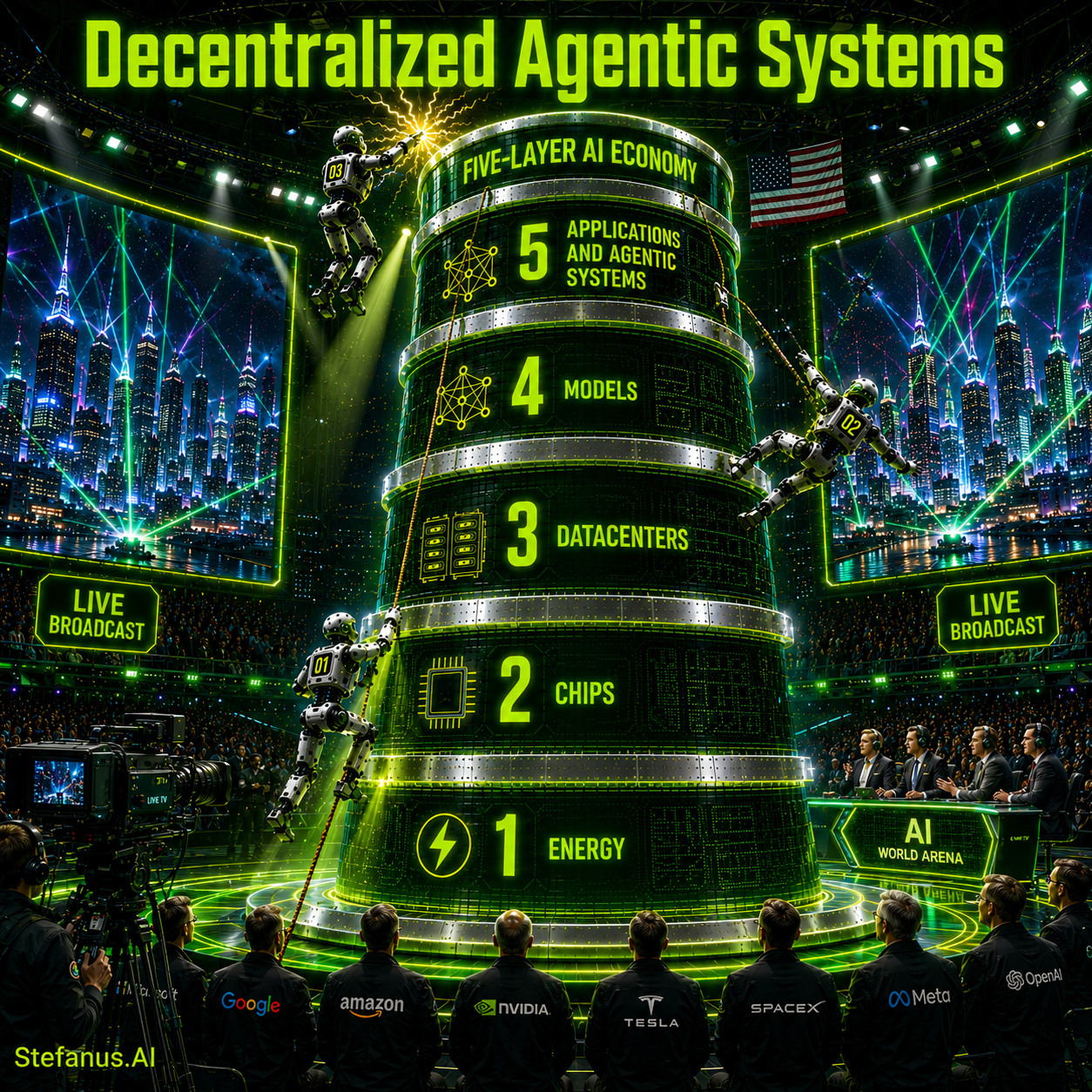
This shift becomes legible when placed against a framework that NVIDIA founder and chief executive Jensen Huang has used repeatedly across 2026 to describe the structure of the AI economy: a five-layer stack consisting of energy, chips, datacenters, models, and applications and agents[1]. Huang has been explicit, at venues from the World Economic Forum in Davos to NVIDIA’s own quarterly briefings, that the uppermost layer of this stack is where the economic story ultimately resolves.
“This layer on top, ultimately, is where economic benefit will happen”
— Jensen Huang, Founder and CEO, NVIDIA — World Economic Forum, Davos [1]
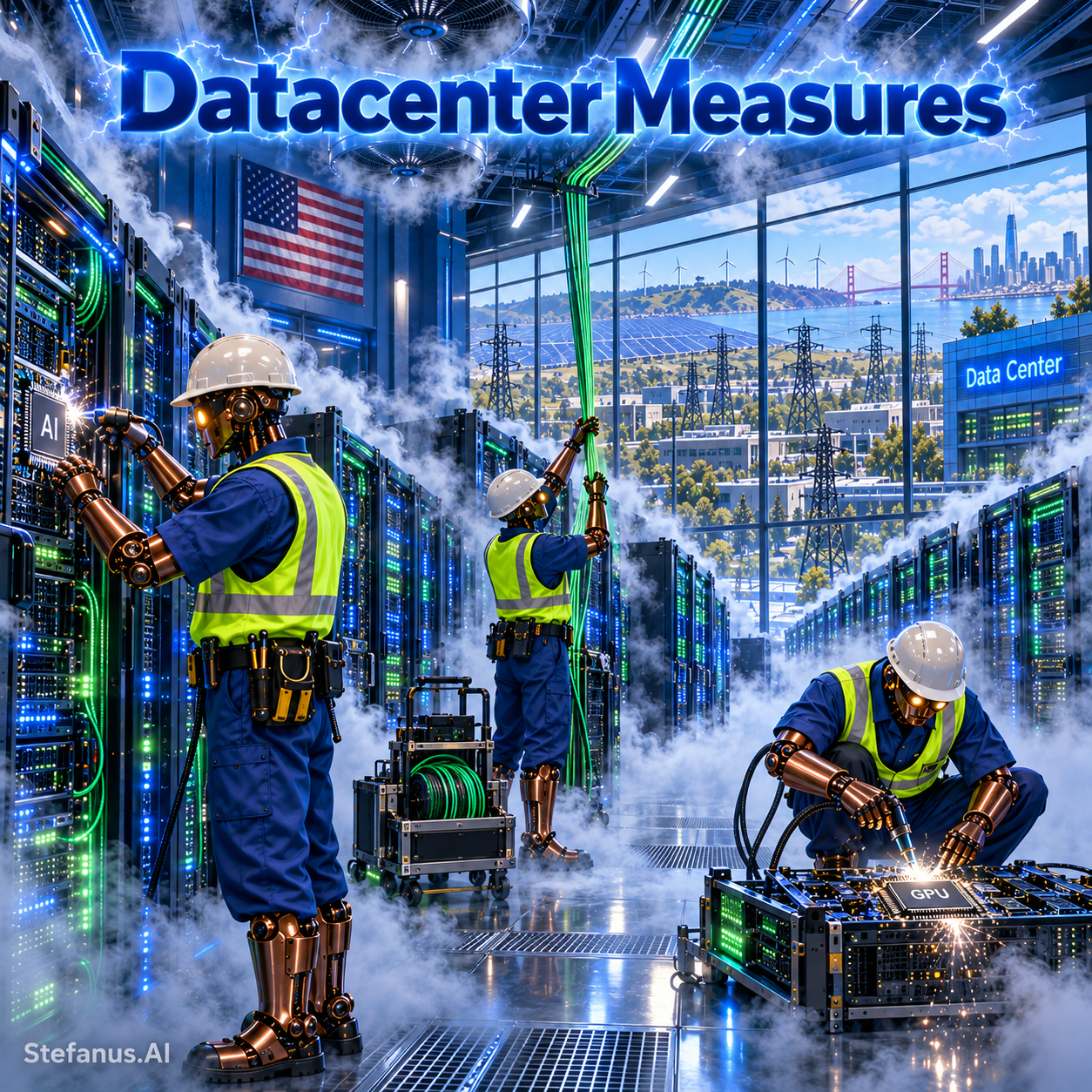
Energy powers chips. Chips power datacenters. Datacenters host models. Models create intelligence. But intelligence, on its own, is inert; it does not buy anything, hire anyone, or move a single container off a ship. Agents create action, and Decentralized Agentic Systems — the coordination architecture that allows millions of agents to act in concert rather than in conflict — is the mechanism through which that intelligence finally becomes economic output. This is why the framework in this paper treats the fifth layer not as a thin coat of paint atop four layers of hardware, but as an economy unto itself, with its own physics of trust, latency, and coordination cost.
The Coming Compute Bottleneck
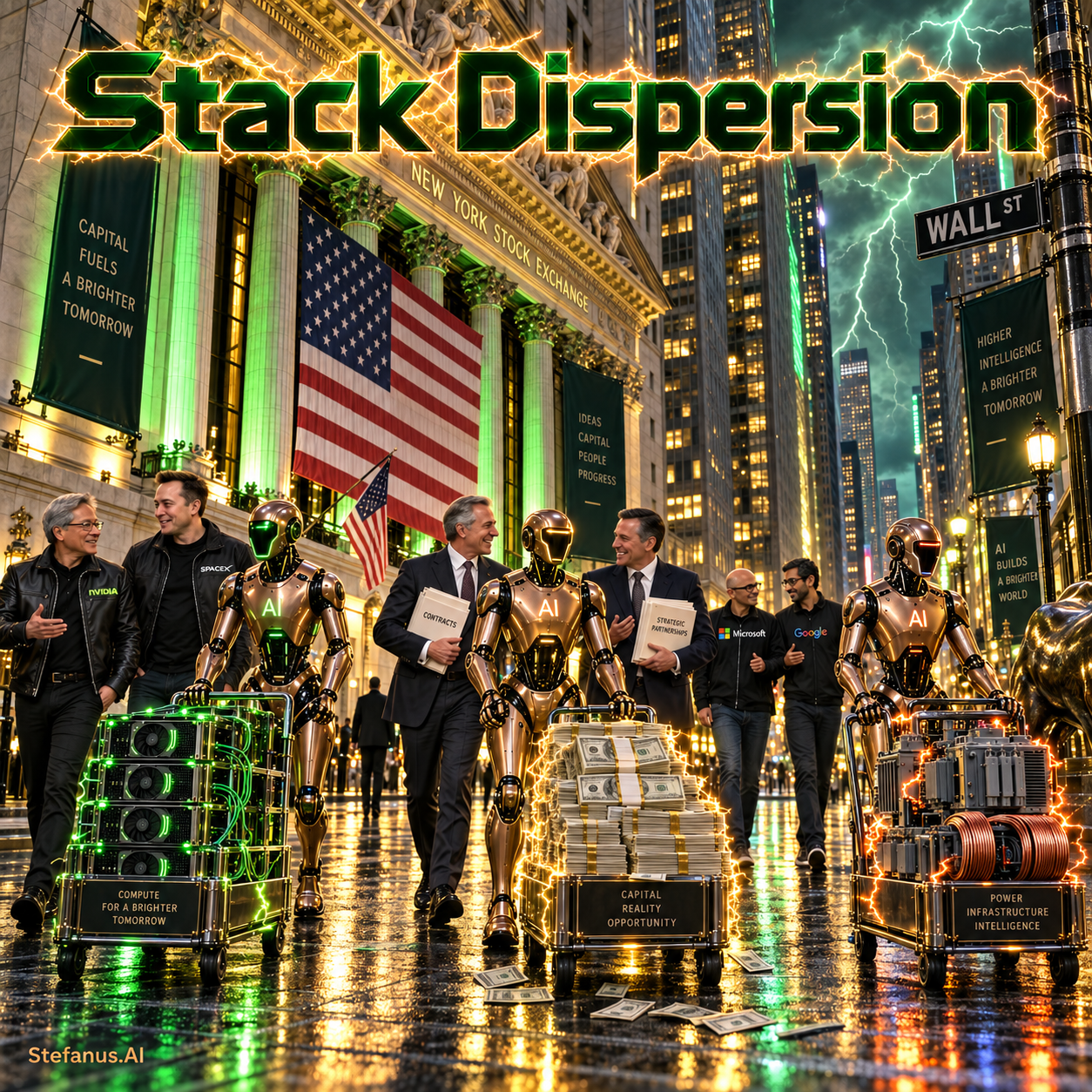
The capital now flowing into the first four layers of this stack is no longer an estimate; it is a quarterly filing. NVIDIA reported first-quarter fiscal 2027 revenue of $81.6 billion on May 20, 2026, with $75.2 billion of that total — more than nine in every ten dollars — coming from data center products alone[3][4], a single quarter’s data center revenue that now exceeds the GDP of most member states of the United Nations. CNBC’s analysis of the same earnings call described the company as having moved decisively past the experimentation phase, framing the results as evidence that what executives across the industry now call the agentic AI inflection point has already arrived rather than being a future milestone[5]. The demand side of the ledger tells a consistent story: independent industry tracking by the Futurum Group placed combined 2026 AI infrastructure capital expenditure across the leading hyperscale cloud providers at roughly $690 billion[6], and Amazon’s own chief executive was characteristically specific about his company’s individual share of that figure on an investor call earlier in the year.
“we expect to invest about $200 billion in capital expenditures across Amazon in 2026”
— Andy Jassy, President and Chief Executive Officer, Amazon [7]
Independent capital-markets research from the energy analytics firm Orennia found that figure broadly consistent with the public disclosures of Amazon’s closest competitors, with Microsoft, Google, and Meta each tracking toward comparable double-digit-billion-dollar quarterly capital budgets of their own across 2026[8]. None of this capital, on its own, guarantees that the fifth layer of the stack will function as Huang describes it. It guarantees only that the first four layers are being built at a pace that has begun to outrun the physical world’s capacity to host them — which is precisely the warning the International Monetary Fund issued only months later. Synthesizing a December 2025 workshop on the macroeconomic implications of artificial intelligence, the Fund concluded that the technology should be treated as [24]
“a macro-critical transition rather than a standard technology shock”
— International Monetary Fund, IMF Notes 2026/002 [24]
and warned that the macroeconomic path forward will be shaped less by frontier model capability than by how quickly institutions and physical infrastructure can absorb it[24]. On the ground, that absorption problem looks like grid saturation, transmission bottlenecks, water scarcity around cooling-intensive campuses, and land constraints in the handful of corridors where fiber, power, and zoning all align. The Trump administration’s own accounting of the buildout, released alongside a March 2026 pledge with Amazon, Google, Meta, Microsoft, OpenAI, Oracle, and xAI to shield household electricity ratepayers from data center costs, cited federal projections that U.S. power developers planned to add a record 86 gigawatts of new utility-scale generating capacity in 2026 alone[26], even as data center construction starts hit $25.2 billion in a single month that January — the highest figure recorded since tracking began in 2020[26]. It is this physical ceiling on Earth-bound compute, more than any shortage of capital or ambition, that has pushed some of the very companies racing to complete their five-layer stacks on the ground to look upward, toward orbit, for the next layer of expansion. That story occupies Section 3 of this paper. First, however, it is necessary to establish exactly what is meant by an agentic civilization, and how the field arrived at one.

Section 1: From Generative AI to Agentic Civilizations
Artificial intelligence did not arrive at agentic coordination in a single leap, and understanding the steps that preceded it matters, because each step removed a constraint that made the next one possible. Traditional software could only do exactly what it was told, in exactly the order it was told to do it. Machine learning loosened that constraint by letting systems infer patterns from data rather than from explicit rules, but those systems still answered narrow questions rather than pursuing open-ended goals. Large language models loosened the constraint further still, producing systems fluent enough in language and reasoning to be mistaken, in short bursts, for a knowledgeable colleague. What none of those three steps could do, however, was act: persist across time, use tools, revise a plan when the world pushed back, or pursue an objective across many steps without a human re-prompting it at every turn. That capability is what defines the fourth step, the AI agent, and it is the step from which everything in this paper follows.
1.1 The Evolution of Artificial Intelligence
The pace of this evolution is now visible in benchmark data rather than only in product announcements. Stanford University’s Institute for Human-Centered Artificial Intelligence, in its 2026 AI Index Report, documented that success rates on WebArena, a benchmark that tests autonomous web agents performing real multi-step tasks, climbed from roughly 15 percent in 2023 to 74.3 percent in early 2026, closing to within four percentage points of human performance[18]. On SWE-bench Verified, a benchmark of autonomous software engineering tasks, performance rose from roughly 60 percent to a level that now approaches the human baseline within a single year[18], while AI agents handling cybersecurity remediation tasks improved from a 15 percent success rate in 2024 to 93 percent[18]. These are not chatbots answering trivia. They are systems completing multi-step work inside real software environments, and the index’s authors were careful to note that the gap between what such agents can do on a benchmark and what enterprises have actually deployed remains the central tension of the moment[18].
1.2 Defining Agentic AI
What separates an agent from a model is a cluster of properties that, taken together, allow a system to behave less like a tool and more like a delegate. An agent is goal-driven rather than prompt-driven, meaning it is given an objective rather than a single instruction. It carries persistent memory across a task, so that what it learned in step three is still available in step thirty. It uses external tools — calendars, databases, payment rails, other models — rather than confining itself to the text it was trained on. It engages in some form of self-reflection, checking its own output against the goal before declaring the task finished. It plans autonomously across multiple steps rather than waiting for a human to specify each one. And it executes adaptively, revising its plan when a tool call fails or the environment changes underneath it. MIT Sloan’s coverage of this shift was unambiguous about how far the transition has already gone.
“The agentic AI age is already here”
— Sinan Aral, Professor of Management, IT, and Marketing, MIT Sloan School of Management [20]
That is not a forecast. It is a description of agents that are, as this paper is written, already deployed at scale inside the economy to negotiate, transact, and execute on behalf of the organizations that built them[20].
1.3 From Single Agents to Collaborative Intelligence
A single agent, however capable, runs into the same wall that a single employee runs into: there is only so much one actor can specialize in, hold in working memory, and execute in parallel before quality degrades. The industry’s answer has been the same answer every mature industry eventually gives to that problem — specialization and division of labor. Instead of one generalist agent attempting an entire workflow, organizations increasingly deploy a planner agent to define tasks, an executor agent to perform them, a critic agent to evaluate the output, and a coordinator agent to manage the flow between all three. This is not merely a parallelism gain. It is a robustness gain, because errors that a single agent would carry silently into a final answer can instead be caught, challenged, and corrected by a neighboring agent before they ever reach a human. It is also the seed of something larger: once agents can specialize, they can begin to trade with one another, and once they can trade, an economy of agents becomes possible. That economy is the subject of Section 2.4.
1.4 The Rise of Agentic Civilizations
Extend that logic from a handful of cooperating agents to millions, and the result starts to resemble less a piece of software and more an ecosystem — a continuously interacting population of specialized actors whose aggregate behavior emerges from local interactions rather than from any central design document. This is not a distant hypothetical. Stanford’s 2026 AI Index Report highlighted findings in which a multi-agent system, evaluated against complex published medical case studies, substantially outperformed unaided physicians working alone[15], a result that matters less for what it says about medicine specifically than for what it implies generally: coordinated groups of narrow agents are already capable of exceeding the performance of any single actor, human or artificial, working in isolation. Scale that finding across supply chains, energy markets, logistics networks, and orbital infrastructure, and the destination is what this paper calls an agentic civilization — a population of autonomous software actors large enough, and coordinated enough, to constitute an economy in its own right. Building that coordination layer safely, however, requires solving a problem that the field has so far under-invested in relative to its urgency: trust. That is the subject of Section 2.

Section 2: Architectures of Trust and Coordination
Of the five sections in this paper, none carries more weight than this one, because none of the preceding section’s promises — specialization, robustness, civilization-scale coordination — survive contact with reality unless agents can be trusted to do what they claim to have done. A model that hallucinates a fact is an embarrassment. An agent that hallucinates a completed wire transfer, a verified compliance check, or a satisfied safety condition is a liability, and at the scale this paper is describing, a systemic one. This section therefore asks four questions in sequence: why centralized coordination breaks down once the population of agents grows large; what communication architectures let decentralized agents coordinate anyway; how trust gets established between actors with no human in the loop; and what kind of economy emerges once agents start transacting with one another directly. A fifth question — why so little research has been devoted to any of this — closes the section, because the gap is itself a finding.
2.1 Why Centralized Coordination Fails at Scale
The instinctive engineering response to a population of agents is to put a single orchestrator on top of all of them, and for small deployments this works perfectly well. It stops working as the population grows, for reasons that are structural rather than merely technical. Latency compounds, because every decision now has to round-trip through one node regardless of how far the requesting agent is from it. The orchestrator becomes a single point of failure, so that an outage which would once have degraded one workflow now stalls every workflow that depends on it. Cost scales linearly with throughput rather than amortizing across the network. Sovereignty concerns multiply once agents are operating across borders, since a central orchestrator domiciled in one jurisdiction becomes, in effect, a chokepoint for every other jurisdiction’s data and decisions. And scalability simply runs out, because no single system, however well provisioned, was designed to mediate millions of simultaneous, semi-independent decisions. The IMF’s own scenario-planning work on AI diffusion reached a parallel conclusion from the economic side: the binding constraint on realizing AI’s potential is increasingly the readiness of institutions and infrastructure to absorb the technology, not the technology’s raw capability[24]. Centralized coordination architectures are, in effect, an attempt to make institutional readiness someone else’s problem by routing it through one machine. It does not work.
2.2 Communication Frameworks for Agent Swarms
If centralization fails, the alternative is to let agents coordinate the way most large, robust systems in nature already do: through peer-to-peer messaging, publish-subscribe channels, and event-driven triggers, rather than through a single switchboard. None of this is a new idea in computer science, but it has acquired new urgency now that the nodes on the network are autonomous decision-makers rather than passive sensors. The biological analogies are not decorative; they describe a real engineering principle. An ant colony solves complex foraging and load-balancing problems with no ant aware of the colony’s overall state, purely through local pheromone signals. A beehive allocates scouts and foragers through a similarly decentralized voting process. A biological neural system reaches a decision through the aggregate firing of neurons that have no individual awareness of the decision being made. A recent paper out of the multi-agent systems research community, titled “Economy of Minds,” formalized this intuition for AI agents directly, showing that decentralized incentive structures can be designed under which coordination automatically emerges, rather than requiring an engineer to specify the coordination logic by hand[21]. That distinction — designing the incentives under which coordination emerges, instead of engineering the coordination itself — is arguably the single most important architectural idea in this entire field, and it recurs throughout the remainder of this paper.
2.3 Trust in Autonomous Systems
Granting that agents can communicate without a central switchboard still leaves the harder question unanswered: how does one agent know that another agent is telling the truth? How does it verify that a task claimed as complete was actually completed, to the standard required, without re-doing the work itself? And how do two agents with partially conflicting objectives negotiate a task allocation that neither can simply impose on the other? The honest answer, at the close of the first half of 2026, is that the field does not yet have good measures for any of this. Ray Perrault, co-director of Stanford’s AI Index and a distinguished computer scientist at SRI International, made the point bluntly while discussing the very benchmarks cited above.
“We generally lack measures of how well a system needs to function”
— Ray Perrault, Co-Director, Stanford AI Index Steering Committee [16]
in a given operational setting — a gap that matters enormously once agents are trusting each other’s outputs rather than a human’s. Stanford’s own survey data quantifies the consequence of that gap directly: when organizations were asked what is blocking them from scaling agentic AI deployments, security and risk concerns were cited by 62 percent of respondents, outranking technical limitations and regulatory uncertainty by a margin of roughly twenty-four percentage points[17]. Security, in other words, is not tied with other constraints on agentic adoption. It is the dominant one, by a wide margin, and it is fundamentally a trust problem rather than a capability problem. The stakes of getting this wrong are not abstract. Researchers at the University of Southern California’s Information Sciences Institute, led by research assistant professor Luca Luceri, published a study accepted at The Web Conference 2026 demonstrating that networks of large language model agents can autonomously coordinate disinformation campaigns without any human directing them step by step.
“Our paper shows that this is not a future threat: It’s already technically possible”
— Luca Luceri, Lead Scientist, USC Information Sciences Institute [22]
That finding is a warning shot for exactly the kind of decentralized coordination this paper otherwise celebrates: the same architectural properties that let beneficial agents self-organize also let malicious or merely careless agents self-organize, and the absence of robust verification is what determines which outcome a given deployment produces. USC’s newly launched Institute on Ethics and Trust in Computing made a related point from the governance side of the same problem during its inaugural summit in April 2026, where Gaurav Sukhatme, executive vice dean of USC Viterbi’s School of Advanced Computing, argued that the ethical stakes of autonomous systems rise sharply once those systems acquire physical agency — a driverless car’s mistake, unlike a chess engine’s, has consequences that cannot be undone with a rematch[23]. The architectural response that the field is converging on — reputation systems that track an agent’s track record over time, consensus mechanisms that require multiple independent agents to agree before an action is taken, cryptographic proofs that let an agent demonstrate a computation was performed correctly without revealing the underlying data, and dedicated verification and auditing agents whose sole job is to check the work of other agents — amounts to rebuilding, in software, the institutions that human economies took centuries to develop: courts, auditors, credit bureaus, and notaries. There is no shortcut available. The institutions have to be built, and built into the architecture itself, because no central authority will exist to enforce them after the fact.
2.4 Agent Economies and Digital Markets
Once agents can verify one another’s claims, the next step follows almost automatically: they can begin to transact. An agent that needs additional compute, a piece of information it does not already hold, or a service it cannot itself perform, can buy that input from another agent rather than waiting for a human to provision it manually. This is no longer speculative architecture; the payment rails for it were built across the second half of 2025 and the first half of 2026. Google’s Agent Payments Protocol, announced with more than sixty launch partners including Mastercard, American Express, PayPal, and Coinbase, defines a chain of cryptographically signed “mandates” — a record of what a user intended, what an agent proposed, and what was ultimately authorized — that lets an agent transact on a person’s behalf across both card rails and stablecoin rails[32]. The head of technology at the AI agent company Manus, evaluating the protocol on the day of its announcement, called out the specific problem it was built to solve.
“the fundamental monetization challenges we’ve long faced in the agent ecosystem”
— Tao Zhang, Chief Technology Officer, Manus [32]
Within months, separate but converging protocols had emerged from Visa, Mastercard, and OpenAI, each tokenizing agent identity onto existing card-network rails rather than building a payments system from scratch[33]. The volumes moving through these rails are no longer trivial: Adobe Analytics measured a roughly forty-seven-fold year-over-year increase in generative-AI-driven traffic to U.S. retail sites between mid-2024 and mid-2025, and the Coinbase-led x402 stablecoin payment protocol processed on the order of one hundred sixty-five million agent-initiated transactions within its first months of operation[33]. An agent economy, in other words, is not a metaphor borrowed from economics to describe software behavior. It is becoming a literal, audited, regulator-visible financial system in which the buyers and sellers happen not to be human.
2.5 The Research Desert
Set against the speed of that commercial buildout, the state of academic and institutional research into agent governance looks thin, and the consequences of that thinness are now showing up in deployment failure rates rather than only in conference papers. Gartner’s research organization, surveying more than 3,400 organizations actively investing in agentic AI, predicted that more than 40 percent of agentic AI projects will be canceled by the end of 2027 — not primarily because the underlying models fail, but because of escalating costs, unclear business value, and inadequate risk controls. Anushree Verma, senior director analyst at Gartner, was direct about the diagnosis.
“Most agentic AI projects right now are early stage experiments or proof of concepts”
— Anushree Verma, Senior Director Analyst, Gartner [34]
that are often misapplied to problems that did not require an autonomous agent in the first place, a phenomenon Gartner separately termed “agent washing” — the rebranding of ordinary chatbots and robotic process automation as agentic systems without the underlying capability to back up the label[34]. This is precisely the research desert the outline for this paper anticipated. The overwhelming majority of published AI research over the past several years has concentrated on improving intelligence — bigger models, better benchmarks, faster inference — while the much harder, much less glamorous problems of resilience, governance, trust, long-term adaptation, and decentralized orchestration have attracted a fraction of the attention. The World Bank’s 2026 World Development Report, which examines AI specifically through the lens of institutional readiness in developing economies, reaches a structurally identical conclusion from a different angle: meaningful AI deployment depends less on access to frontier models than on the surrounding institutional and governance scaffolding required to use them safely[28]. Wherever one looks — Stanford’s security statistics, Gartner’s cancellation forecasts, the IMF’s diffusion modeling, or the World Bank’s development framework — the same gap reappears. The technology has outrun the institutions built to govern it, and closing that gap is no longer optional homework for the field; it is the precondition for everything described in the next two sections.

Section 3: The Emergence of Orbital Intelligence Networks
Section 1 described how intelligence became agentic. Section 2 described how agentic systems can be made to trust one another. This section turns to a question that, as recently as 2024, would have sounded like science fiction inside a serious policy paper, and that by June 2026 has become a line item in corporate capital expenditure plans: what happens once the physical substrate that agentic systems run on can no longer be confined to the surface of the Earth? The answer is not a speculative leap. It is already being filed with regulators, financed by public markets, and, in the case of the satellite at the center of this section, photographed and launched.
3.1 The Physical Limits of Earth-Based Intelligence
Every layer of Jensen Huang’s five-layer stack ultimately rests on the first one, and the first one is running into a wall that no amount of capital can instantly dissolve: there is a finite amount of reliable, permittable, coolable power available in any given geography, and the queue of projects waiting for an interconnection slot is now measured in years rather than months. The federal response to this constraint, formalized in the White House’s March 2026 Ratepayer Protection Pledge, required the largest AI developers to build, bring, or buy enough new generation to meet their own data center demand and to cover the full cost of the transmission and distribution upgrades that demand requires, rather than passing those costs to ordinary electricity customers[26]. The same fact sheet noted that this pledge builds on the administration’s broader AI Action Plan and on a Department of Energy program that has, as of April 2026, signed memoranda of understanding with 51 organizations — including NVIDIA and Amazon Web Services — aimed at using AI itself to speed up power grid planning and interconnection decisions by a factor of twenty to one hundred[27]. Even with that acceleration, the geography of available power is concentrating, not dispersing: the same regions with the fiber, the land, and the regulatory tolerance for hyperscale construction are the regions running out of headroom first. This is the “reliability premium” this paper’s framework places at the center of Section 3 — the rising cost, in both dollars and lead time, of guaranteeing reliable terrestrial compute in the handful of corridors where it has historically been cheapest to build.
3.2 Why Space Changes the Equation
Move the same compute into low Earth orbit, and several of these constraints either disappear or invert. A satellite in a sun-synchronous orbit can receive near-continuous solar illumination rather than the intermittent supply any ground-based solar farm contends with. It requires no land acquisition, no zoning variance, and no water for cooling, because waste heat radiates directly into the near-absolute-zero environment of space rather than needing to be evaporated or pumped away. And it is, by construction, geographically neutral — a single satellite serves every longitude it passes over, rather than being tied to one utility’s service territory. Elon Musk made the underlying logic explicit in the memo announcing SpaceX’s merger with his AI company xAI, framing the entire orbital strategy as a direct response to the terrestrial ceiling described above.
“Global electricity demand for AI simply cannot be met with terrestrial solutions”
— Elon Musk, Chief Executive Officer, SpaceX [14]
even in the near term, without imposing real hardship on the communities and the environment around the data centers built to meet it[14]. Whatever one makes of the rest of Musk’s roadmap, that diagnosis tracks closely with the IMF’s, the White House’s, and the Department of Energy’s own assessments of the terrestrial bottleneck described in Section 3.1. The disagreement in 2026 is not over whether the bottleneck is real. It is over whether orbit is a credible enough solution, on a fast enough timeline, to matter.
3.3 SpaceX and the First Orbital Compute Platforms
The clearest evidence that this question has moved from hypothetical to engineering problem is a regulatory filing and a satellite reveal, both completed within the past several weeks of this paper being written. In a filing with the Federal Communications Commission, SpaceX requested authorization for what it described as an orbital data-center system of up to one million satellites, to be operated in clusters between roughly 500 and 2,000 kilometers of altitude, explicitly designed to power advanced AI models and the applications built on them[9]. The filing’s framing of the underlying economics was unambiguous about where the company believes the curve is heading.
“the lowest cost to generate AI compute will be space”
— SpaceX, FCC Orbital Data Center Constellation Filing [9]
freed, in the company’s words, from the constraints of terrestrial deployment[9]. That filing was followed, on June 9, 2026, by the public reveal of AI1, SpaceX’s first-generation orbital compute satellite, unveiled by Musk in a video posted days ahead of the company’s Nasdaq debut. The hardware specifications are notably modest in scope and notably specific in detail: AI1 delivers 150 kilowatts of peak compute power and 120 kilowatts on average, spans 70 meters tip-to-tip — wider than a Boeing 747 — and reuses core bus technology, including solar cells and inter-satellite laser links, from the existing Starlink V3 satellite design rather than starting from a clean sheet[11]. Musk himself argued that the engineering challenge was, somewhat counterintuitively, simpler than the Starlink satellites SpaceX already mass-produces.
“The AI satellite is much simpler than a Starlink satellite”
— Elon Musk, Chief Executive Officer, SpaceX [10]
because the spacecraft is, at its core, a large solar array and a compute module connected by laser links, without the dense antenna arrays a communications-first satellite requires[10]. The thermal engineering, however, is not simple at all: with no atmosphere available to convect heat away, AI1 relies on a deployable liquid-radiator system with redundant pumping loops to dissipate everything its compute payload generates, a problem space program engineers have wrestled with since the earliest Cold War-era space power research[10]. SpaceX’s own published roadmap calls for two prototype units to launch in early 2027, scaling toward roughly one gigawatt of orbital AI compute capacity by the end of that year, on the theory, stated plainly in supporting materials, that the constraint shifts from construction time to manufacturing throughput once the design is proven.
“no ongoing operational or maintenance needs”
— Elon Musk, Chief Executive Officer, SpaceX [12]
is the phrase used to describe the appeal of scaling by manufacturing satellites rather than by pouring concrete — once a design is proven, adding capacity becomes a factory problem rather than a multi-year construction problem[12]. It would be a disservice to the intellectual honesty this paper is aiming for, however, to present that roadmap without its critics. Andrew McCalip, a space engineer who has built a detailed public cost model comparing orbital and terrestrial data centers, found that a one-gigawatt orbital facility might cost roughly $42.4 billion to deploy — nearly three times its ground-based equivalent — once the full cost of manufacturing and launching the satellites is included[13], even as he acknowledged the strategic logic that makes the bet attractive to a company that already controls its own launch costs.
“A FLOP is a FLOP, it doesn’t matter where it lives”
— Andrew McCalip, Space Engineer [13]
is how he summarized the underlying advantage: a company that can fall back to orbital deployment whenever it hits a permitting or capital bottleneck on the ground has an option value that a purely terrestrial competitor does not[13]. And the skepticism runs deeper than cost modeling alone. Industry analysts have explicitly compared SpaceX’s orbital ambitions to Microsoft’s now-abandoned Project Natick, an undersea data center initiative that met every one of its technical targets and was still shelved after roughly two years because modular, unreachable infrastructure could not be expanded, repaired, or upgraded as quickly as conventional data centers could. Roy Chua, founder of the industry research firm AvidThink, drew the comparison directly.
“These problems are likely to be more severe in space than under the sea”
— Roy Chua, Founder, AvidThink [35]
pointing specifically to the unresolved questions of orbital cooling, high launch costs, and the effect of the space radiation environment on AI chips that have not yet been hardened for a multi-year mission in vacuum[35]. This paper takes no position on whether SpaceX’s specific roadmap succeeds. What matters for the framework developed here is that the attempt is now underway, funded, and partially launched — which means the coordination problem described in the rest of this section is no longer theoretical either.
3.4 Orbital Intelligence Networks
This paper defines an Orbital Intelligence Network, or OIN, as a globally distributed constellation of autonomous compute nodes capable of processing, coordinating, and executing intelligence workloads while in orbit, rather than merely relaying data between ground stations. The distinction matters because it is precisely the distinction between Starlink as it exists today — a communications network that moves bits between two points on the ground — and AI1 as SpaceX has described it: a node that performs computation in place, exchanges intermediate results with its neighbors over laser links, and returns only the output a ground-based user actually needs. An Orbital Intelligence Network, scaled to the million-satellite constellation described in SpaceX’s FCC filing, would be the first computing substrate in history with no fixed geographic address at all — a fact with implications for sovereignty, jurisdiction, and governance that Section 4.3 returns to directly.
3.5 Synthetic Geography Expands Into Orbit
The geography of intelligence, in other words, no longer terminates at the Earth’s surface, and the framework needed to reason about that expanded geography already has a useful precedent in development economics. The World Bank’s 2026 World Development Report organizes its entire analysis of AI readiness around what it calls the “four Cs”: connectivity, meaning the energy and digital infrastructure required to participate at all; compute, meaning access to chips, datacenters, and cloud capacity; context, meaning the availability of relevant data; and competency, meaning the human skills required to put the other three to use[28]. That framework was built to describe the gap between advanced and developing economies on the ground, but it maps with almost no modification onto the gap this paper is describing between terrestrial and orbital compute — connectivity now includes laser inter-satellite links and ground-station bandwidth; compute now includes radiation-hardened chips qualified for a multi-year orbital mission; context now includes the latency budget a given workload can tolerate; and competency now includes the wholly new discipline of operating autonomous agents across a mesh that has no permanent physical location at all. The same report documents how unevenly the terrestrial version of this gap is already closing: more than 40 percent of ChatGPT’s global traffic by mid-2025 originated from middle-income countries, and generative AI job vacancies surged ninefold between 2021 and 2024, with one in five of those roles based in a middle-income economy[29]. If orbital compute follows a similar diffusion curve — concentrated first among the handful of actors who can afford the up-front capital, then spreading as launch costs fall — the governance and coordination challenges Section 2 raised for terrestrial agent populations will simply repeat themselves a few hundred kilometers higher, with one critical difference: there will be no national grid operator, no state utility commission, and no local zoning board with jurisdiction over a satellite passing overhead every ninety minutes. That is precisely the problem Section 4 takes up.

Section 4: Decentralized Agentic Systems as the Operating System of Orbital Intelligence Networks
This is the section the rest of the paper has been building toward, because it is here that the two threads developed separately in Sections 2 and 3 — trustworthy agent coordination, and orbital compute infrastructure — turn out to be the same problem viewed from two different altitudes. An Orbital Intelligence Network without a coordination layer is just an expensive cloud of unreachable hardware. Decentralized Agentic Systems, as defined in this paper, is the only coordination architecture with any plausible chance of operating that hardware once it is in place, for reasons of pure physics as much as of design philosophy.
4.1 Why Centralized AI Cannot Manage Orbital Swarms
SpaceX’s own FCC filing frames the scale this paper has to reckon with: a constellation authorized for up to one million satellites, each one a semi-independent compute node passing in and out of contact with any given ground station every few minutes[9]. No central orchestrator, however well resourced, can poll a million nodes, resolve conflicting resource requests among them, and issue corrected instructions within the latency budget that real-time AI inference requires — the same argument made on Earth in Section 2.1 against centralized agent coordination, except that in orbit the round-trip delay to a single ground-based controller is no longer an inconvenience measured in milliseconds but a structural impossibility measured in orbital mechanics. A constellation at this scale either coordinates itself, locally and continuously, or it does not coordinate at all.
4.2 Agentic Coordination Across Dynamic Orbital Meshes
The specific engineering challenges that make this hard are worth naming individually, because each one maps onto a property Section 2 already identified as a reason decentralized coordination architectures exist in the first place. Connectivity between any two satellites is intermittent, opening and closing as orbital geometry shifts. The topology of the network is dynamic by definition, since every node is moving relative to every other node at several kilometers per second. Latency fluctuates with the same geometry. And hardware heterogeneity is built into the roadmap rather than being an unfortunate accident of staggered procurement: SpaceX has described AI1’s compute payload as deliberately modular and interchangeable, explicitly avoiding dependence on any single chipmaker so that successive generations of satellites can carry different silicon without breaking compatibility with the rest of the mesh[11]. A coordination layer for this environment cannot assume a stable address for any given node, a predictable latency to any given neighbor, or a uniform instruction set across the population it is coordinating. It has to be built, from the ground up, the way Section 2.2’s biological analogies suggest — local rules, local signals, and emergent global behavior — because no other architecture survives contact with orbital mechanics.
4.3 Trustless Intelligence at Planetary Scale
The trust architecture Section 2.3 described as necessary for terrestrial agent populations becomes strictly mandatory, rather than merely advisable, once the population in question has no permanent national jurisdiction at all. A satellite passing over dozens of countries in a single ninety-minute orbit is not meaningfully subject to any one of their regulators in real time, which means the self-verification, consensus, and auditing mechanisms described earlier in this paper are not a governance nicety for orbital infrastructure — they are the only enforcement mechanism available. The United Nations has been explicit that global AI governance is racing to keep pace with exactly this kind of borderless deployment. Secretary-General António Guterres, addressing the pace of the technology directly at a February 2026 press briefing tied to the launch of the UN’s Global Dialogue on AI Governance, did not mince words.
“AI is moving at the speed of light”
— António Guterres, Secretary-General, United Nations [30]
and argued that no single country can see the full picture of the technology’s trajectory alone, which is precisely why the Global Dialogue and a newly convened Independent International Scientific Panel on AI were established to assemble a shared, evidence-based picture across borders rather than leaving each jurisdiction to regulate in isolation[30]. In his remarks to that panel’s first meeting the following month, Guterres described the body’s mandate as intentionally broad, spanning frontier systems and the societal impacts already unfolding, and noted that the panel itself is, in his words, in a race against time to deliver assessments fast enough to inform real policy rather than retrospective history[31]. An Orbital Intelligence Network governed by Decentralized Agentic Systems is, in this sense, a test case the United Nations has not yet formally considered but will eventually have to: what does sovereignty mean for a compute node that completes a circuit of every member state’s territory sixteen times a day?
4.4 Autonomous Space-Based Inference
Set the jurisdictional question aside for a moment and consider the purely operational one: how does a constellation of this kind actually run, day to day, without a human approving each decision? The same agentic primitives developed in Section 1.2 — goal-driven planning, persistent memory, tool use, self-reflection, autonomous execution — have to be re-implemented for an environment where the relevant tools are solar array angles, thermal radiator loops, and inter-satellite laser link schedules rather than calendars and databases. An agent resident on a given satellite has to allocate that satellite’s compute among competing workloads, route data to whichever neighboring node currently has the best link quality, manage power draw against the solar array’s real-time output, and recover from a hardware fault by re-routing its workload elsewhere in the mesh — all without waiting for instructions from the ground, because by the time an instruction arrived from a ground station on the other side of the planet, the orbital geometry that made the instruction relevant would already have changed. This is, in the most literal sense available in 2026, autonomous space-based inference: not a system that occasionally operates without supervision, but one for which constant supervision is physically impossible and constant autonomy is therefore the only available design.
4.5 The Birth of Planetary Intelligence Infrastructure
Every prior wave of infrastructure that reorganized an economy followed a similar arc: railroads connected cities that had previously been economically isolated from one another; the Internet connected information that had previously been siloed inside individual institutions. The IMF’s characterization of artificial intelligence as [24] a transition macro-critical enough to reshape the global economy, rather than an ordinary technology shock, applies with particular force to the infrastructure described in this section. Orbital Intelligence Networks, governed by Decentralized Agentic Systems, are not simply one more data center format competing on price per kilowatt-hour. If the architecture described in this paper proves out even partially, they represent the first attempt to connect intelligence itself — not information, not commerce, but the computational substrate of cognition — into a single, planet-spanning, self-governing infrastructure layer. Whether that attempt succeeds on the timeline SpaceX and its competitors have proposed is genuinely uncertain, for the cost and engineering reasons Section 3.3 documented. That it is now a serious, funded, partially launched engineering program, rather than a thought experiment, is not in question. Section 5 distills what this paper takes that fact to mean.

Section 5: What Have We Learned? The Ten Pillars of Decentralized Agentic Systems
This paper began with an image rather than an argument: thousands of autonomous agents scattered across hyperscale datacenters, utility control rooms, container terminals, a transatlantic cabin, a national park, a cruise ship, a ski resort, and a constellation circling ninety minutes above all of it, coordinating with no central authority directing any of them. Sections 1 through 4 spent the length of this paper working out what that image actually implies — what agentic intelligence is, why trust rather than raw capability is the binding constraint on coordinating it, why the geography available to that coordination is now expanding into orbit, and why centralized control becomes structurally impossible once the population being coordinated reaches into the thousands or millions. What follows distills that argument into ten standing claims, each load-bearing enough to support how this decade’s builders, investors, and regulators ought to think about agentic AI — whether or not the orbital half of the story arrives on the timeline its builders currently project.
Pillar 1: Intelligence Requires Coordination
The first and most foundational claim of this paper is that the binding constraint on artificial intelligence’s economic usefulness has shifted from creating intelligence to coordinating it. MIT’s Initiative on the Digital Economy has been the clearest institutional voice making this case across 2026, documenting in a series of studies that the relevant frontier is no longer how capable a single model is but how reliably a population of agents built on that model can act together[19]. A model that reasons brilliantly in isolation and a civilization of agents that reasons coherently together are not points on the same curve; they are different engineering problems, and this paper has argued throughout that the second problem, not the first, now determines how much economic value the technology actually produces.
Pillar 2: Trust Becomes Critical Infrastructure
Once coordination rather than capability is the binding constraint, trust stops being an ethics footnote and becomes a balance-sheet item. Stanford’s own survey data found security and risk concerns cited by 62 percent of organizations as the leading obstacle to scaling agentic deployments, ahead of every purely technical limitation[17], while USC’s demonstration that agent networks can coordinate disinformation campaigns without any human directing them proved that the same architectural properties enabling beneficial coordination enable harmful coordination with equal ease[22]. An economy of untrustworthy agents is not a smaller version of an economy of trustworthy ones; it is a different and considerably worse economy, which is why the reputation systems, consensus mechanisms, and auditing agents described in Section 2.3 belong in the same budget line as compute, not in a separate compliance afterthought.
Pillar 3: Agent Networks Replace Monolithic Software
The application layer itself is being rebuilt around this shift. Stanford’s 2026 AI Index documented multi-agent systems outperforming unaided human experts on complex, real-world case evaluations[15], while the same report’s benchmark trajectories — web-agent task success climbing from roughly 15 percent to 74.3 percent in three years, cybersecurity remediation rising from 15 percent to 93 percent — describe a field in which static, single-purpose applications are giving way to networks of specialized agents that plan, execute, critique, and recover from one another’s errors[18]. A piece of software that cannot adapt its own workflow when conditions change is, by the standard this paper has set throughout, no longer the relevant unit of analysis. The agent network is.
Pillar 4: Decentralization Improves Resilience
Centralized orchestration is not merely a less elegant way to coordinate agents; it is a less robust one, because every centralized system inherits a single point of failure that a decentralized one, by construction, does not. The formal case for this was made directly by the multi-agent systems research community’s recent work on emergent coordination, which showed that incentive structures can be designed under which beneficial coordination arises locally, without any single node holding authority over the rest of the network[21]. A constellation, a supply chain, or an agent economy built this way degrades gracefully when a single node fails, rather than catastrophically when the orchestrator does — a property that becomes not merely desirable but mandatory once the network in question has no permanent ground-based controller within reach in the first place.
Pillar 5: Orbital Networks Extend the Geography of Intelligence
The geography available to agentic systems no longer terminates at the Earth’s surface. The World Bank’s framework for AI readiness — connectivity, compute, context, and competency — was built to describe the gap between advanced and developing terrestrial economies, but it applies with almost no modification to the gap opening between terrestrial and orbital compute, where connectivity now means inter-satellite laser links and competency now means operating agents across a mesh with no fixed physical address[28]. Whatever timeline orbital infrastructure ultimately follows, the framework for reasoning about it is no longer speculative; it is an extension of development economics that this paper has simply carried a few hundred kilometers higher.
Pillar 6: Autonomous Agents Become Economic Actors
Agents are no longer confined to producing recommendations for humans to act on; they are increasingly the ones transacting. Google’s Agent Payments Protocol, launched with more than sixty partners spanning card networks and stablecoin rails, formalized a chain of cryptographically signed mandates that lets an agent buy and sell on a person’s behalf[32], and within months competing protocols from Visa, Mastercard, and OpenAI had tokenized agent identity onto the existing card-network rails rather than waiting for a clean-sheet alternative, even as Adobe measured generative-AI-driven retail traffic rising roughly forty-seven-fold and the x402 stablecoin protocol cleared on the order of one hundred sixty-five million agent-initiated transactions in its first months[33]. An agent economy, this paper has argued, is not a metaphor. By the second quarter of 2026 it is an audited financial system whose participants happen not to be human.
Pillar 7: Space-Based Compute Enables Continuous Intelligence
Orbital infrastructure offers more than additional floor space for datacenters; it offers a qualitatively different operating environment. SpaceX’s FCC filing for a constellation of up to one million orbital compute satellites and its subsequent reveal of the AI1 prototype — a 70-meter platform delivering 120 kilowatts of average compute power, drawing on near-continuous solar illumination unavailable to any ground-based facility — describe infrastructure designed from the outset to run without the daily interruptions, brownouts, and cooling-driven throttling that terrestrial compute increasingly contends with[9][11]. Continuous intelligence, in the sense this paper has used the term, is not faster intelligence; it is intelligence no longer rationed by a single planet’s weather, grid, and daylight cycle.
Pillar 8: Decentralized Agentic Systems Become the Operating Layer of the Five-Layer AI Economy
Return, finally, to the five-layer stack this paper opened with. Energy powers chips. Chips power datacenters. Datacenters host models. Models create intelligence. And Decentralized Agentic Systems — the coordination architecture developed across Sections 1 through 4 — transform that intelligence into the agentic action Jensen Huang has placed at the top of the stack as the layer where economic benefit ultimately resolves[1]. Huang’s own framing of what stands in the way of that resolution, offered the same week at Davos, was characteristically blunt about which layer of the stack remains the most immediate bottleneck.
“We need more energy”
— Jensen Huang, Founder and CEO, NVIDIA — World Economic Forum, Davos [2]
is the argument in five words: every layer above the first depends on a constraint at the bottom of the stack that capital alone cannot instantly remove. The fifth layer does not function as an independent economy; it is the layer through which every constraint and every investment made in the four layers beneath it is finally converted into something a customer pays for.
Pillar 9: Synthetic Geography Redraws Sovereignty, Jurisdiction, and Governance
A compute node with no fixed terrestrial address is not merely a technical curiosity; it is a governance problem with no historical precedent. The United Nations has been explicit that global AI governance is racing to keep pace with exactly this kind of borderless deployment, with Secretary-General António Guterres warning that the technology’s pace already outstrips any single country’s ability to assess it alone[30] and describing the newly convened Independent International Scientific Panel on AI as working against a closing window to deliver assessments fast enough to inform policy rather than retrospective history[31]. The White House’s own Ratepayer Protection Pledge — requiring the largest AI developers to fund the generation and transmission capacity their datacenters require rather than passing the cost to ordinary ratepayers — shows that even the terrestrial half of this infrastructure is already forcing new governance arrangements between private capital and public utilities[26]. A satellite completing a circuit of every member state’s territory sixteen times a day will force that same negotiation onto a stage with no existing forum equipped to hold it.
Pillar 10: The Coordination Premium Will Decide Who Wins the Agentic Decade
Capability alone will not separate the winners of this decade from the casualties, because capability is increasingly a commodity and coordination is not. Gartner’s survey of more than 3,400 organizations investing in agentic AI projects that more than 40 percent of those projects will be canceled by the end of 2027, not for lack of model capability but for the reasons this paper has organized itself around: escalating costs, unclear business value, and the absence of the governance scaffolding Section 2.5 described as a research desert[34]. The International Monetary Fund’s own leadership has framed the stakes of getting this transition wrong in the starkest terms available to a global institution. Managing Director Kristalina Georgieva, addressing the World Government Summit in Dubai, did not soften the comparison.
“This is like a tsunami hitting the labor market”
— Kristalina Georgieva, Managing Director, International Monetary Fund [25]
The organizations, and indeed the countries, that treat coordination — trust architecture, governance scaffolding, and orchestration infrastructure — as seriously as they treat model procurement will be the ones still standing when that wave finishes breaking. The rest will have spent the decade buying capability they were never equipped to coordinate.

Conclusion: The Autonomous Operating Layer of the AI Economy
Return, once more, to the picture this paper opened with. The agent balancing thermal loads in a Northern Virginia datacenter does not know that another agent, at that same instant, is negotiating an electricity contract on its behalf in Texas. The agent resequencing container moves between the Port of Los Angeles, the Port of Long Beach, and LAX has no awareness of the agent managing a business-class passenger’s connectivity thirty-five thousand feet over the Atlantic, nor of the one logging wildlife movement near the Arches in a Utah summer, nor of the one reconciling galley provisioning on a cruise ship bound for Alaska, nor of the one rebalancing lift-ticket capacity against a snowstorm in Sapporo. None of them is aware of the agents circling ninety minutes above all of it, on hardware that exists for no reason other than to be closer to constant sunlight than anything built on the ground could ever be. No agent in this picture perceives the whole. And yet the whole coordinates anyway — not despite the absence of a central controller, but because of it, in the same way an ant colony or a beehive solves problems no individual ant or bee could ever perceive.
This is why the argument of this paper was never really about models, satellites, or payment protocols individually, however much space each of those topics required. It is about the claim Sinan Aral made at the outset and that this paper has spent five sections substantiating from every available angle — corporate earnings, federal policy, Stanford benchmarks, USC security research, IMF scenario planning, and a regulatory filing for a constellation of up to one million satellites.
“The agentic AI age is already here”
— Sinan Aral, Professor of Management, IT, and Marketing, MIT Sloan School of Management [20]
The future of artificial intelligence will not be measured solely by parameter counts or benchmark scores, however impressive those numbers continue to become. It will be measured by the ability of autonomous systems to coordinate trust, allocate resources, adapt to uncertainty, and execute complex objectives across continents, oceans, and orbital planes, without a central authority making each decision for them. Decentralized Agentic Systems, in the framework this paper has built, are therefore more than a software architecture and more than a research agenda. They are the emergence of a new operating layer for the five-layer AI economy Jensen Huang has described, and the foundational coordination mechanism for whatever Orbital Intelligence Networks ultimately prove out above it. Intelligence, in this account, stops being a model that sits inside a datacenter waiting to be queried. It becomes infrastructure — distributed, self-governing, and, for the first time in the history of computing, no longer confined to the Earth it was built on.

Footnotes and Endnotes:
[1] Jensen Huang, Founder and CEO, NVIDIA, “‘Largest Infrastructure Buildout in Human History’: Jensen Huang on AI’s ‘Five-Layer Cake’ at Davos,” NVIDIA Blog. https://blogs.nvidia.com/blog/davos-wef-blackrock-ceo-larry-fink-jensen-huang
[2] Jensen Huang, quoted by Mauro Orru, Dow Jones Newswires, January 21, 2026, via MarketScreener. https://www.marketscreener.com/news/davos-nvidia-ceo-says-ai-needs-more-investment-in-defiance-of-bubble-fears-ce7e58ddd18cf424
[3] NVIDIA Corporation, SEC Form 8-K, Financial Results for First Quarter Fiscal 2027, May 20, 2026. https://www.sec.gov/Archives/edgar/data/0001045810/000104581026000051/q1fy27pr.htm
[4] NVIDIA Corporation, SEC Form 8-K, CFO Commentary, First Quarter Fiscal 2027. https://www.sec.gov/Archives/edgar/data/0001045810/000104581026000051/q1fy27cfocommentary.htm
[5] CNBC, “Nvidia Earnings Takeaways,” May 20, 2026. https://www.cnbc.com/2026/05/20/nvidia-nvda-earnings-report-q1-2027.html
[6] Futurum Group, “AI Capex 2026: The $690B Infrastructure Sprint,” February 12, 2026. https://futurumgroup.com/insights/ai-capex-2026-the-690b-infrastructure-sprint/
[7] Andy Jassy, quoted in Fast Company, “Big Tech Capex Ranked,” May 1, 2026. https://www.fastcompany.com/91535369/big-tech-ai-spending-meta-google-amazon-microsoft-apple-capex-ranked
[8] Aaron Foyer, Orennia, “2026 Big Tech Spending”. https://orennia.substack.com/p/hyperscalers-hyper-spending
[9] DataCenterDynamics, “SpaceX Files for Million-Satellite Orbital AI Data Center Megaconstellation,” May 7, 2026. https://www.datacenterdynamics.com/en/news/spacex-files-for-million-satellite-orbital-ai-data-center-megaconstellation/
[10] Elon Musk, quoted in Yahoo Finance, “SpaceX Reveals Its First Orbital Data Center… Musk Says,” June 9, 2026. https://finance.yahoo.com/sectors/technology/article/spacex-reveals-its-first-orbital-data-center-much-simpler-than-a-starlink-satellite-musk-says-141110185.html
[11] MLQ News, “SpaceX Unveils AI1 Orbital Data Center Satellite, Targets 1 GW Space Compute by Late 2027,” June 2026. https://mlq.ai/news/spacex-unveils-ai1-orbital-data-center-satellite-targets-1-gw-space-compute-by-late-2027/
[12] Elon Musk, quoted in Carthage Electronics, “SpaceX AI1 Satellite: Orbital AI Data Center Full Breakdown (2026)”. https://carthageelectronics.com/spacex-ai1-satellite-orbital-datacenter-2026/
[13] Andrew McCalip, quoted in TechCrunch, “Why the Economics of Orbital AI Are So Brutal,” February 11, 2026. https://techcrunch.com/2026/02/11/why-the-economics-of-orbital-ai-are-so-brutal/
[14] Elon Musk, quoted in Yahoo Finance, “Elon Musk’s SpaceX Officially Acquires Elon Musk’s xAI…”. https://finance.yahoo.com/news/elon-musk-spacex-officially-acquires-222157679.html
[15] Stanford Institute for Human-Centered Artificial Intelligence, “The 2026 AI Index Report,” April 2026. https://hai.stanford.edu/ai-index/2026-ai-index-report
[16] Ray Perrault, quoted in IEEE Spectrum, “Stanford’s AI Index for 2026 Shows the State of AI,” April 15, 2026. https://spectrum.ieee.org/state-of-ai-index-2026
[17] Kiteworks, “Stanford AI Index 2026: Why 62% Say Security Blocks Agentic AI Scaling,” April 16, 2026. https://www.kiteworks.com/cybersecurity-risk-management/stanford-ai-index-2026-agentic-ai-security-governance/
[18] Steven Wolfe Pereira, Alpha BoardBrief, “Stanford’s 2026 AI Index: 10 Numbers Every Business Leader Needs to See,” April 14, 2026. https://boardbrief.alpha.ac/stanfords-2026-ai-index-10-numbers-every-business-leader-needs-to-see/
[19] Sinan Aral and Harang Ju, quoted in MIT Sloan, “4 New Studies About Agentic AI from the MIT Initiative on the Digital Economy,” January 29, 2026. https://mitsloan.mit.edu/ideas-made-to-matter/4-new-studies-about-agentic-ai-mit-initiative-digital-economy
[20] Sinan Aral, quoted in MIT Sloan, “Agentic AI, Explained,” February 23, 2026. https://mitsloan.mit.edu/ideas-made-to-matter/agentic-ai-explained
[21] Zhenting Qi et al., “Economy of Minds: Emerging Multi-Agent Intelligence with Economic Interactions,” arXiv:2606.02859, June 1, 2026. https://arxiv.org/abs/2606.02859
[22] Luca Luceri, quoted in USC Viterbi, “USC Study Finds AI Agents Can Autonomously Coordinate Propaganda Campaigns Without Human Direction,” March 11, 2026. https://viterbischool.usc.edu/news/2026/03/usc-study-finds-ai-agents-can-autonomously-coordinate-propaganda-campaigns-without-human-direction/
[23] USC Viterbi School of Engineering, “USC Institute on Ethics and Trust in Computing Launched Inaugural Summit,” April 30, 2026. https://viterbischool.usc.edu/news/2026/04/usc-institute-on-ethics-and-trust-in-computing-launched-inaugural-summit/
[24] International Monetary Fund, “Global Economic and Financial Implications of Artificial Intelligence: Lessons from a Scenario Planning Exercise,” IMF Notes 2026/002, April 3, 2026. https://www.imf.org/en/publications/imf-notes/issues/2026/04/03/global-economic-and-financial-implications-of-artificial-intelligence-lessons-from-a-574924
[25] Kristalina Georgieva, Managing Director, International Monetary Fund, Remarks at the World Government Summit, Dubai, February 3, 2026. https://www.imf.org/en/news/articles/2026/02/03/md-speech-leveraging-artificial-intelligence-and-enhancing-countries-preparedness
[26] The White House, “Fact Sheet: President Donald J. Trump Advances Energy Affordability with the Ratepayer Protection Pledge,” March 4, 2026. https://www.whitehouse.gov/fact-sheets/2026/03/fact-sheet-president-donald-j-trump-advances-energy-affordability-with-the-ratepayer-protection-pledge/
[27] Bipartisan Policy Center, “Strategic Federal Actions Aim to Strengthen AI and Energy Infrastructure”. https://bipartisanpolicy.org/explainer/strategic-federal-actions-aim-to-strengthen-ai-and-energy-infrastructure/
[28] World Bank, “World Development Report 2026: Artificial Intelligence for Development”. https://www.worldbank.org/en/publication/wdr2026
[29] World Bank, “Strengthening AI Foundations: Emerging Opportunities for Developing Countries,” November 21, 2025. https://www.worldbank.org/en/news/factsheet/2025/11/21/strengthening-ai-foundations-emerging-opportunities-for-developing-countries
[30] António Guterres, Secretary-General, United Nations, quoted in UN Foundation, “AI Governance: Three Lessons from the Global Digital Compact”, February 24, 2026. https://unfoundation.org/blog/post/ai-governance-three-lessons-from-the-global-digital-compact/
[31] António Guterres, Secretary-General, United Nations, Remarks to the First Meeting of the Independent International Scientific Panel on Artificial Intelligence, March 3, 2026. https://www.un.org/sg/en/content/sg/statements/2026-03-03/un-secretary-generals-remarks-the-first-meeting-of-the-independent-international-scientific-panel-artificial-intelligence-delivered
[32] Tao Zhang, Chief Technology Officer, Manus, quoted in Google Cloud Blog, “Announcing Agent Payments Protocol (AP2),” September 16, 2025. https://cloud.google.com/blog/products/ai-machine-learning/announcing-agents-to-payments-ap2-protocol
[33] Eco, “What Is Agentic Commerce? The 2026 Guide”. https://eco.com/support/en/articles/14839400-what-is-agentic-commerce-the-2026-guide
[34] Anushree Verma, Senior Director Analyst, Gartner, Gartner Newsroom Press Release, “Gartner Predicts Over 40% of Agentic AI Projects Will Be Canceled by End of 2027”. https://www.gartner.com/en/newsroom/press-releases/2025-06-25-gartner-predicts-over-40-percent-of-agentic-ai-projects-will-be-canceled-by-end-of-2027
[35] Roy Chua, Founder, AvidThink, quoted via Reuters/AOL, “Analysis — SpaceX’s Orbital Data Centers Could Face Same Hurdles as Microsoft’s Abandoned Undersea Project”. https://www.aol.com/articles/analysis-spacex-orbital-data-centers-183501064.html