
Consider a simple, everyday interaction with CVS Pharmacy. You receive a notification that your prescription has been filled, accompanied by options to pick it up in-store, pay online, or request delivery within a defined time window. Beneath this seemingly routine experience lies a coordinated system that verifies insurance eligibility, manages inventory, processes transactions, and schedules fulfillment across multiple operational layers.
This is a basic form of delegation, where software systems execute predefined tasks on behalf of a user within structured constraints.
Now extend this model beyond rule-based automation into a system capable of reasoning, adaptation, and autonomous execution. Instead of merely notifying you, the system evaluates alternative medications, compares pricing across providers, aligns delivery with your schedule, and completes the transaction without requiring direct input.
At that point, the system is no longer assisting. It is acting.
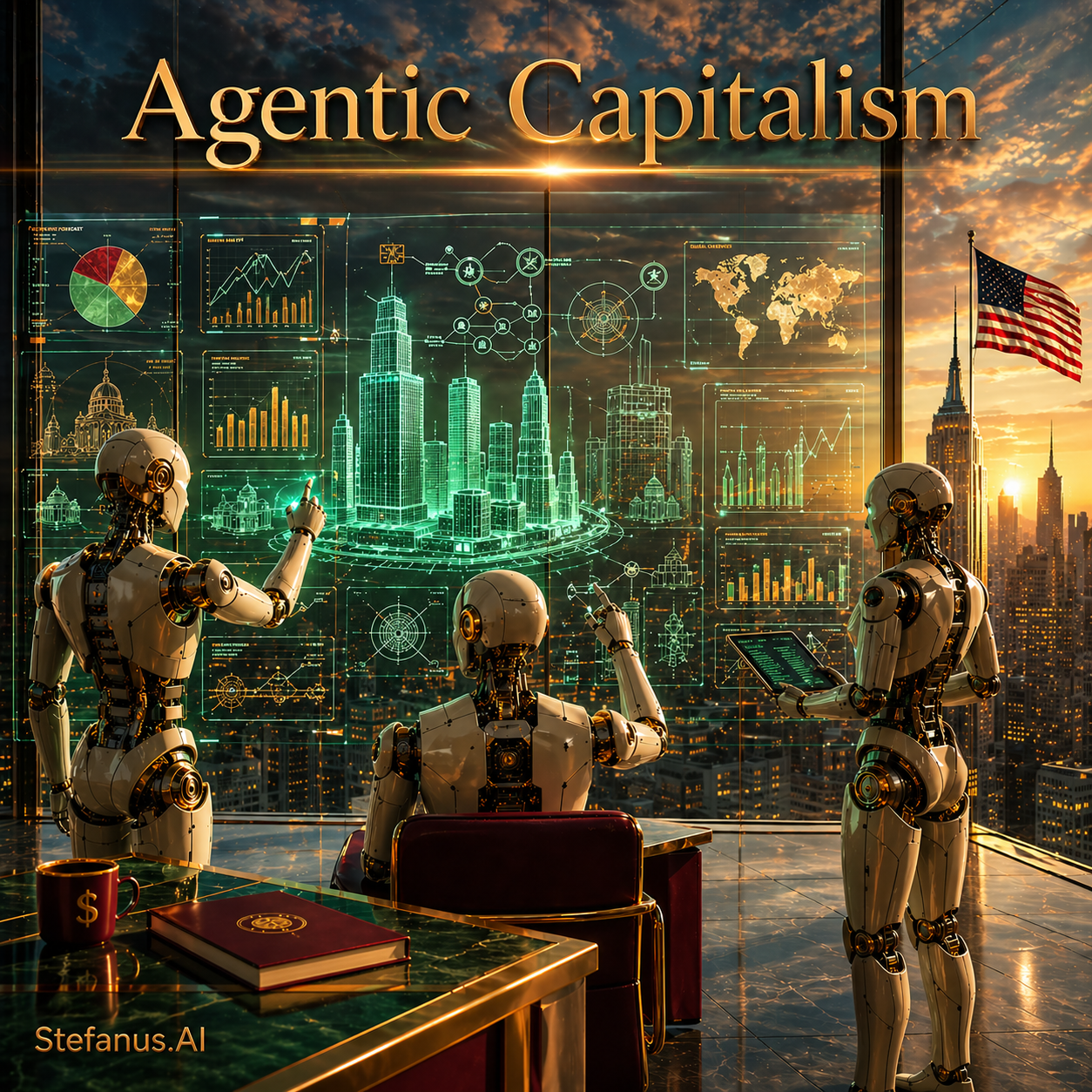
This transition marks the emergence of what can be defined as Agentic Capitalism—an economic system in which autonomous AI agents initiate actions, execute workflows, negotiate outcomes, and participate directly in value creation.
“Artificial intelligence is a general-purpose technology with impacts comparable to electricity.”¹
The analogy is precise. Electricity powered machines; AI agents increasingly determine how those machines—and the systems surrounding them—operate. This shift moves intelligence from a passive capability into an active force within the economy.
The convergence of model capability, infrastructure scale, and economic integration has accelerated this transformation. Systems developed by OpenAI, Anthropic, and Google are now embedded across enterprise and consumer environments, while infrastructure providers such as NVIDIA and Amazon Web Services enable the computational scale required to sustain them.
What emerges is not simply more powerful software, but a fundamental reconfiguration of economic participation itself.

The term Agentic Capitalism is intentionally constructed to capture a structural transformation that is often fragmented across disciplines. The word “agentic” reflects systems capable of independent action, while “capitalism” refers to the broader mechanisms of production, exchange, and value creation. Combined, they describe a system in which software is no longer an instrument of economic activity but an active participant within it.
“We are entering an era where machines can perform tasks that previously required human intelligence.”²
This statement reflects more than incremental progress. Once machines are capable of performing tasks autonomously, they begin to influence economic outcomes in ways that resemble human agency, reshaping how decisions are made and value is generated.
The framework underlying this paper—Claude, OpenAI, Gemini, Grok/xAI, Nvidia infrastructure, enterprise automation, and the emergence of a trillion-line software economy—captures a layered system where intelligence, infrastructure, and economic integration converge into a unified architecture.
At the same time, capital commitments reinforce the scale of this transition. Multi-decade infrastructure investments, including reported commitments exceeding $100 billion for AI compute capacity, indicate that firms are not experimenting with AI at the margins; they are restructuring their core economic models around it.
Section 1 — The Rise of Delegated Intelligence
To understand the significance of AI agents, it is necessary to situate them within the historical evolution of delegation. Economic systems have always relied on delegation to scale productivity, beginning with manual labor, progressing through organizational hierarchies, and eventually incorporating software to automate repetitive processes.
What distinguishes the present moment is that delegation is no longer confined to execution; it now encompasses decision-making.
“The key advance of AI is not automation, but autonomy.”³
Automation operates within predefined rules, whereas autonomy enables systems to adapt, reason, and act under uncertainty. AI agents represent this transition, allowing systems to perform multi-step tasks without continuous human supervision.
“AI systems are increasingly capable of acting in the world, not just analyzing it.”⁴
This capability transforms the structure of economic coordination. Agents can operate on behalf of individuals, enterprises, and governments, managing workflows, optimizing outcomes, and interacting with other agents in dynamic environments.
The result is a new economic primitive: delegated decision-making at scale, where millions of autonomous systems participate in shaping market outcomes simultaneously.

Section 2 — The Agentic Stack: Who Controls the System
The emergence of Agentic Capitalism is not driven by a single breakthrough but by the interaction of multiple layers within what can be described as the Agentic Stack. This structure determines where power resides and how value is captured.
1. Model Layer — Intelligence Creation
- OpenAI
- Anthropic
- Google DeepMind
This layer defines the capabilities of reasoning, language understanding, and decision-making that agents can deploy.
2. Infrastructure Layer — Intelligence Scaling
- NVIDIA
- Hyperscale data centers
- Energy systems (nuclear, grid, renewables)
“Compute is becoming a strategic resource.”⁵
This layer determines how much intelligence can exist and at what cost.
3. Platform Layer — Distribution and Integration
- Microsoft
- Amazon
- Meta
These platforms embed AI into widely used systems, shaping adoption and monetization.
4. Agent Layer — Execution Systems
- Autonomous workflows
- API-driven decision systems
- Multi-agent orchestration
This layer defines how intelligence acts within real-world environments.
5. Economic Layer — Value Capture
- Revenue models
- Labor substitution
- Capital allocation
This layer determines who ultimately benefits from the system.
Together, these layers form a tightly coupled architecture in which control is distributed but concentrated at key points of leverage, particularly in infrastructure and platform integration.

Section 3 — Anthropic & Claude: Trust as Economic Infrastructure
Within this system, Anthropic has adopted a strategy centered on trust. While competitors emphasize scale and performance, Anthropic focuses on alignment, reliability, and safety, particularly in environments where errors carry significant consequences.
“As AI systems become more capable, ensuring they are aligned with human values becomes critical.”⁶
This focus is particularly relevant in sectors such as finance, healthcare, and legal services, where the cost of failure is high. Systems that can be trusted to operate within defined constraints are more likely to be integrated into critical workflows.
Anthropic’s large-scale commitments with Amazon Web Services signal a shift in how AI is treated economically. Rather than a variable cost, AI infrastructure is becoming a long-term capital investment.
In this context, trust functions as a form of economic capital, influencing adoption patterns and shaping the distribution of value within the agentic economy.
Section 4 — OpenAI & Microsoft: The Distribution Empire
The partnership between OpenAI and Microsoft represents one of the most powerful alignments within the agentic ecosystem. OpenAI develops general-purpose intelligence, while Microsoft integrates these capabilities across its global product ecosystem.
“AI will be embedded into every product and service.”⁷
Through Copilot integration across productivity tools, operating systems, and cloud services, Microsoft has embedded AI into the daily workflows of hundreds of millions of users.
“Distribution often matters more than the underlying technology.”⁸
This strategy creates structural advantages, enabling recurring revenue streams through subscriptions, cloud consumption, and enterprise integration, while also establishing dependency within organizational workflows.
Section 5 — Google, xAI, and Nvidia: The Counterweights
The agentic ecosystem is shaped by powerful counterforces that prevent any single model from dominating.
Google leverages its integrated ecosystem, combining search, cloud infrastructure, and consumer devices to distribute AI capabilities at scale.
“AI is at the core of everything we do.”⁹
xAI, led by Elon Musk, emphasizes real-time intelligence and alternative alignment approaches.
“AI must be aligned with truth.”¹⁰
At the infrastructure level, NVIDIA occupies a central position, supplying the hardware and systems that enable the entire ecosystem.
“AI factories will produce intelligence at industrial scale.”¹¹
Nvidia’s role illustrates a critical insight: the most valuable position in the agentic economy may not be at the application layer, but at the level of enabling production itself.

Section 6 — The Economics of a Trillion-Line World
The emergence of a trillion-line software economy reflects a shift in both the scale and nature of production. Historically, software development has been constrained by human labor, limiting the volume of code that could be created.
AI fundamentally alters this constraint.
“Software development is becoming automated at scale.”¹²
As AI systems generate code, the marginal cost of production declines, leading to an expansion in supply. However, this does not eliminate scarcity; it relocates it to compute, energy, and data.
“The cost of intelligence is rapidly approaching zero.”¹³
This shift redefines economic structure, transferring value from labor-intensive processes to infrastructure-intensive systems.
Section 7 — Labor, Power, and Displacement
The rise of AI agents introduces complex dynamics within labor markets, as systems increasingly take on roles that involve decision-making and coordination.
“AI could affect nearly 40% of global employment.”¹⁴
Institutions such as the International Monetary Fund and World Bank emphasize both the opportunities and risks associated with this transformation.
“Technological change will reshape labor markets profoundly.”¹⁵
Rather than eliminating work entirely, AI agents are likely to reshape it, shifting human roles toward supervision, coordination, and exception management.

Section 8 — Policy, Power, and the New Capitalism
The expansion of AI infrastructure has transformed technological development into a matter of public policy. Energy consumption, data center deployment, and resource allocation are increasingly shaped by political decisions.
Governors such as Gretchen Whitmer, Gavin Newsom, and Greg Abbott are directly involved in decisions that influence the growth of AI infrastructure.
“The AI race is also an energy race.”¹⁶
This intersection highlights the extent to which Agentic Capitalism is embedded within broader systems of governance, regulation, and resource management.
Conclusion — When Intelligence Becomes the Economy
Agentic Capitalism represents a fundamental transformation in economic systems. As AI agents become capable of independent action, they transition from tools to participants, reshaping how value is created and distributed.
“AI will reshape the global economy more than any technology in history.”¹⁷
The trillion-line economy is not merely a quantitative milestone but a qualitative threshold marking the transition from tool-based systems to agent-driven systems.
What emerges is a new form of capitalism in which intelligence is not simply an input but an active force within the economy.
The trillion-line economy is not a milestone—it is a threshold. Beyond it lies a system where intelligence no longer assists capitalism. It becomes capitalism itself.

Footnotes
- Erik Brynjolfsson (MIT), https://www.nber.org
- Andrew Ng (Stanford), https://ai.stanford.edu
- Fei-Fei Li (Stanford), https://hai.stanford.edu
- Stuart Russell (UC Berkeley), https://people.eecs.berkeley.edu
- Financial Times, https://www.ft.com
- Dario Amodei (Anthropic), https://www.anthropic.com
- Satya Nadella (Microsoft), https://news.microsoft.com
- Ben Thompson (Stratechery), https://stratechery.com
- Sundar Pichai (Google), https://blog.google
- Elon Musk (xAI), https://x.ai
- Jensen Huang (NVIDIA), https://www.nvidia.com
- McKinsey Global Institute, https://www.mckinsey.com
- Sam Altman (OpenAI), https://openai.com/blog
- IMF Report, https://www.imf.org
- World Bank, https://www.worldbank.org
- Wall Street Journal, https://www.wsj.com
- The Economist, https://www.economist.com

Comments
[…] of enterprise software was able to unify: advanced reasoning models capable of multi-step planning; autonomous agents capable of taking action across software environments; persistent memory systems that allow […]