
Introduction: The Ghost Fleet and the Desert Blackout – The Birth of the Sky-Fiber Economy
Every infrastructural revolution has a moment when the abstraction becomes visible – when a technology that had been quietly maturing in filings, white papers, and demonstration missions is suddenly thrust into the foreground by events too large to ignore. For the transatlantic telegraph it was the exchange of messages between Queen Victoria and President Buchanan in 1858. For the internet itself it was the commercial explosion of the mid-1990s. For the Sky-Fiber Economy, that moment arrived in the first weeks of 2026, delivered not by a product launch but by two overlapping geopolitical crises that stress-tested the world’s terrestrial digital infrastructure and found it wanting.
The Ghost Fleet
In the pre-dawn hours of January 3, 2026, the United States launched Operation Absolute Resolve, a lightning strike into Caracas that suppressed Venezuelan air defenses, captured President Nicolas Maduro and his wife Cilia Flores, and transported them to New York to face narcoterrorism charges – an operation so compressed that, at two hours and twenty-eight minutes, some historians classify it among the shortest armed conflicts ever recorded.[1] The strategic aftermath, however, played out not on land but across thousands of miles of open ocean. Within seventy-two hours of the raid, at least sixteen heavily laden tankers of the so-called “ghost fleet” – sanctioned vessels operating with spoofed transponders, false registries, and flags of convenience – fled Venezuelan ports simultaneously, scattering in different directions in a deliberate attempt to overwhelm the U.S. maritime quarantine.[4]
What followed was one of the most data-intensive maritime interdiction campaigns ever conducted. U.S. naval and Coast Guard forces, coordinating across the Caribbean, the North Atlantic near Iceland, and eventually the Indian Ocean, executed back-to-back precision boardings of dark-fleet tankers such as the Skipper, the Marinera, and the M/T Sophia – vessels whose true identities had to be unmasked in real time by fusing satellite radar imagery, automatic identification system anomalies, and machine-assisted pattern-of-life analysis, often under conditions of deliberate electronic deception.[2,3] By the end of January, at least seven sanctioned tankers carrying roughly seven million barrels of crude had been seized across three oceans.[4] An interdiction campaign of this geographic breadth is, at its core, a networking problem: it requires persistent, high-bandwidth, low-latency connectivity to fast-moving assets in the emptiest regions of the planet – regions where no fiber will ever be trenched and no 5G tower will ever be raised. The connectivity layer that makes such operations possible at scale is not on the ground. It is in orbit.
The Desert Blackout
Then, on February 28, 2026, the second shock arrived. The United States and Israel launched Operation Epic Fury, a massive coordinated air campaign against Iran that killed Supreme Leader Ali Khamenei in its opening decapitation strike.[5] Iran’s retaliation was immediate, decentralized, and aimed squarely at the physical infrastructure of the U.S.-aligned Gulf: hundreds of ballistic and cruise missiles and thousands of drones struck U.S. bases, embassies, ports, refineries – and, critically for this paper, the digital backbone of the region. In early March, Iranian strikes hit Amazon Web Services facilities across the Gulf states, causing significant damage to cloud infrastructure located in the United Arab Emirates and Bahrain, while attacks on the Fujairah Oil Industry Zone, the Ruwais refinery, and Gulf port infrastructure disrupted the physical corridors along which regional fiber and power conduits run.[6] The Strait of Hormuz – through which roughly a quarter of the world’s seaborne oil and a fifth of its liquefied natural gas had flowed – was declared closed by Iranian forces on March 4, strangling the maritime arteries of an entire region and producing what the International Energy Agency characterized as the
“largest supply disruption in the history of the global oil market”
— International Energy Agency assessment of the 2026 Hormuz closure, as documented in the economic literature of the war [8]
For the multinational enterprises and military commands operating in the theater, the lesson of those weeks was not subtle. Hyperscale data centers, however hardened, are fixed coordinates on a targeting map. Subsea and terrestrial fiber conduits follow predictable, published routes through contested chokepoints. Regional cloud availability zones can be degraded not merely by cyberattack but by kinetic strike, blockade, and blackout. The Congressional Research Service, assessing the conflict for U.S. lawmakers, underscored how thoroughly the fighting had entangled energy, shipping, and communications infrastructure across the Gulf.[7] Meanwhile, the systems that degraded most gracefully during the crisis were precisely the ones with no fixed address: satellite-backhauled communications, orbital sensor networks, and space-relayed command links that treated the burning terrestrial grid as merely one path among many.
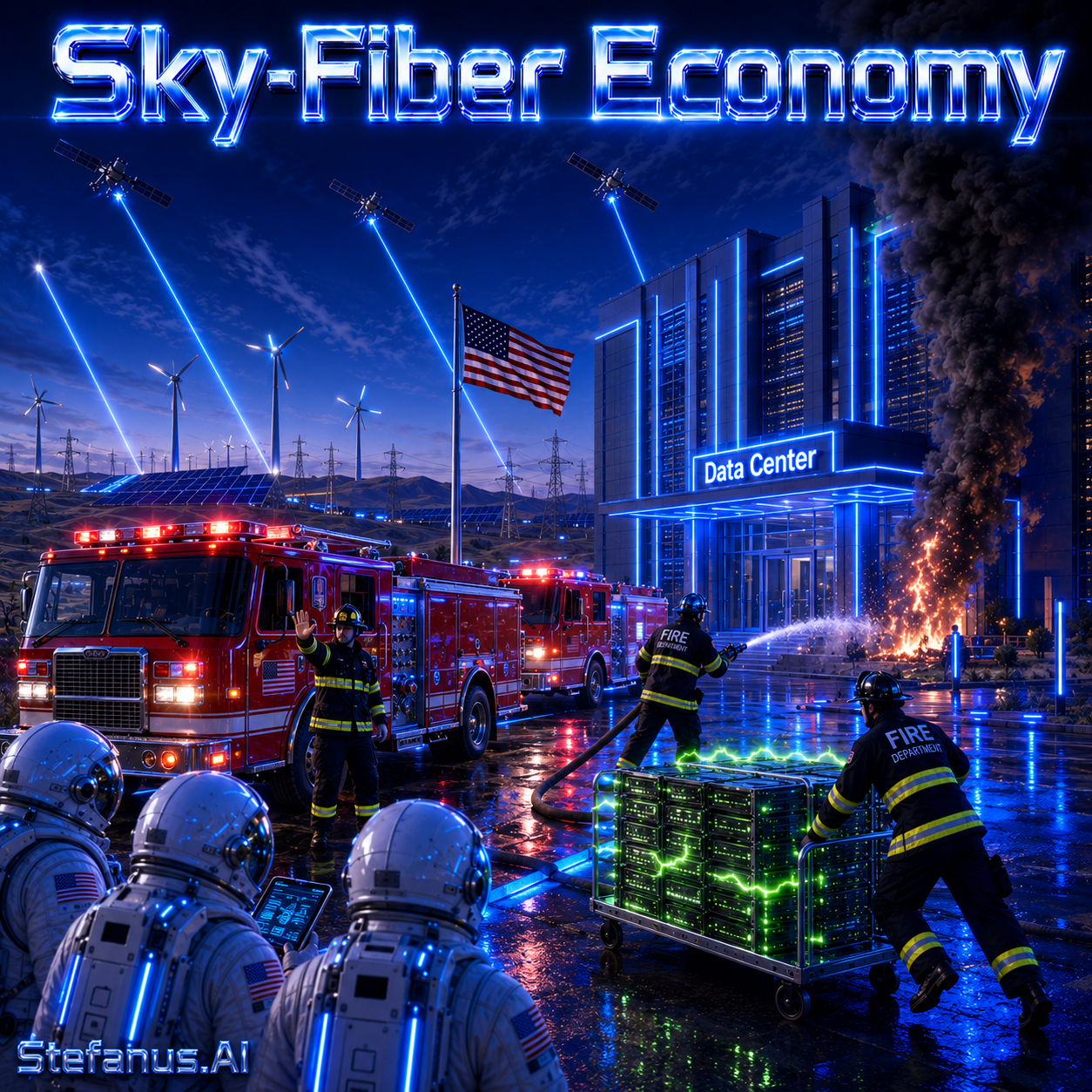
The juxtaposition of the two crises frames the thesis of this paper. In the Atlantic, an armada of autonomous and remotely coordinated maritime assets ran a continent-spanning interdiction campaign over orbital links. In the Gulf, the terrestrial cloud burned while the atmospheric backbone above it remained untouched, thousands of kilometers beyond the reach of any theater ballistic missile. The physical internet on the ground proved terrifyingly fragile; the routing mesh in the sky remained entirely unbowed.
From Consumer Space-Internet to Enterprise Infrastructure: The Paradigm Shift
For most of the 2010s and early 2020s, “satellite internet” occupied a modest mental category for technology executives: a backup link for rural households, a connectivity option for cruise ships and RVs, a lifeline for disaster zones. That category is now obsolete. The LEO constellations of 2026 are high-throughput, optically interlinked routing meshes whose latency profiles rival – and on long intercontinental paths, beat – subterranean glass; whose newest nodes carry data-center-class AI accelerators; and whose customer rosters have shifted decisively from consumers toward enterprises, cloud hyperscalers, militaries, and sovereign governments. Blue Origin’s January 2026 FCC filing for TeraWave stated the enterprise thesis in unusually direct language, warning that
“even brief network outages create unacceptable risks”
— Blue Origin, TeraWave FCC application, on government, defense, critical infrastructure, and enterprise users [15]
and positioning its 6-terabit-per-second optical constellation explicitly as a complement and competitor to terrestrial and subsea fiber for data center interconnection.[15]
Why “Sky-Fiber Economy” Is the Right Term
This paper deliberately introduces the term Sky-Fiber Economy rather than adopting the older vocabulary of “satellite internet,” “NGSO broadband,” or “space-based connectivity.” The first half of the term – Sky-Fiber – forces a re-categorization. These networks are no longer bent-pipe repeaters bouncing signals to dish antennas; they are wavelength-multiplexed, laser-interlinked optical meshes whose inter-satellite links already run at hundreds of gigabits per second, with terabit-class links in flight qualification.[12] Functionally, they are fiber routes that happen to be suspended in vacuum, four hundred kilometers overhead, moving at 7.8 kilometers per second.
The second half of the term – Economy – is chosen with equal deliberation. What is being built in low Earth orbit is not a product category but a macroeconomic layer: an infrastructure whose control determines the routing of global AI inference, the coordination of autonomous logistics, the survivability of national command systems, and, as the SpaceX IPO demonstrated in June 2026, the allocation of trillions of dollars of public-market capital.[29,31] When the interception of a smuggling fleet, the continuity of wartime cloud operations, the valuation of the largest IPO in history, and the industrial policy of three superpowers all converge on the same orbital shell, the correct unit of analysis is no longer a network. It is an economy.
Why Now: The Six Catalysts of Early 2026
The Sky-Fiber Economy did not arrive gradually; it arrived in an avalanche of announcements compressed into roughly twenty weeks. Six catalysts, each independently significant, together constitute the inflection point this paper documents.
First, the million-satellite filing. Late on January 30, 2026, SpaceX filed with the FCC for authority to launch and operate up to one million solar-powered satellites – the SpaceX Orbital Data Center System – operating between 500 and 2,000 kilometers altitude in 30-degree and Sun-synchronous inclinations, optically linked to the Starlink constellation and, through it, to the terrestrial internet.[9] The FCC Space Bureau accepted the application for filing on February 4, 2026, formally opening the largest infrastructure proposal in the history of computing to public comment.[10] The filing projected that launching a million tonnes of satellites per year could ultimately generate on the order of one hundred gigawatts of AI compute capacity, and declared flatly that
“the lowest cost to generate AI compute will be in space”
— SpaceX Orbital Data Center System application, as reported by Jeff Foust of SpaceNews [9]
Second, the SpaceX-xAI merger and the vertical integration of intelligence. Days after the filing, Elon Musk announced that SpaceX had acquired xAI in a transaction valuing the combined entity at 1.25 trillion dollars, uniting AI model development, the Colossus training supercomputer, global launch capacity, and the Starlink distribution layer under a single corporate roof – in Musk’s words,
“the most ambitious, vertically-integrated innovation engine on (and off) Earth”
— Elon Musk, announcing the SpaceX acquisition of xAI, February 2026 [11]
Third, the Blue Origin counterstroke. On January 21, 2026 – nine days before SpaceX’s filing – Blue Origin unveiled TeraWave, a 5,408-satellite constellation of 5,280 optically linked LEO satellites and 128 MEO satellites designed to deliver up to 144 gigabits per second over Q/V-band radio links and up to 6 terabits per second over optical links, purpose-built for enterprise, data center, and government customers rather than consumers.[14,15,58] In March, Blue Origin followed with Project Sunrise, an FCC application for up to 51,600 orbital data center satellites in Sun-synchronous orbits, interconnected with TeraWave.[16]
Fourth, the Amazon-Globalstar consolidation. On April 14, 2026, Amazon announced an agreement to acquire Globalstar for approximately 11.57 billion dollars at 90 dollars per share, folding Globalstar’s globally licensed L-band and S-band spectrum, its operational satellite fleet, and its direct-to-device infrastructure – including the systems powering Apple’s Emergency SOS – into Amazon Leo, the constellation formerly known as Project Kuiper.[17,18,19] The deal, expected to close in 2027, converts Amazon Leo from a broadband constellation into a vertically integrated telecommunications and cloud-edge platform stitched natively into Amazon Web Services.
Fifth, the silicon arrives. On March 16, 2026, at GTC, Nvidia announced the Vera Rubin Space-1 Module – a space-qualified variant of its flagship Rubin platform delivering up to twenty-five times the AI compute of an H100 for space-based inference – alongside space deployments of its IGX Thor and Jetson Orin platforms with partners including Axiom Space, Starcloud, Planet, Kepler Communications, Sophia Space, and Aetherflux.[20,21] CEO Jensen Huang framed the announcement in a single sentence:
“Space computing, the final frontier, has arrived”
— Jensen Huang, CEO of Nvidia, GTC 2026 keynote, March 16, 2026 [20]
Google, for its part, had already announced Project Suncatcher in November 2025 – a research program to fly its TPU accelerators on solar-powered satellite clusters linked by free-space optics, with two prototype spacecraft to launch with Planet by early 2027.[24,25]
Sixth, the capital markets ratify the thesis. On June 12, 2026, SpaceX went public on the Nasdaq in the largest IPO on record, raising 75 billion dollars at 135 dollars per share for an initial valuation of 1.77 trillion dollars; the stock surged past a two-trillion-dollar market capitalization on its first day of trading.[29,30,31] The prospectus disclosed first-quarter 2026 revenue of 4.69 billion dollars, up fifteen percent year over year, on top of 18.67 billion dollars of full-year 2025 revenue – and identified orbital data centers as a core use of IPO proceeds.[29] Days before the debut, SpaceX unveiled AI1, its first orbital compute satellite design: a 70-meter-wingspan solar platform radiating heat directly into vacuum.[56] Two secondary catalysts completed the picture: Musk’s February 8, 2026 announcement that SpaceX had shifted its colonization priority from Mars to a self-growing lunar city – a pivot that tightens the coupling between cislunar logistics and orbital industry – and the confidential IPO filings of Anthropic and OpenAI that followed within days of the SpaceX debut, confirming that the capital markets now treat AI and space infrastructure as a single, converged investment theme.[27,28,29]
Musk framed the lunar pivot in strategic terms:
“the overriding priority is securing the future of civilization and the Moon is faster”
— Elon Musk, February 8, 2026 [27]
Taken together, these catalysts justify the structure of what follows. Section 1 deconstructs the technology of the orbital backbone itself. Section 2 examines how that backbone feeds the agentic world of autonomous AI systems. Section 3 analyzes the military and remote-robotics dimension, grounded in the hard evidence of the 2026 conflicts. Section 4 confronts the vulnerabilities – regulatory, orbital-environmental, and cyber – that threaten the entire edifice. Section 5 profiles the corporate and sovereign combatants in the battle for orbital hegemony. Section 6 distills the analysis into seven structural pillars, and the conclusion issues what this paper calls the Atmospheric Manifesto.

Section 1: The New Orbital Backbone
The global telecommunications paradigm is undergoing its most radical structural shift since the laying of the first transatlantic telegraph cable in 1858. For more than a century and a half, humanity’s answer to high-throughput, long-distance data transmission has been physical trenching: burying glass and copper in the dirt, or sinking armored cable bundles onto the seabed. That approach built the modern world, but it also hard-coded the modern world’s fragility. Fiber follows geography; geography creates chokepoints; chokepoints create targets. Today the terrestrial monopoly is fracturing. Low-Earth-orbit constellations have matured from experimental consumer broadband ventures into a robust, high-performance physical layer of the global internet – and this section deconstructs, in detail, the three technological transformations that made the vacuum of low orbit competitive with, and in important respects superior to, the physics of buried glass.
1.1 The Evolution of Satellite Roles: From Bent Pipes to Flying Routers
Historically, satellite communication was defined by the geostationary (GEO) paradigm. Positioned roughly 35,800 kilometers above the equator, GEO spacecraft functioned essentially as “bent pipes” – passive orbital mirrors that received a signal from a ground station, amplified it, shifted its frequency, and bounced it back down across a broad geographic footprint. For broadcast television, weather monitoring, and thin-route telephony, the architecture was elegant. For interactive computing, it was crippled by an unavoidable tax imposed by the speed of light itself: a round trip to geostationary altitude and back consumes roughly half a second of signal propagation, typically manifesting as 500 to 700 milliseconds of user-experienced latency. No amount of engineering can negotiate with that number, because it is not an engineering artifact – it is geometry. That latency profile rendered GEO systems structurally unfit for cloud synchronization, real-time robotics, financial messaging, interactive AI inference, and every other workload that now defines enterprise demand.
The LEO revolution rewrites the geometry. Operating at altitudes between roughly 300 and 1,200 kilometers, LEO constellations shrink the physical distance a signal must travel by a factor of thirty to one hundred relative to GEO, collapsing baseline propagation delay to the range of 20 to 45 milliseconds – a latency envelope comparable to terrestrial broadband and metropolitan 5G. Starlink, the archetype of the class, now operates more than ten thousand active satellites, roughly two-thirds of every active spacecraft in orbit, and has begun lowering portions of its fleet to around 480 kilometers precisely to shave additional milliseconds and accelerate post-mission deorbit.[12,46]
Just as consequential as the altitude change is the transformation of the satellite itself. The modern LEO spacecraft is not a mirror; it is a router, and increasingly a server. Three onboard capabilities define the new class. First, onboard processing: digital payloads that demodulate, inspect, switch, and re-modulate traffic in orbit, making per-packet routing decisions rather than dumbly reflecting a waveform. Second, software-defined radios and phased-array antennas that can re-shape and re-point beam capacity in real time as demand shifts beneath the orbital plane – concentrating bandwidth over a disaster zone at noon and over a shipping lane at midnight. Third, and most recently, meaningful local compute and storage: Starcloud flew an Nvidia H100 GPU to orbit in November 2025 and trained an AI model in space the following month, and Nvidia’s Vera Rubin Space-1 module is explicitly designed to let large language models and foundation models operate directly on orbital platforms.[23,21] The satellite has completed a three-decade journey from passive reflector, to router, to flying edge server.
1.2 Replacing and Bypassing Terrestrial Fiber: Overcoming Geography and Geopolitics
Terrestrial and subsea fiber remain unmatched in raw aggregate bandwidth, and nothing in this paper should be read as predicting their disappearance. Their structural weakness is not capacity; it is immobility. Laying a new subsea cable is a multi-year, multi-hundred-million-dollar undertaking entangled in landing-rights negotiations, environmental permitting, and the politics of every jurisdiction the route touches. Once laid, the cable’s location is public, fixed, and indefensible. The global economy routes the overwhelming majority of its intercontinental traffic through a few hundred such cables, densely bundled through a handful of maritime corridors – the approaches to the Suez Canal and the Red Sea, the Strait of Malacca, the Luzon Strait, the English Channel, and the shallow, crowded Baltic. Since 2022, roughly ten subsea cables serving the Baltic region alone have been damaged in suspicious circumstances, seven of them in a single ninety-day window between November 2024 and January 2025, prompting NATO to stand up the Baltic Sentry maritime surveillance mission and the UK-led Nordic Warden AI monitoring system.[41,36,37] Section 3 returns to this story in depth; the point here is architectural. A network whose trunk lines can be severed by one dragged anchor is a network with a geometry problem.
Sky-Fiber virtualizes the trunk line out of the geometry. An optical mesh in low orbit has no landing stations to permit, no seabed to survey, no strait to transit. It passes over every jurisdiction and belongs to none of the terrain below it. For a technology leader managing a global enterprise, this collapses a distinction that has structured network planning since the dawn of the internet: the distinction between connected places and remote ones. An office tower in Manhattan, a mining autonomous-haulage operation in the Pilbara, an offshore wind farm in the North Sea, and a research vessel in the Southern Ocean now share, for the first time, an essentially identical network topology, latency profile, and security envelope. Bandwidth has been decoupled from location – a decoupling whose economic consequences Section 6 elevates to the status of a structural pillar.
1.3 The Architectural Core: Inter-Satellite Laser Links and the Optical Routing Mesh
The single breakthrough that transforms a swarm of disconnected repeaters into a coherent Sky-Fiber backbone is the optical inter-satellite link (ISL). Rather than relaying every packet down to a ground station and back up to the next satellite, modern LEO spacecraft carry laser terminal assemblies that establish point-to-point light connections with neighboring spacecraft – typically the satellite ahead in the same orbital plane, the satellite behind, and one or two satellites in adjacent planes. Each node therefore maintains three to five simultaneous laser links, and the constellation as a whole becomes a dynamic, multi-layered optical routing mesh wrapped around the entire globe. Current-generation Starlink satellites carry three laser terminals operating at up to 200 gigabits per second each, with a next generation designed to support terabit-class links; SpaceX’s orbital data center filing describes routing traffic through Starlink’s “high capacity (petabit)” laser mesh, and after Blue Origin advertised 6-terabit optical service on TeraWave, Musk publicly countered that future
“Starlink space to ground laser links will exceed this”
— Elon Musk, responding to Blue Origin’s TeraWave announcement, January 2026 [12]
[Sat A] <==== Laser ISL ====> [Sat B] <==== Laser ISL ====> [Sat C]
| |
RF / Optical Uplink RF / Optical Downlink
| |
[ Gateway Earth Station 1 ] [ Gateway Earth Station 2 ]
| |
[ Terrestrial Cloud Region ] [ Terrestrial Cloud Region ]
The operational advantages of the laser-mesh architecture are threefold, and each deserves unpacking.
The velocity of light in vacuum. In terrestrial silica fiber, light propagates at roughly two-thirds of its vacuum speed – the refractive index of glass imposes an approximately 31 to 33 percent penalty on every kilometer traveled, and real cable routes add further distance because they follow coastlines, seabed contours, and rights-of-way rather than great circles. In the near-vacuum of low orbit, light travels at its absolute physical maximum. The seminal analysis of this trade-off was published by Professor Mark Handley of University College London, whose 2018 HotNets paper and accompanying simulations of the Starlink Phase 1 constellation demonstrated that a laser-meshed LEO network can deliver
“lower latency communications than any possible terrestrial optical fiber network”
— Professor Mark Handley, University College London, on LEO laser-mesh networks over distances beyond roughly 3,000 kilometers [32,33]
Handley’s counterintuitive finding – that climbing 550 kilometers up and back down can still beat a straight run through buried glass once the path is long enough – has since been replicated and extended across the 2020-2026 literature. Professors Aizaz Chaudhry and Halim Yanikomeroglu of Carleton University, in a series of papers on free-space optical satellite networks, showed that optically meshed constellations outperform optical fiber terrestrial networks in every long-haul intercontinental scenario they simulated, with the latency advantage growing as the route lengthens, and later formalized the design of temporary laser inter-satellite links whose topology reconfigures continuously as satellites sweep along their orbital planes.[34,35] For latency-sensitive intercontinental flows – London to Singapore, New York to Tokyo, Frankfurt to Sao Paulo – the physics now favor the sky.
Dynamic packet rerouting in a moving topology. Because every node in the mesh is in motion at 7.8 kilometers per second, the topology of the Sky-Fiber network is not a fixed graph but a continuously evolving one, recomputed in software many times per minute. This is a burden that becomes a gift. A mesh that must constantly re-derive its own routing tables is a mesh with no privileged links: if a satellite suffers an anomaly, drifts for collision avoidance, or is jammed over contested territory, the routing fabric simply computes around it, in milliseconds, without human intervention. Path diversity is not an add-on to the architecture; it is the architecture.
Ultra-dense ground-station handoffs. At the boundary between sky and ground, high-throughput gateway stations use tracking phased-array and parabolic antennas to execute electronic handoffs from a setting satellite to a rising one on millisecond timescales, sustaining uninterrupted multi-gigabit pipelines directly into terrestrial hyperscaler regions and internet exchange points. Blue Origin’s TeraWave ground segment – operations centers, parabolic gateway stations, E-band feeder links, and optical terminals – is representative of the new gateway class, engineered less like a teleport and more like a data center on-ramp.[15]
The composite result is an infrastructure layer with a genuinely novel property set: fiber-class throughput on its trunk routes, better-than-fiber latency on its longest routes, coverage that includes the 71 percent of Earth that is ocean, and a topology that heals around damage by default. That property set is precisely what the next section’s protagonists – autonomous machines and AI agents – require to exist at planetary scale.

Section 2: Fueling the Agentic World
The rapid evolution of artificial intelligence has moved decisively beyond isolated models running in isolated data centers. We have entered the era of the agentic world: an environment populated by autonomous AI agents, distributed machine-learning pipelines, and vast fleets of physical robots that perceive, decide, negotiate, and act with diminishing human intervention. Nvidia’s own framing of its 2026 roadmap – the addition of what it calls “agentic scaling,” in which AI systems interact continuously with other AI systems and tools – captures the shift from AI as a product to AI as a population.[22] These systems do not merely consume data; they emit torrents of real-time telemetry, execute distributed consensus protocols, demand continuous access to frontier-scale inference, and coordinate with each other across every time zone at machine speed.
For such systems, network latency and coverage gaps are not user-experience inconveniences. They are systemic failure points. A stranded chatbot is an annoyance; a stranded autonomous cargo vessel in a shipping lane, a blinded drone swarm over a wildfire, or a logistics agent negotiating a contract on stale market state is an operational casualty. The Sky-Fiber Economy is the indispensable physical substrate of the agentic world for one architectural reason above all: it is the only network layer whose coverage, latency, and resilience envelope matches the operating envelope of the machines themselves.
2.1 Infrastructure for Autonomous Fleets and Global Edge Orchestration
True high-order autonomy – the unmanned cargo ship crossing the Atlantic, the drone logistics network threading rural terrain, the driverless long-haul truck convoy crossing desert highways, the agricultural robot fleet working land no cell tower will ever economically serve – requires machines to operate flawlessly at any coordinate on Earth. Terrestrial mobile networks are fundamentally incapable of underwriting that requirement. Cellular infrastructure is built where subscriber density justifies it, which is why it thins to nothing across deserts, tundra, high seas, and much of the developing world’s interior; it covers a minority of the planet’s land area and effectively none of its oceans. No business case will ever trench fiber to the mid-Atlantic.
The Sky-Fiber network dissolves the coverage problem by construction: a constellation is a continuous, overlapping blanket over the entire planet, and an autonomous asset under that blanket maintains an unbroken, high-bandwidth pipeline no matter where its mission takes it. Three operational capabilities follow directly. Continuous telemetry streaming allows fleets to pour high-definition LiDAR, radar, camera, and health data back into corporate digital twins for real-time safety monitoring and simulation-in-the-loop validation – the same closed sensing loop that made the Atlantic interdiction campaign of January 2026 possible for naval assets is what makes an insurable autonomous shipping industry possible for commercial ones. Dynamic route optimization lets ground-side models continuously re-plan fleet trajectories against live weather, traffic, piracy, and hazard data, pushing updated missions to millions of moving assets simultaneously. And over-the-air assurance – safety patches, perception-model updates, security rotations – can reach an entire global fleet within minutes of release, regardless of how remote any individual vehicle may be. The alternative, fleets that must wait for port calls or coverage windows to receive critical updates, is an alternative no regulator will ultimately accept.
2.2 Decentralized AI Inference and the Orbital Edge Compute Loop
Running frontier-scale AI locally on every edge device is an engineering dead end. State-of-the-art language models, multimodal perception stacks, and reinforcement-learning planners demand accelerators whose mass, power draw, and thermal load are poison to the design budgets of drones, robots, and electric vehicles. The classical answer – offload to the cloud – historically failed wherever the cloud could not be reached with acceptable latency, which was most of the physical world. The Sky-Fiber Economy dissolves this constraint by letting a remote asset treat the cloud as if it were a local component, through what this paper terms the Orbital Inference Loop.
The loop has four stages. Ingest: the edge device captures raw environmental sensor data and identifies a decision that exceeds its onboard model’s competence – an unfamiliar object class, an ambiguous negotiation, a complex multi-agent planning problem. Uplink: the query, compressed and encrypted, is beamed to the nearest Sky-Fiber satellite over Ku/Ka-band or millimeter-wave links. Process or route: the satellite either executes the inference on its own onboard accelerators – the role for which Nvidia’s Space-1 Vera Rubin module, with roughly twenty-five times the space-based inference throughput of an H100, was explicitly designed – or forwards the query across the laser mesh to the optimal terrestrial hyperscaler region.[21,22] Downlink: the refined classification, instruction, or plan returns to the asset, completing the full round trip within tens of milliseconds. The consequence is a new hardware paradigm: lightweight, energy-frugal edge platforms wielding the effective intelligence of multi-billion-parameter cloud models in near-real time.
Importantly, the industry’s own positioning of orbital compute is disciplined on this point. Nvidia has been explicit that, in the current generation,
“ODCs do not replace terrestrial data centers”
— Nvidia, clarifying the role of orbital data centers as real-time edge inference and downlink-reduction infrastructure [22]
The near-term economic logic of orbital compute is edge-first: process the flood of space-generated and remote-generated sensor data where it is created, extract the insight, and downlink kilobytes of answers instead of petabytes of raw pixels. Earth-observation constellations such as Planet – which images the entire landmass of the planet daily and is co-developing Project Suncatcher’s prototype cluster with Google – exemplify the demand pull: the bottleneck of the observation economy is no longer the camera but the downlink, and the cure for a downlink bottleneck is orbital inference.[25,26] The longer-term logic, argued in SpaceX’s and Blue Origin’s data center filings and in Google’s Suncatcher research program, extends the same principle to training itself, powered by near-continuous solar energy in Sun-synchronous orbit.[9,16,25] Google CEO Sundar Pichai, while candid about the unsolved engineering, has predicted that orbital facilities will come to be seen as
“a more normal way to build data centers”
— Sundar Pichai, CEO of Google, on the decade-scale trajectory of orbital data centers [26]
2.3 Global Agentic Systems and Machine-to-Machine Networks
As software agents assume management of logistics chains, financial operations, industrial procurement, and infrastructure orchestration, the dominant communication pattern of the internet is shifting from human-to-machine to machine-to-machine. These agents do not operate in isolation; they bargain, coordinate, verify, and transact with other agents continuously, globally, and at latencies where milliseconds carry economic weight.
Consider a concrete composite: an AI logistics agent optimizing a single containerized shipment in the post-Hormuz-closure trade environment of mid-2026, when rerouted shipping and fertilizer, energy, and grain disruptions rippled through every supply chain.[7,8] To commit the shipment, the agent must concurrently verify inventory in a Hamburg warehouse system, confirm live vessel positions in the Pacific, negotiate a smart-contract customs pre-clearance with an automated broker in Singapore, re-price war-risk insurance against the latest maritime advisories, and hedge the fuel leg on an exchange – five jurisdictions, five counterparties, one decision window. The Sky-Fiber mesh serves as the universal high-speed fabric for exactly this class of distributed agentic coordination: by routing optical packets through vacuum along near-great-circle paths, it strips out the regional routing detours, congested internet exchanges, and national firewall traversals that encumber transcontinental requests on the terrestrial internet. The end state is thousands of autonomous agents synchronizing state and executing transactions with deterministic, low-jitter global latency – the connective tissue of a genuinely friction-reduced, machine-driven marketplace, and the reason this paper insists that the Sky-Fiber layer is not an accessory to the AI economy but its circulatory system.

Section 3: Military AI, Remote Robotics, and the Doctrine of Orbital Resilience
The intersection of national security and advanced automation has produced a new era of distributed warfare and remote operations. Modern defense doctrine no longer centers on massive, fixed installations; it depends on agile, data-saturated, highly automated forces operating at the absolute edge of infrastructure – and, as 2026 demonstrated, sometimes far beyond it. In parallel, civilian industry is deploying remote robotics into environments too hazardous, too distant, or too expensive for human presence: deep-sea infrastructure repair, offshore energy, mine clearance, and long-range telemedicine. Both paradigms share one non-negotiable dependency: an ultra-low-latency, jam-resistant, structurally resilient communications backbone that survives the loss of any individual node, gateway, or region. This section examines how the Sky-Fiber Economy has become that backbone – first in doctrine, then in the unforgiving empirical test of the year’s two wars.
3.1 Tactical Edge Networking and Sensor Fusion in Contested Environments
Battlefield communications historically relied on line-of-sight radio networks and legacy GEO satellite links, and both architectures carry fatal flaws into peer-level conflict. Tactical radio is hostage to terrain and range; GEO links are few, geosynchronously parked, trivially targeted for jamming, and bandwidth-starved relative to the sensor output of a modern force. A single high-altitude reconnaissance drone can generate more raw sensor data in an hour than an entire Cold War corps produced in a week; multiply that by swarms, by satellite constellations, by every rifle-squad’s devices, and the result is a data tsunami that legacy pipes cannot move and forward-deployed processing cannot absorb.
The Sky-Fiber architecture introduces a different model, which this paper calls Orbital Sensor Fusion. Raw telemetry from dispersed collectors – drones, ships, aircraft, ground sensors – is beamed upward through directional, low-probability-of-intercept links into the LEO mesh; routed across space at vacuum light-speed to hardened processing, whether onboard orbital accelerators or onshore military data centers; fused by AI models with overhead radar, signals intelligence, and archival pattern-of-life data; and returned to shooters and decision-makers as ranked, actionable target intelligence, with end-to-end cycle times measured in tens of milliseconds. The doctrinal ambition is what U.S. planners call the kill-web: a mesh of sensors and effectors so densely and rapidly interconnected that it operates permanently inside an adversary’s decision cycle. The Venezuelan interdiction campaign of January 2026 was an early public glimpse of the model at work – a hemispheric hunt for transponder-spoofing tankers, prosecuted across three oceans in weeks, of which U.S. Southern Command’s pre-dawn helicopter boarding of the stateless tanker Sophia, guided by fused surveillance across the entire Caribbean basin, was emblematic.[2,3,4]
3.2 Teleoperation and Remote Robotics: Breaking the Haptic Lag Barrier
In both military and civilian domains, human presence in hazardous environments is steadily being replaced by robotic proxies under remote control: explosive-ordnance-disposal platforms, deep-sea repair submersibles working on the very cables whose vulnerability this paper documents, remote surgical systems serving field hospitals and isolated communities. The perennial limiting factor of high-fidelity teleoperation is the haptic lag barrier. Human sensorimotor control degrades sharply as round-trip feedback delay grows; for delicate manipulation – and above all for telesurgery – the operational literature converges on a round-trip budget on the order of 100 milliseconds, beyond which operators over-correct, disorient, and fail. GEO’s half-second geometry made planetary-scale teleoperation physically impossible. LEO’s 20-to-45-millisecond geometry makes it routine.
[ Operator Console ] –(Uplink ~20ms)–> [ Sky-Fiber Mesh ] –(Downlink ~20ms)–> [ Remote Robot ]
^ |
| |
+—————- ( Haptic + Video Feedback Loop: < 80ms total ) ————–+
Because optical signals cross the vacuum faster than they cross buried glass, and because the mesh routes near-great-circle paths rather than following seabed contours, an operator in San Diego can now manipulate a hazardous-materials robot on a Pacific atoll, or a submersible on a mid-ocean cable fault, with stable force feedback – collapsing the geography of high-precision manual labor in the same way the container collapsed the geography of freight. The economic implications reach far beyond defense: a single expert surgeon, welder, or bomb-disposal technician becomes a globally schedulable resource.
3.3 Geopolitical Resilience I: The Subsea Cable Threat Made Manifest
The modern global economy is startlingly reliant on a small number of physical chokepoints. The overwhelming majority of international data traffic – commonly estimated at well over ninety-five percent – travels through a few hundred subsea fiber-optic cables resting, unguarded, on the ocean floor. The Baltic theater has furnished a running natural experiment in what happens when those cables become instruments of gray-zone conflict. Roughly ten regional cables were damaged in suspicious circumstances between 2022 and early 2025, including the Balticconnector incidents attributed to the Chinese-flagged Newnew Polar Bear, the Estlink 2 power-cable cut for which Finland seized the shadow-fleet tanker Eagle S, and successive ruptures of data links joining Finland, Estonia, Sweden, Lithuania, Latvia, and Germany.[60,41,38,39] Eleven damaged cables in fifteen months pushed NATO, in January 2025, to launch the Baltic Sentry mission – frigates, maritime patrol aircraft, and naval drones surveilling the sea lanes above the cables – while the alliance’s Secretary General, Mark Rutte, compressed the strategic assessment into three words:
“Hybrid means sabotage”
— Mark Rutte, Secretary General of NATO, on the Baltic cable ruptures [36]
The leaders of NATO’s eight Baltic littoral states issued a joint statement declaring themselves
“determined to deter, detect and counter any attempts at sabotage”
— Joint statement of NATO’s Baltic Sea allies at the launch of Baltic Sentry, January 2025 [38]
Two features of the Baltic experience matter for this paper’s thesis. The first is attribution ambiguity: courts and intelligence services have repeatedly found it impossible to prove intent, with Finnish judges dismissing charges against the Eagle S crew for lack of attributable evidence – which is precisely what makes seabed warfare attractive to its practitioners and undeterrable by legal means alone.[39] The second is NATO’s own hedging response: alongside Baltic Sentry, the alliance launched Project HEIST, an explicit program to divert high-priority data traffic from undersea cables to satellites in the event of a rupture – a formal doctrinal admission that the Sky-Fiber layer is now the designated survivor of the alliance’s data architecture.[40] Analysts have correctly noted the catch-22 embedded in that hedge: a backup layer in orbit is itself a target in orbit, a point to which Section 4 returns.[40]
3.4 Geopolitical Resilience II: The Lessons of the 2026 Gulf War
If the Baltic was the laboratory, the 2026 Iran war was the full-scale demonstration. When Operation Epic Fury opened on February 28 and Iran answered with theater-wide missile and drone barrages, the digital infrastructure of the Gulf became a battlespace in the most literal sense. Iranian strikes damaged Amazon Web Services facilities in the United Arab Emirates and Bahrain; drone and missile attacks set fire to the Fujairah Oil Industry Zone and forced the shutdown of the Ruwais refinery; U.S. diplomatic and military installations across the region absorbed repeated hits; and the closure of the Strait of Hormuz from early March strangled the physical logistics – fuel, spares, personnel – on which terrestrial infrastructure repair depends.[6,7] For weeks, portions of the region’s earth-bound cloud were degraded, isolated, or dark, and roughly two thousand ships and twenty thousand mariners sat stranded inside a closed sea.[7]
[ Iranian Missile / Drone Barrages ] —> degrade —> [ Gulf Terrestrial Cloud + Fiber ]
|
+———————————————————–+
v
[ Automated Failover Protocols ] —> [ LEO Sky-Fiber Optical Routing Mesh ]
|
+—————————+
v
[ Cloud-State Continuity via Distant Secure Gateways ]
The infrastructure that did not degrade was the layer with no coordinates to strike. Orbital communications continued to pass over the theater at 7.8 kilometers per second, indifferent to the closure of the strait beneath them; traffic that had terminated in damaged regional facilities was re-homed through the mesh to gateways and cloud regions thousands of kilometers from the combat zone. The architectural lesson generalizes far beyond one war. A LEO constellation of thousands of fast-moving, optically interlinked nodes has no single geographic point of failure: destroying any one satellite removes a router the mesh routes around; destroying a ground gateway removes an off-ramp the mesh replaces with the next gateway along the orbit. Even the wholesale loss of a region’s ground segment leaves the constellation’s internal laser mesh able to carry traffic entirely in space until it finds a secure, operational gateway elsewhere on the planet. By elevating and virtualizing the physical layer of the internet, the Sky-Fiber Economy provides nations and enterprises with something terrestrial engineering cannot: an infrastructure whose survivability is a property of its geometry rather than of its fortifications. That is why the same months that burned the Gulf’s data centers also accelerated every orbital program on Earth – and why Section 4 must now examine, with equal honesty, the ways in which this supposedly invulnerable layer is itself alarmingly fragile.

Section 4: Vulnerabilities and Governance in the Orbital Commons
The rapid expansion of the Sky-Fiber Economy has delivered unprecedented connectivity and computational reach, but it has simultaneously created one of the most fragile, contested, and under-governed operating environments in the history of infrastructure. Precisely because the orbital backbone now underwrites global AI, military command, and autonomous transit, it has become a prime target for adversaries and a prime generator of systemic risk. Honest analysis requires holding two truths at once: the Sky-Fiber layer is the most resilient network humanity has built against terrestrial disruption, and it is exposed to failure modes – legal, physical, and cyber – that terrestrial networks never faced. This section analyzes the three existential threat vectors in turn.
EXISTENTIAL THREAT VECTORS TO THE SKY-FIBER ECONOMY
|
+——————————+——————————+
| | |
v v v
[ Regulatory Anarchy ] [ Orbital Debris / Kessler ] [ Edge Cyber-Vulnerability ]
– Spectrum congestion – Hypervelocity impacts – TT&C signal injection
– Landing-rights walls – Cascade collisions – Supply-chain implants
– Weaponized licensing – Dead-router derelicts – Ground gateway attack
4.1 Regulatory Anarchy: Spectrum Wars, Sovereignty Walls, and Weaponized Licensing
The greatest near-term barrier to a frictionless Sky-Fiber Economy is not engineering but law. The foundational instrument of space law, the Outer Space Treaty of 1967, was drafted for an era of a few dozen state-owned spacecraft; it never contemplated private corporations filing for constellations of a million nodes, and it offers essentially no traffic-management, liability-allocation, or spectrum-adjudication machinery adequate to the present. Into that vacuum, three destructive dynamics have rushed.
The first is spectrum congestion and paper satellites. The radio bands that connect Earth to orbit – Ku, Ka, Q/V, and E – are finite, and the International Telecommunication Union’s first-come priority regime rewards speculative mass filings. The scale of the resulting land-rush is difficult to overstate: counting the SpaceX orbital data center application, astronomers tracking the filings estimate roughly 1.7 million satellites now proposed worldwide, while China has filed ITU paperwork associated with constellations totaling on the order of two hundred thousand satellites – filings widely interpreted as spectrum and orbital-plane reservation rather than concrete deployment plans.[42,12] Professor Peter Plavchan of George Mason University identified the underlying game succinctly, calling the million-satellite filing
“the ultimate first-mover territorial claim strategy in lieu of off-world space regulations”
— Professor Peter Plavchan, George Mason University [42]
The second dynamic is the collision between national sovereignty and orbital ubiquity. A LEO satellite passes over every country on Earth indiscriminately, which authoritarian information-control regimes correctly perceive as an existential challenge. The response has been the erection of landing-rights walls: legal requirements that operators geofence or disable service over national territory unless traffic is routed through state-controlled, monitored gateways. The Sky-Fiber map is thus being partitioned not in orbit but at the gateway layer, where sovereignty can still bite – and every partition subtracts from the ubiquity that gives the architecture its value.
The third dynamic is the weaponization of licensing itself. Domestic regulators have become instruments of industrial policy, and 2026 supplied a vivid case study: on March 6, Amazon’s satellite division formally petitioned the FCC to reject SpaceX’s million-satellite application while simultaneously seeking accommodations for its own systems; the FCC chair publicly criticized Amazon within days; and Blue Origin answered on March 19 by filing Project Sunrise’s 51,600 satellites – three of the most powerful companies on Earth conducting strategy through a licensing docket.[59,16] When market access, spectrum priority, and orbital real estate are allocated through adversarial regulatory combat rather than coherent international rule-making, the predictable end state is the splintering of the sky into protected, mutually suspicious orbital-economic blocs – the exact opposite of the seamless global mesh the technology makes possible.
4.2 The Space Debris Crisis and the Shadow of the Kessler Cascade
The physical layer of the Sky-Fiber Economy operates in an environment that punishes error with permanence. Objects in low orbit travel at roughly 7.8 kilometers per second – about 17,500 miles per hour – at which velocity a paint fleck strikes with the energy of a rifle round and a stray bolt with that of a grenade. A single impact on a satellite’s optical terminal assembly does not degrade a link; it deletes a router, and converts it into shrapnel. The nightmare scenario, articulated by NASA scientist Donald Kessler in 1978 and now discussed in regulatory filings rather than academic seminars, is the cascade: a collision whose debris causes further collisions, whose debris causes further collisions, until entire orbital shells become unusable for generations.
[ Active Sky-Fiber Satellite ] –> collision –> [ Cloud of 10,000+ hypervelocity shards ]
|
+——————————————————+
v
[ Cascade destruction across adjacent planes ] –> [ Orbital shell inoperable for decades ]
The empirical trend lines justify the alarm. In the past decade the active satellite population has grown from roughly one thousand to more than fourteen thousand, two-thirds of it Starlink; SpaceX disclosed to the FCC that its constellation performed approximately three hundred thousand collision-avoidance maneuvers in 2025 alone; and the proposals now on file contemplate another factor-of-one-hundred increase.[43,44] Jonathan McDowell – the Harvard-Smithsonian astrophysicist whose satellite catalog is the de facto public ledger of the orbital population, and now a space-sustainability analyst at the Center for Space Environmentalism – reacted to the million-satellite filing with undisguised incredulity:
“A million satellites, are you kidding me?”
— Dr. Jonathan McDowell, astrophysicist and space sustainability analyst [43]
McDowell’s quantitative point is the one that matters for infrastructure planners: a hundred-fold increase in population implies, absent perfect station-keeping, an increase on the order of ten-thousand-fold in close approaches, layered on top of Chinese filings for further hundreds of thousands of satellites in overlapping shells, operated by parties with a documented history of poor coordination with one another.[42,43] His prescription is equally concrete – he argues that a constellation at this scale
“will absolutely be required to have a fleet of tow-truck satellites to remove failed ones to avoid Kessler”
— Dr. Jonathan McDowell, on active debris removal as a licensing condition for megaconstellations [44]
Three specific debris dynamics bear directly on Sky-Fiber network engineering. First, autonomous maneuver overhead: every evasion burn spends propellant, shortens spacecraft life, and momentarily drags a node out of its optimal slot, injecting latency jitter into the mesh – collision avoidance is now a line item in link-budget planning. Second, the post-mission disposal failure rate: regulations require deorbit within five years of mission end, but hardware failures routinely leave several percent of decommissioned units unresponsive, and each dead router is a multi-hundred-kilogram uncontrolled projectile drifting through active networking planes. Third, the atmosphere as crematorium: the disposal pathway itself – burning satellites up on reentry – is depositing aluminum oxides and other combustion products into the upper atmosphere at rates whose ozone and climate consequences scientists are only beginning to quantify, with researchers warning that scaling reentries a hundred-fold means, by dark-sky consultant John Barentine’s calculation, a spacecraft reentering every three minutes.[46,47] The academic community’s collective verdict is sober rather than hysterical. Professor Aaron Boley of the University of British Columbia, co-director of the Outer Space Institute, noted that researchers were already
“very worried about maintaining a healthy orbital environment”
— Professor Aaron Boley, University of British Columbia, on the transition to a ten-thousand-satellite sky – before the million-satellite era [46]
while others in the academy are building rather than only warning: public-policy scholar Karthik Kannan of the University of Arizona, whose AZSCI project studies how to construct orbital data centers safely and sustainably, frames the same moment as opportunity –
“Innovation in space is the next frontier”
— Professor Karthik Kannan, University of Arizona [45]
The governance conclusion is inescapable: the Sky-Fiber Economy’s greatest long-term threat is not a competitor’s constellation but the commons itself. Debris mitigation, active removal, maneuver-coordination protocols, and reentry-emissions science are not environmental garnish on the orbital economy; they are its load-bearing walls.
4.3 Cybersecurity of Distributed Space Architectures: Protecting the Flying Edge
By evolving from analog mirrors into software-defined routers and servers, Sky-Fiber satellites have inherited the entire vulnerability matrix of terrestrial data centers – and then amplified it with the unique constraints of space operations. A terrestrial core router lives behind fences, guards, and biometric doors; a satellite is an exposed, physically unreachable, wirelessly administered computer that flies over every adversary on Earth sixteen times a day, cannot be patched with a screwdriver, and must survive on whatever security assumptions were welded into it before launch. Three attack surfaces dominate the threat model.
Signal-injection and TT&C exploitation. Command-and-control of a satellite flows over radio. An adversary with sufficiently capable electronic-warfare arrays who can reverse-engineer, steal, or spoof telemetry, tracking, and control credentials does not merely eavesdrop – it potentially owns the spacecraft: its propulsion, its pointing, and its routing tables. A hijacked router in the mesh can silently drop, delay, or misdirect traffic of national significance while presenting nominal telemetry to its operator. The defense – cryptographic agility, authenticated command uplinks, anomaly detection on the bus itself – must be engineered for a platform that may fly for years without physical access.
Supply-chain and firmware poisoning. Megaconstellation economics demand commercial-off-the-shelf components procured through sprawling global supply chains, and every COTS part is an opportunity for a state-sponsored implant. A hardware trojan or poisoned firmware image installed before launch can lie dormant through years of nominal operation and then be triggered to intercept inter-satellite laser traffic or corrupt routing state – an attack that leaves no trace on any terrestrial monitoring network because it never touches one. The 2020-2026 security literature has responded with proposals for cross-layer fingerprinting of inter-satellite links and physical-layer attack detection in dense LEO constellations, but the field is young and the fleet is launching faster than the defenses are maturing.
Ground-gateway attack. The most conventional vector remains the most likely: the gateway stations where the sky-mesh touches the terrestrial internet are frequently sited in remote regions for line-of-sight and spectrum reasons, and a synchronized physical or cyber assault on a region’s gateways can sever that region from the mesh even while every satellite overhead remains healthy – forcing traffic to bottleneck toward surviving entry points, in a mirror image of the subsea chokepoint problem the architecture was built to escape. The Gulf war’s demonstration that regional ground infrastructure is targetable applies with full force to teleports. Gateway diversity, inter-gateway failover at the mesh layer, and direct-to-user optical downlinks are therefore not performance features; they are the continuation of Section 3’s resilience story by other means.

Section 5: The Geopolitical and Corporate Battle for Orbital Hegemony
The Sky-Fiber Economy is not a decentralized utopia; it is one of the most fiercely contested battlegrounds in modern industrial history. Because control over the orbital layer translates directly into leverage over global AI routing, sovereign data security, autonomous commerce, and military command resilience, the buildout has polarized into a struggle between entrenched American corporate titans, cloud hyperscalers, and state-backed national champions – each racing to capture orbital shells, spectrum priority, launch capacity, and enterprise customers before the others can. This section profiles the combatants as they stood at mid-2026, incorporating financial disclosures through the first quarter of the year.
| Operator / Bloc | Constellation | Scale (mid-2026 status) | Strategic Posture |
| SpaceX / xAI (US) | Starlink + Orbital Data Center System | 10,000+ active satellites; up to 1M compute satellites filed | Velocity leader; vertically integrated launch, network, AI, and capital after record IPO |
| Amazon (US) | Amazon Leo (ex-Kuiper) + Globalstar | Hundreds launched; thousands planned; $11.57B Globalstar deal | Cloud-integration play; AWS-native orbit-to-region networking and direct-to-device |
| Blue Origin (US) | TeraWave + Project Sunrise | 5,408 filed (TeraWave); 51,600 filed (Sunrise); first launches target Q4 2027 | Enterprise optical backbone at 6 Tbps; orbital data center layer |
| China (state bloc) | Guowang + Qianfan (+ Honghu-3 et al.) | ~350 launched across both; 28,000+ approved; ITU filings far larger | Sovereign dual-use network for BeiDou-integrated autonomy, BRI export, and military resilience |
| European Union | IRIS2 (SpaceRISE: SES, Eutelsat, Hispasat) | 290 satellites contracted (272 LEO + 18 MEO); first launches 2029 | GDPR-grade sovereign secure fabric; quantum-ready government communications |
| Legacy enterprise | Eutelsat OneWeb, Telesat Lightspeed, Iridium | OneWeb ~648 at 1,200 km; Lightspeed delayed; consolidation pressure rising | B2B backhaul specialists; acquisition targets in a consolidating market |
5.1 The Corporate Megaconstellations: Monetizing the Sky
SpaceX / Starlink – the velocity leader. Operating the largest constellation in human history – more than ten thousand active spacecraft, roughly two-thirds of everything alive in orbit – SpaceX enters the Sky-Fiber era with an advantage no rival can currently replicate: it owns the launch layer.[44,46] Falcon 9’s cadence and Starship’s promised hundred-plus-tonne payloads give SpaceX a cost-per-kilogram and an iteration speed that convert regulatory approvals into orbital hardware faster than competitors can convert filings into review queues. The business has scaled with the fleet: the IPO prospectus disclosed 18.67 billion dollars of 2025 revenue, up thirty-three percent, and Q1 2026 revenue of 4.69 billion dollars, up fifteen percent year over year – with Starlink identified as the company’s largest and only profitable segment.[29,31] The June 12 IPO priced at a 1.77-trillion-dollar valuation, surged past two trillion on debut, and crowned Musk as the first trillionaire on record; company president Gwynne Shotwell, long a skeptic of going public, conceded that the moment
“actually feels like the right time”
— Gwynne Shotwell, President and COO of SpaceX, on the June 2026 IPO [30]
Yet the valuation itself is a referendum on the Sky-Fiber thesis rather than on present cash flows, and serious analysts have said so plainly. Telecom analyst Tim Farrar warned that
“The core Starlink business is not particularly supportive of a $1.5 trillion valuation”
— Tim Farrar, telecom analyst, on the speculative weight carried by orbital data centers and Starship in SpaceX’s valuation [13]
while Quilty Space’s Kimberly Siversen Burke catalogued the open questions on orbital compute as a near-term revenue line: unproven economics, rapidly aging chips in a hard-to-service environment, latency trade-offs, and a use-case set still concentrated in defense, remote sensing, and sovereign compute.[13] Independent telecom engineers add that Starlink’s cost structure remains opaque, with high depreciation baked into a fleet whose members live roughly five years before their fiery disposal.[57] The bull case and the bear case, in other words, are the same fact viewed from opposite sides: SpaceX has wagered the largest IPO in history on the proposition that the sky is the next data center.
Amazon Leo – the cloud-integration play. Amazon’s orbital strategy centers on the asset no space company can match: the world’s largest cloud. Rebranded from Project Kuiper to Amazon Leo in late 2025 as it transitioned from R&D to commercial deployment, the constellation is being sold less as connectivity than as AWS with an orbital on-ramp – enterprise traffic entering the mesh at a remote site and exiting inside an AWS region without ever traversing the public internet, with early customers including Delta Air Lines, AT&T, Vodafone, Australia’s National Broadband Network, and NASA.[17,19] The Globalstar acquisition supplies the missing pieces: globally licensed mobile-satellite spectrum across more than 120 countries, operational L/S-band infrastructure, the satellite backbone behind Apple’s Emergency SOS, and a 2028 pathway to a next-generation direct-to-device system delivering voice, data, and messaging straight to standard phones.[17,18,19] Where SpaceX integrates vertically through launch and AI, Amazon integrates horizontally through cloud and device reach – two different theories of where the profit pool of the Sky-Fiber Economy will sit.
Blue Origin – the optical backbone and the second data center bid. Blue Origin’s January 2026 TeraWave announcement staked out the segment the consumer players had left open: pure high-end enterprise backhaul. With 5,280 LEO satellites delivering up to 144 gigabits per second per customer over Q/V-band and 128 optically linked MEO satellites delivering up to 6 terabits per second, TeraWave is engineered for tens of thousands of data center, government, aviation, and defense customers rather than millions of households – a symmetric, SLA-grade complement to fiber, with first launches targeted for late 2027 on New Glenn.[14,15,58] The March Project Sunrise filing for up to 51,600 orbital data center satellites – interconnected with TeraWave and aimed squarely at the AI compute market – confirmed that Bezos intends to contest not just the network layer but the compute layer, setting up a direct collision with SpaceX’s million-satellite application inside the same FCC docket.[16,59]
The silicon and software layer – Nvidia, Google, and the startup swarm. Beneath the constellation owners, a second stratum of the Sky-Fiber Economy is forming around those who supply its intelligence. Nvidia’s Vera Rubin Space-1 module, IGX Thor, and Jetson Orin platforms give every orbital operator a common accelerated-computing substrate, already adopted by Aetherflux, Axiom Space, Kepler Communications, Planet, Sophia Space, and Starcloud – the last of which flew the first H100 to orbit and filed its own application for an 88,000-satellite compute constellation.[21,23,16] Google’s Project Suncatcher, with its radiation-tested Trillium TPUs, its published system-design research, and its 2027 two-satellite prototype mission with Planet, represents the most methodical of the hyperscaler programs – a research-first bet that launch prices falling toward 200 dollars per kilogram in the mid-2030s will make orbital compute cost-competitive with terrestrial energy on a per-kilowatt-year basis.[24,25,26] It must be recorded, in fairness, that prominent skeptics remain: OpenAI’s Sam Altman has derided orbital data centers, short sellers have called them peak insanity, and Gartner analysts urge caution – a reminder that the Sky-Fiber compute layer, unlike the Sky-Fiber network layer, has yet to prove its unit economics.[23]
5.2 The Sovereign Blocs: Splitting the Global Commons
China’s national net: Guowang and Qianfan. Beijing has mobilized state-owned enterprise, municipal capital, and its expanding launch complex to field a sovereign counterweight to the Western constellations. Guowang – literally “national network,” filed at the ITU for roughly 13,000 satellites in two shells – is operated with notable secrecy and explicit dual-use intent; analysis of the program documents both its role in countering Starlink and reported testing of the network for military targeting applications, and its deployment ramp calls for 310 satellites in 2026, 900 in 2027, and 3,600 per year from 2028.[50,48] Qianfan (“Thousand Sails”), backed by the Shanghai municipal government and the Chinese Academy of Sciences, targets 15,000 satellites by 2030 with a commercial, export-facing orientation – trial service agreements already span Brazil, Malaysia, Kazakhstan, and Turkey, marketing space-based connectivity along the Belt and Road explicitly outside Western-controlled internet exchanges.[49,48] Deployment has been bumpier than the plans: Qianfan paused for months in 2025 after thruster and gyroscope failures stranded satellites, resuming in April 2026 and reaching 182 spacecraft by early June against Guowang’s 168, while Western analysts note that both programs nonetheless scaled faster than any non-Starlink Western equivalent at the same stage.[49,51] Combined with additional constellations such as Honghu-3 and the Three-Body Computing constellation – China’s own orbital-compute program – the Chinese bloc’s approved plans exceed 28,000 satellites, with ITU reservations far larger, integrated by design with BeiDou navigation to feed Chinese autonomous-driving fleets, industrial robotics, and military coordination across East Asia and the Global South.[49,50]
The European Union’s IRIS2 – sovereignty by constellation. Europe’s answer is IRIS2 (Infrastructure for Resilience, Interconnectivity and Security by Satellite), a 10.6-billion-euro multi-orbit system of 290 satellites – 272 in LEO at 1,200 kilometers and 18 in MEO – contracted in December 2024 to the SpaceRISE consortium of SES, Eutelsat, and Hispasat, with a supporting industrial team spanning Thales Alenia Space, Airbus, OHB, Telespazio, Deutsche Telekom, and Orange.[52,53] Its mandate is unapologetically political: encrypted governmental communications, crisis-response channels, critical-infrastructure protection, and a GDPR-compliant, quantum-cryptography-ready routing layer immune to foreign corporate or political whim, with first launches targeted for 2029 and Commissioner Andrius Kubilius publicly pressing for acceleration at the 2026 European Space Conference.[54,52] Eutelsat chief executive Eva Berneke framed the program as the embodiment of
“Europe’s commitment to digital sovereignty, resilience, and strategic autonomy”
— Eva Berneke, CEO of Eutelsat, on the IRIS2 program [53]
The program’s strategic urgency was sharpened by the Ukraine experience, where European governments found themselves financing alternatives to Starlink for a wartime partner and confronting the uncomfortable arithmetic of dependence on a single foreign commercial operator for battlefield connectivity.[52]
The enterprise specialists and the consolidation wave. Around the giants, the specialist tier is being squeezed and acquired. Eutelsat OneWeb operates its 648-satellite fleet in a higher 1,200-kilometer polar orbit as a wholesale, government-and-enterprise backhaul business folded into the IRIS2 industrial base; Canada’s Telesat Lightspeed, a purpose-built B2B constellation for Tier-1 telcos and hyperscalers, has fought repeated delays and funding challenges; and Iridium’s 66-satellite fleet is now openly discussed as an acquisition target for cloud and technology companies seeking instant orbital infrastructure.[55] The Globalstar sale to Amazon is best understood as the opening transaction of this consolidation wave, not its conclusion: the capital intensity of constellation replacement cycles – fleets that must be entirely rebuilt every five to seven years – is an economic gravity well that only the largest balance sheets, or the state, can escape.[55,57]
The strategic map that emerges from Section 5 is a tri-polar one: an American corporate sphere fusing launch, cloud, AI, and capital markets; a Chinese sovereign sphere fusing state industry, navigation, and export diplomacy; and a European regulatory sphere attempting to buy autonomy through procurement. All three are building toward the same architectural end state described in Sections 1 and 2 – and all three are colliding in the same finite shells of low Earth orbit described in Section 4.

Section 6: What Have We Learned? The Seven Pillars of the Sky-Fiber Economy
The preceding five sections span technology, doctrine, law, and geopolitics. To render the analysis actionable for technology and policy leaders, this section distills it into seven structural pillars – the load-bearing assumptions on which any sound strategy for the coming decade must rest.
Pillar 1: Bandwidth Is No Longer Location-Bound
The century-old constraint that connectivity is a function of proximity to trenched infrastructure has dissolved. Data centers can now be sited against energy rather than against fiber – beside stranded geothermal capacity in Iceland, desert solar in the Atacama, or hydro in the sub-Arctic – without sacrificing world-class connectivity, because the trunk line now passes overhead everywhere. The site-selection logic of the entire digital-infrastructure industry inverts accordingly: power, cooling, and jurisdiction become the scarce inputs; bandwidth becomes ambient.
Pillar 2: Vacuum Latency Outperforms Glass on the Long Haul
Because light in vacuum travels roughly half again as fast as light in silica, and because orbital meshes route near-great-circle paths while cables follow coastlines, laser-meshed LEO networks deliver lower round-trip latency than terrestrial fiber on intercontinental routes beyond roughly three thousand kilometers – a result established by Handley at UCL and confirmed across the subsequent literature.[32,33,34] For latency-monetizing industries – trading, real-time coordination, interactive AI – the premium path between distant financial and industrial centers now arcs through space.
Pillar 3: Autonomy Demands Ubiquity
High-order autonomy cannot tolerate dead zones. Continuous, jam-resistant, planet-wide connectivity is the non-negotiable architectural prerequisite for the safety, coordination, and fleet-wide assurance of autonomous systems – and only the orbital layer provides it. Every serious national or corporate autonomy strategy is therefore, implicitly, a Sky-Fiber strategy, whether its authors have recognized it yet or not.
Pillar 4: Space Architecture Is Permanently Dual-Use
The identical constellation that routes enterprise database replication in peacetime routes sensor fusion and targeting data in war, as 2026 demonstrated from the Caribbean to the Gulf. Guowang’s documented military framing, NATO’s Project HEIST, and the defense verticals in every Western operator’s filings all confirm the same truth: there is no such thing as a purely civilian megaconstellation.[50,40,15] Boards, insurers, and regulators must price that duality – its revenue opportunities and its targeting risks – into every orbital dependency they accept.
Pillar 5: Compute and Connectivity Have Unified
The satellite has become a server. With data-center-class accelerators now flying – and with SpaceX, Blue Origin, Starcloud, Google, and China’s Three-Body program all racing to orbit compute at scale – the historic boundary between the network layer and the compute layer has collapsed in space just as it did on the ground with edge computing.[21,16,25] The strategic consequence: whoever owns the orbital mesh increasingly owns a share of the world’s inference capacity, not merely its transit.
Pillar 6: Orbit Is Now a Capital-Markets Asset Class
The June 2026 SpaceX IPO – 75 billion dollars raised, a valuation crossing two trillion, retail allocation at historic scale, and Anthropic and OpenAI filing within days – converted the Sky-Fiber thesis into a publicly traded asset class and welded the AI capital cycle to the space capital cycle.[29,30,31] Public-market discipline will now interrogate constellation economics quarterly; access to orbital infrastructure will be financialized, indexed, and hedged; and the cost of capital for the entire sector will move with the credibility of the orbital-compute story.
Pillar 7: The Commons Is the Constraint
The binding limit on the Sky-Fiber Economy is neither silicon nor spectrum demand but the carrying capacity of low Earth orbit itself – debris, conjunction rates, reentry emissions, and the absence of governance adequate to a million-satellite era. The academic community’s warnings, from McDowell’s collision arithmetic to Boley’s orbital-environment alarm to the night-sky simulations showing artificial objects overwhelming visible stars, define the risk register; active debris removal, coordinated traffic management, and enforceable disposal standards define the mitigation agenda.[43,46,47] The operators who internalize the commons as a hard engineering constraint will inherit the orbit; those who treat it as an externality will forfeit it – for everyone.

Conclusion: The Atmospheric Manifesto
As we look toward the next decade of technology infrastructure, the line separating the digital cloud from the vacuum of orbital space has permanently dissolved. Technology leaders can no longer design software architectures, deploy autonomous machinery, or scale enterprise AI under the outdated assumption that the internet lives exclusively in dirt trenches and under the sea. The events chronicled in this paper – a hemispheric interdiction campaign run over orbital links, a regional cloud burned by missile barrages while the mesh above it carried on, a million-satellite filing accepted for review by a national regulator, the largest IPO in history priced substantially on the promise of orbital compute – are not disconnected curiosities. They are the visible surface of a single structural migration: the infrastructure layer of civilization is moving upward.
The migration will not be smooth, and this paper has declined to pretend otherwise. The regulatory commons is anarchic, the debris arithmetic is genuinely frightening, the cybersecurity of the flying edge is immature, and the unit economics of orbital compute remain unproven against distinguished skepticism. But the direction of travel is no longer in serious dispute, because the demand side has spoken: global AI needs power and coverage the terrestrial grid cannot supply on the required curve; autonomous systems need ubiquity the terrestrial network cannot offer at any price; and nations, having watched cables cut in the Baltic and data centers burn in the Gulf, need a resilience that only geometry – not fortification – can provide.
A brief word on the title, because titles are theses. “Sky-Fiber” is chosen to force the correct mental model: these constellations are not a rural backup plan but high-throughput, mission-critical routing and compute infrastructure – fiber that happens to fly. “Economy” is chosen to signal scale and stakes: a macroeconomic layer that is already restructuring corporate valuations, national industrial policy, and the capital markets themselves. And the subtitle names the two demand engines – global AI and autonomous systems – whose appetite makes the buildout inevitable.
The corporations, nations, and innovators who master this atmospheric routing-and-compute layer will dictate the speed, safety, and operational scale of global automation for a generation. Those who master it while also stewarding the orbital commons on which it stands will do something rarer still: they will make the achievement durable. The physical internet of the twentieth century was built downward, into the dirt and onto the seabed, and it made the modern world. The infrastructure of the twenty-first is being built upward, into the vacuum – and the era it makes possible, the era of the Sky-Fiber Economy, has already begun.

Footnotes and Endnotes:
[1] Wikipedia contributors, “2026 United States intervention in Venezuela” (Operation Absolute Resolve, January 3, 2026) — https://en.wikipedia.org/wiki/2026_United_States_intervention_in_Venezuela
[2] CBS News live coverage, “U.S. seizes Venezuela-linked oil tankers; Rubio says U.S. will control money from oil sales,” January 2026 — https://www.cbsnews.com/live-updates/venezuela-maduro-capture-president-trump-senate-oil/
[3] NPR, “U.S. seizes Russian-flagged oil tanker with ties to Venezuela,” January 7, 2026 — https://www.npr.org/2026/01/07/nx-s1-5669384/u-s-seizes-russian-flagged-oil-tanker-with-ties-to-venezuela
[4] Wikipedia contributors, “2025-2026 United States oil blockade of Venezuela” (ghost-fleet seizures and quarantine) — https://en.wikipedia.org/wiki/2025%E2%80%932026_United_States_oil_blockade_of_Venezuela
[5] Encyclopaedia Britannica, “2026 Iran war” (Operation Epic Fury, February 28, 2026) — https://www.britannica.com/event/2026-Iran-war
[6] Wikipedia contributors, “Timeline of the 2026 Iran war” (damage to AWS facilities in the UAE and Bahrain; Gulf infrastructure strikes) — https://en.wikipedia.org/wiki/Timeline_of_the_2026_Iran_war
[7] Congressional Research Service, “Iran Conflict and the Strait of Hormuz: Impacts on Oil, Gas, and Other Commodities,” 2026 — https://www.congress.gov/crs-product/R45281
[8] Wikipedia contributors, “Economic impact of the 2026 Iran war” (International Energy Agency characterization) — https://en.wikipedia.org/wiki/Economic_impact_of_the_2026_Iran_war
[9] Jeff Foust, SpaceNews, “SpaceX files plans for million-satellite orbital data center constellation,” January 31, 2026 — https://spacenews.com/spacex-files-plans-for-million-satellite-orbital-data-center-constellation/
[10] Federal Communications Commission, Space Bureau Public Notice DA 26-113, “Space Bureau Accepts For Filing SpaceX’s Application for Orbital Data Centers,” February 4, 2026 — https://www.fcc.gov/document/sb-accepts-filing-spacexs-application-orbital-data-centers
[11] Introl, “SpaceX Files for Million-Satellite Orbital Data Center: FCC Filing Analysis,” February 2026 — https://introl.com/blog/spacex-million-satellite-orbital-data-center-2026
[12] Dan Swinhoe, Data Center Dynamics, “SpaceX files for million satellite orbital AI data center megaconstellation,” 2026 — https://www.datacenterdynamics.com/en/news/spacex-files-for-million-satellite-orbital-ai-data-center-megaconstellation/
[13] Rachel Jewett, Via Satellite, “SpaceX Acquires xAI to Pursue Orbital Data Center Constellation,” February 2, 2026 (Tim Farrar and Kimberly Siversen Burke commentary) — https://www.satellitetoday.com/connectivity/2026/02/02/spacex-acquires-xai-to-pursue-orbital-data-center-constellation/
[14] Mike Dano, Light Reading, “Bezos’ Blue Origin preps 6-terabit super satellite constellation,” January 22, 2026 — https://www.lightreading.com/satellite/bezos-blue-origin-readies-6-terabit-super-satellite-constellation
[15] Rachel Jewett, Via Satellite, “Blue Origin Reveals TeraWave LEO/MEO Constellation Out of the Blue,” January 21, 2026 (FCC application language) — https://www.satellitetoday.com/connectivity/2026/01/21/blue-origin-reveals-terawave-leo-meo-constellation-out-of-the-blue/
[16] Alan Boyle, GeekWire, “51,600 more satellites? Blue Origin adds another twist to the data center space race with Project Sunrise,” March 2026 — https://www.geekwire.com/2026/blue-origin-data-center-space-race-project-sunrise/
[17] Alicia Park, Forbes, “Amazon Acquires Satellite Firm Globalstar For $11.57 Billion,” April 14, 2026 — https://www.forbes.com/sites/aliciapark/2026/04/14/amazon-buys-satellite-firm-for-116-billion-as-it-catches-up-with-spacexs-starlink/
[18] CNBC, “Amazon to buy Globalstar to bolster Leo satellite business in deal worth about $11.6 billion,” April 14, 2026 — https://www.cnbc.com/2026/04/14/amazon-globalstar-satellite-leo-internet.html
[19] Ram Iyer, TechCrunch, “Amazon to buy Globalstar for $11.57B in bid to flesh out its satellite biz,” April 14, 2026 — https://techcrunch.com/2026/04/14/amazon-to-buy-globalstar-for-11-57b-in-bid-to-flesh-out-its-satellite-biz/
[20] CNBC, “Nvidia announces Vera Rubin Space-1 chip system for orbital AI data centers,” GTC 2026, March 16, 2026 (Jensen Huang keynote) — https://www.cnbc.com/2026/03/16/nvidia-chips-orbital-data-centers-space-ai.html
[21] NVIDIA Newsroom, “NVIDIA Launches Space Computing, Rocketing AI Into Orbit,” March 2026 — https://nvidianews.nvidia.com/news/space-computing
[22] The Register / Data Center Knowledge coverage of GTC 2026, “Nvidia rolls out Rubin Module for space-based computing” and “Nvidia Unveils Vera Rubin AI Platform” (agentic scaling; ODC positioning) — https://www.theregister.com/special-features/2026/03/17/nvidia-rolls-out-rubin-module-for-space-based-computing/5221345
[23] Sebastian Moss, Data Center Dynamics, “Nvidia announces space compute modules, including Space-1 Vera Rubin” (Starcloud H100 flight; industry critics) — https://www.datacenterdynamics.com/en/news/nvidia-announces-space-compute-modules-including-vera-rubin/
[24] Sundar Pichai / Google, “Meet Project Suncatcher, a research moonshot to scale machine learning compute in space,” November 4, 2025 — https://blog.google/innovation-and-ai/technology/research/google-project-suncatcher/
[25] Blaise Aguera y Arcas, Travis Beals, et al., Google Research, “Towards a future space-based, highly scalable AI infrastructure system design” (Suncatcher preprint summary) — https://research.google/blog/exploring-a-space-based-scalable-ai-infrastructure-system-design/
[26] Jeff Foust, SpaceNews, “Planet bets on orbital data centers in partnership with Google,” December 2025 (Pichai and Bezos remarks; Will Marshall commentary) — https://spacenews.com/planet-bets-on-orbital-data-centers-in-partnership-with-google/
[27] Fox Business, “Musk says SpaceX shifting focus to ‘self-growing city’ on moon before Mars push,” February 9, 2026 — https://www.foxbusiness.com/technology/musk-says-spacex-shifting-focus-self-growing-city-moon-before-mars-push
[28] TIME, “Elon Musk Postpones Mars Plans in Favor of Building ‘Moon City’,” 2026 — https://time.com/7373155/elon-musk-mars-moon-city/
[29] CNBC, “SpaceX raising $75 billion in record-setting IPO as Nasdaq debut awaits,” June 11, 2026 (Q1 2026 and FY2025 revenue disclosures; Anthropic and OpenAI confidential filings) — https://www.cnbc.com/2026/06/11/spacex-raises-75-billion-in-record-setting-ipo-ahead-of-nasdaq-debut.html
[30] CNBC, “SpaceX IPO: Market cap tops $2 trillion after shares gain 19%,” June 12, 2026 (Gwynne Shotwell interview) — https://www.cnbc.com/2026/06/12/spacex-stock-jumps-2-trillion.html
[31] CNBC live updates, “SpaceX IPO takeaways: SPCX closes at $161, jumping 19% after record debut,” June 12, 2026 — https://www.cnbc.com/2026/06/12/spacex-ipo-spcx-live-updates.html
[32] Mark Handley, University College London, “Delay is Not an Option: Low Latency Routing in Space,” ACM HotNets 2018 — https://discovery.ucl.ac.uk/10062262/7/Handley_hotnets.pdf
[33] Mark Handley, UCL Networks Research Group, Starlink simulation research page — http://nrg.cs.ucl.ac.uk/mjh/starlink/
[34] Aizaz U. Chaudhry and Halim Yanikomeroglu, Carleton University, “Optical Wireless Satellite Networks versus Optical Fiber Terrestrial Networks: The Latency Perspective,” arXiv:2106.07737 — https://arxiv.org/pdf/2106.07737
[35] Aizaz U. Chaudhry and Halim Yanikomeroglu, Carleton University, “Temporary Laser Inter-Satellite Links in Free-Space Optical Satellite Networks,” arXiv:2208.11225 — https://arxiv.org/pdf/2208.11225
[36] John Leicester, Associated Press via Defense News, “11 Baltic cables damaged in 15 months, pushing NATO to boost security,” January 28, 2025 (Mark Rutte remarks) — https://www.defensenews.com/global/europe/2025/01/28/11-baltic-cables-damaged-in-15-months-pushing-nato-to-boost-security/
[37] NATO, “NATO launches ‘Baltic Sentry’ to increase critical infrastructure security,” January 14, 2025 — https://www.nato.int/en/news-and-events/articles/news/2025/01/14/nato-launches-baltic-sentry-to-increase-critical-infrastructure-security
[38] CBC News, “NATO’s Baltic Sea allies band together to deter suspected sabotage of undersea cables,” January 18, 2025 (joint statement of Baltic Sea allies) — https://www.cbc.ca/news/world/baltic-sea-security-cables-1.7434895
[39] Bulletin of the Atomic Scientists, “Seabed zero: Baltic sabotage and the global risks to undersea infrastructure,” February 2026 — https://thebulletin.org/2026/02/seabed-zero-baltic-sabotage-and-the-global-risks-to-undersea-infrastructure/
[40] RealClearDefense, “NATO’s Subsea Cable Strategy Turns Into a Catch-22” (Project HEIST satellite failover), October 2025 — https://www.realcleardefense.com/articles/2025/10/24/natos_subsea_cable_strategy_turns_into_a_catch-22_1142966.html
[41] Henry M. Jackson School of International Studies, University of Washington, “Baltic Sea Undersea Cable Security,” 2025 — https://jsis.washington.edu/news/baltic-sea-undersea-cable-security/
[42] Scientific American, “SpaceX plans to launch one million satellites to power orbital AI data centers,” February 2026 (Prof. Peter Plavchan, George Mason University; Dr. Jonathan McDowell; 1.7 million proposed satellites) — https://www.scientificamerican.com/article/spacex-plans-to-launch-one-million-satellites-to-power-orbital-ai-data/
[43] The New York Times via San Francisco Examiner, “Sorry, SpaceX. It’s getting too crowded up there,” February 2026 (Dr. Jonathan McDowell; 300,000 collision-avoidance maneuvers in 2025) — https://www.sfexaminer.com/sorry-spacex-its-getting-too-crowded-up-there/article_26f85281-790a-56bf-a18f-9a7081f89cca.html
[44] Brandon Vigliarolo, The Register, “FCC opens Musk’s 1M-satellite DC plan for public comment,” February 5, 2026 (McDowell on active debris removal; 14,518 active payloads) — https://www.theregister.com/2026/02/05/spacex_1m_satellite_datacenter/
[45] Sky & Telescope, “SpaceX Aims to Launch Up to 1 Million AI Data Center Satellites,” March 2026 (Prof. Karthik Kannan, University of Arizona; AZSCI project) — https://skyandtelescope.org/astronomy-news/spacex-aims-to-launch-1-million-ai-data-center-satellites/
[46] Futurism, “SpaceX’s One Million Orbital Data Centers Would Be Debilitating for Astronomy Research, Scientists Say,” March 2026 (Prof. Aaron Boley, University of British Columbia; John Barentine reentry calculation) — https://futurism.com/space/spacex-one-million-orbital-data-centers-astronomy
[47] Samantha Lawler et al., The Conversation, “A million new SpaceX satellites will destroy the night sky – for everyone on Earth,” June 2026 — https://theconversation.com/a-million-new-spacex-satellites-will-destroy-the-night-sky-for-everyone-on-earth-277938
[48] Andrew Jones, SpaceNews, “China conducts pair of Long March launches for Thousand Sails and Guowang megaconstellations,” April 9, 2026 — https://spacenews.com/china-conducts-pair-of-long-march-launches-for-thousand-sails-and-guowang-megaconstellations/
[49] Orbital Radar, “Guowang & Qianfan – China’s Satellite Internet: 350+ Satellites Launched (2026)” — https://orbitalradar.com/satellite-internet/guowang-qianfan
[50] KeepTrack, “Guowang’s First Ten – Inside China’s Secretive Megaconstellation,” 2026 (ITU filings; PLA Space Engineering University framing; deployment ramp) — https://keeptrack.space/deep-dive/guowang-digui-05
[51] Jack C., China in Space, “Qianfan Jumps Back Ahead of Guowang in Satellite Count,” June 5, 2026 — https://www.china-in-space.com/p/qianfan-jumps-back-ahead-of-guowang
[52] Wikipedia contributors, “IRIS2” (program history, architecture, contract, Ukraine context) — https://en.wikipedia.org/wiki/IRIS%C2%B2
[53] European Space Agency, “ESA to support the development of EU’s secure communication satellites system,” December 16, 2024 (Eva Berneke, CEO of Eutelsat) — https://www.esa.int/About_Us/Corporate_news/ESA_to_support_the_development_of_EU_s_secure_communication_satellites_system
[54] 3DVF, “Launch date finally revealed for IRIS2, Europe’s rival to Starlink,” February 2026 (Commissioner Andrius Kubilius, 2026 European Space Conference) — https://3dvf.com/en/launch-date-finally-revealed-for-iris-europe-s-rival-to-starlink/
[55] Tech Insider, “Amazon’s $11.57B Globalstar Acquisition: Satellite Internet Shakeup,” June 2026 (industry consolidation: OneWeb, Telesat Lightspeed, Iridium) — https://tech-insider.org/amazon-globalstar-acquisition-11-billion-satellite-internet-2026/
[56] ExplainX, “SpaceX AI1 Orbital Solar Datacenter,” June 2026 (AI1 unveiling, 70-meter wingspan, June 8, 2026) — https://explainx.ai/blog/spacex-ai1-solar-orbital-datacenter-space-compute-2026
[57] IEEE ComSoc Technology Blog, “Analysis: SpaceX FCC filing to launch up to 1M LEO satellites for solar powered AI data centers in space,” February 2, 2026 (Starlink cost-structure caution) — https://techblog.comsoc.org/2026/02/02/analysis-spacex-fcc-filing-to-launch-up-to-1m-leo-satellites-for-solar-powered-ai-data-centers-in-space/
[58] NASASpaceflight, “TeraWave enters the scene with lasers and game-changing data speeds,” January 2026 — https://www.nasaspaceflight.com/2026/01/terrawave-lasers-speeds/
[59] Basenor, “Blue Origin Files 51,600 AI Satellite Plan as Space War Heats Up,” March 20, 2026 (Amazon’s March 6 FCC petition against SpaceX; regulatory timeline) — https://www.basenor.com/blogs/news/blue-origin-files-51-600-ai-satellite-plan-as-space-war-heats-up
[60] Atlantic Council, “How the Baltic Sea nations have tackled suspicious cable cuts,” November 2025 — https://www.atlanticcouncil.org/in-depth-research-reports/issue-brief/how-the-baltic-sea-nations-have-tackled-suspicious-cable-cuts/