
In the early decades of the 21st century, humanity entered a new technological era—one in which artificial intelligence began reshaping nearly every aspect of daily life. From the way we work and learn to how we communicate and create art, AI has rapidly integrated itself into modern society. Yet among all these transformations, one of the most profound—and perhaps controversial—frontiers emerging from this revolution involves human intimacy itself. At the intersection of technology, psychology, and culture, a new concept is quietly taking shape: Artificial Erotic, or what we call “Aerotic.”
Interestingly, the idea of Aerotic did not emerge recently. The term was originally coined on July 4, 2001, with the registration of the domain name Aerotic.com, long before today’s explosion of artificial intelligence, virtual avatars, and AI-generated human interaction. At that time, the concept was largely theoretical—an early vision imagining how digital technology might one day reshape intimacy, relationships, and emotional connections between humans and machines.

More than two decades later, that early idea now appears remarkably ahead of its time. With the rapid rise of generative AI, lifelike digital avatars, conversational AI companions, and immersive online environments, many of the foundations that once defined Aerotic are beginning to emerge in real-world technologies. What once sounded futuristic now increasingly feels like a natural extension of everyday digital culture, as AI systems blur the boundaries between human emotion, virtual interaction, and technological companionship.
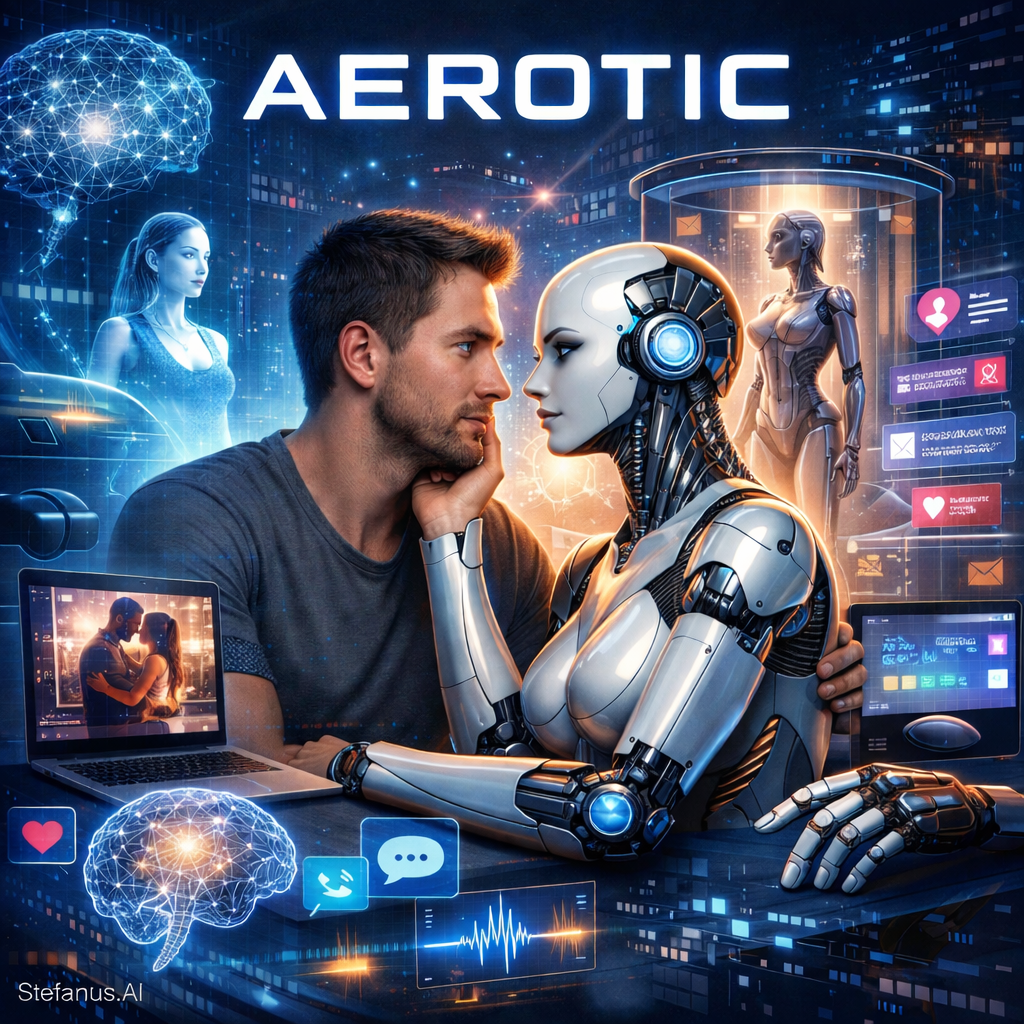
In essence, Aerotic refers to an expanding ecosystem of AI-generated intimacy—a world that includes digital storytelling, interactive virtual partners, emotionally responsive chatbots, and eventually AI-enhanced humanoid companions designed to simulate emotional and romantic relationships. While such ideas once belonged purely to science fiction, recent technological breakthroughs suggest that these forms of digital intimacy may soon become a normalized part of everyday life.

At the same time, broader social trends among younger generations are undergoing significant change. Across many developed countries, young adults are increasingly delaying marriage, forming fewer long-term relationships, and in some cases reporting less sexual activity overall. Research published in the Archives of Sexual Behavior found that the percentage of U.S. adults aged 18–29 reporting no sexual activity in the past year increased from roughly 10% in 2008 to nearly 30% by the late 2010s. Sociologists have even begun referring to this shift as a “sex recession.”
Several factors contribute to this phenomenon. Economic uncertainty, longer educational paths, and shifting career priorities all play important roles. However, technology has also dramatically transformed how younger generations socialize and interact. Social media platforms, streaming entertainment, online gaming, and digital communities now occupy a large share of daily life. As a result, digital engagement sometimes replaces—or reduces—the need for in-person social interaction.

Meanwhile, the cultural landscape surrounding relationships has also evolved. The early 2010s saw a wave of public conversations around workplace behavior, consent, and sexual harassment, highlighted by the globally influential #MeToo movement. These discussions were critical in addressing real problems of power imbalance and misconduct. However, some observers suggest that the broader cultural shift has also contributed to a more cautious and sometimes uncertain environment for interpersonal relationships, particularly in professional or academic settings.
Against this backdrop, technology is beginning to offer alternative pathways for emotional and romantic experiences. Artificial intelligence has advanced rapidly in generating human-like conversations, voices, images, and personalities. AI companions, conversational chatbots, and digital avatars are becoming increasingly sophisticated, capable of maintaining ongoing dialogue, remembering personal preferences, and adapting to users’ emotional patterns.

Recent reports from organizations such as the Pew Research Center and various digital-behavior studies suggest that millions of people already interact with AI companions for emotional support, role-playing scenarios, or simulated relationships. Some AI platforms report that over 40% of conversations involve themes related to friendship, romance, or emotional bonding, demonstrating that users are increasingly comfortable forming connections with digital agents.
It is precisely within this intersection of technological capability and cultural transformation that the concept of Aerotic begins to take shape. Unlike traditional adult media—which largely centers on passive visual consumption—Aerotic represents a more interactive and personalized form of digital intimacy. It combines AI-generated imagery, immersive storytelling, customizable characters, and sometimes voice or video interaction to create experiences that feel emotionally responsive and uniquely tailored to each individual.

For younger generations who grew up surrounded by smartphones, high-speed internet, and digital platforms, this type of interaction often feels entirely natural. With global 5G networks and ultra-fast mobile connectivity, immersive digital experiences can now be streamed or generated instantly on handheld devices. AI systems are increasingly capable of producing personalized narratives and dynamic conversations in real time, transforming intimacy from something static into something interactive.
Looking further ahead, researchers in robotics are exploring the development of AI-enhanced humanoid companions. These machines, equipped with advanced sensors, language models, and expressive facial robotics, aim to replicate aspects of human communication such as eye contact, emotional tone, and conversational nuance. Although still in the early stages of development, some futurists predict that such technologies could eventually evolve into fully interactive social companions.

Yet this technological shift may not necessarily replace human relationships altogether. Instead, it may expand the spectrum of intimacy available to people. Throughout history, new technologies—from printed novels to cinema and later the internet—have continually reshaped how humans experience fantasy, storytelling, and emotional connection. Aerotic may represent simply the next stage in that long evolution: a form of intimacy mediated through algorithms rather than biology.
Naturally, scientists and sociologists remain divided on the long-term implications. Some researchers warn that excessive reliance on artificial companionship could reduce human interaction and potentially deepen social isolation. Others argue that AI-mediated relationships could serve as emotional training environments, helping individuals build confidence, explore identity, or overcome social anxiety before forming real-world relationships.

As technology continues advancing, the line between human relationships and digital companionship will likely blur even further. The same AI systems that generate art, write stories, and power virtual assistants may soon simulate empathy, attraction, and companionship with remarkable realism. In many ways, the question is no longer whether artificial intimacy will exist—it already does—but rather how society chooses to integrate it responsibly.
Ultimately, the rise of Aerotic represents more than a technological curiosity. It signals a deeper transformation in how humanity understands connection, companionship, and desire in an increasingly digital world. Whether this shift leads to richer new forms of interaction or to a retreat from traditional human relationships remains uncertain. What is certain, however, is that the conversation around artificial intimacy has only just begun—and its impact may shape the emotional landscape of future generations.